
Link building is a search engine optimization (SEO) process that improves website rankings by acquiring hyperlinks from other websites. These hyperlinks, called backlinks, connect one page to another and help search engines evaluate trust, authority, and relevance. Link building involves both internal links, which guide users within the same site, and external links, which pass value from other domains.
Link building plays a key role in how search engines determine visibility across competitive search results. Strong backlink profiles increase site authority, drive organic traffic, and support better indexing of content. SEO strategies use link building to support technical optimization, keyword targeting, and long-term content performance.
This article covers what link building is, why link building matters, and how link building works. It explains the main types of link-building strategies, including content creation, outreach, and competitor analysis. It also defines internal and external links and outlines the risks and benefits of different link building approaches.

What is the Importance of Link Building?
Link building drives higher rankings, establishes credibility, and strengthens domain authority. Search engines interpret backlinks as votes of confidence from other websites. Strong link building creates a signal of trust and relevance.
Link building improves ranking by transferring authority from established sources. Search engines rank pages based on signals that include content quality and backlink profiles. Relevant backlinks increase topical alignment and help push pages toward the top of search results. Link building also supports faster crawling and indexing. Search engines prioritize websites with consistent backlink activity. Frequent crawling results in the quicker appearance of new content in search results.
Link building builds connections with authoritative publishers, directories, and media outlets. These links support reputation and digital presence. The Google algorithm favors websites that earn backlinks from respected sources in the same industry. Link building creates long-term value that paid campaigns do not provide. Quality backlinks deliver ongoing ranking benefits. Businesses that invest in link building gain consistent search visibility and compounding SEO results.
What is White Hat Link Building?
White hat link building is the practice of earning backlinks through ethical, search engine-compliant methods that focus on content quality and relevance. White hat link building follows approved guidelines and avoids manipulative tactics. Agencies use this approach to build authority, trust, and long-term visibility.
White hat link building includes outreach to credible publishers, guest posting on relevant sites, broken link recovery, and digital PR campaigns. White hat link building services prioritize editorial standards and content value. Each backlink reflects relevance to the topic and support from a trusted source.
White hat link building passes signals of credibility, topical authority, and user trust. Search engines reward these backlinks with improved rankings and better crawl prioritization. Consistent link acquisition builds domain strength across competitive keywords.
White hat link building reduces risk and supports sustainable SEO growth. Ethical methods create real associations that strengthen digital presence. Agencies focus on strategic placements that align with brand goals and industry relevance.
What is Black Hat Link Building?
Black hat link building uses manipulative tactics, violates search engine guidelines, and prioritizes fast results over long-term stability. Black hat link building focuses on quantity instead of relevance. Services that apply the black hat link building methods often sacrifice content integrity and risk penalties.
Black hat link building includes paid links from low-quality domains, link exchanges, spam comments, automated link placements, and private blog networks. These links lack contextual relevance and often appear unnatural in structure and source. Search engines identify black hat link building tactics as deliberate attempts to manipulate ranking systems.
Black hat link building passes signals of manipulation, artificial link velocity, and untrustworthy associations. Search engines detect link abuse and respond by devaluing or penalizing affected domains. Link profiles built through this method reduce credibility and damage visibility.
Black Hat Link Building leads to unstable rankings, lost traffic, and long-term SEO setbacks. Short-term results often collapse under algorithmic scrutiny. Ethical agencies reject Black Hat Link Building and prioritize methods that support lasting authority and trust.
What are the Types of Link Building Strategies?
Link Building strategies vary in approach, but all aim to earn high-quality backlinks that strengthen authority, increase visibility, and support long-term SEO performance. Each link building strategy plays a specific role in expanding reach, building credibility, and improving rankings across relevant search terms.
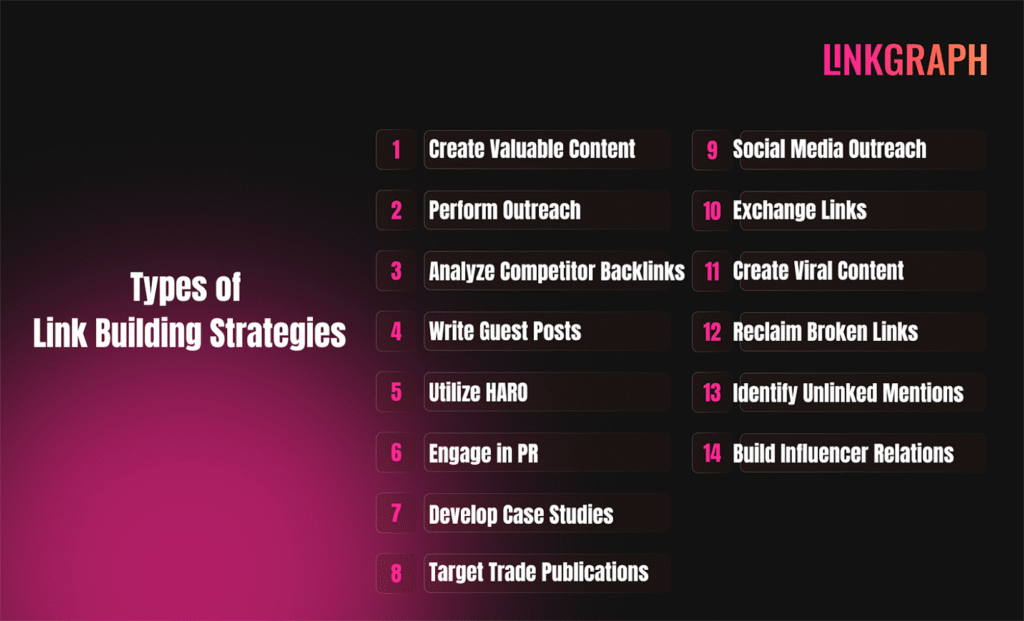
There are many types of link building strategies. The many types of link building strategies have been listed below.
- Create valuable content.
- Perform outreach.
- Analyze competitor backlinks.
- Write guest posts.
- Utilize HARO.
- Engage in public relations.
- Develop cross-brand case studies.
- Target trade-specific publications.
- Conduct social media outreach.
- Exchange links.
- Create viral content.
- Find and reclaim broken links.
- Identify unlinked mentions.
- Build relationships (with influencers or thought leaders).
- Get featured on resource pages.
Create Valuable Content
Creating valuable content involves publishing original, informative, and relevant material that answers specific questions and meets audience needs. Strong content delivers clear information, offers unique insights, and aligns with current search intent. High-performing content earns backlinks by providing value to other websites.
This serves as a link building strategy by attracting backlinks naturally. Editors, bloggers, and publishers link to sources that improve the quality of their own content. Search engines interpret these links as trust signals, increasing ranking potential and visibility.
Companies create valuable content that earns backlinks, as shown in the examples below.
- Publish industry-specific guides: An SEO company creates a detailed guide on “Technical SEO for E-commerce Sites” that explains key processes and includes visual support. This earns links from digital marketers, platform providers, and technical blogs.
- Create original research or studies: The agency produces a data report on “Local Ranking Factors in 2025” and presents the findings in a structured format. Industry sites reference the research and link back as a trusted source.
- Design infographics and visual content: The company develops a visual roadmap of a site migration process. Technical blogs, forums, and content creators link to the infographic in educational content.
Creating valuable content strengthens brand authority, attracts high-quality backlinks, and supports long-term search visibility.
Perform Outreach
Performing outreach involves actively pitching link opportunities to relevant websites, blogs, journalists, or influencers. This strategy builds relationships before requesting backlinks and positions content as mutually valuable. Outreach promotes visibility, supports targeted link acquisition, and generates credibility.
Performing outreach stands as a core link building strategy because it enables the placement of backlinks on high-quality domains that do not link to content automatically. Outreach increases chances of editorial backlinks resulting in better domain authority, higher rankings, and quality referral traffic.
Brands reach out to relevant sites and editors to build links, as shown in the following examples.
- Pitch guest content to niche sites: The agency researches industry-relevant blogs, identifies contact info for editors, and sends customized pitches offering exclusive insights aligned with their audience. Agency follows up twice, securing placements with links embedded in the body and author bio.
- Propose content upgrades to broken links: The team finds relevant broken links on authority sites, builds replacement pages, and emails editors offering upgrade that improves UX. Outreach earns backlinks from sites wanting to resolve broken references.
- Promote original research through targeted PR: The agency creates surveys or data studies and builds media lists of journalists and bloggers. Personalized emails present key findings and charts, offer exclusives, and drive coverage with backlinks from high-DR publications.
Perform outreach positions, content in front of high-value domains, earns trustworthy backlinks, and strengthens the overall link profile.
Analyze Competitor Backlinks
Analyze competitor backlinks amounts to reviewing which websites link to competitors and identifying opportunities to earn similar or better placements. This strategy uncovers proven link sources, reveals what content attracts links, and guides targeted outreach. Analyzing competitor backlinks helps build a stronger and more competitive link profile.
Analyzing competitor backlinks helps identify sites that already link to similar products, services, or topics. Since these domains have shown interest in related content, outreach efforts become more effective by focusing on them to replicate or outperform competitor link profiles.
The following are examples of analyzing competitor backlinks listed below.
- Identify homepage backlinks and pitch alternatives: The SEO company reviews competitor homepage backlinks and identifies tool roundups, resource lists, and forums. They contact the authors or site owners and suggest adding their brand as an alternative option.
- Replicate top-performing blog content: The company finds competitor blog posts with high link volume and builds better resources around the same topic. They reach out to the referring domains with a pitch for updated or more comprehensive content.
- Track new competitor backlinks in real time: The agency sets up alerts to monitor new backlinks pointing to competitors. Each time a new referring domain appears, they reach out quickly to propose the inclusion of similar content from their client.
Analyzing competitor backlinks turns competitor momentum into actionable opportunities. This strategy helps close link gaps, attract attention from relevant domains, and build a high-authority backlink profile rooted in proven success.
Write Guest Posts
Writing guest posts means creating original articles for external websites in relevant industries. These articles include backlinks that point to target pages. Guest posts increase visibility, authority, and referral traffic through strategic content placement.
Guest posts provide contextual backlinks from trusted domains, which search engines view as a sign of credibility and relevance. Placing backlinks within editorial content strengthens ranking signals and boosts domain trust.
The examples below show how companies write guest posts.
- Contribute expert content to industry blogs: The agency researches authoritative blogs in the client space, pitches content ideas, and secures placements that include backlinks to relevant service or blog pages.
- Submit original research to niche publishers: The team develops unique studies or insights, transforms them into articles, and offers them to niche websites. These posts earn backlinks while increasing topic relevance and reach.
- Maintain publisher relationships for recurring features: The agency builds long-term relationships with editors and website owners. Ongoing guest contributions ensure consistent link acquisition from trusted sources.
Guest posting helps build a strong backlink profile through earned editorial placements, supporting both authority and search performance.
Utilize HARO
Utilizing HARO (Help A Reporter Out) involves connecting with journalists who seek expert insights for their stories. It offers direct access to reputable media outlets looking for reliable sources. Journalists publish responses that often include backlinks from high-authority domains, boosting credibility and visibility.
Utilizing HARO earns editorial backlinks from trusted publications. These links appear in context-rich articles, enhancing credibility and search rankings. Search engines recognize them as signals of expertise and authority.
Below are examples of brands using HARO successfully.
- Secure expert quotes in niche articles: The company submits personalized responses to SEO-related queries. Accepted quotes feature backlinks to the client site in digital marketing publications.
- Land features in mainstream business media: The agency responds to finance or tech trends with expert commentary. Publications like Forbes or Inc. include links that boost both authority and visibility.
- Support broader PR campaigns with HARO: After releasing original research or survey data, the agency references it in HARO pitches. This approach attracts journalists interests and earns backlinks from high-traffic editorial sites.
Utilize HARO to strengthen link profiles through trusted media sources. It supports brand reputation and contributes to long-term SEO performance through credible, earned coverage.
Engage in Public Relations
Engaging in public relations means using media outreach, storytelling, and brand positioning to earn backlinks from trusted sources. This includes news sites, trade publications, and relevant blogs. Public relations improves visibility and strengthens brand credibility through earned media coverage.
Engaging in public relations generates editorial backlinks from authoritative domains through brand mentions, expert commentary, or cited data in news stories. Search engines recognize these links as signals of authority and relevance.
These are examples of companies engaging in public relations, listed below.
- Distribute original data through media outreach: The agency conducts industry research, builds stories around the findings, and pitches them to news outlets. Coverage includes backlinks to the original report or landing page.
- React to news with expert commentary: The team monitors trends and offers client insights to journalists covering those stories. Articles include quotes and links to the client site.
- Promote product launches through press releases: The company announces new services or campaigns with targeted press releases. Media pickup results in brand mentions and contextual backlinks from relevant domains.
Engaging in public relations delivers backlinks that reflect real authority. This approach supports SEO growth while positioning the brand as a trusted voice in its industry.
Develop Cross-Brand Case Studies
Developing cross‑brand case studies means collaborating with another company or client to showcase joint success stories. This produces detailed, data-driven content that highlights how both brands achieved a measurable outcome. Case studies build credibility and attract editorial links from both partners and third-party publications.
Cross-brand case studies create mutual branding opportunities and give others a strong reason to reference and link. Publishers use real-world data to support their content, collaborators share backlinks, and industry sites often cite compelling success stories. These links boost domain authority and increase exposure.
Here are some examples of cross-brand case studies in action listed below.
- Co-authored success story with a SaaS partner: A joint study shows how integrating an SEO client tool with a partner platform increased lead generation by 45%. Both brands publish the study and earn links from industry blogs, forums, and newsletters.
- Customer–agency collaboration: A case study features a client project where SEO efforts lifted traffic 300%. Agency and client websites publish the story with reciprocal links and share it via press outreach.
- Multi‑brand industry benchmark report: Agency teams with several niche businesses to compare SEO performance, publishes findings as a comprehensive guide. Coverage from trade outlets leads to backlinks from all participating brands and media sites.
Target Trade-Specific Publications
Targeting trade‑specific publications means securing placements in niche industry outlets that align closely with the market of the brand. These include technical blogs, professional journals, or sector-focused news sites. Links in these publications signal relevance and position a brand as a domain expert.
Targeting trade-specific publications earns context-rich, highly relevant backlinks from specialized sources. These publications reach focused audiences and hold influence within industry networks. Such links enhance topical authority and boost search performance in niche markets.
Below are examples of targeting trade-specific publications.
- Feature in legal tech magazine: Agency arranges expert article on SEO trends for legal tech publications. The article contains a backlink to the client site in the content or the author bio.
- Guest column in e‑commerce trade journal: Specialist submits analysis of conversion optimization strategies to an e‑commerce-focused site. The publication includes a contextual link to a case study on the client site.
- Expert interview in supply chain blog: SEO agency secures an interview slot for a client in a supply chain technology blog. The interview includes links to client services and builds visibility among decision-makers.
Engaging trade‑specific publications earns backlinks that boost domain relevance and attract the audience that matters most.
Conduct Social Media Outreach
Conducting social media outreach means using social platforms to promote content, engage with influencers, and spark conversations that lead to backlinks. Social outreach signals relevance and awareness. It encourages sharing across networks and attracts attention from site owners and publishers.
Conducting social media outreach serves as a link building strategy because content that gains traction on social media often earns backlinks from blogs, news sites, and industry pages. Social signals act as catalysts, prompting other platforms to pick up and link to the content.
These examples highlight how companies use social media outreach.
- Amplify blog assets on LinkedIn and Twitter: The agency shares a new SEO guide in niche groups and threads. Influencers pick it up, leading to links from industry blogs.
- Run a micro-influencer collaboration on Instagram: Agency partners with a niche influencer to showcase a marketing tool. The blog and social channels of the influencer reference and link back to the tool landing page.
- Launch a visual social campaign: Agency creates a short video or infographic on a trending topic. Social buzz drives coverage from news outlets that link to the original content.
Conduct social media outreach to boost content reach, spark backlinks, and strengthen topical authority, bridging visibility between social and SEO efforts.
Exchange Links
Exchange links means trading backlinks with other websites in a niche or complementary industries. Reciprocal linking uses mutual support to increase visibility and referral traffic. It leverages established relationships for SEO benefit.
Exchanging links qualifies as a link building strategy when done thoughtfully, with high-authority and relevant sites. Proper execution brings referral traffic and visibility gains. However, low-quality or excessive link swaps trigger search engine penalties.
Here are some examples of companies exchanging links responsibly.
- Partner swap with a complementary service provider: The agency collaborates with a design agency. Each embeds contextual links in resource pages, driving targeted referral visits.
- Cross-blog links within niche network: Agency networks with high-quality industry blogs. They agree to link to evergreen guides from each side once per quarter.
- Local business reciprocal linking: Agency connects a local HVAC client with an area roofing service. Each business links back from service pages and blog posts.
Exchange links strategically to diversify backlinks, tap into aligned referral traffic, and support niche authority, while avoiding overuse or irrelevant partnerships.
Create Viral Content
Creating viral content involves producing material, like videos, infographics, quizzes, or interactive tools, that captures attention and spreads rapidly across online platforms. The goal centers on provoking emotional engagement or entertainment value. Viral content earns widespread visibility and attracts organic backlinks as publishers and blogs reference trending material.
Creating viral content qualifies as a link building strategy since content with viral potential generates backlinks from diverse sources outside direct outreach. High shareability leads editors, influencers, and audiences to reference the content, increasing referral traffic and SEO authority .
Listed below are examples of viral content that earned backlinks.
- Launch a Buzz‑style listicle or quiz: The agency produces a highly visual quiz on “Which SEO Strategy Matches Your Brand Personality” and promotes across social channels, leading to links from marketing blogs.
- Develop a data-driven infographic: A visually engaging infographic showcases “2025 SEO Tactics by Industry” and gains traction on LinkedIn, picking up backlinks from industry sites after editors use it as a resource.
- Create a short viral-style video: Agency produces a humorous 60-second clip around SEO myths. Influencers share it widely, and niche marketing blogs link back to the video landing page.
Find and Reclaim Broken Links
Finding and reclaiming broken links means locating external backlinks that point to missing or removed pages and reclaiming their value through outreach or technical fixes. This involves using tools to scan backlink profiles and identify 404s or outdated URLs.
Finding and reclaiming broken links serves as a link building strategy because it recovers lost link equity and restores referral traffic. Broken link reclamation turns previous investments into renewed value while improving user experience by fixing dead-end links.
These examples show how companies find and reclaim broken links.
- Recover links from deleted blog posts: Agency identifies backlinks pointing to removed client content, restores or redirects that content, and secures equity from lost external links.
- Replace broken references of competitor: Agency finds broken links on niche sites referencing competitor assets. It creates updated resources and pitches replacements, earning new backlinks.
- Fix unlinked image usage: Agency runs a reverse image search to find client images used without links. It contacts site owners and obtains proper backlink attribution.
Identify Unlinked Mentions
Identifying unlinked mentions means spotting places where a brand or product gets named without a backlink. Mentions often appear in blogs, reviews, or forums. These references present missed opportunities for SEO gains.
Identifying unlinked mentions transforms passive visibility into active linking. Securing a backlink from an existing mention builds domain authority and trust. Links from organic mentions also tend to be contextually relevant and high quality.
Here are examples of identifying unlinked mentions and gaining links.
- Monitor forums and industry blogs for client mentions: Analysts find product names used without links and reach out with a short pitch and the correct URL.
- Recover missing links on third-party content: Researchers scan roundup articles or tool comparisons that mention the brand but skip linking, then ask for the link to be included.
- Track social signals to spot missed coverage: Teams follow viral content or influencer mentions that lack attribution and turn them into earned links with a polite request.
Build Relationships With Influencers Or Thought Leaders
Building relationships means forming long-term connections with key voices in a specific niche. These include bloggers, podcasters, subject matter experts, and online community leaders. Consistent interaction builds familiarity and opens doors for collaborations.
Building relationships is a link building strategy because strong relationships lead to organic link mentions. Influencers frequently link to resources from those they trust. These links originate from high-quality content, such as interviews, co-created pieces, or citations.
Below are examples of building relationships with influencers.
- Coordinate expert roundups and industry surveys: The company invites influencers to contribute insights. Published results feature backlinks from participant sites.
- Co-create blog content or research: Agency and influencer collaborate on a guide or thought leadership piece. Each side publishes the content and links to the other.
- Host or appear on joint webinars: SEO experts co-host sessions with thought leaders. Shared promotion generates links from both audiences.
Get Featured On Resource Pages
Getting featured on resource pages means earning a spot on curated lists that share useful tools, guides, or references. These pages exist on blogs, educational sites, directories, and trade associations. They serve as go-to hubs for discovering trusted content.
Resource pages provide targeted, editorially chosen backlinks. These links are relevant, high authority, and placed for long-term reference. Getting featured also drives qualified traffic from users seeking specific solutions.
These examples illustrate how companies get featured on resource pages.
- Submit helpful guides to industry roundups: Teams pitch SEO checklists or how-to content to digital marketing resource pages.
- List local businesses on city service directories: Agency finds government or community sites and recommends clients for inclusion in business resource sections.
- Add educational content to academic or nonprofit hubs: The agency identifies resource sections for students or professionals and submits client tools that match their needs.
What are the Pros of Outsourcing Link Building?
Outsourcing link building gives businesses access to specialized strategies without the overhead of building an internal team. It simplifies the link acquisition process, improves efficiency, and allows brands to benefit from expert execution at scale. Working with a dedicated provider means faster results, higher-quality backlinks, and stronger SEO outcomes without diverting focus from core operations.
There are many benefits of outsourcing link building. The many benefits of outsourcing link building are listed below.
- Save time: Outsourcing link building saves time by eliminating the need to handle prospecting, outreach, follow-ups, and reporting internally.
- Access expertise: Professional link building teams understand algorithm-safe tactics, editorial standards, and placement strategies to maximize impact.
- Benefit from predictable processes: Link building services use structured workflows that ensure consistent delivery, transparency, and sustainable long-term results.
- Achieve scalability and flexibility: Link building efforts scale easily to fit changing priorities, seasonal needs, or budget adjustments.
- Gain potential for higher quality links: Outsourced link building secures backlinks on authoritative domains with relevant audiences, increasing SEO value.
- Improve domain authority: Strategic link building strengthens domain authority by earning links from reputable, topically aligned sources.
- Enhance brand visibility and awareness: Effective link building increases brand exposure through placements on trusted blogs, media, and industry sites.
- Focus on core competencies: Delegating link building allows teams to focus on product development, strategy, and other critical business functions.
- Improve site metrics and SEO scores: Quality link building improves key metrics like domain rating, trust flow, and page authority.
- Increase organic traffic: Link building boosts keyword rankings, driving more targeted organic search traffic to the website.
- Achieve better rankings: Consistent link building sends strong signals to search engines that improve position in search results.
- Build credibility and trust: Links from respected sources build brand credibility and position the business alongside industry leaders.
- Generate referral traffic: Link building drives qualified referral visitors by placing backlinks on relevant, high-traffic websites.
How does Link Graph Help With Link Building?
Link Graph offers comprehensive link building services that combine strategic outreach with data-driven analysis to secure high-quality backlinks. Their expertise focuses on acquiring authoritative, relevant links that boost domain authority and improve search rankings.
A link building service like Link Graph helps identify valuable opportunities by analyzing competitor profiles and industry trends. This approach ensures links are earned from credible sources that align with the brand niche and audience. By applying proven methods and maintaining compliance with search engine guidelines, the Link Graph link building service drives sustainable SEO growth.
What are the Risks of Paid Link Building?
Paid link building carries significant risks that negatively impact website SEO health. One major concern is Google penalties. Search engines actively detect and penalize manipulative paid links, which lead to ranking drops or even deindexing. Paid links often come with questionable link quality from low-authority or irrelevant sites that offer little real value.
This results in a lack of long-term value as such links fail to build sustainable authority or referral traffic. Additionally, the high cost of paid link building rarely guarantees positive outcomes, making it a risky investment compared to organic, white-hat link building approaches.
What is a Link?
A link, also known as a hyperlink in HTML, is a clickable element that connects one web page to another. It enables users and search engines to navigate between pages across the internet. Links pass signals of relevance and authority, making them essential for website discoverability and SEO performance.
In web development, a link is created using the <a> tag, which defines the hyperlink and specifies the destination URL. Search engines use these links to crawl websites, understand relationships between content, and determine the importance of pages within the broader web ecosystem. Strong, relevant links improve rankings by signaling trustworthiness and topical relevance.
What is a dofollow Link?
A dofollow link is a standard hyperlink that allows search engines to follow it and pass link equity (or “link juice”) from one website to another. Its primary purpose is to signal trust and authority, helping the linked page improve its search engine rankings.
Dofollow links are typically earned through natural, white-hat strategies such as guest posting, editorial mentions, content marketing, and genuine outreach. From an HTML standpoint, a dofollow link is simply a regular <a> tag without any special attributes restricting search engines from following it.
What is a no-follow Link?
A nofollow link is a hyperlink that includes an HTML attribute instructing search engines not to pass link equity or ranking credit to the linked page. Its primary purpose is to prevent endorsement of the linked content, helping to control spam and untrusted or paid links.
Nofollow links commonly arise from user-generated content like blog comments, forum posts, and sponsored or paid placements where transparency is required. From an HTML perspective, a nofollow link is created by adding rel="nofollow" within the <a> tag, for example: <a href="URL" rel="nofollow">link text</a>. This attribute signals search engines to ignore the link for ranking purposes while still allowing users to navigate.
How Long Until You See Results From Link Building?
Results from link building typically begin to show within 8 to 12 weeks after links are acquired. Search engines need time to discover new backlinks, assess their quality, and adjust rankings accordingly. This process involves crawling the linking pages, evaluating the relevance and authority of the link, and then reflecting these changes in search algorithms.
Some improvements, such as increased crawl frequency or early referral traffic, appear within days or weeks, but meaningful ranking boosts generally require several months of consistent link acquisition. The timeline also depends on factors like the competitiveness of target keywords, the authority of linking domains, and overall website health. Patience and ongoing efforts ensure that link building delivers sustainable SEO growth over time.
What Tools Help With Link Building?
Several powerful tools assist in executing effective link building strategies. Ahrefs provides extensive backlink analysis, helping identify quality link opportunities and monitor competitor profiles. SEMrush offers comprehensive outreach management, backlink audits, and link prospecting features that simplify campaign execution. Search Atlas specializes in digital PR and link building, focusing on finding relevant publishers and tracking link acquisition progress. Using these tools enables a strategic approach to link building, improving the quality and efficiency of campaigns.
What is the Difference Between an Internal and External Link?
The difference between an internal and external link lies in the destination of the hyperlink. An internal link points to another page within the same website, helping users and search engines navigate the site structure. An external link directs visitors to a page on a different website, connecting a site to outside sources and building relationships across the web.
