
SEO for accountants and CPA firms, also known as accountants search engine optimization, improves online visibility, attracts targeted clients, and builds authority in competitive financial markets. Local SEO for accountants ensures services like tax planning, payroll management, and audit support appear prominently in location-specific searches. Accounting and CPA firms gain measurable growth by implementing a combination of on-page SEO, technical optimization, content strategies, and off-page link-building to increase rankings and drive organic traffic.
SEO services for accountants enhance brand credibility, strengthen local search presence, and improve lead generation. Firms optimize service pages, metadata, and internal linking while creating topic-focused content aligned with client needs. Well-structured SEO marketing strategies help accounting and CPA firms demonstrate expertise, attract qualified clients, and maintain a competitive advantage.
Partnering with the best SEO agency for accountants provides specialized knowledge, ethical execution, and tailored campaigns. A strategic approach to SEO for accountants integrates local and organic search techniques, increasing engagement, website traffic, and consistent client acquisition across relevant markets.

What Is SEO for Accountants?
SEO for Accounting and CPA Firms is the process of improving the website of an accounting firm to increase visibility in search engine results and attract targeted clients. SEO for Accounting and CPA Firms focuses on optimizing website structure, creating content that addresses client concerns, and enhancing local search presence to appear in relevant queries.
Local SEO for accounting and CPA firms ensures consistent business information across directories and positions the firm in the Google Map Pack. This type of SEO increases visibility for potential clients searching for services like tax preparation, bookkeeping, or small business accounting in their area.
Content marketing for accounting firms develops blog posts, service guides, and educational pages that answer questions about tax preparation, financial planning, and business accounting. On-page SEO strengthens each webpage by integrating keywords into titles, meta descriptions, headers, and images to signal relevance to search engines.
Technical SEO ensures search engines index accounting firm websites accurately, improving crawl efficiency and user experience. Authority building establishes trust by acquiring credible backlinks and generating positive client reviews. SEO for Accounting and CPA Firms creates measurable improvements in search visibility, drives qualified leads, and positions the firm as a reliable financial service provider.
Is SEO Important for Accounting Firms?
Yes, SEO is essential for accounting firms to expand their client base and increase online visibility. SEO for Accounting and CPA Firms improves search engine rankings, making it easier for potential clients to find services such as tax preparation, bookkeeping, and financial planning.
SEO for accounting firms drives targeted, organic traffic to websites, generating qualified leads without relying solely on paid advertising. Implementing local SEO enhances visibility in geographic-specific searches, helping accounting firms attract clients in their service area. Higher search rankings build trust and credibility, as prospective clients perceive firms appearing on the first page as more reliable and professional.
Long-term SEO efforts strengthen brand awareness, showcase expertise, and improve user experience through optimized websites and content. Accounting firms that invest in SEO benefit from consistent lead generation, increased client engagement, and a competitive advantage in a crowded market. SEO for Accounting and CPA Firms serves as a sustainable, cost-effective strategy to support business growth.
What Is the Difference Between Accounting and CPA Firms?
The difference between accounting and CPA firms lies in the scope of services and legal authority. Accounting firms provide general financial services such as bookkeeping, tax preparation, payroll, and financial statement preparation. Staff includes a mix of licensed and unlicensed accountants, which limits the ability of the firm to perform legally regulated tasks.
CPA firms employ Certified Public Accountants with licenses that authorize them to conduct audits, represent clients before the IRS, and prepare SEC filings. These firms follow strict ethical standards and regulations, ensuring greater compliance and accountability.
In practice, accounting firms serve everyday financial needs, while CPA firms handle complex, regulated financial situations requiring professional certification. The distinction ensures clients choose the appropriate firm based on service requirements, complexity, and legal authority.
What Are the Key Advantages of SEO for Accountants?
The benefits of implementing SEO for accountants and CPA firms extend to greater online visibility, a stronger reputation, and measurable growth in revenue. Search engine optimization for accounting and CPA firms drives targeted traffic, enhances client acquisition, and strengthens credibility in competitive financial markets. The key advantages of SEO for accountants have been listed below.
- Effective Marketing Investment: Search optimization for accountants provides a cost-efficient strategy that delivers long-term results compared with traditional advertising.
- Increase Visibility: SEO for accounting firms improves rankings in search results, helping potential clients find services like tax preparation or bookkeeping.
- Build Credibility: Optimizing search engines for accountants signals professionalism and reliability to prospects through higher search engine placement.
- Reputation Building: Search engine optimization for accountants generates authoritative content and positive client feedback, reinforcing industry expertise.
- Client Acquisition: SEO for accounting firms attracts qualified leads ready to engage with services and professional consultations.
- Improve Lead Generation: SEO for accountants drives inquiries, service bookings, and conversions by targeting relevant search queries.
- Enhanced Online Presence: Local SEO for accountants increases visibility in geographic-specific searches and Google Map Pack listings.
- Greater Engagement: Search optimization for accounting firms encourages longer site visits, higher interaction, and more page views.
Implementing SEO for accountants and CPA firms ensures measurable growth, improved client acquisition, and a stronger online reputation.
How Can Accounting Firms Get Started with SEO?
The best ways to get started with accounting firm SEO involve building a strong online presence, targeting relevant topics, and optimizing the website for both users and search engines. SEO for accounting firms requires consistent effort across technical setup, content strategy, and local optimization to drive visibility, credibility, and client engagement.
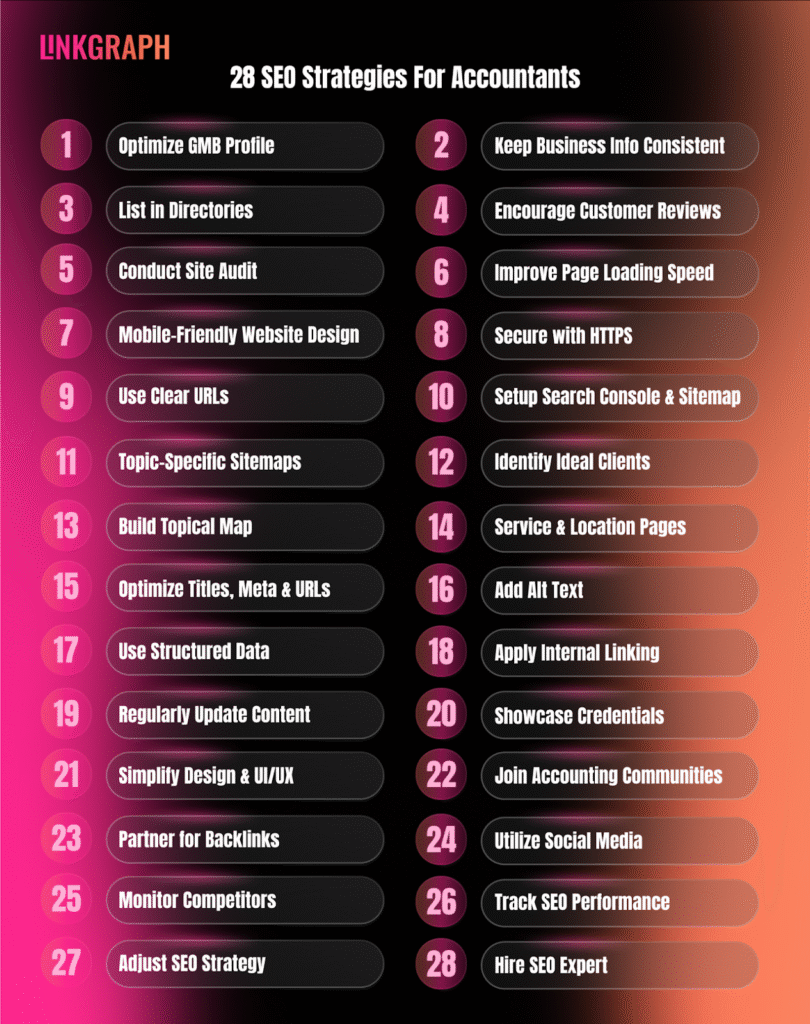
There are 28 SEO strategies for accounting firms. The 28 SEO strategies for accounting firms are listed below.
- Claim, Set Up, Verify, and Optimize Your GMB Profile
- Keep Your Business Information Consistent Across the Web
- List Your Business in Local and Industry Directories
- Encourage Clients to Leave Reviews on Google and Other Platforms
- Perform Complete Site Audit and Fix Technical Errors
- Improve Website Loading Speed and Reduce Server Response Time
- Ensure Website Design Is Professional and Mobile-Friendly
- Secure Your Website with HTTPS
- Ensure Website URLs Are Short, Clear, and Logical
- Set Up Google Search Console and Submit an XML Sitemap
- Create Smaller, Topic-Specific Sitemaps
- Identify Ideal Clients and Target Audience Clearly
- Build Proper Topical Map for Your Accounting Firm
- Create Separate Pages for Each Service and Location
- Write Clear, Context-Rich Page Titles and Meta Descriptions
- Add Descriptive Alt Text to All Images and Media
- Use Structured Data to Present Services Clearly to Google
- Internally Link Pages Using Clear Structure (Root → Seed → Node)
- Update and Prune Existing Content Regularly
- Showcase Professional Credentials, Certifications, and Client Testimonials
- Simplify Design and Improve UI/UX for Easy Navigation
- Join Online Accounting Communities and Discussions
- Partner with Local Businesses to Earn Quality Backlinks
- Use Social Media to Engage and Attract Local Clients
- Monitor Competitors to Find Opportunities for SEO Strategy
- Regularly Track SEO Performance Using Analytics Tools
- Adjust and Improve SEO Strategy Based on Results
- Hire an SEO Expert for Advanced or Complex Tasks
Implementing SEO for accounting firms strengthens visibility, attracts qualified clients, and supports long-term business growth. We have broken down the 28 SEO strategies for accounting firms below.
1. Claim, Set Up, Verify, and Optimize Your Google Business Profile
Claiming, setting up, and verifying a Google Business Profile is the first step toward improving local search visibility for accounting firms. A profile serves as a digital listing on Google Search and Maps, making it easier for potential clients to find contact details, directions, and services. Accurate information across name, address, phone number, and website helps establish trust and increases the likelihood of appearing in the Google Map Pack.
Optimization of the profile requires more than filling in basic details. Accountants should select the most relevant business category, such as “accountant” or “tax consultant,” and add a clear service description that reflects offerings like tax planning, bookkeeping, and payroll. Uploading professional photos of the office and team helps build credibility, while regular updates, service highlights, and seasonal tax reminders keep the listing active.
Reviews play a direct role in ranking and client decision-making. Encouraging satisfied clients to leave positive feedback and responding to each review signals trustworthiness. Using features like Q&A to address common queries enhances engagement. An optimized profile improves local rankings, increases calls and website visits, and drives qualified leads searching for accounting services.
2. Keep Your Business Information Consistent Across the Web
Consistency of business information, often referred to as NAP consistency, forms a core element of SEO for accountants. NAP stands for name, address, and phone number, and these details must match exactly wherever they appear online. Google uses NAP consistency as a trust signal when evaluating an accounting firm for local search results and the Google Map Pack. Small differences, such as using “Street” in one place and “St.” in another, reduce ranking potential.
Accounting firms improve client reach and search visibility by ensuring NAP details remain accurate across Google Business Profile, online directories, and industry platforms. Firms should audit existing listings, correct discrepancies, and maintain uniformity across all platforms. Tools like Moz Local or BrightLocal help track and manage NAP data efficiently.
Maintaining consistent business information strengthens local SEO performance, builds trust with search engines and potential clients, and increases the likelihood of appearing in high-visibility local search features.
3. List Your Business/Firm in Local and Industry Directories
Listing an accounting firm in local and industry directories expands online visibility and strengthens SEO authority. Google evaluates directory listings as signals of legitimacy and relevance when ranking businesses for local searches and the Google Map Pack. Accurate, well-placed listings increase the chances of reaching potential clients who actively search for accounting services in their area.
Accounting firms should prioritize high-authority directories, including Google Business Profile, Yelp, Better Business Bureau, and accounting-specific platforms such as CPA Directory or Accounting Today. Each listing must include consistent NAP information, service descriptions, business categories, and relevant keywords. Regular audits ensure outdated or duplicate listings are corrected to prevent confusion and ranking dilution.
Directory listings drive direct inquiries while improving local search rankings. Firms gain credibility, enhanced online presence, and higher referral traffic from reputable platforms. Tracking listing performance through tools like BrightLocal or Yext helps maintain accuracy and maximizes SEO impact for both general accounting services and niche specialties.
4. Encourage Your Clients to Leave Reviews on Google and Other Platforms
Collecting client reviews on Google and other platforms directly impacts local SEO and builds credibility for accounting firms. Google considers review quantity, quality, and frequency as ranking factors for the Map Pack and local search results. Positive reviews signal trustworthiness to potential clients, increasing engagement and the likelihood of new inquiries.
Accounting firms should request feedback from satisfied clients after services are completed. Reviews should highlight specific experiences, such as tax preparation, audit support, or financial consulting. Promptly responding to all reviews, whether positive or negative, demonstrates professionalism and attentiveness. Platforms to prioritize include Google Business Profile, Yelp, and industry-specific directories.
Encouraging consistent reviews improves search visibility, strengthens online reputation, and drives potential clients to the firm. Using automated review tools or email reminders helps maintain a steady flow of feedback. High-quality, frequent reviews enhance trust signals for Google and increase conversion rates for accounting services.
5. Perform Complete Site Audit and Fix Technical Errors
Performing a full site audit identifies technical issues that affect search engine crawling, indexing, and ranking for accounting firm websites. Google evaluates website health, page speed, broken links, duplicate content, and mobile usability when determining local and organic search rankings. Addressing these issues ensures the site remains accessible, functional, and competitive.
Accounting firms use website auditing tools to analyze site structure, internal links, meta tags, and server responses. Broken links, redirect chains, slow-loading pages, and missing alt text require correction. Canonical tags must be applied to duplicate pages, and sitemap updates must be submitted to search engines to improve indexing.
Fixing technical errors enhances user experience, increases organic visibility, and improves local search performance. Consistent audits maintain a trustworthy, high-performing website. Quick practices include scheduling monthly checks, monitoring crawl errors, and addressing issues immediately to sustain SEO effectiveness.
6. Improve Website Loading Speed and Reduce Server Response Time
Improving website loading speed and reducing server response time is a key technical SEO strategy for accounting firm websites. Fast-loading pages increase engagement, reduce bounce rates, and signal reliability to Google, which enhances both local and organic search performance.
Accounting firms must reduce server response time to under 100ms. Ensuring HTML crawl requests exceed 95% allows search engines to index pages efficiently. Maintaining a refresh rate around 20% supports timely content updates without overloading crawl resources. Targeting a discovery rate of 7–8% ensures new or updated pages are recognized quickly. Performing log file analysis identifies where most crawl budget is lost, enabling optimization of high-priority pages.
This technical SEO strategy improves indexing efficiency, boosts search visibility, and provides faster access to service information for potential clients. Regular monitoring of speed metrics and server performance maintains long-term SEO health for accounting websites.
7. Make Sure Your Website Design Is Professional and Mobile-Friendly
A professional, mobile-friendly website design improves technical SEO for accounting firms by enhancing usability and accessibility. Responsive layouts allow clients to view service pages, contact forms, and resources smoothly across devices, which lowers bounce rates and increases engagement, helping search engines rank pages higher.
Accounting websites benefit from layouts that adapt to smartphones, tablets, and desktops. Navigation menus, buttons, and links must remain easily clickable, and forms should accommodate different input methods. Clear headings, concise content, and logical page structures guide search engines in indexing content accurately. Testing navigation on multiple devices reveals usability issues and ensures key pages are fully accessible.
Mobile-friendly and professional design strengthens search engine performance, increases client trust, and encourages longer site visits. Regular evaluation of design and usability maintains accessibility, improves local and organic search rankings, and supports consistent lead generation for accounting firms.
8. Secure Your Website with HTTPS (Install an SSL Certificate)
Securing an accounting website with HTTPS is a vital technical SEO strategy that protects highly sensitive financial information. Web security is crucial for accounting websites because they handle private client data, including tax records, payroll details, and financial statements. HTTPS encrypts data exchanged between the website and visitors, preventing interception and unauthorized access. Search engines favor secure websites, which improves rankings while signaling trustworthiness to clients.
Accounting websites must install a valid SSL certificate and redirect all pages from HTTP to HTTPS. Identify and fix mixed content issues where some resources load over unsecured protocols. Update internal links to point to secure URLs to ensure accurate crawling and indexing. Regularly monitor certificate validity to avoid errors that compromise security or user trust.
Implementing HTTPS reinforces web security, strengthens website authority, and increases client confidence. Secure websites enjoy improved engagement, lower bounce rates, and enhanced local and organic search performance. Consistently maintaining HTTPS ensures long-term technical SEO health and safeguards private financial information effectively.
9. Ensure Your Website URLs Are Short, Clear, and Logical
Optimizing website URLs is a technical SEO strategy that improves search engine crawling, indexing, and user understanding. Short, clear, and logical URLs allow search engines to quickly identify the topic and relevance of the page, while helping visitors navigate the site with ease. For accounting websites, clean URLs improve clarity for services such as tax preparation, auditing, or bookkeeping pages.
Each URL should reflect the page hierarchy and include primary keywords related to the service or location. Use hyphens to separate words, maintain lowercase letters for consistency, and avoid unnecessary characters or numbers. Consistently structured URLs across the site strengthen internal linking, making navigation intuitive and reinforcing topic relevance for search engines.
Optimized URLs increase the likelihood of higher search rankings, improve user trust, and enhance click-through rates from search results. Clear and concise URL structures support indexing efficiency, reduce confusion for visitors, and contribute to overall technical SEO performance for accounting websites.
10. Set Up Google Search Console and Submit an XML Sitemap
Setting up Google Search Console and submitting an XML sitemap is a technical SEO strategy that ensures search engines efficiently crawl and index an accounting website. Google Search Console provides insights into indexing status, crawl errors, and keyword performance, helping accounting firms monitor how their website appears in search results.
An XML sitemap organizes all pages, services, and important content into a structured format that search engines read easily. For accounting websites, this includes service pages, blog posts, location-specific pages, and resource guides. Submitting the sitemap alerts search engines to new or updated content, ensuring faster discovery and improved indexing.
Proper implementation enhances technical SEO by increasing visibility, reducing indexing delays, and allowing search engines to prioritize important pages. Regularly monitoring Search Console for errors and performance metrics helps maintain optimal crawl efficiency, improves search rankings, and ensures accounting firms attract relevant, qualified traffic from organic searches.
11. Create Smaller, Topic-Specific Sitemaps
Creating smaller, topic-specific sitemaps is a technical SEO strategy that improves crawl efficiency and indexing for accounting websites. Large, generic sitemaps overwhelm search engines and slow down content discovery. Dividing content into focused sitemaps, such as services, blog posts, and location pages, allows search engines to understand the website structure clearly.
For accounting websites, separate sitemaps cover tax services, bookkeeping, payroll, and financial planning. Each sitemap highlights the most important URLs for that category, improving crawl prioritization and ensuring that high-value pages get indexed promptly. Organizing content this way supports internal linking and signals topical relevance to search engines, boosting authority across specialized service areas.
Smaller, well-structured sitemaps enhance technical SEO by reducing crawl errors, increasing indexing accuracy, and improving search engine visibility. Regularly updating and submitting these sitemaps helps accounting websites maintain optimal rankings, ensures timely discovery of new content, and supports consistent organic traffic growth from relevant searches.
12. Clearly Identify Your Ideal Clients and Target Audience
Identifying the ideal clients and target audience is a foundational SEO strategy for accounting firms. Accounting firms improve online visibility and engagement by understanding who searches for their services. Targeted SEO efforts attract high-intent users actively seeking accounting solutions, increasing the chances of acquiring qualified leads. Defining client profiles helps clarify service offerings, highlight unique expertise, and prioritize content that addresses client needs.
Accounting firms map demographics, industries, and specific service requirements to determine the audience. This includes analyzing search patterns, geographic locations, and financial service interests. Clear audience identification ensures content aligns with search intent and prepares the website for structured thematic organization. Firms focus on relevant keywords and service areas to capture local and niche traffic effectively.
Accurate audience targeting sets the stage for creating a topical map. With well-defined client segments, accounting firms organize content around the topics most valuable to their audience. This structured approach strengthens internal linking, reinforces authority, and improves search engine understanding of the relevance of the website. Firms experience higher engagement, longer session duration, and increased inquiries by addressing specific user needs through carefully mapped content clusters.
13. Build Proper Topical Map for Your Accounting and CPA Firm
Building a proper topical map is a key SEO strategy that organizes content for accounting and CPA firms into clear, interconnected themes. A topical map helps search engines understand the depth and relevance of an accounting and CPA firm’s website while guiding clients to the information they seek. It ensures every service page, blog, and resource contributes to overall expertise and authority.
Accounting and CPA firms create topical clusters by grouping services such as tax planning, payroll management, and audit support under core themes. Each theme branches into subtopics that answer client questions, explain processes, or provide financial guidance. Keyword research and audience insights inform the mapping, aligning content with what clients actively search for online.
Topical mapping enhances internal linking and signals relevance to search engines, improving organic visibility for multiple related queries. Accounting and CPA firms achieve higher rankings, increased qualified traffic, and stronger authority in their niche. Best practices include reviewing search trends, updating content clusters regularly, and linking related pages to create a coherent, authoritative website structure.
14. Create Separate Pages for Each Service and Important Location
Creating separate pages for each service and key location is a vital on-page SEO strategy for accounting firms. Dedicated pages help search engines recognize specific offerings and geographic areas, improving relevance and search visibility. Clear, focused pages provide clients with easy access to information about services such as tax planning, payroll, audit support, or advisory services.
Accounting websites need to develop unique pages for every service and each city or region served. Each page should include descriptive, original content highlighting service benefits, processes, and professional credentials. Websites need to incorporate location-specific keywords in headings, body text, and meta elements to align with client search queries. Internal links should connect service pages to related location pages, reinforcing site structure and distributing authority across the website.
Properly structured service and location pages improve the likelihood of ranking in local and organic search results. Accounting firms need to conduct regular audits to maintain accurate, optimized content, ensuring long-term effectiveness of on-page SEO and maximizing qualified traffic and lead generation.
15. Write Clear, Context-Rich, and Topic Focused Page Titles and Meta Descriptions
Writing clear, context-rich, and topic-focused page titles and meta descriptions is a critical on-page SEO strategy for accounting firms. Titles and meta descriptions help search engines understand the content of each page while improving click-through rates from search results. Well-crafted metadata ensures potential clients recognize the relevance of pages for services such as tax planning, payroll management, or audit support.
Accounting firms need to create unique titles and meta descriptions for every service and location page. Titles should include primary keywords reflecting the specific service and geographic focus, while meta descriptions summarize page content with concise, informative language. Both elements need to highlight value propositions such as certifications, professional expertise, or client benefits, providing clear reasons for clients to visit the site.
Optimized titles and meta descriptions improve search engine rankings, increase organic traffic, and enhance brand credibility. Accounting websites need to review and update metadata regularly to maintain accuracy and strengthen on-page SEO performance over time.
16. Add Descriptive Alt Text to All Images and Visual Media on Your Website
Adding descriptive alt text to all images and visual media is a key on-page SEO strategy for accounting websites. Alt text helps search engines understand the content of images and improves accessibility for clients using screen readers. Properly written alt text ensures visual content, such as charts, graphs, or service illustrations, contributes to page relevance and search visibility.
Accounting websites need to include concise, descriptive alt text that accurately reflects each image. For example, an image showing a tax consultation session has alt text like “accountant explaining tax strategies to small business client.” Naturally, including relevant keywords reinforces the page topic without keyword stuffing.
Effective alt text improves rankings in both image and web search results, enhances user experience, and ensures clients access information regardless of visual limitations. Regularly auditing and updating alt attributes maintains SEO benefits as new visuals are added, supporting continuous visibility and engagement for accounting services.
17. Use Structured Data to Clearly Present Your Services to Google
Structured data is a vital on-page SEO strategy for accounting firms that helps search engines interpret website content more accurately. Using structured markup, accounting firms highlight services, locations, hours, and client reviews, making pages eligible for rich results. This improves visibility in search results and increases the likelihood of attracting qualified leads.
Accounting firms implement schema types relevant to their services, connecting elements like FAQs, testimonials, and contact information. Properly structured data communicates the expertise and offerings of the firm to search engines while enhancing local SEO performance.
Optimized structured data boosts search result appearance, click-through rates, and overall authority for accounting firms. Regular validation ensures accurate presentation of all services and updates as new offerings or client feedback arise, sustaining SEO effectiveness over time.
18. Internally Link Pages Using Clear Structure (Root → Seed → Node)
Internal linking is a critical on-page SEO strategy for accounting firms that organizes website content and distributes authority efficiently. A root-to-seed-to-node structure connects high-priority pages with related service and location pages, guiding visitors while helping search engines understand site hierarchy.
Accounting firms implement a linking hierarchy where root pages, such as the homepage or main service categories, connect to seed pages covering core services. Seed pages link to node pages containing subtopics or region-specific offerings. Descriptive anchor text improves clarity and strengthens topical relevance.
Well-executed internal linking enhances user navigation, encourages exploration of multiple services, and improves rankings for targeted queries. Consistent monitoring allows accounting firms to integrate new content seamlessly into the structure while maintaining authority flow and site coherence.
19. Update and Prune Your Existing Content to Keep It Fresh and Accurate
Updating and pruning existing content is an essential on-page SEO strategy for accounting firms. This strategy ensures that pages remain relevant, accurate, and aligned with current tax laws, financial regulations, and client needs. Outdated or redundant content lowers search engine rankings and reduces client trust.
Accounting firms need to review service pages, blog posts, and resource materials regularly. They improve content quality by adding updated insights, clarifying processes, and ensuring all examples reflect current accounting practices. Removing duplicate or thin content helps strengthen overall site authority and improves crawl efficiency for search engines.
Regular content audits maintain website accuracy, enhance organic visibility, and support user engagement. Fresh, well-organized content signals search engines that the site is active and authoritative. Accounting firms gain higher rankings, increased traffic, and improved credibility through continuous content updates and pruning, reinforcing long-term on-page SEO performance.
20. Showcase Your Professional Credentials, Certifications, and Client Testimonials
Showcasing professional credentials, certifications, and client testimonials is a powerful on-page SEO strategy for accounting firms. Highlighting qualifications and successful client experiences establishes credibility, builds trust, and signals expertise to both potential clients and search engines. This content differentiates an accounting firm in competitive local and organic search results.
Accounting firms need to prominently display CPA licenses, industry certifications, awards, and client success stories across service pages, landing pages, and dedicated testimonial sections. Clear presentation of credentials reassures clients of professional competence, while detailed testimonials provide social proof and demonstrate real-world results. Incorporating structured data for reviews further improves search engine understanding and enhances visibility in rich results.
Regularly updating credentials and adding fresh client testimonials maintains accuracy, strengthens authority, and encourages user engagement. Accounting firms that present verifiable achievements and authentic client feedback achieve higher trust, increased inquiries, and improved local and organic SEO performance over time.
21. Simplify Cluttered Design and Improve UI/UX for Easier Navigation
Simplifying website design and improving user interface and experience (UI/UX) is an essential on-page SEO strategy for accounting firms. A clean, intuitive layout helps clients locate services, pricing, and contact options quickly, reducing bounce rates and encouraging deeper engagement. Search engines interpret well-organized pages as more user-friendly, which supports higher rankings.
Accounting firms need to organize menus logically, prioritize key information above the fold, and make buttons and links prominent for easy interaction. Forms should be concise, readable, and accessible on both desktop and mobile devices. Consistent fonts, colors, and spacing improve clarity, while removing unnecessary elements minimizes distractions that frustrate visitors.
Enhanced UI/UX increases client trust and engagement, resulting in longer site sessions and more inquiries. Accounting firms that maintain a polished, user-centered interface benefit from improved on-page SEO performance, higher local and organic search rankings, and stronger lead generation over time.
22. Join and Participate in Online Accounting Communities and Discussions
Engaging in online accounting communities and discussions is an effective off-page SEO strategy for accounting firms. Active participation enhances visibility, builds authority, and generates referral traffic from clients seeking expert guidance. Search engines interpret meaningful engagement as a sign of credibility, indirectly boosting rankings.
Accounting firms need to contribute to forums, professional groups, and Q&A platforms by sharing insights on tax planning, payroll management, audits, and financial advisory services. Providing detailed answers, commenting on relevant discussions, and offering resources encourages recognition as a trusted authority in the accounting industry. Interaction with peers and potential clients strengthens professional reputation while creating opportunities for natural backlinks to the website of the firm.
Consistent involvement in accounting communities increases brand awareness, drives qualified traffic, and positions the firm as a thought leader. Firms that maintain regular, valuable contributions benefit from enhanced online presence, improved search visibility, and greater trust from prospective clients.
23. Partner with Local Businesses to Earn Quality Backlinks
Partnering with local businesses is an effective off-page SEO strategy that strengthens the online authority of an accounting firm. Earning backlinks from reputable local companies signals trustworthiness to search engines and helps the firm rank higher in local search results. Strategic partnerships create mutually beneficial opportunities for content collaboration, referrals, and mentions across relevant websites.
Accounting firms identify complementary local businesses, such as law firms, financial advisors, or real estate agencies, for collaborations. Each partnership should include contextual backlinks pointing to relevant service pages, enhancing domain authority and supporting targeted keyword rankings. Establishing consistent relationships with trusted local partners encourages recurring link opportunities, increasing visibility and credibility.
Well-executed backlink partnerships improve organic search performance, attract geographically relevant clients, and reinforce the reputation of an accounting firm in the local community. Best practices include focusing on high-authority, niche-relevant websites, ensuring anchor text aligns with target keywords, and monitoring link quality to maintain SEO value. Regularly reviewing backlink profiles allows firms to capitalize on new opportunities and sustain long-term off-page SEO growth.
24. Use Social Media to Engage and Attract Local Clients
Social media is a powerful off-page SEO strategy that helps accounting firms increase visibility, earn backlinks, and engage local audiences. Sharing content such as tax tips, financial planning advice, or client success stories drives interaction and encourages links from relevant websites. Platforms that connect accounting firms with potential clients also signal relevance to search engines, improving local search performance.
Content on social media for accounting firms must focus on practical value, highlighting services, promotions, and educational insights. Engaging posts that encourage comments, shares, and discussion generate attention from both clients and industry peers, creating natural opportunities for link building. Using geo-targeted content helps reach the local audience more effectively, reinforcing authority within the service area.
Strong social engagement increases website traffic, enhances brand credibility, and strengthens local SEO signals. Tracking post performance and adjusting content based on interaction patterns ensures ongoing optimization. Accounting firms maintain an active presence to sustain backlinks, drive qualified leads, and support long-term growth in search rankings.
25. Monitor Competitors to Find Opportunities for Your SEO Strategy
Monitoring competitors is an essential off-page SEO link-building strategy that helps accounting firms uncover new opportunities for growth. Analyzing how competitors earn backlinks, where they gain mentions, and which partnerships support their authority allows firms to identify proven tactics to replicate or refine. This process provides insights into what strategies drive visibility in local markets and highlights areas where competitors are outperforming.
Competitor insights are transformed into actionable steps that strengthen the SEO strategy of an accounting firm. For example, spotting industry blogs, local business directories, or community organizations linking to competitors creates a roadmap for outreach. Tracking competitor activity on social media and professional platforms also reveals engagement tactics that are adapted to attract more clients and build credibility.
Consistently applying these observations ensures that firms stay ahead of industry trends, uncover gaps in their own approach, and secure stronger positions in search results. The result is higher authority, more high-quality backlinks, and long-term growth in both visibility and client acquisition.
26. Regularly Track Your SEO Performance Using Analytics Tools
Regularly tracking SEO performance is a crucial strategy that helps accounting firms understand whether their optimization efforts are producing measurable results. Analytics tools provide insights into traffic sources, keyword rankings, user behavior, and conversion patterns, allowing firms to evaluate which strategies drive the most value. Without consistent tracking, it becomes difficult to identify areas of strength or address weaknesses that limit visibility and client acquisition.
Reviewing performance data allows accounting websites to adapt and refine their SEO approach over time. For example, if a specific service page generates strong engagement but attracts limited traffic, the issue lies in keyword targeting or metadata optimization. Similarly, high bounce rates signal problems with page load speed, design, or content relevance.
Ongoing monitoring ensures that firms stay aligned with both search engine updates and client expectations. Adjusting strategies based on data-driven insights leads to higher search rankings, stronger organic traffic, and a steady flow of qualified leads.
27. Continually Adjust and Improve Your SEO Strategy Based on Results
Continually adjusting and improving SEO strategy based on results is an essential step for accounting firms to maintain long-term visibility and growth. Search engine algorithms evolve, client behaviors shift, and competitor tactics change, which means a static strategy quickly loses effectiveness. Reviewing data and identifying trends ensures SEO efforts remain aligned with firm goals and market demands.
Accounting firms refine their strategies by analyzing performance reports, tracking keyword movements, and observing which content or service pages deliver the highest engagement. Insights gained from these evaluations guide improvements such as updating content, enhancing internal linking, or refining targeting for specific services and locations. Small, consistent adjustments prevent stagnation and ensure the site continues to meet search engine requirements.
Firms that consistently refine their SEO strategy strengthen authority, protect existing rankings, and open opportunities to capture new audiences. Continuous improvement not only boosts organic visibility but also creates a cycle of sustainable growth and lead generation.
28. Hire an SEO Expert for Advanced or Complex Tasks
Hiring an SEO expert for advanced or complex tasks ensures accounting firms receive professional guidance in areas that demand specialized knowledge. While in-house teams manage foundational steps like content updates or local optimization, certain technical and strategic challenges require expert intervention. These include resolving deep technical errors, implementing structured data at scale, recovering from penalties, or building authoritative backlink profiles.
An experienced SEO professional evaluates current website performance, identifies gaps, and applies advanced techniques tailored to accounting services. This expertise helps maximize return on investment by focusing efforts where they deliver the most impact. Firms benefit from up-to-date knowledge of algorithm changes, competitive insights, and proven strategies that sustain long-term growth.
Engaging an expert for complex SEO tasks safeguards online presence, strengthens authority, and accelerates results that might otherwise take years to achieve through trial and error.
Is There a Right Time for Accounting Firms to Start Doing SEO?
Yes, accounting firms should start SEO as early as planning a website or even sooner. SEO works as the foundation of long-term visibility, and delaying it allows competitors to gain authority while search engines take time to recognize new domains. Early implementation ensures technical foundations like site structure, keyword alignment, and mobile usability are in place from the beginning. Starting late often requires restructuring pages, rewriting URLs, and fixing metadata, which leads to wasted effort.
How Long Does It Take for SEO to Start Working for Accounting Businesses?
SEO typically delivers noticeable results within 4 to 6 months, while more substantial improvements take 6 to 12 months, especially in competitive accounting markets. Early shifts in rankings appear sooner, but lasting growth requires sustained effort.
Timelines depend on factors such as competition level, domain authority, site age, and the quality of technical SEO and content relevance. Firms in highly saturated niches see slower progress, while those targeting specific services or locations often gain traction faster.
Some improvements, like increased impressions or ranking boosts for less competitive terms, emerge in as little as 2 to 4 months. However, consistent traffic growth and lead generation usually align closer to the 6-month mark.
Patience and steady optimization are essential. Firms that invest early in technical fixes, authoritative content, and trust-building see stronger, long-term visibility and lead flow
Is GMB Optimization Enough for Accounting Firms to Get Consistent Leads?
No, GMB optimization alone is not enough for accounting firms to secure consistent leads. While it boosts local visibility and helps attract nearby clients, it only covers one part of the search ecosystem. Search engines evaluate many factors, such as website content, backlinks, reviews, and structured data, when ranking businesses.
Without a broader local SEO strategy that includes optimized service pages, high-quality content, and link building, firms risk losing visibility to competitors. GMB is a strong starting point, but sustainable lead generation requires combining it with full-scale SEO efforts.
Which Online Directories Are Most Valuable for Accounting Firms to Be Listed In?
Being listed in trusted directories improves local SEO, builds credibility, and makes it easier for clients to find accounting services. Google Business Profile is the most important, followed by Bing Places, Yelp, and niche directories tailored to accounting and tax professionals. Some valuable online directories for accounting firms have been listed below.
- Google Business Profile: Essential for local search visibility and client trust.
- Bing Places: Extends presence across multiple search engines.
- Yelp: Encourages client reviews and high online visibility.
- CPAdirectory: Focuses on licensed accounting professionals.
- AICPA Directory: Official listing by professional accounting association.
- IRS Directory of Federal Tax Return Preparers: Trusted source for tax-prep credentials.
- QuickBooks ProAdvisor Directory: Connects accountants with software-specific clients.
- TaxBuzz: Service-specific listing for tax professionals.
- Bill.com Find-an-Accountant: Access to bookkeeping and accounting clients.
- YP (Yellow Pages): Longstanding general business directory.
- Yalwa: Multi-country business directory that supports categorized listings.
Combining niche accounting directories with general business listings maximizes visibility, authority, and client reach.
Is It Possible for Accountants or Firm Owners to Implement SEO Strategies on Their Own?
Yes, accountants and firm owners implement basic SEO strategies on their own, such as optimizing Google Business Profile, updating website content, and managing client reviews. However, advanced tasks like technical audits, structured data, or competitive link building often require expertise. While DIY SEO builds a strong foundation, achieving consistent results and staying ahead of competitors usually demands guidance from an experienced SEO professional.
What Should I Check Before Hiring an SEO Agency for My Accounting Firm?
Finding the right SEO agency for an accounting firm requires careful evaluation. A suitable agency must understand the accounting industry, local search dynamics, and technical SEO requirements while delivering measurable results. Focusing on specific factors helps ensure the firm selects a partner capable of driving relevant traffic, improving online visibility, and generating qualified leads. The factors to consider before hiring an SEO agency for an accounting firm have been listed below.
- Specialized experience in accounting firm SEO: Expertise in accounting industry nuances improves targeting and service alignment.
- Local SEO optimization skills: Clarity on local search tactics increases visibility in region-specific searches and maps.
- Transparent pricing structure: Knowing costs upfront avoids surprises and supports budgeting.
- Proven ranking and traffic results: Case studies and past performance confirm the capability to deliver results.
- Custom SEO strategies tailored to business needs: Off-the-shelf approaches fail to account for unique firm goals and audiences.
- Consistent communication and performance reporting: Regular updates ensure alignment and accountability.
- Ethical, Google-compliant methods only: Avoid agencies relying on spammy or black-hat tactics that risk penalties.
- Strong technical SEO proficiency: Expertise in site speed, schema, crawlability, and mobile-first optimization supports structural health.
Checking for niche-specific experience, transparent reporting tied to lead generation, local SEO skills, technical strength, custom strategies, and ethical standards ensures the agency is suited to drive meaningful results for the accounting firm.
Who Offers the Best SEO Services for Accounting Firms Near Me?
LinkGraph is a top SEO agency for accounting firms, providing specialized strategies that deliver measurable results. The agency has extensive experience across multiple industries and a proven record of increasing organic traffic, improving search rankings, and generating leads. LinkGraph offers comprehensive SEO services, including technical SEO, content strategy, local SEO, and link building, all tailored for accounting firms.
Ethical, transparent practices ensure compliance with search engine guidelines while leveraging advanced analytics for continuous optimization. Accounting firms benefit from improved visibility, higher client engagement, and sustainable growth through the expertise of LinkGraph.
Which Types of SEO Services Does LinkGraph Offer for Accounting Firms?
LinkGraph offers comprehensive SEO services designed specifically for accounting firms. These services enhance online visibility, improve search rankings, and drive qualified leads. Each service addresses a critical area of SEO, ensuring that accounting firms achieve measurable results and sustained growth. The types of SEO services that LinkGraph offers for accounting firms are listed below.
- Holistic SEO: Integrates all SEO aspects to improve overall site performance and authority.
- Local SEO: Targets location-specific searches to attract nearby clients actively seeking accounting services.
- Technical SEO: Optimizes site architecture, speed, and crawlability for search engines.
- On-Page SEO: Improves page-level elements like titles, meta descriptions, and content relevance.
- Off-Page SEO / Link Building: Builds high-quality backlinks to increase domain authority and trust.
- Local Map Pack Optimization: Enhances presence in Google Map Pack for local searches.
- Content Creation: Develops informative, targeted content to attract and engage potential clients.
- LLM and AI Overview Optimization: Uses AI-driven strategies to improve content relevance and discoverability.
- Structured Data and Schema Markup Integration: Implements schema to help search engines understand services and offerings.
- Lead Tracking and Reporting: Measures performance and provides actionable insights for ongoing SEO improvements.
These services collectively empower accounting firms to maximize online presence, attract high-value clients, and achieve sustainable growth through a tailored SEO strategy.
Can All Types of Accounting Professionals Get SEO Services from LinkGraph?
Yes, LinkGraph provides SEO services to a wide range of accounting professionals. The services are tailored to meet the specific needs of different accounting roles, helping them increase online visibility, attract potential clients, and grow their businesses.
Accounting professionals who can get SEO services from LinkGraph are listed below.
- Certified Public Accountant (CPA)
- Management Accountant
- Chartered Accountant (CA)
- Auditor
- Government Accountant
- Tax Accountant
- Financial Adviser / Controller
- Forensic Accountant
- Project Accountant & Cost Accountant
- Chartered Global Management Accountant (CGMA)
LinkGraph adapts strategies to the niche of each professional, ensuring optimized content, local SEO targeting, technical SEO improvements, and lead generation tailored to the services they provide.
How Much Does LinkGraph Charge for Accounting SEO Services?
LinkGraph charges start at around $500 per month for small accounting firms. Standard packages range from $1,000 to $5,000 per month, while enterprise-level SEO begins at $5,000 monthly. Pricing depends on firm size, service complexity, and growth objectives. Each package includes tailored strategies for on-page, off-page, technical SEO, and local optimization. LinkGraph provides consultations to assess specific needs and deliver a customized plan that aligns with business goals and maximizes ROI, ensuring accounting firms receive value based on their budget and growth requirements.
Does LinkGraph Only Offer SEO Marketing Services for Accounting Firms?
No, LinkGraph provides a comprehensive suite of digital marketing services beyond SEO for accounting firms. While they specialize in SEO, their offerings also encompass content marketing, paid media management, public relations, reputation management, and web development. This holistic approach ensures that accounting firms receive a well-rounded strategy to enhance their online presence, engage with potential clients, and drive business growth.
What Other Industries Can Get SEO Services From LinkGraph
LinkGraph provides SEO services to a wide range of industries that benefit from improved online visibility, higher search rankings, and measurable lead generation. Their expertise extends beyond accounting firms to businesses aiming to grow in competitive markets. Some other industries that can get SEO services from LinkGraph are listed below.
- Healthcare & Medical Practices: Clinics, dentists, and therapists gain local visibility and attract patient appointments.
- Legal & Law Firms: Lawyers and legal consultants improve search presence for case-specific queries.
- E-commerce & Retail: Online stores increase traffic, sales, and brand awareness.
- Real Estate & Property Management: Agents and firms capture local leads and listings.
- Finance & Investment Services: Advisors, banks, and investment firms generate targeted client inquiries.
- Education & Tutoring Services: Schools, tutors, and training centers attract students and course sign-ups.
- Hospitality & Travel: Hotels, resorts, and travel agencies improve booking rates and customer engagement.
- Home Services & Contractors: Plumbers, electricians, and remodelers gain local leads and trust.
- Technology & SaaS Companies: Software providers and tech startups increase product visibility and demo requests.
- Fitness & Wellness: Gyms, personal trainers, and wellness coaches grow memberships and service bookings.
LinkGraph customizes SEO strategies for each industry, leveraging specialized knowledge to maximize rankings, traffic, and conversions.
What are the Other Ways to Market Accounting Services Besides SEO?
Accounting firms complement SEO with multiple marketing strategies to attract clients, increase visibility, and strengthen their reputation. Diverse marketing channels help target both local and niche audiences effectively. Other ways to market accounting services besides SEO have been listed below.
- Content Marketing: Publish blogs, guides, and whitepapers on tax planning, audits, and financial management to showcase expertise.
- Email Marketing: Send newsletters, updates, and promotions to nurture leads and maintain client relationships.
- Social Media Marketing: Engage clients on platforms like LinkedIn, Facebook, and Twitter with educational posts, success stories, and service updates.
- Paid Advertising (PPC): Run targeted ads on search engines and social media to attract immediate leads.
- Referral Programs: Encourage satisfied clients to refer peers, enhancing trust and acquiring qualified leads.
- Networking & Events: Attend conferences, webinars, and local business events to build connections and brand authority.
- Partnerships with Local Businesses: Collaborate with complementary businesses for co-marketing opportunities and mutual referrals.
Combining these strategies with SEO creates a comprehensive marketing approach that boosts brand visibility, client acquisition, and long-term growth for accounting firms.
Is SEO More Effective Than PPC for Marketing Accounting Services?
SEO and PPC both deliver value for marketing accounting services, but their effectiveness depends on goals. SEO builds long-term authority, organic traffic, and trust, attracting clients searching for accounting expertise. PPC provides immediate visibility and highly targeted leads, ideal for time-sensitive campaigns or niche offerings. Combining both strategies maximizes results: SEO sustains ongoing growth while PPC accelerates lead generation. Accounting firms achieve higher brand recognition, increased inquiries, and stronger client acquisition by using both strategically.
