
SEO for car dealerships and showrooms involves enhancing online presence to increase visibility, attract qualified buyers, and drive more sales. Automotive SEO focuses on optimizing dealership websites, local listings, vehicle inventory, and content to rank higher in search engines. Car dealership SEO improves discovery of specific models, services, and showroom locations, ensuring potential buyers engage with the business before visiting physically.
Car dealer search engine optimization provides measurable benefits, including higher organic traffic, better lead generation, and stronger local authority. Dealership local SEO emphasizes Google Business Profile optimization, consistent business information across directories, review management, and local keyword targeting. SEO for car dealers ensures listings, pages, and vehicle descriptions align with search intent while improving overall user experience.
Implementing a complete car dealer SEO strategy allows showrooms to outperform competitors, enhance credibility, and maintain relevance in local and organic search results. Partnering with an experienced agency ensures execution of advanced techniques, from technical SEO fixes to content optimization, creating sustainable growth for car dealerships and showrooms.

What is Search Engine Optimization for Car Dealers?
Search Engine Optimization for car dealers is the process of improving the visibility on search engines of a dealership website to attract potential buyers actively seeking vehicles. SEO for car dealers focuses on optimizing online presence to rank higher for relevant keywords, driving organic traffic from local and targeted searches. The goal is to increase leads, test drives, and vehicle sales while reducing dependency on paid advertising.
Local SEO forms a central part of automotive search engine optimization. Car dealer websites benefit from claiming business listings on Google, Bing, and Apple, maintaining consistent contact information, and acquiring local citations. Optimized local content, reviews, and proximity-based keywords ensure dealerships appear in nearby search results, maps, and location-based queries.
On-page SEO strengthens the structure and content of the website. Car dealer SEO involves optimizing page titles, meta descriptions, vehicle listings, schema markup, and internal linking to improve indexing and search engine comprehension. Mobile responsiveness, fast load times, and user-friendly navigation enhance engagement while increasing ranking potential.
Content creation and review management are critical. Descriptive vehicle listings, blog posts, service information, and review monitoring improve trust and relevance. Technical optimizations ensure search engines efficiently crawl pages, interpret content, and deliver highly targeted leads, resulting in increased appointments, test drives, and car sales.
Is SEO Important for Car Dealers and Showroom Websites?
SEO is essential for car dealers and showroom websites because most buyers research vehicles online before visiting a dealership. Strong SEO increases website visibility, attracts targeted traffic searching for specific models, and generates qualified leads through calls and online inquiries. Car dealer SEO establishes authority in local searches, helping dealerships gain trust and attract customers seeking nearby services. Effective SEO reduces dependency on paid ads while maintaining long-term, cost-efficient marketing benefits.
Local SEO drives relevance in nearby searches. Claiming and optimizing business listings on Google, Bing, and Apple ensures dealerships appear on maps and local results. Accurate contact information, optimized pages, and location-specific content improve ranking potential.
SEO improves engagement and conversions. Optimized vehicle descriptions, service information, and blog content provide value to visitors. Review management builds credibility while technical optimizations increase crawlability and site performance. Overall, search engine optimization for car dealers boosts leads, enhances trust, and drives measurable sales growth.
What are the Main Benefits of Doing SEO for Car Dealerships and Showrooms?
The main benefits of SEO for car dealerships and showrooms include higher online visibility, more direct leads, and less dependence on third-party platforms. Implementing effective SEO strategies significantly impact the ability of a dealership to attract and convert potential customers. The benefits of doing SEO for car dealerships are listed below.
- Increased Organic Traffic: SEO enhances the online presence of a dealership, leading to higher organic traffic from search engines. By optimizing for relevant keywords, such as “used car dealer near me,” dealerships attract potential customers actively searching for their services.
- Improved Local Search Visibility: Local SEO practices, like optimizing Google Business Profiles and acquiring local citations, ensure that a dealership appears in local search results. This visibility is crucial for attracting nearby customers who are more likely to visit the showroom.
- Enhanced User Experience: Optimizing website elements, such as page speed, mobile responsiveness, and clear navigation, improves the user experience. A well-structured website encourages visitors to explore inventory and services, increasing the likelihood of conversions.
- Higher Conversion Rates: Targeted SEO efforts attract users who are actively searching for specific vehicles or services. This targeted traffic often results in higher conversion rates, as visitors are more likely to take desired actions, such as scheduling test drives or contacting the dealership.
- Cost-Effective Marketing: Compared to traditional advertising methods, SEO offers a more cost-effective way to reach potential customers. Once established, organic search rankings continue to drive traffic without the ongoing costs associated with paid advertising.
- Long-Term Results: SEO efforts build over time, leading to sustained visibility and traffic. Unlike paid ads that stop generating leads once the budget is exhausted, SEO provides long-term benefits that continue to attract customers.
- Competitive Advantage: Implementing effective SEO strategies give a dealership a competitive edge in the market. By appearing higher in search results, dealerships outshine competitors and attract more customers.
- Better ROI Tracking: SEO allows dealerships to track and measure the effectiveness of their marketing efforts. Tools like Google Analytics and Search Console provide insights into traffic sources, user behavior, and conversion rates, enabling data-driven decisions.
Implementing SEO strategies for car dealerships and showrooms offers numerous benefits, including increased visibility, higher traffic, and improved conversion rates. By focusing on local SEO, enhancing user experience, and targeting specific keywords, dealerships attract more qualified leads and achieve long-term success.
Is Automotive SEO the Same as SEO for Car Showrooms?
Automotive SEO differs from SEO for car showrooms because it targets the entire automotive industry, while SEO for car showrooms applies these tactics specifically to retail dealerships. Automotive SEO focuses on strategies that optimize online visibility for dealerships, manufacturers, and service centers across the sector. It involves industry-specific methods, such as optimizing for local searches, managing inventory pages, and aligning with buyer journeys from research to purchase.
SEO for car showrooms uses automotive SEO principles but applies them to physical dealerships selling vehicles. It emphasizes increasing local visibility, promoting vehicle listings, and targeting transactional searches like “buy used SUV near me.” The approach prioritizes local search optimization, Google Maps presence, and inventory-specific content to drive showroom visits and test drives.
A specialized approach is essential because car dealerships face unique challenges. Automotive SEO addresses complex sales cycles, inventory management, and buyer education. It incorporates review management, content creation, and targeting informational, commercial, and transactional keywords, ensuring higher-quality leads and improved conversion rates.
What Are the Best Ways to Get Started with SEO for Car Dealerships?
The best ways to get started with SEO for car dealerships and showrooms involve building a strong online presence that makes vehicles and services easy to find. Optimizing Google Business Profiles, creating location-specific content, and improving vehicle listings ensure dealerships attract buyers actively searching for cars and automotive services. Implementing technical, on-page, and off-page SEO lays the foundation for higher search visibility and better engagement with potential customers.
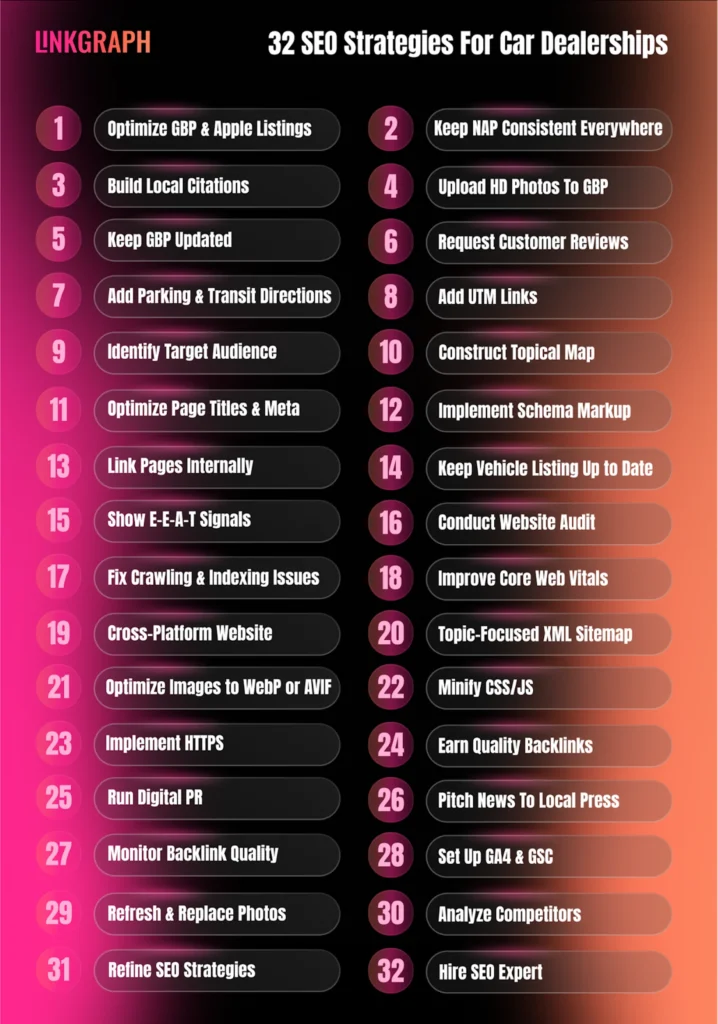
There are 32 SEO strategies for car dealerships. The 32 SEO strategies for car dealerships are listed below.
1. Claim and Fully Complete Google, Bing, and Apple Business Profiles
2. Keep Business Information Consistent Across All Citations and OTAs
3. Build Local Citations on Reputable Directories
4. Upload High-Quality Photos to Site and GBP
5. Keep Business Profiles Fresh with Photos and Posts
6. Ask and Manage Customer Reviews
7. Add Clear Driving, Parking, and Transit Directions
8. Add UTM Parameters to GBP Website and Booking Links
9. Identify Target Audience, Market, and Key Needs
10. Construct Proper Topical Map Based on Source Context
11. Optimize Page Titles, Meta Descriptions, and Image Alt Text
12. Implement Schema Markup Across All Pages
13. Internally Link Pages with a Logical Hierarchy
14. Keep Vehicle Listings, Content, And Schema Markup Up To Date
15. Show E-E-A-T Signals with Reviews, Certifications, and Awards
16. Conduct Complete Website Audit to Identify Technical Errors
17. Fix All Crawling and Indexing Issues
18. Improve Core Web Vitals and Overall Page Speed
19. Build Mobile-Friendly, Responsive Website for All Devices
20. Create Smaller Topic-Focused XML Sitemaps
21. Use Optimized Images and Convert Them to WebP or AVIF
22. Minify CSS/JS and Defer Non-Essential Scripts
23. Implement HTTPS Across Entire Site
24. Earn Quality Backlinks from Automotive Sites, Local Media, and Mobility Partners
25. Run Digital PR Campaigns and Influencer Collaborations
26. Pitch Newsworthy Updates to Local Press
27. Monitor Backlink Quality and Manage Risk Without Overusing Disavows
28. Track Calls, Bookings, and Directions via GA4, GSC, and GBP
29. Refresh and Replace Photos, Amenities, and Seasonal Pages
30. Analyze Top-Ranking Competitors and SERPs for New Opportunities
31. Refine SEO Strategies Based on Performance Data and Results
32. Hire an SEO Specialist When Needed
These steps provide a comprehensive roadmap for dealerships to launch and maintain effective SEO campaigns that attract, engage, and convert potential buyers. We have broken down the 32 SEO strategies for car dealerships below.
1. Claim and Verify Google, Bing, and Apple Business Profiles
Claiming and verifying Google, Bing, and Apple Business Profiles establishes the foundation for local search visibility. Car dealerships that complete and optimize these profiles appear in map results, local searches, and high-intent buyer queries. Verification ensures the listing belongs to the dealership and prevents unauthorized changes.
Dealerships should provide complete business information, including name, address, phone number, hours, services, and website links. Adding vehicle types, showroom photos, and service offerings improves search relevance. Regularly updating the profile signals active management, which supports higher rankings in map packs.
Car dealerships benefit from adding categories, attributes, and business descriptions optimized with relevant local keywords. Using high-quality images, videos, and offers increases engagement and encourages click-throughs. Maintaining consistency across all platforms strengthens credibility and improves trust with both search engines and potential buyers. Verified and optimized profiles serve as a central hub for lead generation and local customer interactions.
2. Complete Every Section of Business Profiles (Hours, Services, Photos, Offers)
Completing every section of Google, Bing, and Apple Business Profiles maximizes visibility in local searches. Car dealerships that fill out hours, services, vehicle types, and offers provide search engines with comprehensive information, improving ranking potential. Complete profiles give potential buyers a clear understanding of the offerings and operating schedule of a dealership.
Adding high-quality photos of vehicles, the showroom, and staff enhances engagement and builds trust. Listings with detailed services and promotions attract buyers searching for specific models, financing options, or seasonal deals. Car dealerships that regularly update offers and images demonstrate active management, which supports higher rankings in map packs and local search results.
Providing accurate descriptions, categories, and attributes ensures profiles match search intent. Consistent and detailed information across all business profiles strengthens credibility, increases click-through rates, and encourages direct inquiries, test drives, and service appointments. Complete profiles act as a powerful tool for lead generation.
3. Get Listed on Automotive Directories and Ensure NAP Consistency
Listing a car dealership on reputable automotive directories increases online visibility and builds authority. Directories like Edmunds, Cars.com, AutoTrader, and local automotive sites serve as trusted references for search engines, improving rankings. Car dealerships with consistent Name, Address, and Phone (NAP) across all listings signal reliability to search engines and potential buyers.
Maintaining NAP consistency prevents confusion, ensures accurate contact information, and strengthens local SEO efforts. Listings with updated hours, services, and website links improve lead generation and drive traffic to the website of the dealership. Car dealerships that regularly monitor directory entries quickly correct inaccuracies or outdated information, protecting brand reputation.
Combining directory listings with optimized business profiles and local SEO tactics allows car dealerships to dominate local search results. Accurate, consistent listings increase trust, boost rankings, and attract buyers actively searching for vehicles or automotive services nearby.
4. Collect and Respond to Customer Reviews on Google and Other Review Sites
Car dealerships benefit from actively collecting and managing customer reviews on platforms like Google, Yelp, and Cars.com. Positive reviews enhance credibility, improve local search rankings, and influence the decisions of potential buyers.
Responding to reviews demonstrates attentiveness and builds trust with customers. Dealerships that reply promptly to both positive and negative feedback show commitment to service quality. For example, acknowledging praise reinforces strengths, while addressing concerns professionally mitigates reputational risks.
Encouraging satisfied buyers to leave reviews increases overall review volume and strengthens authority in search results. Monitoring review sites allows dealerships to track trends, identify common issues, and make data-driven improvements.
Integrating review management with Google Business Profile optimization and local SEO strategies ensures higher visibility in map results and organic listings. A structured approach to collecting, responding, and leveraging reviews supports lead generation and builds long-term trust in the dealership brand.
5. Post Regular Updates, Offers, and Photos on Business Profiles
Car dealerships improve engagement and search visibility by posting frequent updates, promotions, and high-quality photos on Google, Bing, and Apple Business Profiles. Regular posts signal activity to search engines and potential customers, helping dealerships appear more authoritative and relevant in local searches.
Highlighting current offers, seasonal promotions, or new vehicle arrivals captures attention and encourages users to interact with listings. Including photos of inventory, service areas, or dealership events makes profiles visually appealing and builds trust with buyers.
Scheduling updates consistently keeps profiles fresh and demonstrates that the dealership actively maintains its online presence. Well-optimized posts with keywords and location details further improve local SEO performance.
Integrating post strategies with review management and map-pack optimization enhances overall local search performance. This structured approach drives higher engagement, increases website visits, and ultimately generates more qualified leads for the dealership.
6. Identify Target Audience, Market, and Key Needs
Car dealerships optimize SEO performance by clearly identifying the target audience, local market, and buyer needs. Understanding the audience helps create content and vehicle listings that match what potential buyers search for, from specific car models to financing options. This approach ensures marketing efforts reach the right customers at the right time.
Segmenting the market by location, demographics, and buyer intent allows dealerships to prioritize strategies that generate the highest-quality leads. Focusing on the types of vehicles, services, or promotions that appeal to each segment ensures all content and campaigns align with user expectations.
Connecting these insights to topical authority content strengthens search engine presence. Articles, guides, and resources about popular models, maintenance tips, and industry trends position dealerships as trusted experts. This strategy improves internal linking, reinforces keyword relevance, and drives qualified traffic, ultimately building long-term online authority for the dealership.
7. Construct Proper Topical Map Based on Source Context
Building a topical map organizes content around relevant automotive themes and dealership offerings. A proper topical map ensures that each page focuses on a specific topic, such as vehicle types, financing options, or service packages. This structure improves website navigation, making it easier for visitors to find information and for search engines to index pages accurately.
Linking related pages within the map creates a logical hierarchy from root topics to seed and supporting nodes. This hierarchy strengthens internal linking, distributes authority across the site, and improves keyword relevance for both general and specific search queries.
Topical maps connect directly to high-value content, including blog posts, buyer guides, and local service pages. Creating content that aligns with search intent enhances topical authority for the dealership. This approach ensures the website appears as a trusted resource in search results, attracting more qualified traffic and supporting higher conversion rates.
8. Optimize Title Tags, Meta Descriptions, and Vehicle Listings on All Pages
Optimizing title tags and meta descriptions improves search engine visibility and click-through rates for dealership websites. Each page should have a unique, keyword-rich title that clearly describes the content, such as specific vehicle models or dealership services. Meta descriptions should summarize the page concisely, highlighting features or offers that attract potential buyers.
Vehicle listings require detailed descriptions including make, model, year, mileage, and pricing. Structured content with clear headings and bullet points enhances readability for both users and search engines. Optimized listings improve organic traffic and help potential buyers find relevant inventory faster.
Combining optimized title tags, meta descriptions, and vehicle listings strengthens on-page SEO for the dealership. It aligns content with user intent, enhances relevance for targeted keywords, and increases the likelihood of appearing in local search results, driving qualified leads and increasing conversions.
9. Write Complete Descriptions for Each Vehicle
Complete vehicle descriptions are essential for helping car dealerships rank in search results and convert browsing visitors into buyers. Each description should include critical details such as make, model, year, mileage, trim level, condition, and pricing to give shoppers the clarity they need.
Adding unique selling points like fuel efficiency, safety ratings, or advanced technology features not only improves the customer experience but provides rich content that search engines value. Using local keywords, such as “SUV for sale in [city],” makes the listing more discoverable to nearby buyers.
Dealerships that maintain consistent, detailed, and well-structured descriptions build topical authority in automotive search. This approach allows every inventory page to serve as an optimized entry point for potential customers and reduces reliance on third-party platforms.
10. Record Video Overviews, Comparisons, and Walkthroughs
Video content is a powerful way for car dealerships to showcase vehicles and improve visibility in search results. Recording short overviews of each car, feature walkthroughs, and side-by-side comparisons helps buyers evaluate options without leaving the website. These videos be uploaded directly to vehicle listing pages, Google Business Profiles, and YouTube, driving more organic traffic.
Including details such as trim differences, interior features, and technology highlights positions the dealership as an authority in automotive knowledge. Local keywords spoken naturally within the video and added in titles or descriptions enhance SEO performance.
Car dealerships that consistently produce authentic video content build stronger connections with customers. Videos increase time on page, encourage more engagement, and give buyers confidence in their purchase decisions before visiting the showroom.
11. Implement Schema Markup on All Pages
Schema markup helps search engines interpret car dealership websites with greater accuracy. Marking up pages with structured data highlights key details such as dealership name, address, phone number, services, and vehicle inventory. Search engines then display this information in rich results, which increases visibility in local and automotive searches.
Vehicle-specific schema markup allows car dealerships to display price, availability, mileage, and model year directly in search snippets. This detail gives buyers fast access to essential information and improves click-through rates. Review schema for customer feedback strengthens trust signals and boosts credibility in local rankings.
Car dealerships that apply schema across every page create a consistent structure for search engines. Proper implementation not only improves ranking opportunities but helps websites appear in Google’s Knowledge Panel, Local Pack, and rich snippets.
12. Internally Link Pages with a Logical Hierarchy (Root → Seed → Node)
Internal linking creates a clear path for both users and search engines to navigate car dealership websites. Establishing a hierarchy from root pages to seed and node pages organizes content around main topics, services, and vehicle categories. This structure allows search engines to understand page relationships and assign authority appropriately.
Root pages contain core information such as dealership overview, services offered, and main inventory categories. Seed pages expand on specific vehicle types or services, while node pages provide detailed listings, specifications, and individual vehicle information. Proper internal linking distributes link equity, which improves ranking potential for high-priority pages.
Logical internal linking enhances user experience by guiding visitors through relevant content efficiently. Car dealerships that maintain this hierarchy reduce bounce rates, increase engagement, and help search engines index pages more effectively, boosting overall SEO performance.
13. Show E-E-A-T Signals with Certifications, Testimonials, and Awards
Demonstrating experience, expertise, authoritativeness, and trustworthiness (E-E-A-T) strengthens credibility for car dealership websites. Displaying certifications, industry awards, and customer testimonials signals authority to both search engines and potential buyers.
Certifications highlight professional qualifications and adherence to automotive standards. Awards emphasize recognition from reputable organizations, building confidence in the services and inventory quality of a dealership. Customer testimonials showcase real experiences, providing social proof that reinforces trust and reliability.
Integrating E-E-A-T signals across vehicle listings, service pages, and informational content increases both search engine visibility and user confidence. Car dealerships that actively promote certifications, awards, and positive reviews achieve higher engagement, improve rankings, and attract more qualified leads from local search traffic.
14. Keep Vehicle Listings, Content, and Schema Markup Updated
Regularly updating vehicle listings ensures inventory information remains accurate for potential buyers and search engines. Fresh content signals activity to search engines, improving rankings for car dealership websites.
Updating listings includes pricing, availability, specifications, and new arrivals. Consistently refreshing descriptions and images maintains user engagement and encourages repeat visits from interested buyers. Schema markup for vehicles, services, and offers should reflect these updates to improve visibility in search results and rich snippets.
Car dealerships that maintain up-to-date content and structured data enhance user experience, increase click-through rates, and attract more qualified leads. Combining accurate listings, engaging content, and current schema markup builds authority and trust in the local automotive market.
15. Conduct Complete Website Audit to Identify Technical Errors
A full website audit identifies technical issues that prevent search engines from properly crawling or indexing a dealership website. Car dealership websites with unresolved errors lose visibility and reduce qualified leads.
Audits examine broken links, duplicate content, slow page load, mobile responsiveness, and schema markup accuracy. Each issue impacts user experience, search engine rankings, and the performance of vehicle listings. Technical SEO ensures these elements meet search engine standards, improving website authority and organic traffic.
Regular audits allow car dealerships to resolve technical errors proactively. Addressing these issues strengthens the foundation of the website, enhances indexing, and supports ongoing SEO efforts. Dealerships that implement technical SEO through systematic audits maintain a competitive edge in search results and capture more local and high-intent buyers.
16. Fix All Crawling and Indexing Issues
Crawling and indexing issues prevent search engines from discovering and ranking dealership websites properly. Technical SEO addresses crawling and indexing issues to ensure every important page, including vehicle listings, service pages, and blog content, appears in search results.
Reducing server response time to under 100ms allows search engine bots to crawl more pages efficiently. Ensuring HTML crawl requests exceed 95% guarantees that nearly all web pages are accessible for indexing. Maintaining a refresh rate of around 20% helps search engines stay updated on changes without overloading the crawl budget. A discovery rate of 7–8% ensures new or updated content is recognized quickly.
Performing a log file analysis identifies where the majority of the crawl budget is being lost, highlighting blocked pages, broken links, and redirect chains. Resolving these issues, updating XML sitemaps, improving internal linking, and implementing proper canonical tags collectively enhance indexing. Addressing these key technical SEO points strengthens visibility and drives more qualified leads to dealership websites.
17. Improve Site Speed and Core Web Vitals (LCP, INP, CLS Thresholds)
Optimizing site speed and Core Web Vitals ensures car dealership websites load quickly and offer a smooth browsing experience. Technical SEO plays a major role in improving loading times, interaction responsiveness, and visual stability.
Largest Contentful Paint (LCP) measures how fast the main content appears. Reducing LCP under recommended thresholds allows visitors to see vehicle listings and inventory instantly. Interaction to Next Paint (INP) tracks how quickly the website responds to user actions, improving navigation across vehicle categories and service pages. Cumulative Layout Shift (CLS) ensures visual elements remain stable, preventing disruptive shifts while browsing or scrolling.
Techniques to enhance site speed include compressing and optimizing images, deferring non-essential scripts, minimizing CSS and JavaScript, and ensuring mobile responsiveness. Continuous monitoring of Core Web Vitals with technical SEO best practices maintains a fast, user-friendly website that encourages longer visits and increases the likelihood of generating high-quality leads.
18. Make Website Mobile-Friendly and Responsive Across Devices
Creating a mobile-friendly, responsive website improves user experience for visitors accessing car dealership sites from smartphones and tablets. Technical SEO emphasizes responsive design, ensuring inventory pages, service information, and contact forms adapt seamlessly to various screen sizes.
A responsive website allows potential buyers to browse vehicle listings, view photos, and submit inquiries without layout issues. Mobile optimization enhances local search performance, increasing visibility in searches like “used cars near me” or “SUVs for sale in [city].”
Techniques include using flexible grids, scalable images, and adaptive navigation menus. Regular testing across devices ensures that all pages maintain readability, speed, and interactive functionality. Optimizing for mobile devices strengthens technical SEO, reduces bounce rates, and increases engagement, resulting in more qualified leads and higher chances of converting visitors into customers.
19. Avoid Intrusive Popups and Unnecessary Chatbots
Intrusive pop-ups and excessive chatbots disrupt user experience and lower engagement on car dealership websites. Technical SEO prioritizes a clean, user-friendly design that allows visitors to browse vehicle listings, service pages, and contact information without interruptions.
Pop-ups that block content or appear too frequently increase bounce rates and negatively affect search rankings. Streamlined chat features that provide value, such as quick responses to specific queries, enhance user satisfaction without overwhelming visitors.
Implementing minimal, contextually relevant pop-ups improves conversions while maintaining site credibility. Reducing distractions aligns with technical SEO best practices, ensuring search engines recognize the website as high-quality and user-focused. This approach supports higher organic visibility, longer site sessions, and better overall engagement from potential buyers.
20. Maintain Clear Site Structure for Easy Navigation
A clear site structure improves user experience and supports technical SEO for car dealership websites. Logical organization of pages, categories, and vehicle listings helps visitors find information quickly and encourages longer site sessions.
Using a hierarchical structure with main pages, subpages, and related content ensures search engines crawl and index all important pages efficiently. Clear navigation menus and breadcrumb trails guide users through inventory, services, and contact sections without confusion.
Maintaining a well-organized site structure enhances discoverability, reduces bounce rates, and supports higher search rankings. Consistent labeling and categorization of vehicle models, services, and locations make the website intuitive for both users and search engines. This foundation strengthens overall technical SEO and improves the visibility of the dealership in search results.
21. Secure Website with HTTPS (SSL Certificate)
Securing a car dealership website with HTTPS protects user data and strengthens technical SEO. HTTPS encryption ensures all information, including personal details and payment data, remains safe from interception during browsing or transactions.
Search engines prioritize secure websites in rankings, so implementing an SSL certificate directly supports visibility in search results. A secure connection builds trust with potential buyers, encouraging engagement with vehicle listings, forms, and service pages.
Maintaining HTTPS across all pages prevents security warnings that drive users away. Regularly renewing SSL certificates and verifying proper configuration keeps the website compliant with modern security standards. This simple yet essential step improves site credibility, supports technical SEO, and enhances user confidence in the dealership’s online presence.
22. Create Smaller Topic-Focused XML Sitemaps
Car dealership websites benefit from smaller, topic-focused XML sitemaps that organize content clearly for search engines. Segmenting sitemaps by vehicle types, services, or location pages helps search engines crawl and index pages more efficiently.
Technical SEO improves when sitemaps highlight priority pages, making inventory, service, and promotional content easier to discover. Well-structured sitemaps reduce crawl errors and support faster indexing, ensuring new or updated pages appear promptly in search results.
Regularly updating XML sitemaps with new models, offers, or service pages maintains accuracy and enhances search engine understanding. Smaller, organized sitemaps prevent oversized files from overwhelming crawl budgets, ultimately improving visibility, user experience, and performance across all dealership web pages.
23. Use Optimized Images and Convert to WebP or AVIF
Car dealership websites rely heavily on high-quality vehicle images to attract buyers. Optimizing images reduces file size without sacrificing clarity, improving page load speed, and enhancing overall user experience.
Technical SEO benefits when images are converted to modern formats like WebP or AVIF, which offer faster loading times compared to traditional JPEG or PNG files. Faster-loading pages improve Core Web Vitals metrics, boost search engine rankings, and reduce bounce rates.
Properly optimized images should include descriptive file names and alt text for better accessibility and search engine understanding. Converting vehicle photos, showroom images, and promotional banners to WebP or AVIF ensures that all visual content contributes to faster performance, improved visibility, and a smoother browsing experience for potential buyers.
24. Minify CSS/JS and Defer Non-Essential Scripts
Website performance depends on efficient code delivery, especially for car dealership sites with extensive vehicle listings. Minifying CSS and JavaScript reduces file sizes by removing unnecessary spaces, comments, and characters, which accelerates page load times and improves user experience.
Deferring non-essential scripts ensures that critical content loads first, allowing visitors to access key information quickly. This practice enhances Core Web Vitals, supports technical SEO, and increases the likelihood of higher search engine rankings.
Optimized scripts help mobile and desktop users navigate the site smoothly, view vehicle details, and interact with calls-to-action without delays. Combining minification with script deferment strengthens overall website performance, lowers bounce rates, and ensures that search engines crawl and index pages efficiently.
25. Earn Quality Backlinks from Automotive Sites, Local Media, and Mobility Partners
Earning backlinks from reputable automotive websites, local news outlets, and mobility partners strengthens the online authority of a dealership. High-quality backlinks signal to search engines that a website is trustworthy, relevant, and valuable, improving search rankings for key vehicle and service queries.
Automotive backlinks include mentions from local industry associations, partner garages, or car review websites. Local media coverage highlights dealership news, events, or promotions, driving traffic and building community credibility. Partnerships with mobility providers or automotive blogs offer contextual links that reinforce topical relevance.
Focusing on authoritative sources ensures the dealership gains meaningful exposure while avoiding low-quality or spammy links. This off-page SEO strategy complements on-page and technical SEO efforts, enhancing domain authority, boosting visibility in search results, and attracting qualified buyers actively searching for vehicles.
26. Run Digital PR Campaigns and Influencer Collaborations
Digital PR campaigns and influencer collaborations enhance brand visibility and drive high-quality traffic to dealership websites. Sharing newsworthy updates, vehicle launches, or community initiatives through digital channels increases online presence and attracts potential buyers searching for relevant automotive content.
Collaborating with automotive influencers allows dealerships to showcase vehicles, test drives, and services to engaged audiences. Endorsements of influencers build trust and credibility, while their content generates backlinks and social signals that strengthen off-page SEO.
Combining digital PR and influencer strategies amplifies reach across multiple platforms, reinforces brand authority, and supports search rankings. Effective campaigns focus on relevant audiences, maintain consistent messaging, and highlight dealership expertise, ensuring measurable results in both website traffic and lead generation.
27. Monitor Backlink Quality and Manage Risk Without Overusing Disavows
Monitoring backlink quality helps maintain a strong online reputation and protects search rankings. Dealerships must regularly review referring domains, focusing on relevance, authority, and trustworthiness. High-quality backlinks from automotive sites, local media, and industry partners strengthen off-page SEO.
Low-quality or spammy backlinks pose a risk to rankings and credibility. Address these issues carefully without relying excessively on disavow files. Instead, prioritize outreach to remove harmful links and build relationships with reputable sites to replace weak backlinks with authoritative ones.
Consistent backlink monitoring ensures a balanced link profile, enhances domain authority, and supports long-term SEO performance. Proactive management reduces penalties, reinforces dealership trustworthiness, and complements other off-page strategies such as digital PR and influencer collaborations.
28. Strengthen Online Reputation on Social Media Platforms
Active management of social media profiles helps dealerships build credibility and trust with potential buyers. Regular posts showcasing vehicles, promotions, and customer experiences highlight expertise and engage followers.
Engaging with comments, messages, and reviews on social platforms strengthens relationships and signals responsiveness. Positive interactions encourage word-of-mouth referrals and amplify dealership authority.
Maintaining a consistent and professional presence across platforms reinforces brand recognition, supports off-page SEO efforts, and drives traffic to the website. Strong social signals contribute to overall search visibility and enhance the online reputation of a dealership.
29. Set Up Tracking for Calls, Form Submissions, and Conversions
Tracking calls, form submissions, and online conversions helps dealerships measure the effectiveness of SEO campaigns. Accurate tracking identifies which pages and listings drive the most customer engagement and leads.
Recording user interactions provides insights into customer behavior, enabling adjustments to content, website structure, and marketing strategies. This ensures resources target high-performing areas and improve lead generation.
Monitoring conversions over time allows dealerships to quantify ROI from SEO efforts. Data-driven insights support continuous optimization, helping the dealership attract more qualified leads and increase vehicle sales efficiently.
30. Analyze Top-Ranking Competitors and SERPs for New Opportunities
Analyzing top-ranking competitors and search engine results pages (SERPs) reveals strategies that drive visibility and engagement. Understanding competitor keywords, content formats, and ranking tactics provides actionable insights for the dealership.
Examining SERPs shows which topics, inventory pages, and local searches dominate rankings. This helps identify gaps where new content or optimized listings outperform competitors.
Regular competitor and SERP analysis allows dealerships to adjust SEO strategies based on market trends. Continuous monitoring uncovers opportunities for improved content, better keyword targeting, and enhanced local search presence, driving more qualified traffic and leads.
31. Refine SEO Strategies Based on Performance Data and Results
Refining SEO strategies based on performance data ensures ongoing improvements in search visibility and lead generation. Tracking metrics like organic traffic, engagement, and conversion rates highlights which tactics yield the best results.
Analyzing performance data allows dealerships to adjust keyword targeting, content focus, and local optimization efforts. Performance insights guide decisions on updating vehicle listings, website structure, and on-page SEO elements for maximum impact.
Regularly reviewing results identifies underperforming pages, missed opportunities, and emerging trends in local automotive search. Refining strategies based on data ensures dealerships maintain a competitive edge, attract qualified buyers, and increase sales through well-informed, adaptive SEO practices.
32. Hire an SEO Specialist When Needed
Hiring an SEO specialist provides expert guidance to improve website visibility and attract more qualified leads. Specialists bring experience in technical SEO, on-page optimization, and off-page strategies tailored to car dealerships.
An SEO specialist identifies gaps in current efforts, implements best practices, and ensures content, vehicle listings, and business profiles align with search engine requirements. They optimize local search presence, schema markup, and site structure to enhance overall performance.
Specialists monitor results, refine strategies, and respond to changes in search algorithms. Engaging an SEO professional helps dealerships save time, maximize marketing ROI, and maintain a strong online presence that drives more inquiries, test drives, and car sales consistently.
What Common SEO Mistakes Should Car Dealers Avoid?
The common SEO mistakes car dealership and showroom owners should avoid often stem from ignoring local SEO, failing to optimize vehicle listings, not maintaining accurate business information, and neglecting website performance and mobile usability. Identifying and correcting these errors improves online visibility and attracts potential customers. Some common SEO mistakes for car dealerships to avoid are listed below.
- Neglecting Local SEO Optimization: Ignoring local SEO tactics reduces the visibility of a dealership in search results. Optimizing for local searches ensures potential customers find the dealership when searching for terms like “car dealership near me.” This includes optimizing the Google Business Profile and using location-specific keywords.
- Failing to Optimize Vehicle Listings: Each vehicle listing should include complete details such as make, model, year, mileage, and high-quality images. Using relevant keywords in descriptions improves search engine rankings and attracts more buyers.
- Inconsistent or Incorrect Business Information: Outdated business information across platforms confuses customers and harms SEO. Ensuring name, address, and phone number consistency across all directories builds trust with search engines and users.
- Neglecting Mobile Optimization: A mobile-friendly website loads quickly and navigates easily on smartphones, enhancing user experience and search rankings.
- Overlooking Website Performance and Speed: Slow-loading websites increase bounce rates. Optimizing images, minimizing code, and leveraging caching improve load times and user experience.
- Ignoring Customer Reviews and Testimonials: Encouraging positive reviews enhances credibility and improves local SEO rankings.
- Not Utilizing Structured Data Markup: Schema markup for vehicle listings, reviews, and business information enhances search engine understanding and click-through rates.
- Failing to Monitor and Analyze SEO Performance: Tracking website traffic, keyword rankings, and user behavior provides insights to refine strategies and improve results.
- Overlooking Social Media Engagement: Active participation on social platforms drives traffic and improves brand visibility.
- Not Keeping Up with SEO Trends and Algorithm Updates: Adapting strategies to evolving SEO trends and algorithm changes maintains and improves search rankings.
Can a Single SEO Approach Work for All Types of Car Dealerships?
No, a single SEO approach is not effective for all types of car dealerships. Each dealership has unique needs and target audiences. For instance, new car dealerships should emphasize brand-specific keywords and inventory pages, while used car dealerships might focus on highlighting vehicle history reports and competitive pricing. Luxury dealerships benefit from showcasing premium services and exclusive inventory, whereas service-based dealerships should optimize for local repair and maintenance keywords. Therefore, customizing SEO strategies to fit the unique needs and target audiences of each dealership type is essential for maximizing online visibility and lead generation.
When Should Car Dealers and Showroom Owners Start Investing in SEO?
Car dealerships and showroom owners should consider investing in SEO as early as possible, ideally during the website development phase. Implementing SEO from the outset ensures that the site is structured for optimal search engine visibility. However, if the website is already live, it’s never too late to begin. Starting SEO efforts promptly lead to improved search rankings, increased organic traffic, and higher-quality leads over time. Given the competitive nature of the automotive industry, early investment in SEO provide a significant advantage in attracting and retaining customers.
Is Optimizing a GMB Profile Enough for Car Dealers to Generate Consistent Leads?
While optimizing a Google Business Profile (GMB) is a crucial component of local SEO, relying solely on it is insufficient for generating consistent leads. A comprehensive SEO strategy should include website optimization, content marketing, backlink building, and technical SEO. By integrating these elements with a well-optimized GMB profile, dealerships improve their online presence and attract a steady stream of leads.
How Long Does SEO Take to Produce Results for a Car Dealership?
SEO is a long-term strategy, and results typically begin to manifest within 3 to 6 months. However, the timeline vary based on several factors, including website age and authority, competition, and the quality of SEO implementation. While initial improvements be seen within a few months, achieving and maintaining top rankings requires ongoing SEO efforts and adjustments based on performance data.
Which Online Directories Are Most Valuable for Car Dealerships?
The most valuable online directories for car dealerships are platforms that highlight inventory, showcase business details, and attract buyers. These directories improve visibility, generate leads, and build credibility for dealerships across competitive markets. Some valuable online directories for car dealerships are listed below.
- Cars.com: Widely used by car buyers searching for new and used vehicles, boosting exposure and direct inquiries.
- Autotrader: Known for its broad audience, offering lead generation and advanced listing features for dealerships.
- CarGurus: Popular for price transparency and dealer ratings, helping buyers compare listings and trust dealerships.
- Edmunds: Strong authority site that builds credibility with vehicle reviews and detailed dealer listings.
- DealerRater: Focused on customer reviews, strengthening reputation and trust signals for dealerships.
- TrueCar: Provides price comparisons and connects buyers with dealers through trusted pricing tools.
- AutoTempest: Aggregates listings from multiple sites, expanding reach for vehicle inventory.
- Carfax for Dealers: Boosts trust by highlighting vehicle history reports alongside dealership listings.
- Hemmings: Specialized in classic and collectible cars, ideal for niche dealerships.
- Cars & Bids: Online auction site targeting modern enthusiast vehicles, useful for specialty dealers.
- Bring a Trailer: Auction platform for unique and classic cars, attracting a dedicated buyer base.
- AutoTrader Classics: Focused on vintage and collectible cars, supporting dealerships with niche inventory.
Car dealerships that maintain consistent listings across these directories gain stronger authority, more visibility, and higher chances of converting serious buyers.
Can Car Dealers Successfully Implement SEO on Their Own?
Car dealers attempt to implement SEO on their own, but consistent success requires advanced knowledge and ongoing effort. SEO for car dealerships involves technical SEO, local optimization, content creation, and link-building, which demand expertise and time. Without professional guidance, many dealerships struggle to achieve sustainable rankings or generate qualified leads. Partnering with experts ensures strategies are properly executed, monitored, and refined, helping dealerships secure long-term visibility and compete effectively in local automotive markets.
What Should Car Dealers Evaluate Before Hiring an SEO Agency?
Car dealerships and showrooms must carefully evaluate an SEO agency before making a decision. The right choice impacts visibility, lead generation, and long-term results. The following points outline what to check before moving forward. The factors to consider before hiring an SEO agency are listed below.
- Proven Experience in Automotive SEO: Confirm the agency has case studies or examples from car dealerships.
- Clear SEO Strategy: Assess how the agency handles technical SEO, content, local SEO, and backlinks.
- Transparent Reporting: Look for detailed reports on rankings, traffic, and conversions with measurable KPIs.
- Knowledge of Local SEO: Ensure the agency understands how to optimize for “near me” searches and local visibility.
- Strong Communication: Identify who manages your account and how often updates are shared.
- Customized Approach: Avoid one-size-fits-all tactics; SEO must reflect dealership goals and inventory needs.
- Pricing and Contracts: Review terms for hidden costs, lock-ins, or unclear deliverables.
- Reputation and Reviews: Check testimonials, online reviews, or industry recognition for credibility.
Evaluating these factors helps car dealers select an SEO agency that drives qualified leads, increases visibility, and supports long-term growth.
Who Offers the Best Car Dealership SEO Services Near Me?
LinkGraph emerges as a top choice among automotive SEO and internet marketing firms for car dealers. Strong proof lies in the case study with Auto Auction Mall. LinkGraph helped a brand new site face stiff competition and nearly tripled its organic traffic while improving keyword rankings and conversions dramatically.
LinkGraph delivers a full suite of services tailored for dealerships. Their automotive SEO service includes technical SEO optimizations, content strategy, structured data implementation, and high-authority backlink building. These tactics led to major lifts in search visibility for clients in the automotive space.
Recognition outside their case studies reinforces LinkGraph’s status. The agency won the U.S. Search Awards’ Best Start-Up Agency and appeared on the Inc. 5000 list for fastest growing private companies. These awards reflect hard performance results and industry trust in their capabilities.
What SEO Services Does LinkGraph Offer for Car Dealerships?
LinkGraph provides a comprehensive range of SEO services for car dealerships, ensuring each dealership increases online visibility, drives qualified leads, and ranks higher in search results. These services cover every aspect of automotive SEO, from technical optimizations to content creation and local search strategies. The SEO services offered by LinkGraph to car dealerships are listed below.
- Semantic SEO for Car Dealers: Optimizes website content around related topics and search intent to improve relevance and ranking.
- Holistic SEO for Car Dealers: Addresses the full SEO ecosystem, combining on-page, off-page, and technical strategies for maximum performance.
- Local SEO for Car Dealers: Enhances dealership visibility in local search results and map packs to attract nearby buyers.
- Technical SEO for Car Dealers: Fixes crawlability, indexing, site speed, and other technical issues to boost search performance.
- On-Page SEO for Car Dealers: Optimizes page titles, meta descriptions, headings, and vehicle listings for search engines.
- Off-Page SEO for Car Dealers: Builds high-quality backlinks and authority signals to strengthen online presence.
- Content Creation for Car Dealers: Produces blog posts, vehicle descriptions, guides, and other content to attract and educate buyers.
- LLM and AI Optimization for Car Dealers: Implements AI-powered strategies to enhance content relevance and search performance.
- Lead Tracking and Reporting for Car Dealers: Monitors calls, form submissions, and online interactions to measure SEO ROI.
- Branding for Car Dealers: Strengthens online authority, trust, and dealership recognition across digital channels.
These services from LinkGraph combine to create a full-service SEO solution for car dealerships, helping each dealership outperform competitors and attract more buyers.
Can All Types of Car Dealers and Showroom Owners Get SEO Services from LinkGraph?
Yes, LinkGraph provides SEO services for all types of car dealers and showroom owners. Every dealership, whether luxury, budget, or specialty, benefits from LinkGraph’s tailored strategies. Services cater to local dealerships, used car dealers, new car showrooms, and online automotive retailers. LinkGraph customizes SEO approaches for inventory, location, and target audience, ensuring improved search visibility, more qualified leads, and higher conversion rates across all dealership types.
How Much Does LinkGraph Charge for Car Dealership SEO Services?
LinkGraph offers flexible pricing based on dealership size, inventory, and marketing goals. Packages are designed to match local, regional, or national SEO needs. Pricing includes ongoing optimization, content creation, technical fixes, and off-page strategies, providing measurable ROI.
Does LinkGraph Only Offer SEO Services for Car Dealerships?
No, LinkGraph provides SEO services across multiple industries. Beyond automotive, the agency supports hospitality, SaaS, e-commerce, healthcare, and professional services. Each industry receives customized strategies that address unique search intents, audience targeting, and competitive landscapes. LinkGraph adapts technical SEO, content creation, local optimization, and off-page efforts to meet industry-specific goals, helping businesses of all sizes improve visibility, generate qualified leads, and increase revenue through search engine optimization.
Which Other Businesses Get SEO Services from LinkGraph?
LinkGraph provides SEO services to a wide range of businesses that aim to increase online visibility, attract qualified leads, and grow revenue. Each business receives tailored strategies designed to improve search rankings, engage target audiences, and drive measurable results. Other industries that can get SEO services from LinkGraph are listed below.
- SaaS Companies: Optimizing product pages, blog content, and onboarding flows increases organic traffic and trial sign-ups.
- IT & Technology Firms: Technical content and local SEO help attract enterprise clients and showcase expertise.
- E-commerce Stores: Product optimization and structured data improve visibility in search results and enhance conversions.
- Healthcare Providers: Local SEO, reputation management, and content marketing drive patient acquisition.
- Legal Services: Targeted content and local optimization increase leads for specific practice areas.
- Hospitality & Travel: Hotel and travel SEO boosts bookings and builds brand authority.
- Financial Services: SEO strategies attract high-intent customers for loans, investments, and advisory services.
LinkGraph’s versatile approach ensures businesses across industries achieve measurable SEO success and sustainable growth.
What Are Other Ways to Market a Car Dealership Besides SEO?
Car dealerships expand their reach and attract buyers using multiple marketing channels alongside SEO. These methods help generate leads, build brand awareness, and increase conversions across both digital and offline platforms. Some other ways to market car dealerships besides SEO are listed below.
- Pay-Per-Click (PPC) Advertising: Running targeted ads on search engines and social media drives immediate traffic and leads.
- Social Media Marketing: Platforms like Facebook, Instagram, and TikTok engage potential buyers with promotions, vehicle showcases, and community content.
- Email Marketing: Personalized campaigns inform leads about new arrivals, promotions, and service offers, nurturing conversions.
- Video Marketing: Walkthroughs, comparisons, and reviews showcase inventory and help buyers make informed decisions.
- Influencer Collaborations: Partnering with automotive influencers increases visibility and trust among target audiences.
- Local Events & Sponsorships: Hosting or sponsoring community events strengthens brand recognition and builds relationships with buyers.
Combining these strategies with SEO ensures comprehensive marketing coverage and drives consistent dealership growth.
Is SEO More Cost-Effective Than Paid Ads for Car Dealers?
SEO is generally more cost-effective than paid ads for car dealerships. While paid search provides immediate visibility, it becomes expensive over time, especially in competitive automotive markets. SEO requires upfront investment in time and resources, but delivers lower customer acquisition costs over the long term. Organic acquisition consistently costs significantly less than paid channels, helping dealerships achieve better ROI while building a sustainable online presence.
Does Video Content Help Car Dealers Attract More Buyers?
Video content is a powerful tool for car dealerships to engage potential buyers. Effective formats include vehicle walkarounds, customer testimonials, how-to guides, and behind-the-scenes footage. These videos build credibility and trust by giving customers a personal, detailed view of vehicles and dealership offerings.
How Car Showrooms Use Social Media to Reach More Customers?
Car showrooms use platforms like Facebook, Instagram, and TikTok to connect with potential buyers. Sharing vehicle showcases, promotions, and behind-the-scenes content increases engagement. Paid social campaigns allow targeting based on demographics and interests, improving visibility and customer interaction.
How Influencer Marketing Help Car Dealers Attract More Buyers?
Influencer marketing expands dealership reach through collaborations with individuals who have strong online followings. Showcasing vehicles via influencers provides authentic promotion, builds trust, and raises brand awareness. This strategy drives engagement and encourages more direct buyers.
Is Email Marketing as Important as Other Car Dealership Marketing Channels?
Yes, email marketing is a highly effective channel for car dealerships. It offers a direct line to potential and existing customers, allowing dealerships to share promotions, new inventory, and personalized offers. With a high return on investment, email marketing remains a cornerstone of digital marketing strategies for car dealerships.
How Do Promotions and Seasonal Offers Affect Car Dealers SEO?
Promotions and seasonal offers positively impact dealership SEO by generating increased search interest and traffic. By aligning content with seasonal keywords and updating listings to reflect current deals, dealerships improve their visibility in search engine results, attracting more potential buyers.
Can Small Car Dealers Compete with Large Auto Chains Using SEO?
Absolutely. Small car dealerships leverage local SEO strategies to target specific geographic areas, optimizing their online presence to attract nearby customers. By focusing on niche markets and providing personalized services, small dealers effectively compete with larger auto chains in their locality.
How Car Dealers Track the ROI of Their SEO Campaigns?
Car dealerships track the ROI of their SEO campaigns by monitoring key performance indicators such as organic traffic, lead conversions, and sales attributed to organic search. Utilizing tools like Google Analytics and CRM systems, dealerships assess the effectiveness of their SEO efforts and make data-driven decisions to optimize their strategies.
