
Coaches search engine optimization improves online visibility for coaches and personal trainers. SEO services for coaches attract clients and grow business through targeted content and keyword strategies. Local SEO for coaches ensures fitness professionals appear in searches relevant to their location.
Effective SEO for coaches combines on-page, technical, and off-page optimization to generate sustainable traffic and credibility. Coaches search engine optimization creates measurable results through content creation, link building, and structured analytics. The best SEO agency for coaches and personal trainers implements strategies that match audience and competitive goals.
SEO services for coaches strengthen brand recognition and improve client acquisition. Each element of coaches SEO contributes to website authority, engagement, and search rankings. Structured SEO for coaches and personal trainers provides a foundation for long-term growth and online success.

What Is Coaching?
Coaching is a structured practice where a coach guides individuals toward specific goals through focused conversations and actionable strategies. A coaching session emphasizes clarity, accountability, and measurable progress for personal or professional development.
Coaching in health, wealth, business, and life improvement highlights targeted problem-solving and outcome-driven methods. Each coaching process involves defined objectives, clear milestones, and practical steps that align with the needs of the clients.
Unlike informal advice, coaching applies tested frameworks that strengthen growth in performance, mindset, or lifestyle. For search engine optimization purposes, defining coaching with precise language ensures search engines connect coaching services to relevant user intent and industry-specific queries. This alignment increases visibility for coaching practices across multiple niches.
What Is SEO for Coaches?
SEO for coaches is the process of optimizing a coaching website to increase search engine visibility and attract qualified clients. A coaching website uses keyword-rich content, optimized metadata, and structured pages to match search intent for health, business, life, or niche coaching services.
Coaching SEO combines on-page, local, and technical strategies to ensure potential clients find relevant services. Keyword research identifies phrases clients use, while high-quality content answers their questions. On-page optimization enhances page titles, headings, and internal links to strengthen relevance.
Technical and local SEO improve site accessibility and trust. Mobile responsiveness, fast loading, and clear navigation help search engines index pages efficiently. Optimizing Google Business Profiles and obtaining reviews boosts local rankings. Together, these methods allow coaching practices to connect with clients actively searching for coaching services in their area.
Is SEO Important for Coaches?
Yes, SEO is highly important for coaches because it increases online visibility and connects practices with clients actively searching for coaching services. A coaching website optimized for search engines ranks higher for relevant queries, attracting individuals who are already seeking solutions like life, business, or health coaching.
SEO helps coaches generate qualified leads, improve credibility, and establish authority in their niche. Optimized websites deliver a better user experience, making content easier to navigate and understand, which builds trust with potential clients.
Targeted SEO reduces wasted marketing efforts by focusing on clients who are most likely to convert. Over time, a consistent SEO strategy drives sustainable growth, strengthens brand presence, and provides a cost-effective alternative to paid advertising, making it essential for business expansion.
Which Type of Coach Benefits the Most from SEO?
Search Engine Optimization (SEO) is one of the most effective ways for coaches to attract a steady flow of qualified leads without relying solely on paid ads or social media. For health, wealth, life, and other personal or professional development coaches, SEO improves visibility and ensures potential clients find their services online when searching for relevant solutions. The types of coaches that benefit from SEO are listed below.
- Life Coaches: Individuals seeking guidance on personal growth easily find services with optimized search results.
- Business Coaches: Entrepreneurs looking for strategic support locate credible coaches faster.
- Health Coaches: People searching for wellness plans or nutrition advice reach the right professionals online.
- Wellness Coaches: Optimized content highlights services like stress management, mindfulness, and holistic care.
- Career Coaches: Job seekers and professionals discover tailored coaching to advance careers.
- Financial Coaches: SEO connects clients needing budgeting, investing, or financial planning guidance.
- Relationship Coaches: Couples and individuals find coaching for communication, dating, and life balance.
- Mindset & Performance Coaches: Athletes, executives, and professionals locate strategies for peak performance.
- Executive Coaches: Leaders searching for leadership, productivity, and organizational guidance find top options.
- Spiritual Coaches: Clients seeking meditation, mindfulness, or spiritual growth services discover relevant coaches.
Optimizing online presence allows all these coaching types to attract qualified clients consistently while establishing authority in their niche.
What Is the Difference Between a Coach and a Personal Trainer?
A personal trainer specializes in physical fitness and creates exercise programs that target specific goals such as weight loss, muscle gain, or strength improvement. The trainer teaches proper form, monitors performance during workouts, and ensures exercises are completed safely and effectively. The focus stays mainly on physical activity, and the scope of work is tied directly to fitness outcomes.
A coach, in contrast, adopts a broader approach that extends beyond the gym. Coaching involves guiding individuals through lifestyle adjustments that include exercise, nutrition, stress management, and mindset development. Instead of only addressing physical performance, the coach supports long-term behavioral changes and helps clients align daily choices with larger life goals.
The core difference lies in scope. A personal trainer focuses on physical training, while a coach integrates physical, mental, and lifestyle elements into one system. This distinction makes trainers more specialized in exercise delivery, while coaches provide a more comprehensive pathway to sustainable well-being.
What Are the Main Benefits of Doing SEO for Coaches?
The benefits of SEO for coaches and personal trainers go far beyond just ranking higher on Google. SEO for coaches helps attract the right clients, build trust, and grow a sustainable business by making coaching services more visible to people actively searching for support in health, wealth, life, or personal growth. The main benefits of doing SEO for coaches are listed below.
1. Attracts Qualified Clients: SEO draws individuals who are already searching for coaching services, making them more likely to convert into paying clients.
2. Increases Online Visibility: Ranking on the first page of search results puts a coaching business in front of a larger audience.
3. Builds Authority and Trust: High rankings and quality content establish credibility, positioning the coach as a reliable figure in their niche.
4. Reduces Reliance on Paid Ads: SEO provides consistent traffic without the ongoing expense of advertising, offering long-term marketing stability.
5. Improves Local Reach: For coaches serving specific locations, local SEO boosts visibility on Google Maps and nearby searches.
6. Enhances User Experience: Optimized websites load faster, look better on mobile devices, and keep visitors engaged for longer.
7. Delivers Long-Term Results: Unlike short campaigns, SEO produces lasting visibility and continues driving clients over time.
8. Strengthens Business Growth: With consistent traffic and client acquisition, SEO directly supports sustainable coaching business expansion.
Strong SEO strategies ensure coaches remain competitive while connecting with the right clients who are actively seeking transformation.
How Can Coaches Get Started with SEO?
The best way for coaches to get started with SEO is to build a strong foundation, beginning with their website and local presence. Following structured steps helps coaches achieve long-term visibility, credibility, and steady client acquisition.
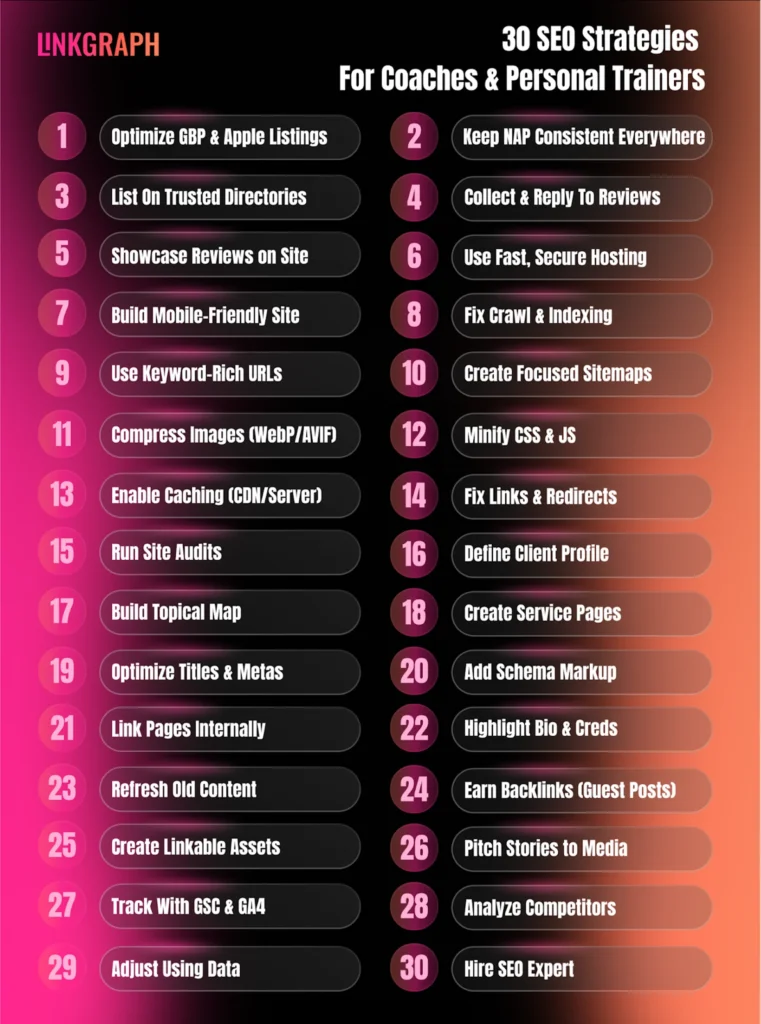
There are 30 SEO strategies for coaches. The 30 SEO strategies for coaches have been listed below.
1. Claim, Verify, and Fully Optimize Google, Bing, Yahoo, and Apple Business Listings
2. Ensure Name, Address, and Phone Are Identical Across All Listings and Directories
3. List Your Business on Trusted Local and National Directories
4. Collect Reviews on All Platforms and Respond to Them Professionally
5. Showcase Positive Reviews on Your Website
6. Choose Fast, Reliable Hosting with Uptime Guarantees
7. Build a Clean, Responsive, and Mobile-Friendly Website
8. Fix Crawlability and Indexing Issues
9. Use Short, Descriptive, Keyword-Rich URLs
10. Create Smaller, Topic-Focused XML Sitemaps
11. Compress and Convert Images to WebP or AVIF
12. Minify or Remove Unused CSS and JavaScript
13. Enable Server-Side or CDN Caching
14. Fix Broken Links, Add Redirects, and Reduce 404 Errors
15. Run Full Site Audit to Identify Technical Errors
16. Build an Ideal Client Profile (Pain Points, Goals, Search Behavior)
17. Create Proper Topical Map for Your Coaching Business
18. Build Dedicated, Optimized Pages for Each Service plus Location
19. Write Clear, Descriptive Page Titles, Meta Descriptions, and Headings
20. Add Structured Data for Services, FAQs, Videos, and Business Info
21. Link Pages Internally in a Logical Hierarchy (Root → Seed → Node)
22. Highlight Bio, Credentials, Certifications, Testimonials, Media Mentions, and Case Studies
23. Refresh Outdated Pages and Remove Thin or Low-Value Content
24. Earn Backlinks Through Guest Posts, Podcast Appearances, and Partnerships
25. Create Linkable Assets Like Checklists, Templates, and Tools
26. Pitch Newsworthy Stories or Research Data to Local and Niche Media
27. Set Up and Monitor Google Search Console and Google Analytics 4
28. Analyze Top-Ranking Competitors and SERPs for New Opportunities
29. Refine SEO Strategies Based on Performance Data and Results
30. Hire an SEO Professional When Technical Challenges Exceed Your Expertise
A clear, step-by-step approach allows coaches to build authority, attract ideal clients, and maintain lasting online visibility. We have broken down the 30 SEO strategies for coaches below.
1. Claim, Verify, And Fully Optimize Google, Bing, Yahoo, And Apple Business Listings
Claiming and verifying business listings on Google, Bing, Yahoo, and Apple Maps improves local visibility for coaches and personal trainers. These listings act as digital storefronts, ensuring that potential clients see accurate details such as address, phone number, website, and operating hours. A verified profile builds trust with both clients and search engines, making it easier to appear in the Map Pack.
Optimization requires more than filling out the basics. Coaches benefit from adding high-quality photos, selecting the most relevant service categories, writing clear service descriptions with natural keywords, and updating business hours regularly. Features such as Q&A, messaging, and posts enhance engagement and raise ranking potential. For example, a fitness coach who updates services frequently and shares short tips through the listing demonstrates reliability, making it more likely for searchers to click and inquire.
Consistency across directories is equally important. Keeping details aligned and responding to client reviews not only signals professionalism but increases the likelihood of better placement in local searches. Over time, a fully optimized and actively maintained listing generates stronger credibility, more inquiries, and steady website traffic from search engines.
2. Ensure Name, Address, And Phone Are Identical Across All Listings And Directories
Ensuring the name, address, and phone number remain identical across all business listings strengthens local visibility for coaches and personal trainers. Search engines use consistent NAP information to accurately associate a business with its location, increasing the chances of appearing in local searches and map results. Inconsistent entries, such as alternate spellings, outdated phone numbers, or mismatched addresses, reduce ranking potential and confuse potential clients.
Coaches need to audit all existing listings, identify discrepancies, and update them to match the official business information precisely. Directories, social platforms, and niche coaching sites require the same consistent information. Monitoring new listings prevents errors from propagating and affecting search performance. Verifying each listing after updates ensures the information remains accurate.
Maintaining a consistent NAP builds trust with potential clients and improves the likelihood of inquiries or appointments. Accurate listings simplify client interaction and help clients reach the coaching business without confusion. Over time, consistent NAP across multiple directories supports higher local rankings, increases website visits, and delivers a steady flow of targeted client inquiries searching for coaching services in the area.
3. List Your Business on Trusted Local And National Directories
Listing a coaching business on reputable local and national directories improves online visibility and drives potential clients to the website. Search engines interpret directory citations as signals of legitimacy and relevance. Accurate and authoritative directory listings increase the likelihood of appearing in local search results and map packs, giving coaches a competitive advantage in their niche.
Coaches need to select directories relevant to coaching services, such as business directories, industry-specific listings, and local chambers of commerce. Each listing requires consistent business information, service descriptions, and categories that match the coaching niche. Updating listings regularly and ensuring profiles include clear descriptions, images, and service offerings helps maintain accuracy and engagement.
A presence on trusted directories supports higher search rankings, reinforces credibility, and encourages prospective clients to explore coaching services. Consistent, well-maintained listings increase referral traffic and improve local search performance. Directory citations create opportunities for backlinks, further enhancing domain authority and driving long-term client acquisition for coaching businesses.
4. Collect Reviews On All Platforms And Respond To Them Professionally
Gathering reviews on multiple platforms strengthens the reputation of a coaching business and influences local search rankings. Reviews signal trustworthiness and quality to both search engines and potential clients. Positive, genuine feedback increases visibility in local searches and encourages prospects to engage with the coaching business.
Coaches need to actively request reviews from satisfied clients on platforms such as search engines, social media, and niche coaching directories. Responding promptly and professionally to both positive and negative reviews demonstrates attentiveness and credibility. Responses should address client feedback respectfully, clarify concerns, and highlight service strengths, showing prospective clients that the business values customer experience.
Maintaining a steady stream of reviews improves local SEO performance and attracts more qualified leads. High-quality reviews enhance online reputation, increase client confidence, and support better rankings in map packs and local search results. Consistent management of reviews contributes to sustained client acquisition and long-term business growth.
5. Showcase Positive Reviews On Your Website
Displaying positive reviews on a coaching website improves credibility and strengthens user trust. Reviews act as social proof, demonstrating the value and effectiveness of services to prospective clients while influencing search engine perception.
Coaches need to select genuine reviews that highlight key services, client successes, and overall satisfaction. Integrating them in strategic locations such as service pages, homepages, or dedicated testimonial sections increases visibility. Including client names, service details, and dates adds authenticity and context, enhancing the reliability of the website.
Showcasing reviews supports technical SEO by increasing engagement metrics, lowering bounce rates, and signaling trustworthiness to search engines. Structured implementation using a review schema helps search engines index these testimonials properly, improving local ranking potential. Consistently updated reviews contribute to better user experience, higher rankings, and stronger lead generation for coaching services.
6. Choose Fast, Reliable Hosting With Uptime Guarantees
Selecting fast and reliable hosting improves website performance, stability, and search engine visibility. Hosting impacts page loading speed, uptime, and accessibility, all of which influence user experience and search rankings.
Coaches need hosting that maintains high uptime and quick server response. Optimizing server performance includes minimizing unnecessary plugins, compressing files, and monitoring refresh rates around 20 percent. Reliable hosting ensures consistent availability, reducing downtime that negatively affect both clients and search engines.
High-performance hosting contributes to technical SEO by improving page speed, enhancing crawl efficiency, and supporting mobile responsiveness. Coaches gain better engagement, reduced bounce rates, and higher chances of ranking in search results, which directly leads to increased visibility and client inquiries.
7. Build Clean, Responsive, And Mobile-Friendly Website
A clean, responsive, and mobile-friendly website improves user experience, engagement, and search engine rankings. Coaches websites with clear navigation, simple layouts, and fast-loading pages allow visitors to find services and information easily.
Responsive design adapts the website to all screen sizes, from desktops to smartphones. Mobile-friendly websites are prioritized in search results, increasing visibility for clients searching on mobile devices. Optimizing images, minimizing clutter, and structuring content logically support faster load times and better interaction.
Technical SEO benefits from a well-built website as search engines index pages efficiently, and users stay longer on the site. Coaches experience improved client engagement, higher conversion potential, and increased organic visibility through a site designed for usability and performance.
8. Fix Crawlability And Indexing Issues
Crawlability and indexing issues prevent search engines from properly accessing and ranking a coaching website. Coaches need a site structure that allows bots to navigate and index pages efficiently. Reduced server response times under 100ms improves crawl speed, ensuring content loads quickly for both users and search engines. Ensuring HTML crawl requests exceed 95% and maintaining a discovery rate of 7–8% allows search engines to cover the most valuable pages.
A detailed log file analysis identifies where the crawl budget is being lost, highlighting broken links, redirect chains, or orphaned pages. Fixing these issues ensures search engines index all essential content, improving organic visibility. Other points include eliminating duplicate content, setting proper canonical tags, optimizing robots.txt, submitting XML sitemaps, removing unnecessary query parameters, correcting structured data errors, fixing slow-loading pages, and auditing internal links.
Addressing each technical issue increases site accessibility, enhances indexing, and improves rankings. Coaches experience faster visibility in search results, more accurate indexing, and higher engagement from potential clients navigating a functional and well-structured site.
9. Use Short, Descriptive, Keyword-Rich URLs
Short, descriptive, keyword-rich URLs help search engines understand page content and improve ranking potential. Coaches need URLs that clearly indicate the topic of each page. For example, a life coach offering confidence sessions uses/life-coach-confidence instead of a long, generic URL with numbers or symbols.
Clear URLs improve user experience by making links readable and memorable, which encourages clicks from search results. Each URL should include primary keywords naturally without stuffing and avoid unnecessary words or parameters. Consistency in URL structure across the website supports better crawlability and indexing.
Optimized URLs contribute to higher visibility, stronger click-through rates, and better alignment with search intent. Coaches benefit from a clean URL structure that helps both search engines and potential clients quickly understand and access the services offered.
10. Create Smaller, Topic-Focused XML Sitemaps
Smaller, topic-focused XML sitemaps improve search engine crawling and indexing for coaching websites. Each sitemap should group pages by service, location, or content type, helping search engines prioritize important pages efficiently. For example, a coaching website has separate sitemaps for life coaching, business coaching, and health coaching services.
Organizing sitemaps by topic ensures that new or updated content is discovered faster, while preventing less important pages from consuming crawl budget. Coaches need to submit these sitemaps to search engines and keep them updated whenever new pages are added.
This strategy increases the chances that high-value pages appear in search results and supports better ranking. Well-structured sitemaps enhance site visibility, improve indexing speed, and make it easier for potential clients to find relevant coaching services online.
11. Compress And Convert Images To WebP Or AVIF
Optimizing images by compressing and converting them to modern formats like WebP or AVIF reduces page load times and improves website performance. Faster websites retain visitors longer and increase the likelihood of higher search engine rankings. Websites of coaches with heavy image content, such as before-and-after transformations or service illustrations, benefit most from this approach.
Image optimization includes resizing large images, removing unnecessary metadata, and converting formats to reduce file size without losing quality. Properly compressed images improve visual clarity while keeping pages light, which enhances user experience on both desktop and mobile devices.
Implementing these practices lowers bounce rates, increases page speed scores, and helps search engines crawl more efficiently. Well-optimized images contribute to better rankings, faster browsing, and a more professional presentation of coaching services.
12. Minify Or Remove Unused CSS And JavaScript
Minifying CSS and JavaScript reduces file sizes by eliminating unnecessary spaces, comments, and characters, improving page load speed and performance. Faster websites keep visitors engaged longer and improve search engine rankings. Coaching websites with multiple interactive elements, animations, or tracking scripts benefit from careful optimization of these files.
Removing unused CSS and JavaScript prevents code bloat and ensures the website runs efficiently. Auditing the website helps identify scripts and styles that are not contributing to page functionality or appearance. Eliminating these files lowers the number of requests browsers make, reducing server load and improving responsiveness.
These optimizations enhance user experience across devices, increase speed scores, and allow search engines to crawl pages more effectively. Efficient code improves overall site performance, resulting in better rankings, quicker content delivery, and smoother navigation for clients exploring coaching services.
13. Enable Server-Side Or CDN Caching
Enabling server-side or CDN caching stores copies of web pages and static resources closer to site visitors, reducing load times and improving website performance. Faster pages increase user engagement, lower bounce rates, and positively influence search engine rankings for coaching websites.
Coaches benefit when repeated visitors access pages without reloading full content from the server. Implementing caching requires configuring the web server or a content delivery network to store frequently requested assets like images, scripts, and style sheets. Proper cache expiration rules ensure content updates appear promptly while minimizing unnecessary server requests.
This optimization reduces latency for visitors across different regions, enhances mobile and desktop experiences, and allows search engines to crawl pages more efficiently. A caching strategy ensures consistent speed and reliability, boosting site authority and client satisfaction for coaching services.
14. Fix Broken Links, Add Redirects, And Reduce 404 Errors
Broken links and 404 errors harm user experience and reduce search engine rankings for coaching websites. Search engines lower rankings when pages fail to load or internal links lead to missing content.
Coaches need to regularly scan the website for broken links, including internal links, external references, and media files. Implementing proper redirects, such as 301 redirects for moved pages, ensures visitors reach relevant content instead of encountering errors. Removing outdated or irrelevant pages prevents clutter and maintains a clean site structure.
A well-maintained link structure improves crawl efficiency, enhances user trust, and increases the likelihood of pages appearing higher in search results. Consistently resolving link issues supports long-term visibility, improves navigation, and creates a smoother experience for potential clients exploring coaching services.
15. Run Full Site Audit To Identify Technical Errors
A full site audit identifies technical issues that hinder search engine performance and user experience on coaching websites. Technical errors, such as broken links, slow-loading pages, and duplicate content, reduce rankings and limit visibility to potential clients.
Coaches need to perform a comprehensive review covering site speed, mobile responsiveness, indexing status, structured data, and security issues. Audits highlight areas requiring improvement, prioritize fixes, and ensure all pages function correctly. Regular audits reveal hidden problems, including crawl errors, redirect chains, and outdated scripts that affect search engine accessibility.
Addressing technical errors improves website performance, strengthens search engine rankings, and enhances visitor experience. A website free of technical barriers attracts more organic traffic, encourages engagement, and supports consistent client acquisition for coaching businesses.
16. Build An Ideal Client Profile (Pain Points, Goals, Search Behavior)
Creating an ideal client profile defines the specific audience a coaching business aims to reach. Understanding pain points, goals, and search behavior of clients allows coaches to tailor content that addresses real needs. An accurate profile guides messaging, service offerings, and marketing strategies.
Coaches map client profiles directly to a topical map, linking key search queries and content clusters to each segment. For instance, a life coach targeting career transition seekers creates content addressing career planning, confidence building, and goal setting. This structured topical map ensures content aligns with client intent and covers all relevant subtopics.
Integrating client profiles with a topical map improves content relevance, increases organic search visibility, and attracts qualified leads actively searching for coaching services. It ensures every page serves a purpose, making the website more navigable for users and easier for search engines to index.
17. Create Proper Topical Map For Your Coaching Business
A topical map organizes all website content around key subjects, showing the relationships between main topics and supporting subtopics. For coaching businesses, it ensures every service, blog post, or resource connects to core offerings. A proper topical map highlights areas like life coaching, health coaching, or business coaching and links related content logically.
Topical maps guide content creation by identifying gaps in coverage and prioritizing high-value topics. They improve user experience by making navigation intuitive, helping visitors find relevant services or information quickly. Structured content helps search engines understand website relevance, boosting rankings for targeted queries.
Building a topical map involves categorizing services, defining supporting pages, and linking content hierarchically. This organization ensures the website communicates authority within the coaching niche, attracts qualified leads, and maximizes organic search visibility while aligning with client search intent.
18. Build Dedicated, Optimized Pages For Each Service plus Location
Creating separate pages for each coaching service and location improves relevance for search engines and helps potential clients find precise offerings. Each page should focus on a single service, such as life coaching, business coaching, or health coaching, and highlight the specific location served. This targeted structure increases the likelihood of appearing in local search results.
Pages need optimized headings, descriptive content, and naturally integrated keywords that match search intent. Including location-specific information, testimonials, and calls to action enhances both credibility and conversion potential. Linking each service page from the main navigation and relevant blog content strengthens the internal site structure.
Optimized service pages improve visibility in local and niche searches, generate higher-quality leads, and align with the broader topical map. For example, a business coaching page targeting Chicago will appear in searches for “Chicago business coach,” attracting clients actively seeking that service.
19. Write Clear, Descriptive Page Titles, Meta Descriptions, And Headings
Crafting unique page titles, meta descriptions, and headings improves search engine understanding of coaching services and boosts click-through rates. Each page needs a title that clearly conveys the service and includes relevant keywords naturally. Meta descriptions should summarize the page content in a concise, engaging way that encourages users to visit the site.
Headings must organize content logically, helping both visitors and search engines navigate pages efficiently. Using clear, descriptive headings improves readability and signals content relevance to search engines. Avoid vague phrases and repetition to maintain clarity.
Well-structured titles, meta descriptions, and headings enhance on-page SEO, increase visibility in search results, and guide users to relevant content. For example, a “Life Coaching for Confidence in Chicago” title paired with descriptive headings ensures search engines and clients immediately understand the purpose of the page.
20. Add Structured Data For Services, FAQs, Videos, And Business Info
Adding structured data to a coaching website improves the ability to understand and display content accurately in results in search engines. Service schema highlights offerings, while FAQ schema provides quick answers to common client questions. Video schema enhances visual content visibility, and business information schema ensures details like address, hours, and contact appear correctly.
Implement structured data using markup language to tag relevant elements across pages. Coaches should include a schema for each service, FAQ, and multimedia content. This approach increases the likelihood of rich results in search listings, helping pages stand out.
Structured data enhances on-page SEO, improves search result appearance, and drives higher click-through rates. For example, a properly tagged FAQ section allows questions to appear directly in search results, making information accessible and encouraging potential clients to engage.
21. Link Pages Internally In A Logical Hierarchy (Root → Seed → Node)
Internal linking organizes a coaching website so search engines understand relationships between pages and prioritize important content. The root page acts as the main hub, seed pages cover core topics, and node pages provide supporting details. Proper linking guides visitors through the website, improves navigation, and distributes authority to high-value pages.
Coaches should connect relevant pages using descriptive anchor text that matches the topic of the target page. Organize links from the homepage to main service pages, then to supporting content like blog posts or resources. This hierarchy ensures search engines crawl efficiently and index pages accurately.
Logical internal linking enhances on-page SEO, helps search engines rank key pages higher, and improves user experience. For instance, linking a service page to related blog posts increases engagement and signals expertise in that area.
22. Highlight Bio, Credentials, Certifications, Testimonials, Media Mentions, And Case Studies
Showcasing the qualifications of a coach and achievements builds credibility and trust with potential clients. Bios, certifications, and professional accolades demonstrate expertise, while testimonials, media mentions, and case studies provide proof of successful outcomes and satisfied clients.
Coaches need to place these elements prominently on service pages, homepage sections, and dedicated bio pages. Include clear images, concise descriptions, and links to certifications or media features. Featuring client success stories and detailed case studies strengthens the perceived authority of the coaching business.
Highlighting professional and client validation improves user confidence, encourages engagement, and enhances conversion rates. Search engines recognize rich, authoritative content, which contributes to higher rankings and better visibility for key service pages.
23. Refresh Outdated Pages And Remove Thin Or Low-Value Content
Updating old pages improves relevance for both users and search engines. Content that is outdated, inaccurate, or thin reduces credibility and lowers engagement metrics, which affect rankings.
Coaches need to review website pages regularly, updating information, statistics, and service details. Remove low-value pages that do not attract traffic or provide meaningful information. Consolidating similar pages improves content depth and user experience.
Refreshing content keeps the website current, strengthens topical authority, and encourages repeat visits. Search engines reward websites that maintain accurate, comprehensive, and well-structured content, leading to better visibility and higher rankings in search results.
24. Earn Backlinks Through Guest Posts, Podcast Appearances, And Partnerships
Acquiring backlinks from reputable sources improves domain authority and boosts search engine rankings. High-quality backlinks signal trustworthiness to search engines and drive referral traffic from relevant audiences.
Coaches write guest articles for authoritative websites, appear on podcasts in their niche, and collaborate with complementary businesses or influencers. Each backlink should come from sites with strong relevance to coaching, health, business, or personal development. Tracking the source and quality of links ensures sustained off-page SEO benefits.
Strategic backlink building increases visibility, attracts potential clients, and strengthens brand authority. A consistent approach to earning credible links supports long-term search performance and reinforces the online reputation of a coaching business.
25. Create Linkable Assets Like Checklists, Templates, And Tools
Creating valuable resources such as checklists, templates, and interactive tools attracts attention from other websites and professionals. These assets serve as references that others link to, increasing domain authority and driving targeted traffic.
Coaches design downloadable guides, planning worksheets, or calculators tailored to their niche. For example, a life coach might offer a goal-setting template, while a business coach provides a productivity checklist. Promoting these assets through social channels, newsletters, and partnerships encourages organic backlinking.
Well-crafted linkable assets improve search engine rankings, generate referral traffic, and position the coaching business as an authority in the field. Over time, these resources create a sustainable stream of links and enhance online visibility.
26. Pitch Newsworthy Stories Or Research Data To Local And Niche Media
Sharing newsworthy updates or original research with local and niche media builds authority and attracts backlinks. Media outlets referencing these stories increase website visibility and drive targeted traffic.
Coaches highlight client success stories, publish survey results, or share unique insights relevant to their niche. Sending press releases or personalized pitches to local newspapers, online publications, and industry blogs ensures that the content reaches the right audience.
Consistent media coverage strengthens credibility, enhances brand recognition, and supports search engine rankings. Over time, these mentions create high-quality backlinks, expanding the online presence of a coaching business and reinforcing trust with potential clients.
27. Set Up And Monitor Google Search Console And Google Analytics 4
Setting up and monitoring Google Search Console and Google Analytics 4 provides precise insights into website performance and user behavior. These platforms track traffic sources, page engagement, and technical issues that affect search rankings.
Coaches need to verify their website, submit sitemaps, and monitor crawl errors in Search Console. Analytics 4 tracks user sessions, conversions, and on-site behavior, offering data to refine content and marketing strategies. Regular monitoring identifies underperforming pages, high-exit points, and opportunities to optimize for target keywords.
Using the data effectively helps improve SEO efforts, enhance user experience, and increase lead generation. Over time, consistent tracking supports informed decisions, stronger search visibility, and sustainable growth for coaching businesses.
28. Analyze Top-Ranking Competitors And SERPs For New Opportunities
Analyzing top-ranking competitors and search engine results pages reveals strategies that drive traffic and conversions in a coaching niche. Competitor insights show which keywords attract clients, which content formats perform well, and which backlink sources strengthen authority.
Coaches need to examine competitor service pages, blog content, meta elements, and internal linking to identify gaps or opportunities. Reviewing SERPs highlights search intent trends, featured snippet possibilities, and local pack placements, guiding content creation and optimization priorities.
Applying these insights helps improve rankings, refine messaging, and attract more qualified leads. Understanding competitors and SERPs ensures the SEO strategy remains data-driven, targeted, and effective over time.
29. Refine SEO Strategies Based On Performance Data And Results
Refining SEO strategies using performance data ensures continuous improvement in visibility and client acquisition for coaching businesses. Tracking metrics like organic traffic, keyword rankings, click-through rates, and user behavior highlights which strategies drive results and which areas need adjustment.
Coaches need to analyze this data regularly to prioritize high-performing pages, update underperforming content, and adjust targeting. Comparing results against previous periods helps identify trends, evaluate content effectiveness, and optimize technical or on-page elements.
Data-driven refinements enhance search rankings, improve user engagement, and increase lead generation. Consistently evaluating and adjusting strategies ensures long-term growth, sustained online presence, and steady acquisition of clients actively searching for coaching services.
30. Hire An SEO Professional When Technical Challenges Exceed Your Expertise
Hiring an SEO professional becomes necessary when technical or strategic challenges surpass the in-house expertise of a coaching business. SEO professionals bring specialized knowledge in areas like technical SEO, local optimization, structured data, link building, and analytics.
Coaches facing persistent ranking issues, complex website errors, or stagnant traffic need expert intervention to implement advanced strategies correctly. Professionals evaluate current performance, identify gaps, and execute improvements efficiently, avoiding common mistakes that harm search visibility.
Engaging an experienced SEO expert enhances website performance, increases organic traffic, and drives consistent client acquisition. It ensures that optimization efforts follow best practices, yield measurable results, and sustain long-term growth for the coaching business.
Can One SEO Method Work for All Types of Coaches?
No, each coaching niche, such as life, business, health, or mindset, has unique client needs and search behaviors. Therefore, SEO strategies must be tailored to align with the specific services offered and the search intent of a target audience. A generic SEO approach does not effectively address the nuances of each niche.
Is SEO for Life Coaches Similar to SEO for Personal Coaches?
Yes, SEO strategies for life coaches and personal coaches share similarities, as both focus on personal development and self-improvement. However, the specific keywords, content topics, and client personas differ slightly. Tailoring SEO efforts to the unique aspects of each coaching style ensures better alignment with the search queries of potential clients.
Is SEO for Mindset Coaches Similar to SEO for Business Coaches?
While both mindset and business coaches aim to enhance the performance of clients, their SEO strategies differ. Mindset coaches often target emotional and psychological transformation, requiring SEO content that addresses personal growth and mental well-being. In contrast, business coaches focus on professional development, necessitating SEO content centered around career advancement, leadership, and organizational skills.
Is SEO for Health Coaches Similar to SEO for Wealth Coaches?
SEO for health coaches and wealth coaches involves distinct approaches due to the different focuses of each niche. Health coaches emphasize physical well-being, nutrition, and fitness, requiring SEO content that addresses these topics. Wealth coaches, on the other hand, concentrate on financial education, investment strategies, and wealth management, necessitating SEO content tailored to financial topics.
When Is the Best Time for Coaches to Get Started with SEO?
The optimal time for coaches to begin SEO is as soon as they establish their online presence. Implementing SEO from the outset ensures that the website is structured to attract search engine traffic and meet the needs of potential clients. Even if a website is already live, initiating SEO efforts promptly leads to improved visibility and client acquisition over time.
How Long Does It Take for SEO to Start Working for Coaching Businesses?
SEO results for coaching businesses typically begin to manifest within 4 to 6 months. However, achieving significant and sustained results takes 6 to 12 months, depending on factors like website age, competition, and the effectiveness of the SEO strategy implemented. Patience and consistent effort are key to long-term SEO success.
Is GMB Profile Optimization Enough for Coaches to Get Consistent Clients?
No, optimizing a GMB, now known as GBP, alone does not guarantee a steady flow of clients for coaches. GMB optimization improves local visibility and helps appear in map pack results, but it addresses only one part of the overall online presence. A coaching business needs a fully optimized website, high-quality content targeting niche-specific keywords, internal linking, structured data, and consistent online reviews to capture and convert leads effectively.
Relying solely on GMB limits exposure to potential clients searching outside local packs and reduces opportunities to rank for broader search queries. Integrating website SEO, content strategy, and local listings ensures consistent client acquisition and sustainable growth.
Which Online Directories Are Most Valuable for Coaches to Be Listed In?
Listing your coaching practice in reputable online directories enhances visibility, builds credibility, and connects you with potential clients actively seeking coaching services. Some of the most valuable directories for coaches have been listed below.
1. Noomii: Noomii is a leading directory for professional coaches, offering a platform where clients find coaches based on specialization and location. It provides features like client reviews and a matching service to connect clients with suitable coaches. Noomii is recognized for its extensive reach and user-friendly interface.
2. Life Coach Spotter: Life Coach Spotter is a free directory that matches clients with coaches through a personalized questionnaire. Coaches listed here benefit from increased exposure to clients seeking specific coaching services. The platform emphasizes personalized connections, enhancing the likelihood of client engagement.
3. WiseHead: WiseHead is a niche directory focusing on holistic and wellness coaching. It caters to clients looking for coaches specializing in personal development, mindfulness, and well-being. Being listed here attracts clients aligned with these specific coaching areas.
4. My Coach Match: My Coach Match offers a personalized coach-matching service, allowing clients to find coaches that best fit their needs. Coaches benefit from the customized approach of an agency, which enhances the chances of connecting with suitable clients.
5. Erickson Coach Directory: The Erickson Coach Directory is associated with Erickson Coaching International, a well-known coaching school. Being listed here adds credibility, especially for coaches trained under Erickson’s methodologies. It connects coaches with clients seeking specific coaching approaches.
6. Bark: Bark is a platform that connects professionals with clients across various industries, including coaching. Coaches create profiles and respond to client requests, potentially leading to new client engagements. The broad reach of a platform is advantageous for coaches looking to expand their client base.
7. The Life Coach School Directory: This directory is exclusive to graduates of The Life Coach School, offering a community of certified coaches. Being listed here enhances credibility among clients familiar with the methodologies of the school and attracts those seeking coaches with this specific certification.
8. Life Coach Hub: Life Coach Hub offers a comprehensive directory with customizable listings, allowing coaches to showcase their services, certifications, and client testimonials.
The directories listed above are based on available information and offer different features and benefits. It’s advisable to explore each platform to determine which aligns best with your coaching practice and target audience.
Is It Possible for Coaches or Coaching Business Owners to Implement SEO Strategies on Their Own?
Yes, coaches and coaching business owners implement SEO independently. Learning keyword research, on-page optimization, content creation, mobile optimization, and local SEO allows them to improve visibility and attract clients. Structured approaches, such as creating high-quality content and optimizing pages for target keywords, lead to steady traffic. While implementing SEO independently requires time and consistency, many coaches have successfully grown their online presence without external help, achieving measurable results and client acquisition.
What Should I Check Before Hiring an SEO Agency for My Coaching Business?
Finding the right SEO agency makes a huge difference for your coaching business. The right partner will help increase your visibility online, attract more clients, and grow your brand. On the other hand, choosing the wrong agency wastes time, money, and energy. The factors to check before hiring an SEO agency for coaching businesses are listed below.
1. Define Your SEO Goals Clearly: Before reaching out to agencies, it’s important to know exactly what you want to achieve. Whether your focus is attracting more coaching clients, increasing newsletter sign-ups, or improving the search engine rankings of a website, having clearly defined goals allows an agency to create a tailored strategy that aligns with your business objectives.
2. Check Their Experience with Coaching Businesses: Not all SEO agencies have the same level of experience, and it matters which industries they specialize in. Look for agencies that have a proven track record working with coaching or service-based businesses. They should understand the nuances of your audience and the type of content that engages potential clients. Reviewing their portfolio and past case studies is a great way to gauge whether they have the expertise to handle your specific needs.
3. Understand Their SEO Strategy: A reputable SEO agency should be able to clearly explain its approach. This includes how they conduct keyword research, optimize on-page elements, create and market content, build links, and handle technical SEO. It’s essential to ensure their methods are ethical, effective, and aligned with your business goals. Avoid agencies that rely on shortcuts or black-hat tactics, as these hurt the long-term performance of a website.
4. Assess Communication and Reporting: Communication is key to any successful partnership. Your SEO agency should provide regular updates on progress, offer clear metrics and KPIs to measure results, and respond promptly to your questions. Transparent reporting helps track ROI and ensure that coaches understand how agency efforts are contributing to their business growth.
5. Watch Out for Red Flags: Certain warning signs indicate that an SEO agency is not trustworthy. Be cautious of agencies that guarantee specific rankings or traffic increases, use outdated or unethical tactics, or are unclear about their processes. Choosing an agency with these red flags will harm your website and the brand reputation rather than helping it grow.
6. Review Client Testimonials and Case Studies: Client feedback and detailed case studies provide insight into the effectiveness of an agency. Look for success stories involving businesses similar to yours, measurable results they have achieved, and evidence of long-term client relationships. This will give you confidence that the agency has the skills and experience to deliver meaningful results for your coaching business.
7. Align on Budget and Expectations: Discussing the budget upfront is important. A professional agency should provide a clear breakdown of costs, outline realistic timelines for achieving results, and offer scalable strategies as your business grows. Ensuring that your investment aligns with your business goals and expected return helps prevent misunderstandings and sets the foundation for a productive partnership.
8. Ensure They Understand Your Target Audience: The most effective SEO strategies are built around a deep understanding of your target audience. The agency should be familiar with the demographics, interests, behaviors, and pain points of ideal clients. An SEO strategy customized to the audience attracts the right clients genuinely interested in coaching services.
Hiring the right SEO agency is a pivotal decision for your coaching business. By carefully evaluating their goals, experience, strategies, communication, reputation, budget, and understanding of your audience, coaches choose a partner who will help you grow your online presence and reach more potential clients. A well-planned, customized SEO approach set the foundation for long-term success and meaningful business growth.
Who Offers the Best SEO Services for Coaches Near Me?
LinkGraph stands out as a premier SEO provider for coaches and personal trainers. Their tailored SEO strategies encompass technical audits, content optimization, and authoritative link-building, all designed to enhance online visibility and client acquisition. With a track record of success across various industries, including healthcare and legal services, LinkGraph demonstrates expertise in crafting SEO campaigns that drive measurable results.
Their innovative tools, such as the SEO AI Writer and performance dashboards, empower businesses to monitor and optimize their SEO efforts effectively. Trusted by over 3,200 companies, LinkGraph’s commitment to delivering sustainable growth makes it a top choice for coaches seeking to elevate their online presence.
Which Types of SEO Services Does LinkGraph Offer for Coaches and Personal Trainers?
LinkGraph delivers SEO services for coaches and personal trainers. Each service improves visibility, attracts targeted clients, and drives business growth. The types of SEO services offered by LinkGraph to coaches and personal trainers are listed below.
- Holistic SEO: LinkGraph combines on-page, off-page, and technical SEO to improve overall website performance. Holistic SEO boosts rankings, traffic, and search engine visibility. LinkGraph ensures every website element contributes to search success.
- Local SEO: LinkGraph optimizes websites to rank higher in local searches. Local SEO increases visibility among nearby clients actively seeking services. LinkGraph enhances content, listings, and citations for a stronger local presence.
- Technical SEO: LinkGraph improves site speed, mobile performance, and crawlability to support search rankings. Technical SEO fixes indexing and structural issues that reduce website performance. LinkGraph applies technical strategies to strengthen website reliability and user experience.
- On-Page SEO: LinkGraph optimizes pages using keywords, meta tags, headings, and structured content. On-page SEO improves page relevance for search engines and user engagement. LinkGraph enhances content to attract more targeted traffic effectively.
- Off-Page SEO / Link Building: LinkGraph acquires backlinks from authoritative websites to improve domain authority. Off-page SEO increases credibility and strengthens search engine rankings. LinkGraph develops strategies to secure high-quality links relevant to coaching and personal training.
- Local Map Pack Optimization: LinkGraph improves business listings and local content to appear in map-based search results. Local Map Pack optimization increases visibility for nearby clients. LinkGraph adjusts maps, citations, and local signals for maximum exposure.
- Semantic SEO: LinkGraph creates content aligned with searcher intent and context. Semantic SEO improves relevance and engagement for target audiences. LinkGraph structures content to match user queries and search expectations.
- Content Creation: LinkGraph produces high-quality, SEO-friendly content for websites, blogs, and landing pages. Content creation attracts visitors and converts them into clients. LinkGraph tailors content to coaching and personal training audiences.
- LLM and AI Overview Optimization: LinkGraph optimizes content for AI-driven search results and large language models. AI overview optimization improves visibility in emerging search environments. LinkGraph adapts existing content to align with AI algorithms.
- Structured Data and Schema Markup Integration: LinkGraph adds schema markup to improve search engine understanding. Structured data enhances visibility in rich search results. LinkGraph ensures all relevant pages include accurate schema elements.
- Lead Tracking and Reporting: LinkGraph monitors leads generated from SEO strategies. Lead tracking and reporting measure results and inform decisions. LinkGraph uses data to adjust strategies for maximum impact.
- Marketing Planning Strategy: LinkGraph develops marketing plans integrating SEO, content, and business goals. Marketing planning strategy guides all digital campaigns effectively. LinkGraph prioritizes tactics based on client objectives and results.
- Branding: LinkGraph strengthens brand identity and messaging for coaches and personal trainers. Branding differentiates businesses in competitive markets. LinkGraph aligns brand elements with audience expectations.
- Creative Services: LinkGraph produces visual, multimedia, and design assets for websites and campaigns. Creative services improve engagement and support SEO efforts. LinkGraph ensures materials reflect brand identity consistently.
LinkGraph’s full range of SEO services helps coaches and personal trainers grow online. Each service strengthens visibility, attracts relevant clients, and supports business growth. Combining these strategies creates measurable results and long-term digital success.
Can All Types of Coaches and Personal Trainers Get SEO Services from LinkGraph?
LinkGraph offers SEO services to every type of coach and personal trainer. LinkGraph customizes strategies to match the unique goals and audiences of each coaching business. These services improve online visibility, attract targeted clients, and support business growth.
The main categories of coaches and trainers served by LinkGraph are listed below.
- Personal Trainers
- Strength and Conditioning Coaches
- Fitness and Health Coaches
- Sports-Specific Coaches
- Lifestyle Coaches
- Mindset, Motivation, and Performance Coaches
- Special Population Coaches
LinkGraph adapts strategies to match the target audience, goals, and specialization of every coach. These SEO services make businesses discoverable, credible, and competitive in the online market.
How Much Does LinkGraph Charge for Coaching SEO Services?
LinkGraph pricing for coaching SEO services varies based on service scope, website size, and target goals. Packages include holistic SEO, local optimization, content creation, and link building. Pricing adjusts depending on coaching specialization and audience reach requirements. Businesses receive a customized proposal after an initial consultation.
LinkGraph ensures strategies align with client budgets while maximizing ROI. Transparent pricing outlines monthly fees, deliverables, and expected timelines. Coaching businesses select packages tailored to growth objectives, geographic focus, and content needs. Every proposal specifies services, reporting frequency, and measurable outcomes.
Does LinkGraph Only Offer SEO Marketing Services for Coaches?
No, LinkGraph serves more than just coaching businesses. LinkGraph provides SEO and digital marketing to personal trainers, fitness studios, health professionals, and service-based industries. Clients in other niches access technical SEO, content strategies, and link-building services. Coaching businesses are one specialization among many industries served by LinkGraph.
What Other Industries Can Get SEO Services from LinkGraph?
LinkGraph offers customized SEO services to various industries. Each sector benefits from strategies designed to enhance online visibility, attract targeted audiences, and drive business growth. Other industries that get SEO services from LinkGraph are listed below.
- Healthcare Providers: LinkGraph helps medical professionals, clinics, and hospitals improve local search rankings and patient acquisition.
- E-commerce Businesses: LinkGraph supports online retailers in optimizing product pages and increasing organic traffic to boost sales.
- Legal Services: LinkGraph assists law firms in enhancing their online presence to attract potential clients seeking legal assistance.
- Real Estate Agencies: LinkGraph aids real estate professionals in improving local SEO to connect with prospective buyers and sellers.
- SaaS Companies: LinkGraph works with software-as-a-service providers to enhance online visibility and customer acquisition.
- Startups: LinkGraph supports startups in establishing a strong online presence to compete in their respective markets.
- Small Businesses: LinkGraph helps small enterprises improve local SEO to attract nearby customers and grow their businesses.
- Educational Institutions: LinkGraph assists schools, colleges, and online courses in enhancing their online visibility to attract students.
- Financial Services: LinkGraph supports financial advisors and institutions in improving their online presence to reach potential clients.
- Hospitality Industry: LinkGraph helps hotels and travel services enhance their online visibility to attract tourists and guests.
Each industry receives a customized SEO strategy to meet its unique challenges and goals.
What Are Other Ways to Market Coaching Services Besides SEO?
Coaching services benefit from multiple marketing methods beyond SEO. Each approach reaches target audiences, generates leads, and supports business growth. Other ways to market coaching services besides SEO are listed below.
- PPC Advertising: Pay-per-click campaigns deliver instant visibility on search engines. Coaches reach clients actively searching for services. PPC campaigns target specific locations, demographics, and keywords to maximize results.
- Social Media Marketing: Social media platforms promote coaching services and showcase client success stories. Platforms like Instagram, Facebook, and LinkedIn connect with relevant audiences. Social media increases engagement, awareness, and program sign-ups.
- Email Marketing: Email marketing maintains communication with existing clients and nurtures new leads. Newsletters and automated sequences share tips, promotions, and updates. This strategy builds trust and loyalty over time.
- Content Marketing: Blog posts, videos, and podcasts establish coaching expertise. Content marketing attracts audiences searching for guidance, tips, or inspiration. High-quality content strengthens credibility and encourages conversions.
- Webinars and Online Workshops: Live or recorded sessions introduce coaching services and demonstrate expertise. Webinars attract interested participants and encourage enrollment in programs. They provide value while promoting services effectively.
- Referral Programs: Encouraging current clients to refer others expands the client base organically. Referral incentives motivate satisfied clients to share services. Word-of-mouth marketing leverages trust and social proof.
- Partnerships and Collaborations: Collaborating with complementary businesses or influencers expands reach. Partnerships allow coaches to access new audiences interested in fitness, wellness, or personal development.
These methods complement SEO or operate independently to generate leads, grow audience engagement, and increase coaching program enrollment.
Is SEO More Effective Than PPC for Promoting Coaching Services?
SEO and PPC both drive results for coaching services. SEO builds long-term visibility and credibility while generating sustained leads. PPC delivers immediate traffic through targeted campaigns and attracts clients quickly. Combining SEO and PPC amplifies results and reaches wider audiences. Effectiveness depends on goals, budget, and audience targeting.
