
SEO for dermatologists is the process of optimizing the online presence of a dermatology practice to improve visibility in search engines and attract more patients. Local SEO for dermatologists ensures the practice appears in relevant local searches, increasing patient acquisition for nearby services. Dermatology practice search engine optimization involves on-page improvements, technical optimizations, content creation, and off-page strategies to position the practice as a trusted authority in skin care.
Effective SEO services for dermatologists deliver measurable growth, improve patient engagement, and drive qualified traffic to the website. A strong strategy combines optimized Google Business profiles, targeted content, structured data, and backlink acquisition to maximize results. Selecting the best SEO agency for dermatologists guarantees expert implementation, consistent monitoring, and strategic adjustments customized to the goals of a dermatology practice, helping them achieve sustainable growth and a competitive edge.
This approach aligns online presence with patient intent, strengthens brand credibility, and ensures the dermatology practice consistently reaches the right audience while maximizing return on marketing investment.

What Is Dermatology?
Dermatology is a medical specialty focused on diagnosing, treating, and preventing conditions of skin, hair, and nails. Dermatology addresses issues such as acne, eczema, psoriasis, infections, pigment disorders, and skin cancers. Dermatology extends to cosmetic concerns, including wrinkles, scars, and signs of aging.
Dermatologists practice dermatology through medical, surgical, and cosmetic procedures. Dermatologists perform biopsies, laser treatments, cryotherapy, and allergy testing to manage diverse conditions. Dermatologists provide both restorative and preventive care to maintain healthy skin and detect serious issues early.
The skin is the largest organ of the human body and serves as a protective barrier against external threats. Healthy skin directly supports overall health and well-being. Skin disorders affect confidence, comfort, and quality of life, so dermatology holds an important place in healthcare.
What Is SEO for Dermatologists?
SEO (Search Engine Optimization) for dermatologists is a digital marketing strategy that increases visibility for dermatology practices on search engines. SEO for dermatologists focuses on improving rankings on platforms like Google so potential patients find skin care services more easily. SEO for dermatologists attracts qualified leads by enhancing online presence and building local trust.
Keyword research in dermatology SEO identifies search terms used by patients, such as “skin cancer screening in [City].” On-page optimization uses those keywords in headers, titles, and internal links to strengthen page relevance. Local SEO improves visibility by optimizing Google Business Profiles, building citations, and collecting positive patient reviews.
Content creation in dermatology SEO provides informative answers to patient questions and establishes practice expertise. Technical health ensures that websites are mobile-friendly, fast-loading, and accessible to search engines for crawling and indexing. SEO for dermatologists works as a comprehensive approach that combines content, local visibility, and technical strength to attract new patients consistently.
Is SEO Important for Dermatology Practices?
Yes, SEO is important for dermatology practices because it increases online visibility and attracts more patients. Dermatology practices benefit from SEO by ranking higher in search results for relevant services and locations. Strong rankings drive qualified traffic, which leads to more appointment bookings.
Local SEO connects dermatology practices with patients in their geographic area who actively search for care. Targeted visibility ensures that the practice reaches the right audience and gains relevant leads.
High rankings signal credibility and authority in dermatology. This trust, combined with cost-effective results, gives practices an advantage in a competitive market while sustaining long-term patient acquisition.
What Is the Difference Between a Dermatologist and a Cosmetic Dermatologist?
A dermatologist is a medical doctor who diagnoses, treats, and prevents conditions affecting skin, hair, and nails. A cosmetic dermatologist is a dermatologist who specializes in elective treatments designed to enhance appearance. The difference lies in their primary focus.
Medical dermatologists treat conditions such as acne, eczema, psoriasis, and skin cancer. They perform procedures like biopsies, screenings, and medical treatments for skin diseases. Their training includes medical school, residency, and board certification.
Cosmetic dermatologists focus on improving skin tone, reducing wrinkles, and removing blemishes. They perform procedures like Botox, fillers, chemical peels, and laser resurfacing. Their medical training matches that of dermatologists, but they gain further expertise in aesthetic care.
Some overlap exists because dermatologists do provide cosmetic treatments. Patients visit medical dermatologists for health-related concerns and cosmetic dermatologists for appearance-focused improvements.
What Are the Key Advantages of SEO for Dermatologists?
SEO for dermatologists is more than a technical strategy. SEO for dermatologists helps practices connect with patients actively seeking skin care services. Appearing at the top of search results builds trust, attracts new patients, and boosts the reputation of the dermatologist. With consistent SEO efforts, dermatology practices increase visibility, generate qualified leads, and create long-term growth while establishing themselves as trusted authorities in their field. The key advantages of SEO for dermatologists have been listed below.
1. Drive organic website traffic: SEO allows dermatology practices to appear in search results where potential patients are looking, generating consistent organic visits without paid ads.
2. Increase online visibility: Strong rankings ensure that a practice shows up for relevant searches, keeping the dermatology brand visible to local patients.
3. Build brand presence: Search optimization helps practices establish trust and authority online, shaping a stronger reputation over time.
4. Attract more patients: Optimized websites and local SEO strategies bring in patients actively seeking dermatology services in their area.
5. Boost practice profits: More targeted patient leads translate into higher appointment bookings and increased revenue for dermatology practices.
6. Target relevant users: Keyword optimization ensures that the practice connects with people searching for services that match its offerings.
7. Generate qualified leads: High-quality SEO strategies bring patients who are more likely to convert into appointments.
8. Generate long-term growth: Unlike short-term ads, SEO builds sustainable visibility that continues to deliver results over time.
These advantages make SEO essential for dermatology practices. It drives targeted traffic, boosts local visibility, strengthens brand presence, and generates qualified leads for long-term growth.
How Can Dermatologists Get Started with SEO?
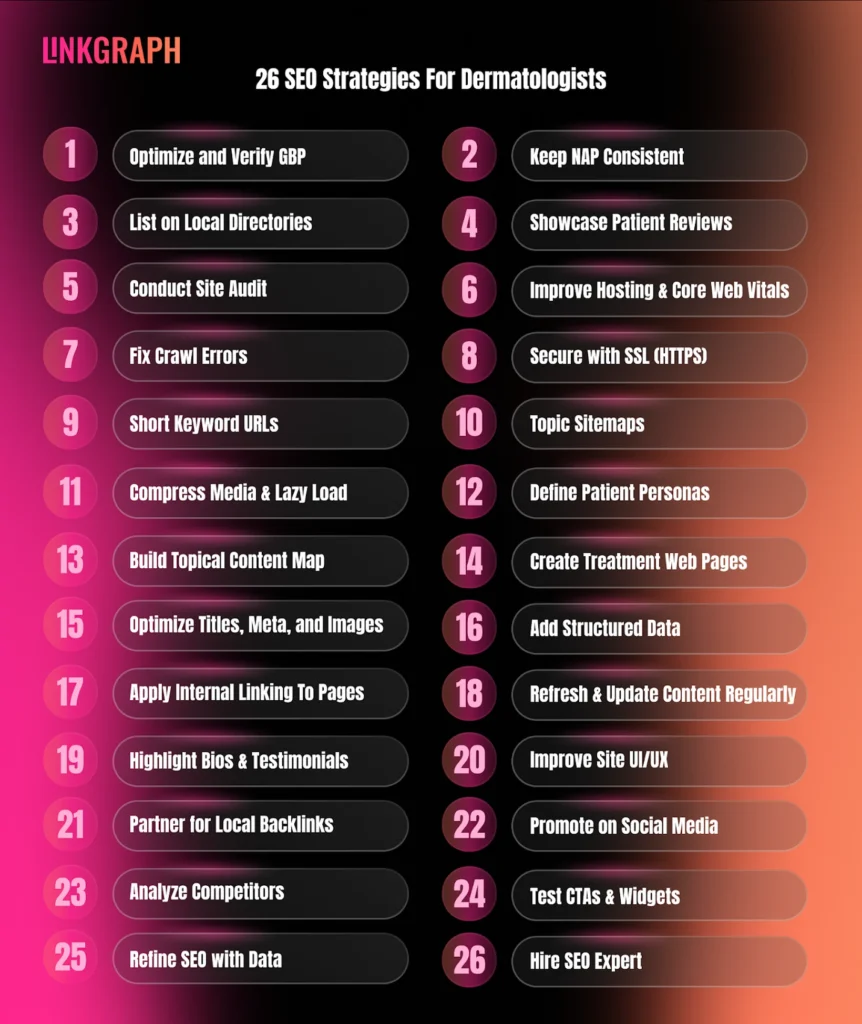
The best way for dermatologists to get started with SEO is to build a strong foundation. Begin with the website, optimize local presence, and ensure accurate listings to attract more patients. Each step strengthens visibility, improves patient trust, and drives qualified traffic. There are 26 steps to get started with SEO for dermatologists. The 26 steps for dermatologists to get started with SEO are listed below.
- Set Up, Verify And Optimize Your Google Business Profile
- Keep NAP (Name-Address-Phone) Consistent Everywhere
- List Your Practice On Trusted Local and National Healthcare Directories
- Collect Patient Reviews, Respond Politely, And Showcase Them Onsite
- Run Full Site Audit And Fix Technical Errors
- Upgrade Hosting, Remove Plugins And Optimize Core Web Vitals
- Resolve Crawl Errors, Broken Links, And Canonical Issues
- Secure Site With An SSL Certificate (HTTPS)
- Use Short, Descriptive, Keyword-Rich URLs
- Create Smaller, Topic-Specific XML Sitemaps
- Compress Media Files And Enable Lazy Loading
- Define Your Ideal Patient Personas And Target Audience
- Construct Proper Topical Map For Your Dermatology Practice
- Create Dedicated Pages For Each Treatment Offered
- Write Unique, Descriptive Page Titles, Meta Descriptions, And Headings
- Add Structured Data (Schema) For Practice, Services, FAQs, And Videos
- Link Pages Internally In A Root → Seed → Node Hierarchy
- Refresh, Update, And Prune Existing Content To Keep It Fresh
- Highlight Doctor Bios, Credentials, Awards, And Testimonials
- Simplify Design And Improve Site Navigation
- Earn Backlinks From Respected Medical Sites, Journals, And News Outlets
- Share Visual, Helpful Content On Facebook, Instagram, And Other Social Platforms
- Analyze Top-Ranking Competitors And SERPs For New Opportunities
- Test Different CTAs And Appointment Widgets To Increase Bookings
- Continuously Refine Your SEO Strategy Based On Data
- Hire A Professional SEO Expert When Necessary
Implementing these SEO steps creates a solid foundation for long-term growth, higher search rankings, and consistent patient acquisition. Following the list helps dermatology practices increase visibility, attract new patients, and maintain authority in their local market. We have broken down the 26 steps for dermatologists to get started with SEO below.
1. Set Up, Verify And Optimize Your Google Business Profile
Setting up, verifying, and optimizing a Google Business Profile is a foundational step for dermatologists aiming to improve local visibility. A fully completed profile ensures the practice appears in Google Maps and local search results, helping attract patients actively searching for dermatology services. Key details such as practice name, address, phone number, hours, and website must be accurate and consistent across all listings to enhance credibility and trust with both patients and search engines.
Optimizing a Google Business Profile involves adding high-quality photos, posting regular updates, selecting appropriate categories, and crafting a compelling description that highlights services and specialties. Including patient-friendly details like appointment options or accepted insurance makes the profile more useful and engaging. Actionable steps such as responding to patient questions, highlighting popular treatments, and maintaining up-to-date business hours enhance the authority of the profile and directly influence placement in the local map pack.
The impact of a well-optimized profile extends to increased local rankings, higher click-through rates, and more appointment requests. Using local analytics tools to monitor traffic sources and patient interactions allows dermatologists to refine the profile continuously. Practices that maintain consistent engagement and optimization typically experience sustained visibility, stronger patient trust, and measurable growth in new patient acquisition.
2. Keep NAP (Name-Address-Phone) Consistent Everywhere
Maintaining consistent Name, Address, and Phone information across all online platforms is essential for dermatologists seeking strong local search performance. Search engines rely on accurate and uniform data to verify legitimacy and rank practices in local results. Inconsistencies between the website, Google Business Profile, directories, and social media confuse search engines and reduce visibility, causing missed opportunities for new patient acquisition.
Dermatology practices should audit all listings and ensure that the practice name matches branding, addresses are formatted identically, and phone numbers use the same format everywhere. Listing on trusted local and national healthcare directories reinforces authority, while updating any outdated information promptly avoids potential confusion. Internal website pages, footer details, and contact forms must mirror this information precisely.
Consistent NAP data improves trust signals with search engines, increasing the likelihood of appearing in the local map pack and local search results. Practices that maintain uniformity experience higher click-through rates from local searches and generate more qualified patient inquiries. Regular monitoring of citations and directory listings ensures that new inconsistencies are identified and corrected, supporting steady growth in patient acquisition and local presence.
3. List Your Practice On Trusted Local and National Healthcare Directories
Listing a dermatology practice on reputable local and national healthcare directories boosts online visibility and signals credibility to search engines. Complete and accurate listings make it easier for potential patients to find the practice while confirming legitimacy and location, which strengthens local SEO.
Business profiles must include a detailed description of services, professional credentials, up-to-date contact information, and high-quality images. Consistent information across directories and Google Business Profile reinforces trust signals with search engines and increases chances of ranking higher in local search results.
Optimized directory listings attract patients actively searching for dermatology services. Regular audits uncover outdated or incorrect information, allowing immediate corrections. A strong presence across multiple trusted directories drives referral traffic, enhances online authority, and sustains long-term patient growth.
4. Collect Patient Reviews, Respond Politely, And Showcase Them Onsite
Patient reviews act as social proof that builds trust and credibility for a dermatology practice. Positive feedback highlights expertise, service quality, and patient satisfaction, while addressing concerns professionally demonstrates accountability. Both elements influence search engine rankings and help attract new patients.
Encourage patients to leave reviews after visits, ensuring reminders are polite and unobtrusive. Respond to all reviews promptly, thanking positive reviewers and addressing concerns in a constructive manner. Showcasing reviews on the website reinforces trust, boosts user engagement, and improves the local SEO performance of the site.
Regularly monitoring reviews allows early identification of recurring issues, providing opportunities to refine the patient experience. High-quality reviews across multiple platforms increase visibility in local search results, support decision-making for prospective patients, and improve the reputation of the practice online.
5. Run Full Site Audit And Fix Technical Errors
A full website audit identifies issues that hinder search engine crawling, indexing, and user experience. Technical errors such as broken links, slow page speed, or missing meta tags prevent dermatology practices from ranking higher and reduce conversion potential.
Analyzing the site with technical SEO tools allows identification of errors, duplicate content, and accessibility issues. Fixing broken links, updating outdated plugins, optimizing images, and correcting meta information improve site structure and usability. Ensuring proper canonicalization and sitemap setup guides search engines effectively through the webpages.
Regular audits maintain website health, prevent ranking drops, and enhance patient experience. A technically optimized site loads faster, performs reliably on mobile devices, and encourages visitors to explore treatment pages, ultimately increasing appointment bookings and organic traffic.
6. Upgrade Hosting, Remove Plugins, and Optimize Core Web Vitals
Website performance plays a major role in search engine rankings and user experience. Upgrading hosting ensures faster server response times, ideally under 100 milliseconds, reducing delays for visitors. Removing unnecessary plugins eliminates excess code, decreases load times, and minimizes conflicts that slow down a site. Optimizing Core Web Vitals, including layout stability, interactivity, and loading speed, ensures smoother user interactions and higher engagement.
Improving server performance and refresh rates by around 20 percent enhances page responsiveness. Optimized images, compressed files, and simple scripts contribute to faster loading times. These adjustments directly influence rankings, as search engines prioritize websites that provide better user experiences.
Maintaining a fast, stable, and responsive website increases patient satisfaction and encourages users to explore treatment pages. A technically optimized site reduces bounce rates, improves conversion potential, and increases the visibility of the dermatologist in organic search results.
7. Resolve Crawl Errors, Broken Links, And Canonical Issues
Crawl errors, broken links, and canonical issues negatively affect website indexing and search rankings. Resolving these issues ensures search engines access and understand all pages of the dermatology website. Regularly auditing the site helps identify broken internal and external links, redirect loops, and missing or incorrect canonical tags.
Maintaining HTML crawl requests above 95 percent and aiming for a discovery rate of around 7 to 8 percent ensures optimal page visibility. Performing log file analysis identifies areas where the crawl budget is wasted, allowing focused corrections that improve indexing efficiency. Structured internal linking and proper canonical usage prevent duplicate content penalties and guide search engines to the preferred pages.
Fixing technical issues enhances user experience by avoiding dead ends and improving navigation. Correct indexing increases organic traffic, strengthens rankings in local and national search results, and ensures potential patients easily access key dermatology services. A fully optimized technical setup builds a reliable foundation for long-term SEO success.
8. Secure Site With An SSL Certificate (HTTPS)
Securing a dermatology website with an SSL certificate encrypts data exchanged between visitors and the site, protecting sensitive patient information. A secure site builds trust with potential patients and signals reliability to search engines, improving overall rankings. Implementing HTTPS ensures compliance with data privacy standards and enhances user confidence during appointment bookings or online form submissions.
Updating all website pages to HTTPS and redirecting HTTP pages prevents mixed content issues that trigger browser warnings. Ensuring proper certificate installation and renewing it before expiration avoids accessibility interruptions. Regular security checks protect against vulnerabilities and maintain uninterrupted secure access.
A fully secured website boosts search engine trust, improves local and organic rankings, and encourages patient engagement. Patients visiting a site with HTTPS are more likely to submit inquiries and schedule appointments, ultimately increasing patient acquisition and supporting long-term growth of the dermatology practice.
9. Use Short, Descriptive, Keyword-Rich URLs
Clear and concise URLs improve both user experience and search engine understanding of a dermatology website. A short, keyword-rich URL communicates what the page is about before it is even clicked, increasing trust and click-through rates. Search engines use URL structure as a ranking signal, so keeping them clean and descriptive helps reinforce topical relevance.
Each service page benefits from a URL that reflects its specific treatment, such as /acne-treatment instead of /page?id=123. Avoiding unnecessary parameters, numbers, or filler words makes the structure easy to read and remember. Consistency across the website ensures that patients and search engines follow a logical path through the site.
Optimized URLs contribute to higher visibility in local and organic search results. Patients are more likely to click on pages with clear addresses, while search engines index and rank them more effectively. A simplified structure reduces crawl waste, improving site performance and long-term SEO impact.
10. Create Smaller, Topic-Specific XML Sitemaps
XML sitemaps act as roadmaps that guide search engines through the most important pages of a dermatology website. Breaking them into smaller, topic-specific files makes the structure more organized and improves crawl efficiency. Instead of overwhelming search engines with a single large file, dividing sitemaps by services, blog content, or location pages ensures each area receives proper indexing focus.
A dermatology site offering services like acne care, laser treatments, and skin cancer screenings benefits from separate sitemaps for each category. This prevents dilution of crawl budget and ensures updates to individual sections are discovered faster. Keeping each file within recommended size limits improves processing speed, while submitting them through webmaster platforms helps track indexing performance.
Well-structured sitemaps improve the visibility of high-value treatment pages and reduce the risk of important content being overlooked. Search engines navigate a clean structure more efficiently, allowing them to index pages faster, which leads to stronger rankings and greater visibility for patients seeking specialized care.
11. Compress Media Files And Enable Lazy Loading
Dermatology websites rely heavily on visual content such as treatment photos, before-and-after galleries, and educational videos. Large, unoptimized media files slow down site performance, leading to higher bounce rates and weaker search rankings. Compressing images and videos reduces file sizes without sacrificing visible quality, allowing pages to load faster and improving user experience.
Lazy loading adds another layer of efficiency by ensuring media files load only when users scroll to them. This prevents unnecessary strain on servers and reduces initial page load time. A gallery page with dozens of skin treatment images becomes much lighter when media appears progressively, keeping patients engaged instead of waiting for every file to load at once.
Optimized media improves both user satisfaction and technical performance metrics such as Core Web Vitals. Faster websites rank higher in search results, which increases patient acquisition opportunities. Properly compressed files combined with lazy loading enhance the visibility and create a smoother browsing experience that encourages more appointment bookings.
12. Define Your Ideal Patient Personas And Target Audience
Every dermatology practice serves a unique mix of patients, from those seeking acne care to individuals interested in cosmetic procedures. Defining patient personas creates clarity around who the practice wants to reach and what their most common concerns look like. Personas include age range, lifestyle, location, and specific skin conditions, which shape how content and services are positioned.
Clear patient profiles guide the construction of topical maps. A topical map organizes all website content around core patient needs and related subtopics. For example, if one persona focuses on anti-aging treatments, the topical map includes supporting content on wrinkle reduction, skincare routines, and cosmetic procedures. This ensures patients find answers that reflect their journey while search engines recognize the practice as an authority.
Targeted personas paired with a structured topical map improve both user engagement and search performance. Patients connect with content that speaks directly to them, while search engines reward the site for covering subjects comprehensively. This approach raises visibility, increases trust, and drives more qualified leads.
13. Construct Proper Topical Map for Your Dermatology Practice
A topical map serves as the blueprint for organizing content around the services and conditions most relevant to a dermatology practice. Instead of creating random articles, a topical map ensures each page connects logically to a broader theme. This builds a strong knowledge structure that search engines easily interpret while giving patients a clear path to follow as they explore different treatments.
For instance, a core page on acne treatment branches into supporting topics like causes of acne, skincare routines, and available prescription options. Similarly, a cosmetic dermatology hub links to subpages covering Botox, fillers, and laser therapy. Each section flows into another, creating a layered web of information that addresses multiple stages of the patient journey.
A well-constructed topical map strengthens rankings by signaling to search engines that the site covers dermatology comprehensively. It keeps patients engaged longer, as they discover detailed answers without leaving the website. With strong topical coverage, a practice builds both authority and trust, ultimately driving more qualified leads.
14. Create Dedicated Pages For Each Treatment Offered
Each treatment deserves its own dedicated page because patients often search for specific services rather than general dermatology terms. A targeted page for acne scar treatment, laser resurfacing, or mole removal increases the chance of appearing in search results and matching patient intent. This approach ensures that patients immediately find detailed information about the exact service they need.
Breaking services into individual pages allows room to describe procedures, expected outcomes, and recovery timelines in greater depth. Adding before-and-after examples, FAQs, and clear calls to action creates an informative and user-friendly experience. This answers common patient questions while strengthening trust and credibility.
From a ranking perspective, search engines reward clarity and specificity. Dedicated treatment pages strengthen keyword relevance, improve topical authority, and increase opportunities to capture long-tail searches. As a result, patients spend more time on the site, conversion rates improve, and the practice gains a stronger presence in both local and broader search results.
15. Write Unique, Descriptive Page Titles, Meta Descriptions, and Headings
Page titles, meta descriptions, and headings form the core of on-page SEO because they guide both users and search engines. A clear and descriptive title signals what the page contains, while meta descriptions summarize the value of the content. Each page that uses unique and accurate language avoids duplication and helps the practice stand out in search results.
Headings play a role in organizing information so that readers quickly find what they are looking for. Using headings tied to treatments, services, or patient concerns keeps the content relevant and easy to follow. For example, a heading like “Acne Scar Treatment Options” makes the subject immediately clear and supports search intent. Structured formatting improves readability and strengthens topical alignment.
From a ranking perspective, unique titles and descriptions improve click-through rates, while headings containing relevant terms give search engines precise context. These simple but consistent on-page SEO practices help dermatology websites gain higher visibility, attract engaged visitors, and increase the chance of converting searches into appointments.
16. Add Structured Data (Schema) For Practice, Services, FAQs, And Videos
Structured data is a key part of on-page SEO because it communicates extra details about a page directly to search engines. Markup for a dermatology practice highlights business information, services, reviews, FAQs, and even videos. This makes the practice more visible in enriched search features like knowledge panels and rich snippets, which stand out more than plain results.
Adding a schema for services allows each treatment to appear with detailed information such as availability, cost range, or benefits. The FAQ schema displays answers directly on the search page, saving users time while increasing credibility. Video schema helps educational or testimonial videos reach wider audiences by making them easier to surface in search results.
The impact extends beyond visibility. Structured data improves click-through rates, strengthens topical signals, and builds authority in search engines. A well-implemented schema helps dermatology websites appear more professional, makes content easier to index, and supports long-term growth in search performance.
17. Link Pages Internally In A Root → Seed → Node Hierarchy
Internal linking creates a clear path for both users and search engines to follow within a dermatology website. A structured hierarchy starts with the root page, such as the homepage, then moves into seed pages like service categories, and finally reaches node pages that cover specific treatments in detail. This setup distributes authority across the site and helps every page receive proper visibility.
For a dermatology practice, linking works best when treatment pages point back to their parent categories while categories connect to the homepage. For example, a “Skin Treatments” seed page can link to nodes like “Acne Therapy” or “Chemical Peels” while linking back up to the root. This simple flow reduces dead ends and keeps visitors engaged across multiple services.
The result is stronger on-page SEO signals, better indexing, and improved ranking for both broad and specific terms. Visitors find relevant content faster, while search engines gain a clearer understanding of the site structure and topical depth.
18. Refresh, Update, And Prune Existing Content To Keep It Fresh
Regularly updating a dermatology website ensures information remains accurate and relevant for patients. Fresh content signals to search engines that the site is active, which supports higher rankings. This includes updating treatment pages, adding new patient information, and removing outdated content that no longer aligns with current practices.
Refreshing content involves revising outdated statistics, enhancing explanations, and integrating new insights or treatments. Pruning removes pages with low value, thin content, or outdated services, which strengthens the overall website authority. For example, a page on an old acne treatment can be updated with current procedures or combined with broader skin care content.
Maintaining fresh content improves on-page SEO, increases user engagement, and boosts visibility in search results. Patients encounter relevant, up-to-date information, which builds trust and encourages them to schedule appointments, while search engines reward consistent maintenance with better indexing.
19. Highlight Doctor Bios, Credentials, Awards, And Testimonials
Showcasing dermatologist credentials, awards, and patient testimonials establishes trust and authority with potential patients. Detailed bios help visitors understand the expertise and experience of each dermatologist, while awards and recognitions reinforce credibility. Including authentic patient testimonials demonstrates successful outcomes and positive experiences, which encourages new patients to book appointments.
Presenting this information clearly on the website improves user engagement and strengthens on-page SEO signals. Organizing bios and credentials in a structured, readable format allows search engines to associate expertise with the practice. For example, a dermatologist with a board certification and multiple awards listed alongside patient success stories increases confidence in their services.
Highlighting qualifications and reviews benefits both patients and search engines. It improves rankings for local searches, attracts more qualified patients, and positions the practice as a reputable authority in dermatology. Consistently updating this information ensures continued relevance and credibility.
20. Simplify Design And Improve Site Navigation
A clean, intuitive website design helps patients find information quickly and enhances the overall user experience. Simplified navigation reduces confusion, lowers bounce rates, and encourages visitors to explore multiple pages, increasing engagement. Clear menus, logical page hierarchy, and easily accessible contact information guide potential patients through the site efficiently.
Improved navigation supports on-page SEO by allowing search engines to crawl and index pages more effectively. Structuring the site with clear categories and internal links ensures each page receives proper visibility. For instance, separating services, treatment pages, and patient resources into well-labeled sections improves accessibility and relevance.
Streamlined design and navigation directly impact patient acquisition. A website that is easy to use attracts more visitors, keeps them engaged longer, and increases the likelihood of appointments. Regularly reviewing site layout ensures it remains user-friendly and optimized for both patients and search engines.
21. Earn Backlinks From Respected Medical Sites, Journals, And News Outlets
Acquiring backlinks from authoritative medical websites, journals, and news outlets strengthens off-page SEO and increases domain authority. High-quality links signal to search engines that a dermatology practice is trustworthy and relevant, improving rankings in search results.
Link building involves outreach to reputable sources, guest contributions, and partnerships with related healthcare organizations. Dermatology practices that secure mentions or citations from established sites gain referral traffic while enhancing credibility. Off-page SEO benefits from consistent efforts to acquire links naturally, focusing on quality rather than quantity.
Earning authoritative backlinks supports long-term growth. Practices with strong off-page SEO see improved visibility, higher search engine rankings, and increased patient inquiries. Maintaining a steady link acquisition strategy ensures ongoing recognition and reinforces the reputation of the practice in both local and broader medical communities.
22. Share Visual, Helpful Content On Facebook, Instagram, And Other Social Platforms
Sharing engaging, informative content on social media enhances off-page SEO and boosts the online presence of a dermatology practice. Visual content such as procedure before-and-after images, educational videos, and infographics attracts attention, encourages shares, and drives traffic back to the website.
Social platforms provide opportunities to connect with local patients, build community trust, and highlight expertise in skin care. Off-page SEO improves when social signals, such as engagement and content shares, indicate the authority and relevance of the dermatology practice. Consistently posting valuable content strengthens brand recognition and keeps the practice top of mind for potential patients.
Regularly updating social media with helpful visuals and educational posts increases interaction and patient inquiries. Combining social engagement with off-page link-building efforts ensures dermatology practices gain both credibility and visibility, leading to sustained growth in search rankings and patient reach.
23. Analyze Top-Ranking Competitors And SERPs For New Opportunities
Analyzing competitors and search engine results pages helps dermatology practices identify opportunities to improve off-page SEO and overall online visibility. Studying high-ranking practices reveals effective content strategies, backlink sources, and local optimization methods that contribute to their search performance.
Competitor analysis highlights gaps in services, content, and patient engagement, allowing dermatologists to tailor their strategy to attract more qualified leads. Observing patterns in top-ranking pages informs decisions about content topics, internal linking, and social media promotion. This approach ensures marketing efforts target areas with the highest potential impact.
Continuously monitoring competitors keeps dermatology practices adaptive to evolving search trends. Implementing insights gained from competitor analysis increases website authority, attracts new patients, and strengthens local and organic rankings. Off-page SEO benefits from strategic adjustments based on real-world performance benchmarks.
24. Test Different CTAs And Appointment Widgets To Increase Bookings
Testing different call-to-action buttons and appointment scheduling widgets helps dermatology practices optimize user engagement and conversion rates. Clear, compelling CTAs encourage patients to book consultations, request information, or sign up for newsletters, directly impacting appointment volume.
Experimenting with placement, color, wording, and design of CTAs allows practices to identify what resonates best with potential patients. Appointment widgets that are user-friendly and mobile-optimized reduce friction in the booking process, making it easier for visitors to schedule consultations quickly.
Tracking performance of various CTAs and widgets provides actionable insights to refine on-page elements and improve patient flow. Optimized CTAs and seamless booking tools increase conversion rates, strengthen patient acquisition, and support the overall SEO strategy of the dermatology practice.
25. Continuously Refine Your SEO Strategy Based On Data
Tracking and refining an SEO strategy based on performance metrics allows dermatology practices to identify what drives traffic, conversions, and engagement. Analyzing data from website analytics, keyword rankings, and local search performance highlights strengths and weaknesses, guiding informed adjustments to improve rankings and patient acquisition.
Dermatologist practices begin tracking by monitoring organic traffic trends, patient inquiries from search engines, and local map pack performance using analytics and SEO tracking tools. Reviewing this data regularly uncovers underperforming pages, high-value keywords, and potential content gaps.
Hiring a professional SEO expert ensures accurate tracking and actionable insights when internal resources or expertise are limited. Expert guidance allows practices to make informed changes efficiently, resulting in sustained visibility, more qualified leads, and long-term growth in search rankings.
26. Hire A Professional SEO Expert When Necessary
Engaging a professional SEO expert ensures dermatology practices implement advanced strategies correctly and save time. Experts provide technical audits, on-page and off-page optimization, and continuous monitoring to maximize patient acquisition from search engines.
Practices without in-house expertise struggle to interpret data or implement complex SEO tactics. Professionals manage tracking, content optimization, local SEO, and link-building efforts while adapting to algorithm changes.
Working with an expert results in improved website visibility, higher rankings for relevant keywords, and more consistent patient leads. Investing in professional SEO strengthens long-term growth and helps dermatology practices maintain a competitive advantage online.
When Is the Best Time for Dermatologists to Get Started with SEO?
The best time for dermatologists to start SEO is immediately. Implementing SEO strategies early ensures that your practice becomes visible to potential patients searching for dermatology services in your area. Starting sooner allows you to establish a strong online presence and build credibility, which is crucial in the competitive healthcare market.
How Long Does It Take for SEO to Start Working for Dermatology Practices?
Typically, it takes at least four to six months to see noticeable improvement from your healthcare SEO efforts. However, this timeline varies depending on factors such as website age, competition, and the effectiveness of the SEO strategies implemented.
Is GMB Profile Optimization Enough for Dermatologists to Get Consistent Patients?
No, optimizing your Google My Business (GMB) profile is not enough on its own to ensure consistent patient acquisition. While a well-optimized GMB profile improves local search visibility, a complete SEO strategy that includes website optimization, content creation, and backlink building is essential for sustained patient growth.
Which Online Directories Are Most Valuable for Dermatologists to Be Listed In?
Listing dermatology practices in trusted online directories increases visibility and helps patients find relevant services quickly. Each directory strengthens credibility and supports local SEO, making it easier for nearby patients to discover the practice. Accurate and consistent information across platforms builds trust with potential patients and improves search rankings. Online directories that are valuable for dermatologists are listed below.
1. Healthgrades: A leading directory where patients find and review healthcare providers, including dermatologists. A complete and accurate profile increases patient inquiries.
2. WebMD’s Physician Directory: Offers a trusted platform for patients to search for dermatologists based on location and specialty. Being listed here enhances credibility and patient trust.
3. Zocdoc: Allows patients to find and book appointments with dermatologists online. A presence on Zocdoc simplifies appointment scheduling and attract new patients.
4. American Academy of Dermatology (AAD): Provides a directory of board-certified dermatologists, helping patients find qualified professionals. Listing here adds professional credibility.
5. Google Business Profile: Enhances local search visibility by displaying practice information directly in Google search results and maps. Regular updates and patient reviews improve local SEO.
6. Yelp: A popular review platform where patients share experiences and rate services. Active engagement and positive reviews influence the decisions of potential patients.
7. RealSelf: Specializes in aesthetic procedures, allowing dermatologists to showcase treatments and patient testimonials. It’s particularly beneficial for practices focusing on cosmetic dermatology.
8. Cigna Health Care Provider Directory: Lists dermatologists who accept Cigna insurance, making it easier for insured patients to find in-network providers.
9. RateMDs: Offers patient reviews and ratings for healthcare providers, including dermatologists. A well-maintained profile enhances online reputation.
10. Facebook: A social platform where practices engage with patients, share updates, and receive reviews. An active presence builds community trust.
Maintaining accurate listings on these platforms improves online visibility, drives local patient traffic, and solidifies the credibility of the dermatologist. Consistent information across directories ensures patients find the right contact details and services, supporting long-term growth.
Is It Possible for Dermatologists or Practice Owners to Implement SEO Strategies on Their Own?
Yes, dermatologists and practice owners implement some SEO strategies on their own, but success requires time, technical knowledge, and consistent effort. Basic tasks such as updating website content, maintaining Google Business Profile accuracy, and encouraging patient reviews are managed in-house.
More advanced strategies, including structured data implementation, technical SEO fixes, creating a topical map, optimizing site speed, and building authoritative backlinks, require specialized skills and tools. Without expertise, these efforts do not yield results and harm rankings. Hiring a professional SEO provider ensures strategies are executed correctly, saves time, and maximizes long-term traffic and patient acquisition.
What Should I Check Before Hiring an SEO Agency for My Dermatology Practice?
Before hiring an SEO agency, dermatology practices should carefully evaluate the experience, capabilities, and approach of the agency to ensure results and return on investment. The factors to consider when hiring an SEO agency for a dermatology practice are listed below.
- Proven Experience with Healthcare Clients: The agency should show successful SEO campaigns for dermatology or medical practices.
- Case Studies and Results: Review documented case studies highlighting improved rankings, traffic, and patient leads.
- Lead-Focused Reporting: The agency should track metrics that directly relate to patient acquisition, not just traffic numbers.
- Local SEO and Google Business Profile Expertise: The agency must optimize for local search to attract nearby patients.
- Technical SEO Competence: Ensure the team fixes crawl errors, optimizes site speed, and handles structured data.
- Transparent Pricing and Contracts: Clear contracts avoid hidden fees and set expectations upfront.
- Client References: Speak with existing or past clients to confirm reliability and effectiveness.
- Communication and Strategy: The agency should provide regular updates and clear recommendations for improvement.
Checking these factors ensures dermatology practices partner with an SEO agency capable of delivering measurable results and sustainable growth.
Who Offers the Best SEO Services for Dermatologists Near Me?
LinkGraph offers leading SEO services for dermatology practices, focusing on increasing online visibility, patient acquisition, and local search presence. The LinkGraph team provides a complete strategy, including technical SEO, content optimization, Google Business Profile management, and authoritative link building tailored for dermatologists.
Evidence of LinkGraph’s success includes case studies showing substantial organic traffic growth and higher patient leads for healthcare clients. The agency prioritizes lead-focused reporting, ensuring SEO efforts generate measurable results. Expertise in local SEO and technical site health strengthens rankings, while transparent contracts and client references provide credibility.
Dermatology practices seeking effective, data-driven SEO benefit from LinkGraph’s proven strategies, experienced team, and demonstrated results in healthcare marketing.
Does SEO for Cosmetic Dermatologists Work the Same as SEO for Medical Dermatologists?
SEO for cosmetic dermatologists follows the same core principles as SEO for medical dermatologists, but strategies differ based on the target audience and services. Both types require on-page optimization, local SEO, content creation, technical site health, and reputation management.
Cosmetic dermatologists focus more on aesthetic treatments, so keyword targeting, content, and visuals emphasize procedures like Botox, fillers, and laser treatments. Medical dermatologists prioritize condition-based searches such as acne, eczema, or skin cancer screenings. Local SEO efforts for both types remain essential to attract nearby patients.
Adjusting SEO strategies to match the audience and service focus ensures higher relevance, better search rankings, and more qualified patient leads for each type of dermatology practice.
Which Types of SEO Services Does LinkGraph Offer for Dermatologists and Skin Care Clinics?
LinkGraph provides a comprehensive suite of SEO services tailored to the unique needs of dermatology and skincare practices, ensuring enhanced online visibility, patient acquisition, and sustained growth. The types of SEO services offered by LinkGraph to dermatologists are listed below.
1. Holistic SEO: An integrated approach combining on-page, off-page, and technical SEO to improve overall site performance and rankings.
2. Local SEO: Optimizing your presence in local search results and Google Maps to attract nearby patients.
3. Technical SEO: Addressing site speed, mobile-friendliness, and crawlability to enhance user experience and search engine indexing.
4. On-Page SEO: Optimizing individual web pages, including content and HTML elements, to rank higher and earn more relevant traffic.
5. Off-Page SEO / Link Building: Acquiring high-quality backlinks to increase domain authority and improve search engine rankings.
6. Local Map Pack Optimization: Enhancing your dermatology practice’s visibility in local search results and Google Maps to attract nearby patients.
7. Semantic SEO: Optimizing content to align with user intent and search engine algorithms, improving relevance and rankings.
8. Content Creation: Developing informative and engaging content that addresses patient concerns and establishes authority.
9. LLM and AI Overview Optimization: Using large language models and AI to enhance content relevance and user engagement.
10. Structured Data and Schema Markup Integration: Implementing schema markup to help search engines understand your content and improve search visibility.
11. Lead Tracking and Reporting: Monitoring and analyzing patient inquiries and conversions to measure SEO effectiveness.
12. Marketing Planning Strategy: Developing a comprehensive marketing strategy to align SEO efforts with business goals.
13. Branding: Establishing a strong online brand presence to build trust and recognition among patients.
14. Creative Services: Providing design and multimedia services to enhance user experience and engagement.
These services work synergistically to ensure dermatology and skincare clinics attract the right audience, improve search rankings, and convert visitors into patients effectively.
Can All Types of Dermatologists and Skin Specialists Get SEO Services from LinkGraph?
LinkGraph provides SEO services for all types of dermatologists and skin specialists, ensuring each practice achieves visibility and growth online. The team customizes strategies to meet the unique needs of medical, cosmetic, and specialized dermatology practices. Each service focuses on attracting the right patients, improving rankings, and enhancing online credibility.
Dermatology and skin care specialists who make use of general SEO services from LinkGraph are listed below.
- General (Medical) Dermatologists
- Pediatric Dermatologists
- Cosmetic Dermatologists
- Dermatologic Surgeons
- Mohs Surgeons
- Dermatopathologists
- Immunodermatologists
Some specialized dermatologists who benefit from LinkGraph’s expertise are listed below.
- Teledermatologists
- Oncodermatologists
- Contact Dermatitis Specialists
- Hair and Nail Specialists (Trichologists and Nail Pathologists)
- Photodermatologists
- Venereologists (STD Specialists)
- Transplant Dermatologists
Each specialist receives tailored on-page, off-page, and technical SEO approaches. Local SEO and content strategies align with the patient demographics of each dermatology practice. This ensures both highly specialized and general dermatology practices generate qualified leads, increase patient bookings, and strengthen their online presence efficiently.
How Much Does LinkGraph Charge for Dermatology SEO Services?
LinkGraph charges for dermatology SEO services range from $2,500 to $25,000 per month, depending on practice size, goals, and target market. Smaller local practices start with packages around $1,500 to $3,000 per month. Pricing reflects the comprehensive nature of services, including on-page SEO, technical optimization, content creation, link building, and performance tracking.
Each campaign is customized to meet the unique needs of a dermatology practice. Investing in these services drives higher online visibility, attracts more patients, and supports sustainable growth, making the cost a justified investment for long-term results.
Does LinkGraph Only Offer SEO Marketing Services for Dermatologists?
No, LinkGraph provides SEO and digital marketing services to a wide range of industries beyond dermatology. The agency works with law firms, finance companies, healthcare providers, e-commerce businesses, and more. Services include technical SEO, on-page optimization, content creation, link building, and local SEO.
This broad expertise allows LinkGraph to apply proven strategies and data-driven insights from multiple industries, delivering customized campaigns that improve visibility, attract qualified leads, and drive sustainable growth for businesses in any sector.
What Other Industries Can Get SEO Services from LinkGraph?
LinkGraph provides SEO services to a wide range of industries that benefit from improved online visibility, lead generation, and long-term growth. Businesses that rely heavily on digital presence gain the most value from professional SEO campaigns. Other industries that get SEO services from LinkGraph are listed below.
- Law Firms: Legal practices need high search visibility to attract clients in competitive markets.
- Finance & Accounting: Banks, accountants, and financial advisors require targeted SEO to generate leads and build online trust.
- Healthcare Providers: Hospitals, clinics, and medical specialists benefit from local SEO and patient acquisition strategies.
- E-commerce Businesses: Online retailers need SEO to increase traffic, conversions, and sales.
- Real Estate Agencies: Visibility in local searches drives leads and property inquiries.
- Education & Training: Schools, universities, and training centers use SEO to attract students and participants.
- Tech & SaaS Companies: Software and tech firms rely on SEO to reach niche B2B or B2C audiences.
- Restaurants & Food Services: Local SEO helps diners find menus, reservations, and delivery options.
- Travel & Hospitality: Hotels, travel agencies, and tour operators benefit from higher visibility in destination searches.
- Fitness & Wellness: Gyms, yoga studios, and wellness centers attract clients with optimized local searches.
- Home Services: Plumbers, electricians, and contractors generate leads through local search visibility.
- Automotive: Dealerships, auto repair shops, and car rental services improve discovery and conversions.
LinkGraph’s SEO strategies help businesses across industries improve search rankings, attract the right audience, and drive sustainable growth.
What Are Other Ways to Market Dermatology Services Besides SEO?
Dermatology practices reach more patients using marketing strategies beyond SEO. Combining paid campaigns, local outreach, and content promotion boosts visibility, builds trust, and drives appointments effectively. Some other effective ways to market dermatology services besides SEO are listed below.
- Pay-Per-Click Advertising (PPC): Targeted ads on search engines and social media help dermatologists attract immediate traffic and patient inquiries.
- Social Media Marketing: Platforms like Instagram and Facebook allow dermatology practices to showcase treatments, patient testimonials, and educational content.
- Email Marketing: Sending newsletters, appointment reminders, and promotional offers keeps patients engaged and encourages repeat visits.
- Content Marketing: Creating blogs, videos, and guides educates patients while establishing the practice as an authority.
- Referral Programs: Encouraging satisfied patients to refer friends and family increases new patient acquisition organically.
- Local Events and Sponsorships: Participating in health fairs, seminars, or community events improves visibility and builds credibility.
- Traditional Media: Radio, print, and TV ads help dermatology practices reach audiences outside digital channels.
Combining these strategies with SEO creates a comprehensive marketing approach that maximizes patient reach and practice growth.
Is SEO More Effective Than PPC for Promoting Dermatology Services?
SEO and PPC both drive results, but they serve different purposes for dermatology practices. SEO builds long-term visibility, increasing organic traffic to a website and improving rankings in search results for relevant procedures and treatments. PPC delivers immediate leads by targeting specific keywords and audiences, generating new patient inquiries quickly.
Using SEO establishes authority, trust, and sustained growth, while PPC ensures fast visibility and appointment bookings. Dermatology practices benefit most by combining both approaches, leveraging SEO for long-term patient acquisition and PPC for short-term campaigns and targeted promotions.
