
SEO for contractors focuses on improving online visibility for contractor businesses, including general contractors, builders, and construction companies. Contractor SEO targets local search results, optimizes service pages, and enhances online profiles to attract high-intent leads. Effective SEO for contractors generates organic traffic, builds trust, improves user experience, and provides a measurable, long-term advantage over competitors.
Advantages of SEO for contractors include increased visibility, higher-quality leads, credibility, cost-effective marketing, and long-term brand recognition. Strategic implementation covers keyword research, on-page optimization, local SEO, technical improvements, content creation, and reputation management.
Choosing the right SEO agency ensures tailored strategies that address contractor-specific challenges. Expert agencies provide proven methodologies, measurable results, and scalable solutions for residential, commercial, and specialized contractors. Proper SEO execution drives growth, increases bookings, and strengthens the market presence of a contractor in competitive construction and home improvement sectors.
What Is SEO for Contractors?
SEO for contractors means optimizing web presence to rank higher in search results. Contractors use local keywords, structured data, and service pages to match homeowner search intent. Contractors rely on Google Business Profile, citations, and reviews to gain local visibility.
Local SEO focuses on map listings, city pages, and proximity signals. On-page SEO optimizes titles, headers, and image text for service queries. Technical SEO fixes crawlability, speed, and mobile issues that affect indexing. Content strategy builds authority through service pages and project portfolios.
SEO for contractors drives organic traffic and increases booking requests. Contractors gain higher credibility through consistent reviews and accurate listings. Contractors reduce dependency on paid ads and secure sustainable lead flow. Choosing a specialized agency ensures focused execution and measurable outcomes.
Is SEO for Contractors the Same as SEO for Construction Companies?
SEO for contractors differs from SEO for construction companies due to client focus and messaging. Contractor SEO targets residential clients, focusing on local search, Google Business Profile optimization, and customer reviews. Construction company SEO targets commercial clients, emphasizing industry-specific platforms, professional networks, and data-driven content.
Both contractor and construction SEO share core elements. Local optimization improves visibility for geographically bound searches. Service pages and high-quality content address client needs. Technical improvements, including mobile-friendliness and site speed, enhance user experience. Backlinks from reputable sources build authority for both sectors.
Key differences appear in audience, messaging, and keywords. Contractors use approachable language to attract homeowners searching for home services. Construction companies use professional terms to appeal to business clients seeking commercial projects. Contractors rely heavily on Google Business Profiles and reviews. Construction companies focus on industry directories and professional networks. Keyword choices reflect user intent, targeting homeowner queries versus industry-specific search terms.
Why Is SEO Important for Contractors?
SEO for contractors increases visibility in search results and attracts qualified leads from active searchers. High placement in search rankings creates trust and improves perception. Contractor websites with strong SEO draw consistent organic traffic without recurring ad expenses.
Increased visibility directs local searchers toward specific services. Homeowners searching for roof repairs or remodeling find contractors positioned at the top of search results. This visibility drives targeted traffic with strong intent, improving lead quality and conversion rates.
SEO builds trust through search engine signals. Pages that rank higher gain perceived authority compared to lower-ranked competitors. Reviews, optimized Google Business Profiles, and accurate citations reinforce reliability for residential and commercial clients.
Cost efficiency sets SEO apart from paid advertising. Organic clicks generate steady leads without constant bidding. Sustained rankings offer long-term growth and stable lead flow. Contractors maintaining SEO efforts strengthen market presence while reducing marketing spend.
SEO improves technical performance and user experience. Fast, mobile-friendly sites with clear navigation keep visitors engaged. Structured data, optimized content, and clean architecture allow search engines to crawl and index efficiently. These improvements raise rankings while enhancing user engagement.
Consistent SEO creates measurable impact. Tools like Google Analytics and Search Console track keyword positions, traffic sources, and conversions. Contractors use this data to refine strategies, allocate resources effectively, and maintain competitive positioning.
What Are the Advantages of Doing SEO for Contractors?
The main advantages of doing SEO for contractors focus on visibility, lead quality, cost efficiency, credibility, user engagement, and measurable growth. Each advantage directly impacts how contracting services reach and convert potential clients. The advantages of doing SEO for contractors are listed below.
- Higher Search Visibility: Strong SEO places contractor websites in top positions for relevant keywords. Prominent rankings increase exposure to homeowners and businesses actively searching for specific services.
- Better Quality Leads: SEO attracts searchers with clear intent. People looking for local contractors through search engines are closer to making decisions, which improves conversion rates.
- Cost-Effective Marketing: Organic traffic delivers continuous results without ongoing ad spend. Once rankings stabilize, contractors generate steady leads at a lower cost than paid channels.
- Stronger Credibility: High search rankings signal trust. Optimized business profiles, structured data, and positive reviews establish authority within local markets.
- Improved Website Performance: SEO involves technical improvements like faster loading speeds, mobile responsiveness, and structured internal linking. These elements create better user experiences and allow search engines to index pages efficiently.
- Trackable and Sustainable Growth: SEO provides detailed performance data through tools like Google Analytics and Search Console. Contractors track keyword positions, traffic trends, and conversions to refine strategies for long-term gains.
These advantages work together to build a durable online presence, attract consistent leads, and strengthen competitive positioning for contractors.
How Can Contractors Get Started with SEO?
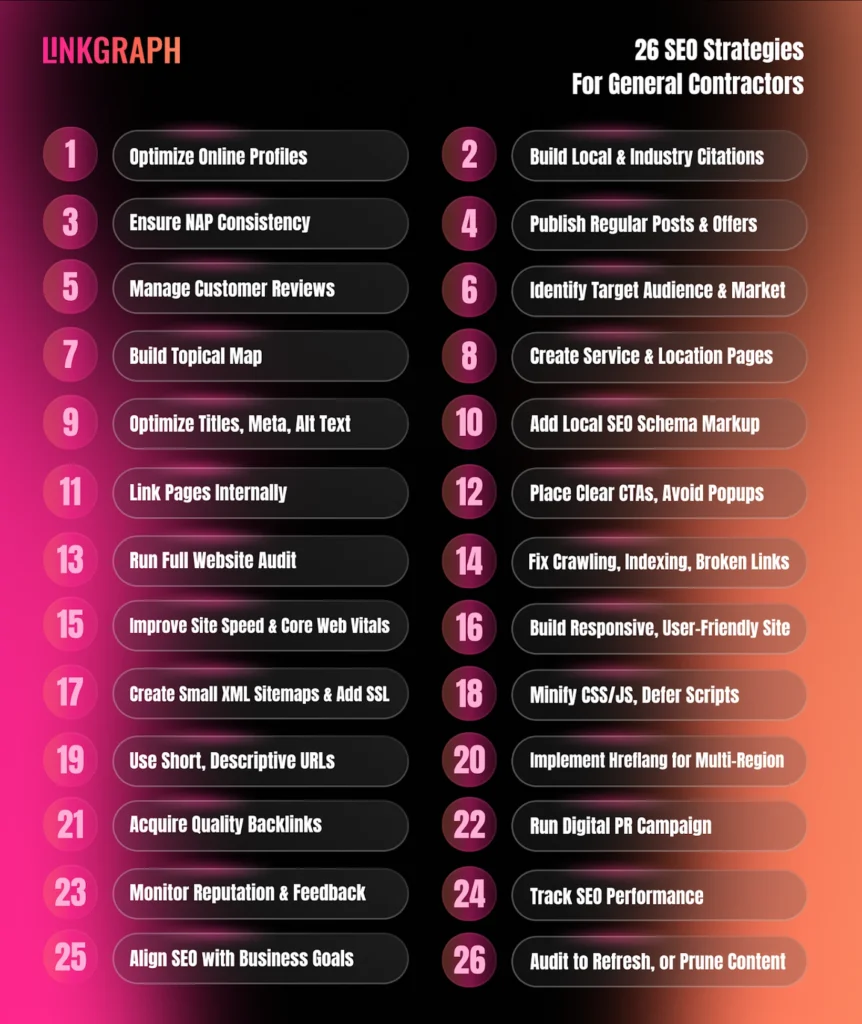
The starting point for contractor SEO involves building strong local visibility, optimizing on-page elements, improving technical foundations, and expanding authority through consistent off-page efforts. Each step creates a structure that drives targeted traffic and conversions. There are 26 SEO strategies for contractors to get started with SEO. The 26 SEO strategies for contractors to get started with SEO are listed below.
- Claim, Verify, and Optimize Google, Bing, and Apple Business Profiles
- Build Citations on Local and Industry-Specific Directories
- Ensure NAP Consistency Across All Online Directories
- Publish Regular Posts, Offers, Updates, and Events Across Profiles
- Ask and Manage Customer Reviews Across All Platforms
- Identify Target Audience, Market, and Their Needs
- Build Proper Topical Map Based on Source Context
- Create Separate Pages for Services and Important Locations
- Optimize Titles, Meta Descriptions, Headers, and Alt Text
- Implement Local SEO Schema Markup on Important Pages
- Link Pages Internally with Correct Hierarchy (Root → Seed → Node)
- Place Clear CTAs and Avoid Intrusive Popups/Chatbots
- Run Full Website Audit to Identify Site-Wide Errors
- Fix Crawling, Indexing, and Broken Link Issues
- Improve Overall Website Speed and Core Web Vitals
- Build a User-Friendly, Fully Responsive Website for All Devices
- Create Smaller XML Sitemaps and Install SSL Certificate
- Minify CSS/JS and Defer Non-Essential Scripts
- Use Short, Descriptive Topic-Focused URLs
- Implement Hreflang for Multi-Region/Language
- Acquire Quality Backlinks from Local and Relevant Sources
- Run Digital PR Campaign
- Monitor Online Reputation and Address Feedback
- Track SEO Performance with Google Analytics, Search Console, and GBP Insights
- Align SEO Strategy with Overall Business Objectives
- Run Audits to Fix, Refresh, Merge, or Prune Content
These actions create a strong SEO foundation for contractors and establish a path for sustainable search visibility and lead generation. We have broken down the 26 SEO strategies for contractors to get started with SEO below.
1. Claim, Verify, and Optimize Google, Bing, and Apple Business Profiles
The first step for contractors to build local visibility is claiming and verifying business profiles on Google Business Profile, Bing Places, and Apple Business Connect. These listings act as digital storefronts, allowing your business to appear in local search results and map packs when potential clients look for services nearby.
After verification, optimize each profile with accurate NAP (Name, Address, Phone), website URL, business hours, service categories, and areas served. Add high-quality images, a clear description, and relevant attributes to give search engines and users a complete view of your services.
Finally, keep profiles active by posting updates, offers, and responding to reviews. Regular maintenance signals reliability to search engines and boosts engagement. A fully optimized profile improves rankings in local packs and drives steady, high-intent traffic to your website.
2. Build Citations on Local and Industry-Specific Directories
Building citations on trusted directories increases local search visibility for contractors. Citations act as digital references that confirm business information across the web. Search engines use these references to validate the legitimacy and relevance of a business within a specific location or industry.
Start by listing the business on major platforms such as Yelp, Yellow Pages, Angi, and HomeAdvisor. Include accurate NAP details, website links, and service descriptions. Expand to local chambers of commerce, community directories, and niche industry sites that match the service type and region of the contractor.
Maintain consistent information across every listing to strengthen search signals. Regular checks prevent outdated or duplicate entries that reduce visibility. A strong citation profile improves local rankings and increases the chances of appearing in map results for targeted service areas.
3. Ensure NAP Consistency Across all Online Directories
Maintaining consistent Name, Address, and Phone number (NAP) across all online directories signals credibility to search engines. Contractors benefit from consistent information as it reinforces trust and improves local search rankings.
Audit every directory where the business appears, including Google Business Profile, Bing Places, Yelp, and industry-specific listings. Verify that the business name, phone number, and address match exactly across all platforms. Small discrepancies, such as abbreviations or outdated numbers, confuse search engines and reduce local visibility.
Consistency strengthens authority in local search algorithms and enables potential clients to locate services without errors. Regular monitoring ensures updates, new directories, or changes to service locations remain accurate. Accurate NAP information ultimately drives higher-quality leads and strengthens broader SEO strategies for contractors.
4. Publish Regular Posts, Offers, Updates, and Events Across Profiles
Regular posting on Google Business Profile, Bing, and industry directories keeps contractor listings active and engaging. Fresh content signals to search engines that the business is active, enabling maintenance and improvement of local rankings.
Posts include service promotions, seasonal offers, completed project highlights, or upcoming events. Each update should contain relevant keywords and clear descriptions of services to attract potential clients. Including images or videos increases engagement and makes posts more appealing to users browsing profiles.
Frequent updates build credibility with clients, demonstrating that the business is operational, responsive, and attentive to customer needs. Scheduling consistent posts ensures a steady flow of content, strengthens overall SEO efforts, and encourages repeat visits from clients who rely on accurate, up-to-date information when selecting contractor services.
5. Ask and Manage Customer Reviews Across all Platforms
Collecting and managing customer reviews on Google, Bing, and local directories establishes credibility for contractors. Positive reviews improve search rankings and influence potential clients seeking reliable services.
Encourage clients to leave detailed feedback about completed projects, service quality, and professionalism. Respond promptly to every review, thanking satisfied customers and addressing concerns from critical feedback. Active engagement demonstrates attentiveness and builds trust with future clients.
Monitoring reviews across all platforms allows identification of service strengths and areas needing improvement. Consistent review management strengthens local SEO by signaling authority and reliability to search engines while maintaining a strong online reputation that attracts new business opportunities.
6. Identify Your Target Audience, Market, and Their Needs
Defining the target audience is essential for contractor SEO. Understanding the demographics, location, and specific needs of clients allows tailoring content, service pages, and marketing messages. Contractors should focus on the types of projects clients seek, such as home remodels, roofing, or commercial builds, to ensure messaging aligns with search intent.
Analyzing the local market uncovers demand trends, seasonal patterns, and competitive gaps. This research allows contractors to optimize website content for high-intent keywords and create services that address precise client requirements.
Mapping audience insights to a topical map ensures that content strategy covers relevant themes and subtopics systematically. A proper topical map connects root topics to seed and node pages, guiding internal linking, content creation, and local SEO efforts, which improves rankings and attracts qualified leads consistently.
7. Build Proper Topical Map Based on Your Source Context
Creating a proper topical map organizes all website content around core topics and their related subtopics. Contractors should start with root topics, such as “roofing services” or “kitchen remodeling,” and branch into seed and node pages covering specific services, locations, and frequently asked questions. This structure ensures search engines understand the hierarchy and relevance of the website.
A well-structured topical map improves internal linking, guiding users from general pages to detailed service pages efficiently. It allows prioritizing content creation by identifying gaps and opportunities in coverage.
Aligning the topical map with the source context, including market trends, competitor content, and audience search behavior, allows contractors to produce relevant and authoritative content. This method enhances topical authority, strengthens local SEO efforts, and attracts qualified leads searching for specific contractor services.
8. Create Separate Pages for Services and Important Locations
Creating dedicated pages for each service and key location improves website organization and visibility in search results. Contractors should design individual pages for each service offered, such as “bathroom remodeling” or “deck construction,” and separate pages for important service areas or neighborhoods.
Service-specific pages allow the inclusion of targeted keywords, detailed descriptions, and unique content relevant to each offering. Location pages focus on geographic terms, local landmarks, and community-specific information, allowing search engines to match queries with relevant local results.
These pages strengthen internal linking strategies, connecting root topics to detailed subpages in a logical hierarchy. Properly segmented pages enhance topical authority, make navigation intuitive for visitors, and increase the likelihood of ranking for both service-specific and local search queries. This approach ensures contractors reach potential clients actively searching for their exact services in the intended areas.
9. Optimize Titles, Meta Descriptions, Headers, and Alt Text
Optimizing titles, meta descriptions, headers, and alt text ensures that search engines understand the content and relevance of each page. Contractors should craft page titles with clear service and location keywords to improve rankings and attract the right audience.
Meta descriptions provide concise summaries for search results, encouraging users to click through while accurately reflecting the page content. Headers (H1, H2, H3) structure content, making it scannable for visitors and signaling key topics to search engines.
Location pages focus on geographic terms, local landmarks, and community-specific information, allowing search engines to match queries with relevant local results. Incorporating descriptive, keyword-focused alt text on service photos, project galleries, and team images strengthens the connection between visual content and relevant search queries. Proper optimization across these elements improves visibility, relevance, and user engagement, increasing the likelihood of generating qualified leads and improving on-page SEO.
10. Implement Local Seo Schema Markup on Important Pages
Implementing local SEO schema markup on key pages allows search engines to understand the content and context of the services of a contractor. Schema markup provides structured data, highlighting details such as service type, location, business hours, and contact information, improving visibility in local search results.
Adding schema to service pages, location pages, and contact pages ensures search engines display rich snippets, including ratings, reviews, and service availability. Rich snippets increase click-through rates by providing clear, actionable information directly in search results.
On-page SEO benefits significantly from proper schema implementation, as it clarifies page purpose and strengthens the topical relevance of the content. Contractors should regularly audit pages for correct schema formatting, update changes in services or locations, and monitor how structured data affects search performance to maximize local search visibility and user engagement.
11. Link Pages Internally with Correct Hierarchy (Root → Seed → Node)
Internal linking organizes the website of a contractor, guiding search engines and visitors through key service pages and locations. Using a hierarchy from root to seed to node ensures that authority flows logically across the site, highlighting priority services and location-specific pages.
Root pages serve as primary landing points, seed pages cover major service categories, and node pages focus on individual services or locations. Implementing local SEO schema markup on key pages allows search engines to understand the content and context of a contractor’s services.
On-page SEO benefits from structured internal links because it strengthens topic clusters and enhances user navigation. Contractors should routinely review internal linking, remove broken links, and update connections as services or locations expand to maintain website authority and provide clear, intuitive pathways for both users and search engines.
12. Place Clear CTAs and Avoid Intrusive Popups/ Chatbots
Well-designed calls-to-action guide visitors to take steps like requesting quotes or scheduling consultations. Clear CTAs improve navigation and encourage users to explore services. Contractors benefit from CTAs that integrate naturally into pages, enhancing on-page SEO efforts without being forced.
Intrusive popups or unnecessary chat widgets disrupt user experience and lower engagement. Reducing interruptions allows pages to load faster and keeps attention on essential service information. Users interact more confidently with websites that feel clean and professional.
Optimized page layouts with concise CTAs and minimal distractions contribute to higher conversion rates and stronger engagement metrics. Search engines interpret intuitive pages as user-friendly, enhancing the effectiveness of on-page SEO strategies. Visitors move through the site smoothly, boosting leads and reinforcing credibility.
13. Run Full Website Audit To Identify Site-Wide Errors
A full website audit evaluates every page, uncovering issues that hinder search engine rankings and user experience. Audits examine broken links, duplicate content, missing metadata, and structural inconsistencies. Contractors improve visibility by addressing these site-wide errors systematically.
Technical checks within audits ensure pages load efficiently, are mobile-friendly, and maintain proper indexing. Identifying crawl errors and analyzing site architecture allows search engines to understand service offerings clearly, which enhances overall SEO performance.
Regular audits reveal gaps in content coverage and user navigation. Fixing these errors strengthens trust with potential clients and aligns the website structure with targeted keywords. Well-executed audits form the foundation for all subsequent technical SEO strategies, enabling measurable improvements in traffic, engagement, and leads.
14. Fix Crawling, Indexing Broken Links Issues
Crawling and indexing issues prevent search engines from fully understanding a contractor website, lowering visibility. Fixing these problems ensures pages are discoverable and rank appropriately. Broken links disrupt user experience and reduce site authority, so repairing or redirecting them is essential for SEO performance.
Technical SEO best practices include reducing server response time under 100ms, maintaining HTML crawl requests above 95%, keeping refresh rates around 20%, and targeting a discovery rate of 7–8%. Log file analysis identifies pages where crawl budget is wasted, guiding improvements in site architecture. Each page should be accessible, with proper canonical tags and redirects to consolidate authority.
Other key fixes include optimizing XML sitemaps, removing duplicate content, correcting structured data errors, ensuring mobile responsiveness, and monitoring server errors. Implementing these measures creates a technically sound site that search engines crawl and index efficiently, boosting rankings and improving organic traffic.
15. Improve Overall Website Speed and Core Web Vitals
Website speed and Core Web Vitals play a significant role in search engine rankings and user experience. Slow-loading pages increase bounce rates and reduce conversions for contractor websites. Optimizing images, compressing files, and leveraging browser caching allow pages to load faster. Reducing server response time and minimizing render-blocking resources ensures smoother site performance.
Core Web Vitals, including Largest Contentful Paint (LCP), First Input Delay (FID), and Cumulative Layout Shift (CLS), measure loading, interactivity, and visual stability. Improving these metrics makes websites more accessible and enjoyable for users. Contractors benefit from fast, responsive pages that retain visitors and encourage engagement with service offerings.
Regular speed audits using tools like Google PageSpeed Insights or Lighthouse identify bottlenecks and performance issues. Adjusting JavaScript, CSS, and implementing lazy loading for images ensures consistent site speed across devices. Optimized website speed strengthens SEO efforts and improves search engine rankings.
16. Build User-Friendly, Fully Responsive Website For All Devices
A user-friendly, fully responsive website ensures contractors reach clients across all devices without usability issues. Responsive design automatically adjusts layout, images, and navigation for desktops, tablets, and smartphones. Contractors benefit from consistent branding and professional presentation, improving engagement and reducing bounce rates.
Accessibility and intuitive navigation make it easier for visitors to find services, request quotes, or contact the business. Mobile responsiveness affects search engine rankings, as Google prioritizes mobile-first indexing for all websites.
Regular testing on multiple devices identifies layout or functionality issues. Incorporating fast-loading elements, touch-friendly buttons, and clear service sections enhances usability. A well-structured, responsive website improves user satisfaction, increases time spent on the site, and strengthens SEO performance for contractor businesses.
17. Create Smaller XML Sitemaps and Install SSL Certificate
Creating smaller XML sitemaps allows search engines to crawl and index contractor websites efficiently. Dividing a large sitemap into focused, manageable segments allows search engines to prioritize important pages, ensuring critical service pages appear in search results faster. Regularly updating sitemaps reflects new content, removed pages, or structural changes, maintaining accurate indexing.
Installing an SSL certificate secures data transfer between websites and users, establishing trust with potential clients. Contractors with HTTPS-enabled sites appear more reliable to visitors and receive a ranking preference from search engines. SSL protects sensitive information submitted via contact forms or quote requests, reducing security risks.
Combining smaller, well-organized sitemaps with SSL implementation enhances technical SEO. Search engines navigate and index pages more effectively, while visitors experience a secure, trustworthy browsing environment. This dual approach enhances website performance, trust, and overall search visibility for contractor businesses.
18. Minify CSS/JS and Defer Non-Essential Scripts
Minifying CSS and JavaScript files reduces file sizes by removing unnecessary spaces, comments, and characters. Smaller files load faster, which improves website speed and overall user experience. Contractor websites benefit from faster-loading pages, which retain visitors and improve search engine rankings.
Deferring non-essential scripts ensures that critical content loads first while less important scripts execute later. This method prioritizes visible content, enhancing perceived performance for visitors. Search engines interpret this as better page speed and optimized site structure, contributing to improved rankings.
Combining minification and script deferral aligns with technical SEO best practices. Faster, more responsive pages reduce bounce rates and allow search engines to crawl important content efficiently. Contractor websites with optimized scripts maintain smoother performance, higher user satisfaction, and stronger search visibility.
19. Use Short, Descriptive Topic-Focused URLs
Short, descriptive URLs improve website clarity for both users and search engines. Clear URLs indicate page content, making it easier for visitors to understand the topic before clicking. For contractor websites, URLs that include service type and location, such as /kitchen-remodeling or /roof-repair, attract relevant traffic and improve click-through rates from search results.
Descriptive URLs contribute to better indexing by search engines. URLs containing targeted keywords allow crawlers to quickly identify the relevance of the page to specific searches. This strengthens topical relevance without overloading content with unnecessary characters or parameters.
Maintaining consistent, concise URL structures improves overall site organization. Contractors benefit from easy-to-share links, improved user trust, and enhanced search visibility. A logical URL hierarchy, aligned with page topics, complements on-page SEO efforts and ensures both users and search engines navigate the site efficiently.
20. Implement Hreflang For Multi-Region/Language
Implementing hreflang tags improves the ability of search engines to serve the correct language or regional version of a contractor website. Hreflang tags signal to Google which version of a page should appear for users in specific countries or language preferences, reducing duplicate content issues and improving international SEO.
Proper implementation involves adding tags to the head section of each relevant page, specifying the language and region codes accurately. This ensures search engines display the most appropriate version to users, enhancing user experience across multiple regions.
Contractor websites targeting multilingual or multi-region audiences benefit from this strategy by capturing relevant traffic in each target area. Hreflang optimization complements technical SEO efforts by aligning site structure with search engine indexing priorities. It increases visibility for region-specific searches and prevents competing pages from cannibalizing search rankings.
21. Acquire Quality Backlinks From Local And Relevant Sources
Acquiring backlinks from authoritative local and industry-specific websites improves the credibility and search engine rankings of a contractor website. Each backlink acts as a signal of trust, indicating that other reputable sites recognize the value of the content or services offered.
Effective backlink strategies include collaborating with local business directories, industry associations, suppliers, and partner organizations. Guest posts, resource listings, and case studies published on relevant sites generate links that attract both search engines and potential clients.
Local backlinks reinforce the presence of a contractor in the target service area, improving visibility in regional searches. Combining backlink acquisition with consistent content updates and optimized on-page elements strengthens overall SEO performance and positions the contractor website as a trusted authority in the local market.
22. Run Digital PR Campaign
Running a digital PR campaign amplifies contractor brand visibility and generates high-quality backlinks from reputable websites. Press releases, online features, and guest contributions highlight completed projects, awards, or community involvement, signaling authority to search engines and potential clients.
Effective digital PR campaigns involve outreach to local news sites, industry blogs, and online publications relevant to construction and home services. Securing mentions and backlinks from these sources increases referral traffic while improving domain authority.
Combining digital PR efforts with consistent website updates and local SEO practices strengthens overall online presence. High-authority mentions contribute to better search rankings, enhance brand reputation, and create additional pathways for clients to discover contractor services online.
23. Monitor Online Reputation And Address Feedback
Monitoring online reputation allows contractors to track client sentiment across Google Business Profiles, review sites, and social media platforms. Promptly addressing feedback demonstrates professionalism, builds trust, and encourages potential clients to engage with services.
Positive reviews reinforce credibility, while resolving negative feedback shows commitment to customer satisfaction. Each response contributes to a transparent and reliable brand image, signaling authority to search engines and clients alike.
Reputation management integrates with broader SEO strategies. Regularly tracking mentions, reviews, and ratings identifies patterns, refines service offerings, and maintains consistent messaging across all platforms. This proactive approach ensures contractors maintain a strong online presence while driving long-term lead generation.
24. Track SEO Performance With Google Analytics, Search Console, And GBP Insights
Tracking SEO performance allows contractors to measure website traffic, user behavior, and conversion metrics accurately. Google Analytics provides insights into page views, session duration, and sources of organic traffic. Search Console identifies indexing issues, keyword performance, and click-through rates, refining optimization strategies.
Google Business Profile Insights reveal how clients interact with business listings, including calls, direction requests, and profile views. Monitoring these metrics highlights which campaigns and content drive results.
Regular performance tracking enables data-driven decisions, allowing contractors to adjust keywords, content, and on-page elements for better results. Combining analytics, Search Console, and GBP insights ensures a comprehensive understanding of SEO impact, promoting continuous improvement and measurable growth.
25. Align SEO Strategy with Overall Business Objectives
Aligning SEO strategy with overall business objectives ensures that optimization efforts contribute to company growth and revenue goals. SEO tactics such as keyword targeting, content creation, and local listings should reflect the services, markets, and priorities of the contracting business.
Strategic alignment allows contractors to focus on high-value pages, target profitable services, and attract clients most relevant to their offerings. Tracking SEO outcomes alongside business metrics ensures that website traffic translates into meaningful leads and bookings.
Integrating SEO with broader business objectives creates a cohesive approach, connecting online visibility, branding, and marketing initiatives. Contractors achieve measurable impact, improve ROI, and maintain a consistent digital presence that advances both marketing and operational goals.
26. Run Audits to Fix, Refresh, Merge, Or Prune Content
Running regular content audits ensures that all website pages remain relevant, accurate, and valuable to visitors. Audits identify outdated information, duplicate content, or pages with low engagement, allowing contractors to take corrective action.
Fixing broken or underperforming content improves search engine rankings and user experience. Refreshing existing pages with updated information and optimized keywords maintains topical relevance. Merging similar pages consolidates authority and reduces internal competition, while pruning unnecessary content streamlines site navigation and focus.
Content audits strengthen overall SEO performance, ensuring that every page contributes to lead generation and aligns with business objectives. Contractors maintain a high-quality, organized website that aligns with user intent and improves organic search visibility.
Can a Single SEO Strategy Work for All Types of Contractors?
No, a one-size-fits-all SEO strategy is ineffective for contractors. Each trade, plumbing, roofing, or landscaping, requires a tailored approach. Plumbers should target local search terms like “emergency plumber in [city]” while landscapers focus on seasonal keywords such as “spring lawn care in [area].” Customizing SEO strategies ensures higher relevance and stronger engagement with the target audience.
When Is the Right Time for Contractors to Invest in SEO?
Contractors should invest in SEO when their goal is to build a strong online presence, attract local clients, and reduce reliance on paid ads. It is especially effective when the business has a clear service area and a defined target audience. SEO is a long-term investment that builds credibility and generates consistent leads over time.
Is GMB Profile Optimization Enough for Contractors to Generate Consistent Leads?
Optimizing a Google Business Profile is crucial for local visibility, but relying on it alone does not generate consistent leads. A comprehensive SEO strategy that includes a user-friendly website, quality content, and local citations complements GMB optimization and ensures sustained online visibility and lead flow.
How Long Does It Take for SEO to Show Results for Contractors?
Contractors typically see noticeable SEO results within 3 to 6 months. Significant improvements in rankings and lead generation usually take 6 to 12 months, depending on competition, website quality, and the effectiveness of the SEO strategy.
Which Online Directories Are Most Valuable for Contractors to Be Listed In?
The most valuable online directories for contractors to be listed in provide exposure to high-intent clients, improve local SEO, and build credibility across the web. The online directories that are valuable for contractors to list in are listed below.
- Angi (formerly Angie’s List): Connects contractors with homeowners actively searching for services and reviews.
- HomeAdvisor: Offers a platform for service requests, ratings, and lead generation for local contractors.
- ContractorHub: Focuses on connecting skilled tradespeople with commercial and residential projects.
- BuildZoom: Highlights contractor licenses and project history, improving trust and authority.
- Thumbtack: Allows contractors to submit quotes and showcase services for local customer inquiries.
- Nextdoor: A neighborhood-focused platform where contractors gain referrals and local visibility.
- Better Business Bureau (BBB): Establishes credibility through verified ratings and customer feedback.
- The Blue Book: Provides a commercial construction directory for contractors to reach industry clients.
Listing on these platforms strengthens local SEO, improves online visibility, and connects contractors with quality leads.
Can Contractors Effectively Manage SEO on Their Own?
Contractors manage basic SEO tasks like optimizing business profiles, maintaining NAP consistency, and creating local content. These actions improve visibility without large costs. Advanced work, such as schema, crawl optimization, and backlink building, needs technical skill. Errors in these areas reduce rankings and waste resources. A hybrid model works best. Contractors handle simple tasks while professionals manage complex strategies for consistent growth.
What Are the Most Common SEO Mistakes Contractors Should Avoid?
Several mistakes reduce visibility and limit growth in search results. Avoiding these issues improves ranking stability and leads to quality. The most common SEO mistakes for contractors to avoid are listed below.
- Ignoring Google Business Profiles: Unclaimed or incomplete profiles reduce local search visibility and limit customer engagement opportunities.
- Inconsistent NAP Information: Mismatched details across directories confuse search engines and reduce trust signals.
- Thin or Duplicate Content: Pages with low-value or repeated text fail to target location-specific keywords and weaken topical depth.
- Weak Technical Foundation: Slow speed, broken links, poor indexing, and crawl inefficiencies reduce site performance and ranking potential.
- Lack of Structured Internal Linking: Disorganized linking breaks topical flow, preventing pages from passing authority effectively.
- Neglecting Regular Audits: Unresolved errors, outdated content, and missed updates lead to ranking drops over time.
Avoiding these mistakes creates a stronger foundation for long-term SEO growth.
What Should Contractors Consider Before Hiring an SEO Agency?
The following points outline the key factors contractors need to evaluate before choosing an SEO agency. Each factor ensures stronger alignment, measurable performance, and reduced risk. The factors to consider before hiring an SEO agency are listed below.
- Industry Experience: Agencies with proven work in contractor-focused SEO understand local service keywords, lead funnels, and niche ranking factors. Industry familiarity shortens the learning curve and increases execution accuracy.
- Case Studies and References: Verified examples of past success highlight the track record of an agency. Metrics such as traffic growth, call volume increases, and ranking improvements give tangible proof of capability.
- Transparent Reporting and Communication: Consistent reporting through analytics tools builds trust and exposes performance issues early. Clear communication avoids strategy misalignment and keeps progress measurable.
- Technical SEO Expertise: Proficiency in audits, site structure optimization, and Core Web Vitals reflects operational depth. Strong technical work drives higher content visibility and maintains stable rankings.
- Contract Terms and Pricing Structure: Transparent deliverables, realistic timelines, and clear pricing indicate professionalism. Vague agreements or unrealistic promises often signal weak execution quality.
Who Provides the Best SEO Services for Contractors Near Me?
LinkGraph provides specialized SEO services for contractors, delivering measurable results through strategies tailored specifically for the contracting industry. The agency has increased organic traffic by over 50% for contractor clients, improving keyword rankings and generating high-quality leads consistently. Services include local SEO for targeting specific service areas, on-page SEO to optimize content and structure, technical SEO to enhance website performance, and link building to boost authority.
Client testimonials highlight tangible growth, including improved visibility and higher conversions. Industry recognition, such as shortlistings in the 2023 U.S. Search Awards, reinforces LinkGraph’s credibility and expertise in contractor marketing SEO.
Affordable SEO for contractors, combined with professional contractor SEO agency services, ensures businesses of all sizes gain measurable results. LinkGraph integrates comprehensive strategies to maximize search engine performance, enhance local presence, and maintain long-term growth, making it the best choice for contractor SEO and online visibility.
What SEO Services Does LinkGraph Offer for Contractors?
LinkGraph offers a comprehensive suite of SEO services designed specifically for contractors to improve online visibility, attract high-quality leads, and grow their businesses. Each service focuses on a unique aspect of SEO, ensuring a complete and strategic approach. The types of SEO services offered by LinkGraph to contractors are listed below.
- Semantic and Holistic SEO for Contractors: Optimizes content and website structure to align with search intent and topical relevance.
- Entity SEO for Contractors: Focuses on building authority for contractor businesses as recognized entities across the web.
- Local SEO for Contractors: Targets location-specific searches to drive nearby customers to websites and physical locations.
- Technical SEO for Contractors: Enhances site speed, crawlability, indexing, and structured data implementation for better rankings.
- On-Page SEO for Contractors: Optimizes titles, meta descriptions, headers, and content for search relevance and user experience.
- Off-Page SEO for Contractors: Builds authoritative backlinks and strengthens online presence across relevant platforms.
- Content Creation for Contractors: Produces service pages, blogs, and guides tailored to contractor audiences.
- LLM and AI Optimization for Contractors: Implements AI-driven strategies for content creation and search optimization.
- Lead Tracking and Reporting for Contractors: Monitors traffic, leads, and conversions to measure SEO effectiveness.
- Branding for Contractors: Enhances brand authority and visibility across digital channels.
- Conversion Rate Optimization (CRO) for Contractors: Improves website design and user pathways to increase leads and inquiries.
- Voice Search Optimization for Contractors: Prepares content for voice queries and smart device searches.
- Reputation and Review Management for Contractors: Monitors and manages online reviews to maintain trust and credibility.
- Mobile SEO Optimization for Contractors: Ensures websites perform seamlessly on all mobile devices for better rankings.
LinkGraph’s services combine technical expertise, content strategy, and local optimization to achieve measurable SEO results for contractors.
Can All Types of Contractors Benefit from LinkGraph’s SEO Support?
Yes, all types of contractors benefit from LinkGraph’s SEO services. LinkGraph designs strategies that suit both residential and commercial contracting businesses, assisting them to rank higher in search engines, attract targeted leads, and increase overall visibility online. Contractors of any specialization gain measurable results from optimized content, technical SEO fixes, local search enhancements, and reputation management.
The types of contractors that benefit from SEO support from LinkGraph are listed below.
- General Contractors: Improve local visibility and generate more project inquiries.
- Home Remodeling Contractors: Attract clients searching for kitchen, bathroom, and whole-home remodeling services.
- Residential & Commercial Contractors: Rank for both homeowner-focused and business-focused search queries.
- Construction Contractors: Gain authority through industry-specific content and technical SEO optimizations.
- Kitchen and Bathroom Remodeling Contractors: Drive traffic through service-specific landing pages and reviews.
- Home Renovation Contractors: Showcase portfolios and service offerings to attract high-intent leads.
- Room Addition Contractors: Target local audiences seeking specialized renovation projects.
- Custom Home Builder Contractors: Enhance brand presence and generate inquiries for custom home projects.
LinkGraph’s SEO strategies adapt to each contractor type, ensuring relevant traffic, qualified leads, and measurable growth.
How Much Does LinkGraph Charge Contractors for SEO Services?
LinkGraph offers flexible SEO pricing for contractors based on business size, industry competitiveness, and project goals. Pricing considers the scope of work, including local SEO, on-page optimization, technical SEO, content creation, and backlink acquisition. Packages scale for small, medium, and large contractor businesses, ensuring an affordable and results-driven approach. Contractors receive customized proposals that align with their marketing objectives and budget while delivering measurable improvements in visibility, leads, and conversions.
Does LinkGraph Specialize Only in SEO for Contractors?
LinkGraph provides SEO services across multiple industries and specializes in contractor SEO. The agency focuses on residential, commercial, and specialized contractor segments, offering local SEO, technical fixes, content strategy, and reputation management. While contractors remain a key focus, LinkGraph applies expertise in other niches, including automotive, legal, and health industries, ensuring adaptable and proven SEO methodologies.
Is SEO More Cost-Effective Than Paid Advertising for Contractors?
SEO provides long-term value by generating organic traffic without ongoing ad spend. Paid advertising delivers immediate visibility but stops generating leads once the budget ends. SEO investments continue producing results over time, attracting high-intent clients, improving rankings, and enhancing credibility. For contractors, SEO often delivers a higher ROI compared to paid campaigns, especially for competitive local searches.
How Can Contractors Combine SEO with Paid Advertising for Better Results?
Contractors maximize reach and lead generation by integrating SEO with paid ads. SEO builds sustainable organic traffic and improves credibility, while paid ads provide immediate visibility for high-intent keywords. Combining both strategies allows targeting multiple stages of the buyer journey, from awareness to conversion. Coordinating ad campaigns with top-ranking organic content amplifies brand authority and reinforces client acquisition efforts.
Can Independent Contractors Compete with Large Firms by Using SEO?
Independent contractors compete effectively with large firms through targeted local SEO, optimized service pages, and strategic keyword targeting. Focused campaigns highlight unique services, generate high-quality leads, and improve online visibility. Smaller businesses outperform larger competitors in specific niches by leveraging local search, reputation management, and content tailored to their target market.
How Can Contractors Measure the ROI of Their SEO Efforts?
Contractors measure SEO ROI using tools like Google Analytics, Search Console, and Google Business Profile Insights. Tracking metrics such as organic traffic, keyword rankings, conversion rates, and lead quality provides insight into performance. Comparing organic lead generation against overall marketing spend allows contractors to quantify value and adjust strategies for continuous improvement.