
SEO for hotels involves optimizing hotel websites, local listings, content, and technical foundations to improve their ranking in search engine results when travelers search for accommodations. Hotel SEO includes keyword research, local SEO, on-page content, image and schema markup, backlink strategies, and user experience improvements. Strong hotel SEO drives more direct bookings, builds brand trust, reduces dependency on OTAs, and increases long-term visibility.
Proper hotel SEO offers benefits like more organic traffic, better SERP rankings, enhanced website performance, and improved guest engagement. Hotels that implement full SEO strategies benefit from reduced marketing spend per booking and more sustainable growth. Selecting the right SEO agency matters because agencies familiar with hotel industry demands provide strategies tailored to amenities, seasonal offers, competitive markets, and traveler intent, yielding better returns.
This article covers what hotel SEO is, why hotels need it, the main benefits, and how to get started with proven strategies for hotels of all types.

What Is Search Engine Optimization for Hotels?
Search engine optimization for hotels is the structured practice of improving the digital presence of a hotel to rank higher in search engine results. Hotel SEO strengthens a hotel website, Google Business Profile, and online listings so potential guests easily find accurate information about rooms, amenities, rates, and services. Search engine optimization for hotels increases discoverability for keywords like “boutique hotel in New York” or “pet-friendly hotel near airport.”
Hotel SEO relies on interconnected strategies such as keyword research, local optimization, technical improvements, and off-page authority building. A hotel website with optimized titles, schema markup, and a responsive design signals relevance to search engines. Local SEO for hotels ensures visibility on Google Maps, travel directories, and local searches where booking intent is strongest.
Search engine optimization for hotels serves as a direct growth driver for revenue. Increased visibility attracts qualified traffic, leading to higher booking rates through direct channels rather than third-party platforms. Effective hotel SEO boosts online visibility and helps establish long-term trust, improve user experience, and strengthen overall brand reputation in competitive hospitality markets.
Is SEO Important for Hotel Websites?
SEO for hotels increases visibility in search results and directs more qualified traffic to hotel websites. Hotel SEO focuses on ranking for local and transactional keywords that guests actively search before booking. A hotel website that secures top positions on Google receives more visits, which translates into stronger opportunities or direct bookings.
Search engine optimization for hotels attracts high-intent travelers who are ready to reserve. Optimizing pages with location-based keywords positions the property directly in front of those planning stays, which reduces reliance on costly Online Travel Agencies. Direct bookings increase profitability since hotels avoid paying commissions to third-party platforms.
SEO for hotels improves website performance, mobile responsiveness, and navigation flow. These elements create better experiences for visitors, which increases booking conversions. Strong rankings build trust, elevate brand credibility, and establish long-term value in a competitive hospitality market where visibility determines occupancy success.
What Are the Main Benefits of Doing SEO for Hotels?
The main benefits of doing SEO for hotels include higher online visibility, more direct bookings, and reduced reliance on third-party platforms. SEO strengthens brand credibility, improves profitability, and ensures long-term growth by attracting travelers who are ready to book. The main benefits of doing SEO for hotels are listed below.
- Increased Visibility and Traffic: Higher search rankings make hotel websites more visible to travelers searching for accommodations, bringing in steady organic traffic.
- More Direct Bookings: SEO drives qualified traffic from users actively searching for hotels, leading to stronger conversion rates and direct reservations.
- Reduced Reliance on OTAs: Direct bookings limit dependence on Online Travel Agencies, lowering commission costs and improving overall profit margins.
- Enhanced Brand Authority and Credibility: Top search positions build trust and establish hotels as reputable, reliable options in competitive markets.
- Cost-Effective Marketing: SEO creates sustainable traffic growth without ongoing ad spend, producing stronger ROI compared to paid campaigns.
- Targeted Traffic: Optimizing for relevant and location-specific keywords attracts high-intent travelers already planning trips in the area.
- Improved User Experience: SEO optimizations, such as faster load speeds and mobile responsiveness, make websites more engaging and easier to use.
- Long-Term Benefits and Competitive Advantage: Effective SEO produces lasting results, helping hotels outperform competitors and secure a larger share of bookings.
Hotels that invest in SEO gain consistent visibility, attract the right guests, and build lasting revenue growth through direct bookings.
Is SEO for Hotels Different From SEO For Restaurants?
Yes, SEO for hotels differs from SEO for restaurants because the two industries target different audiences and search intents. Hotel SEO centers on long-term travel planning, direct bookings, and amenities like pools, spas, or family packages. Restaurant SEO focuses on immediate dining needs, specific cuisines, and proximity-based searches such as “best Thai near me.”
Hotels rely on keywords tied to accommodations, travel destinations, and booking funnels. Restaurants rely on menu-driven and intent-based keywords that influence reservations, takeout, or in-person visits. Hotels must highlight availability, services, and special offers to convert travelers, while restaurants must showcase menus, hours, and dining experiences to attract local traffic.
Despite these differences, both hotels and restaurants depend on local SEO, Google Business Profile optimization, mobile-friendly websites, and strong review management to increase visibility and build trust. This shared foundation supports discoverability, but tailored strategies ensure each business type captures its specific audience effectively.
What Are the Best Ways to Get Started with SEO for Hotels?
The best ways to get started with SEO for hotels involve building a strong online foundation that makes the property easy to find and book. From optimizing Google Business Profiles to creating content around local attractions, hotel SEO captures travelers actively searching for accommodations.
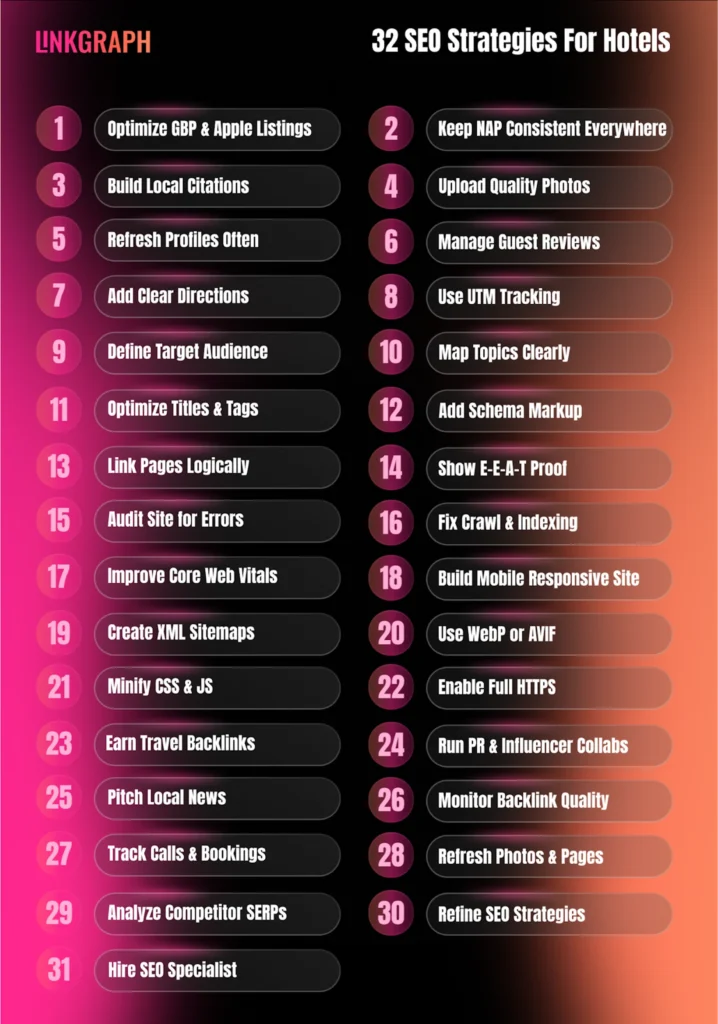
There are 31 SEO strategies for hotels. The 31 SEO strategies for hotels are listed below.
- Claim and Fully Complete Google, Bing, and Apple Business Profiles
- Keep Business Information Consistent Across All Citations and OTAs
- Build Local Citations on Reputable Directories
- Upload High-Quality Photos to Site and GBP
- Keep Business Profiles Fresh with Photos and Posts
- Ask and Manage Customer Reviews
- Add Clear Driving, Parking, and Transit Directions
- Add UTM Parameters to GBP Website and Booking Links
- Identify Target Audience, Market, and Key Needs
- Construct Proper Topical Map Based on Source Context
- Optimize Page Titles, Meta Descriptions, and Image Alt Text
- Implement Schema Markup Across All Pages
- Internally Link Pages with a Logical Hierarchy
- Show E-E-A-T Signals with Reviews, Certifications, and Awards
- Conduct Complete Website Audit to Identify Technical Errors
- Fix All Crawling and Indexing Issues
- Improve Core Web Vitals and Overall Page Speed
- Build Mobile-Friendly, Responsive Website for All Devices
- Create Smaller Topic-Focused XML Sitemaps
- Use Optimized Images and Convert Them to WebP or AVIF
- Minify CSS/JS and Defer Non-Essential Scripts
- Implement HTTPS Across Entire Site
- Earn Quality Backlinks from Travel, Tourism, and Hospitality Sources
- Run Digital PR Campaigns and Influencer Collaborations
- Pitch Newsworthy Updates to Local Press
- Monitor Backlink Quality and Manage Risk Without Overusing Disavows
- Track Calls, Bookings, and Directions via GA4, GSC, and GBP
- Refresh and Replace Photos, Amenities, and Seasonal Pages
- Analyze Top-Ranking Competitors and SERPs for New Opportunities
- Refine SEO Strategies Based on Performance Data and Results
- Hire an SEO Specialist When Needed
A well-structured SEO plan builds long-term visibility, drives direct bookings, and helps hotels reduce reliance on third-party platforms while staying competitive. We have broken down the 31 SEO strategies for hotels listed below.
1. Claim and Fully Complete Google, Bing, and Apple Business Profiles
Hotels must claim their profiles on Google, Bing, and Apple to build trust and strengthen visibility. These platforms serve as the first point of contact for travelers searching for accommodations. A complete profile ensures guests receive accurate details about location, contact information, and booking options.
Consistency is vital across all fields. Correct business name, address, and phone number improve local rankings. Adding high-quality photos of rooms, amenities, dining areas, and exteriors showcases the property and sets expectations. Categories and attributes like parking, Wi-Fi, accessibility, or pet-friendly options help attract specific travelers.
Profiles should not remain static. Regular updates with photos, announcements, and seasonal offers keep them active, which search engines value. Reviews on these listings influence guest decisions and rankings, so encouraging feedback is essential. A fully optimized presence across Google, Bing, and Apple creates a strong foundation for hotel SEO and increases direct bookings.
2. Keep Business Information Consistent Across All Citations and OTAs
Hotels must maintain consistent business information across all online citations and OTAs. Search engines and travelers rely on accuracy, and even small inconsistencies harm trust and rankings. Uniform details such as name, address, phone number, and website ensure the hotel is easily identifiable across multiple sources.
Consistency improves local SEO by signaling reliability to search engines, which factors accuracy into ranking decisions. On guest-facing platforms, it prevents confusion that causes booking abandonment or negative reviews. OTAs, travel directories, and local listings should always display identical data.
Updating details promptly is just as important. Seasonal hours, new amenities, or contact changes must reflect everywhere at once. A single incorrect phone number or outdated URL redirects potential guests to competitors. Hotels that control their citations across the web create a seamless booking experience and strengthen brand credibility in competitive search results.
3. Build Local Citations on Reputable Directories
Hotels gain stronger online visibility by building local citations on reputable directories. A citation is any mention of the name, address, and phone number of the hotel across trusted platforms. Search engines use these mentions to validate business legitimacy, boosting authority in local search results.
Directories like TripAdvisor, Yelp, Booking.com, and regional travel portals carry high trust signals. Listings on these platforms not only improve rankings but place hotels directly in front of travelers who are ready to book. High-quality citations serve two purposes: they strengthen SEO performance and drive referral traffic from platforms where guests frequently search for accommodations.
Hotels should prioritize accuracy and completeness when submitting information to directories. Photos, amenities, and reviews make profiles more engaging and competitive. Focusing on authoritative sources rather than spammy sites ensures stronger signals to search engines and maximizes the chances of capturing qualified, high-intent traffic.
4. Upload High-Quality Photos to Site and GBP
High-quality photos strongly influence guest decisions and strengthen SEO for hotels. Search engines reward engaging visual content because it improves user experience and increases time spent on the site. Clear, well-lit photos of rooms, amenities, dining spaces, and the hotel exterior help set accurate expectations and attract bookings.
Google Business Profile (GBP) and the hotel website should feature updated images that reflect seasonal changes, renovations, and events. Photos should be compressed for fast loading while maintaining resolution. Alt text descriptions with relevant keywords give search engines context, improving visibility in image search results.
Consistent photo updates signal that the hotel is active, reliable, and guest-focused. A strong visual presentation supports search engine optimization and builds trust, encouraging more travelers to book directly through the website of hotel. Professional, authentic visuals remain one of the most powerful tools in hospitality marketing.
5. Keep Business Profiles Fresh with Photos and Posts
Active business profiles boost visibility in search results and improve trust for hotels. Regular updates show that the property is well-managed and responsive to guest needs. Adding fresh photos of rooms, amenities, and events helps search engines and travelers see the hotel as current and relevant.
Posts on Google Business Profile or similar platforms highlight promotions, seasonal offers, or updates like renovations and awards. This activity engages potential guests and strengthens local SEO signals. Each update provides search engines with new content, improving indexing and increasing chances of appearing for location-specific searches.
Hotels that maintain dynamic profiles attract more clicks and direct bookings compared to those with outdated or neglected pages. Frequent updates make the hotel more competitive in search results while building credibility with travelers seeking reliable accommodations.
6. Ask and Manage Customer Reviews
Customer reviews influence both rankings and booking decisions for hotels. Search engines use reviews as trust signals, while travelers rely on them for guidance. A steady flow of recent, positive reviews strengthens the credibility of the property and improves visibility in local search results.
Hotels should actively encourage guests to leave feedback after their stay. Simple requests at checkout, follow-up emails, or reminders through booking confirmations often increase review volume. Responding promptly to both positive and negative feedback shows accountability and builds stronger guest relationships.
Managing reviews across Google, TripAdvisor, and OTAs ensures consistency and reinforces reputation. Highlighting positive experiences in responses helps potential guests feel more confident about booking. A well-maintained review strategy reduces OTA reliance, increases direct bookings, and positions the hotel as a trusted option in a competitive market.
7. Add Clear Driving, Parking, and Transit Directions
Hotels attract more guests when directions and transport details are clear and accessible. Travelers prefer properties that make arrival easy, whether they drive, use public transport, or arrange airport transfers. Search engines reward hotels that provide detailed location information, as it improves user experience and matches local search intent.
Business profiles and hotel websites should include maps, step-by-step driving instructions, and parking details. Information on nearby transit stations, shuttle services, and taxi availability adds extra value. Structured data helps search engines recognize and highlight this information for better visibility.
Updated directions are essential if road access, parking rules, or transit routes change. Accurate guidance reduces guest frustration, improves satisfaction, and encourages positive reviews. Hotels that simplify the arrival process increase direct bookings and strengthen their position in local search results.
8. Add UTM Parameters to GBP Website and Booking Links
Hotels improve tracking and marketing performance when UTM parameters are added to the website and booking links. UTM tags allow precise measurement of traffic sources, showing which campaigns, posts, or ads drive visitors to booking pages. This data helps optimize marketing strategies for maximum return on investment.
Adding UTM parameters to Google Business Profile links enables hotels to see which keywords, local searches, or posts generate clicks and reservations. Each link should include source, medium, and campaign identifiers for detailed analytics. Hotel marketers then evaluate which platforms or updates produce the highest engagement.
Consistently using UTM tags across all booking and promotional links ensures accurate reporting in Google Analytics, allowing hotels to adjust campaigns quickly. Hotels that track traffic effectively understand guest behavior, improve conversion rates, and allocate resources to the most profitable channels.
9. Identify Target Audience, Market, and Key Needs
Hotels improve marketing efficiency when the target audience, market, and key guest needs are clearly identified. Understanding traveler demographics, preferences, and booking habits allows hotels to tailor content, offers, and website experience. The website of the hotel and profiles then attract relevant guests actively searching for accommodations.
Segmenting the market by location, travel purpose, and budget helps hotels create targeted campaigns. Luxury travelers, business guests, and families have distinct needs, so understanding these differences guides keyword selection, content creation, and on-page SEO efforts. Hotels that align messaging with audience expectations increase engagement and direct bookings.
Analyzing competitors and search behavior reveals trends in guest interests. Hotels that continually refine their understanding of visitor intent improve local SEO, Google Business Profile performance, and overall marketing outcomes. This approach ensures resources focus on attracting guests most likely to book.
10. Construct Proper Topical Map Based on Source Context
Hotels improve search relevance when a proper topical map is constructed based on source context. A topical map organizes website content around key themes, such as room types, amenities, local attractions, and services. This structure helps search engines understand hotel offerings and match them to relevant queries.
Creating a clear hierarchy of topics ensures primary pages support subpages with internal linking. For example, a “Luxury Suites” page links to “Spa Services” and “Private Dining” pages, establishing context and authority. Hotels that structure content this way enhance both user navigation and SEO performance.
Analyzing competitor content and search intent informs topical map decisions. Hotels that align content with audience expectations and keyword demand increase visibility in organic search. Proper topical mapping improves indexing, enhances local SEO, and drives targeted traffic that is more likely to convert into bookings.
11. Optimize Page Titles, Meta Descriptions, and Image Alt Text
Hotels improve search rankings by optimizing page titles, meta descriptions, and image alt text. Page titles should clearly reflect the content of each page, including relevant keywords like room types, amenities, or location. Optimized titles increase click-through rates from search engine results pages.
Meta descriptions provide concise summaries for searchers and help hotels stand out in competitive results. Each description should be unique, informative, and include primary keywords, encouraging potential guests to explore the website further.
Image alt text improves accessibility and provides additional on-page SEO value. Descriptions like “Ocean view suite at downtown hotel” help search engines understand image content while supporting ranking for relevant queries. Hotels that optimize these elements increase visibility, enhance user experience, and drive more targeted traffic to booking pages.
12. Implement Schema Markup Across All Pages
Hotels improve search engine understanding by implementing schema markup across all pages. A schema provides structured data that highlights key hotel information, including room types, amenities, prices, ratings, and location. Integrating schema markup enhances on-page SEO by ensuring that each page communicates relevant details clearly to search engines.
Structured data supports rich results such as star ratings, availability, and pricing, which directly increase click-through rates for hotel websites. Google and other search engines use this data to display enhanced snippets, making the hotel stand out among competitors.
Hotels that apply schema markup across all pages signal authority and relevance to search engines. Proper on-page SEO combined with schema ensures room details, reviews, and local information are accurately indexed, improving visibility and the likelihood of direct bookings while strengthening the overall SEO foundation.
13. Internally Link Pages with a Logical Hierarchy
Hotels improve navigation and SEO by linking pages internally using a clear hierarchy. A logical structure, such as Root → Seed → Node, organizes content from main landing pages to category and detail pages. This hierarchy helps search engines crawl and index pages efficiently.
Internal linking distributes page authority across the website, strengthening key pages like booking, amenities, and location pages. Proper links guide users seamlessly through the hotel website, increasing engagement, reducing bounce rates, and improving the likelihood of direct bookings.
Hotels that implement structured internal links enhance both user experience and on-page SEO. Each page signals relevance through contextual anchor text, reinforcing the topical authority of the hotel. This approach ensures that search engines understand relationships between pages while guests navigate easily to important information such as rooms, services, and local attractions.
14. Show E-E-A-T Signals with Reviews, Certifications, and Awards
Hotels establish trust and authority by showcasing E-E-A-T signals: experience, expertise, authoritativeness, and trustworthiness. Displaying verified guest reviews, industry certifications, and awards demonstrates credibility to both users and search engines. Positive reviews and ratings indicate a reliable service, while certifications validate quality standards.
Highlighting awards and recognitions on key pages, such as the homepage, rooms, and amenities sections, reinforces authority in the hospitality market. Guests often reference these indicators when choosing accommodations, which increases confidence in booking directly through the hotel website.
Incorporating E-E-A-T signals supports on-page SEO efforts. Structured markup for reviews, awards, and certifications ensures search engines correctly interpret and display this information in search results. This improves visibility, boosts click-through rates, and positions the hotel as a trusted choice for travelers.
15. Conduct Complete Website Audit to Identify Technical Errors
A thorough website audit identifies technical errors that hinder search engine crawling, indexing, and user experience. Hotel websites benefit from audits that check broken links, missing metadata, duplicate content, and page speed issues. Detecting these problems ensures the website functions efficiently and remains accessible to both users and search engines.
Audits should assess mobile responsiveness, Core Web Vitals, structured data, and internal linking. Hotels that fix these issues provide a smoother booking experience, which increases conversions and visitor satisfaction.
Regular website audits support ongoing SEO efforts by uncovering hidden problems that impact search rankings. Resolving technical errors strengthens the performance of the website, enhances user experience, and helps search engines index pages correctly, ultimately driving more direct bookings and organic traffic.
16. Fix All Crawling and Indexing Issues
Hotels need to ensure search engines crawl and index website pages efficiently. Crawling and indexing issues prevent Google from understanding hotel content, which reduces visibility in search results. Start by reducing server response time to under 100 milliseconds, which improves crawl efficiency and user experience.
Maintain an HTML crawl request rate exceeding 95% to ensure the most important pages are accessible. A refresh rate around 20% keeps updated content discoverable, while aiming for a discovery rate of 7–8% ensures new pages are indexed quickly. Performing log file analysis reveals where the crawl budget is being wasted, highlighting broken links, redirect chains, or low-priority pages that drain resources.
Other key technical SEO fixes include optimizing robots.txt files to guide crawlers, resolving duplicate content issues, fixing canonical tag errors, ensuring proper sitemap structure, and maintaining a logical internal linking system. Addressing these elements improves indexation, strengthens organic visibility, and drives more direct bookings to the hotel website.
17. Improve Core Web Vitals and Overall Page Speed
Hotel websites must deliver fast, smooth, and responsive experiences to attract and retain guests. Core Web Vitals, including Largest Contentful Paint (LCP), Interaction to Next Paint (INP), and Cumulative Layout Shift (CLS), directly affect search rankings and user satisfaction. LCP should occur within 2.5 seconds, INP under 200 milliseconds, and CLS below 0.1 for optimal performance.
Reducing server response times, compressing images, minifying CSS and JavaScript, and deferring non-critical scripts improve page speed across all devices. Optimizing hotel images, including room photos and amenities, ensures quick loading without compromising visual quality. Mobile responsiveness and adaptive design reduce friction for users on smartphones and tablets, increasing the likelihood of booking conversions.
Regular speed audits with tools like Google PageSpeed Insights allow hotels to monitor performance, identify bottlenecks, and implement continuous improvements. A fast, stable website enhances user trust, boosts search visibility, and maximizes direct bookings.
18. Build Mobile-Friendly, Responsive Website for All Devices
Hotel websites must deliver seamless experiences across smartphones, tablets, and desktops. Mobile responsiveness ensures that navigation, booking forms, and content display correctly on every device. A responsive design automatically adjusts layouts, images, and text, providing consistent usability for guests.
Guests frequently browse and book hotels using mobile devices. A mobile-friendly website improves engagement, reduces bounce rates, and increases direct bookings. Responsive sites positively influence search rankings, as Google prioritizes mobile-first indexing for hotel websites.
Implementing adaptive images, touch-friendly buttons, and fast-loading mobile pages enhances usability. Testing hotel website performance on multiple screen sizes ensures that booking workflows remain smooth and error-free. Mobile optimization strengthens brand credibility, increases visibility in search results, and supports higher conversion rates.
19. Create Smaller Topic-Focused XML Sitemaps
Dividing XML sitemaps into smaller, topic-focused sections improves crawl efficiency and indexing for all hotel pages. Each sitemap covers a specific area, such as rooms, amenities, dining, or local attractions, helping search engines prioritize important content.
Smaller, organized sitemaps reduce crawl errors and ensure high-value pages, like booking or promotional pages, are discovered more frequently. Google and other search engines navigate these sitemaps more effectively, improving overall SEO performance.
Regularly updating topic-focused sitemaps with new content, seasonal offers, or availability changes keeps search engines aware of the latest information. Submitting these sitemaps to Google Search Console provides performance insights and helps maintain strong visibility across key hotel pages.
20. Use Optimized Images and Convert Them to WebP or AVIF
Optimizing images for hotels improves page load speed and enhances user experience. Large, uncompressed images slow websites, reducing engagement and harming search rankings. Converting images to WebP or AVIF formats decreases file size without losing quality.
High-quality, optimized images showcasing rooms, amenities, and property exteriors increase visual appeal and encourage bookings. Adding descriptive alt text improves on-page SEO and accessibility, helping search engines understand the content of each image.
Regularly auditing image libraries and updating visuals ensures the hotel website remains attractive and fast. Proper image optimization contributes to better Core Web Vitals, higher conversion rates, and improved rankings in search results.
21. Minify CSS/JS and Defer Non-Essential Scripts
Minifying CSS and JavaScript files reduces their size, allowing pages to load faster for hotel websites. Smaller files improve server response times and enhance user experience, which contributes to higher search rankings.
Deferring non-essential scripts prevents them from blocking the main content from rendering, ensuring visitors see the page quickly. This is particularly important for hotel booking pages, where delays reduce conversions.
Regularly reviewing scripts, removing unused code, and optimizing essential files helps maintain website performance. Combining minification and deferred loading improves Core Web Vitals, decreases bounce rates, and supports better search engine indexing for hotels.
22. Implement HTTPS Across Entire Site
Securing a hotel website with HTTPS protects guest data during online bookings and interactions. HTTPS encrypts communication between browsers and servers, which builds trust and demonstrates professionalism.
Search engines prioritize secure websites, improving rankings for hotel pages compared to unsecured HTTP sites. All pages, including booking, contact, and amenities sections, should use HTTPS to prevent mixed content errors and maintain a secure browsing experience.
Regularly renewing SSL certificates ensures uninterrupted protection. Implementing HTTPS across the entire hotel site enhances credibility, boosts search visibility, and safeguards sensitive customer information, supporting both SEO performance and guest confidence.
23. Earn Quality Backlinks from Travel, Tourism, and Hospitality Sources
Acquiring backlinks from reputable travel, tourism, and hospitality websites strengthens the domain authority of a hotel. These links signal to search engines that the hotel website is trustworthy and relevant for travel-related searches.
Hotels earn backlinks by contributing guest posts, collaborating with tourism boards, featuring in local guides, or partnering with travel bloggers. Each backlink drives referral traffic while enhancing SEO credibility.
High-quality backlinks improve search rankings for key hotel pages, including booking and amenities pages. A strategic backlink profile ensures hotels appear higher in search results, attracts more potential guests, and supports long-term visibility and growth in competitive markets.
24. Run Digital PR Campaigns and Influencer Collaborations
Digital PR campaigns and influencer collaborations increase the online visibility and authority of a hotel. Engaging travel influencers or media outlets highlights hotel services, events, or unique offerings, generating high-quality backlinks and social signals.
Hotels pitch story ideas, host influencer stays, or showcase seasonal promotions to attract coverage. Each campaign boosts brand recognition, drives referral traffic, and strengthens the online presence of the hotel.
Well-executed digital PR helps hotels reach a targeted audience, improve search engine rankings, and build credibility in the hospitality market. These efforts complement traditional SEO strategies and support long-term growth for both visibility and bookings.
25. Pitch Newsworthy Updates to Local Press
Sharing newsworthy updates with the local press improves hotel visibility and authority in the community. Hotels announce renovations, new amenities, awards, seasonal events, or service expansions to attract media coverage and online attention.
Press coverage generates high-quality backlinks, referral traffic, and signals to search engines that the hotel is active and reputable. It reaches potential guests who follow local news or travel publications.
Regularly pitching updates strengthens the brand image, reinforces credibility, and complements broader SEO strategies for the hotel. Local press engagement ensures that both search engines and potential guests recognize the hotel as a trusted and noteworthy option in its market.
26. Monitor Backlink Quality and Manage Risk Without Overusing Disavows
Monitoring backlink quality helps hotels maintain a strong and trustworthy online profile. Low-quality or spammy backlinks harm search rankings, while authoritative links improve visibility and credibility.
Hotels should regularly audit backlinks to identify risky links and take action only when necessary, avoiding excessive use of disavow tools that might reduce valuable link equity. Tracking link sources from travel blogs, tourism boards, and review sites ensures that backlinks remain relevant and beneficial.
Consistent backlink monitoring supports long-term SEO success by maintaining authority, reducing the risk of penalties, and maximizing the impact of earned links on search engine performance and direct bookings.
27. Track Calls, Bookings, and Directions via GA4, GSC, and GBP
Tracking calls, bookings, and directions provides clear insights into hotel website performance and guest behavior. GA4 captures website interactions, while GSC monitors search performance and indexing issues. GBP analytics track clicks, calls, and direction requests from local searches.
Hotels measure which pages and campaigns drive direct bookings, identify traffic sources, and optimize marketing strategies. Accurate tracking helps evaluate ROI, improve guest acquisition, and adjust content or local SEO efforts for higher engagement and conversions.
Consistent monitoring ensures hotels respond quickly to trends, refine targeting, and maximize revenue by understanding how users interact with both the website and business profiles.
28. Refresh and Replace Photos, Amenities, and Seasonal Pages
Updating photos, amenities, and seasonal pages keeps hotel websites and business profiles appealing and relevant. Fresh images of rooms, dining areas, lobbies, and amenities attract guests searching for accurate visuals.
Hotels that regularly refresh seasonal pages highlighting offers, events, or packages maintain higher engagement and improved local SEO rankings. Search engines reward updated content, signaling activity and relevance.
Consistent updates ensure potential guests see accurate information, enhancing trust and encouraging bookings. Regularly replacing outdated images and revising amenities details strengthens hotel branding, improves user experience, and helps hotels remain competitive in search results.
29. Analyze Top-Ranking Competitors and SERPs for New Opportunities
Analyzing top-ranking competitors and search engine results pages (SERPs) identifies strategies that drive high visibility for hotels. Competitor analysis reveals effective keywords, content structure, backlink sources, and on-page optimizations.
Hotels that examine SERPs understand what travelers search for and which pages dominate rankings. This insight helps refine content, target relevant queries, and uncover gaps where the hotel outperforms competitors.
Regular competitor and SERP analysis support strategic adjustments in website content, local SEO efforts, and marketing campaigns. It ensures hotels remain aligned with evolving search trends, capitalize on new opportunities, and maintain a strong presence in highly competitive hospitality markets.
30. Refine SEO Strategies Based on Performance Data and Results
Tracking performance data from search engines, analytics tools, and booking platforms allows hotels to refine SEO strategies effectively. Data reveals which keywords, pages, and campaigns drive traffic, engagement, and direct bookings.
Hotels that continuously analyze performance metrics, such as impressions, clicks, and conversion rates, identify areas needing improvement. Adjustments in content, on-page SEO, technical fixes, or local optimization enhance search visibility and guest engagement.
Refining SEO based on results ensures hotels maintain a competitive edge, maximize ROI, and adapt to changes in search trends or traveler behavior. Consistent optimization creates a sustainable growth loop that strengthens long-term online presence and increases direct bookings.
31. Hire an SEO Specialist When Needed
Hotels benefit from hiring an SEO specialist when internal resources lack the expertise or time to manage complex optimization tasks. An SEO specialist brings knowledge of technical SEO, local SEO, content strategy, and backlink acquisition customized to the hospitality industry.
Specialists conduct in-depth audits, implement schema markup, optimize Google Business Profiles, and refine website performance to maximize search visibility. They ensure strategies align with traveler search behavior and booking trends, improving the chances of higher direct bookings.
Engaging a professional allows hotels to focus on guest experience while maintaining a strong online presence. Regular collaboration with an SEO specialist ensures continuous improvement, adaptation to algorithm updates, and sustained growth in competitive hospitality markets.
What Are the Common SEO Mistakes Hotel Owners Should Avoid?
The common SEO mistakes hotel owners should avoid often stem from overlooking the basics that make websites search engine-friendly and user-centric. Understanding these pitfalls is crucial for enhancing online visibility and driving direct bookings. The common SEO mistakes that hotel owners should avoid are listed below,
- Ignoring Local SEO: Failing to optimize for local search terms like “hotel in [destination]” results in missing nearby travelers actively seeking accommodations.
- Slow Website Load Times: Unoptimized images and heavy scripts slow down a site, negatively impacting user experience and search engine rankings.
- Poor Mobile Optimization: With a large portion of hotel bookings made on mobile devices, a non-responsive site deters potential guests and harms SEO performance.
- Duplicate or Thin Content: Using the same content across multiple pages or lacking substantial text confuses search engines and reduces page rankings.
- Neglecting On-Page SEO Elements: Missing or poorly optimized title tags, meta descriptions, and header tags hinder search engine understanding of the content.
- Overlooking Analytics and Tracking: Not setting up tools like Google Analytics and Search Console means missing valuable insights into user behavior and site performance.
- Lack of Quality Backlinks: Not earning backlinks from reputable travel and tourism sites limits site authority and search engine ranking.
- Inconsistent NAP Information: Discrepancies in Name, Address, and Phone number across directories confuse search engines and potential guests.
- Not Utilizing Structured Data: Missing schema markup means missing out on rich snippets like star ratings and availability, which enhance click-through rates.
- Failing to Update Content Regularly: Stale content leads to decreased rankings; regularly updating a site with fresh information keeps it relevant and engaging.
Avoiding these common mistakes significantly improves the presence online, leading to better search engine rankings and increased direct bookings.
Can One SEO Approach Work for All Types of Hotels?
No, a one-size-fits-all SEO approach is ineffective for hotels. Different types of hotels, such as boutique, luxury, budget, or eco-friendly, cater to distinct audiences and have unique offerings. Tailoring SEO strategies to align with the specific target market, services, and location is essential for maximizing visibility and attracting the right guests.
When Should Hotels Get Started with SEO?
Hotels should initiate SEO efforts as early as possible, ideally during the website development phase. Starting early allows for the implementation of best practices from the outset, ensuring that the site is optimized for search engines and user experience. Delaying SEO results in missed opportunities and increased competition.
Is GMB Profile Optimization Enough for Hotels to Get Consistent Guests?
Optimizing a Google Business Profile (GBP) is crucial for local visibility, but relying solely on it is insufficient for sustained guest acquisition. A comprehensive SEO strategy that includes on-page optimization, quality content creation, backlink building, and performance tracking is necessary to maintain and enhance online presence, leading to consistent bookings.
How Long Does It Take for SEO to Show Results for a Hotel?
SEO is a long-term strategy, and results typically become noticeable within 3 to 6 months. Factors such as website age, competition, and the quality of SEO efforts influence the timeline. Consistent optimization and monitoring are key to achieving and maintaining high rankings and visibility in search engine results.
Which Online Directories Are Most Valuable for Hotels to Be Listed In?
Listing hotels on the right online directories increases visibility, drives direct bookings, and enhances credibility. Hotels gain exposure to travelers actively searching for accommodations while strengthening local SEO presence through authoritative platforms. Some valuable online directories for hotels are listed below.
- Booking.com: Widely used global platform for hotel bookings with high search traffic.
- Expedia: Popular travel marketplace that connects hotels to international guests.
- Hotels.com: Offers hotel listings, reviews, and booking options for travelers worldwide.
- Agoda: Strong presence in Asia, ideal for hotels targeting international tourists.
- Trip.com: Comprehensive platform with booking options across multiple travel services.
- Airbnb: Expands reach for boutique and short-stay accommodations.
- HRS: Useful for business travelers and corporate hotel bookings.
- Lastminute.com: Targets travelers seeking spontaneous trips and hotel deals.
- HotelTonight: Focuses on last-minute hotel bookings for mobile users.
- Trivago: Meta-search engine comparing hotel prices across platforms.
- HotelsCombined: Aggregates hotel listings for price comparison and visibility.
- Google Business Profile: Essential for local search visibility and map listings.
- Yelp: Supports reviews, location, and local search discoverability.
- Bing Places: Improves visibility for travelers using the Microsoft search ecosystem.
Hotels listed on these directories improve rankings, attract high-intent travelers, and establish credibility across multiple online touchpoints.
Can Hotel Owners Successfully Implement SEO Strategies on Their Own?
Hotel owners implement basic SEO strategies on their own, such as updating Google Business Profiles, optimizing page titles, and creating quality content. However, complex technical SEO, structured schema markup, backlink acquisition, and performance tracking require specialized skills. Partnering with an SEO specialist ensures strategies align with search algorithms, maximize visibility, and deliver measurable results, helping hotels compete effectively in highly competitive markets while avoiding common mistakes that limit organic traffic and direct bookings.
What Should Be Checked Before Hiring an SEO Agency for a Hotel?
Before hiring an SEO agency for a hotel, evaluate their experience, track record, and alignment with the marketing goals of the hotel. The right agency ensures better search visibility, more direct bookings, and long-term growth in a competitive hospitality market. The factors to consider before hiring an SEO agency are listed below.
- Experience in Hotel SEO: Confirm the agency has successfully managed SEO campaigns for hotels or hospitality businesses.
- Proven Case Studies: Review performance results, including increased rankings, traffic, and direct bookings.
- Technical SEO Expertise: Ensure the agency handles website audits, crawl optimization, and core web vitals improvements.
- Local SEO Knowledge: The agency should optimize Google Business Profiles, citations, and local search presence.
- Content Strategy Skills: Check their ability to create high-quality, optimized content for hotel pages and blogs.
- Backlink Strategy: Evaluate approaches for acquiring authoritative, relevant backlinks in travel and tourism niches.
- Reporting and Analytics: Confirm they provide regular, transparent reports on traffic, conversions, and ROI.
- Client Testimonials and References: Look for verified feedback from previous hotel clients for credibility and reliability.
Reviewing these factors ensures the agency delivers measurable SEO results, improves hotel visibility, and increases bookings efficiently.
Who Offers the Best SEO Services for Hotels Near Me?
LinkGraph delivers some of the most effective SEO services for hotels, combining industry expertise with a results-driven approach. LinkGraph focuses on optimizing hotel websites for local search visibility, technical performance, and content relevance, ensuring every property attracts high-intent travelers. The team at LinkGraph creates tailored strategies for each hotel, managing on-page SEO, technical SEO, and backlink acquisition to maximize bookings.
Hotels that work with LinkGraph experience measurable improvements in organic traffic, search rankings, and overall online visibility. LinkGraph uses data-driven methods, analyzing competitors and search trends to refine strategies continuously. Client testimonials and case studies highlight how LinkGraph helped hotels improve direct bookings while reducing reliance on third-party platforms.
With a strong reputation in the hospitality SEO space, LinkGraph stands out as a trusted partner for hotels. LinkGraph’s focus on local SEO, guest review management, and booking intent keywords ensures hotels attract qualified traffic consistently. Choosing LinkGraph provides hotels with expertise, proven results, and ongoing strategic guidance.
Which Types of SEO Services Does LinkGraph Offer for Hotels?
LinkGraph provides a comprehensive suite of SEO services for hotels, designed to improve search visibility, increase direct bookings, and enhance overall online presence. Each service addresses specific aspects of search engine optimization, ensuring hotels attract the right audience and perform well in competitive markets. The types of SEO services offered by LinkGraph to hotels are listed below.
- Semantic SEO for Hotels: Optimizes content around topics and entities to improve relevance and search rankings.
- Holistic SEO for Hotels: Combines technical, on-page, and off-page strategies for full-spectrum optimization.
- Local SEO for Hotels: Targets location-based searches to capture travelers searching for accommodations nearby.
- Technical SEO for Hotels: Ensures fast-loading, crawlable, and mobile-friendly websites with proper indexing.
- On-Page SEO for Hotels: Optimizes page titles, meta descriptions, headings, and images for search engines.
- Off-Page SEO for Hotels: Builds authoritative backlinks and manages online reputation to improve rankings.
- Content Creation for Hotels: Produces high-quality blogs, guides, and landing pages to engage travelers.
- LLM and AI Optimization for Hotels: Utilizes AI-driven tools to optimize content and keyword strategies.
- Lead Tracking and Reporting for Hotels: Monitors calls, bookings, and web traffic to measure ROI.
- Branding for Hotels: Enhances brand recognition and authority across search engines and online platforms.
LinkGraph tailors each SEO service to the unique needs of hotels, ensuring measurable growth and stronger online performance.
Can All Types of Hotels Get SEO Services from LinkGraph?
All types of hotels benefit from LinkGraph’s specialized SEO services. LinkGraph designs tailored strategies that address unique search behavior, booking intent, and guest expectations. Each hotel receives optimization for both local and organic search, improving visibility, attracting high-intent travelers, and increasing direct bookings. LinkGraph ensures websites are structured, optimized, and content-rich to outperform competitors in competitive hospitality markets.
The SEO approach adapts for different service levels, from luxury and boutique hotels to budget-friendly and extended-stay accommodations. LinkGraph’s expertise in technical SEO, local SEO, and content strategy provides measurable results across all hotel categories. Hotels gain improved rankings, enhanced brand credibility, and sustained traffic growth through these customized strategies.
The types of hotels that can get SEO services from LinkGraph are listed below.
- Luxury Hotels
- Business Hotels
- Resort Hotels
- Boutique Hotels
- Budget/Economy Hotels
- Airport Hotels
- Extended-Stay Hotels
- Hostels
- Guesthouses
LinkGraph’s comprehensive SEO solutions deliver consistent growth for every hotel type, ensuring each property captures its target audience and maximizes direct bookings effectively.
How Much Does LinkGraph Charge for Hotel SEO Services?
LinkGraph customizes hotel SEO pricing based on property size, competition, and project scope. Costs reflect technical SEO, content creation, local optimization, and backlink campaigns. Each hotel receives a clear proposal with deliverables, timelines, and ROI-focused strategies to improve visibility and direct bookings.
Does LinkGraph Only Offer SEO Marketing Services for Hotels?
LinkGraph provides more than SEO for hotels. Services include content creation, local marketing, paid media, website optimization, and branding support. Hotels benefit from a full digital marketing approach that increases visibility, drives bookings, and grows online presence.
What Other Businesses Get SEO Services from LinkGraph?
LinkGraph delivers SEO services to a wide range of businesses beyond hotels and restaurants. Companies seeking higher online visibility, targeted traffic, and improved conversions benefit from tailored SEO strategies. These businesses include both local and national brands aiming to capture more customers through search engines.
Other businesses that can get SEO services from LinkGraph are listed below.
- E-commerce Stores: Increase product visibility, drive sales, and outrank competitors.
- Medical Practices & Clinics: Attract patients locally through optimized local SEO and content.
- Legal Firms: Enhance authority, gain leads, and improve search rankings for specialized services.
- Real Estate Agencies: Showcase listings and capture buyers searching for properties online.
- Travel and Tourism Companies: Improve bookings and attract tourists through targeted search strategies.
- Fitness Centers & Gyms: Boost memberships and local visibility for fitness services.
- Education Institutions: Attract students and build credibility online.
- Home Services & Contractors” Connect with local clients and increase service inquiries.
- SaaS & IT Companies: Drive leads, highlight software solutions, and increase market reach.
LinkGraph’s expertise across industries ensures businesses achieve measurable results and sustainable growth.
What Are Other Ways to Market Hotels Besides SEO?
SEO is essential for visibility, but hotels gain stronger results by combining it with other marketing methods. Using multiple channels helps attract travelers at different stages of their booking journey and increases overall revenue.
Other ways to market hotels besides SEO are listed below.
- PPC Advertising Drive immediate traffic and bookings with Google Ads and Bing Ads, targeting high-intent travelers.
- Social Media Marketing: Showcase amenities, experiences, and offers on platforms like Instagram, Facebook, and TikTok.
- Email Marketing: Build loyalty through personalized promotions, seasonal deals, and guest retention campaigns.
- Influencer Partnerships: Expand reach by collaborating with travel bloggers and content creators.
- Video Marketing: Highlight rooms, facilities, and local attractions through professional video content.
- Content Marketing: Publish blogs, travel tips, and guides to engage travelers researching destinations.
- Partnership Marketing: Work with airlines, tourism boards, and local attractions for cross-promotions.
- Retargeting Campaigns: Convert undecided website visitors into bookings through smart remarketing ads.
Hotels that integrate SEO with PPC and these additional channels build stronger visibility, brand authority, and long-term guest loyalty.
Is SEO More Cost-Effective Than Paid Ads for Hotels?
SEO is more cost-effective for hotels than paid ads because it generates long-term traffic without ongoing ad spend. Paid ads require continuous investment, while SEO builds organic visibility that continues to deliver results. Direct bookings from SEO reduce reliance on OTAs, saving commission fees. Although SEO takes time, the return compounds over months, making it a sustainable marketing channel. Paid ads are useful for quick visibility, but SEO delivers stronger profitability over time.
Does Video Content Help Hotels Attract More Direct Bookings?
Video content helps hotels attract more direct bookings by showcasing rooms, amenities, and guest experiences in a dynamic format. Travelers connect better with authentic video tours than with static images. Videos embedded on websites and shared across social media platforms improve engagement and drive trust. Search engines reward video-rich pages with better rankings, which brings more organic traffic. Effective video marketing highlights the atmosphere of the hotel, making it easier for potential guests to choose direct booking.
How Hotels Use Social Media to Reach More Guests?
Hotels use social media to reach more guests by creating engaging content that highlights experiences and amenities. Platforms like Instagram and TikTok allow hotels to share visual storytelling that attracts travelers researching destinations. Paid social campaigns expand reach by targeting specific demographics, travel interests, and locations. Social media is effective for promoting seasonal offers, events, and last-minute deals. Consistent engagement with comments and messages builds trust, increasing the likelihood of direct bookings.
How Influencer Marketing Helps Hotels Attract More Customers?
Influencer marketing helps hotels attract more customers by leveraging trusted voices within the travel community. Collaborations with travel bloggers and social media creators expose hotels to highly engaged audiences. Influencers create authentic content showcasing hotel stays, amenities, and experiences, encouraging followers to book directly. Campaigns target specific niches such as luxury travelers, families, or adventure tourists. Reviews and recommendations from influencers act as social proof, which builds credibility and inspires travelers to choose the hotel over competitors.
Is Email Marketing as Important as Other Hotel Marketing Strategies?
Email marketing is important for hotels because it nurtures relationships with past guests and encourages repeat bookings. Personalized offers, loyalty rewards, and seasonal promotions keep the hotel brand top-of-mind. Compared to paid ads, email campaigns reach an audience that has already shown interest, which improves conversion rates. While SEO attracts new guests, email marketing strengthens guest retention, making it a complementary strategy. Hotels that combine SEO with email marketing maximize both reach and long-term revenue growth.
How Do Promotions and Seasonal Offers Affect SEO?
Promotions and seasonal offers affect SEO by creating fresh, timely content that search engines prioritize. Pages optimized for events like holidays, festivals, or local attractions attract travelers searching for deals. These offers generate backlinks and social shares, improving authority. Limited-time promotions increase click-through rates, which signals relevance to search engines. Seasonal content aligned with target keywords helps hotels capture short-term search demand, boosting visibility during high-travel periods. Regular updates ensure the website stays active and competitive.
Can Small Hotels Compete with Big Chains Using SEO?
Small hotels compete with big chains using SEO by focusing on local search and niche keywords. Unlike large brands, smaller properties highlight unique experiences, personalized services, and location-specific advantages. Local SEO helps capture searches like “boutique hotel near [landmark],” which big chains often overlook. Strong content, optimized profiles, and positive reviews give smaller hotels credibility. With consistent SEO, small hotels secure visibility, attract high-intent travelers, and win bookings without relying on a large advertising budget.
How Hotels Track the ROI of Their SEO Campaigns?
Hotels track the ROI of SEO campaigns through measurable metrics like bookings, calls, and inquiries generated from organic traffic. Tools such as Google Analytics, Search Console, and Google Business Profile provide insights into conversions and engagement. Tracking revenue from direct bookings versus OTA bookings shows cost savings and profitability. Keyword rankings and traffic growth reveal performance trends. By comparing campaign expenses with direct revenue generated, hotels calculate true ROI and refine strategies for continuous improvement.
