SEO for interior designers and SEO for exterior designers focus on increasing online visibility, attracting qualified leads, and improving local and national search presence. Interior and exterior designer SEO ensures websites rank higher on search engines like Google, which connects design services with motivated clients searching for residential, commercial, or specialty projects.
Local SEO for interior and exterior designers strengthens presence in specific geographic areas, while Map Pack SEO for interior and exterior designers enhances visibility in Google Maps and local listings. Google SEO for interior and exterior designers optimizes technical elements, content, and website structure to improve rankings, engagement, and conversion opportunities.
Implementing these strategies builds credibility, showcases portfolios, and drives consistent inquiries. Selecting the right SEO agency ensures strategies align with business goals, target audiences, and service offerings, which delivers measurable growth and sustainable online performance.
What Does SEO Mean for Interior and Exterior Designers?
SEO for interior and exterior designers involves optimizing website content, structure, and technical elements (titles, meta descriptions, headers) to improve search engine visibility and attract qualified clients. Interior and exterior designers implement on-page SEO by crafting optimized titles, meta descriptions, headers, and content aligned with targeted keywords like “modern interior design” or “sustainable exterior solutions.”
Off-page SEO strengthens website authority through backlinks, mentions on design platforms, and recognition from industry publications (design platforms, industry magazines, professional directories). Technical SEO ensures fast-loading, mobile-responsive websites with proper indexing and structured data, which makes websites easier for search engines to crawl and rank.
High-quality content, which includes portfolios, case studies, and design trend articles, engages visitors and positions interior and exterior designers as credible professionals. Optimized user experience guides visitors through services efficiently, which improves engagement and conversion rates.
Interior and exterior designers using these strategies generate measurable growth, increase brand recognition, and secure more projects in competitive local and global markets.
How Is SEO for Interior and Exterior Designers Different from SEO for Construction Companies
SEO for interior and exterior designers focuses on attracting clients for design services by showcasing portfolios, project galleries, and aesthetic expertise. Designers target buyers searching for concepts like “modern kitchen design” or “sustainable exterior solutions,” using descriptive language and optimized images to communicate style and capabilities. Lead generation prioritizes long-term projects and client engagement rather than immediate service requests. Local SEO drives nearby client acquisition and highlights national or international projects.
SEO for construction companies emphasizes local services and completed projects, which use location-specific keywords like “roofing contractor in Brooklyn” or “commercial construction services.” Construction SEO relies on Google Business Profile (GBP) optimization, local citations, and detailed service pages to attract clients seeking immediate construction or renovation work. Project portfolios and case studies demonstrate expertise in complex building processes. Keyword strategies target service-specific topics and building materials to reach potential clients ready to hire contractors.
The primary difference lies in targeting, content strategy, and local focus, with designers emphasizing aesthetics and long-term client engagement while construction companies prioritize local lead generation and service-specific search visibility.
Is SEO for Architects the Same as SEO for Interior and Exterior Designers
SEO for architects differs from SEO for interior and exterior designers despite sharing identical core principles. Each profession requires strategies that reflect distinct services, search intentions, and client expectations. Architects focus on structural design and building planning, while designers emphasize decoration, aesthetics, and spatial enhancement.
Keyword targeting reflects these differences. Architects use phrases such as “residential architecture,” “commercial building design,” and “sustainable architecture” to reach clients seeking planning expertise. Interior designers focus on terms like “living room decor” and “kitchen remodel,” while exterior designers target queries around façade upgrades and outdoor space improvements.
Content strategies align with these keyword themes. Architectural content highlights blueprints, project management, and structural concepts. Design content emphasizes color palettes, materials, space layout, and stylistic trends.
All three fields rely on technical SEO, on-page optimization, local SEO, and link building. However, the language, visuals, and page structures differ to match each audience. Architects address large-scale structural projects, while designers focus on transforming existing spaces.
Is SEO Really Important for Interior and Exterior Designers?
Search engines act as primary discovery platforms for people seeking design expertise. High rankings on Google increase exposure, generate qualified inquiries, and build digital authority. Competitors already apply SEO, so ignoring it leads to lost opportunities in a crowded market.
Interior and exterior designers benefit from SEO across several key areas. Search visibility increases through optimized titles, structured metadata, and keyword-rich service pages. Local SEO enhances placement on Google Maps and location-based searches, attracting nearby clients to design studios. Consistent keyword targeting drives traffic from users searching phrases such as “luxury living room design” or “modern landscape design.”
Trust grows through strong organic placement. Websites ranking higher signal authority and reliability to visitors. Visual portfolios reach broader audiences through descriptive text, structured markup, and fast-loading layouts.SEO turns design projects into searchable assets that attract clients for both residential and commercial spaces.
What Are the Main Benefits of Implementing SEO for Interior and Exterior Designers?
The main advantages of doing SEO for interior and exterior designers involve stronger online visibility, qualified traffic growth, improved credibility, and consistent business opportunities across residential and commercial markets. Strategic SEO application aligns digital presence with client search behavior, which allows design services to reach audiences searching for specific aesthetics or specialized expertise. The key benefits of implementing SEO for interior and exterior designers are listed below.
- Increased Visibility and Targeted Traffic: SEO raises rankings for relevant keywords, which positions design services in front of people searching phrases such as “modern apartment interior design” or “outdoor living space renovation.” Strong placement attracts both local and national audiences interested in residential and commercial design.
- More Leads and Conversions: Optimized content attracts qualified visitors who search with clear intent. These visitors explore portfolios, browse service pages, and initiate contact, which generates project inquiries and improves overall conversion rates for design services.
- Enhanced Credibility and Authority: High rankings and structured, informative content build trust in design expertise. Well-optimized websites signal reliability, which turns organic visibility into stronger reputational standing among residential and commercial clients.
- Cost-Effective and Sustainable Marketing: SEO drives long-term traffic without the recurring expenses of paid campaigns. Optimized content continues to attract inquiries after initial setup, which creates lasting value for design businesses.
- Improved User Experience: Technical optimization improves page speed, mobile responsiveness, and navigation. Visitors engage with projects more easily, which increases viewing time, portfolio exploration, and inquiry rates.
Applying these advantages allows interior and exterior designers to secure consistent leads, strengthen brand presence, and maintain a competitive position across search engines.
How Can Interior and Exterior Designers Effectively Get Started with SEO?
The main steps for interior and exterior designers to get started with SEO involve building a strong local presence, which optimizes website structure, improves content quality, and strengthens authority signals. A structured process ensures search engines understand design services while potential clients discover portfolios and service pages through targeted queries.
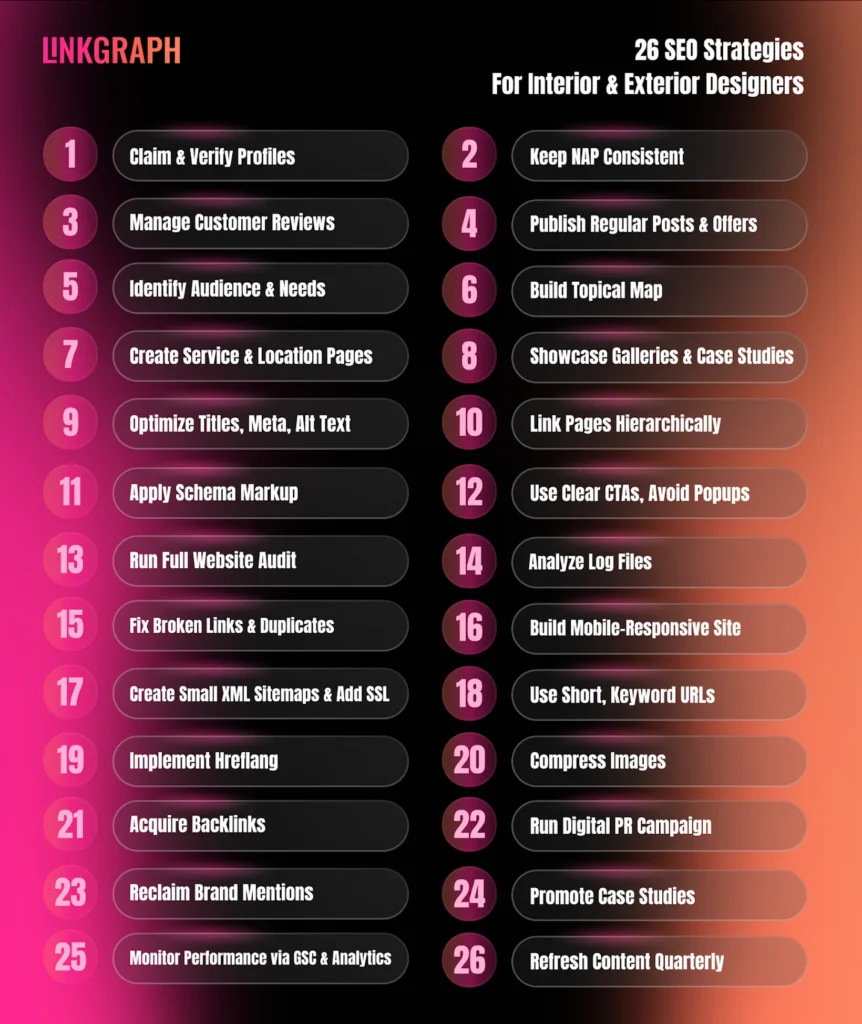
There are 26 SEO strategies for interior and exterior designers. The 26 SEO strategies for interior and exterior designers are listed below.
- Claim and Verify Business Profiles
- Maintain Consistent NAP Citations Across the Web
- Actively Manage Customer Reviews and Responses
- Publish Regular Posts, Offers, Updates, and Events Across Profiles
- Identify Target Audience, Market, and Their Needs
- Construct Proper Topical Map Based on Source Context
- Create Separate Pages for Services and Important Locations
- Showcase Project Galleries and Case Studies with Detailed Descriptions
- Optimize Title Tags, Meta Descriptions, Headers, and Alt Text
- Link Pages Internally with Correct Hierarchy (Root → Seed → Node)
- Apply Schema Markup (Local Business, Projects, Person)
- Place Clear CTAs and Avoid Intrusive Popups or Chatbots
- Conduct Full Website Audit to Resolve Errors
- Conduct Log File Analysis
- Fix Broken Links, 404 Errors, and Content Duplication Issues
- Build User-Friendly, Clean, Mobile-Responsive Website for All Devices
- Generate and Submit XML Sitemaps and Install SSL Certificate
- Implement Short, Keyword-Relevant URLs
- Implement Hreflang for Multi-Region or Language
- Compress Images to Improve Page Load Performance
- Earn Quality Backlinks from Authoritative Businesses and Industry Partners
- Execute Digital PR Strategy for Project Features and Awards
- Reclaim Unlinked Brand Mentions from Suppliers and Clients
- Promote Project Case Studies to Generate Editorial Backlinks
- Monitor Organic Performance via Google Search Console and Analytics
- Conduct Quarterly Content Audits to Refresh and Update Pages
These steps build a strong foundation for sustainable search performance, which drives consistent traffic, leads, and brand recognition for interior and exterior design services. We have broken down the 26 SEO strategies for interior and exterior designers are listed below.
1. Claim and Verify Business Profiles (Google, Bing, Apple)
Claiming and verifying business profiles on Google, Bing, and Apple ensures the business appears in local search results. Verified profiles signal legitimacy to search engines, which improves the chances of ranking higher for location-based queries. Interior and exterior designers gain control over how business information appears, which includes contact details, service categories, and operational hours.
Verified profiles allow designers to manage the information that potential clients see when searching for design services. Designers upload portfolios, add descriptions, and showcase unique offerings. Accurate profiles increase trust and make clients more likely to contact the business directly through search results.
Regular monitoring of these profiles keeps information up-to-date and consistent across platforms. Designers respond to client questions, update project photos, and highlight promotions. Consistent and verified profiles increase visibility, attract high-quality local leads, and create a strong foundation for other SEO strategies (local citations, review management, verified listings).
2. Maintain Consistent NAP Citations Across the Web
Consistent Name, Address, and Phone (NAP) citations across directories, review sites, and social platforms ensure accurate business information. Interior and exterior designers maintain uniform details to prevent confusion for clients and search engines. Accurate citations improve local search rankings and increase trust with potential clients.
Search engines use NAP information to verify the legitimacy and geographic relevance of the business. Inconsistent data reduces visibility in local map results and organic listings. Designers benefit from consistent citations on industry-specific platforms, local directories, and prominent business listings.
Monitoring citations regularly keeps information current and correct. Updates to address, phone number, or business name propagate across platforms to maintain consistency. Correct and uniform NAP citations strengthen local SEO, enhance credibility, and drive qualified leads to design services.
3. Actively Manage Customer Reviews and Responses
Interior and exterior designers improve their online reputation by actively managing customer reviews. Responding to positive and negative feedback demonstrates professionalism, builds trust, and shows commitment to client satisfaction. Designers who engage with reviews attract more inquiries from potential clients.
Review management increases visibility on Google Business Profiles (GBP) and other platforms where clients search for services. Higher ratings and frequent engagement signal credibility to search engines, which enhances local search rankings. Designers benefit from encouraging satisfied clients to leave detailed, authentic reviews.
Regular monitoring identifies trends, common concerns, and areas for improvement in service delivery. Responding promptly strengthens relationships and encourages repeat business. A proactive review strategy amplifies trust, improves local SEO performance, and generates more qualified leads for design projects.
4. Publish Regular Posts, Offers, Updates, and Events Across Profiles
Interior and exterior designers maintain engagement by publishing regular updates across online profiles. Sharing posts, promotions, and event announcements keeps audiences informed and drives traffic to the website. Consistent updates signal activity and professionalism, which attracts potential clients searching for design services.
Regular publishing strengthens local SEO by keeping GBP and social media profiles active. Search engines favor businesses that consistently provide fresh, relevant content. Designers showcase new projects, seasonal offers, and design tips to highlight expertise and attract targeted leads.
Updating profiles with events, offers, or news encourages interaction and improves brand visibility. Engaged clients are more likely to inquire about services and share updates with others. A structured posting schedule builds credibility, reinforces the authority of the designer, and strengthens overall lead generation efforts.
5. Identify Your Target Audience, Market, and Their Needs
Interior and exterior designers define their target audience by analyzing market demographics, client preferences, and common search behaviors. Understanding the audience ensures that website content, project portfolios, and marketing campaigns address the specific needs of potential clients actively seeking design services.
Mapping the audience to relevant topics creates a foundation for a proper topical map. Each segment of the audience links to specific service pages, blog content, and visual portfolios, which ensures that search engines associate pages with precise user intent. Topical mapping connects keywords, content clusters, and project examples to the needs of residential or commercial clients.
A detailed topical map guides content creation, internal linking, and keyword strategy. Designers prioritize high-value topics like kitchen remodeling, landscape design, or home renovation. This approach improves search engine visibility, ensures relevance for target audiences, and enhances the chance of converting visitors into qualified leads.
6. Construct Proper Topical Map Based on Your Source Context
Constructing a topical map involves organizing all website content around core services, design styles, and project types. Interior and exterior designers categorize pages by themes such as residential design, commercial spaces, or outdoor landscaping, which ensures each page addresses a specific context relevant to the audience.
The source context includes client queries, competitor content, and industry trends. Mapping this context to website content ensures that each page targets unique keywords, aligns with user intent, and avoids redundancy. This structure enables search engines to understand the hierarchy and relationship between pages, which boosts relevance and authority.
A proper topical map connects service pages, blog posts, and portfolio galleries into clusters. Internal linking follows this structure, which guides both users and search engines through the site logically. This approach strengthens SEO performance, improves ranking potential, and directs qualified traffic to the most important design services.
7. Create Separate Pages for Services and Important Locations
Interior and exterior designers should create dedicated pages for each service, such as kitchen remodeling, office design, or outdoor landscaping. Separate service pages allow detailed descriptions, targeted keywords, and optimized content, which makes it easier for search engines to rank pages for specific design offerings.
Location-specific pages target clients in different cities or regions. Including the city or neighborhood in titles, meta descriptions, and headings improves local search visibility and attracts nearby clients searching for specialized design services.
Organizing services and locations into distinct pages improves website navigation, user experience, and on-page SEO performance. Each page functions as a landing point for specific queries, which increases the chances of attracting qualified leads and directing visitors to relevant portfolios or contact forms.
8. Showcase Project Galleries, Before-and-After Case Studies with Detailed Descriptions
Project galleries display completed interior and exterior design work with high-quality images. Including descriptive captions and alt text ensures search engines understand the content while improving visibility for relevant design searches.
Before-and-after case studies highlight transformation, which demonstrates design expertise and problem-solving skills. Detailed descriptions explain the process, materials, and client goals, which adds context that attracts prospective clients and builds trust.
Organizing galleries and case studies on the website enhances user experience, which allows visitors to explore work efficiently. Clear presentation of projects increases engagement, reinforces authority in the design field, and encourages inquiries from targeted leads.
9. Optimize Title Tags, Meta Descriptions, Headers, and Alt Text
Title tags, meta descriptions, headers, and alt text directly influence search engine rankings and user engagement. Titles must include relevant keywords, summarize page content accurately, and attract clicks from search results.
Meta descriptions provide concise summaries of page content, which increases relevance and encourages potential clients to explore the website. Headers organize content logically, improving readability and guiding visitors efficiently.
Alt text describes images for search engines and users. Optimizing project galleries and portfolio visuals improves accessibility and strengthens on-page SEO, allowing interior and exterior designers to rank higher while showcasing their work effectively.
10. Link Pages Internally with Correct Hierarchy (Root → Seed → Node)
Internal linking creates a structured pathway between pages, which guides both search engines and visitors through the website. Proper hierarchy from root to seed to node ensures important pages receive link equity and rank better in search results.
Root pages represent main service areas, seed pages cover specific sub-services, and node pages provide detailed, supplementary content. This structure improves crawl efficiency, which allows search engines to index content more effectively.
Strategically linking pages enhances user navigation and engagement, which makes it easier for visitors to find relevant information. These linking practices reinforce on-page SEO, which distributes authority across the site while highlighting key portfolio pieces and service offerings.
11. Apply Schema Markup (e.g., for Local Business, Projects, Person)
Schema markup adds structured data to a website, which allows search engines to understand the context of content. Applying markup for local businesses, project portfolios, or team members enhances visibility in search results, which generates rich snippets and knowledge panels.
Local business schema provides key details such as address, phone number, operating hours, and service areas, which ensures accurate representation in search results. Project schema highlights completed work with images, descriptions, and timelines, while person schema features designers or staff profiles to showcase expertise.
Implementing schema markup improves click-through rates by presenting additional information to potential clients. Correct markup reinforces on-page SEO efforts, which makes each page more relevant and discoverable while enhancing local and national visibility for interior and exterior design services.
12. Place Clear CTAs and Avoid Intrusive Popups/Chatbots
Clear calls-to-action (CTAs) guide visitors to take desired steps, like requesting a consultation, viewing a portfolio, or signing up for updates. Strategically placed CTAs increase engagement and improve conversion rates for interior and exterior designers.
Intrusive popups or chatbots that disrupt user flow reduce website usability and increase bounce rates. Pages with smooth, unobstructed navigation provide a better experience, which allows potential clients to focus on services, projects, and contact opportunities.
Integrating CTAs with minimal interruptions complements on-page SEO by keeping visitors engaged on key pages longer. Well-designed interactions ensure designers capture leads efficiently while maintaining a positive user experience across all devices and screen sizes.
13. Conduct Full Website Audit to Resolve Errors
A full website audit identifies technical issues that prevent search engines from crawling, indexing, and ranking pages properly. Interior and exterior designers benefit from audits that assess site speed, mobile responsiveness, URL structure, broken links, duplicate content, schema implementation, and overall site architecture. Each element directly affects visibility, lead generation, and user experience.
Server response time should remain under 100ms to ensure fast page delivery, which improves crawl efficiency and enhances user engagement. HTML crawl requests must exceed 95% to confirm that most pages are accessible to search engine bots. Maintaining a refresh rate of around 20% allows updated content to be indexed promptly, while a discovery rate of 7–8% balances new content exploration with crawl budget limitations.
Performing a log file analysis reveals where search engines spend the most crawl resources and highlights pages that block indexing or waste crawl budget. Additional technical SEO fixes include optimizing internal linking, verifying XML sitemaps, resolving 404 errors, implementing canonical tags, compressing images, and ensuring SSL certificates remain active. These measures collectively improve search engine comprehension, enhance rankings, and ensure optimal website performance for potential clients.
14. Conduct Log File Analysis
Log file analysis provides a clear picture of how search engines crawl a website, which identifies which URLs receive the most visits from bots. Interior and exterior designers use this data to detect pages that are under-indexed or ignored, which ensures priority content like service pages and portfolio galleries are fully discoverable.
Analyzing logs highlights crawl errors, 404 responses, or redirect chains that might impede search engines from properly indexing important pages. Designers pinpoint inefficient crawl paths, which optimizes internal linking structures and sitemap organization.
Regular log file review maintains ongoing SEO by tracking changes in crawl behavior over time. Designers gain actionable insights into search engine interaction patterns, which allows targeted improvements that enhance indexing efficiency, strengthen visibility for high-value content, and improve organic search performance.
15. Fix Broken Links, 404, and Content Duplication Issues
Fixing broken links preserves link equity and improves navigation for both users and search engines. Interior and exterior designers update project pages, portfolios, or service URLs, which leave behind outdated links. Regularly scanning for broken internal and external links keeps crawlers moving efficiently through priority pages, which prevents crawl waste and ranking drops.
Addressing 404 errors ensures search engines do not encounter dead ends. Redirecting outdated URLs to relevant active pages maintains page authority and ensures consistent user journeys. Designers benefit from structured redirect rules that avoid loops and chains, which keep crawling paths clean.
Eliminating duplicate content strengthens indexing accuracy. Repeated content across location pages, service sections, or galleries confuses search engines and splits ranking signals. Canonical tags, unique page copy, and proper URL structures resolve duplication, which ensures each page serves a distinct purpose in the technical SEO strategy.
16. Build User-Friendly, Clean Mobile Responsive Website for All Devices
Building a mobile-responsive website improves accessibility and engagement across different screen sizes. Interior and exterior designers rely heavily on visuals, so layouts must adapt without losing quality. Clear navigation, fast-loading galleries, and properly scaled images make browsing smooth for visitors using phones or tablets. On-page SEO strengthens these efforts by improving how search engines interpret and rank mobile pages.
A clean design structure eliminates unnecessary elements that slow performance. Lightweight code, compressed images, and minimal popups reduce load times, which improves both user satisfaction and crawl efficiency. Keeping server response times under 100ms boosts technical SEO metrics and enables higher rankings in mobile-first indexing environments.
Consistency across devices builds trust and improves conversion opportunities. A portfolio page viewed on a desktop must retain the same clarity and functionality on mobile. Implementing responsive breakpoints, touch-friendly buttons, and well-placed CTAs creates a unified experience that enhances both usability and search visibility.
17. Generate and Submit XML Sitemaps and Install SSL Certificate
Generating and submitting XML sitemaps improves how search engines discover and index website content. Interior and exterior designers publish service pages, galleries, and project features, so structured sitemaps ensure all important URLs receive crawl priority. A smaller sitemap increases indexing efficiency by reducing wasted crawl activity on less relevant URLs. On-page SEO benefits from this structured approach because search engines understand content distribution more effectively.
Submitting the sitemap through Google Search Console (GSC) and Bing Webmaster Tools gives search engines a direct crawl path. This submission confirms that URLs remain accessible and updated. Maintaining a refresh rate around 20 percent ensures new or revised pages receive timely indexing without overloading crawl resources.
Installing an SSL certificate enhances security and trust signals. HTTPS encrypts data between the server and users, which protects sensitive information such as inquiry forms or project details. Search engines treat SSL as a ranking factor, so implementing it strengthens technical SEO performance and user confidence.
18. Implement Short, Keyword-Relevant URLs
Short, keyword-relevant URLs strengthen technical SEO by improving clarity for search engines and visitors. Interior and exterior designers showcase service pages, galleries, and location-specific content. Clean URLs without unnecessary parameters allow search engines to understand the site hierarchy and content purpose. On-page SEO elements align better with concise URL structures, which improves crawl efficiency and indexing accuracy.
Including primary keywords in URLs reinforces topic relevance. A URL like /living-room-design performs better than one cluttered with numbers or generic terms. This structure signals page focus, strengthens internal linking, and makes links more readable when shared across platforms.
Short URLs improve user experience on mobile and desktop. Clear structures reduce confusion, improve navigation, and increase click-through rates from search results. Maintaining this format across all pages ensures consistent indexing and strengthens overall site architecture.
19. Implement Hreflang for Multi-Region/Language
Hreflang implementation improves technical SEO for interior and exterior designers targeting audiences in multiple regions or languages. Search engines use hreflang attributes to understand language preferences and regional targeting. Correct implementation reduces duplicate content issues across language versions, which preserves rankings and prevents index dilution.
Interior and exterior designers publish similar content for different regions. Applying hreflang tags ensures the right language or regional page appears in relevant search results. This step improves visibility in target markets and strengthens alignment between content versions.
Accurate hreflang tags ensure better user experiences for international visitors. Users land on the appropriate version of each page without manual switching. This structure boosts engagement, reduces bounce rates, and maintains authority across multiple language variations.
20. Compress Images to Improve Page Load Performance
Image compression enhances website speed, a key aspect of technical SEO for interior and exterior designers. Reducing file sizes without sacrificing quality ensures faster page loads, improving user experience and search engine rankings. Slow-loading pages lower engagement and decrease conversions for visitors browsing project galleries or portfolios.
Optimized images maintain visual appeal while minimizing bandwidth usage. Designers feature high-resolution visuals to showcase work, which makes compression critical for balancing aesthetics and performance. This approach allows search engines to crawl pages efficiently and index content more effectively.
Proper compression techniques, which include modern formats like WebP and lazy loading, further reduce load times. Faster pages increase user satisfaction, encourage longer site visits, and contribute to better overall SEO performance for both local and broader audiences.
21. Earn Quality Backlinks from Authoritative Businesses and Industry Partners
Backlinks from reputable businesses and industry partners improve domain authority and search rankings for interior and exterior designers. High-quality links signal to search engines that a website is trustworthy and relevant within the design industry.
Designers collaborate with suppliers, contractors, or design blogs to earn editorial backlinks. Featuring project collaborations, awards, or case studies on partner sites generates authoritative references that drive referral traffic and improve online visibility.
Focusing on relevant, authoritative sources ensures links strengthen SEO rather than dilute it. Consistently acquiring quality backlinks improves long-term search performance, increases credibility, and positions designers as leaders in residential and commercial interior and exterior design services.
22. Execute Digital PR Strategy for Project Features and Awards
A digital PR strategy amplifies visibility for interior and exterior designers by promoting project features, awards, and press mentions across online channels. Highlighting recognized projects builds credibility and attracts attention from potential clients and industry peers.
Designers make use of media coverage, guest articles, and online publications to showcase completed projects, innovative designs, or award-winning work. Each mention serves as an authoritative backlink, which boosts search engine rankings and drives targeted traffic to the website.
Strategically executing digital PR ensures consistent brand exposure while reinforcing expertise and trustworthiness. This approach strengthens both local and broader market recognition, increases referral traffic, and enhances overall online authority for design services.
23. Reclaim Unlinked Brand Mentions from Suppliers and Clients
Reclaiming unlinked brand mentions strengthens online authority by converting existing references into backlinks. Suppliers, collaborators, or clients mention designers on their websites without linking, which represents a missed SEO opportunity.
Interior and exterior designers should systematically identify these mentions using monitoring tools and reach out to request proper attribution links. Each acquired link contributes to improved domain authority, better search engine rankings, and higher visibility for key services.
Reclaimed mentions increase referral traffic from relevant industry sources, which connects designers with potential clients who are already interested in design expertise. Consistently addressing unlinked mentions ensures the website maximizes all existing online recognition for SEO benefit.
24. Promote Project Case Studies to Generate Editorial Backlinks
Promoting project case studies positions interior and exterior designers as industry authorities while generating valuable editorial backlinks. High-quality case studies, which detail processes, challenges, and results, attract attention from blogs, industry publications, and partner websites.
Sharing these studies on professional networks and outreach campaigns encourages reputable sites to link back to the website of the designer. Each editorial backlink increases domain authority, enhances search rankings, and drives relevant traffic to service pages.
Consistently creating and promoting case studies strengthens the credibility of the website, showcases expertise, and enhances SEO efforts. Editorial backlinks earned this way provide sustainable visibility and reinforce the position designer in competitive local and national searches.
25. Monitor Organic Performance via Google Search Console and Analytics
Tracking organic performance allows interior and exterior designers to evaluate the effectiveness of SEO strategies. Google Search Console (GSC) provides data on search impressions, click-through rates, and keyword rankings, revealing which pages attract the most traffic.
Google Analytics (GA4) offers insights into visitor behavior, session duration, bounce rates, and conversion paths. These metrics highlight high-performing pages, identify underperforming content, and guide adjustments to improve engagement and lead generation.
Regular monitoring ensures SEO efforts align with business goals. Designers use data from both Google Analytics and GSC to make informed decisions, optimize content, adjust technical elements, and refine outreach strategies, maintaining strong visibility and attracting targeted, qualified clients consistently.
26. Conduct Quarterly Content Audits to Refresh and Update Pages
Quarterly content audits allow interior and exterior designers to maintain relevant, high-quality website content. Reviewing each page identifies outdated information, broken links, or underperforming content that fails to attract or convert visitors.
Audits provide opportunities to update text, images, and keywords, which ensures alignment with current trends, user search behavior, and SEO best practices. Refreshing content improves search engine rankings, enhances user engagement, and strengthens overall website authority.
Regular audits uncover content gaps, highlight opportunities for new pages or blog posts, and optimize internal linking. Designers maintain a competitive online presence by systematically updating content to match evolving client needs and search engine algorithms.
How Long Does It Take for Interior and Exterior Designers to See SEO Results?
SEO results for interior and exterior designers typically begin to appear within 3 to 6 months, which depends on competition, website authority, and content quality. Initial improvements usually include higher indexing rates, increased organic traffic, and better visibility for long-tail or local keywords.
Significant, measurable outcomes such as top rankings for competitive terms, consistent lead generation, and higher conversions generally take 6 to 12 months. These results depend on implementing a full SEO strategy, which includes on-page optimization, technical fixes, local SEO, content creation, and backlink acquisition.
Designers with high-quality content, strong domain authority, and an active link-building approach experience faster results. Continuous monitoring, content updates, and local SEO efforts ensure that rankings stabilize, organic traffic grows steadily, and business inquiries increase consistently over time.
What Type of Content Works Best for Interior and Exterior Designers in SEO?
Portfolio-driven content performs exceptionally well for interior and exterior designers. High-quality project images with descriptive alt text, before-and-after case studies, and detailed project narratives allow search engines to understand the services offered. Blog posts addressing design trends, tips, and guides for homeowners or businesses attract organic traffic from targeted search queries.
Service-specific landing pages optimized for location-based and niche keywords increase relevance for potential clients. Combining visual content with well-structured textual descriptions improves engagement, dwell time, and overall search visibility. Interactive elements, such as 3D tours, design videos, and downloadable guides, further enhance user experience while providing SEO value.
How Can Interior and Exterior Designers Benefit from Local SEO?
Local SEO ensures that designers appear prominently in searches within their service area, which captures clients looking for nearby design professionals. Google Business Profiles (GBP) optimization, consistent NAP citations, and collecting client reviews strengthen credibility and trust. Location-specific landing pages and local keyword targeting increase visibility in maps and local search results.
Local SEO encourages engagement through phone calls, appointment bookings, and in-person consultations. For interior and exterior designers, this focused approach generates high-quality leads, promotes nearby projects, and positions the business as a trusted local authority in residential and commercial design services.
Which Online Directories Are Most Valuable for Interior and Exterior Designers to Be Listed In?
The most valuable online directories for interior and exterior designers provide increased visibility, credibility, and potential client leads. Listing on these platforms ensures that design professionals appear in relevant searches, connect with clients, and build industry authority. The most valuable online directories for interior and exterior designers are listed below.
- Houzz: A leading platform for home renovation and design, which connects designers with homeowners actively searching for services.
- ASID Designer Directory: American Society of Interior Designers directory listing, enhancing credibility among residential and commercial clients.
- IIDA Member Directory: International Interior Design Association directory listing, which showcases designers to corporate and commercial project leads.
- Decorist: Online interior design marketplace that promotes designers to homeowners seeking remote and local design services.
- The Expert: Curated platform for service professionals, which increases discoverability for specialized interior and exterior designers.
- brick&batten: Directory emphasizing premium design services, ideal for designers targeting high-end residential or commercial projects.
- Dzinly: Showcases portfolios of designers, which offers exposure to clients seeking modern and creative design solutions.
- ASLA Firm Finder: American Society of Landscape Architects directory for exterior designers attracts commercial and residential projects.
- APLD Designer Directory: Association of Professional Landscape Designers directory, which boosts trust and project inquiries for exterior design services.
- AIA Directory: American Institute of Architects directory, valuable for designers which collaborates on architecture and design projects.
Listing in these directories strengthens online presence, builds credibility, and connects interior and exterior designers with qualified clients.
Is Technical SEO also Important for Interior and Exterior Designers?
Technical SEO plays a vital role in ensuring websites are accessible, fast, and structured for search engines. Interior and exterior designers rely heavily on visual portfolios, which makes proper indexing, fast loading, and mobile responsiveness essential for user engagement. Optimized technical elements such as XML sitemaps, SSL certificates, structured data, and proper URL hierarchy improve visibility and crawlability.
A technically sound website ensures images, project galleries, and case studies appear correctly in search results. Designers attract more qualified leads when search engines understand their site structure and content. Focusing on technical SEO reduces crawl errors, improves page speed, and enhances overall user experience, which leads to higher rankings, better organic traffic, and increased inquiries for both residential and commercial design projects.
How Does SEO Help Interior and Exterior Designers Attract New Clients?
SEO increases visibility on search engines, which makes interior and exterior designers discoverable to clients actively searching for design services. Optimized websites appear in relevant local and national searches, which ensures potential clients find portfolios, service pages, and contact information quickly.
Targeted keyword strategies drive high-intent traffic to designer websites. Clients searching for terms like “modern kitchen design” or “outdoor landscape renovation” are more likely to engage when relevant content appears at the top of search results.
Consistent SEO practices, such as publishing project galleries, case studies, and optimized service pages, build authority and trust. High-quality content and technical optimization create positive user experiences, which convert visitors into inquiries. Designers gain measurable leads, increase project opportunities, and strengthen their online reputation, which results in a steady flow of qualified clients.
How Can SEO Strengthen the Brand Identity of Interior and Exterior Designers?
SEO reinforces brand identity by consistently showcasing the style, expertise, and portfolio of an interior designer across search results. Optimized websites with structured content, high-quality images, and clear service descriptions present a professional image that builds recognition.
Targeted keyword strategies align the brand with services clients seek, such as “luxury interior design” or “sustainable exterior renovation,” positioning designers as authorities in their niche. High rankings in search results increase exposure, which establishes credibility and trust with potential clients.
Ongoing content updates, case studies, and visual project galleries maintain the relevance of the brand. SEO ensures that every page communicates design philosophy and quality, which creates a cohesive and memorable digital presence that resonates with both local and national clients.
Can SEO Help Interior and Exterior Designers Stay Ahead of Competitors?
SEO increases visibility on search engines, which attracts clients actively searching for design services before competitors do. Optimized portfolios, case studies, and localized pages highlight expertise and set brands apart from other designers in the same market.
Consistent on-page, technical, and off-page optimization maintains search rankings, which ensures potential clients encounter the brand first. Local SEO strengthens presence in nearby searches, while strategic content marketing demonstrates authority, which allows interior and exterior designers to outperform competitors and secure more project opportunities.
Is SEO More Cost-Effective Than Paid Advertising for Interior and Exterior Designers?
SEO generates organic traffic and leads at a lower ongoing cost than paid advertising, which includes PPC campaigns. Unlike PPC ads, optimized content continues attracting clients over time without recurring ad spend.
Both SEO and PPC provide value. PPC delivers immediate visibility, while SEO builds long-term authority, credibility, and brand recognition. SEO combined with local search strategies and high-quality content offers a sustainable, cost-efficient approach that complements paid campaigns. It ensures ongoing visibility and attracts targeted traffic without recurring ad spend.
How Can Interior and Exterior Designers Combine SEO with Paid Advertising for Better Results?
Combining SEO with paid advertising allows interior and exterior designers to maximize online visibility and lead generation. SEO establishes long-term organic authority, while paid campaigns deliver immediate exposure for targeted keywords. Designers achieve better results by aligning both strategies with service offerings and geographic focus, which ensures that paid ads complement high-ranking organic pages. Coordinated efforts provide more insights into customer behavior, which allows adjustments to messaging, targeting, and content to attract qualified leads efficiently.
How Can Interior and Exterior Designers Measure the ROI of Their SEO Efforts?
Designers measure SEO ROI by tracking metrics such as organic traffic, keyword rankings, lead generation, and conversion rates. Analytics tools show which pages generate inquiries, while local listings and portfolio pages indicate engagement quality. Comparing organic results against marketing costs and paid campaigns determines profitability. Regular reporting identifies high-performing content and underperforming areas, which enables adjustments that improve overall performance and maximize returns from SEO efforts.
Can Interior and Exterior Designers Effectively Manage SEO on Their Own?
Designers manage SEO independently if they possess technical knowledge, content skills, and time for regular updates. Tasks include keyword research, on-page optimization, content creation, and monitoring analytics. Managing SEO internally reduces costs, but outsourcing to specialized agencies ensures expert implementation and faster results. Combining in-house efforts with professional guidance allows designers to maintain visibility, attract qualified clients, and focus on design work while optimizing digital presence efficiently.
What Are the Most Common SEO Mistakes Interior and Exterior Designers Should Avoid?
Interior and exterior designers make SEO mistakes that reduce search visibility, limit high-quality leads, and weaken overall website performance. Avoiding these errors ensures stronger rankings, higher engagement, and better conversion potential. The most common SEO mistakes that interior and exterior designers should avoid are listed below.
- Ignoring Local SEO: Failing to optimize Google Business Profiles (GBP), local listings, and location-specific landing pages prevents designers from showing in nearby searches. Local SEO improves project inquiries from clients within a service area.
- Duplicate or Thin Content: Reusing content across multiple pages or having pages with little value decreases authority. Search engines penalize thin content, which limits ranking potential for targeted keywords.
- Neglecting Technical SEO: Slow-loading pages, broken links, XML sitemaps that are missing, and crawl errors reduce indexability. Technical SEO ensures search engines discover, crawl, and rank pages efficiently.
- Poor Keyword Strategy: Targeting overly broad or irrelevant keywords attracts unqualified visitors. Strategic keyword research aligned with service offerings drives higher-quality traffic and qualified project leads.
- Ignoring Mobile Optimization: Non-responsive sites frustrate users and decrease rankings in mobile searches. Mobile-friendly design improves engagement and ensures smooth access to portfolios and services.
- Lack of Authoritative Backlinks: Failing to earn links from reputable websites reduces domain authority. Backlinks signal trust to search engines and increase the likelihood of ranking for competitive design-related terms.
Addressing these mistakes allows interior and exterior designers to capture local and national clients, improve search rankings, and maintain consistent online growth.
What Should Interior and Exterior Designers Consider Before Hiring an SEO Agency?
Choosing the right SEO agency ensures interior and exterior designers achieve higher visibility, attract qualified leads, and maximize the impact of marketing investments. Key factors guide informed decision-making and long-term results. The factors to consider before hiring an SEO agency for interior and exterior designers are listed below.
- Proven Track Record: Review case studies, client performance reports, and measurable results. Agencies with experience in design-related SEO demonstrate their ability to rank portfolio and service pages effectively.
- Industry Expertise: Ensure the agency understands interior and exterior design services, client expectations, and niche-specific marketing challenges. Specialized knowledge results in targeted keyword strategies and relevant content creation.
- Transparent Reporting: The agency should provide clear metrics, progress updates, and actionable insights. Visibility into campaign performance allows designers to track ROI and adjust strategies where necessary.
- Customized Strategies: Avoid generic SEO solutions. Agencies must develop strategies aligned with specific service offerings, project types, and geographic locations to generate relevant traffic and leads.
- Reputation and Client Feedback: Check testimonials, online reviews, and references. Agencies with positive feedback demonstrate reliability, professionalism, and the ability to deliver measurable growth for design businesses.
Evaluating these factors ensures interior and exterior designers partner with agencies that drive tangible results, long-term visibility, and sustainable client acquisition.
Who Provides the Best SEO Services for Interior and Exterior Designers Near Me?
LinkGraph provides the best SEO services for interior and exterior designers, which deliver measurable growth, higher search visibility, and targeted leads. Interior and exterior designer SEO requires a holistic approach, which combines technical optimization, content strategy, local SEO, and authoritative link building. LinkGraph has demonstrated success through multiple case studies where design firms increased organic traffic, lead inquiries, and client acquisition within competitive local markets.
Our team specializes in interior and exterior company SEO services, which offer customized strategies that align with design services, geographic targeting, and aesthetic-driven search intent. Holistic SEO for interior and exterior designers ensures portfolio pages, project galleries, and service descriptions rank effectively, while technical fixes improve site performance and indexing.
Client testimonials confirm consistent improvement in search rankings, website traffic, and inquiries. Industry recognition and repeat partnerships further validate LinkGraph as a leading provider. Designers seeking interior designer SEO or exterior designer SEO gain a trusted partner capable of delivering measurable, long-term results.
What SEO Services Does LinkGraph Offer for Interior and Exterior Designers?
LinkGraph offers comprehensive SEO services designed for interior and exterior designers, which improve online visibility, attract qualified leads, and strengthen brand authority. Each service targets key areas of digital marketing to ensure measurable results. The SEO services offered by LinkGraph to interior and exterior designers are listed below.
- Local SEO Optimization for Interior and Exterior Designer: Optimizes Google Business Profiles (GBP), local citations, and service-area landing pages to attract clients searching for nearby design services.
- Technical SEO for Interior and Exterior Designer: Improves site speed, mobile responsiveness, crawlability, indexing, and structured data to enhance search engine performance.
- On-Page SEO for Interior and Exterior Designer: Optimizes title tags, meta descriptions, headers, image alt text, and content relevance to align with target keywords.
- Off-Page SEO for Interior and Exterior Designer: Builds authoritative backlinks, earns mentions, and executes digital PR campaigns to strengthen domain authority and referral traffic.
- Content Strategy and Optimization for Interior and Exterior Designer: Creates high-value blog posts, project case studies, and portfolio pages tailored to attract the ideal audience and convert visitors.
- Conversion Rate Optimization (CRO) for Interior and Exterior Designer: Enhances calls-to-action, user flows, and website layout to turn site visitors into qualified leads.
- Branding and Online Presence for Interior and Exterior Designer: Strengthens brand identity, online reputation, and visibility across directories, review platforms, and social media channels.
- LLM Optimization for Interior and Exterior Designer: Integrates advanced language model strategies to optimize content for search intent, semantic relevance, and enhanced discoverability.
LinkGraph’s SEO services for interior and exterior designers combine strategy, execution, and ongoing monitoring to maximize ROI and deliver sustainable, measurable growth.
Can All Types of Interior and Exterior Designers Benefit from LinkGraph’s SEO Support?
LinkGraph’s SEO support adapts to various design niches, which include residential, commercial, and luxury interior and exterior designers. Each strategy targets specific client types, project scopes, and service areas, which ensures all designers gain improved visibility and relevant traffic. Residential designers benefit from local SEO and portfolio optimization, while commercial designers gain authority in B2B searches and large-scale project visibility.
Specialized design services, such as sustainable interiors or outdoor landscaping, see targeted keyword strategies and content planning that generate qualified leads. LinkGraph delivers customized solutions that align with unique business goals, which enable measurable growth and improved conversion rates across all design specialties.
How Much Does LinkGraph Charge Interior and Exterior Designers for SEO Services?
LinkGraph offers pricing based on project scope, competition, and service requirements. Packages consider factors such as website size, target keywords, content needs, and backlink campaigns. Residential designers with smaller portfolios require lower-tier plans focused on local SEO and content optimization.
Commercial and large-scale design firms select higher-tier services that include technical SEO, digital PR, and ongoing analytics. Each package includes clear deliverables, regular reporting, and performance tracking to ensure investments align with measurable results and ROI. LinkGraph customizes plans to fit budgets while maintaining high-impact strategies for sustainable growth.
Does LinkGraph Only Specialize in SEO for Interior and Exterior Designers?
LinkGraph specializes in multiple industries beyond interior and exterior design, which include construction, legal, medical, real estate, e-commerce, and technology sectors. While the team has extensive experience with design-focused SEO, the methodologies and technical expertise apply across various niches.
Clients from different industries use LinkGraph’s data-driven strategies, technical audits, content optimization, and link-building campaigns to achieve measurable visibility, lead generation, and revenue growth. This cross-industry expertise allows interior and exterior designers to benefit from proven strategies refined in competitive markets.
Which Other Industries or Businesses Can Benefit from LinkGraph’s SEO Services?
Industries such as construction companies, law firms, healthcare providers, e-commerce stores, SaaS platforms, and real estate agencies benefit from LinkGraph’s SEO services. Each industry receives tailored strategies, which include local SEO, technical optimization, content marketing, and backlink campaigns. Services adapt to unique audience behaviors, search intent, and competitive industries.
Businesses aiming for higher organic visibility, lead generation, or brand authority implement LinkGraph strategies to improve search performance. Interior and exterior designers gain insights from these multi-industry strategies, which apply proven methods to attract clients and grow their business effectively.