
SEO for Jewelers focuses on optimizing the online presence of jewelry stores to attract high-intent customers and increase both in-store and e-commerce sales. Jewelry retailers, including boutique jewelers, luxury gold and silver stores, and vintage jewelry businesses, benefit from SEO for jewelers by improving visibility on search engines, targeting local and global audiences, and converting organic traffic into measurable revenue.
Effective SEO for jewelry stores integrates technical website audits, content optimization, local SEO for jewelry stores, structured data, and high-quality backlink strategies. On-page tactics refine product pages, category pages, and store listings, while off-page SEO for jewelry businesses enhances authority through influencer collaborations, PR campaigns, and niche-relevant backlinks. Local SEO for jewelry stores drives foot traffic and engagement by optimizing Google Business Profiles (GBP), maintaining consistent NAP across listings, and creating location-specific content.
Selecting the right SEO agency for jewelers is essential. Expert agencies customize strategies for SEO for jewelers websites, aligning with business goals, market segmentation, and customer behavior. They ensure jewelry businesses achieve measurable results, improve search rankings, and gain competitive advantages. SEO for jewelry businesses strengthens brand identity, builds trust, and sustains long-term growth across organic and local channels.

What Is SEO for Jewelers?
SEO for Jewelers refers to the structured optimization of the digital presence of a jeweler to gain higher rankings in search results for jewelry-related keywords. This process, often called SEO for Jewelry Stores or Jewelry Business SEO, focuses on improving online visibility for collections, repair services, and showroom locations. The main objective of SEO for Jewelers is to attract qualified buyers searching for fine jewelry, diamonds, or gemstones while strengthening brand recognition within local and global markets.
Effective SEO for Jewelers begins with keyword targeting for intent-driven phrases such as custom wedding bands or jewelry repair near me. On-page optimization in jewelry SEO involves refining meta titles, structured data, and image tags to reflect brand craftsmanship and style precision. Off-page elements in SEO for Jewelry Businesses include backlinks from fashion magazines, gemology institutes, and luxury blogs to increase domain authority.
Local SEO for Jewelers plays a defining role for physical jewelry stores. Optimized Google Business Profiles (GBP), accurate NAP information, and authentic customer reviews improve local discovery and drive showroom visits. Technical SEO for Jewelry Stores focuses on page speed, mobile usability, and crawlability, ensuring search engines (Google, Bing, Yahoo!) properly index product pages. Consistent content creation, such as gemstone education guides, craftsmanship articles, and jewelry care tips, reinforces topical authority.
Is SEO Really Important for Jewelry Businesses?
SEO for Jewelers is essential for achieving visibility, credibility, and steady sales growth in the digital marketplace. Most jewelry buyers begin their purchasing journey on search engines, searching for products like diamond engagement rings or vintage gold bracelets. Without SEO for Jewelry Stores, even the most elegant websites remain unseen by high-intent shoppers. Search optimization allows jewelry retailers to appear in front of customers at the exact moment of purchase intent.
An effective SEO strategy for jewelry businesses improves ranking positions for valuable search terms, bringing qualified traffic instead of casual visitors. Higher visibility in search results not only drives online sales but increases in-store visits for jewelers who rely on local customers. Through precise targeting, SEO for Jewelry Stores attracts buyers who already have an interest in specific designs, metals, or gemstones, which increases conversion probability.
Jewelry SEO builds long-term trust and authority. Websites ranking high on Google are perceived as reputable and reliable, which is particularly important in the fine jewelry market, where purchase confidence drives decisions. Local SEO for Jewelers strengthens map pack visibility for searches like jewelry stores near me, directing more customers toward showrooms. Compared to paid campaigns that stop once the budget ends, SEO for Jewelry Businesses creates lasting visibility and a continuous return on investment through organic traffic.
What Are the Key Benefits of Implementing SEO Strategies for Jewelry Stores?
The key benefits of implementing SEO for Jewelers include stronger visibility, increased qualified traffic, and long-term business growth. Search optimization for jewelry stores strengthens both digital and physical performance by attracting the right buyers and building authority in competitive markets. The key benefits of SEO for jewelry stores are listed below.
- Higher Search Visibility: SEO for Jewelry Stores improves rankings for transactional keywords like custom engagement rings or gold bangles online, making it easier for potential buyers to discover jewelry brands across Google Search and Maps.
- Targeted Customer Reach: Through optimized keywords and local targeting, SEO for Jewelers attracts visitors who are actively searching for specific jewelry designs or services, resulting in higher-quality leads and stronger conversion rates.
- Increased Local Foot Traffic: Local SEO for Jewelry Businesses enhances map visibility and store listing accuracy, connecting nearby buyers directly with jewelers and increasing showroom visits.
- Long-Term Return on Investment: Unlike paid ads that stop once spending ends, organic visibility from Jewelry SEO continues to generate steady traffic and revenue, creating a sustainable marketing advantage.
- Improved User Trust and Credibility: Websites ranking on the first page for jewelry-related searches are perceived as more reputable. Consistent optimization builds brand authority and strengthens consumer confidence in luxury jewelry purchases.
- Enhanced Mobile and E-Commerce Experience: Technical SEO for Jewelers optimizes mobile site speed, structure, and navigation, reducing cart abandonment rates and improving online shopping experiences for high-value customers.
- Better Insight Into Buyer Behavior: SEO analytics for jewelry stores reveal keyword performance and customer intent data, allowing jewelers to align inventory, pricing, and marketing decisions with real-time demand trends.
- Competitive Edge in a Crowded Market: Well-executed SEO for Jewelry Businesses allows smaller brands to compete effectively with large jewelry chains by targeting niche markets and unique product categories.
SEO for Jewelers transforms digital presence into a measurable source of consistent traffic, trust, and sales, ensuring long-term success across online and in-store channels.
Is SEO for Gold Jewelers Different from SEO for Silver Jewelers?
SEO for Gold Jewelers differs from SEO for Silver Jewelers because the product focus, buyer intent, and keyword strategy vary significantly. Gold jewelry often targets high-value, investment-focused customers searching for engagement rings, gold chains, and luxury pieces, whereas silver jewelry attracts more casual buyers looking for affordable fashion or gift items.
Gold Jewelers SEO emphasizes high-intent, long-tail keywords like 24k gold necklace or custom gold engagement ring, optimized content highlighting purity, craftsmanship, and luxury perception. Silver Jewelers SEO uses broader keywords such as silver bracelets or fashion silver rings, optimized content focusing on style, trends, and affordability.
Content strategies and backlink profiles differ as well. Gold Jewelers SEO targets authoritative, premium sources such as luxury blogs, financial gift guides, and investment-oriented publications. Silver Jewelers SEO leverages lifestyle and fashion blogs, social media collaborations, and trend-focused platforms.
Optimizing metadata, schema, and product descriptions differs. Gold-focused SEO highlights certification, hallmarking, and luxury branding. Silver-focused SEO emphasizes variety, trends, and visual appeal. These distinctions ensure each jewelry segment reaches its target audience efficiently.
What Are the Most Effective Ways for Jewelers to Get Started with SEO?
The initial steps for SEO for jewelers focus on optimizing online presence, technical performance, and content strategies to attract qualified customers. Effective jewelry SEO aligns with both local and global search intent, ensuring that jewelry stores gain visibility across search engines, directories, and marketplaces.
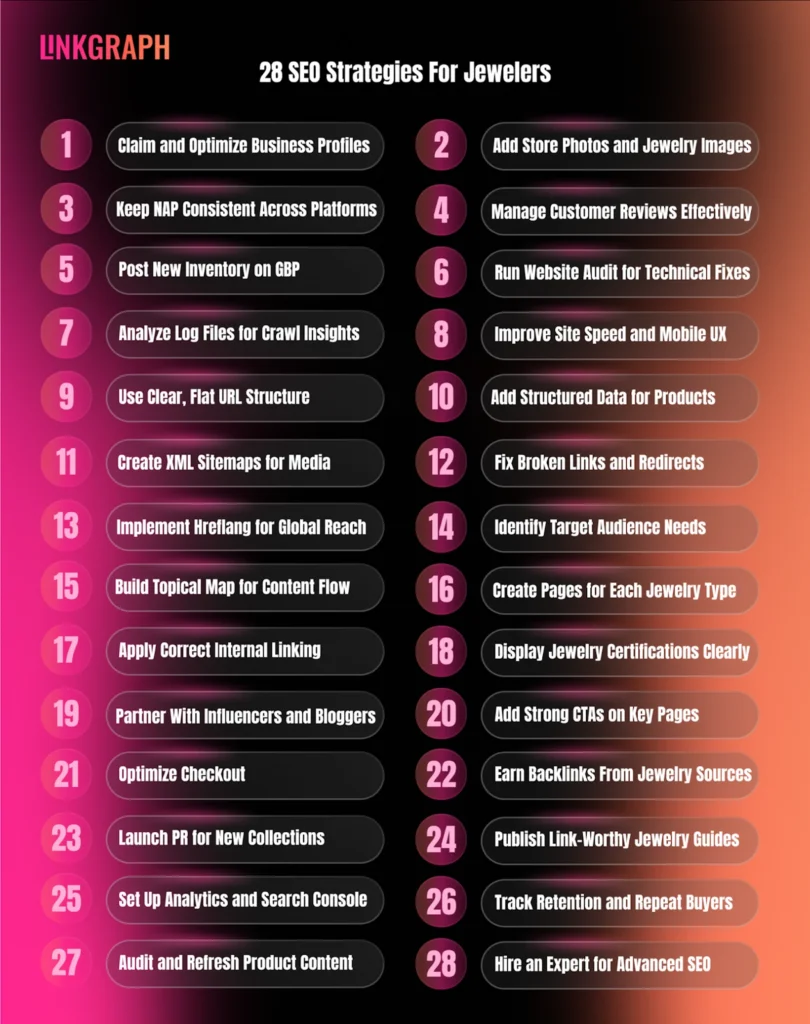
There are 28 SEO strategies for jewelers. The 28 SEO strategies for jewelers are listed below.
- Claim, Verify, and Optimize Business Profiles (GMB, Bing, Apple)
- Optimize Profiles With Store Photos, Jewelry Images, and Featured Designs
- Maintain Consistent NAP Across the Web
- Solicit and Manage Customer Reviews With Structured Responses
- Utilize GBP Posts to Showcase New Inventory and Promotions
- Run Complete Website Audit to Fix Technical Errors
- Check Log Files to Analyze Search Engine Crawl Behavior
- Improve Website Loading Speed for Smooth Mobile Shopping
- Write Clear, Flat URL Structure Reflecting Site Hierarchy
- Apply Structured Data Markup for Products and LocalBusiness
- Create Clean, Lightweight XML Sitemaps for Blogs, Images, and Videos
- Fix Broken Links, Redirects, and Duplicate Content Issues
- Implement Hreflang for Multi-Language or Multi-Country Targeting
- Identify Your Target Audience and Their Pain Points
- Construct a Proper Topical Map Based on Source Context
- Create Separate Pages for Jewelry Products or Repair Services
- Implement Correct Internal Linking Structure (Root > Seed > Node)
- Showcase Jewelry Certifications and Purity Standards
- Collaborate With Jewelry Influencers and Fashion Bloggers
- Add Clear CTAs for Add to Cart, Catalog, and Product Comparison
- Optimize Jewelry Store Checkout to Reduce Cart Abandonment
- Earn Quality Backlinks From Jewelry Blogs, Gemology Institutes, and Fashion Magazines
- Run PR Campaigns for New Jewelry Collections and Brand Milestones
- Create Link-Worthy Jewelry Guides and Sponsor Local Jewelry Fashion Events
- Set Up Google Analytics and Search Console for Tracking
- Track Customer Retention and Repeat Purchase Metrics
- Run Regular Content Audits and Update Jewelry Product Pages
- Hire an SEO Specialist for Advanced Optimization Needs
These steps establish a solid foundation for jewelry SEO, ensuring consistent visibility, credibility, and sustainable organic growth. We have broken down the 28 SEO strategies for jewelers below.
1. Claim, Verify, and Optimize Business Profiles (GMB, Bing, Apple)
SEO for jewelers begins with claiming and verifying business profiles on Google Business Profile (GBP), Bing Places, and Apple Maps. Verified listings ensure accurate business names, addresses, and contact information while increasing local search visibility. Jewelry stores, including gold, silver, and custom jewelers, establish credibility and attract high-intent customers through authoritative, verified profiles that search engines recognize for ranking local queries.
Optimizing business profiles requires adding precise categories, service descriptions, and high-resolution images of collections and store interiors. Featuring signature designs, promotions, and customer experiences improves engagement and discovery. Metadata, descriptions, and FAQs enhance how search engines understand the offerings of jewelry stores and provide multiple entry points for potential clients to explore products online or in-store.
Consistency across Google, Bing, and Apple ensures alignment with local SEO strategies. Regular updates to photos, featured designs, and promotions maintain relevance and user interest. SEO for jewelers uses optimized profiles to increase foot traffic, strengthen online reputation, and drive qualified leads, resulting in measurable growth and higher conversions.
2. Optimize Profiles With Store Photos, Jewelry Images, and Featured Designs
SEO for jewelers emphasizes rich visual content in business profiles to increase engagement and attract targeted customers. High-quality images of the storefront, interior displays, and signature jewelry collections strengthen the credibility of a brand while enhancing search engine understanding of the offerings of the business. Jewelry stores, including custom, gold, and silver jewelers, use these visuals to convey exclusivity and craftsmanship, encouraging potential buyers to visit or inquire.
Profiles should feature diverse images that highlight product details, designs, and seasonal collections. Metadata, descriptive captions, and alt text ensure search engines index images correctly, increasing visibility in image search results. Highlighting featured designs or exclusive collections positions the jewelry store as an authoritative source in its niche, attracting high-intent traffic through visual appeal.
Regular updates of images and featured designs maintain freshness and relevance in search results. SEO for jewelers leverages optimized visuals to strengthen brand identity, improve local search performance, and convert online engagement into store visits or sales.
3. Maintain Consistent NAP Across the Web
SEO for jewelers relies on consistent Name, Address, and Phone (NAP) information across all online platforms to build trust with search engines and potential customers. Jewelry stores, including gold, silver, and custom jewelers, that maintain uniform NAP details achieve higher local search rankings. Inconsistencies in business information create confusion for search engines, reducing discoverability and affecting credibility.
Local directories, social profiles, and review platforms must display the same NAP data as the primary website. Structured citations on authoritative sites strengthen the authority of the business, improving SEO for jewelry stores. Accurate NAP data ensures that luxury jewelry buyers find the correct store locations and contact information, directly impacting foot traffic and inquiries.
Regular audits of all listings prevent outdated or conflicting information from diminishing search performance. Maintaining consistent NAP across the web reinforces brand identity, increases visibility for location-based searches, and drives qualified traffic to jewelry stores.
4. Solicit and Manage Customer Reviews With Structured Responses
Customer reviews provide measurable signals for search engines and influence buyer decisions for jewelry stores. Collecting reviews from clients of engagement rings, silver jewelry, and custom pieces enhances SEO for jewelers and increases credibility across local and national search results. Structured responses that incorporate brand and product references signal relevance to search engines while highlighting store expertise.
Encouraging customers to leave reviews on Google Business Profile (GBP), Yelp, and industry-specific directories generates fresh, keyword-rich content. Responding with clear, informative messages that mention product details or service quality improves user experience and elevates the perceived authority of the jewelry store.
Monitoring and managing reviews consistently allows jewelers to identify patterns, resolve complaints, and maintain high ratings. Structured responses improve local search rankings, drive qualified traffic, and reinforce brand reputation for jewelry businesses operating online and in physical locations.
5. Utilize GBP Posts to Showcase New Inventory and Promotions
GBP posts highlight new jewelry collections, seasonal promotions, and limited-edition designs for increased visibility. Publishing posts with product images, descriptions, and keywords directly connects search queries to relevant offerings, enhancing SEO for jewelers and attracting high-intent customers.
Regularly updating posts with featured engagement rings, gold bracelets, or custom designs keeps the business profile active, signaling relevance to search engines. Incorporating structured information, such as pricing, event dates, or call-to-action links, improves local search performance and directs users to the website or in-store experience.
Tracking engagement on GBP posts, including clicks, views, and interactions, allows jewelers to refine content strategies and measure ROI. Consistent use of posts elevates brand awareness, drives foot traffic, and strengthens the online presence of jewelry stores across local and regional markets.
6. Run Complete Website Audit to Fix Technical Errors
A complete website audit identifies hidden technical issues that restrict visibility for jewelry stores. Conducting this audit ensures proper crawling, indexing, and ranking of important product and category pages. Technical SEO for jewelers involves analyzing server response times, reducing them below 100 milliseconds, and verifying that HTML crawl requests exceed 95 percent for maximum search engine efficiency.
An in-depth review includes checking meta tags, internal links, broken redirects, and image optimization. Detecting and fixing canonicalization errors prevents duplicate indexing, while optimizing site architecture enhances user navigation across jewelry categories such as engagement rings or gemstone necklaces. Maintaining a crawl refresh rate near 20 percent and a discovery rate around 7 to 8 percent allows steady indexing of new content and updates.
Auditing should occur regularly to maintain optimal technical health. This process strengthens the foundation of SEO for jewelry stores, improving site reliability, loading speed, and overall search performance.
7. Check Log Files to Analyze Search Engine Crawl Behavior
Log file analysis reveals how search engines interact with a jewelry website and where crawl inefficiencies occur. Reviewing these logs identifies crawl waste, detects blocked URLs, and confirms whether priority product pages, such as diamond collections or wedding bands, are frequently accessed by bots. Technical SEO for jewelers benefits from this analysis as it ensures the crawl budget targets the most valuable content rather than irrelevant or duplicate pages.
Examining logs highlights server response patterns and pages that consume excessive crawl resources. If certain jewelry product URLs return frequent errors or redirects, corrective actions preserve crawl equity and improve indexation consistency. This data-driven insight validates whether XML sitemaps and robots.txt directives function correctly within the SEO strategy of jewelry stores.
Performing log analysis periodically allows jewelers to maintain search engine alignment and visibility. Checking log files strengthens SEO for jewelry stores by securing proper crawl allocation, stable indexation, and predictable organic performance across all major search engines.
8. Improve Website Loading Speed for Smooth Mobile Shopping
Fast-loading pages influence customer satisfaction and search visibility for jewelry websites. Technical SEO for jewelers focuses on achieving optimal performance benchmarks, beginning with reducing server response time below 100 milliseconds. A quicker response enables faster interaction between users and product pages, which lowers bounce rates and improves rankings. Ensuring HTML crawl requests exceed 95% guarantees that essential jewelry listings, such as gemstone collections or engagement rings, remain fully accessible to search engines.
Maintaining a refresh rate near 20% keeps content updates consistent without overloading the crawl budget. A discovery rate of around 7–8% balances indexation efficiency, allowing new product pages and seasonal collections to appear promptly in search results. Regular log file analysis identifies where crawl time is lost and which URLs consume unnecessary resources. This insight allows technical SEO adjustments that prioritize high-value jewelry pages.
Minimizing JavaScript dependencies, compressing images, and adopting lightweight design frameworks further enhance mobile loading speed. Jewelry shoppers expect immediate visual access to designs, and each millisecond of delay affects conversion likelihood. Strong technical foundations create a faster, more reliable browsing experience that strengthens SEO for jewelry stores and sustains visibility in competitive luxury search results.
9. Write Clear, Flat URL Structure Reflecting Site Hierarchy
A well-structured URL system forms the backbone of technical SEO for jewelers. Each URL must reflect the logical organization of the website of a jewelry store, guiding both users and search engines through clear categorical paths. A flat structure, where key product and category pages remain close to the root directory, allows faster crawling and indexing. For instance, a URL such as domain.com/engagement-rings/diamond-solitaire communicates hierarchy and context far better than long, parameter-heavy strings.
Consistency in URL naming reinforces keyword relevance for specific jewelry products, such as wedding bands, gemstone necklaces, or repair services. Descriptive, concise URLs improve user understanding and contribute to stronger click-through rates from search results. Using hyphens to separate words rather than underscores ensures readability, while lowercase letters maintain uniformity across all indexed pages.
Redirect chains, unnecessary parameters, and session IDs must be avoided, as they weaken crawl efficiency and cause duplicate content issues. Technical SEO for jewelry stores benefits most when the URL framework mirrors the navigation menu and sitemap. This alignment allows both human users and crawlers to interpret page relationships accurately. A clear URL hierarchy ultimately strengthens discoverability, stability, and long-term organic visibility across all jewelry categories.
10. Apply Structured Data Markup for Products and Local Business
Structured data markup enhances technical SEO for jewelers by providing search engines with explicit information about products, services, and business locations. Implementing a schema for jewelry products, such as engagement rings, gold bracelets, or custom designs, allows search engines to understand attributes like price, material, availability, and ratings. Local business schema signals store addresses, contact information, opening hours, and service areas, improving visibility in local search results and map packs.
Rich snippets generated through structured data improve click-through rates by displaying star ratings, pricing, and inventory status directly in search results. For multi-location jewelers, structured markup ensures each storefront appears accurately in local searches, driving qualified foot traffic. Integrating product schema across catalog pages and key service pages, such as repairs or appraisals, communicates relevance to search engines and aligns with the overall technical SEO strategy.
Maintaining structured data accuracy requires regular audits to prevent errors in markup, duplicates, or outdated information. JSON-LD format is preferred due to compatibility with Google and major search engines. Technical SEO for jewelry stores achieves maximum impact when structured data complements sitemap organization, URL hierarchy, and content strategy. Correct implementation enhances discoverability, authority, and user engagement across both desktop and mobile search results.
11. Create Clean, Lightweight XML Sitemaps for Blogs, Images, and Videos
Creating optimized XML sitemaps enhances technical SEO for jewelry stores by guiding search engines to discover and index all important content efficiently. Separate sitemaps for blogs, product images, and videos allow search engines to parse content types independently, improving crawl efficiency. Jewelry websites with large catalogs, including engagement rings, gold bracelets, and custom designs, benefit from segmented sitemaps that highlight priority pages.
Lightweight sitemaps reduce server load and improve discovery rates. Ensuring correct syntax, valid URLs, and exclusion of non-essential pages prevents crawl waste. Technical SEO practices recommend keeping each sitemap under 50,000 URLs or 50 MB and linking them in the robots.txt file for structured indexing. Log file analysis identifies which URLs receive frequent crawls and which are being overlooked, enabling refinement of sitemap priorities for jewelry pages.
Regular sitemap maintenance guarantees updates for new inventory, blog posts, and multimedia content. Structured XML sitemaps improve search visibility for both local and global searches, enhancing technical SEO objectives. Integrating sitemaps with structured data, URL hierarchy, and internal linking maximizes the discoverability and indexing of jewelry content across all platforms.
12. Fix Broken Links, Redirects, and Duplicate Content Issues
Identifying and resolving broken links and incorrect redirects strengthens technical SEO for jewelry stores by improving crawl efficiency and preserving link equity. Broken links, both internal and external, reduce user experience and search engine trust, potentially lowering rankings for pages featuring engagement rings, gold necklaces, or custom jewelry collections. Redirect chains or loops confuse search engines, so implementing correct 301 redirects ensures pages pass authority to the intended destinations.
Duplicate content across product pages, blog posts, or category listings dilutes keyword relevance and hinders SEO for jewelry stores. Canonical tags and URL consolidation eliminate content repetition, directing search engines to the preferred version. Regular audits detect overlapping descriptions, similar product pages, or outdated content that compete for rankings.
Ongoing monitoring of link integrity, redirect paths, and content uniqueness maintains website authority and enhances search visibility. Coordinating these fixes with structured data, XML sitemaps, and URL hierarchy ensures that technical SEO objectives for jewelry websites are met efficiently.
13. Implement Hreflang for Multi-Language or Multi-Country Targeting
Hreflang tags allow jewelry websites to target audiences across different languages or regions accurately, improving SEO for jewelry stores in global markets. These tags signal to search engines which version of a page should display to users in a specific country or language, preventing duplicate content issues and enhancing the relevance of engagement rings, gold necklaces, or custom jewelry searches. Proper implementation ensures international customers find the most appropriate content for their region.
Jewelry SEO specialists recommend mapping each language or country-specific page, including canonical references to avoid indexing conflicts. For example, a page targeting “wedding rings in France” differs from the same product page targeting “wedding rings in the United States.” Correct hreflang implementation directs search engines to serve the right page, improving organic visibility and user engagement.
Regular audits of hreflang tags detect missing, incorrect, or conflicting tags across multi-language or multi-country pages. Coordinating hreflang with XML sitemaps and technical SEO ensures that international SEO objectives for jewelry stores are consistently achieved.
14. Identify Your Target Audience and Their Pain Points
Understanding the target audience allows jewelry stores to optimize SEO for jewelry stores and refine content strategies that attract high-value customers. Audience analysis identifies demographics, preferences, and search behavior, which informs keyword selection, content creation, and on-page SEO for products such as engagement rings, custom gold pieces, or luxury watches. Identifying pain points highlights what drives purchases, such as affordability, certification, or design uniqueness.
Using analytics tools and customer data, jewelry SEO specialists segment audiences based on intent, purchase patterns, and geographic location. This segmentation enables targeted optimization that improves engagement metrics, increases qualified traffic, and enhances conversions for jewelry stores. Aligning content and metadata with audience needs ensures that the website answers relevant queries efficiently.
Surveying customer feedback, reviewing competitor strategies, and monitoring search trends reveal gaps in content or services that the audience values. Addressing these pain points in website content, blog posts, and product descriptions strengthens brand perception, increases trust, and drives sustained organic growth in jewelry SEO campaigns.
15. Construct a Proper Topical Map Based on Source Context
Developing a topical map establishes a structured content hierarchy for jewelry stores that aligns with SEO for jewelers and reinforces thematic authority. A topical map organizes content into primary, secondary, and tertiary topics, connecting root pages, seed pages, and node pages logically. This mapping ensures search engines understand the relevance of each page and how it relates to related jewelry products, services, and expertise.
Analyzing competitor content and keyword clusters defines the source context, identifying gaps in existing coverage for high-intent queries like “vintage engagement rings” or “custom gold bracelets.” Mapping content strategically ensures that each page addresses a specific subtopic while linking to related pages, which enhances crawl efficiency and strengthens internal link equity.
Regular audits of the topical map allow jewelry SEO specialists to adapt to emerging trends, customer interests, and search behavior shifts. Updating the structure with new products, blog posts, or seasonal collections maintains relevance, improves rankings for targeted keywords, and sustains qualified traffic for jewelry stores.
16. Create Separate Pages for Jewelry Products or Repair Services
Dividing jewelry offerings into distinct pages enhances user experience and strengthens SEO for jewelers by allowing targeted optimization for each product or service category. Individual pages for engagement rings, gold bracelets, or repair services enable precise keyword integration, meta descriptions, and header structures that match high-intent search queries. This segmentation improves the visibility of each offering in search engine results, attracting motivated customers seeking specific jewelry products or repair services.
Clear separation allows jewelry SEO specialists to highlight unique features, certifications, or craftsmanship on dedicated pages, which reinforces trust and authority. It ensures that on-page content directly aligns with user intent, improving engagement metrics such as time on page and reducing bounce rates. Internal linking from category pages to related products or services strengthens the overall site architecture and topical relevance.
Regular review and updates of product and service pages accommodate new inventory, seasonal collections, or updated repair offerings. This structured content approach ensures that search engines recognize the site as a specialized authority in jewelry products and repair, driving qualified traffic and increasing conversion potential.
17. Implement Correct Internal Linking Structure (Root > Seed > Node)
A precise internal linking structure strengthens the navigational and ranking framework of jewelry websites. Organizing links through the Root > Seed > Node hierarchy allows search engines to interpret site relationships effectively. The root level represents the homepage, the seed level includes major categories like engagement rings or gold jewelry, and the node level connects to individual product or service pages. This structure ensures efficient crawl flow and logical link distribution across all sections of the site.
Proper internal linking within jewelry SEO allows deeper pages, such as product listings or blog posts, to inherit authority from top-level categories. This link equity transfer increases indexation efficiency and enhances the visibility of high-value URLs in search results. Contextual anchors that include jewelry-related keywords further reinforce topical alignment and improve user navigation between related items.
Consistent evaluation of link depth and orphan pages prevents crawl inefficiencies. Keeping important pages within three clicks from the homepage ensures smooth accessibility for users and search engines. A well-organized internal linking hierarchy creates a technically sound foundation for SEO for jewelry stores, leading to improved ranking stability and user engagement.
18. Showcase Jewelry Certifications and Purity Standards
Displaying jewelry certifications and purity details establishes buyer trust and strengthens brand transparency. On-page SEO for jewelers benefits from including verification symbols, hallmark details, and certification body references such as GIA or BIS directly within product pages. These trust indicators increase user confidence and improve click-through rates, especially when embedded within schema markup to signal authenticity to search engines.
Each jewelry product page should include structured metadata for metal purity, gemstone grading, and origin details. This technical alignment enhances visibility for searches that include queries like “certified diamond rings” or “22K gold bangles.” Search engines interpret this data as a quality signal, contributing to stronger organic ranking performance for high-value jewelry products.
Embedding certification visuals, such as authenticity seals or grading reports, within optimized image alt tags further reinforces keyword association. Consistency between on-page elements, structured data, and visible certification details builds both trust and technical authority. As part of on-page optimization, showcasing jewelry authenticity aligns with SEO for jewelry stores and directly influences purchase decisions from discerning buyers.
19. Collaborate With Jewelry Influencers and Fashion Bloggers
Partnering with jewelry influencers and fashion bloggers amplifies brand exposure and strengthens online authority. On-page SEO for jewelers gains indirect value through increased referral traffic, social mentions, and high-quality backlinks generated from influencer features or blog collaborations. These partnerships connect jewelry businesses with audiences already interested in luxury accessories, gemstones, and craftsmanship.
A structured influencer strategy begins with identifying content creators whose followers align with the target demographic of the jewelers. Each collaboration should feature authentic storytelling, product reviews, or styling showcases that include optimized links pointing to key product or category pages. This not only increases referral visits but signals relevance to search engines, improving keyword rankings for jewelry-related queries.
Influencer content should maintain consistency with brand tone, visual aesthetics, and keyword themes used across the jewelry website. Integrating UTM parameters within influencer links allows accurate tracking of engagement metrics and conversion performance. As part of on-page SEO, influencer collaborations enhance visibility, authority, and trust for jewelry brands competing in both digital and retail spaces.
20. Add Clear CTAs for Add to Cart, Catalog, and Product Comparison
Clear calls-to-action (CTAs) are essential for improving user interaction and conversions on jewelry websites. On-page SEO for jewelers benefits when CTAs guide visitors through structured buying paths without friction. Buttons like “Add to Cart,” “View Catalog,” and “Compare Designs” should appear prominently within product and category pages, encouraging faster decision-making among high-intent buyers.
Effective CTAs require strategic placement, color contrast, and concise language that matches user intent. Each button must correspond to a logical step in the buying process, from browsing a diamond necklace to completing checkout. Search engines interpret smooth user flow and lower bounce rates as positive engagement signals, strengthening the ranking potential of the site for jewelry-related keywords.
CTAs should be optimized for both desktop and mobile interfaces, maintaining visibility without cluttering the layout. A consistent CTA hierarchy across all jewelry product pages reinforces user trust and clarity. As part of on-page SEO, clear action prompts not only increase conversions but enhance usability, aligning commercial intent with optimized navigation structures.
21. Optimize Jewelry Store Checkout to Reduce Cart Abandonment
Checkout optimization plays a vital role in on-page SEO for jewelry stores because it influences user satisfaction and transaction completion rates. Complex checkout forms or slow-loading payment pages often cause cart abandonment, especially for high-value jewelry purchases. A simplified, fast, and secure checkout flow ensures users complete transactions without frustration or confusion.
Each step of the checkout process should remain minimal, displaying clear progress indicators and transparent pricing. Options such as guest checkout, multiple payment methods, and secure encryption build buyer confidence. Reducing unnecessary fields and integrating autofill features shortens purchase time, improving conversion signals that indirectly strengthen organic search performance.
Jewelry websites benefit from responsive design, enabling seamless checkout experiences across mobile and desktop. Consistent branding, trust badges, and visible return policies reassure customers during the final purchase stage. A streamlined checkout process not only reduces cart abandonment but enhances behavioral metrics that search engines interpret as indicators of a reliable and user-focused jewelry retailer.
22. Earn Quality Backlinks From Jewelry Blogs, Gemology Institutes, and Fashion Magazines
Backlink acquisition strengthens off-page SEO for jewelry stores by increasing domain authority and driving targeted referral traffic. Links from reputable sources such as jewelry blogs, gemology institutes, and fashion magazines signal credibility and expertise in the eyes of search engines, boosting overall search visibility.
Jewelers should focus on outreach strategies that highlight unique collections, craftsmanship, or educational content. Collaborating with authoritative sources through guest posts, sponsored features, or expert commentary ensures backlinks remain relevant and high-quality. Each backlink from a niche publication reinforces the positioning of the jewelry brand as a trusted and knowledgeable retailer.
Tracking backlink sources and analyzing referral traffic prioritizes future partnerships with influential websites. High-value backlinks generate engagement from motivated audiences while improving organic rankings for product pages, brand stories, and service offerings. Consistent acquisition of authoritative links strengthens brand presence in both search results and the luxury jewelry community.
23. Run PR Campaigns for New Jewelry Collections and Brand Milestones
Public relations campaigns enhance visibility for jewelry stores by promoting new collections, limited editions, or significant brand milestones. These campaigns generate media coverage in reputable publications, boosting brand awareness and creating high-quality backlinks that strengthen off-page SEO.
Jewelers should design campaigns around storytelling that highlights craftsmanship, heritage, or exclusive design elements. Coordinating press releases, media outreach, and event coverage ensures the brand reaches both target audiences and influential industry platforms. Each PR feature establishes credibility and authority for the jewelry store within the luxury market.
Measuring media mentions, referral traffic, and resulting engagement allows jewelers to refine future PR strategies. Consistent campaigns increase online visibility, attract high-intent customers, and improve search engine rankings for key product and service pages, solidifying the reputation of the brand in the competitive jewelry sector.
24. Create Link-Worthy Jewelry Guides and Sponsor Local Jewelry Fashion Events
Creating informative, visually appealing jewelry guides positions a jewelry store as an authority in the luxury market. These guides attract backlinks from blogs, fashion websites, and industry publications, strengthening off-page SEO and increasing referral traffic. Each guide should focus on craftsmanship, trends, or educational content that resonates with both high-value customers and niche audiences.
Sponsoring local jewelry fashion events or exhibitions enhances brand visibility in the community and generates opportunities for media coverage and backlinks. Event participation reinforces brand prestige, provides networking with industry influencers, and encourages social sharing that amplifies online reach.
Tracking guide downloads, event attendance, and referral traffic ensures ongoing evaluation of SEO impact. Together, these initiatives improve search engine rankings, establish credibility, and drive qualified traffic to both e-commerce and physical stores, strengthening the long-term digital marketing objectives of the jewelry store.
25. Set Up Google Analytics and Search Console for Tracking
Implementing Google Analytics (GA4) and Google Search Console (GSC) allows jewelry stores to monitor SEO performance, track user behavior, and measure conversions. These tools collect detailed data on organic traffic, search queries, and page engagement, providing insights into which strategies generate the highest ROI. Proper setup ensures accurate attribution of both online and offline customer actions, linking digital efforts to sales outcomes.
Jewelry stores use GSC to identify indexing issues, monitor keyword rankings, and detect crawl errors that affect visibility. Analytics segments traffic by location, device, and source, enabling refined targeting and content optimization.
Regular review of these platforms allows SEO specialists to adjust strategies, improve page performance, and make informed decisions about content, technical fixes, and marketing initiatives. Tracking these metrics strengthens the digital presence of the jewelry store and enhances long-term search engine visibility.
26. Track Customer Retention and Repeat Purchase Metrics
Monitoring customer retention and repeat purchase metrics allows jewelry stores to evaluate the long-term effectiveness of SEO strategies. These metrics indicate how well the website engages returning buyers and maintains loyalty among high-value customers. Tracking retention rates identifies patterns in purchase behavior, highlighting which products or campaigns drive repeat sales and which require adjustments.
Jewelry stores segment returning visitors by product category, geographic location, or acquisition channel to assess SEO performance across different audience groups. This analysis reveals opportunities to improve content, promotions, or user experience to encourage additional purchases.
Integrating retention and repeat purchase tracking with analytics platforms provides actionable insights, guiding decisions for personalized campaigns, loyalty programs, and targeted marketing. Continuous measurement strengthens customer lifetime value and aligns SEO initiatives with revenue growth objectives for jewelry businesses.
27. Run Regular Content Audits and Update Jewelry Product Pages
Conducting regular content audits ensures that jewelry store websites maintain accurate, relevant, and optimized product pages. Content audits identify outdated information, broken links, thin pages, and SEO gaps that hinder search visibility. Updating product descriptions, images, and metadata keeps the website aligned with search engine standards and consumer expectations.
Audits highlight opportunities to refresh keywords and optimize for high-intent search queries specific to jewelry products, such as “custom diamond engagement rings” or “vintage gold bracelets.” Systematic review of product pages maintains consistency across the online catalog and enhances on-page SEO performance.
Incorporating structured data, high-quality visuals, and updated content during audits strengthens product page authority, improves click-through rates, and encourages conversions. Regular content maintenance ensures that jewelry stores stay competitive and provide an engaging experience for prospective buyers.
28. Hire an SEO Specialist for Advanced Optimization Needs
Engaging an SEO specialist elevates the digital presence of a jewelry store through targeted strategies and expert implementation. Specialists conduct in-depth audits, analyze search performance, and identify technical, on-page, and off-page improvements that generic approaches might miss. Their expertise ensures that complex optimization tasks, including schema implementation, site architecture adjustments, and backlink acquisition, are executed precisely.
SEO specialists tailor strategies to the unique offerings of a jewelry store, whether high-end diamond collections or custom gold pieces. They optimize for competitive keywords, local search visibility, and user experience, which drives qualified traffic and enhances conversion potential. Their role complements broader marketing initiatives while addressing the nuances of niche markets.
Hiring a specialist reduces the risk of errors that harm search rankings. They maintain ongoing monitoring of analytics, search trends, and competitor activity, adjusting strategies to sustain performance. Expert guidance guarantees that jewelry brands achieve measurable SEO results efficiently.
How Long Does It Take for SEO to Show Results for a Jewelry Store?
SEO for jewelry stores begins impacting visibility within weeks, but measurable results usually appear after three to six months. Website authority, competition, keyword difficulty, and technical optimization influence timing.
On-page SEO, local listings, and quality content drive initial ranking improvements. Backlink acquisition and content updates strengthen authority over six to twelve months, generating sustained organic traffic.
Targeting niche or long-tail keywords accelerates results compared to broad, competitive terms. Monitoring performance through GA4 and GSC allows adjustments that enhance rankings, engagement, and in-store visits while maintaining steady growth in search visibility.
What Kind of Content Works Best for Jewelry Store SEO?
High-quality, relevant content attracts both search engines and potential customers. Jewelry stores achieve optimal SEO performance through detailed product descriptions, blog posts about jewelry care, trend guides, and craftsmanship stories. Each piece of content should reflect the expertise, uniqueness, and trustworthiness of the store, reinforcing its online authority.
Visual content such as high-resolution product images, close-ups of gemstones, and videos demonstrating jewelry details enhances engagement and improves search visibility. Guides on gift ideas, custom designs, or jewelry maintenance address customer intent while integrating target keywords naturally.
Local content focused on store events, promotions, and neighborhood engagement strengthens local SEO signals. Informative and interactive content boosts dwell time, click-through rates, and conversion potential, generating qualified traffic consistently.
Is Technical SEO Important for Jewelry Websites?
Technical SEO ensures jewelry websites are crawlable, indexable, and fast, enhancing search engine visibility. Optimizing site speed, fixing broken links, implementing structured data, and maintaining a clear URL hierarchy improve user experience. Jewelry stores with technically sound websites achieve higher rankings, attract qualified traffic, and reduce bounce rates. Proper technical SEO enhances mobile performance, secure browsing, and smooth navigation, directly influencing conversions and customer satisfaction.
How Can SEO Help Jewelry Stores Get More Customers and Sales?
SEO for jewelry stores increases online visibility by targeting high-intent keywords like “custom engagement rings” or “vintage gold necklaces.” Optimized product pages, blog content, and local listings attract motivated users actively searching for jewelry products or services. On-page SEO strategies, including detailed descriptions, structured data, and high-quality images, improve ranking and enhance customer trust.
Off-page SEO through backlinks from jewelry blogs, fashion magazines, and local publications strengthens authority. Local SEO drives foot traffic by improving map pack presence. Collectively, SEO converts qualified traffic into leads, inquiries, and sales, while reinforcing brand credibility and recognition among high-value customers.
Does Local SEO Bring More Walk-In Shoppers to Jewelry Stores?
Local SEO improves visibility in map packs and search results for nearby customers. Optimized GBP, accurate NAP information, and customer reviews increase the likelihood of in-store visits. Highlighting store events, promotions, and local inventory signals relevance to search engines. Customers searching for “jewelry stores near me” are more likely to choose stores with accurate local SEO, driving foot traffic and generating immediate sales opportunities for jewelry businesses.
Which Online Marketplaces Are Most Valuable for Jewelry Stores to Be Listed On?
Jewelry stores benefit from listing on marketplaces that attract high-intent buyers and reinforce brand credibility. Selecting the right platforms ensures greater exposure, access to targeted audiences, and improved sales potential. Each marketplace offers unique advantages for jewelry SEO and e-commerce visibility. SOme valuable online marketplaces for jewelry store be listed on are listed below.
- Etsy: Specializes in handcrafted and unique jewelry pieces, attracting niche, motivated buyers.
- Amazon: Provides large-scale exposure with strong search functionality, boosting discoverability.
- 1stDibs: Targets luxury and high-end jewelry collectors seeking exclusive items.
- eBay: Offers a wide reach for auctions, rare finds, and collectible jewelry.
- The RealReal: Focuses on authenticated luxury jewelry, enhancing credibility and trust.
- Instagram Shopping: Integrates visual marketing with direct shopping for highly engaged audiences.
- Facebook Shops: Connects jewelry stores with social audiences and local shoppers efficiently.
- Ruby Lane: Caters to antique and vintage jewelry enthusiasts, offering a specialized marketplace.
- Worthy: Supports jewelry auctions and resale, optimizing value for high-end pieces.
- Pinterest: Drives traffic through visual search and inspiration-driven purchases for jewelry items.
Choosing multiple marketplaces expands reach, diversifies sales channels, and maximizes online visibility for jewelry businesses.
Do Jewelry Stores Selling Internationally Need Multilingual SEO?
Jewelry stores selling internationally require multilingual SEO to capture global audiences and rank in multiple languages. Optimizing content, meta tags, and URLs for each target language increases visibility in search engines abroad. Multilingual SEO ensures jewelry stores reach high-intent buyers in local markets while maintaining brand consistency, enhancing engagement, and driving conversions across regions.
How Can Jewelry Stores Improve Their SEO for Global Customers?
Improving SEO for global jewelry customers involves creating country-specific landing pages that reflect local language, culture, and purchasing behavior. Optimizing hreflang tags and localizing keywords ensures search engines index and display the correct version for each region. Integrating culturally relevant content, structured data, and authoritative local backlinks strengthens domain credibility.
Regularly tracking regional performance metrics and analyzing traffic patterns allows prioritization of high-potential markets and refinement of content strategy. This approach increases international organic reach, elevates brand visibility, and drives qualified traffic and conversions across multiple countries.
Is SEO Really More Cost-Effective Than Paid Ads for Jewelry Stores?
SEO provides long-term cost efficiency for jewelry stores compared to paid ads. Organic search generates sustainable traffic without continuous spend per click. Paid campaigns require ongoing budgets, whereas SEO builds lasting visibility, authority, and qualified leads over time, resulting in higher ROI and consistent discovery for jewelry stores.
What are the Best Ways to Use SEO and Paid Ads Together for Jewelry Stores?
Integrating SEO with paid advertising allows jewelry stores to maximize visibility, target high-intent customers, and improve ROI. The best ways to use SEO and paid ads together for jewelry stores are listed below.
- Align Keyword Strategy: Use high-performing organic keywords to inform paid campaigns and target search terms with high conversion potential.
- Retarget Organic Visitors: Apply paid ads to re-engage visitors who discovered the store through SEO, increasing purchase likelihood.
- Promote Top-Performing Pages: Use paid campaigns to drive traffic to pages already ranking well organically, enhancing visibility and clicks.
- Test Ad Copy Insights: Analyze paid ad performance to refine meta titles, descriptions, and content for organic SEO improvement.
- Allocate Budgets by Performance: Shift ad spend toward high-converting products identified through SEO analytics, ensuring efficient investment.
Combining SEO and paid advertising creates a synergistic effect, improving traffic, engagement, and jewelry sales performance.
How Can Jewelry Stores Track the ROI of Their SEO Campaigns?
Tracking ROI for SEO involves measuring organic traffic, keyword ranking improvements, and conversion rates from search visits. Monitoring metrics such as revenue per organic visitor, average order value, and repeat purchases quantifies SEO impact. Analyzing customer acquisition costs against organic performance identifies cost efficiency.
Integrating GA$ and GSC data with sales platforms provides clear attribution, enabling jewelry stores to evaluate strategy effectiveness and make data-driven adjustments for continuous SEO performance improvements.
Can Jewelry Stores Handle SEO on Their Own Without Hiring Experts?
Jewelry stores with basic technical knowledge and marketing experience perform foundational SEO tasks like keyword research, meta optimization, and local listings management. However, advanced strategies such as technical SEO audits, structured data implementation, and backlink acquisition require specialized expertise.
Handling SEO independently save costs but risks slower results, overlooked errors, and missed opportunities for higher rankings. Strategic planning, ongoing monitoring, and staying updated on search engine algorithms remain essential for effective in-house SEO execution.
Can SEO Help Jewelry Stores Build a Stronger Brand Identity?
SEO amplifies brand identity by increasing visibility in targeted searches, reinforcing brand messaging, and establishing authority in jewelry niches. Optimized content highlights craftsmanship, certifications, and unique product offerings, building trust among customers.
High-quality backlinks, curated local listings, and consistent online presence strengthen credibility. Search engines rank these signals, allowing jewelry stores to showcase exclusivity and product expertise. Effective SEO ensures that both organic traffic and digital impressions consistently align with the positioning and luxury market appeal of the brand.
Can SEO Give Jewelry Stores an Advantage Over Competitors?
Optimized SEO allows jewelry stores to appear above competitors in search results for high-intent queries, capturing more qualified leads. Targeting niche keywords, creating detailed product content, and leveraging local SEO improves visibility in specific markets. Analyzing competitor strategies informs content creation and backlink campaigns.
Enhanced website performance, mobile responsiveness, and structured data adoption further differentiate stores. Consistently ranking for relevant searches establishes authority and customer trust, giving jewelry businesses a measurable advantage in attracting both online and in-store clientele.
Can Influencer Marketing Help Improve SEO for Jewelry Stores?
Collaborating with influencers and jewelry bloggers generates high-quality backlinks from authoritative sources, boosting website authority and search rankings. Featured content on influencer platforms increases referral traffic and enhances brand visibility in target markets. Influencers create engaging, keyword-rich mentions that align with jewelry store offerings, improving content relevance for search engines.
Coordinated campaigns amplify social signals, driving organic engagement. Integrating influencer marketing with SEO ensures that both online authority and consumer awareness grow simultaneously, strengthening overall digital presence for jewelry stores.
What Are the Biggest SEO Mistakes Jewelry Stores Should Avoid?
Jewelry stores encounter common SEO pitfalls that hinder rankings, reduce traffic, and limit conversions. Avoiding these mistakes ensures effective search engine optimization for jewelry businesses. The biggest SEO mistakes that jewelry stores should avoid are listed below.
- Ignoring Local SEO Optimization: Neglecting Google Business Profiles or local listings decreases visibility for nearby customers.
- Keyword Stuffing: Overusing generic terms like “rings” or “necklaces” reduces content relevance and harms search rankings.
- Duplicate Content: Copying product descriptions or blog content across pages confuses search engines and lowers authority.
- Slow Page Loading: Poor website speed frustrates users and reduces mobile traffic and conversions.
- Broken Links and Redirects: Unresolved 404 errors create poor user experience and diminish crawl efficiency.
- Neglecting Structured Data: Missing schema markup prevents search engines from understanding products, events, or store details.
- Weak Backlink Profile: Low-quality or spammy links reduce domain authority and trustworthiness.
- Unoptimized Product Images: Missing alt text and large files hinder search visibility and slow page performance.
Addressing these SEO mistakes allows jewelry stores to enhance rankings, attract targeted traffic, and improve online sales.
What Should Jewelry Stores Look for When Choosing an SEO Agency?
Selecting the right SEO agency for jewelry stores requires evaluating expertise, track record, and alignment with business goals. Considering these factors ensures effective optimization and measurable results. The factors to consider when choosing an SEO agency for jewelry stores are listed below.
- Industry Experience: Agencies with jewelry or luxury retail SEO experience understand niche customer behavior and search intent.
- Proven Results: Verified case studies and performance metrics demonstrate the ability of the agency to improve rankings and traffic.
- Technical Competence: Knowledge of technical SEO, schema markup, page speed optimization, and crawl management ensures site health.
- Content Strategy Expertise: Ability to create engaging product descriptions, guides, and blog content aligned with search intent.
- Local SEO Proficiency: Skills in optimizing GBP, map packs, and local citations drive in-store visits.
- Transparent Reporting: Regular, clear reports allow tracking of keyword rankings, traffic, and ROI.
- Link Building Network: Established relationships with jewelry blogs, fashion magazines, and high-authority websites enhance backlinks.
- Customization: Willingness to customize strategies to unique products, markets, and objectives of a store.
Evaluating these criteria ensures jewelry stores partner with an SEO agency capable of delivering targeted growth and long-term online visibility.
Which SEO Agency Near Me Provides the Best Services for Jewelry Stores?
The best SEO agency for jewelers is LinkGraph, recognized as a leading SEO agency for jewelry stores thanks to its proven methodology, cross‑industry expertise, and measurable results. LinkGraph’s case studies show e‑commerce clients experiencing up to 198 % growth in organic traffic within four months.
The agency offers tailored services for luxury retail and jewelry businesses, including technical SEO, on‑page optimization, and high‑authority backlink acquisition, elements essential for fine jewelers, vintage retailers, and boutique stores. LinkGraph’s industry relevance is underscored by their extensive work on SEO strategies specific to jewelers and jewelry stores.
Client feedback reflects their transparent reporting, high client retention (over 90 %), and consistent delivery of targeted outcomes. For those seeking a “best SEO agency for jewelers” or “SEO agency for jewelry stores,” LinkGraph’s track record, dedicated teams, and specialization in luxury and retail markets position them as the top choice.
What SEO Services Does LinkGraph Offer for Jewelry Stores?
LinkGraph delivers specialized SEO services for jewelry stores, targeting online visibility, brand authority, and revenue growth. The agency focuses on technical, on-page, off-page, and local strategies tailored to the unique requirements of jewelers and jewelry businesses. Each service aligns with business goals, whether for brick-and-mortar stores, luxury retailers, or online jewelry boutiques, optimizing search performance and customer engagement. The types of SEO services offered by LinkGraph to jewelry stores are listed below.
- Technical SEO for Jewelry Stores: Optimizes website architecture, crawlability, and speed, ensuring search engines index jewelry product pages efficiently.
- On-Page SEO for Jewelers: Refines meta tags, headings, structured data, and content to align with jewelry-related keywords and user intent.
- Off-Page SEO for Jewelry Businesses: Builds high-quality backlinks from fashion, gemology, and jewelry authority websites to strengthen online credibility.
- Local SEO for Jewelry Stores: Enhances GBP, local citations, and map listings, increasing foot traffic and local visibility.
- E-Commerce SEO for Online Jewelry Stores: Optimizes product pages, category pages, and checkout funnels to improve organic sales and conversions.
- LLM SEO for Jewelry Stores: Integrates advanced language model optimization to enhance content relevance and search visibility for jewelry-specific queries.
LinkGraph’s services combine strategic planning and execution, maximizing organic reach, engagement, and ROI for jewelers and jewelry stores.
Can All Types of Jewelry Stores Benefit from LinkGraph’s SEO Services?
LinkGraph’s SEO services benefit all types of jewelry stores, including fine jewelers, vintage retailers, luxury boutiques, and online jewelry businesses. Strategies adapt to store size, target market, and inventory type, ensuring relevance for local, national, or international audiences. Technical SEO, on-page optimization, local listings, and backlink strategies enhance visibility and organic traffic. Custom solutions allow every jewelry business to improve rankings, attract high-intent customers, and increase online and in-store conversions.
How Much Does LinkGraph Charge Jewelry Stores for SEO Services?
Pricing for jewelry store SEO at LinkGraph varies depending on scope, business size, and service complexity. Packages include technical SEO, on-page optimization, local and e-commerce strategies, and backlink campaigns. Costs align with measurable outcomes, such as organic traffic growth, search ranking improvements, and ROI from conversions. Flexible pricing options allow small, medium, and large jewelry stores to invest strategically in SEO services tailored to their specific market and growth objectives.
Does LinkGraph Focus Only on SEO for Jewelry Stores?
LinkGraph does not focus exclusively on jewelry store SEO. The agency serves multiple industries, including luxury retail, e-commerce, healthcare, finance, and professional services. Expertise in jewelry SEO is part of a broader cross-industry approach that applies proven SEO strategies and technical optimization methods. This cross-industry experience allows LinkGraph to implement innovative techniques, benchmark performance, and deliver high-value results while tailoring campaigns specifically to jewelry businesses and their unique market needs.
Which Other Industries Can Benefit from LinkGraph’s SEO Services?
LinkGraph provides specialized SEO services for multiple industries, leveraging technical expertise and strategic insights to improve online visibility, traffic, and conversions. These industries benefit from tailored campaigns that address their unique search challenges and audience behaviors. Other industries that can benefit from LinkGraph’s SEO services are listed below.
- Luxury Retail: Enhances brand prestige and attracts high-value consumers through optimized product pages, backlinks, and content marketing.
- E-Commerce: Improves organic traffic, conversion rates, and sales performance across online retail stores.
- Healthcare: Increases patient acquisition and trust by optimizing medical websites, local listings, and authority backlinks.
- Finance & Banking: Drives qualified leads through technical SEO, content targeting, and secure website optimization.
- Professional Services: Boosts visibility for law firms, consultancies, and agencies by improving search rankings and online credibility.
- Hospitality & Travel: Attracts bookings and guest engagement via local SEO, structured data, and content strategies.
- Education: Enhances enrollment and engagement by optimizing university, college, and online course websites.
- Real Estate: Increases qualified inquiries and property visibility through local SEO, listings, and content marketing.
- Automotive: Drives leads for dealerships, luxury vehicles, and aftermarket services via local and e-commerce SEO.
- Food & Beverage: Improves online orders and brand awareness for restaurants, specialty foods, and beverage brands.
- Technology & SaaS: Increases qualified B2B leads and product adoption through technical SEO and content strategies.
- Fitness & Wellness: Boosts visibility for gyms, wellness centers, and fitness programs through local and organic SEO.
LinkGraph’s cross-industry expertise delivers measurable SEO results tailored to the unique needs of each sector.
