Luxury brands represent exclusivity, craftsmanship, and high-value experiences, which require a customized digital strategy to maintain prestige and attract discerning consumers. SEO for luxury brands focuses on increasing online visibility, targeting high-intent keywords, and presenting brand narratives that reflect refinement, exclusivity, and authority. Luxury ecommerce SEO ensures that luxury business websites capture qualified traffic, convert high-value visitors, and strengthen long-term digital presence.
Luxury brands SEO provides measurable advantages, which include increased organic visibility, brand trust, targeted traffic acquisition, and competitive differentiation. Technical optimization, content strategy, influencer collaborations, and local SEO for luxury brands create a cohesive framework that aligns digital efforts with offline brand experience. Luxury business SEO elevates each digital touchpoint to maintain consistency with brand identity while reinforcing authority within the luxury industry.
Selecting the right SEO agency for luxury businesses ensures strategies align with brand prestige, target audience expectations, and performance metrics. SEO for luxury e-commerce integrates advanced analytics, structured content, and link-building strategies to maximize ROI. Combining luxury brands local SEO with SEO for the luxury industry best practices achieves visibility, conversions, and sustainable growth across global and niche markets.
What Does SEO Mean for Luxury Brands?
Luxury brand SEO focuses on increasing online visibility for high-end businesses while preserving exclusivity and brand prestige. Luxury industry marketing depends on this process to reach affluent consumers who value quality, craftsmanship, and authenticity. The purpose of luxury brand SEO is not broad exposure but visibility among a refined audience that searches with strong purchase intent and appreciation for premium experiences.
Luxury business SEO achieves targeted visibility by optimizing for high-intent, low-volume keywords aligned with the image and tone of the brand. The strategy emphasizes editorial content that showcases heritage, artistry, and attention to detail. Every page optimized under a luxury brand SEO becomes a digital reflection of elegance, credibility, and exclusivity, which reinforces the perception of superiority within the luxury market.
Technical luxury SEO strengthens site performance through structured markup, crawl efficiency, and page speed improvements. Local luxury SEO extends the reach to boutique locations, which connect digital discovery with physical retail experiences. Together, these layers of luxury brand SEO create a unified search presence that mirrors the sophistication and trust associated with premium brands.
Is SEO Really Necessary for Luxury Brands?
SEO for luxury brands is essential for maintaining prominence and authority in an increasingly digital luxury industry. Luxury brand SEO allows high-end businesses to reach wealthy consumers who search online for exclusive items and premium services. Even established names rely on search visibility to sustain market share, as the majority of luxury research and discovery begins on search engines. Without a structured SEO framework, luxury businesses lose valuable visibility to competitors with optimized websites and strong content relevance.
Luxury brand SEO drives qualified traffic by targeting specific, intent-driven queries instead of broad keywords. This precision connects the brand with affluent users who already understand the product value and are closer to purchase decisions. Each search result position represents digital shelf space that directly influences brand perception, customer trust, and eventual sales.
In the luxury industry, SEO strengthens authority through editorial storytelling, high-quality backlinks, and expert-authored content. These signals validate the authenticity and expertise of the brand, which reinforces its reputation across digital platforms. Therefore, SEO for luxury businesses functions not as an optional marketing effort but as a strategic necessity that sustains visibility, reinforces prestige, and protects long-term brand equity.
What Are the Key Benefits of SEO for Luxury Brands?
The key advantages of SEO for luxury brands extend beyond simple search visibility and impact multiple facets of brand growth, audience engagement, and revenue generation. Implementing a precise SEO strategy for luxury businesses enhances authority, drives high-intent traffic, and strengthens digital positioning in a competitive luxury industry. The key benefits of SEO for luxury brands are listed below.
- Enhanced Online Visibility: Luxury brand SEO ensures the business appears for high-intent searches, which increases discoverability among affluent consumers.
- Targeted Traffic Acquisition: Optimized keywords and content attract users actively seeking premium products, which drives qualified traffic to the website.
- Brand Authority and Trust: High-quality content, structured data, and authoritative backlinks reinforce credibility and prestige for luxury brands.
- Competitive Advantage: Luxury business SEO positions the brand ahead of rivals who compete for the same high-value audience online.
- Increased Conversions and Sales: Attracting motivated users, SEO improves engagement, inquiry rates, and purchase likelihood.
- Long-Term Digital Equity: Structured SEO strategies build a sustainable online presence, which reinforces reputation and drives future growth.
These benefits illustrate how luxury brand SEO strengthens both digital visibility and market influence while generating measurable business outcomes.
Is SEO for Luxury Brands Different from SEO for Fashion Brands?
Yes, SEO for luxury brands differs from SEO for fashion brands because it targets exclusivity, prestige, and high-value audiences rather than broad traffic. Luxury brand SEO prioritizes high-intent, niche keywords and emphasizes editorial storytelling that reflects craftsmanship, status, and brand heritage. Fashion brand SEO generally focuses on wider keyword sets, trend-driven content, and high-volume traffic to capture a larger but less specialized audience.
Luxury brand SEO enhances digital presence through refined user experience, elegant interface design, and specialized schema that highlights limited-edition products and luxury attributes. Each content piece reinforces brand prestige and attracts affluent consumers actively searching for premium goods. Fashion SEO relies more on product descriptions, style guides, and trend reporting, optimizing for reach over exclusivity.
The measurable difference appears in traffic quality, engagement rates, and brand perception. Luxury SEO generates fewer but more qualified visits with higher conversion potential, whereas fashion SEO delivers larger volumes of general traffic. This distinction demonstrates the need for a tailored SEO strategy that aligns with the unique objectives of luxury brands versus fashion brands.
Is SEO for Luxury Brands Different from SEO for Lifestyle Brands?
Yes, SEO for luxury brands differs from SEO for lifestyle brands because it emphasizes exclusivity, high-value consumers, and brand prestige. Luxury brand SEO prioritizes niche, long-tail keywords, premium content, and flawless website performance to convey refinement and aspirational positioning. Lifestyle brand SEO targets broader psychographic profiles, which integrate content into the daily lives and interests of audiences to build community and loyalty.
Luxury brand SEO generates authority through endorsements from high-prestige publications and selective backlinks, which reinforce status and trust among affluent consumers. Lifestyle brand SEO acquires diverse, contextually relevant backlinks to increase reach and engagement with audiences sharing common values or passions.
The difference appears in audience targeting, content strategy, and user experience metrics. Luxury brand SEO delivers fewer but highly qualified visitors with high conversion potential, while lifestyle brand SEO drives broader engagement and community growth. These distinctions illustrate why SEO strategies must align with the identity, positioning, and market objectives of the brand.
What Are the Most Effective Ways for Luxury Brands to Get Started with SEO?
The most effective methods for luxury brands to launch SEO strategies combine technical optimization, content excellence, and authority-building initiatives. Luxury brand SEO starts with a detailed audit and structured planning that aligns with exclusivity, prestige, and high-value audience targeting. Each step integrates advanced on-page, off-page, and local SEO elements while maintaining a refined digital presence.
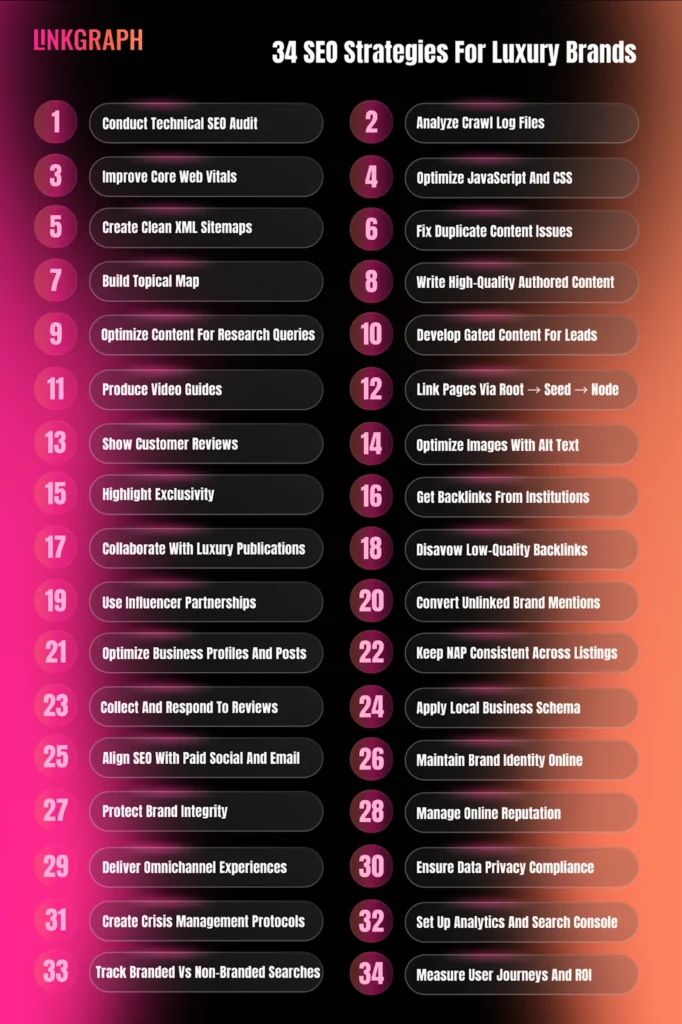
There are 34 SEO strategies for luxury brands. The 34 SEO strategies for luxury brands are listed below.
- Conduct Full Technical SEO Audit to Identify and Fix Site Errors
- Analyze Log Files to Track Search Engine Crawl Behavior
- Improve Core Web Vitals (LCP, FID, CLS) for Better Page Experience
- Optimize JavaScript and CSS for Faster Above-the-Fold Loading
- Create Small and Clean XML Sitemaps for Blogs, Videos, and Images
- Resolve Duplicate Content Issues Caused by URL Parameters
- Construct Topical Map Based on Your Source Context
- Write Accurate Content Following Authorship and Quality Guidelines
- Optimize Content for Research and Editorial Queries
- Develop Gated Content to Generate Leads
- Produce Video Guides to Explain or Promote Content
- Internally Link Pages Using a Clear Hierarchy (Root → Seed → Node)
- Display Customer Reviews and Real Experiences to Build Trust
- Optimize Images with Alt Text and Titles for Visual Search
- Emphasize Exclusivity, Craftsmanship, and Trust on Key Pages
- Acquire High-Quality Backlinks from Educational and Cultural Institutions
- Collaborate with Luxury Publications and Partner Brands for PR Backlinks
- Monitor and Disavow Toxic or Low-Quality Backlinks Regularly
- Leverage Influencer Partnerships for Backlinks and Brand Visibility
- Convert Unlinked Brand Mentions into Backlinks via Outreach
- Optimize Business Profiles with Key Attributes, Posts, and Q&A
- Ensure Consistent Name, Address, and Phone Across All Listings
- Collect and Respond to Customer Reviews Regularly
- Implement Local Business Schema on All Physical Locations
- Align SEO With Paid Social and Email Marketing Strategies
- Maintain Consistent Brand Identity Across All Digital Touchpoints
- Protect Brand Integrity and Prevent Counterfeit or Unauthorized Sales
- Manage Brand Reputation and Ensure Strong Online Presence
- Deliver Seamless Omnichannel Experiences From Search to In-Store
- Ensure Compliance With Privacy and Data Security Regulations
- Establish Protocols For Crisis Management and Search Visibility Protection
- Set Up Google Analytics and Search Console for Tracking
- Track Branded vs Non-Branded Search Performance and Share of Voice
- Measure Cross-Device User Journeys, Conversions, and Organic Search ROI
Luxury brand SEO success requires disciplined execution across all digital touchpoints, combining technical, content, and authority measures to maintain prestige, attract high-value consumers, and maximize online and offline impact.
1. Conduct Full Technical SEO Audit to Identify and Fix Site Errors
A full technical SEO audit for luxury brand SEO evaluates website architecture, server performance, and indexing to maintain high-value search visibility. Luxury brand SEO audits start with assessing server response times, which must remain under 100ms to reduce latency and enhance page delivery speed for affluent users. HTML crawl requests require monitoring to exceed 95%, which ensures search engines index the majority of relevant pages.
Refresh rate should be maintained around 20%, which allows search engines to update content without overloading crawl budgets. Discovery rate, ideally 7–8%, measures how effectively search engines find new and updated content. Luxury brand SEO requires tracking these metrics continuously to preserve a premium online presence.
Log file analysis identifies where most crawl budget is lost. Analyzing server logs, luxury brand SEO specialists detect inefficient crawl patterns, errors, or duplicate URLs. Correcting these issues enhances visibility for high-intent queries, strengthens indexing of priority pages, and prevents resource waste across high-value digital assets.
2. Analyze Log Files to Track Search Engine Crawl Behavior
Log file analysis forms a cornerstone of luxury brand SEO by revealing how search engines interact with website pages. It tracks crawler frequency, status codes, and page access, allowing luxury brand SEO specialists to identify errors, bottlenecks, and orphan pages. Correct analysis ensures high-value pages receive optimal crawl attention, which improves indexing and visibility for niche luxury queries.
Crawl efficiency metrics, such as time spent per page and request volume, highlight areas where server resources or page structure impede search engine activity. Luxury brand SEO benefits from understanding which pages are over- or under-crawled, which allows specialists to adjust internal linking, robots directives, or sitemap priorities.
This process uncovers duplicate content, redirects, or low-performing URLs that consume crawl budget unnecessarily. Optimizing crawl allocation, luxury brand SEO ensures priority pages rank for high-intent searches, maintains an authoritative presence, and maximizes organic traffic from affluent audiences.
3. Improve Core Web Vitals (LCP, FID, CLS) for Better Page Experience
Luxury brand SEO prioritizes Core Web Vitals to deliver premium user experiences, which directly impact rankings. LCP measures the time to render the largest visible element, FID gauges interactivity delay, and CLS tracks layout stability during page load. Optimizing these metrics ensures affluent users experience fast, smooth, and visually stable interactions.
Improving LCP requires server response optimization, image compression, and critical CSS prioritization, which reduces load time and enhances perceived performance. FID improves through efficient JavaScript execution and minimal third-party script usage, which ensures immediate responsiveness to user inputs. CLS reduction involves defining explicit size attributes for media and limiting dynamic content shifts to prevent layout instability.
Luxury brand SEO strategies integrate Core Web Vitals monitoring via Google PageSpeed Insights or Lighthouse, which applies continuous improvements to maintain optimal scores. Enhanced page performance strengthens brand prestige, increases engagement, and boosts search visibility for high-value, intent-driven traffic.
4. Optimize JavaScript and CSS for Faster Above-the-Fold Loading
Luxury brand SEO emphasizes rapid above-the-fold rendering to preserve a seamless, high-end user experience. Optimizing JavaScript and CSS ensures the first visible section of the page loads immediately, which reduces perceived delay and maintains brand prestige online. Efficient code delivery enhances user engagement and encourages interaction with key luxury content.
Critical CSS extraction separates essential styles for immediate rendering, while deferring non-critical CSS prevents render-blocking delays. JavaScript minification and asynchronous loading reduce execution time and prevent delays in interactivity. Combining and compressing files further minimizes request overhead, which improves performance metrics for both desktop and mobile users.
Continuous monitoring through tools like Lighthouse or WebPageTest identifies render-blocking scripts and layout shifts. Luxury brand SEO uses these optimizations to enhance search rankings, improve Core Web Vitals, and deliver a polished, high-value browsing experience that mirrors the physical store standards of the brand.
5. Create Small and Clean XML Sitemaps for Blogs, Videos, and Images
Luxury brand SEO requires precise XML sitemap architecture to ensure efficient indexing of premium digital assets. Small and well-structured sitemaps guide search engines through high-value pages, allowing consistent crawling of blogs, videos, and images that reflect the exclusivity of the brand. Proper sitemap segmentation prevents crawl inefficiencies and improves content discovery across multiple media types.
Each sitemap should remain under 50,000 URLs and ideally below 10 MB for optimal crawl response. Blogs deserve dedicated sitemaps to highlight editorial content and storytelling that reinforce craftsmanship and heritage. Video sitemaps improve visibility for fashion films, runway clips, or designer interviews, while image sitemaps enable search engines to interpret visual details that showcase texture, color, and design.
All URLs within XML sitemaps must return a 200 status, include canonical references, and update automatically with new publications. Submitting the sitemap index to Google Search Console ensures every media type receives consistent crawl attention. This technical foundation strengthens luxury brand SEO by maintaining crawl efficiency and maximizing exposure for branded narratives across visual and editorial assets.
6. Resolve Duplicate Content Issues Caused by URL Parameters
Duplicate content reduces crawl efficiency and dilutes ranking signals, which weakens luxury brand SEO performance. URL parameters often create identical versions of product or campaign pages, leading to indexing confusion and fragmented visibility. Eliminating this duplication maintains search equity and reinforces brand authority across all indexed URLs.
Canonical tags should be applied to indicate the preferred version of each page. Parameters used for tracking or filtering, such as color or size variations, must be excluded from indexation using parameter handling rules in Google Search Console. Implementing consistent internal linking to canonical URLs further strengthens crawl direction and consolidates authority.
Luxury e-commerce websites must maintain a clean URL structure with minimal query strings. Server-side redirects resolve redundant pages generated by outdated campaign URLs or product filters. Regular technical audits combined with log file reviews reveal duplicate content clusters and confirm correct canonical flow. This disciplined control over URL parameters preserves the exclusivity and precision that define luxury brand SEO, while maintaining a clear, unified search presence.
7. Construct Topical Map Based on Your Source Context
A topical map defines the structural hierarchy of luxury brand SEO by arranging subjects, entities, and keywords into logical relationships. It determines how search engines interpret brand expertise and contextual relevance across every page. For luxury brands, the topical map must reflect the identity, craftsmanship, and heritage of the brand through a clear, organized content framework that mirrors its exclusivity and precision.
The structure begins with root pages that represent primary subjects such as collections, craftsmanship, or brand legacy. Seed pages, then expand these subjects by adding related themes such as sustainability, materials, or design philosophy. Node pages complete the hierarchy by detailing subtopics such as artisan profiles, care instructions, or product insights. Each page must connect through contextual internal links that express meaning rather than rely on plain navigation.
Keyword clusters must align with the semantic intent that matches the search behavior of affluent consumers. This alignment allows luxury brand SEO to strengthen entity recognition across the Knowledge Graph and increases visibility for high-value niche queries. A precise topical map connects storytelling, brand authority, and search relevance, which creates a cohesive digital ecosystem that reflects the prestige of the brand.
8. Write Accurate Content Following Authorship and Quality Guidelines
Luxury brand SEO depends on content accuracy and verified authorship, as both influence credibility and trust signals across search engines. Each page must reflect expert insight that aligns with Google’s E-E-A-T standards, which stand for experience, expertise, authoritativeness, and trustworthiness. The author or contributor must be identifiable, preferably through a verified profile or byline that establishes subject expertise related to luxury goods, craftsmanship, or design.
Accurate content involves factual precision in descriptions, material details, and production methods. Every statement must reference verifiable data or authoritative sources such as trade publications, research institutions, or brand archives. For editorial and storytelling content, factual correctness combined with high linguistic refinement strengthens the perception of quality that defines luxury brand communication.
Each article, product description, or brand story must maintain a distinct tone consistent with the aesthetic of the brand. Avoid exaggeration and generic claims. Instead, use descriptive depth that mirrors exclusivity and attention to detail. Structured data markup for authorship should be implemented, ensuring authors and creators are properly identified. This precision in authorship and content validation reinforces trust in both consumers and search engines, which positions the brand as an authoritative voice within the luxury industry.
9. Optimize Content for Research and Editorial Queries
Luxury brand SEO demands content optimization that targets research-driven and editorial-focused queries, aligning with high-value, niche search intent. Pages must address topics that users investigate before purchase, which include craftsmanship, provenance, and design inspiration. Optimizing content for these queries increases visibility for informational and consideration-phase searches, attracting affluent and discerning audiences.
Content should integrate long-tail keywords, semantically related terms, and natural language phrases that reflect the search patterns of luxury audiences. Incorporating structured headings, lists, and multimedia enhances readability and allows search engines to interpret context accurately. Editorial content, which includes interviews, features, and in-depth analyses, benefits from these optimizations by ranking for queries that signal intent and authority.
Linking to authoritative sources and internal pages strengthens content context and search relevance. Metadata, schema, and descriptive captions must be precise to improve search engine understanding of topic intent. Consistent optimization for research and editorial queries positions the luxury brand as a reference point, drives qualified traffic, and enhances trust among high-value consumers within the luxury industry.
10. Develop Gated Content to Generate Leads
Luxury brand SEO uses gated content to attract high-value prospects while collecting qualified lead information. Offering exclusive reports, whitepapers, or guides in exchange for user details captures data from individuals who demonstrate genuine interest in luxury products or services. This tactic converts organic traffic into actionable leads while maintaining brand prestige.
Gated content must reflect the authority and exclusivity of the brand, which features in-depth analysis, industry insights, or curated collections that appeal to affluent audiences. Luxury brands benefit from aligning gated assets with high-intent keywords, which ensures visibility for users conducting research or exploring purchase options. Each content piece reinforces brand credibility and establishes expertise in the luxury market.
Integration with CRM systems and email marketing automates lead nurturing and follow-up. Tracking interactions with gated content provides metrics for engagement, conversion potential, and content ROI. Developing and optimizing gated assets positions the luxury brand as a trusted source, which captures high-quality leads while enhancing overall search performance.
11. Produce Video Guides to Explain or Promote Content
Luxury brand SEO benefits from video guides that demonstrate products, craftsmanship, or brand stories. Video content increases user engagement, extends on-page dwell time, and communicates the premium value of the brand to high-net-worth audiences. Well-produced videos establish authority and enhance search visibility for multimedia search queries.
Videos must align with the identity of the luxury brand, showcasing exclusivity, quality, and unique features. Embedding transcripts, optimized titles, and structured metadata improves search engine indexing and accessibility. Including videos on product, category, or editorial pages enhances content richness, attracting organic traffic from both branded and niche high-intent searches.
Distribution across owned channels and platforms like YouTube or luxury-specific portals strengthens brand presence. Tracking metrics such as watch time, engagement rate, and click-through conversions provides insights into content performance. Video guides serve dual purposes: educating prospects and reinforcing the prestige of the brand on the internet.
12. Internally Link Pages Using a Clear Hierarchy (Root → Seed → Node)
Luxury brand SEO relies on a structured internal linking hierarchy to distribute authority and enhance crawl efficiency. Root pages define primary topics, seed pages expand related subtopics, and node pages provide detailed content that strengthens the overall structure. This organization ensures search engines understand content relationships and prioritize high-value pages.
Implement contextual links within content to connect related pages, which increases session duration and guides users through the brand experience. Anchor text must be precise and reflect the subject of the page, strengthening relevance signals. Clear hierarchies reduce orphan pages and improve the discoverability of niche, high-intent content.
Regular audits of internal links identify broken or misdirected links, preventing loss of SEO equity. Tracking click paths and page authority flow allows luxury brands to refine hierarchy for optimal engagement. Internal linking strengthens brand authority, improves indexation, and amplifies the impact of premium content.
13. Display Customer Reviews and Real Experiences to Build Trust
Luxury brand SEO uses authentic customer reviews and real experiences to increase credibility and attract discerning buyers. Displaying verified reviews on product pages, collection pages, and testimonials sections signals trustworthiness to search engines and potential customers alike. Real experiences highlight quality, craftsmanship, and exclusivity, reinforcing the positioning of the brand within the luxury industry.
Integrate structured data, such as review schema, to enhance visibility in search results with rich snippets. Highlight reviews that mention premium features, exceptional service, or unique product attributes to target high-value, intent-driven searches. Consistently monitoring new feedback ensures the freshness and relevance of user-generated content.
Showcasing real experiences improves engagement, increases session duration, and encourages repeat visits to luxury ecommerce platforms. This approach strengthens perceived authority, improves conversion rates, and complements other SEO strategies by providing unique, high-quality content that aligns with the prestige of the brand.
14. Optimize Images with Alt Text and Titles for Visual Search
Luxury brand SEO requires image optimization to improve visual search visibility and enhance user experience. Alt text and title attributes provide context to search engines, allowing images to rank for relevant, high-intent queries. Correctly labeled images increase discoverability for branded and product-specific searches within the luxury industry.
Each product image, lifestyle shot, or editorial photo should include descriptive, keyword-focused alt text that reflects the identity and key attributes of the luxury brand. Titles must summarize the image accurately while reinforcing brand prestige. Structured metadata and descriptive file names enhance indexing and relevance for image search results.
Optimized images reduce page load times, maintain quality, and improve Core Web Vitals scores, contributing to higher engagement and better search performance. This approach ensures luxury ecommerce platforms attract affluent users through visual search while maintaining consistent brand presentation and authority online.
15. Emphasize Exclusivity, Craftsmanship, and Trust on Key Pages
Luxury brand SEO prioritizes highlighting exclusivity, craftsmanship, and trust to reinforce brand prestige and attract high-value customers. Key pages, including product listings, landing pages, and editorial content, must communicate these qualities clearly through text, visuals, and interactive elements. Demonstrating quality and uniqueness strengthens the perception of luxury businesses.
Content should showcase meticulous craftsmanship, limited editions, and brand heritage to engage affluent audiences. Testimonials, awards, and verified credentials increase credibility, enhancing trust signals for search engines and users. This approach positions the luxury brand as a reliable, authoritative source in the luxury industry.
Integrating these elements with structured data, optimized headings, and high-quality visuals improves search rankings for high-intent queries. Emphasizing exclusivity and trust consistently across critical pages boosts conversions, drives qualified traffic, and ensures luxury ecommerce platforms maintain a distinguished digital presence.
16. Acquire High-Quality Backlinks from Educational and Cultural Institutions
Luxury brand SEO relies on acquiring high-quality backlinks from authoritative sources to build credibility and improve search rankings. Educational institutions, cultural organizations, and industry publications provide highly trusted links that signal authority to search engines. Linking luxury brand websites to these domains enhances visibility in relevant searches.
Identify relevant institutions whose content aligns with brand values, exclusivity, and craftsmanship. Collaborate through sponsorships, guest contributions, or featured projects that highlight brand expertise and heritage. These partnerships generate backlinks while reinforcing the prestige and recognition of the brand within the luxury industry.
Monitor backlink quality regularly, disavow low-value links, and maintain a diverse link profile. High-authority backlinks from educational and cultural institutions drive referral traffic, improve domain authority, and strengthen the SEO performance of the luxury brand for competitive, high-intent queries.
17. Collaborate with Luxury Publications and Partner Brands for PR Backlinks
Luxury brand SEO gains authority when backlinks originate from reputable publications and partner brands. Collaborating with luxury magazines, online journals, and industry partners strengthens domain credibility and increases visibility for high-value search queries.
Identify publications and partners that align with the values of the brand, exclusivity, and target audience. Contribute expert insights, press releases, and feature stories to secure backlinks, ensuring content reflects the craftsmanship of the brand and premium positioning. Partner collaborations create opportunities for cross-promotion and extended reach within the luxury market.
Track backlink performance to evaluate quality and referral traffic impact. High-authority PR backlinks from luxury publications and aligned partner brands improve search rankings, reinforce brand prestige, and drive targeted traffic, strengthening overall SEO objectives for luxury brands.
18. Monitor and Disavow Toxic or Low-Quality Backlinks Regularly
Luxury brand SEO depends on a clean backlink profile to maintain authority and ranking signals. Toxic or low-quality backlinks from irrelevant or spammy sites reduce domain credibility and negatively impact search performance.
Regularly audit backlinks using tools that identify harmful links based on domain authority, relevance, and spam score. Flag and disavow links that originate from low-quality sources, directories, or unrelated websites. Maintain a proactive approach to prevent negative SEO attacks and preserve the integrity of the online presence of the luxury brand.
Tracking the disavow process and re-evaluating periodically ensures that luxury brands maintain a high-quality link profile. This practice secures rankings, strengthens trust with search engines, and preserves the prestige and authority that luxury brand SEO requires.
19. Leverage Influencer Partnerships for Backlinks and Brand Visibility
Luxury brand SEO benefits from strategic influencer collaborations that generate high-authority backlinks and expand digital reach. Influencers with relevance to luxury lifestyle, fashion, and premium experiences amplify brand messaging and signal authority to search engines.
Identify influencers whose audience aligns with luxury products and services. Collaborate to create editorial content, product features, or campaign highlights that naturally include backlinks to the website of the brand. These backlinks pass authority, improve referral traffic, and strengthen the online credibility of the brand.
Monitor the impact of influencer-driven backlinks and refine partnerships based on engagement and referral metrics. Consistent collaboration with high-quality influencers ensures luxury brands achieve sustained visibility, reinforce prestige, and enhance overall SEO performance across digital channels.
20. Convert Unlinked Brand Mentions into Backlinks via Outreach
Unlinked brand mentions across industry publications, blogs, and media represent untapped opportunities for luxury brand SEO. Transforming these mentions into backlinks increases domain authority, drives qualified traffic, and signals credibility to search engines.
Scan online content using monitoring tools to detect unlinked mentions of the brand. Contact editors, authors, or website managers with a concise request to hyperlink the official page of the brand. Focus on relevance, demonstrating how the link adds value for readers and improves content authority.
Maintain a record of acquired backlinks and evaluate their impact on traffic and search visibility. Continuous monitoring and prioritization of high-authority sources strengthen luxury brand SEO, enhance digital reputation, and secure long-term organic performance.
21. Optimize Business Profiles with Key Attributes, Posts, and Q&A
Luxury brand SEO benefits from fully optimized business profiles on platforms like Google Business Profile, Bing, and Apple Maps. Detailed attributes, regular posts, and structured Q&A enhance search visibility, attract high-intent local and global customers, and reinforce brand authority.
Include accurate business information, operational hours, product or service highlights, and verified location data. Regularly publish updates, promotions, or news posts to maintain engagement and signal activity to search engines. Utilize Q&A sections to address common inquiries, providing authoritative and informative responses that reflect the expertise of the brand.
Monitor performance metrics such as profile views, clicks, and user interactions to refine content strategy. Well-maintained profiles contribute to improved local SEO, elevated user trust, and consistent representation of the luxury brand across digital channels.
22. Ensure Consistent Name, Address, and Phone Across All Listings
Luxury brand SEO requires uniform Name, Address, and Phone (NAP) across all digital directories, marketplaces, and social platforms. Consistent NAP improves local search rankings, enhances credibility, and prevents user confusion when locating physical stores or contacting the brand.
Audit all listings to confirm that the name, address format, and phone numbers of the brand match precisely across platforms. Any discrepancies fragment search signals, reduce local visibility, and weaken the authority of the luxury brand online.
Automate or schedule regular checks to maintain alignment of NAP information. Maintaining consistency strengthens the online presence of the brand, increases discoverability for high-intent customers, and reinforces accurate representation in luxury brand local SEO campaigns.
23. Collect and Respond to Customer Reviews Regularly
Active management of customer reviews significantly influences luxury brand SEO and strengthens trust with high-value audiences. Reviews act as social proof, which signals search engines about the authority and relevance of the brand. Luxury brand SEO benefits when reviews reflect quality, exclusivity, and attention to detail, aligning with the overall positioning of the brand.
Collect reviews through verified platforms, post-purchase emails, and loyalty programs, ensuring authenticity and credibility. Respond to feedback promptly using precise, brand-aligned language that communicates professionalism, craftsmanship, and luxury standards. Handling both positive and negative reviews consistently demonstrates commitment to customer experience.
Analyzing reviews uncovers patterns in customer satisfaction, product performance, and content relevance, guiding SEO and marketing strategies. Regular engagement with reviews enhances local SEO visibility, attracts affluent buyers, and builds long-term trust, which directly improves organic rankings and reinforces the prestige of the brand in search results.
24. Implement Local Business Schema on All Physical Locations
Local business schema markup structures data for search engines, which improves visibility for luxury brand SEO across multiple locations. Implementing schema signals the physical presence, contact information, and services of the brand, which increases the likelihood of appearing in rich results, maps, and local search queries. Luxury brands with multiple boutiques benefit when each location is indexed accurately, reflecting exclusivity and high-value offerings.
The schema should include name, address, phone number, operating hours, and geocoordinates for each store. Adding structured data for images, reviews, and events enhances local search appearance. Luxury brand SEO benefits from rich snippets that communicate prestige, trust, and curated experiences to potential high-net-worth customers.
Testing schema using Google’s Rich Results Test and updating it after changes ensures search engines interpret data correctly. Regular auditing of schema markup ensures consistent local SEO performance, strengthens brand authority, and increases qualified foot traffic to physical stores, ultimately boosting both online and offline conversions.
25. Align SEO With Paid Social And Email Marketing Strategies
Integrating SEO with paid social and email marketing amplifies luxury brand visibility and attracts high-value customers efficiently. Coordinating keyword research, landing pages, and content with paid campaigns ensures consistent messaging across organic and paid channels. Luxury brand SEO benefits when search-driven content complements social ads, email campaigns, and retargeting efforts, creating a unified brand perception.
Content optimization for SEO should align with email newsletters and social media posts that highlight exclusivity, craftsmanship, and limited-edition offerings. Linking organic landing pages from paid campaigns improves authority signals while increasing click-through rates. High-quality, targeted content attracts qualified traffic and nurtures leads throughout the luxury purchase journey.
Monitoring analytics across search, social, and email platforms allows adjustments based on performance data. Luxury brand SEO strategies use insights to refine targeting, improve engagement, and maximize return on investment. Unified efforts enhance brand recognition, credibility, and conversions from multiple digital touchpoints.
26. Maintain Consistent Brand Identity Across All Digital Touchpoints
Luxury brand SEO achieves maximum impact when brand identity remains consistent across websites, social media, email campaigns, and online marketplaces. Visual elements, tone of voice, and messaging must reflect the exclusivity, craftsmanship, and prestige of the brand. Consistency strengthens recognition and ensures that all digital touchpoints reinforce the luxury positioning of the brand in the minds of high-value consumers.
Content, metadata, and design should follow unified guidelines across all platforms. Luxury brands that maintain coherent messaging across product pages, blogs, and promotional campaigns enhance credibility and build trust with affluent audiences. Structured brand elements signal reliability to search engines and improve organic rankings for targeted queries.
Regular audits of digital assets detect deviations from established brand standards. Adjustments across SEO, social media, email marketing, and paid campaigns prevent fragmentation. Consistent brand identity maximizes visibility, improves engagement, and drives conversions by aligning all digital channels with the aspirational value of the brand.
27. Protect Brand Integrity And Prevent Counterfeit Or Unauthorized Sales
Luxury brand SEO relies on protecting brand integrity to maintain exclusivity, trust, and high-value perception. Unauthorized sellers and counterfeit products dilute brand authority, confuse customers, and negatively affect search visibility. Luxury brands must monitor marketplaces, e-commerce platforms, and social channels to detect infringements and remove counterfeit listings promptly.
Technical measures such as canonical tags, structured data, and verified business profiles enable search engines to distinguish authentic content from unauthorized copies. Legal actions and takedown notices reinforce credibility while signaling authority to both consumers and search engines. Monitoring backlinks and brand mentions ensures that only trusted sources reference the luxury brand online.
Implementing anti-counterfeit programs and closely auditing distribution channels preserves brand prestige. Ensuring that only verified retailers and partners showcase products maintains exclusivity. Consistent vigilance protects luxury brand SEO performance, strengthens online reputation, and prevents revenue loss caused by unauthorized sales.
28. Manage Brand Reputation And Ensure Strong Online Presence
Luxury brand SEO depends on a strong online presence, which starts with proactive reputation management. Monitoring reviews, mentions, and social conversations allows luxury brands to detect negative feedback early and maintain a positive perception. Timely responses to inquiries and concerns signal credibility to consumers and search engines alike.
Search engine optimization integrates reputation management by promoting high-quality content, authoritative backlinks, and accurate brand listings across platforms. Press releases, media coverage, and collaborations with reputable partners enhance trust signals and reinforce brand prestige. Regular audits of website content, business profiles, and social accounts ensure that all public information remains consistent and up-to-date.
Tracking performance metrics, such as branded search volume, sentiment analysis, and social engagement, enables luxury brands to maintain control over their digital footprint. A well-managed reputation strengthens SEO performance, increases consumer confidence, and preserves the exclusivity and authority of the luxury brand online.
29. Deliver Seamless Omnichannel Experiences From Search To In-Store
Consumers expect a consistent luxury experience across online and physical channels. Optimized SEO for luxury brands integrates website pages, search listings, and product catalogs with real-world store operations. This integration allows customers to transition effortlessly from discovering products online to purchasing in-store without confusion or friction.
Synchronizing e-commerce platforms, social media, and physical locations enables real-time inventory updates, accurate product information, and personalized interactions. Structured data and verified business profiles reinforce brand authority in search results and guide consumers to available products efficiently.
Tracking metrics such as cross-device behavior, local searches, and conversion flows allows luxury brands to refine omnichannel strategies. Delivering unified experiences from search to in-store strengthens brand prestige, increases engagement, and drives long-term customer loyalty.
30. Ensure Compliance With Privacy And Data Security Regulations
Luxury brands collecting customer data through websites and e-commerce platforms must comply with privacy and security regulations. Adhering to GDPR, CCPA, and other regional standards protects consumer information and reduces legal risks. Proper implementation of secure protocols, encrypted data storage, and transparent privacy policies signals professionalism and reliability.
Monitoring data collection practices across forms, newsletters, and checkout processes ensures personal information remains protected. Luxury brand SEO benefits when users trust the website, resulting in increased engagement, longer time on site, and higher conversions. Regular audits identify vulnerabilities and maintain ongoing regulatory compliance.
Integrating privacy compliance with analytics, CRM, and marketing systems allows brands to analyze performance without violating regulations. Compliance strengthens brand authority, safeguards reputation, and enhances long-term online presence.
31. Establish Protocols For Crisis Management And Search Visibility Protection
Luxury brands face risks from negative publicity, website downtime, or SEO attacks, which damage reputation and organic search visibility. Establishing clear crisis management protocols allows luxury brand SEO teams to respond quickly to technical or PR issues. These protocols include pre-defined communication plans, designated team responsibilities, and rapid content adjustments to mitigate impact.
Monitoring website performance, backlinks, and brand mentions allows early detection of potential threats to search rankings. Brands safeguard luxury brand SEO by implementing automated alerts for traffic drops, indexing errors, or negative media coverage.
Coordinating technical fixes with PR responses ensures that both online visibility and brand reputation remain protected. Maintaining these protocols strengthens long-term SEO performance, prevents ranking losses, and preserves the prestige associated with luxury brand identity.
32. Set Up Google Analytics and Search Console for Tracking
Luxury brand SEO requires precise data collection to measure performance, detect issues, and optimize strategies. Setting up Google Analytics allows luxury brand SEO teams to track traffic sources, user behavior, conversions, and engagement across devices. Search Console provides visibility into indexing status, keyword performance, and technical errors affecting search visibility.
Integrating both platforms allows luxury brand SEO specialists to identify which content drives high-value traffic, discover crawl issues, and analyze search impressions and click-through rates. Custom dashboards and reports enable continuous monitoring of SEO health, highlighting areas requiring immediate attention or optimization.
Regular analysis of Analytics and Search Console data informs luxury brand SEO decisions, including content updates, backlink strategies, and technical fixes. This structured tracking framework ensures accurate measurement of ROI and strengthens the long-term search presence of the luxury brand.
33. Track Branded vs Non-Branded Search Performance and Share of Voice
Monitoring branded versus non-branded search performance allows luxury brand SEO teams to understand brand recognition and organic reach. Branded queries indicate direct brand awareness, while non-branded searches reflect discovery potential among new audiences. Tracking both refines keyword strategies and content targeting for luxury brands.
Share of voice metrics reveal how the luxury brand ranks compared to competitors across key search terms. This insight guides luxury brand SEO teams to optimize pages, build backlinks, and create content that strengthens market visibility.
Regular analysis of branded and non-branded traffic informs performance evaluation, guides marketing alignment, and enhances the competitive positioning of the luxury brand. This structured approach ensures data-driven decisions that improve search visibility, audience engagement, and overall ROI.
34. Measure Cross-Device User Journeys, Conversions, and Organic Search ROI
Tracking cross-device user journeys allows luxury brand SEO teams to understand how users interact with content across desktops, tablets, and mobile devices. This analysis identifies friction points and informs design and content improvements for a seamless luxury experience.
Monitoring conversions from organic search provides insight into which pages, keywords, and campaigns drive high-value customer actions. Luxury brand SEO strategies benefit from this data to prioritize efforts that increase purchases, lead generation, and engagement.
Calculating organic search ROI enables evaluation of SEO effectiveness against marketing investment. Combining cross-device tracking, conversion data, and ROI metrics ensures luxury brand SEO campaigns remain measurable, actionable, and aligned with business goals, strengthening overall digital performance.
How quickly do luxury brands expect results from SEO?
Luxury brand SEO shows measurable results within three to six months, depending on website authority, competition, and content quality. Initial improvements appear in technical performance, indexed pages, and keyword rankings. Significant traffic growth, lead generation, and conversions often occur between six and twelve months.
Long-tail, high-intent keywords and niche luxury content accelerate visibility. Consistent optimization, backlink acquisition, and user experience enhancements contribute to steady, sustainable results, ensuring luxury brand SEO delivers measurable impact over time.
What SEO strategies do luxury brands use to attract high-value customers?
The following SEO strategies allow luxury brands SEO to reach affluent audiences, drive qualified traffic, and strengthen brand prestige online. The SEO strategies for luxury brands are listed below.
- Target High-Intent Keywords: Luxury brands SEO focuses on niche, long-tail keywords that signal exclusivity and match high-value consumer searches.
- Produce Premium Content: Luxury brand SEO creates storytelling-driven content, including articles, videos, and visual assets, that highlight craftsmanship, heritage, and unique value.
- Optimize On-Page SEO: Luxury brands SEO refines meta descriptions, headings, structured data, and internal linking to communicate brand authority and aspirational positioning.
- Acquire Authoritative Backlinks: Luxury brand SEO builds backlinks from high-authority sources such as cultural institutions, premium publications, and industry experts to reinforce trust.
- Leverage Local SEO: Luxury brands local SEO optimizes location-based listings, schemas, and maps, ensuring high-end customers nearby discover physical stores or showrooms.
- Enhance User Experience: Luxury brand SEO improves page load speed, mobile responsiveness, and navigation to deliver an elegant and seamless digital experience.
Implementing these strategies allows luxury brands SEO to attract high-value consumers, increase online visibility, and generate meaningful conversions aligned with brand prestige.
How does SEO drive conversions and sales for luxury e-commerce brands?
Luxury brand SEO attracts qualified traffic by targeting high-intent keywords that affluent consumers use to search for exclusive products. Optimized landing pages, rich content, and structured metadata guide users through the purchase journey. Luxury brand SEO increases visibility in search results, strengthens brand credibility, and encourages engagement, resulting in higher conversion rates and measurable sales growth for luxury e-commerce platforms.
In what ways SEO strengthen a luxury brands identity and online presence?
Luxury brands SEO reinforces brand prestige through high-quality content, authoritative backlinks, and visually refined web experiences. Luxury brand SEO showcases craftsmanship, heritage, and exclusivity across online channels, building a consistent and credible identity that resonates with target audiences.
How luxury brands differentiate themselves in a competitive digital market through SEO?
Luxury brand SEO focuses on niche, high-value keywords, premium content, and strategic link-building to establish authority. Luxury brands SEO highlights unique value propositions, enhances user experience, and ensures the brand stands out in search results amidst competitors targeting general or mass-market audiences.
Which types of content deliver the best SEO performance for luxury brands?
Luxury brand SEO benefits from storytelling content, product showcases, videos, editorial articles, and high-quality visuals. Interactive guides, lifestyle imagery, and exclusive interviews amplify engagement, increase dwell time, and attract backlinks, enhancing search rankings and organic visibility for luxury e-commerce platforms.
Can influencer collaborations and high-profile partnerships enhance luxury SEO?
Influencer collaborations and brand partnerships increase online visibility and strengthen backlink profiles for luxury brands SEO. Collaborations with reputable figures generate high-authority mentions, referral traffic, and user engagement. Luxury brand SEO benefits when these partnerships align with the brand’s identity, reinforcing exclusivity and trust while expanding digital reach among affluent audiences.
How SEO and paid advertising complement each other in luxury brand marketing?
Luxury brands SEO and paid advertising combine organic visibility with immediate audience reach. SEO builds long-term authority, while paid ads capture quick conversions from targeted demographics. Data from paid campaigns refines keyword targeting, and SEO insights lower acquisition costs, creating a unified, data-driven luxury marketing framework.
Why is technical SEO crucial for luxury e-commerce websites?
Technical SEO for luxury brands ensures efficient crawling, fast loading, and secure transactions. It maintains the structural integrity of the website and guarantees smooth navigation for users across all devices. Luxury brands SEO depends on optimized site architecture and error-free performance to preserve prestige and maximize organic discoverability.
Is It Important for Luxury Brands to Optimize Category Pages?
Optimized category pages improve keyword visibility and guide users toward key collections in luxury brand SEO. Structured metadata, descriptive titles, and elegant visuals strengthen user engagement. Category page optimization allows luxury e-commerce platforms to rank for broader search queries and attract qualified traffic with strong purchase intent.
What are the best practices for optimizing luxury brands product pages?
Optimizing product pages is essential for achieving visibility and conversion goals in luxury brands SEO. Each page must communicate craftsmanship, exclusivity, and trust through a refined structure and presentation. The following best practices improve search visibility and create a premium on-site experience.
- Use Descriptive and Branded Titles: Incorporate luxury-specific keywords such as “handcrafted,” “limited edition,” or “designer” within concise titles that reflect exclusivity.
- Write Unique, Persuasive Descriptions: Explain the craftsmanship, materials, and origin of each product to align with brand prestige and justify pricing.
- Add Structured Data Markup: Implement Product and Review schema to improve search appearance and attract high-intent buyers seeking authentic items.
- Optimize High-Resolution Images: Use professional imagery with descriptive alt text that includes target keywords to improve visual search visibility.
- Integrate Internal Linking: Link related items or collections to strengthen topical relevance and maintain user flow across luxury product categories.
- Include Customer Reviews and Ratings: Display verified reviews to increase credibility and guide decision-making among discerning customers.
- Enhance Page Speed and Mobile Performance: Reduce file sizes and optimize load times to maintain a premium user experience on all devices.
Luxury brand SEO gains measurable value when product pages combine technical precision with elegant presentation, maintaining both visibility and brand integrity.
What are the most common SEO mistakes that luxury brands should avoid?
Luxury brands SEO often fails due to poor alignment between brand identity and search optimization strategies. Avoiding common pitfalls preserves exclusivity while improving search visibility and digital reputation. The mos common SEO mistakes that luxury brands should avoid are listed below.
- Targeting Generic Keywords: Using broad, high-volume terms weakens exclusivity. Target refined, high-intent keywords that match affluent search behavior.
- Ignoring Technical SEO: Slow site speed, crawl errors, or broken links damage user experience and lower rankings for high-value searches.
- Using Duplicate Content Across Collections: Repetitive product descriptions confuse search engines and dilute topical authority across multiple luxury pages.
- Neglecting Mobile Optimization: Poor mobile performance drives away potential customers who expect smooth navigation on all devices.
- Overlooking Local SEO Opportunities: Failure to optimize store listings and local schema limits discovery among nearby luxury shoppers.
- Underestimating Backlink Quality: Acquiring irrelevant or low-authority backlinks harms brand credibility within the luxury industry.
- Ignoring Analytics Data: Without tracking, brands lose insight into user behavior, conversion paths, and keyword performance.
Avoiding these luxury brand SEO errors sustains brand prestige, strengthens digital visibility, and aligns technical performance with consumer expectations.
Can luxury brands manage SEO effectively in-house, or is outsourcing preferable?
Luxury brands manage SEO in-house if they have a dedicated team skilled in technical optimization, content strategy, and analytics. However, outsourcing to a specialized luxury SEO agency often delivers faster and more consistent results. Agencies bring deep expertise, access to advanced tools, and experience working with premium brands. A hybrid approach that combines internal oversight with agency collaboration maintains brand voice while benefiting from expert technical execution and scalable, data-driven SEO growth.
When is the right time for a luxury brand to hire a specialized SEO agency?
Hiring a specialized SEO agency becomes essential when organic traffic stagnates, rankings decline, or expansion into new regions is planned. Luxury brands benefit from agency expertise during rebranding, website redesigns, or e-commerce migrations. Expert agencies understand luxury consumer intent, competitor landscapes, and high-end digital storytelling. Partnering at the right time ensures seamless visibility improvements, technical stability, and strong alignment between SEO performance and brand identity.
How local SEO increase foot traffic and in-store visits for luxury boutiques?
Local SEO plays a vital role in connecting nearby high-intent shoppers with luxury boutiques. Optimizing Google Business Profiles, using structured data, and maintaining accurate NAP details improve visibility for searches like “luxury jewelry store near me.” Publishing localized content, hosting regional events, and gathering positive customer reviews enhance trust and search prominence.
Luxury brands use location-based keywords and geo-targeted campaigns to attract affluent local audiences. Paired with map pack optimization and high-quality visuals, local SEO drives both online engagement and in-store visits, bridging digital discovery with physical experience.
Which Online Marketplaces Are Most Valuable for Luxury Brands to Be Listed On?
Luxury brands gain visibility, credibility, and high-intent traffic by listing on premium online marketplaces. These platforms connect luxury brand SEO with affluent audiences who actively search for designer products and curated collections. Presence on multiple marketplaces expands reach while reinforcing exclusivity and brand prestige.
Some valuable platforms that luxury brands can list in are listed below.
- Farfetch: Connects luxury brands with global consumers seeking high-end fashion and accessories.
- Net-a-Porter: Highlights premium brands through editorial content and curated collections.
- Mytheresa: Offers a specialized audience focused on designer apparel and seasonal collections.
- Saks Fifth Avenue: Combines in-store prestige with digital reach for luxury retail.
- SSENSE: Reaches trend-conscious consumers with a focus on high-fashion and streetwear luxury.
- Neiman Marcus: Provides a trusted platform for classic and contemporary luxury products.
- Vestiaire Collective: Allows luxury resale, driving sustainability and premium second-hand visibility.
- Moda Operandi: Highlights pre-order and exclusive collections, enhancing brand scarcity and demand.
- 24S: Showcases French and international luxury brands with editorial-led storytelling.
- The RealReal: Strengthens luxury resale presence while reaching high-value, eco-conscious shoppers.
Listing on these marketplaces amplifies luxury brand SEO and strengthens digital presence across multiple consumer touchpoints.
Is multilingual SEO important for luxury brands that operate internationally?
Yes, multilingual SEO holds strategic importance for luxury brands targeting international markets. Luxury brand SEO expands global visibility when websites appear in native languages for high-value consumers across regions. Implementing hreflang tags, localized keywords, and region-specific content ensures accurate indexing and reduces duplicate content issues.
Multilingual SEO enhances user experience, aligns with cultural preferences, and increases engagement metrics such as session duration and click-through rates. It allows luxury brands to maintain authority and trust in diverse markets, driving qualified traffic, higher conversions, and global revenue growth while reinforcing brand prestige worldwide.
What metrics should luxury brands track to measure SEO ROI accurately?
Tracking precise metrics enables luxury brand SEO teams to evaluate performance and maximize return on investment. Monitoring these metrics allows luxury brands to identify successful strategies, optimize campaigns, and allocate resources efficiently. The metrics that luxury brands should track to measure SEO ROI accurately are listed below.
- Organic Traffic: Measures the volume of visitors arriving via search engines, reflecting visibility and engagement for luxury brand SEO.
- Branded vs Non-Branded Searches: Differentiates searches targeting the luxury brand specifically versus generic luxury queries, highlighting brand authority and awareness.
- Conversion Rate: Tracks how many visitors complete desired actions, showing the effectiveness of luxury brand SEO in driving sales or inquiries.
- Keyword Rankings: Monitors positions of targeted high-value keywords, indicating the impact of SEO on search visibility.
- Backlink Quality and Quantity: Evaluates authoritative links pointing to the luxury website, demonstrating trust and domain authority.
- Engagement Metrics: Includes session duration, bounce rate, and pageviews per session, reflecting user experience and content effectiveness for luxury brand SEO.
Monitoring these metrics ensures ongoing optimization, measurable growth, and higher ROI for luxury brand SEO initiatives.
What factors should luxury brands consider before partnering with an SEO agency?
Evaluating the right SEO agency allows luxury brands to select partners that align with their high-end positioning, target audience, and business objectives. Assessing these factors ensures maximum impact from SEO campaigns. The factors to consider for luxury brands before partnering with an SEO agency are listed below.
- Experience with Luxury Brands: The agency should demonstrate expertise in managing luxury brand SEO campaigns and understanding premium market dynamics.
- Proven Track Record: Review case studies, client success stories, and performance metrics to verify effectiveness in achieving organic growth for high-end brands.
- Technical SEO Expertise: Ensure the agency handles advanced technical SEO, including Core Web Vitals, schema markup, and site architecture for luxury websites.
- Content Strategy and Quality: The agency should create high-quality, brand-aligned content that conveys exclusivity, craftsmanship, and authority.
- Backlink Acquisition Capability: Verify the ability to build authoritative backlinks from premium, relevant sources to strengthen domain authority.
- Reporting and Analytics: The agency must provide transparent reporting, tracking metrics such as keyword rankings, traffic, and conversions to measure ROI.
Selecting an agency with these capabilities ensures a strategic and measurable SEO investment for luxury brand growth.
How luxury brands identify the most effective SEO agency for their needs?
Luxury brands require SEO agencies that understand premium markets, high-value customer behavior, and brand prestige. Identifying the right agency involves a structured evaluation process that measures expertise, results, and alignment with brand goals. The factors that are involved in identifying the most effective SEO agencies for luxury brands are listed below.
- Research Agency Expertise: Investigate the experience of the agency with luxury brands, case studies, and knowledge of high-end market dynamics.
- Assess Technical and Creative Skills: Evaluate proficiency in technical SEO, content creation, backlink acquisition, and on-page optimization tailored for luxury websites.
- Check Performance Metrics: Examine previous campaign outcomes, such as organic traffic growth, conversion rates, and keyword ranking improvements.
- Request Strategic Proposals: Ask agencies for detailed plans that reflect an understanding of the exclusivity, audience, and business objectives of the brand.
- Evaluate Communication and Reporting: Ensure the agency provides clear reporting, actionable insights, and frequent updates to track ROI effectively.
Following these steps enables luxury brands to select an SEO agency capable of delivering measurable growth and reinforcing brand prestige online.
What SEO services does LinkGraph provide specifically for luxury brands?
LinkGraph offers specialized SEO services tailored for luxury brands, addressing the unique challenges of high-end digital marketing. Each service focuses on enhancing visibility, driving qualified traffic, and reinforcing brand prestige in the luxury market. The types of SEO services that LinkGraph provides specifically for luxury brands are listed below.
- Technical SEO for Luxury Brands: Optimizes site structure, speed, and crawlability to ensure a flawless user experience.
- On-Page SEO for Luxury Brands: Refines meta tags, headings, and keyword usage to align with brand exclusivity.
- Off-Page SEO for Luxury Brands: Builds high-authority backlinks from relevant, premium sources to enhance brand reputation.
- Content Strategy & Optimization for Luxury Brands: Develops storytelling-driven content that highlights craftsmanship and exclusivity.
- E-Commerce SEO for Luxury Brands: Optimizes product pages, category pages, and shopping experiences for high-intent users.
- Local SEO for Luxury Brands: Enhances visibility for physical boutiques and targeted regional searches.
- Conversion Rate Optimization (CRO) for Luxury Brands: Improves user flows and interactions to maximize purchase intent.
- Branding for Luxury Brands: Maintains consistent brand identity and messaging across all digital platforms.
- LLM Optimization for Luxury Brands: Adapts content and strategies for AI-driven search and large language models.
- Reputation Management for Luxury Brands: Monitors and manages online presence to protect brand prestige.
LinkGraph’s comprehensive approach ensures luxury brands achieve measurable SEO growth while preserving exclusivity and premium positioning online.
Does LinkGraph offer SEO solutions across all luxury market segments?
LinkGraph provides SEO solutions that cover every segment within the luxury market, including fashion, jewelry, watches, automobiles, hospitality, and lifestyle products. Each strategy adapts to the specific needs and expectations of high-end consumers while maintaining brand exclusivity.
Luxury brand SEO from LinkGraph targets niche keywords, premium content creation, and high-authority backlink acquisition to increase online visibility across multiple verticals. This ensures that whether a brand operates in fashion, travel, or lifestyle luxury, the SEO strategy aligns with the market segment and customer expectations.
How much does LinkGraph charge for SEO services for luxury brands?
LinkGraph pricing for luxury brand SEO varies based on the scale of the business, market segment, and specific service requirements. Customized packages reflect the complexity of technical SEO, content strategy, local SEO, and reputation management. Brands receive detailed proposals with clear deliverables, allowing high-end companies to invest strategically in SEO that targets affluent consumers, maximizes qualified traffic, and maintains premium brand positioning.
Does LinkGraph focus exclusively on luxury brand SEO?
LinkGraph specializes in luxury brand SEO but serves clients across other industries. Its expertise in high-end market strategies allows for tailored campaigns that preserve brand prestige. While not exclusive to luxury, LinkGraph applies the same premium approach to elevate search visibility and authority for luxury clients, ensuring targeted audience engagement and measurable ROI.
Which other industries benefit from LinkGraph’s expertise in luxury SEO?
LinkGraph’s luxury SEO expertise extends to industries where premium positioning, high-value clients, and brand prestige are essential. Companies aiming to attract discerning consumers and maintain authority benefit from strategies used in luxury brand campaigns. Other industries that can benefit from LinkGraph’s expertise in luxury SEO are listed below.
- High-End Automotive Brands: Target affluent buyers seeking performance and exclusivity.
- Luxury Hospitality and Resorts: Increase bookings by reaching high-net-worth travelers through niche search queries.
- Fine Jewelry and Watches: Enhance visibility for premium products and limited-edition collections.
- Luxury Real Estate: Attract high-value clients looking for exclusive properties and investment opportunities.
- High-End Fashion and Accessories: Promote designer collections to targeted, affluent audiences.
- Gourmet Food and Beverage: Elevate brands in artisanal and premium product markets.
- Wellness and Spa Services: Capture customers seeking luxury health and lifestyle experiences.
These industries gain measurable results by applying tailored SEO strategies used for luxury brands, increasing visibility, authority, and high-value conversions.