
Manufacturing SEO focuses on optimizing websites to increase visibility, attract industrial buyers, and generate qualified leads for manufacturing units. SEO for manufacturers includes targeted keyword research, technical site improvements, on-page optimization, content strategy, and authority-building through backlinks. Manufacturing unit SEO ensures companies reach buyers actively searching for specific products, services, or industrial solutions, which boosts traffic, engagement, and brand credibility.
SEO for manufacturing companies provides measurable benefits, such as higher rankings for industry-specific queries, stronger online presence, cost-efficient lead generation, and long-term brand authority. Proper strategies integrate technical, on-page, and off-page elements to create a strong online footprint. Local SEO enhances visibility for nearby clients, while multilingual optimization expands reach to international markets, which keeps manufacturers competitive across regions.
Choosing the right SEO agency is essential to achieve these results. Agencies with expertise in manufacturing SEO implement audits, structured content strategies, topical mapping, and performance tracking to optimize websites effectively. Partnering with a skilled team ensures measurable outcomes, maximizes ROI, and aligns SEO efforts with the business objectives of manufacturers.
What Does SEO Mean for the Manufacturing Industry?
SEO for the manufacturing industry refers to optimizing the website of a manufacturer so search engines (Google, Bing, Yahoo) rank it higher for relevant queries. Manufacturers depend on online visibility to attract buyers who search for specific products or services before contacting suppliers. SEO for manufacturing improves rankings on search engines, which increases the chances of reaching qualified decision-makers. Manufacturers apply targeted keyword strategies, optimize technical elements, and publish relevant content to secure this visibility.
A manufacturing company uses SEO to attract leads by ranking for industry-specific keywords. These rankings place the manufacturer in front of buyers who search for solutions, which increases inquiries and quote requests. Higher visibility gives manufacturers a competitive edge in B2B markets where buyers research suppliers online before making decisions. Increased traffic brings more opportunities to convert visitors into customers, which drives revenue growth.
SEO for manufacturers builds brand authority through consistent, well-structured content and a strong backlink profile. Publishing case studies, detailed product pages, and technical resources signals expertise to both search engines and buyers. Optimizing on-page elements improves keyword targeting, while off-page strategies strengthen credibility through references from trusted industry sources. Technical SEO ensures fast load speeds, mobile responsiveness, secure connections, and proper indexing. Together, these practices make the website of a manufacturer easier to discover, navigate, and trust.
Is SEO Truly Essential for Manufacturing Companies?
SEO is essential for manufacturing companies because it attracts qualified leads, builds credibility, and sustains long-term growth. Manufacturers compete in markets where B2B buyers complete most of their research online before contacting suppliers. Search visibility places the manufacturer in front of these buyers at the right stage of the decision process (awareness, consideration, conversion). Without SEO, competitors capture this traffic and convert those opportunities into revenue.
Buyer behavior has shifted toward independent research, with many industrial buyers completing most of their evaluation online. Search engines act as primary discovery channels where potential customers find suppliers, assess expertise, and compare options. A manufacturing company that ranks high for targeted queries gains trust and positions itself as a reliable source.
SEO delivers high-quality leads that convert at higher rates than traditional outreach methods such as cold calls. Ranking for relevant terms generates traffic from decision-makers who already search for specific solutions, which increases the likelihood of inquiries and sales. SEO offers a cost-efficient marketing method that continues to generate leads over time without recurring ad spend.
Competitors already invest in SEO to secure positions that drive their sales pipelines. A manufacturer that ignores SEO gives away visibility, leads, and market share. SEO maintains complex industrial sales cycles by ensuring visibility across multiple research stages (awareness, evaluation, conversion), which strengthens relationships with high-intent buyers.
What Key Benefits Can Manufacturers Gain from Investing in SEO?
The key benefits that manufacturers gain from SEO include higher search visibility, stronger authority, reduced acquisition costs, and steady growth. A focused SEO strategy places the manufacturer in front of buyers who actively search for industrial products and services. The key benefits of SEO for manufacturers are listed below.
- Higher Visibility and Targeted Traffic: SEO raises the position of a manufacturer in search results for relevant keywords. Higher rankings place the manufacturer where buyers search, which attracts visitors with specific purchase intent.
- Lower Customer Acquisition Cost: Organic search traffic (sessions, visitors, impressions) reduces dependence on paid campaigns. A continuous flow of visitors from search engines lowers acquisition costs while maintaining lead volume without constant ad spending.
- Improved Return on Investment: SEO builds a durable marketing channel that compounds value over time. Paid ads stop producing once the budget ends, but optimized pages continue to generate traffic and leads.
- Stronger Credibility and Brand Authority: High organic rankings (SERP positions, snippets, features) signal reliability to buyers. Consistent appearances in search results establish the manufacturer as a trusted industry source. Repetition reinforces authority and strengthens reputation.
- Competitive Edge: A solid SEO presence protects market share and prevents competitors from capturing valuable industrial traffic. Manufacturers with effective strategies stay ahead in competitive search environments.
- Sustainable Growth and Buyer Insights: SEO ensures long-term scalability. Keyword rankings, behavioral data, and content performance (CTR, bounce rate, conversions) reveal how buyers search and interact with pages, which refines future marketing decisions.
Manufacturers who invest in SEO secure stronger visibility, generate qualified leads, and build a durable foundation for growth.
Does SEO for Manufacturers Differ from Other Industries?
Yes, SEO for manufacturers differs from other industries because it focuses on a B2B audience and follows a technical strategy tailored to industrial buyers. Manufacturers target engineers, procurement teams, and executives rather than general consumers. These audiences expect precise information, authoritative content, and relevant terminology that aligns with their technical requirements.
The keyword strategy uses industry-specific, long-tail terms related to machinery, materials, and production methods. This differs from e-commerce, which uses product-based keywords, or general SEO, which covers broader search terms.
Content for manufacturers must present technical details and demonstrate expertise. It often addresses multiple stakeholders inside one company, such as engineers evaluating specifications and procurement teams assessing vendor capabilities.
The primary goal is to generate qualified leads for complex industrial sales rather than immediate online purchases. These sales cycles involve extended research, multiple decision-makers, and a greater emphasis on credibility.
What Are the Most Effective Ways for Manufacturers to Get Started with SEO?
The main advantages of implementing SEO for manufacturers include attracting qualified leads, online visibility improvement, and long-term authority in competitive industrial markets. Following a structured strategy ensures all aspects of SEO, from technical performance to content and local presence, work together to drive measurable results.
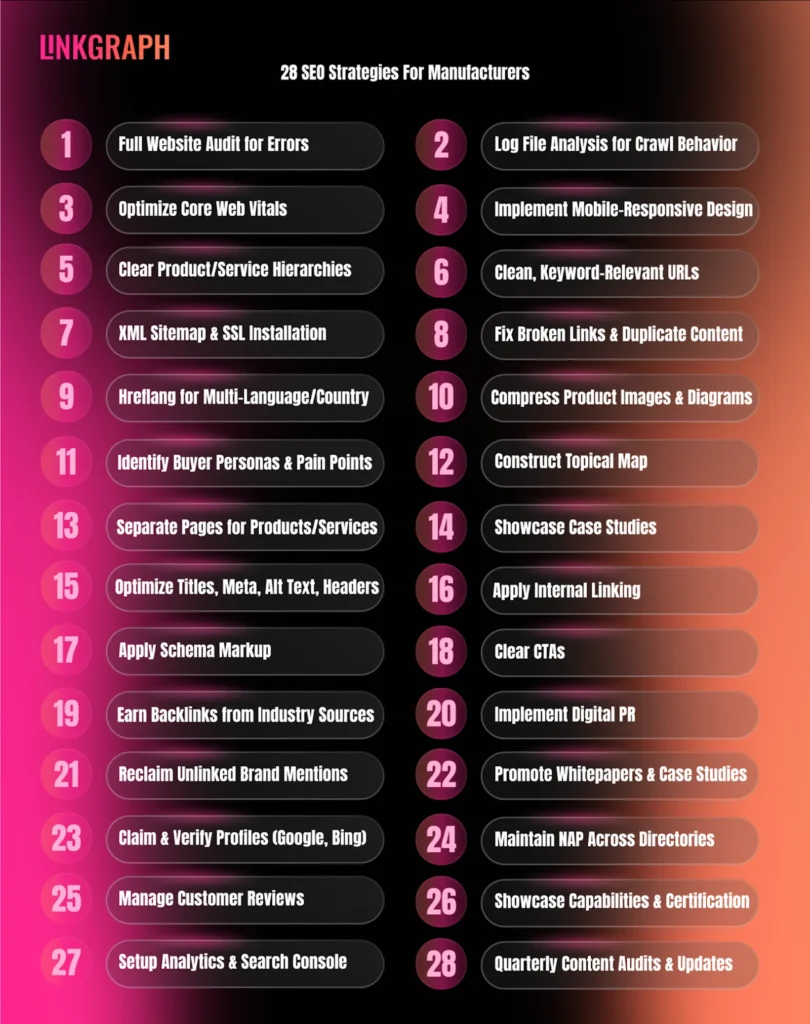
There are 28 SEO strategies for manufacturers. The 28 SEO strategies for manufacturers are listed below.
- Conduct Full Website Audit to Identify Errors
- Conduct Log File Analysis to Understand Search Engine Crawl Behavior
- Optimize Core Web Vitals (LCP, FID, CLS)
- Ensure Mobile-Responsive Design for All Devices
- Build a Logical Site Architecture with Clear Product/Service Hierarchies
- Implement Clean, Keyword-Relevant URLs
- Generate and Submit an XML Sitemap and Install SSL Certificate
- Fix Broken Links and Resolve Duplicate Content Issues
- Implement Hreflang for Multi-Language or Multi-Country Targeting
- Compress Technical Diagrams and Product Images to Improve Load Times
- Identify Target Buyer Personas and Their Pain Points
- Construct Proper Topical Map Based on Source Context
- Create Separate Pages for Each Product, Service, and Application
- Showcase Technical Case Studies with Specifications and Results
- Optimize Title Tags, Meta Descriptions, Alt Text, and Headers
- Implement Correct Internal Linking Strategy (Root → Seed → Node)
- Apply Relevant Schema Markup (Product, Organization, FAQ, How-To)
- Place Clear CTAs for Quote Requests, Catalog Downloads, and Contact
- Earn Backlinks from Industry Publications, Trade Associations, and Supplier Websites
- Execute Digital PR Strategy Highlighting Innovations, Certifications, and Projects
- Reclaim Unlinked Brand Mentions from Partners, Clients, and Industry News
- Promote Whitepapers and Technical Case Studies to Generate Editorial Links
- Claim and Verify Business Profiles on Key Platforms (Google, Bing)
- Maintain Consistent NAP Citations in Industrial Directories
- Actively Solicit and Manage Customer Reviews and Testimonials.
- Showcase Manufacturing Capabilities, Certifications, and Facility Updates on Profiles
- Set Up Google Analytics 4 and Search Console for Performance Tracking
- Conduct Quarterly Content Audits to Refresh and Update Pages
Implementing this comprehensive SEO roadmap allows manufacturers to optimize technical performance, create authoritative content, and strengthen online visibility. Following these steps builds credibility, attracts high-quality leads, and ensures sustainable long-term growth in the industrial sector. We have broken down the 28 SEO strategies for manufacturers below.
1. Conduct Full Website Audit to Identify Errors
A full website audit forms the foundation of SEO for manufacturers. It examines all website elements to uncover technical and content-related weaknesses that reduce search visibility. Manufacturers depend on accurate indexing to reach engineers, procurement teams, and industrial buyers. Search engines assess crawl efficiency, site architecture, internal linking, structured data, and server performance. Identifying issues early allows manufacturers to build a stable SEO strategy rather than correcting problems later.
Firstly, the audit reviews indexing status, crawl errors, broken links, duplicate content, and redirect chains. Technical SEO optimization includes reducing server response time below 100ms for faster page loads, ensuring HTML crawl success above 95%, maintaining a refresh rate of around 20%, and targeting a discovery rate of 7–8%. Log file analysis identifies wasted crawl budget from redirects or low-value pages.
Secondly, the audit evaluates on-page elements such as title tags, meta descriptions, headers, and schema markup, which align them with product and service keywords. It reviews Core Web Vitals, XML sitemaps, SSL certificates, and mobile responsiveness. The audit produces a prioritized action plan, which resolves critical issues first, improves crawlability, user experience, and creates a solid technical SEO foundation for long-term growth.
2. Conduct Log File Analysis to Understand Search Engine Crawl Behavior
Log file analysis gives manufacturers clear evidence of how search engines crawl their websites. Every visit from a search engine bot leaves a record in the server logs. Examining these records reveals how frequently bots access different pages, which sections they ignore, and where crawl inefficiencies occur. For manufacturers with extensive product catalogs or technical documentation, this method uncovers patterns that directly affect indexing and ranking. Search engines rely on efficient crawl paths to discover and rank important product, service, and resource pages.
Firstly, the analysis identifies crawl frequency for each URL. Pages that receive limited crawl attention are not indexed properly, which restricts their ability to rank for relevant keywords. Secondly, it highlights wasteful crawl activity on low-value or outdated pages, which prevents search engines from focusing on priority sections. Thirdly, it exposes redirect chains, orphan pages, and blocked resources that interrupt crawling and create indexing gaps within manufacturing websites.
The insights from log file analysis inform strategic decisions about site structure, internal linking, and crawl budget allocation. Manufacturers prioritize key service and product pages, reduce crawl waste, and create cleaner pathways for search engine bots. Over time, this improves indexing coverage, stabilizes rankings for technical keywords, and ensures that high-value industrial content receives consistent search engine attention.
3. Optimize Core Web Vitals (LCP, FID, CLS)
Core Web Vitals optimization ensures manufacturing websites perform efficiently for both users and search engines. These metrics include Largest Contentful Paint (LCP), First Input Delay (FID), and Cumulative Layout Shift (CLS). Manufacturing sites often contain technical diagrams, high-resolution images, and complex layouts, which slow load times and disrupt page stability. Optimizing these metrics improves usability, reduces bounce rates, and boosts search rankings.
Firstly, improving LCP focuses on speeding up the largest visible element, such as a product image or technical diagram. Techniques include image compression, render-blocking resource reduction, and server response enhancement. Secondly, FID reduction ensures interactive elements, like quote forms or product filters, respond quickly. This involves minimizing heavy JavaScript and optimizing event handling. Thirdly, CLS control prevents layout shifts caused by images or embedded content. Manufacturers stabilize layouts using explicit size attributes and CSS management.
Optimizing Core Web Vitals increases user engagement with technical content and product pages while improving search visibility. Consistently monitoring LCP, FID, and CLS allows manufacturers to maintain fast, stable, and responsive websites as new content and products are added.
4. Ensure Mobile-Responsive Design for All Devices
Mobile responsiveness ensures manufacturing websites display correctly and function smoothly across all devices, which include smartphones, tablets, and desktops. Manufacturers often showcase detailed product specifications, technical diagrams, and interactive tools, which make mobile design essential for user engagement. Responsive layouts prevent distorted images, misaligned content, and unusable menus, which provide a smooth experience for engineers, procurement specialists, and other B2B visitors.
Firstly, implement flexible grids and fluid layouts to allow content to adjust automatically to different screen sizes. Secondly, touch-friendly buttons, easy-to-read fonts, and optimized navigation menus improve usability on smaller screens, which allows visitors to find product details, catalogs, or contact information quickly. Thirdly, test across multiple devices to ensure compatibility, which reveals issues like overlapping elements or slow load times that hinder the user experience.
Mobile responsiveness contributes to higher search engine rankings, as Google prioritizes mobile-friendly sites for indexing and ranking. Manufacturers benefit from improved accessibility, lower bounce rates, and increased engagement, which leads to more qualified leads. Maintaining consistent responsiveness as new products and content are added preserves usability and search performance over time.
5. Build a Logical Site Architecture with Clear Product/Service Hierarchies
A well-structured site architecture organizes a manufacturing website into clear product and service hierarchies, which makes it easier for both users and search engines to navigate. Manufacturers often offer multiple product lines, services, or applications, so arranging content into logical categories prevents confusion and highlights core offerings. Clear hierarchies improve indexing, which allows search engines to understand relationships between pages and boost organic visibility for relevant queries.
Firstly, manufacturers need to group main services or product lines as root pages, with sub-services or variations as seed pages, and detailed specifications, case studies, or technical documents as node pages. Secondly, implement breadcrumb navigation and internal linking to ensure users move smoothly between sections, by locating information like material specifications, machine capabilities, or certifications without frustration. Thirdly, consistent URL structures reflecting these hierarchies reinforce page relevance and make sharing links easier across platforms or marketing materials.
Logical architecture reduces duplicate content risks, enhances crawl efficiency, and distributes link equity effectively across the site. Manufacturers gain improved discoverability for core offerings, faster indexing of new products, and a smoother experience for engineers, buyers, and partners researching complex industrial solutions. This organization strengthens authority in search results while increasing engagement and conversion rates.
6. Implement Clean, Keyword-Relevant URLs
Clean, keyword-relevant URLs improve the search engine visibility of a manufacturing website and provide clarity for users navigating complex product catalogs. Manufacturers often have multiple product lines and technical services, so URLs that clearly reflect page content allow both search engines and visitors to understand what each page offers. A URL like www.company.com/cnc-machining-services immediately signals the focus of the page, which boosts relevance for queries related to CNC machining.
Firstly, incorporate primary keywords naturally into URLs while keeping them concise and readable. Secondly, avoid unnecessary parameters, numbers, or symbols to prevent confusion and ensure links are easier to share in marketing campaigns, emails, and social profiles. Thirdly, consistent URL structure across the site reinforces the logical hierarchy of root, seed, and node pages, which strengthens indexing and distributes link equity efficiently.
Well-structured URLs improve crawling and indexing by search engines while enhancing user trust and navigation. Manufacturers benefit from improved organic rankings for targeted keywords, clearer identification of products or services, and increased click-through rates from search engine results. This practice aligns technical optimization with user experience, which reinforces overall SEO effectiveness.
7. Generate and Submit an XML Sitemap and Install an SSL Certificate
Generating and submitting an XML sitemap ensures that search engines discover and index all important pages on the website of a manufacturer efficiently. Manufacturers often have complex sites with multiple product lines, services, and technical resources, which make it crucial to provide search engines with a clear roadmap. An XML sitemap lists every page, which includes product pages, service descriptions, and case studies, which reduces the risk of pages being overlooked and improves overall visibility.
Installing an SSL certificate secures the website, which encrypts data transmitted between users and the server. Search engines, which include Google, prioritize secure sites in rankings, so SSL installation contributes to higher visibility and trustworthiness. Manufacturers benefit from increased confidence among clients when they browse technical specifications, submit inquiries, or download catalogs.
Firstly, generate an XML sitemap that includes all critical URLs, and update it whenever new products, services, or case studies are added. Secondly, submit the sitemap to search engines via platforms like Google Search Console (GSC) and Bing Webmaster Tools. Thirdly, implement an SSL certificate across all pages, which ensures HTTPS is used site-wide. This combination of structured indexing and enhanced security improves crawl efficiency, potential for ranking, and user trust for manufacturing websites.
8. Fix Broken Links and Resolve Duplicate Content Issues
Fixing broken links and resolving duplicate content ensures the website of a manufacturer remains authoritative, crawlable, and user-friendly. Broken links disrupt navigation, frustrate visitors, and signal poor maintenance to search engines, while duplicate content dilutes keyword relevance and weakens page authority. For manufacturers, maintain accurate technical and product information is critical because decision-makers rely on precise details when evaluating suppliers and services.
Manufacturers regularly scan their website using tools in the technical SEO category to identify 404 errors, redirect chains, and repeated content. Internal links point to active pages, outdated URLs are redirected, and duplicate product descriptions or technical case studies are consolidated or rewritten. Implementing canonical tags on similar pages ensures search engines understand which version to index, which preserves ranking potential and link equity.
Correcting these issues improves crawl efficiency, strengthens domain authority, and increases the likelihood of ranking higher for industry-specific terms like “CNC machining services” or “custom metal fabrication.” Consistent maintenance reduces wasted crawl budget, enhances user experience, and reinforces credibility with both search engines and potential clients. A practical tip is to schedule quarterly audits to catch errors early and maintain an organized, authoritative site structure.
9. Implement Hreflang for Multi-Language or Multi-Country Targeting
Hreflang tags specify the language and regional target of a webpage, which ensures search engines display the correct version to users. For manufacturers, hreflang prevents duplicate content issues and directs engineers, procurement specialists, and buyers to pages tailored to their country or language.
Implementation involves mapping each page to its corresponding region or language and adding hreflang attributes in the header or sitemap. SEO auditing and site analysis tools validate tags, detect errors, and ensure proper indexing. Reciprocal links and self-referencing tags maintain consistency and prevent conflicts.
Proper hreflang improves visibility in international markets, reduces bounce rates, and strengthens domain authority across regions. Manufacturers gain higher engagement from qualified global buyers, improved rankings for regional keywords, and a cleaner multilingual site structure. Begin with priority markets and expand coverage gradually while monitoring performance.
10. Compress Technical Diagrams and Product Images to Improve Load Times
Large images and technical diagrams increase page load times, which slows down the website of a manufacturer and negatively affects search rankings. Fast-loading pages enhance user experience for engineers, buyers, and procurement teams, while search engines prioritize pages that load quickly.
Compression involves reducing file size without sacrificing visual clarity. Image optimization tools optimize images, while WebP or AVIF formats offer modern alternatives. Lazy loading ensures images load only when visible on the screen, further improving performance.
Optimized images improve Core Web Vitals, lower bounce rates, and boost organic rankings for product and service pages. Manufacturers benefit from faster navigation, higher engagement, and an increased likelihood of converting qualified leads. Regularly audit and compress new uploads to maintain optimal site speed.
11. Identify Target Buyer Personas and Their Pain Points
Defining target buyer personas allows manufacturers to focus SEO efforts on the right audience, which includes engineers, procurement specialists, or industrial decision-makers. Understanding their challenges, needs, and search behaviors allows content to align with queries and purchasing intent. Accurate personas guide keyword selection, content creation, and site structure to attract qualified leads rather than general traffic.
Manufacturers need to research buyer pain points, frequently asked questions, and industry-specific requirements. Surveys, interviews, and analytics tools provide insights into search intent and content preferences. Integrating these personas into a topical map ensures each page addresses a specific problem or query, which forms clusters that strengthen relevance and authority. For example, a CNC machining service page links to related topics like precision tolerances, material selection, and cost optimization, which form a logical content hierarchy.
Using buyer personas and topical mapping improves engagement, reduces bounce rates, and increases conversions by delivering tailored information that resonates with the decision-maker. Clear persona-driven content enhances internal linking and site architecture, which signals authority to search engines. Regular updates to personas and topical maps ensure evolving market demands continue to guide SEO strategy effectively.
12. Construct Proper Topical Map Based on Source Context
A proper topical map organizes website content around core subjects, subtopics, and additional information, which creates a logical hierarchy that search engines easily understand. For manufacturers, this means grouping product pages, service descriptions, technical guides, and case studies in a way that aligns with buyer intent. Clear topical mapping allows search engines to associate content with relevant queries, which improves rankings for both broad and niche industrial searches.
Developing a topical map starts with identifying main products or services, then branching into subtopics and related content, which form clusters that link back to central hub pages. Keyword research and content analysis tools assist in mapping keywords, search intent, and semantic relationships. For example, a manufacturer of injection molding equipment creates a hub page for the service and clusters pages on materials, process optimization, and maintenance tips.
Properly structured topical maps improve content discoverability, enhance internal linking, and establish authority across industry-specific search queries. Linking related pages within clusters boosts page relevance and authority, which leads to higher rankings. Continuous refinement of the topical map ensures it reflects evolving industry trends and buyer needs, which maximizes SEO effectiveness over time.
13. Create Separate Pages for Each Product, Service, and Application
Creating dedicated pages for each product, service, or application allows manufacturers to present focused content tailored to specific buyer needs. Each page highlights specifications, benefits, and use cases, which makes it easier for industrial buyers and search engines to find relevant information. On-page SEO elements like optimized headings and meta descriptions enhance visibility without being the main focus.
Individual pages improve engagement by providing technical details, certifications, and case studies that build trust and authority. Search engines favor clear, topic-specific content, which boosts rankings for product- or service-related queries.
Manufacturers need to structure pages with descriptive content, headings, CTAs, and internal links to category or hub pages. This organization strengthens site hierarchy, improves topical relevance, and allows performance tracking to optimize lead generation and conversions.
14. Showcase Technical Case Studies with Specifications and Results
Displaying technical case studies demonstrates the expertise, project capabilities, and measurable outcomes of a manufacturer. Each case study needs to present the client challenge, applied solution, and achieved results, which offer industrial buyers tangible evidence of performance. On-page SEO is applied to headings, image alt text, and summaries to improve discoverability without being the main focus.
Case studies build credibility and trust, which shows that the manufacturer delivers on complex projects. Detailed specifications, project metrics, and process explanations resonate with engineers, procurement teams, and decision-makers, which improves engagement and drives qualified inquiries.
Manufacturers need to structure case studies with clear headings, concise descriptions, visuals of technical diagrams or product results, and CTAs for further contact. Linking these studies to relevant product or service pages enhances site hierarchy, topical authority, and search visibility.
15. Optimize Title Tags, Meta Descriptions, Alt Text, and Headers
Optimizing title tags, meta descriptions, headers, and image alt text ensures search engines understand the website content of a manufacturer. Properly crafted elements improve rankings for targeted industry-specific keywords and increase click-through rates from search results. On-page SEO principles apply to these optimizations without making them the main focus.
This strategy enhances relevance and visibility by signaling to search engines which products, services, or technical solutions are offered. Clear headers structure content for readers, while descriptive alt text communicates the value of diagrams, product images, and charts to search engines and accessibility tools.
Manufacturers need to create unique, keyword-focused titles and descriptions for each page, use hierarchical headers to organize content logically, and provide accurate, descriptive alt text for all visuals. These practices strengthen topical relevance, improve organic traffic, and encourage higher engagement from industrial buyers.
16. Implement Correct Internal Linking Strategy (Root → Seed → Node)
A structured internal linking strategy guides search engines and users through the website of a manufacturer, which clarifies page hierarchy and content relationships. Root pages represent primary service or product categories, seed pages cover sub-services, and node pages provide detailed, related content. This approach improves crawl efficiency and distributes authority across the site while reinforcing on-page SEO naturally.
Correct internal linking enhances discoverability for technical content and ensures high-value pages receive adequate link equity. For manufacturers, this method highlights product specifications, case studies, and application details, which makes it easier for search engines to index and rank important pages. Users navigate the website efficiently and find relevant information without frustration.
Implement this strategy by mapping the website structure and identifying key pages to serve as root, seed, or node pages. Insert contextual links within page content, maintain a logical hierarchy, and avoid orphaned pages. This improves rankings, increases organic traffic, and strengthens user engagement across the manufacturing website.
17. Apply Relevant Schema Markup (Product, Organization, FAQ, How-To)
Schema markup provides structured data that allows search engines to understand the website content of a manufacturer more clearly. Applying product, organization, FAQ, and how-to schemas ensures search engines correctly interpret products, services, company information, and step-by-step processes. This boosts the likelihood of rich results, enhances visibility, and complements on-page SEO efforts without dominating them.
For manufacturers, product schema highlights specifications, pricing, and availability, while organization schema communicates credibility and industry authority. FAQ and how-to schemas improve engagement by answering common buyer questions directly in search results. This structured approach increases click-through rates and attracts highly qualified traffic from industrial buyers actively researching products and services.
Implement schema markup by reviewing website pages and selecting schemas aligned with the purpose of each page. Embed structured data in JSON-LD format, validate with a structured data testing tool, and monitor performance in GSC reports. Proper schema application enhances rankings, increases visibility in rich snippets, and strengthens overall search presence.
18. Place Clear CTAs for Quote Requests, Catalog Downloads, and Contact
Clear calls-to-action (CTAs) guide website visitors of manufacturers toward meaningful steps, such as request a quote, download a catalog, or contact sales teams. Strategically placed CTAs improve user navigation, increase engagement, and directly contribute to lead generation, while complementing on-page SEO elements without overshadowing them.
For industrial websites, CTAs need to be visually distinct, concise, and contextually relevant. Placing a “Request a Quote” button near product specifications, or a “Download Catalog” link alongside technical diagrams, encourages high-intent visitors to act quickly. Effective CTAs reduce bounce rates and create a smooth buyer journey, which makes it easier for search engines to identify valuable pages.
Implementation involves mapping CTAs to the goals of each page, which ensures mobile-friendly placement, and testing different designs for optimal performance. Monitoring click-through rates and conversion metrics allows manufacturers to refine CTAs over time. Well-structured CTAs increase lead volume, improve user experience, and enhance overall site effectiveness in attracting qualified B2B prospects.
19. Earn Backlinks from Industry Publications, Trade Associations, and Supplier Websites
Backlinks from authoritative sources signal trust and credibility to search engines, which boosts the website authority of a manufacturer. High-quality links from industry publications, trade associations, and supplier websites demonstrate expertise, which allows industrial buyers to recognize the brand as a reliable partner. Backlinks enhance referral traffic and strengthen broader SEO efforts without overshadowing other optimization strategies.
Manufacturers need to focus on creating valuable content, such as technical whitepapers, case studies, and product insights that industry platforms find worth linking to. Collaborate with trade associations, participate in industry events, and maintain strong supplier relationships to increase the likelihood of receiving natural, relevant backlinks. Each link strengthens the authority of a website, which improves rankings for niche manufacturing keywords.
Practical implementation involves mapping target domains, outreach with personalized proposals, and tracking acquired backlinks to ensure relevance and quality. Consistent backlink acquisition strengthens higher organic search visibility, reinforces brand credibility, and drives qualified traffic from trusted industry sources, ultimately increasing potential leads and conversions.
20. Execute Digital PR Strategy Highlighting Innovations, Certifications, and Projects
A digital PR strategy promotes the innovations, certifications, and completed projects of a manufacturer, which signals authority and expertise to search engines and industry audiences. Highlighting achievements positions the company as a leader in its field while generating organic mentions and backlinks from trusted publications. This approach strengthens brand reputation and strengthens broader SEO efforts without relying solely on on-page optimization.
Manufacturers need to develop press releases, feature articles, and case studies that emphasize unique innovations, certifications earned, or major project milestones. Sharing this content through industry news outlets, trade websites, and professional networks increases visibility and attracts relevant backlinks. Each published story reinforces credibility and expands the digital footprint of the company.
Execution requires identifying media targets, crafting compelling content aligned with business strengths, and tracking coverage for impact. A well-orchestrated digital PR campaign elevates search engine rankings, drives referral traffic, and enhances the authority of a company in the manufacturing sector, which leads to higher engagement from potential clients and partners.
21. Reclaim Unlinked Brand Mentions from Partners, Clients, and Industry News
Reclaiming unlinked brand mentions ensures that references to the name of a manufacturer across the web contribute to SEO authority and domain credibility. Many partners, clients, or industry publications mention companies without linking back to their website, which results in lost opportunities for traffic and search recognition. Capturing these mentions strengthens backlink profiles and amplifies the online presence of a manufacturer.
The process begins by monitoring mentions of the brand, products, or key personnel across industry websites, forums, and news outlets. Once identified, outreach involves politely requesting the addition of a hyperlink pointing to the official site, which emphasizes mutual value. This approach converts passive recognition into tangible SEO benefits.
Reclaimed links improve search engine trust signals, enhance organic rankings, and drive referral traffic from relevant sources. Maintaining a consistent effort in monitoring and following up ensures that all mentions strengthen authority-building strategies and maximize the impact of digital marketing campaigns.
22. Promote Whitepapers and Technical Case Studies to Generate Editorial Links
Publishing and promoting whitepapers and technical case studies establishes the expertise of a manufacturer while generating high-quality editorial backlinks. These resources provide in-depth insights into processes, product innovations, or project results, which attract attention from industry publications, research platforms, and professional networks. Editorial links from authoritative sites enhance domain authority and drive targeted traffic to the website of a manufacturer.
Promotion begins by distributing these materials through professional channels, trade associations, and relevant industry communities. Sharing highlights, summaries, or infographics increases visibility and encourages natural linking from websites that reference the content. This strategy ensures that the knowledge of a manufacturer becomes a recognized resource within the sector.
Editorial links improve search engine rankings, strengthen brand authority, and attract potential clients or partners seeking technical expertise. Regularly updating whitepapers and case studies keeps content relevant, sustains backlink growth, and reinforces the position of a manufacturer as a trusted industry leader.
23. Claim and Verify Business Profiles on Key Platforms (Google, Bing)
Claiming and verifying business profiles on platforms like Google Business Profile (GBP) and Bing Places establishes an official online presence for manufacturers. Verified profiles increase trust with search engines and potential clients, which signals that the company is legitimate and active. This visibility ensures that accurate business information, such as address, phone number, and operating hours, appears in search results and maps, which improves local discoverability.
Maintaining complete and consistent profiles with detailed descriptions, high-quality images, and accurate service listings boosts engagement and enhances the authority of a company. Including posts, project updates, and relevant offerings on these profiles strengthens their value and allows search engines to understand the business scope. Verification prevents competitors or inaccurate sources from claiming the profile of the company, which protects online reputation.
Properly claimed profiles impact rankings in local search results and map packs, which drive targeted leads and site visits. Consistency across all platforms improves citation authority, reinforces local SEO efforts, and provides insights through analytics on how users interact with the profiles. Regular updates ensure that profiles remain accurate and continue to attract relevant traffic.
24. Maintain Consistent NAP Citations in Industrial Directories
Maintaining consistent Name, Address, and Phone (NAP) citations across industrial directories establishes trust with search engines and potential clients. Accurate NAP information ensures manufacturers appear correctly in local and industry-specific searches, which improves visibility and reduces confusion for buyers seeking products or services. Discrepancies in NAP details negatively affect rankings, as search engines question the legitimacy of a business.
Consistency across directories, trade associations, and supplier listings reinforces the authority of a manufacturer and strengthens local SEO. Each listing needs to match the official business information exactly, which includes abbreviations and formatting, to create a uniform digital footprint. This approach allows search engines to link citations accurately to the main website and improves the likelihood of appearing in map packs and local search results.
Regularly auditing industrial directories for outdated or inconsistent listings ensures ongoing accuracy and prevents lost opportunities. Updating directories with correct NAP data, high-quality images, and relevant service details increases credibility and enhances lead generation. This process ultimately enhances search visibility, strengthens brand presence, and drives qualified traffic from both local and global industrial clients.
25. Actively Solicit and Manage Customer Reviews and Testimonials
Customer reviews and testimonials provide social proof that enhances the credibility and trustworthiness of a manufacturer. Positive feedback from clients, suppliers, or partners signals reliability to both search engines and potential buyers. Actively managing reviews allows manufacturers to highlight strengths, address concerns, and demonstrate commitment to quality and customer satisfaction.
Encouraging reviews on key platforms, such as search engines and industry directories, increases visibility in local and B2B searches. Responding to feedback promptly, whether positive or negative, shows professionalism and builds stronger client relationships. These interactions influence search rankings and allow manufacturers to stand out against competitors.
Regularly monitoring review platforms and showcasing testimonials on the website and marketing materials strengthens online reputation. Structured, verified reviews improve click-through rates from search results and enhance lead generation by providing potential clients with clear evidence of successful past projects. Consistent review management ultimately drives more inquiries, conversions, and long-term client trust.
26. Showcase Manufacturing Capabilities, Certifications, and Facility Updates on Profiles
Displaying manufacturing capabilities, certifications, and facility updates on business profiles establishes authority and builds confidence among potential clients. Highlighting specialized equipment, production processes, and quality standards communicates professionalism and expertise to engineers, procurement teams, and industrial buyers. Search engines recognize detailed, accurate profile information, which improves visibility in relevant B2B searches.
Manufacturers need to include recent certifications, ISO compliances, and facility expansions on platforms like GBP and industry directories. Sharing updates about new technologies, production capacity, or notable projects demonstrates ongoing investment in quality and innovation. This transparency strengthens credibility and differentiates the company from competitors who provide limited or outdated information.
Regularly refreshing profiles with verified content ensures search engines index the most current information, enhancing discoverability. Adding multimedia, such as photos or short videos of facilities and processes, further engages potential clients and enhances conversion. Consistent profile updates signal reliability and expertise, which drives increased inquiries and reinforces the reputation of a manufacturer in the market.
27. Set Up Google Analytics 4 and Search Console for Performance Tracking
Implementing Google Analytics (GA4) and Google Search Console (GSC) enables manufacturers to monitor website performance and measure the impact of SEO efforts. Analytics provides insights into user behavior, traffic sources, and conversion patterns, while GSC tracks indexing status, crawl errors, and keyword performance. Together, these tools offer a comprehensive view of how industrial buyers interact with a website and identify opportunities for optimization.
Manufacturers configure GA4 to track key events, such as quote requests, catalog downloads, or contact form submissions. GSC monitors impressions, clicks, and coverage issues across product and service pages. Regular review of this data prioritizes technical fixes, content updates, and keyword targeting, which ensures the SEO strategy aligns with business objectives.
Integrating these platforms allows manufacturers to measure ROI from organic traffic accurately. Analyzing trends over time reveals high-performing pages and underperforming areas, which guide decision-making. Actionable insights from analytics and GSC data drive continuous improvement, increasing qualified leads, website engagement, and overall visibility in B2B search results.
28. Conduct Quarterly Content Audits to Refresh and Update Pages
Quarterly content audits evaluate all website pages to ensure relevance, accuracy, and alignment with current manufacturing industry trends. Regular audits identify outdated product specifications, expired certifications, or technical case studies that no longer reflect capabilities. Manufacturers use these insights to update content, improve keyword targeting, and maintain authority with industrial buyers and search engines.
Audits need to assess page performance metrics, which include traffic, engagement, and conversions, alongside SEO elements such as title tags, meta descriptions, headers, and internal links. Reviewing content quality and structure ensures that technical information, diagrams, and product descriptions remain clear and valuable to a specialized B2B audience. Pages with low performance should be improved, merged, or removed to optimize the overall website experience.
Refreshing content strengthens search engine visibility by signaling that the website remains active, authoritative, and relevant. Manufacturers highlight new capabilities, certifications, or project results to attract qualified leads and reinforce brand credibility. Consistent content maintenance ensures long-term SEO success and positions the company as a trusted industry leader.
How Long Does It Take for Manufacturers to See SEO Results?
For manufacturers, SEO typically takes 3 to 6 months to show initial results, with more substantial outcomes often emerging between 6 to 12 months. This timeline varies based on factors such as industry competition, website age, and the quality of SEO efforts.
In highly competitive industries, it takes longer to achieve top rankings due to the need to outperform established competitors. Conversely, in niche markets with less competition, manufacturers see quicker improvements. Expedite SEO results by focusing on creating high-quality, relevant content, which optimizes technical website elements and builds a strong backlink profile. Consistent effort and patience remain key to achieving long-term SEO success.
What Type of Content Works Best for Manufacturers in SEO?
Manufacturers benefit from technical, detailed content that addresses buyer needs and showcases expertise. Product pages with clear specifications, case studies highlighting project outcomes, and whitepapers explaining processes perform well.
Informational blogs on industry trends, how-to guides, and comparisons attract decision-makers researching solutions. Video demonstrations, infographics, and downloadable catalogs engage users while improving SEO.
Content should integrate relevant keywords naturally and align with the journey of a buyer. Structured, authoritative content positions a manufacturer as a trusted resource in their niche and drives qualified leads effectively.
How Can Manufacturers Benefit from Local SEO?
Local SEO increases the online visibility of a manufacturer in specific regions, which connects them with nearby clients. Optimizing for location-based searches enables appearance in the Local Pack on search engines, which attracts high-intent prospects.
Consistent NAP (Name, Address, Phone) information, optimized Google Business Profiles (GBP), and positive reviews improve credibility and trust. Local SEO enhances search rankings, strengthens relationships with the community, and drives targeted website traffic. Manufacturers gain higher conversion rates and a stronger regional presence by focusing on local optimization.
Which Online Directories Are Most Valuable for Manufacturers to Be Listed In?
The most valuable online directories for manufacturers to be listed in improve discoverability, enhance credibility, and connect with potential clients and industry partners. Some valuable online directories for manufacturers to be listed in are listed below.
- Thomasnet: Connects manufacturers with industrial buyers and suppliers across North America.
- IQS Directory: Provides a comprehensive listing of manufacturers, which enables targeted lead generation.
- Kompass International Directory: Expands global reach for B2B connections and export opportunities.
- IndustrySelect: Offers verified industrial company profiles for easier sourcing and research.
- Alibaba Manufacturer Directory: Connects manufacturers with international buyers and bulk purchasing clients.
- Global Sources Online Directory: Promotes verified manufacturers to global buyers and distributors.
- MFG.com Supplier Directory: Focused on custom manufacturing projects and supplier-client matching.
- Supplier Black Book: Highlights top manufacturers and suppliers, which provide credibility and trust.
- MacRAE’S Blue Book: Long-standing industrial directory connecting manufacturers with commercial buyers.
Listing on these platforms increases visibility, attracts qualified leads, and strengthens the authority of a manufacturer in their niche.
Is Technical SEO Important for Manufacturers?
Technical SEO is essential for manufacturers because it ensures that search engines efficiently crawl, index, and understand complex product and service pages. Manufacturers often have detailed specifications, diagrams, and multi-page product catalogs that require proper site structure, fast load times, and secure connections to be visible in search results.
Implementing technical SEO improves page performance, reduces crawl errors, and enhances mobile responsiveness, which directly impacts rankings. Manufacturers with optimized technical SEO experience higher visibility, more qualified traffic, and improved user engagement
How Does SEO Help Manufacturers Attract More Clients and Partners?
SEO increases online visibility, which allows manufacturers to appear for industry-specific searches, such as “custom metal fabrication” or “CNC machining supplier.” This visibility attracts qualified leads, which include engineers, procurement specialists, and distributors actively seeking manufacturers.
Optimizing content, site structure, and authority signals allows manufacturers to demonstrate expertise and credibility, which builds trust with potential clients and partners. SEO improves local and global discoverability and connects manufacturers to nearby and international buyers. Overall, effective SEO generates consistent inquiries, expands networks, and strengthens business growth opportunities.
How Can SEO Strengthen the Brand Identity of Manufacturers?
SEO strengthens the brand identity of a manufacturer by increasing online visibility and consistently showcasing expertise. High search rankings for industry-specific keywords, such as “CNC machining services” or “custom metal fabrication,” reinforce the authority of a company in the eyes of buyers. Optimized content, which includes technical case studies and product pages, communicates the capabilities and differentiators of a manufacturer and shapes how potential clients perceive the brand.
Structured on-page elements, such as clear headers, metadata, and schema markup, ensure consistent brand messaging across all website pages. This clarity ensures that both search engines and human visitors recognize the specialization and reliability of a manufacturer. Over time, repeated exposure to well-optimized content builds familiarity and trust.
SEO amplifies offline branding efforts by driving targeted traffic to the website, which allows manufacturers to highlight certifications, innovations, and success stories. Engaging content and strong online authority create a cohesive brand narrative that distinguishes the company from competitors, which results in increased recognition, credibility, and preference among buyers in industrial markets.
Can SEO Help Manufacturers Stay Ahead of Competitors?
SEO gives manufacturers an edge by improving visibility for industry-specific searches like “precision metal fabrication” or “industrial automation solutions.” Higher rankings attract qualified traffic and position a manufacturer as a top choice before competitors appear. Optimizing website content, technical performance, and backlinks ensures the brand remains prominent in search engines.
Tracking competitor strategies and adjusting keywords or content focus allows manufacturers to outperform rivals in key queries. Highlighting unique capabilities, certifications, and projects differentiates the brand from competitors with a weaker online presence.
How Can Manufacturers Optimize SEO for International Markets?
Manufacturers targeting international markets must structure websites to address regional search behavior, language preferences, and cultural nuances. Creating country-specific pages or subdomains with relevant content ensures that industrial buyers find accurate product information and localized offerings. Optimizing keywords for regional terminology, industry standards, and local competitors improves visibility in foreign search engines.
Technical considerations like hreflang tags, local server hosting, and compliance with regional search engine guidelines prevent duplicate content issues and enhance crawl efficiency. Structured data adapted to international markets signals relevance to search engines and improves rich results visibility.
Monitoring performance through regional analytics allows manufacturers to adjust content, metadata, and link-building strategies for each market. This targeted approach increases qualified leads, strengthens global brand authority, and ensures long-term growth across multiple regions.
Is Multilingual SEO Important for Global Manufacturers?
Multilingual SEO allows search engines to index content accurately across languages, improving visibility for international buyers. Translating content with precise technical details maintains relevance and credibility.
Correct use of language tags and hreflang prevents duplicate content issues and directs visitors to pages in their preferred language. Manufacturers using multilingual SEO expand reach, attract qualified leads, and strengthen global recognition. Localized keywords paired with tailored content improve rankings and conversions across different regional markets.
Is SEO More Cost-Effective Than Paid Advertising for Manufacturers?
Both SEO and paid advertising, known as Pay-Per-Click (PPC), offer distinct advantages for manufacturers. SEO builds a long-term traffic source by improving visibility in organic search. Once rankings stabilize, the ongoing cost of maintaining this visibility remains low compared to continuous ad spending.
Paid advertising delivers faster visibility, which makes it suitable for time-sensitive campaigns or new product launches. It allows precise targeting and immediate traffic but requires consistent investment to sustain results.
A balanced strategy often works best. Manufacturers benefit from combining the compounding value of SEO with the speed and targeting flexibility of PPC.
How Can Manufacturers Combine SEO with Paid Advertising for Better Results?
Manufacturers achieve stronger marketing outcomes by aligning SEO and paid advertising. Organic search builds authority and drives sustained traffic, while paid campaigns offer immediate visibility for targeted keywords. Combining both creates a stable presence across search results, which increases brand exposure and captures users at different stages of the buying process.
Paid ads target competitive or seasonal keywords while SEO focuses on long-term rankings for core topics. This approach ensures coverage for high-intent searches and maintains consistent lead generation.
Data from paid campaigns guide SEO keyword prioritization, while high-performing organic pages reduce paid spending over time. Coordinating both channels improves reach, lowers acquisition costs, and strengthens overall visibility.
How Can Manufacturers Measure the ROI of Their SEO Efforts?
Measuring ROI for SEO requires tracking performance across traffic, leads, and revenue. Manufacturers rely on clear metrics to evaluate whether optimization activities generate measurable business outcomes. Organic visibility, keyword rankings, and lead quality indicate how well strategies attract the right audience.
Comparing conversion rates between organic and other channels reveals how SEO contributes to sales pipelines. Tracking form submissions, quote requests, and catalog downloads connects search visibility with real inquiries. Monitoring customer acquisition costs highlights the financial efficiency of organic traffic compared to paid channels.
Setting clear goals and reviewing analytics dashboards allows manufacturers to see trends over time. Regular performance evaluations guide budget allocation, refine keyword focus, and confirm whether SEO investments drive long-term profitability.
Can Manufacturers Successfully Manage SEO on Their Own?
Some manufacturers manage basic SEO internally through optimized content, link fixes, and metadata updates. Advanced tactics like log file analysis, schema markup, and large-scale link building need specialized expertise. In-house teams without this experience risk missing key ranking factors. A hybrid model works best. Manufacturers handle routine tasks while experts manage technical audits and strategy, which ensures consistent progress and strong performance.
What Are the Most Common SEO Mistakes Manufacturers Should Avoid?
The common SEO mistakes manufacturers must avoid involve technical gaps, ineffective content strategies, and structural issues that reduce search engine visibility and limit qualified leads. Addressing these errors early ensures a website performs efficiently and attracts the right audience. The most common SEO mistakes for manufacturers are listed below.
- Ignoring Technical SEO: Overlooking aspects like site speed, mobile responsiveness, crawl errors, and proper indexing prevents search engines from fully accessing pages. This reduces ranking potential and limits visibility for industrial buyers searching for specific products or services. Conducting regular technical audits and monitoring crawl behavior fixes these issues.
- Keyword Misalignment: Targeting generic or overly broad keywords drives traffic that rarely converts. Manufacturers must focus on long-tail, industry-specific terms that match the intent of engineers, procurement specialists, and decision-makers, which ensures visitors align with products or services offered.
- Duplicate Content: Copying product specifications, service descriptions, or marketing pages across URLs confuses search engines and dilutes authority. Unique, detailed content for each page strengthens rankings and clarifies offerings for buyers.
- Weak Internal Linking: Poor link structure prevents efficient crawling and hides important product, service, or application pages. Organizing links with a logical hierarchy from main pages to subpages improves discoverability and user navigation.
- Neglecting Local SEO: Skipping local optimization reduces visibility among nearby buyers and potential partners. Consistent NAP citations, verified GBP, and location-specific content increase relevance in local search results and map listings.
Avoiding these mistakes boosts organic traffic, strengthens authority, and ensures SEO strategies deliver measurable results for manufacturers.
What Should Manufacturers Consider Before Hiring an SEO Agency?
Before hiring an SEO agency, manufacturers must evaluate experience, technical expertise, and industry-specific strategies. Choosing the right partner ensures measurable results, protects brand authority, and maximizes ROI from SEO investments. The factors to consider before hiring an SEO agency are listed below.
- Industry Experience: Agencies with prior experience in manufacturing understand complex sales cycles, technical products, and B2B buyer behavior, which enables targeted strategies.
- Proven Results: Look for case studies, client testimonials, or performance metrics showing tangible improvements in traffic, rankings, and lead generation for similar industrial clients.
- Technical Expertise: Ensure the agency handles technical SEO tasks like log file analysis, schema markup, page speed optimization, hreflang implementation, and structured data for industrial websites.
- Content Strategy Capabilities: The agency should develop industry-specific content, including technical case studies, whitepapers, and product descriptions that appeal to engineers, procurement teams, and decision-makers.
- Local and Global SEO Skills: The agency must optimize for both local markets and international audiences, which includes map pack listings, multi-language targeting, and regional keyword optimization.
- Transparency and Reporting: Clear reporting on keyword performance, traffic, conversions, and SEO health allows manufacturers to track ROI and monitor strategy effectiveness.
- Link-Building and PR Approach: The agency should focus on authoritative backlinks from industry publications, trade associations, suppliers, and technical media to boost credibility.
- Customization and Strategy Alignment: Avoid one-size-fits-all solutions. Agencies must tailor strategies to the product lines, services, target buyers, and competitive industry of a manufacturer.
Considering these factors ensures manufacturers partner with an SEO agency that drives sustainable growth, strengthens brand authority, and delivers measurable business results.
Which SEO Agency Near Me Provides the Best Services for Manufacturers?
For manufacturing companies seeking an SEO agency near Chattogram, LinkGraph provides specialized expertise in manufacturing SEO and marketing services for manufacturing companies. The agency has a proven track record of driving organic growth, improving online visibility, and generating qualified leads for clients across diverse industrial sectors.
LinkGraph focuses on technical SEO, optimizing site speed, mobile responsiveness, and crawlability to ensure manufacturing websites perform efficiently across all devices. Their holistic approach includes content marketing, link building, conversion rate optimization, and local SEO strategies, offering a comprehensive solution tailored to industrial businesses.
Client testimonials highlight professionalism, responsiveness, and measurable results, reflecting satisfaction with both strategy and execution. Proprietary tools enable scalable campaigns and data-driven decisions, strengthening overall effectiveness. For manufacturers aiming to boost search visibility, attract targeted leads, and establish brand authority online, LinkGraph stands out as a top manufacturing SEO agency with a results-driven, client-focused approach.
What SEO Services Does LinkGraph Offer for Manufacturers?
LinkGraph provides a comprehensive suite of SEO services tailored specifically for manufacturers, ensuring every aspect of their online presence drives visibility, leads, and conversions. The SEO services offered by LinkGraph for manufacturers are listed below.
- Technical SEO for Manufacturers: Optimizes site speed, mobile responsiveness, crawlability, and structured data to improve search engine indexing.
- On-Page SEO for Manufacturers: Enhances title tags, meta descriptions, headers, and content to target industry-specific keywords effectively.
- Content Strategy and Optimization for Manufacturers: Develops authoritative, technical content such as case studies, whitepapers, and product descriptions that attract qualified leads.
- Local SEO for Manufacturers: Optimizes business profiles, local citations, and map pack visibility to reach nearby buyers and partners.
- Off-Page SEO for Manufacturers: Builds high-quality backlinks from industry publications, trade associations, and supplier websites to boost authority.
- Branding and Online Presence for Manufacturers: Establishes credibility and recognition through consistent messaging and digital visibility.
- Conversion Rate Optimization (CRO) for Manufacturers: Improves website layout, CTAs, and forms to convert traffic into inquiries or sales.
- LLM Optimization for Manufacturers: Utilizes AI language models to refine content strategy, improve relevance, and enhance search rankings.
- E-Commerce SEO for Manufacturers: Optimizes product pages, catalogs, and online sales channels for search visibility.
- Analytics and Performance Tracking for Manufacturers: Monitors rankings, traffic, and conversions to measure ROI and guide strategy.
These services combine to deliver a holistic SEO approach, enabling manufacturers to strengthen their digital presence, attract high-quality leads, and maintain a competitive edge in industrial markets.
Can All Types of Manufacturers Benefit from LinkGraph’s SEO Support?
LinkGraph’s SEO strategies apply to manufacturers across all sectors, from heavy machinery and automotive components to electronics and custom fabrication. Each approach targets industry-specific buyer personas, addresses unique search behaviors, and optimizes technical and on-page elements relevant to the niche. Manufacturers with B2B sales, complex product catalogs, or global operations benefit from tailored keyword strategies, local SEO, and multilingual optimization. Even smaller manufacturers gain visibility in local and industry-specific searches, while larger enterprises strengthen authority and drive international leads.
How Much Does LinkGraph Charge Manufacturers for SEO Services?
LinkGraph offers customized pricing based on the scope of SEO services, industry complexity, and campaign goals. Packages account for website size, number of products or services, technical requirements, content creation needs, and ongoing optimization efforts. Manufacturers receive a transparent proposal outlining deliverables, timelines, and costs. This ensures investment aligns with expected ROI and long-term growth. Pricing scales with the level of service, from local SEO to full-service enterprise campaigns.
Does LinkGraph Specialize Exclusively in SEO for Manufacturers?
LinkGraph serves a broad range of industries beyond manufacturing, including legal, healthcare, technology, and professional services. However, the agency has dedicated expertise in manufacturing SEO, backed by case studies, technical optimization experience, and B2B marketing knowledge. This specialization allows the team to address industrial buyer behaviors, technical content needs, and complex sales cycles while leveraging best practices from other sectors to maximize results.
Which Other Industries Can Benefit from LinkGraph’s SEO Services?
LinkGraph’s SEO expertise extends beyond manufacturing, enabling businesses across multiple industries to increase visibility, attract qualified leads, and strengthen online authority. Other industries that benefit from LinkGraph’s SEO services are listed below.
- Legal Services: Law firms improve local search visibility, attract case-specific clients, and showcase expertise through content marketing.
- Healthcare Providers: Hospitals, clinics, and private practices enhance local SEO, patient acquisition, and content for specialized treatments.
- Technology Companies: SaaS providers and tech startups optimize product pages, technical content, and industry-specific keywords to reach decision-makers.
- E-Commerce Brands: Online retailers increase organic traffic, optimize product listings, and improve user experience for higher conversions.
- Professional Services: Accountants, consultants, and architects enhance credibility, highlight services, and capture leads in competitive markets.
- Education and Training: Schools, universities, and tutoring services improve visibility for courses, programs, and local search queries.
These industries benefit from tailored SEO strategies, combining technical optimization, content development, and local or industry-specific search visibility to drive growth.