
SEO for nutritionists and dietitians is a targeted digital marketing approach that optimizes websites, local listings, and online content to attract clients actively seeking nutrition services. Nutritionists and dietitians specialize in guiding health, wellness, and medical nutrition, providing tailored dietary solutions for diverse client needs. Implementing search engine optimization enhances online visibility, establishes authority, and drives qualified leads, transforming a practice into a trusted source for nutrition guidance.
Effective SEO for nutritionists and dietitians combines local SEO, on-page optimization, technical improvements, and strategic content creation. Optimized service pages, structured data, and relevant keywords ensure higher rankings in search results while reaching clients in specific geographic regions. Regular updates, review management, and backlink strategies reinforce credibility and foster long-term growth.
≈Selecting the right SEO agency for nutritionists and dietitians ensures expertise in niche strategies, performance tracking, and content alignment with audience needs. Agencies experienced in SEO services for nutritionists and dietitians maximize organic reach, improve local Map Pack performance, and generate measurable results. Local SEO for nutritionists and dietitians, nutritionists and dietitians search engine optimization, SEO services for nutritionists and dietitians, and the best SEO agency for nutritionists and dietitians together form a complete framework for business growth.

What Is SEO for Nutritionists and Dietitians?
SEO for nutritionists and dietitians is a structured digital marketing method that improves search visibility for nutrition practices. SEO for nutritionists and dietitians aligns websites with how search engines process relevance, authority, and intent. This alignment ensures nutrition and dietetics services reach people searching online for expert guidance.
Nutrition SEO targets queries such as “dietitian near me” or “IBS dietitian Chicago” and connects them to optimized service pages, blog articles, and location-based listings. Search optimization includes keyword research, on-page refinements, and technical fixes that help search engines interpret nutrition content clearly.
Content creation gives detailed explanations of diet plans, health conditions, and treatment goals. These articles, guides, and case studies establish expertise through context-rich material and make nutrition content valuable for both readers and search engines.
Local SEO emphasizes Google Business Profile optimization and accurate listings across healthcare directories. This process improves local rankings and ensures visibility for nutrition professionals within their geographic areas.
Off-page authority signals such as backlinks, citations, and reviews further build reputation and domain trust. As a result, SEO in nutrition and dietetics becomes a long-term growth method where visibility, lead quality, and client trust expand without reliance on constant advertising.
Is SEO Important for Nutritionists and Dietitians?
Yes, SEO is important for nutritionists and dietitians because it increases online visibility and connects professionals with people actively searching for nutrition guidance. A nutrition website that ranks higher in search results attracts more attention from potential clients seeking diet plans, recipes, or condition-specific support. This visibility directly supports client acquisition and business growth.
SEO is important for nutrition professionals because it matches services with real search intent. People typing queries like “keto meal plan for beginners” or “dietitian for weight loss in Chicago” already need guidance. Optimized pages, accurate local listings, and keyword-focused content place nutrition services in front of these motivated audiences.
SEO is important for building credibility in health-related fields where trust drives decisions. An optimized website that publishes detailed guides, recipes, and educational resources positions nutritionists and dietitians as reliable authorities. Positive client reviews and local SEO signals reinforce this trust, leading to a stronger reputation and long-term growth.
Which Type of Nutritionist or Dietitian Benefits the Most from SEO?
Search Engine Optimization (SEO) is one of the most effective ways for a nutritionist or dietitian to attract a steady flow of qualified leads without relying solely on paid ads or social media. For health, wellness, sports, family care, and specialized medical nutrition, SEO creates consistent visibility and connects practitioners with people searching for customized guidance. The types of nutritionist or dietitian that benefit the most from SEO are listed below.
- Clinical Nutritionist: Clinical nutritionists benefit through optimized service pages targeting condition-specific needs like diabetes, heart health, or digestive disorders.
- Sports Nutritionist: Sports nutritionists gain clients by ranking for queries on performance diets, pre-workout fueling, and recovery meal plans.
- Pediatric Nutritionist: Pediatric nutritionists attract parents looking for expert help with child nutrition, picky eating, allergies, and growth concerns.
- Renal Nutritionist: Renal nutritionists reach individuals managing kidney disease by targeting searches about dialysis-friendly diets and renal meal plans.
- Holistic Nutritionist: Holistic nutritionists connect with audiences searching for natural approaches to health, detox diets, and lifestyle-focused plans.
- Weight Management Nutritionist: Weight management nutritionists benefit from SEO targeting high-volume searches around weight loss programs, meal prep, and healthy lifestyle guides.
- Corporate Wellness Nutritionist: Corporate wellness nutritionists reach organizations by optimizing for terms like employee health programs and workplace nutrition workshops.
- Online/Virtual Nutritionist: Online nutritionists benefit strongly from SEO, ranking for queries like “virtual dietitian” or “online nutrition counseling”.
- Research Nutritionist: Research nutritionists use SEO to share studies, publish findings, and attract academic collaborations or institutional recognition.
- Public Health Nutritionist: Public health nutritionists attract partnerships and community projects by optimizing content on nutrition education and population wellness initiatives.
SEO supports nutritionists and dietitians across different specialties by connecting them with the exact audience searching for their expertise. Each type benefits in unique ways, but all gain stronger visibility, credibility, and client growth through optimized search presence.
What Is the Difference Between a Nutritionist and a Dietitian?
A dietitian is a legally recognized healthcare professional, while a nutritionist provides general dietary guidance without standardized legal protection. Dietitians complete a degree, supervised internship, and pass a national exam, often requiring state licensure or certification. They provide medical nutritional therapy for chronic conditions such as diabetes, heart disease, and digestive disorders. Nutritionists focus on general wellness, healthy eating habits, and lifestyle improvement, with qualifications ranging from advanced degrees to short training programs or unregulated practice.
Dietitians often work in clinical settings like hospitals, clinics, or nursing homes, creating personalized plans for patients. Nutritionists work in gyms, community programs, or online platforms, guiding clients on general nutrition and lifestyle choices. The dietitian title is protected by law in many regions, ensuring consistent standards and expertise. Nutritionist titles are usually unregulated, though some areas require specific certifications.
What Are the Main Benefits of SEO for Nutritionists and Dietitians?
The main benefits of SEO for nutritionists and dietitians go far beyond just ranking higher on Google. Dietitians SEO helps attract the right clients, build trust, and grow a sustainable business. SEO aligns websites, content, and local listings with search intent, connecting health professionals to people actively seeking nutrition guidance and dietetic services. Optimized search presence improves visibility, authority, and client engagement over time. The key advantages of SEO for nutritionists and dietitians are listed below.
- Increased Online Visibility: SEO improves website ranking in search results, making nutritionists and dietitians to find relevant queries.
- Attracts Qualified Clients: People searching for specific nutrition services, such as weight management or pediatric diets, are more likely to engage.
- Local Client Reach: Local SEO positions practices in geographic searches, ensuring nutrition services appear for nearby clients actively seeking guidance.
- Builds Trust and Authority: High-quality content, positive reviews, and optimized listings signal credibility and expertise in the nutrition field.
- Sustainable Lead Generation: Unlike paid ads, SEO continuously attracts new clients over time without constant advertising spend.
- Improves User Experience: Optimized websites load faster, are mobile-friendly, and provide clear navigation, keeping visitors engaged.
- Supports Content Strategy: Regular blog posts, guides, and FAQs educate clients and reinforce the dietitian or nutritionist’s expertise.
- Enhances Competitive Advantage: Effective SEO ensures nutritionists and dietitians outperform competitors in search visibility and client acquisition.
SEO drives measurable results, creating long-term growth for nutrition and dietetic practices while connecting professionals to the right audience efficiently.
How Can Nutritionists and Dietitians Get Started with SEO?
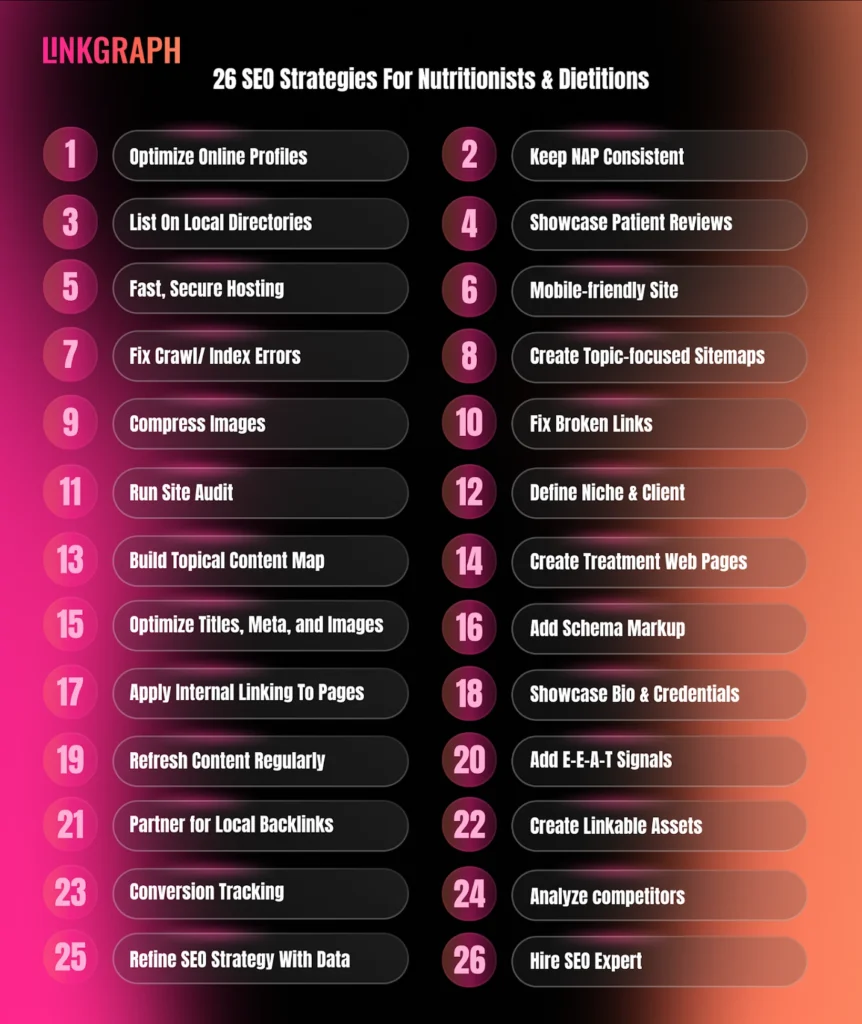
The best way for nutritionists and dietitians to get started with SEO is to begin with a strong foundation, starting with their website and local presence. From optimizing profiles to creating valuable content, each step strengthens visibility, builds credibility, and attracts clients searching for nutrition and dietetic services online. There are 26 steps for a nutritionist and dietitian to get started with SEO. The 26 steps for a nutritionist and dietitian to get started with SEO are listed below.
- Claim, Verify, And Fully Optimize Google, Bing, Yahoo, Profiles
- Ensure Consistencey in NAP Across All Listings And Healthcare Portals
- List Your Business on Trusted Local And National Directories
- Collect Cliets Reviews On All Platforms And Respond To Them Professionally
- Use Fast, Secure Hosting with HTTPS, CDN, and Caching Enabled
- Build Fast, Easy-to-Use Website That Works on Any Device
- Fix Crawling And Indexing Issues
- Create Smaller, Topic-Focused XML Sitemaps
- Compress And Convert Images To WebP Or AVIF
- Fix Broken Links, Add Redirects, And Reduce 404 Errors
- Run Complete Site Audit To Identify Technical Errors
- Define Your Niche and Audience, and Build an Ideal Client Profile (Pain Points, Goals, Search Behavior)
- Create Proper Topical Map For Your Nutritionist or Dietitian Business
- Create Separate, Optimized Page for Each Service and Location
- Write Clear, Context-Rich Page Titles and Meta Descriptions
- Add Schema Markup for Business Details, Services, FAQs, and Videos
- Strengthen Internal Linking with a Logical Hierarchy (Root → Seed → Node)
- Highlight Your Bio, Credentials, Certifications, Testimonials, Media Mentions, And Case Studies
- Refresh Outdated Content and Keep It Up to Date
- Establish E-E-A-T Signals in Your Content
- Earn High-Quality Backlinks via Guest Posts, Partnerships, PR, and Podcasts
- Create Linkable Assets and Promote via Social & Email with UTMs
- Set Up Conversion Tracking for Calls, Bookings, Forms, and Chat
- Analyze Top-Ranking Competitors And SERPs For New Opportunities
- Refine SEO Strategies Based On Performance Data And Results
- Hire An SEO Professional When Technical Challenges Exceed Your Expertise
Getting started with SEO as a nutritionist or dietitian is a step-by-step process. With consistent effort, clear strategy, and professional support when necessary, SEO becomes a powerful tool to grow visibility, attract the right clients, and build a sustainable practice. We have broken down the 26 steps for nutritionists and dietitian to get started with SEO below.
1. Claim, Verify, And Fully Optimize Google, Bing, Yahoo, Profiles
Setting up and optimizing profiles on Google Business Profile (GBP), Bing Places, and Yahoo Local improves local SEO and increases visibility in the Map Pack. These listings receive the highest click-through rates when clients search for nearby nutrition or diet services.
Claim and verify each profile, then ensure the business name, address, and phone number (NAP) remain identical across all directories. Add a detailed description of services with relevant keywords such as “weight management nutritionist” or “meal plans for diabetes.” Include high-quality images of the practice, team, or client events, and maintain activity by posting weekly updates like nutrition tips or healthy recipes to engage potential clients and boost search visibility naturally.
Encouraging reviews and responding professionally strengthens credibility and improves local rankings. Use local listing management tools to track profile completeness, monitor engagement, and maintain accurate information. A fully optimized profile enhances visibility, builds trust, and converts searches into booked appointments.
2. Ensure Consistencey in NAP Across All Listings And Healthcare Portals
Accurate and consistent name, address, and phone number (NAP) across all listings and healthcare portals strengthens local SEO and improves Map Pack rankings. Search engines compare information across directories to verify legitimacy, and inconsistencies lower local visibility.
Review each online directory and healthcare portal, correcting differences in spelling, abbreviations, or formatting. Include suite numbers, zip codes, and primary phone lines uniformly. Maintaining a master list of all listings helps track updates and ensures ongoing accuracy. Posting updates or small content adjustments regularly on these portals naturally reinforces consistency while signaling activity to search engines.
Consistency builds credibility with both search engines and potential clients, reduces confusion, and supports better local rankings. Monitoring tools for local listings help identify discrepancies and manage updates efficiently, driving more relevant client inquiries and increasing trust in the practice.
3. List Your Business on Trusted Local And National Directories
Submitting a nutrition or dietetics practice to well-known local and national directories improves discoverability and drives targeted traffic. These listings expand online presence beyond search engines and provide additional referral sources.
Include accurate NAP details, website link, and primary services. Highlight specialties in descriptions with keywords like “holistic nutrition counseling” or “weight management dietitian” to attract specific client segments. Adding categories and tags relevant to nutrition and dietetics increases the likelihood of appearing in directory searches.
Regularly review and update listings to reflect new services, certifications, or achievements. Active, complete listings enhance trust with prospective clients and contribute to search engine confidence in the business. Proper directory management broadens visibility, creates referral opportunities, and reinforces credibility within the health and wellness community.
4. Collect Clients Reviews On All Platforms And Respond To Them Professionally
Gathering client reviews across multiple platforms enhances credibility and strengthens local SEO for nutrition and dietetics practices. Reviews act as social proof, influencing potential clients and signaling trustworthiness to search engines.
Encourage clients to leave honest feedback after consultations, workshops, or online sessions. Ensure reviews are collected on key platforms like local directories, healthcare portals, and Google Business Profile. Respond promptly and professionally to every review, addressing concerns, thanking clients, and providing clarification when needed. Craft responses that reflect expertise and a caring approach, showing potential clients the practice values engagement and feedback.
High-quality reviews improve ranking in local search results and increase visibility in Map Pack listings. Consistent review management attracts more qualified clients and boosts overall reputation. Monitoring platforms for new reviews allows timely responses and helps maintain a positive online presence. Maintaining active client engagement through reviews supports trust, credibility, and long-term growth.
5. Use Fast, Secure Hosting with HTTPS, CDN, and Caching Enabled
Website speed and security play a major role in search rankings and user experience for nutrition and dietetics practices. Slow or insecure sites reduce engagement and increase bounce rates, negatively affecting visibility.
Select hosting that guarantees high uptime and fast server response. Activate HTTPS to secure user data and signal trustworthiness to search engines. Implement content delivery networks (CDNs) to distribute website content globally, reducing load times for distant users. Enable server-side or browser caching to store static content locally, improving page speed for returning visitors. Regularly monitor performance metrics to identify bottlenecks and optimize resource delivery.
Fast, secure websites rank higher and create a smoother experience for prospective clients. Improving load times and security increases the likelihood of conversions, strengthens credibility, and supports higher organic rankings. Regular audits of hosting and caching settings ensure long-term performance and search engine trust.
6. Build Fast, Easy-to-Use Website That Works on Any Device
A responsive, fast-loading website improves user experience and boosts search engine rankings for nutrition and dietetics practices. Websites that adapt to different screen sizes reduce bounce rates and increase engagement from prospective clients.
Design pages with clear navigation, concise menus, and intuitive layouts to make information easy to access. Optimize images, fonts, and media for mobile and desktop devices to maintain speed without sacrificing quality. Conduct usability testing to identify friction points, ensuring forms, buttons, and interactive elements function smoothly on all devices. Regularly monitor page load times and implement updates to prevent performance issues.
A well-designed, responsive website keeps visitors engaged and encourages appointment bookings or inquiries. Search engines favor fast, user-friendly sites, improving ranking potential and visibility in local and organic search results. Maintaining mobile compatibility ensures accessibility, strengthens credibility, and supports long-term SEO performance.
7. Fix Crawling And Indexing Issues
Ensuring search engines efficiently crawl and index a nutrition or dietetics website is essential for optimal visibility. Pages blocked by errors or slow server responses prevent content from appearing in search results, reducing traffic and engagement.
Reduce server response time to under 100 milliseconds to improve crawl efficiency. Maintain HTML crawl requests above 95% and keep a refresh rate around 20% to ensure updated content is processed quickly. Aim for a discovery rate of 7–8% to allow search engines to find new pages consistently. Perform log file analysis to identify where crawl budget is being wasted, highlighting broken links, redirects, or non-essential pages that consume resources.
Fixing crawling and indexing issues improves the likelihood of complete website coverage in search results. Efficient crawl paths, optimized server performance, and consistent indexing increase rankings, ensure new content is discoverable, and allow potential clients to find relevant nutrition and dietetics services more easily.
8. Create Smaller, Topic-Focused XML Sitemaps
Organizing a nutrition or dietetics website with smaller, topic-focused XML sitemaps improves search engine crawling and indexing efficiency. Large, cluttered sitemaps overwhelm search engines and delay content discovery.
Segment sitemaps by service, location, or content type, such as “weight management programs,” “pediatric nutrition guides,” or “blog articles on diet tips.” Ensure each sitemap includes only relevant, indexable URLs and excludes pages with low value or duplicate content. Submit sitemaps via search console platforms to guide search engines to high-priority pages. Regularly update sitemaps when new services or blog posts are added, and monitor indexing reports to confirm proper coverage.
Smaller, organized sitemaps enhance crawl efficiency, helping search engines prioritize the most important pages. This improves rankings, accelerates content discovery, and ensures potential clients access relevant nutrition and dietetics services quickly. Properly segmented sitemaps reduce crawl budget waste and support long-term SEO performance.
9. Compress And Convert Images To WebP Or AVIF
Optimizing images for a nutrition or dietetics website improves page speed, user experience, and search engine rankings. Large or unoptimized images slow loading times, increase bounce rates, and reduce engagement.
Compress images without sacrificing visual quality and convert them to modern formats such as WebP or AVIF. These formats reduce file size while maintaining clarity, allowing faster page rendering on desktop and mobile devices. Implement lazy loading for images to prioritize content above the fold and prevent unnecessary bandwidth use. Regularly audit the website to identify oversized or outdated media files and update them to optimized formats.
Faster-loading, optimized images enhance user experience and support higher rankings in search results. Reduced page load times improve client retention and encourage engagement with nutrition content. Proper image optimization ensures the website performs efficiently, boosts visibility, and strengthens credibility for dietetics and nutrition services.
10. Fix Broken Links, Add Redirects, And Reduce 404 Errors
Broken links and frequent 404 errors create a poor user experience and send negative signals to search engines, leading to lower rankings. Visitors who encounter errors are more likely to leave without exploring further, which increases bounce rates and reduces trust in the nutrition or dietetics brand.
Regularly scan the website to identify broken internal and external links. Replace outdated URLs, update resource links, or remove them if no longer relevant. For content that has moved or been consolidated, implement 301 redirects to guide users and search engines to the correct pages. Maintain a custom 404 page that offers helpful navigation options instead of leaving visitors stranded.
Fixing these issues ensures smooth navigation, preserves link equity, and maximizes crawl efficiency. Over time, this improves search visibility, keeps potential clients engaged, and builds stronger authority for the website of the nutritionist or dietitian.
11. Run Complete Site Audit To Identify Technical Errors
A site audit is one of the most reliable ways to uncover hidden technical issues that affect both user experience and search visibility. Errors such as duplicate titles, slow-loading pages, missing tags, or broken scripts are not always obvious, but hold back the website of a nutritionist or dietitian from ranking well. Search engines encountering these barriers crawl fewer pages and index less valuable content.
A thorough audit should review speed, mobile usability, structured data, internal linking, and security elements. Reports on index coverage help pinpoint which pages are being ignored or blocked, while deeper checks identify wasted crawl budget or redundant resources. Addressing these weaknesses ensures that important service pages, blogs, and location content remain accessible and prioritized.
Regularly running audits, ideally every quarter or after major updates, keeps a website technically sound. A clean, error-free site signals trust and reliability, improves visibility, and strengthens performance in competitive search results. Small improvements identified through audits often lead to measurable boosts in ranking, traffic, and client conversions.
12. Define Your Niche and Audience, and Build an Ideal Client Profile (Pain Points, Goals, Search Behavior)
A successful SEO strategy for nutritionists and dietitians begins with clarity about who the content is created for. Defining a niche helps narrow the focus to a specific audience, whether that’s clients seeking weight management, athletes needing performance nutrition, or individuals managing conditions like diabetes. Building an ideal client profile involves identifying their pain points, goals, and search behavior so the content addresses real needs instead of guessing what people want.
This clarity directly informs the creation of a topical map, which structures content around the most relevant themes and questions for the target audience. For example, if the niche is digestive health, the topical map includes clusters like “foods for gut health,” “meal plans for IBS,” and “supplements for digestion.” Each page and blog post then supports the overall expertise in that area, showing both clients and search engines that the practice specializes in solving those problems.
Niche, audience, and topical mapping working together result in higher rankings, stronger authority, and more targeted traffic. Clients searching for precise solutions feel understood and are more likely to book consultations, while search engines reward the site for its depth and relevance.
13. Create Proper Topical Map For Your Nutritionist or Dietitian Business
A topical map is a structured plan that organizes all content around the key themes, subtopics, and questions relevant to the niche of a nutritionist or dietitian. Instead of publishing random articles, a topical map ensures every piece of content fits into a hierarchy that builds authority. This approach shows search engines that the website comprehensively covers its area of expertise, making it easier to compete for high-value keywords.
For example, a dietitian specializing in sports nutrition might create a topical map with core themes like “pre-workout meals,” “hydration strategies,” and “recovery nutrition.” Each theme branches into supporting pages such as recipes, supplement guides, or FAQs, all interlinked to form a logical structure. This improves rankings and creates a user-friendly path for clients, helping them navigate from general questions to specific services.
A well-built topical map makes SEO more strategic and scalable. It guides content creation, strengthens internal linking, and signals depth to search engines. Over time, this results in stronger visibility, more targeted traffic, and greater trust from both algorithms and potential clients who see the practice as an authority in its specialty.
14. Create Separate, Optimized Page for Each Service and Location
Clients search with specific intent, often looking for a particular service or a nutritionist in their area. A single generic page cannot effectively meet these needs. Dedicated pages for each service, such as weight management programs, pediatric nutrition, or sports performance plans, help capture these distinct search queries. Similarly, location-focused pages allow the business to appear in local searches when someone types “nutritionist near me” or “dietitian in [city].”
Each page needs to be crafted with a clear headline, a concise service description, and content that addresses client pain points and goals. Adding details like pricing, appointment options, and client success stories makes the page more useful. For local pages, including maps, directions, and neighborhood references, ensure both relevance and trustworthiness.
This structure improves visibility by signaling to search engines that the business covers multiple areas in depth, not just broadly. It makes navigation easier for clients, guiding them directly to the information they are looking for. The result is higher rankings, more relevant traffic, and a greater chance of converting searches into appointments.
15. Write Clear, Context-Rich Page Titles and Meta Descriptions
Page titles and meta descriptions serve as the first point of contact between a nutritionist or dietitian and potential clients on search engines. Clear, context-rich titles tell both users and search engines exactly what the page covers. Meta descriptions provide a concise summary that encourages clicks while reflecting the relevance of the content. Together, they directly impact click-through rates and overall search performance.
Titles need to include targeted keywords relevant to the service or niche, such as “Sports Nutritionist for Athletes” or “Pediatric Dietitian in Chicago.” Meta descriptions should briefly highlight unique benefits, services, or outcomes while remaining readable and persuasive. Keeping them specific to the page content avoids confusion and reduces bounce rates.
This strategy improves rankings by signaling content relevance to search engines and helps potential clients find exactly what they need. Well-crafted titles and descriptions make pages more discoverable, attract qualified visitors, and increase the likelihood of turning searches into booked consultations. Regularly reviewing and updating these elements ensures continued optimization and engagement.
16. Add Schema Markup for Business Details, Services, FAQs, and Videos
Schema markup provides structured data that helps search engines understand the content and purpose of the website of a nutritionist or dietitian. Adding schema for business details, services, FAQs, and videos highlights key information and increases the chance of rich results, such as featured snippets or knowledge panels. This structured approach makes pages more attractive in search results and improves visibility.
Business schema must include an accurate name, address, phone number, and service categories. Service schema outlines individual offerings with descriptions, pricing, and availability. FAQ schema helps answer common client questions directly in search results, while video schema provides context for educational or promotional videos. Each addition improves content clarity for both users and search engines.
Implementing structured data strengthens authority and increases click-through rates by making search listings more informative. It reduces misinterpretation by search engines and enhances the likelihood of appearing in specialized search features. Regularly reviewing schema ensures accuracy and keeps pages aligned with evolving search standards, ultimately driving more qualified client traffic.
17. Strengthen Internal Linking with a Logical Hierarchy (Root → Seed → Node)
Internal linking organizes content to create a logical hierarchy that guides both users and search engines through the website of a nutritionist or dietitian. A root page introduces the main topic, seed pages cover subtopics, and node pages address specific questions or services. This structure improves navigation, helps search engines index pages effectively, and distributes link equity throughout the site.
Each link needs to use descriptive anchor text that clearly indicates the destination content, such as linking “pediatric nutrition plans” from a general “child health” page. Group related topics together and ensure important pages receive multiple internal links. This method makes it easier for clients to find relevant services and for search engines to understand topical relevance.
A strong internal linking hierarchy improves rankings by signaling content depth and relevance. It enhances user experience, encourages longer visits, and increases the likelihood of conversions. Regularly auditing links prevents broken paths and ensures that all pages contribute to the overall SEO strategy and authority of the site.
18. Highlight Your Bio, Credentials, Certifications, Testimonials, Media Mentions, And Case Studies
Showing expertise and credibility on the website of a nutritionist or dietitian builds trust with potential clients. A detailed bio, professional credentials, certifications, and any media mentions demonstrate authority in the field. Including client testimonials and case studies provides social proof that reinforces reliability and effectiveness.
Each section should be structured clearly, using headings, bullet points, or short paragraphs to improve readability. Bios highlight education, experience, and specialty areas. Certifications and media mentions confirm professional recognition, while case studies and testimonials illustrate real results. Displaying this content strategically across service pages strengthens authority for both users and search engines.
Highlighting credentials and client success increases confidence in the services offered, encouraging users to engage or book consultations. Search engines recognize this content as valuable, improving rankings for service-specific queries. Maintaining updated bios and testimonials ensures continued relevance and demonstrates ongoing success in the nutrition or dietetics field.
19. Refresh Outdated Content and Keep It Up to Date
Nutrition and dietetics advice evolves constantly, making updated website content essential. Refreshing outdated articles, guides, or blog posts ensures that information remains accurate, relevant, and aligned with current best practices. Search engines favor websites that provide timely, high-quality content, which improves rankings.
Updating content involves reviewing articles for accuracy, adding new research or statistics, and optimizing keywords to reflect changing search trends. Outdated images, broken links, or references to old services should be replaced or removed. Highlighting updated dates signals freshness to both users and search engines, enhancing credibility.
Regular content refreshes maintain user trust and keep the website competitive in search results. This practice increases engagement, encourages repeat visits, and supports conversions. Maintaining a content update schedule ensures all pages remain authoritative and relevant, ultimately attracting more qualified traffic and establishing the nutritionist or dietitian as a reliable expert.
20. Establish E-E-A-T Signals in Your Content
Expertise, Experience, Authoritativeness, and Trustworthiness (E-E-A-T) are essential for nutritionists and dietitians to rank well and gain client confidence. Content demonstrating knowledge and practical experience signals credibility to both users and search engines. High-quality articles, case studies, and professional insights reinforce authority and expertise.
Showcasing qualifications, certifications, and real-world outcomes highlights experience. Including citations from reputable sources and linking to authoritative research strengthens content authority. Trustworthiness increases when client testimonials, privacy policies, and transparent contact information are visible across pages. Clear author bios with credentials further enhance E-E-A-T signals.
Establishing strong E-E-A-T improves search engine rankings for relevant queries and increases client engagement. Users are more likely to trust and act on information from a credible source, leading to higher conversion rates. Regularly reviewing content ensures expertise remains current and maintains trust across the website.
21. Earn High-Quality Backlinks via Guest Posts, Partnerships, PR, and Podcasts
Backlinks remain a key factor in signaling authority to search engines. Nutritionists and dietitians benefit when reputable websites link to their content, boosting visibility and credibility. High-quality backlinks show search engines that a website provides valuable, trustworthy information.
Strategies include contributing guest posts to authoritative health and wellness blogs, forming partnerships with complementary businesses, sharing research through PR outlets, and appearing on relevant podcasts. Each backlink should come from sites with strong domain authority and relevance to the nutrition or dietetics field.
Strong backlinks improve rankings for competitive service keywords and increase referral traffic. Consistent link-building efforts demonstrate ongoing expertise and build long-term authority. At LinkGraph, link-building expertise ensures targeted strategies that amplify online presence, attract qualified clients, and position nutritionists and dietitians as trusted authorities in their field.
22. Create Linkable Assets and Promote via Social & Email with UTMs
Linkable assets like guides, checklists, infographics, and research summaries provide content others want to reference. Nutritionists and dietitians create resources that answer common questions or provide actionable advice, making them valuable for other websites and media outlets.
Promote these assets through social media posts, newsletters, and email campaigns, using UTM parameters to track performance. Sharing content strategically increases chances of backlinks and enhances referral traffic.
High-quality linkable assets build authority, improve search engine rankings, and attract relevant, engaged audiences. Consistent creation and promotion of these assets demonstrates expertise and increases visibility. At LinkGraph, creating and distributing linkable assets is integrated with broader SEO strategies, ensuring maximum impact on rankings and client acquisition.
23. Set Up Conversion Tracking for Calls, Bookings, Forms, and Chat
Conversion tracking measures the actions clients take on the website of a nutritionist or dietitian, such as booking consultations, submitting forms, making calls, or using chat. Tracking these conversions provides insights into which pages, content, or campaigns drive meaningful engagement. Without this data, optimizing the website or marketing efforts relies on guesswork.
Start by defining key actions to track, like appointment requests or email sign-ups. Set up tracking using analytics platforms that monitor user interactions and attribute conversions to specific sources. Tracking links and tags should be tested to ensure accurate data collection.
Conversion tracking enables informed decisions for content, SEO, and marketing strategies. Observing patterns in client behavior helps improve underperforming pages and boost overall ROI. For those unfamiliar with setup or data interpretation, hiring an SEO professional ensures proper configuration and analysis, preventing errors and maximizing the impact of each optimization effort.
24. Analyze Top-Ranking Competitors And SERPs For New Opportunities
Competitor and SERP analysis uncovers what is working for others in the nutrition and diet space and highlights gaps you fill. Reviewing the search results shows which types of content, keywords, and formats Google rewards. For example, if recipe-based blogs or case studies appear frequently, that signals the kind of content clients value and engage with.
Top-ranking competitor pages are evaluated by examining their keyword targeting, content depth, internal structure, and backlink profiles. SERPs reveal valuable elements such as featured snippets, “People Also Ask” boxes, and local Map Pack results, which highlight areas where nutritionists and dietitians improve visibility. These insights guide content creation and optimization efforts that directly match audience needs.
Competitor-driven insights save time by removing guesswork and provide a clear roadmap for improvement. Nutritionists and dietitians who leverage SERP patterns identify untapped opportunities, refine their SEO strategy, and attract more qualified traffic. Detailed analysis can feel difficult, so working with SEO specialists ensures data is interpreted effectively and translated into actions that drive long-term growth.
25. Refine SEO Strategies Based On Performance Data And Results
Performance data provides a roadmap for improving SEO outcomes. Tracking metrics such as organic traffic, click-through rates, bounce rates, and conversions helps identify which strategies are driving success and which require adjustments. For example, if certain service pages attract high traffic but low conversions, the content needs stronger calls-to-action or clearer messaging.
Refining SEO strategies begins with regular monitoring, then testing new approaches and measuring outcomes. Adjusting keyword targeting, improving underperforming content, or enhancing site structure ensures the SEO plan stays aligned with both user intent and search engine signals. Small improvements, when consistently applied, compound into significant ranking and visibility gains over time.
Consistently updating and refining SEO strategies based on data prevents stagnation and keeps a website competitive in changing search landscapes. Nutritionists and dietitians who track results and adapt accordingly will continue to see growth in client inquiries, local visibility, and overall authority. For those without the expertise or time to manage this process, partnering with SEO professionals ensures data-driven refinements are implemented effectively for long-term success.
26. Hire An SEO Professional When Technical Challenges Exceed Your Expertise
SEO becomes highly complex once technical issues, advanced site structures, or large-scale campaigns are involved. Tasks such as handling crawl budget, resolving indexing conflicts, implementing structured data, or managing large backlink profiles often require expertise beyond what most business owners have the time or skill to manage. Attempting to solve these without the right knowledge creates more problems than solutions.
Hiring an SEO professional ensures that these technical challenges are addressed with precision. Experienced specialists not only resolve issues quickly but build strategies that align with long-term growth. They audit a website thoroughly, identify hidden barriers to ranking, and implement solutions that keep the site compliant with search engine best practices.
For nutritionists and dietitians, partnering with an SEO expert means focusing more on clients while leaving the complexities of optimization to professionals. This investment often leads to stronger rankings, consistent traffic growth, and better conversion rates, ensuring that SEO efforts deliver measurable business results.
Can One SEO Method Work for All Types of Nutritionists and Dietitians?
No single SEO method works for every nutritionist or dietitian because each specialty attracts clients with different needs and search behaviors. A sports nutritionist focuses on performance-based keywords, while a clinical dietitian needs content around medical nutrition therapy. While core SEO practices like optimizing local listings, creating service pages, and earning backlinks apply to all, strategies must be customized to the niche to achieve the best visibility, attract qualified clients, and drive conversions.
Is SEO for Sports Nutritionists Similar to SEO for Clinical Nutritionists?
Sports nutritionists focus on improving the performance of the athletes through diet plans, supplements, and nutrient timing. Clinical nutritionists provide medical nutrition therapy for patients with chronic conditions such as diabetes, heart disease, or kidney issues. Sports nutritionists target active individuals and fitness enthusiasts, while clinical nutritionists serve medically diagnosed patients.
SEO needs to share common elements like local SEO, optimized service pages, and authoritative content. Differences emerge in keywords and content focus. Sports nutritionists target searches like “meal plans for athletes,” while clinical nutritionists optimize for “diet therapy for heart disease.” Tailored content ensures stronger engagement and relevant leads, so while technical SEO overlaps, each type requires a separate keyword and content strategy for best results.
Is SEO for Pediatric Dietitians Similar to SEO for Geriatric Dietitians?
Pediatric dietitians guide parents in improving child nutrition, focusing on growth, development, and balanced diets. Geriatric dietitians support older adults and caregivers with dietary plans for age-related conditions. Pediatric dietitians cater to parents searching for urgent guidance, while geriatric dietitians focus on clarity and accessibility for seniors.
Both types benefit from local SEO, structured service pages, and professional content. Pediatric keywords include “child nutritionist near me,” whereas geriatric keywords target “nutrition for seniors.” Adjusting tone, readability, and topics ensures content resonates with each audience. Technical SEO elements overlap, but keyword targeting and content must remain distinct to maximize visibility and engagement.
Is SEO for Weight Loss Nutritionists Similar to SEO for Medical Nutrition Therapists?
Weight loss nutritionists provide guidance for clients aiming to manage or reduce weight through diet and lifestyle changes. Medical nutrition therapists create clinically precise meal plans for patients with chronic illnesses such as diabetes or renal conditions. Weight loss specialists serve lifestyle-focused clients, while medical nutrition therapists serve patients requiring medical nutrition therapy.
SEO requirements overlap in local optimization, structured service pages, and authoritative content. Weight loss nutritionists target “weight loss nutritionist near me,” while medical nutrition therapists target “medical nutrition therapy for diabetes.” Content focus and keyword strategy must match the intent of the audience. Shared technical SEO works for both, but separate content and keyword strategies produce stronger rankings and better client targeting.
When Is the Best Time for Nutritionists and Dietitians to Get Started with SEO?
Nutritionists and dietitians gain the most by starting SEO immediately, even before the website goes live. Early optimization allows search engines to index pages, build authority, and attract local clients from the start. Establishing local listings, optimized service pages, and relevant content early creates a strong foundation. Consistent SEO work over time improves rankings, drives qualified leads, and supports business growth. Waiting reduces visibility and allows competitors to dominate searches for key services.
How Long Does It Take for SEO to Start Working for Nutrition or Dietetics Businesses?
SEO for nutrition and dietetics businesses usually shows results in 3 to 6 months, depending on website age, competition, and optimization quality. Highly competitive markets require longer. Focusing on local SEO, creating high-quality content, and building a strong backlink profile accelerates results. Optimizing for specific services, such as “pediatric nutrition counseling” or “sports dietitian services,” attracts targeted traffic. SEO is a long-term strategy that increases visibility, builds authority, and helps attract more clients over time.
Is GMB Optimization Enough for Nutritionists and Dietitians to Get Consistent Clients?
Optimizing a Google Business Profile (GMB) is essential for enhancing local visibility and attracting clients. A well-maintained GMB profile increases the chances of appearing in relevant searches, leading to more calls, website visits, and appointments.
Relying solely on GMB optimization is not sufficient for consistent client acquisition. A complete digital marketing strategy, including a user-friendly website, engaging content, and an active social media presence, is important for sustained growth.
Which Online Directories Are Most Valuable for Nutritionists and Dietitians to Be Listed In?
Listing nutritionists and dietitians in reputable online directories improves visibility, builds credibility, and helps potential clients find services quickly. The right platforms ensure targeted exposure and better local search performance. Some valuable online directories for nutritionists and dietitians are listed below.
- Academy of Nutrition and Dietetics: The Academy’s “Find a Nutrition Expert” directory connects clients with credentialed professionals across the U.S.
- HealthProfs.com: A widely used directory that allows practitioners to list their services, specialties, and contact information, aiding clients in finding local professionals.
- Dietitian Directory: This platform helps users find registered dietitians in Canada and the U.S., offering guidance tailored to individual needs.
- In Good Nutrition: A comprehensive directory that pairs clients with dietitians based on location and specialty, ensuring personalized matches.
- HealthifyMe: An Indian digital health and wellness company that provides an app with services such as calorie tracking and advice on nutrition and fitness.
- Dietitians On Demand: Offers a directory of dietitians available for various services, including temporary placements and consulting.
- Dietitians Worldwide: A global directory connecting clients with dietitians across different countries, facilitating international consultations.
- Featured.com: A platform that highlights top professionals in various fields, including nutrition and dietetics, enhancing visibility.
- Facebook: While not a traditional directory, Facebook allows practitioners to create business profiles, engage with clients, and share valuable content.
It’s essential to ensure that the platforms align with your target audience and professional goals.
Is It Possible for Nutritionists or Dietitians to Implement SEO Strategies on Their Own?
Yes, nutritionists and dietitians implement SEO strategies on their own, but success depends on technical knowledge, time, and consistency. Basic steps like optimizing Google Business Profile, creating service pages, publishing blog content, and maintaining accurate NAP information are achievable with online guides and SEO courses. Advanced practices such as technical SEO, schema markup, site audits, and backlink building require specialized expertise. Inexperienced implementation leads to errors, poor rankings, or wasted effort. Hiring an SEO professional ensures strategies are correctly executed, maximizing visibility, client acquisition, and long-term growth.
What Should I Check Before Hiring an SEO Agency for My Nutrition or Dietetics Practice?
Hiring the right SEO agency is essential for improving online presence and attracting clients to a nutrition or dietetics practice. Evaluating the agency carefully ensures effective results and long-term growth. Factors to consider before hiring an SEO agency are listed below.
- Experience in Healthcare or Nutrition SEO: The agency should have a proven record working with nutritionists, dietitians, or healthcare professionals. Knowledge of industry-specific challenges and regulations improves campaign effectiveness.
- Transparency of SEO Strategies: Agencies must clearly explain their methods, including keyword research, on-page optimization, and link-building approaches. Avoid agencies that provide vague or unclear explanations.
- Customized SEO Plans: SEO strategies need to align with the unique goals of the practice. Generic packages rarely deliver optimal outcomes.
- Proven Results and Case Studies: Reviewing case studies or prior client results demonstrates the ability of the agency to achieve measurable improvements in traffic, rankings, and leads.
- Clear Communication and Reporting: The agency must offer regular updates with transparent metrics on keyword rankings, traffic, and engagement.
- Expertise in Local SEO: Local SEO knowledge is essential to appear in nearby search results and attract local clients.
- Ethical SEO Practices: Agencies should follow search engine guidelines, avoiding black-hat techniques that risk penalties.
- Client Testimonials and Reviews: Positive reviews indicate reliability, quality of service, and client satisfaction.
Thoroughly checking these factors ensures the selected SEO agency aligns with practice goals and drives measurable growth.
Who Offers the Best SEO Services for Nutritionists and Dietitians Near Me?
LinkGraph provides SEO services specifically for nutritionists and dietitians, focusing on driving qualified client traffic and improving search visibility. LinkGraph’s strategies target local SEO, content optimization, technical website improvements, and authority-building, all tailored to the unique needs of nutrition and dietetics practices. Case studies show consistent improvement in Google rankings, lead generation, and client engagement after implementing these methods.
Client testimonials highlight measurable results, including higher appointment bookings, improved website traffic, and stronger online presence. LinkGraph uses data-driven audits to identify SEO gaps and implements solutions that align with client goals. Nutrition and dietetics businesses benefit from structured keyword targeting, optimized service pages, and enhanced local listings.
Independent industry recognition, performance metrics, and long-term client success demonstrate LinkGraph’s ability to deliver effective SEO solutions for nutritionists and dietitians. Businesses that partner with LinkGraph achieve stronger search visibility, attract more qualified clients, and build credibility in their markets.
Which Types of SEO Services Does LinkGraph Offer for Nutritionists and Dietitians?
LinkGraph provides a full spectrum of SEO services for nutritionists and dietitians, covering every aspect needed to boost online visibility, attract clients, and grow the practice. Each service focuses on specific areas of search optimization, from local presence to technical performance, content strategy, and authority building. The types of SEO services offered by LinkGraph for nutritionists and dietitians are listed below.
- Holistic SEO: Integrates all SEO strategies into a unified plan tailored for nutrition and dietetics businesses.
- Local SEO: Optimizes local listings, Google Business Profile, and location-based keywords to attract clients nearby.
- Technical SEO: Ensures websites load fast, remain crawlable, and have clean site architecture for better rankings.
- On-Page SEO: Optimizes page titles, meta descriptions, headers, and internal linking for user and search clarity.
- Off-Page SEO / Link Building: Builds authority through high-quality backlinks from relevant, trusted sources.
- Local Map Pack Optimization: Improves visibility in map search results and local searches.
- Semantic SEO: Enhances content relevance by understanding search intent and context.
- Content Creation: Produces informative blogs, guides, and pages that attract and engage target audiences.
- LLM and AI Overview Optimization: Optimizes content for AI-driven search results and large language model recognition.
- Structured Data and Schema Markup Integration: Adds structured data to improve SERP features and rich results.
- Lead Tracking and Reporting: Monitors traffic, conversions, and engagement to measure SEO performance.
- Marketing Planning Strategy: Aligns SEO efforts with broader business and marketing goals.
- Branding: Strengthens online presence, messaging, and brand authority in the nutrition field.
- Creative Services: Designs visuals, infographics, and multimedia assets to support SEO content.
These services work together to create a complete SEO ecosystem, helping nutritionists and dietitians attract the right clients and maintain long-term online growth.
Can All Types of Nutritionists and Dietitians Get SEO Services from LinkGraph?
Yes, LinkGraph provides SEO services to all types of nutritionists and dietitians, regardless of specialization, credentialing, or practice focus. The agency tailors strategies to meet the specific goals of each practice, ensuring targeted visibility and attracting the right clients. SEO campaigns are designed for both local and online practices, helping build authority and trust while generating sustainable lead flow.
LinkGraph serves a wide range of nutrition and dietetics professionals, who have been listed below.
- Clinical Dietitians
- Holistic Nutritionists and Nutritional Therapists
- Sports Nutritionists
- Food Policy Analysts and Nutrition Scientists
- Telehealth Dietitians and Digital Nutrition Coaches
This approach ensures that each type of practitioner benefits from customized SEO strategies, boosting both search rankings and client acquisition.
How Much Does LinkGraph Charge for Nutrition and Dietetics SEO Services?
LinkGraph charges $1,500 to $12,000 per month for managed SEO campaigns for nutrition and dietetics practices, depending on the scope, size, and goals of the practice. Link building packages range from $549 to $9,999 per month, based on the number of links and domain authority required. These services include keyword research, on-page SEO, technical optimization, content creation, and authority building through high-quality backlinks. Practices using LinkGraph have reported significant traffic growth and improved search rankings. Pricing is customized after consultation to align strategies with specific objectives and expected ROI.
Does LinkGraph Only Offer SEO Marketing Services for Nutritionists and Dietitians?
No, LinkGraph provides a full range of digital marketing services beyond SEO, including content marketing, PPC advertising, public relations, analytics, and SEO monitoring tools. These services help nutritionists and dietitians improve online visibility, attract targeted clients, and achieve sustainable growth in competitive markets.
What Other Industries Can Get SEO Services from LinkGraph?
LinkGraph provides SEO services to businesses across multiple industries, helping increase online visibility, attract qualified clients, and grow digital presence. LinkGraph’s strategies adapt to the unique audience, goals, and competitive environment of each sector. Other industries that can get SEO services from LinkGraph are listed below.
- Legal Services: Law firms require local visibility, authoritative content, and targeted keywords to attract clients seeking legal assistance.
- Healthcare & Medical Practices: Clinics, dentists, and specialists benefit from local SEO, educational content, and review management to build trust.
- E-commerce & Retail: Online stores gain from product page optimization, category targeting, and content strategies to drive sales.
- Real Estate: Realtors and agencies require local SEO, optimized listings, and content to connect with potential buyers and sellers.
- Finance & Accounting: Accountants and financial advisors need targeted keyword content, link building, and authoritative positioning for credibility.
- Education & Training: Schools, tutors, and online courses benefit from SEO to attract students and showcase programs.
- Fitness & Wellness: Gyms, personal trainers, and wellness studios increase local visibility and lead generation through content and map pack optimization.
- Travel & Hospitality: Hotels, resorts, and travel agencies leverage SEO for local searches, reviews, and destination content.
- Technology & SaaS: Software and tech companies require optimized landing pages, technical SEO, and content marketing to capture niche audiences.
- Food & Beverage: Restaurants, cafes, and catering services increase foot traffic and online orders through local SEO and menu optimization.
LinkGraph creates customized SEO strategies for each industry, producing measurable results, higher search rankings, and increased client engagement.
What Are Other Ways to Market Nutrition and Dietetics Services Besides SEO?
Nutritionists and dietitians expand their reach and attract clients using multiple digital and offline marketing strategies beyond SEO. Diversifying marketing efforts helps target different audiences, build authority, and drive engagement across platforms. Other ways to market nutrition and dietetics services besides SEO are listed below.
- PPC Advertising: Paid search campaigns on platforms like search engines and social media drive immediate traffic and targeted leads.
- Social Media Marketing: Sharing nutrition tips, recipes, and client success stories on Instagram, Facebook, or LinkedIn builds community and engagement.
- Email Marketing: Newsletters and follow-ups keep existing and potential clients informed about services, programs, and promotions.
- Content Marketing: Blogs, videos, and guides educate audiences, establish authority, and support long-term client acquisition.
- Influencer Collaborations: Partnering with health influencers or local fitness professionals expands reach to new, relevant audiences.
- Webinars & Online Workshops: Hosting educational sessions positions nutritionists as experts and generates leads.
- Public Speaking & Community Events: Participating in health fairs, workshops, or corporate wellness events increases local visibility.
- Referral Programs: Encouraging satisfied clients or allied health professionals to refer services boosts credibility and client acquisition.
Combining these methods with SEO creates a comprehensive marketing approach that attracts, engages, and converts potential clients effectively.
Is SEO More Effective Than PPC for Promoting Nutrition and Dietetics Services?
SEO and PPC both drive client acquisition, but their effectiveness depends on goals and timelines. SEO builds long-term visibility, authority, and consistent organic traffic for nutrition and dietetics services. Optimized websites, service pages, and local listings attract clients actively searching for specific nutrition solutions. PPC delivers immediate traffic through targeted ads, ideal for promotions, new service launches, or seasonal campaigns. Combining SEO and PPC ensures sustained growth, maximizes lead generation, and balances short-term results with long-term online presence.
