
Restaurant SEO is the practice of improving the online presence of a restaurant to appear higher in search engine results, attracting local diners and driving reservations, orders, and visits. Search engine optimization for restaurants ensures websites, Google Business Profiles, and other listings accurately reflect menus, hours, services, and offers. Implementing local SEO for restaurants increases visibility for searches such as “best pizza near me” or “catering near me,” connecting restaurants to relevant, high-intent customers.
Effective restaurant SEO integrates keyword research, on-page optimization, and content strategies to target diners in specific locations while building trust through reviews, imagery, and structured data. Restaurant website builders and marketers enhance SEO by optimizing titles, meta descriptions, menus, and images, supporting discoverability across search engines. Catering SEO and seasonal content updates further reinforce visibility for specialty services.
Following practical search engine optimization tips, restaurants achieve measurable results through consistent audits, internal linking, performance improvements, and monitoring. Choosing the right SEO approach ensures long-term growth, increased bookings, and stronger brand recognition. Implementing these strategies defines a structured path for how to do SEO for a site, enabling restaurants to compete effectively in local markets and maximize online impact.

What Is Search Engine Optimization for Restaurants?
Search engine optimization for restaurants is the structured process of improving a restaurant website and connected profiles to increase visibility in search engine results. Restaurant SEO targets location-based dining queries that diners type into search engines, such as “sushi near me” or “Italian food in downtown.” Optimizing a restaurant website involves refining its architecture, metadata, and on-page content to match the ranking signals search engines use to decide which pages to display.
Restaurant SEO relies on keyword alignment across menus, service pages, and blog content so that a restaurant matches the exact terms local diners use when searching online. It integrates local SEO techniques to strengthen signals on platforms like Google Business Profile, Apple Maps, and Bing Places. These optimizations help search engines accurately associate a restaurant with its geographic area and service type, which improves local rankings.
Restaurant SEO improves crawlability and user experience by applying structured schema markup for menus and reviews, organizing internal linking, and ensuring a fast-loading mobile design. These elements help search engines understand a restaurant website and encourage visitors to explore pages without friction. Through this approach, restaurant SEO attracts nearby customers, increases organic website visits, and drives more reservations or online orders.
Is SEO Important for Restaurant Websites?
Yes, SEO is critically important for restaurant websites because it determines how easily potential customers discover the business online. People searching for dining options overwhelmingly rely on search engines, and ranking prominently for local keywords directly affects restaurant visibility. A website that is optimized for search engines attracts a consistent flow of high-intent visitors who are actively looking for a place to eat.
SEO helps restaurant websites appear in top positions for queries like “brunch near me” or “best Thai food in [city],” which significantly increases their exposure to local diners. This heightened visibility leads to more website visits where potential customers browse the menu, check reviews, and make reservations. In competitive local markets, this kind of visibility is often the deciding factor that drives people to choose one restaurant over another.
Furthermore, SEO fuels long-term growth by improving the technical health and user experience of the website. Fast load times, mobile responsiveness, structured menu data, and accurate local listings build trust with both search engines and users. As search engines recognize a restaurant website as reliable and relevant, its rankings strengthen, creating a sustainable source of organic traffic that converts into bookings, orders, and repeat customers.
What Are the Main Benefits of Doing SEO for Restaurants?
The main benefits of SEO for restaurants go far beyond just ranking higher on Google—it helps attract the right customers, build trust, and grow a sustainable business. With the right SEO strategies, your restaurant becomes more visible to local diners, improves its online reputation, and turns casual website visitors into loyal customers. The main benefits of doing SEO for restaurants are listed below.
- Increased Visibility: SEO improves the position of your website in search engine results, making it easier for people to find you when they search for terms like “best sushi near me” or “Italian restaurant nearby.”
- More Website Traffic: Higher search rankings drive more visitors to your site, giving potential customers the opportunity to explore your menu, read reviews, and place orders or reservations online.
- Higher Brand Awareness: Consistent visibility on search engines strengthens your brand presence and makes your restaurant recognizable to local customers who have not discovered you otherwise.
- More Reservations & Orders: Targeting relevant keywords attracts users with high purchase intent, resulting in more table bookings and online food orders from nearby customers.
- Improved Customer Experience: SEO encourages the creation of a mobile-friendly, fast-loading website with accurate details like hours, location, and menus, making it easier for visitors to navigate and engage.
- Cost-Effective Marketing: Compared to paid advertising, SEO offers a more budget-friendly and long-term solution to bring in customers who are actively searching for dining options.
- Enhanced Local SEO: Optimizing your Google Business Profile and local keywords ensures your restaurant appears in local map packs and “near me” searches, which are crucial for driving foot traffic.
- Better Online Reputation: An optimized site supported by positive online reviews builds credibility and trust with potential customers, encouraging them to choose your restaurant over competitors.
These benefits help increase traffic to your website, boost online orders and reservations, build brand awareness, enhance customer engagement, and ultimately grow your revenue.
What Are the Best Ways to Get Started with SEO for Restaurants and Food Businesses?
The best ways for restaurants and food businesses to get started with SEO are to begin with a strong foundation that builds local visibility, enhances user experience, and supports long-term growth. Focusing on accurate information, structured content, and technical optimization will help your restaurant appear prominently in local search results and attract ready-to-dine customers.
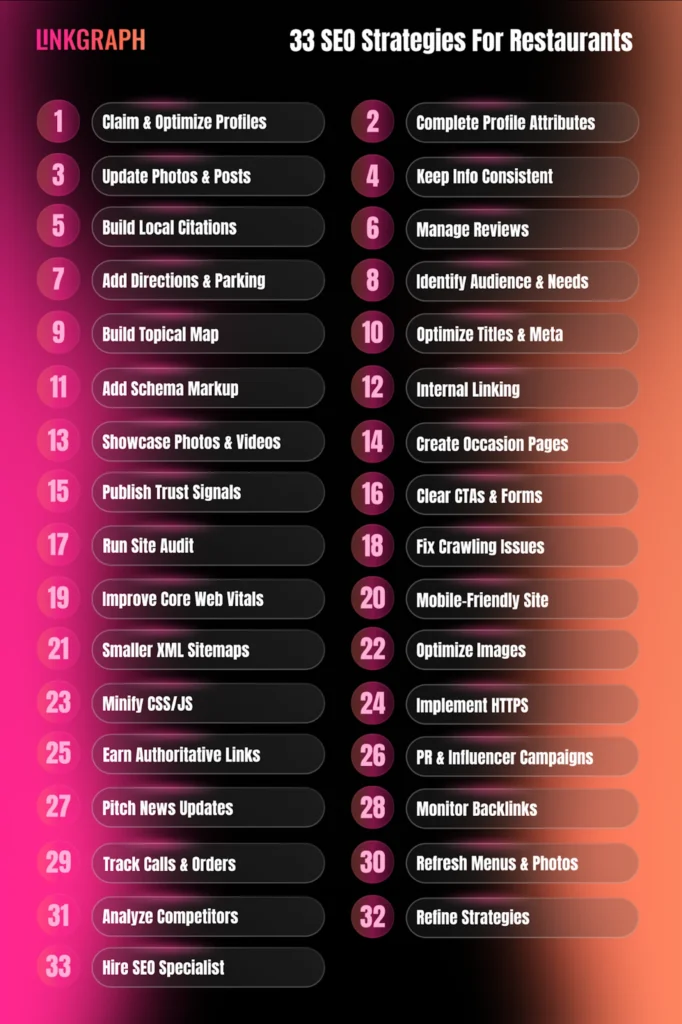
There are 33 SEO strategies for restaurants. The 33 SEO strategies for restaurants are listed below.
- Claim, Verify, and Completely Optimize Google, Bing, and Apple Business Profiles
- Fill Business Profile Attributes (Dine-In, Takeout, Delivery, Payments, Accessibility)
- Keep Business Profiles Fresh with Photos and Posts
- Maintain Business Information Consistent Across All Citations
- Build Local Citations on Reputable Directories
- Encourage and Manage Customer Reviews
- Add Driving, Parking, and Transit Directions
- Identify Your Target Audience, Market, and Their Key Needs
- Construct Proper Topical Map Based on Your Source Context
- Optimize Page Titles, Meta Descriptions, and Image Alt Text
- Implement Food-Specific Schema Markup Across Key Pages
- Link All Pages Internally with a Logical Hierarchy (Root → Seed → Node)
- Showcase Real Food/Cuisine Photos, Short Videos, and Customer Reviews
- Create Occasion Pages for Brunch, Date Night, Family, Catering, and Holidays
- Publish Trust Signals Like Staff Bios, Hygiene Practices, and Awards
- Place Clear CTAs and Reservation, Call, Direction, and Order Forms Above the Fold
- Run Complete Website Audit to Identify All Technical Errors
- Fix All Crawling and Indexing Issues
- Improve Core Web Vitals and Overall Page Performance (LCP, INP, CLS Thresholds)
- Build a Mobile-Friendly, Fully Responsive Website for All Devices
- Create Smaller XML Sitemaps
- Use Optimized Images and Convert Them to WebP or AVIF
- Minify CSS/JS and Defer Non-Essential Scripts for Faster Loading
- Implement HTTPS Across Entire Site
- Earn Authoritative Backlinks from Chambers, Tourism Boards, Universities
- Run Digital PR Campaigns and Influencer Collaborations with Seasonal Hooks
- Pitch Newsworthy Updates (Chef, Menu, Awards, New Location) to Local Press
- Monitor Backlink Quality and Manage Risk Without Overusing Disavows
- Track Calls, Reservations, Orders, and Directions with GA4, GSC, and GBP Insights
- Refresh Photos, Menus, Hours, and Seasonal Pages Regularly
- Analyze Top-Ranking Competitors and SERPs for New Opportunities
- Refine SEO Strategies Based on Performance Data and Results
- Hire an SEO Specialist When Needed
We have broken down the 33 SEO strategies for restaurants below.
1. Claim, Verify, and Completely Optimize Google, Bing, and Apple Business Profiles
Claiming and verifying Google Business Profile, Bing Places, and Apple Maps listings builds local search presence for restaurants. Verification confirms ownership and allows full control over displayed information. Unverified listings often show outdated details, which mislead diners and reduce local search visibility.
After verification, add accurate business information such as name, address, phone number, website URL, and hours of operation. Select a primary category that describes the restaurant, like “Italian Restaurant,” and add secondary categories such as “Pizza” or “Catering.” Write a clear business description that includes local keywords like “family brunch,” “downtown steakhouse,” or “late-night dining.” Complete every available field to help search engines understand the offerings and location of the restaurant.
Upload high-quality photos of the exterior, interior, dishes, and menu pages. Enable booking links, online ordering, and reservation buttons if available. Post weekly updates about specials or events. Fully optimized listings appear in the Map Pack more often, which increases calls, direction requests, and reservations.
2. Fill Business Profile Attributes (Dine-In, Takeout, Delivery, Payments, Accessibility)
Filling business profile attributes builds trust and improves how restaurants appear in local search results. Attributes describe the dining experience, payment methods, and accessibility features, helping customers decide quickly. Profiles with complete attributes often rank higher in local results because search engines recognize them as more informative.
Add service attributes like Dine-In, Takeout, and Delivery to show available dining options. Include payment types such as credit cards, mobile payments, or cash to reduce friction during the visit. Mention accessibility features like wheelchair access, ramps, or accessible restrooms to help all customers plan their visit comfortably. These details appear directly in Google, Bing, and Apple listings, giving customers immediate clarity.
Update attributes regularly as services change. Seasonal offerings or temporary closures should reflect in the profile to avoid confusion. Accurate attributes improve click-through rates on listings, which drives more calls, online orders, and reservations from local searchers.
3. Keep Business Profiles Fresh with Photos and Posts
Regularly updating business profiles with fresh photos and posts improves online visibility and attracts potential customers. Restaurants should upload high-quality images showing the exterior, interior, and food or drink items. This helps diners visualize the experience and increases the chances of appearing in local search results.
Images must meet size and quality standards. JPG or PNG formats between 10 KB and 5 MB work best. Resolutions should be at least 720 px by 720 px. Photos need to be well-lit, clear, and accurately reflect the restaurant without heavy filters.
Posting updates about events, specials, or new menu items keeps the profile active and informative. Each post includes a title, description, and call-to-action buttons such as “Order Online” or “Call Now.” Regular posts help the restaurant stay relevant in search results and Google Maps, encouraging engagement and visits from local diners.
4. Maintain Business Information Consistent Across All Citations
Restaurants must keep business information consistent across all online listings to improve search visibility and avoid confusion. Key details include the restaurant name, address, phone number, and website URL. Consistent information signals reliability to search engines and helps rank higher in local search results.
Every citation on directories, review sites, and social platforms should match the official business information exactly. Inconsistencies, such as variations in abbreviations, phone formatting, or address details, reduce trust and negatively impact local SEO performance.
Regular audits of all citations ensure that updates to hours, menus, or contact details are reflected everywhere. Consistency strengthens the local presence of the restaurant, making it easier for diners to find accurate information. Maintaining uniform information across platforms increases trust with both search engines and potential customers, driving more reservations and visits.
5. Build Local Citations on Reputable Directories
Restaurants benefit from creating local citations on authoritative directories to strengthen their online presence and local SEO. Citations include the name, address, phone number, and website of the restaurant, appearing consistently on trusted platforms.
High-quality directories, such as TripAdvisor, Yelp, and Zomato, provide search engines with validation that the restaurant exists and operates in a specific location. Each listing improves discoverability and contributes to higher rankings in local search results.
Restaurants should prioritize directories relevant to the food and dining industry while ensuring all details remain accurate and uniform. Maintaining these citations over time supports ongoing visibility, helps potential customers find the restaurant, and enhances credibility. Well-structured local citations drive more local traffic, boost trust with search engines, and increase the likelihood of reservations and orders.
6. Encourage and Manage Customer Reviews
Customer reviews play a central role in restaurant SEO, influencing search rankings and attracting potential diners. Positive reviews signal quality and reliability, helping restaurants appear higher in local search results and the Google Map Pack.
Restaurants should actively request reviews from satisfied customers after dining experiences, using email follow-ups, receipts, or table signage. Promptly responding to all reviews, both positive and negative, demonstrates engagement and builds trust with potential diners.
Maintaining a steady flow of authentic reviews strengthens credibility and enhances visibility in search engines. Restaurants with well-managed review profiles enjoy increased reservations, higher foot traffic, and stronger local authority. Monitoring review trends helps identify areas for improvement and ensures the online reputation remains positive.
7. Add Driving, Parking, and Transit Directions
Providing accurate driving, parking, and transit directions enhances the visibility of the restaurant and the convenience for diners. Clear directions improve the user experience, making it easier for customers to visit the restaurant and increasing foot traffic.
Restaurants should ensure that maps, parking details, and public transit options are up-to-date across Google Business Profile, Apple Maps, and Bing Places. Including specific instructions for popular landmarks or complex locations helps potential diners reach the restaurant without confusion.
Adding this information supports local SEO efforts by signaling relevance to search engines for “near me” queries. Restaurants that offer precise directions encourage more reservations and visits, while minimizing missed opportunities due to unclear or incomplete location information.
8. Identify Your Target Audience, Market, and Their Key Needs
Identifying the target audience allows a restaurant to tailor its marketing and SEO efforts to attract the right customers. Understanding the preferences, behaviors, and needs of diners ensures content and promotions resonate with the intended audience, increasing engagement and conversions.
Restaurants should analyze local demographics, dining trends, and search behavior to determine which customer segments are most valuable. Mapping these insights helps prioritize menus, offers, and digital content that align with what diners actively seek.
Linking audience research to a topical map ensures that the website and content of the restaurant cover all relevant topics. Each page, blog, or menu section targets specific keywords and search intents derived from audience insights. Using a structured topical map improves internal linking, reinforces relevance, and strengthens SEO performance across search engines.
9. Construct Proper Topical Map Based on Your Source Context
Constructing a topical map organizes the website content of a restaurant into a logical hierarchy that reflects key themes, topics, and subtopics. A well-structured topical map guides visitors through menus, blog posts, events, and promotions while helping search engines understand content relationships.
Each node of the topical map represents a focused topic relevant to the restaurant, such as cuisine types, special offers, or dining experiences. Root topics act as pillars, seed nodes connect closely related content, and supporting nodes provide detailed insights. This structure strengthens the authority of the site for targeted keywords.
Using a source context such as competitor analysis, local dining trends, and keyword research ensures the topical map aligns with actual search behavior. Properly implementing this map improves internal linking, distributes authority across pages, and increases the chances of ranking higher in search results for relevant dining queries.
10. Optimize Page Titles, Meta Descriptions, and Image Alt Text
Optimizing page titles ensures each restaurant page clearly conveys its content to both users and search engines. Titles should include primary keywords, such as menu items, cuisine types, or location, while remaining concise and compelling. Well-crafted titles increase click-through rates from search results and help search engines understand page relevance.
Meta descriptions summarize page content and influence user decisions in search results. Writing unique, keyword-rich descriptions for each page encourages users to visit the restaurant website. Including details like specialties, offers, or service options makes descriptions actionable and informative.
Image alt text improves accessibility and provides additional context for search engines. Describing images of dishes, dining areas, or events with relevant keywords enhances SEO signals and ensures visually impaired visitors receive the same information. Properly optimized titles, meta descriptions, and image alt text together strengthen on-page SEO and overall website performance.
11. Implement Food-Specific Schema Markup Across Key Pages
Adding food-specific schema markup helps search engines understand restaurant content more accurately. Schema types like Restaurant, Menu, Recipe, and Review provide structured data that highlights key information such as cuisine, menu items, prices, and operating hours. Proper implementation improves visibility in rich results and enhances search appearance.
Each key page, including the homepage, menu, and reservation pages, should include schema markup relevant to its content. Structured data allows search engines to display additional features like ratings, availability, and special offers directly in search results. This increases the likelihood of attracting clicks from users searching for restaurants or specific dishes.
Testing and validating schema markup ensures accurate implementation without errors. Tools like Google’s Rich Results Test help verify that structured data is recognized. Food-specific schema strengthens on-page SEO by connecting content with search engines in a clear, organized manner.
12. Link all Pages Internally with a Logical Hierarchy (Root → Seed → Node)
Internal linking creates a structured website hierarchy that improves navigation and search engine understanding. A logical structure using Root, Seed, and Node pages organizes content from broad topics to specific subtopics, guiding both users and search engines through the website efficiently.
Root pages cover core restaurant topics, such as the homepage or main menu page. Seed pages target primary categories like brunch, dinner, or catering services. Node pages address specific details, including individual menu items, promotions, or special events. This hierarchy ensures link equity flows naturally, boosting rankings for both main and supporting pages.
Consistent internal linking enhances user experience by making content easier to find. It helps search engines index all relevant pages, improving visibility in search results. Properly structured internal links support on-page SEO and establish clear topical relevance across the restaurant website.
13. Showcase Real Food/Cuisine Photos, Short Videos, and Customer Reviews
Displaying high-quality photos of dishes and beverages helps attract diners by giving them a visual understanding of the offerings of the restaurant. Real images of meals, drinks, and the dining environment increase engagement and encourage potential customers to explore the menu or visit in person.
Short videos, such as behind-the-scenes kitchen clips or preparation of popular dishes, enhance user interaction. Videos improve on-page engagement metrics, keep visitors on the website longer, and provide dynamic content that highlights the personality of the restaurant.
Customer reviews add credibility and social proof. Featuring authentic reviews on the website or business profiles builds trust with potential diners. Positive feedback demonstrates quality and service standards, reinforcing the reputation of the restaurant while supporting SEO by including relevant keywords and boosting local search visibility.
14. Create Occasion Pages for Brunch, Date Night, Family, Catering, and Holidays
Creating dedicated pages for specific dining occasions helps target customers looking for tailored experiences. Occasion pages allow restaurants to highlight offerings for brunch, romantic dinners, family meals, catering services, and holiday specials.
These pages improve SEO by targeting long-tail keywords related to each occasion, such as “family brunch near me” or “holiday catering services.” Search engines recognize the relevance of these pages, helping restaurants rank for specific queries.
Occasion pages enhance user experience by providing clear, organized information. Visitors quickly find menus, booking options, and special promotions for each event type. Well-structured pages encourage conversions, increase reservations, and guide diners toward a satisfying dining experience.
15. Publish Trust Signals Like Staff Bios, Hygiene Practices, and Awards
Publishing trust signals strengthens credibility and reassures potential diners about the quality and safety of the restaurant. Staff bios showcase expertise, experience, and friendly service, helping visitors feel confident in choosing the restaurant.
Highlighting hygiene practices demonstrates commitment to cleanliness and food safety, which is essential for attracting health-conscious customers. Displaying awards, certifications, or industry recognition further establishes the authority and reputation of the restaurant.
Trust signals support SEO indirectly. Search engines value websites that provide reliable, transparent information, which improves rankings. Clear presentation of trust signals encourages higher engagement, increases bookings, and builds long-term customer loyalty.
16. Place Clear CTAs Reservation, Call, Direction, and Order Forms Above the Fold
Placing clear calls-to-action (CTAs) above the fold ensures visitors immediately see options for reservations, calls, directions, or online orders. Restaurants capture attention quickly and reduce friction in the customer journey.
Visible CTAs increase engagement and improve conversion rates, guiding users toward taking desired actions without scrolling or searching. Buttons for reservations, calls, directions, and online orders make interaction simple and intuitive.
Proper placement of CTAs signals website structure and usability to search engines, supporting better on-page SEO. Restaurants that prioritize prominent CTAs experience higher bookings, increased orders, and a smoother user experience for diners across devices.
17. Run Complete Website Audit To Identify All Technical Errors
Running a full website audit helps restaurants identify technical errors affecting search engine visibility and user experience. Audits reveal broken links, missing meta tags, slow-loading pages, and other issues that hinder performance.
Technical audits allow restaurants to prioritize fixes, ensuring pages are crawlable, indexable, and accessible. Auditing highlights opportunities to improve Core Web Vitals, mobile responsiveness, and overall site speed, enhancing both SEO and customer satisfaction.
Regular website audits track changes over time, preventing recurring errors and maintaining consistent performance. Restaurants that conduct audits maintain a strong technical foundation, improving search rankings, user engagement, and the effectiveness of other SEO strategies.
18. Fix All Crawling and Indexing Issues
Crawling and indexing issues prevent search engines from properly discovering and ranking restaurant pages. Fixing these problems ensures menus, location pages, and promotions appear in search results.
Common issues include broken links, duplicate content, blocked pages in robots.txt, and incorrect canonical tags. Addressing these errors improves website accessibility for search engines and helps Google and other engines correctly index each page.
Restaurants that resolve crawling and indexing problems maintain a healthy site structure. This enhances overall SEO performance, increases organic visibility, and ensures potential customers find accurate and complete information about the restaurant online.
19. Improve Core Web Vitals and Overall Page Performance (LCP, INP, CLS Thresholds)
Core Web Vitals measure user experience on a restaurant website. Optimizing these metrics ensures fast loading, smooth interactions, and visual stability.
Largest Contentful Paint (LCP) tracks how quickly the main content loads. Reducing LCP keeps visitors engaged and decreases bounce rates. Interaction to Next Paint (INP) measures responsiveness to user actions, and improving it ensures buttons, menus, and forms respond quickly. Cumulative Layout Shift (CLS) monitors visual stability. Minimizing CLS prevents content from moving unexpectedly, improving usability.
Restaurants that optimize Core Web Vitals enhance page performance across devices. Improved load times, smoother interactions, and stable layouts increase organic rankings and create a positive experience for diners, encouraging online reservations and repeat visits.
20. Build a Mobile-Friendly, Fully Responsive Website for All Devices
A mobile-friendly website ensures that visitors navigate and interact with restaurant pages on any device. Mobile optimization improves user experience, making menus, reservations, and ordering features easily accessible.
Responsive design adapts layout, images, and text for different screen sizes. Restaurants benefit from consistent branding and functionality whether users access the site on smartphones, tablets, or desktops. Search engines prioritize mobile-friendly sites, which boosts visibility in local and organic search results.
Implementing responsive design reduces bounce rates, increases session duration, and improves overall website performance. Restaurants that maintain fully responsive websites attract more customers, enhance engagement, and support higher online reservations and orders.
21. Create Smaller XML Sitemaps
Smaller XML sitemaps improve website crawlability and indexing by search engines. Dividing the pages of a restaurant into multiple focused sitemaps ensures that search engines discover and prioritize the most important content.
Segmenting sitemaps by categories, such as menus, locations, events, or blog posts, helps search engines understand the site structure. Restaurants benefit from faster indexing of new or updated pages, ensuring content appears promptly in search results.
Maintaining smaller, topic-focused sitemaps reduces errors and improves crawl efficiency. It enhances the overall SEO performance of a restaurant website by making it easier for search engines to access and rank all relevant pages.
22. Use Optimized Images and Convert Them to WebP or AVIF
Optimizing images improves page load speed, which directly impacts user experience and search engine rankings. Restaurants should compress photos of dishes, interiors, and menus without losing quality to keep pages fast.
Converting images to modern formats like WebP or AVIF reduces file sizes significantly. WebP and AVIF provide better compression than JPEG or PNG while maintaining visual clarity. This ensures that restaurant websites load quickly across devices, especially on mobile networks.
Optimized images enhance accessibility and SEO by using descriptive alt text. Clear, well-optimized visuals help search engines understand content context, improve image search visibility, and attract potential diners to the restaurant website.
23. Minify CSS/JS and Defer Non-Essential Scripts for Faster Loading
Minifying CSS and JavaScript removes unnecessary spaces, comments, and code, reducing file sizes and improving page load speed. Restaurants that implement minification experience faster website performance and smoother user interactions.
Deferring non-essential scripts ensures that critical content loads first, allowing visitors to see menus, photos, and reservation options quickly. This prevents delays caused by scripts that are not immediately needed and improves overall user experience.
Combining minification with script deferral benefits SEO. Search engines favor websites that load efficiently, especially on mobile devices. Faster-loading restaurant websites rank higher in search results, keeping potential diners engaged and reducing bounce rates.
24. Implement HTTPS Across Entire Site
Implementing HTTPS secures all data exchanged between the restaurant website and visitors, protecting sensitive information like payment details and reservation forms. Websites using HTTPS gain trust from users, encouraging them to interact and complete bookings.
Search engines favor secure websites, which improves visibility in search results. A restaurant website with HTTPS signals credibility and reliability, making potential customers more likely to visit.
Migrating a restaurant site to HTTPS involves installing an SSL certificate and ensuring all pages redirect properly from HTTP. This process maintains existing rankings while enhancing security, user confidence, and overall search performance.
25. Earn Authoritative Backlinks From Chambers, Tourism Boards, Universities
Authoritative backlinks strengthen the credibility of a restaurant website and improve search rankings. Links from chambers of commerce, tourism boards, and universities signal to search engines that the website is trustworthy and relevant.
Restaurants earn backlinks by participating in local events, sponsoring community programs, or contributing guest content to reputable sites. Each high-quality backlink drives referral traffic and enhances the visibility of the restaurant in search results.
Maintaining a consistent strategy to acquire authoritative links builds long-term SEO value. Restaurants that secure credible backlinks see improved domain authority, higher organic traffic, and increased online orders and reservations over time.
26. Run Digital PR Campaigns and Influencer Collaborations With Seasonal Hooks
Digital PR campaigns and influencer collaborations boost the online visibility of a restaurant and attract relevant traffic. Seasonal hooks, such as holiday menus or special events, make campaigns timely and engaging for potential diners.
Restaurants partner with food bloggers, local influencers, and social media personalities to showcase dishes, promotions, or experiences. These partnerships generate content that earns attention, clicks, and social shares, which contributes to search engine authority.
Tracking the performance of each campaign ensures measurable results. Restaurants that consistently execute digital PR and influencer collaborations with seasonal relevance gain higher brand recognition, stronger backlinks, and increased reservations or online orders throughout the year.
27. Pitch Newsworthy Updates (Chef, Menu, Awards, New Location) to Local Press
Restaurants benefit from pitching newsworthy updates to local media outlets to increase visibility and attract attention. Announcing a new chef, seasonal menu, awards, or a new location provides timely, relevant stories for journalists and editors.
Local press coverage highlights the restaurant in community-focused publications, driving awareness among potential customers nearby. These mentions generate high-quality backlinks, improving the authority and online presence of a restaurant in search engines.
Consistent updates to the press keep the restaurant top-of-mind for local audiences. Restaurants that actively share newsworthy updates strengthen their reputation, build trust with diners, and create ongoing opportunities for website traffic, reservations, and orders.
28. Monitor Backlink Quality and Manage Risk Without Overusing Disavows
Restaurants must regularly monitor backlink quality to maintain a strong and safe online presence. Low-quality or spammy backlinks harm search rankings and reduce website authority.
Tracking backlinks allows the restaurant to identify harmful links and take corrective action before they affect performance. Avoiding overuse of disavows prevents unnecessary loss of legitimate link equity, keeping the authority of the website intact.
Consistent backlink management supports long-term SEO stability and ensures that link profiles contribute positively to search rankings. Restaurants that actively maintain high-quality backlinks strengthen credibility, improve trust with search engines, and sustain organic traffic and visibility.
29. Track Calls, Reservations, Orders, and Directions with GA4, GSC, and GBP Insights
Tracking calls, reservations, online orders, and directions is essential for measuring restaurant SEO performance. GA4, Google Search Console (GSC), and Google Business Profile (GBP) Insights provide accurate data on customer interactions and website engagement.
Restaurants identify which marketing channels drive the most reservations or orders and adjust strategies accordingly. Tracking these metrics helps evaluate the effectiveness of on-page elements, local SEO efforts, and promotional campaigns.
Using these analytics ensures that restaurants make informed decisions to increase traffic, improve conversions, and enhance user experience. Consistent monitoring supports long-term growth by linking SEO actions directly to measurable business outcomes.
30. Refresh Photos, Menus, Hours, and Seasonal Pages Regularly
Restaurants must keep website content and online profiles up-to-date to maintain engagement and search visibility. Updating photos, menus, business hours, and seasonal offerings signals freshness to search engines and users.
Fresh images of dishes and interiors attract diners and enhance trust in the quality of the restaurant. Accurate menus and hours prevent customer frustration and ensure smooth operations. Seasonal pages for holidays, events, or limited-time promotions improve relevance for targeted searches.
Regular content refreshes strengthen local SEO, increase clicks from search results, and encourage repeat visits. Maintaining current information across the website and Google Business Profile supports a consistent brand image and higher conversion rates.
31. Analyze Top-Ranking Competitors And SERPs For New Opportunities
Restaurants must study top-ranking competitors and search engine results to discover untapped opportunities and improve visibility. Analyzing competitor content, keywords, and backlink profiles provides actionable insights for enhancing the SEO strategy of a restaurant.
Examining SERPs helps identify search intent, trending queries, and gaps in content coverage that the restaurant’s address. Understanding which competitors dominate local and niche searches informs content creation, menu optimization, and promotional strategies.
This analysis enables restaurants to adjust keywords, refine website structure, and identify potential partnerships or link-building opportunities. Monitoring competitors regularly ensures strategies remain effective, capturing more clicks, reservations, and online orders while maintaining a competitive edge in local search results.
32. Refine SEO Strategies Based On Performance Data And Results
Restaurants must continuously refine SEO strategies using performance data from analytics tools like GA4, Search Console, and ranking trackers. Reviewing metrics such as organic traffic, click-through rates, and keyword positions helps identify which strategies produce results and which need adjustment.
Analyzing conversions from reservations, online orders, and calls allows restaurants to link SEO efforts directly to revenue impact. Adjusting content, meta tags, internal links, and local SEO elements based on these insights improves visibility and engagement.
Regular performance reviews help restaurants capitalize on emerging trends and changing search behavior. Refining SEO strategies ensures the website consistently attracts relevant diners, maintains high rankings, and maximizes return on marketing efforts in a competitive restaurant market.
33. Hire an SEO Specialist When Needed
Restaurants require an SEO specialist to manage complex optimization tasks, especially when internal teams lack technical expertise. An SEO specialist brings experience in keyword strategy, local SEO, on-page and technical optimization, content planning, and link-building campaigns tailored for the restaurant industry.
Specialists audit existing websites, identify performance gaps, and implement advanced strategies that improve rankings, drive more reservations, and increase online orders. They track analytics, monitor competitors, and refine campaigns based on real data to ensure continuous improvement.
Hiring an SEO specialist ensures restaurants maximize results from SEO efforts without wasting time or resources. Experts handle ongoing updates, algorithm changes, and technical issues efficiently, allowing restaurants to focus on delivering high-quality food and service while maintaining a strong online presence.
What Are the Common SEO Mistakes Restaurant Owners Should Avoid?
The common SEO mistakes restaurant owners should avoid often stem from overlooking the basics that make a website user-friendly, mobile-responsive, and optimized for local search. These oversights hinder visibility in search results, reduce customer engagement, and impact revenue. Some of the common SEO mistakes that restaurant owners should avoid are listed below.
- Ignoring Local SEO: Restaurants that neglect local SEO miss appearing in potential customers’ “near me” searches. Optimizing online content for local SEO by including location-specific keywords, claiming the Google Business Profile listing, and ensuring the name, address, and phone number (NAP) of the restaurant are consistent across all platforms is essential.
- Overlooking Mobile Optimization: Increasing numbers of people use smartphones to search for restaurants. A website that is not mobile-optimized leads to high bounce rates and lower rankings in search results, drastically affecting traffic.
- Using Non-Descriptive URLs and Meta Tags: URLs and meta tags that do not accurately describe the content confuse search engines and users. Clean, descriptive URLs and concise, relevant meta titles and descriptions improve click-through rates.
- Ignoring the Importance of Reviews: Online reviews influence customer decisions. Ignoring or failing to engage with reviews harms a restaurant’s reputation. Actively monitoring and responding to reviews shows that customer feedback is valued.
- Not Updating Content Regularly: Stale content decreases engagement and rankings. Regularly updating the website with fresh content, such as seasonal menus or promotions, keeps the site relevant and encourages repeat visits.
- Failing to Optimize for Voice Search: Voice assistants increasingly influence search. Focusing on natural language and question-based keywords captures voice search traffic.
- Not Utilizing Structured Data: Structured data helps search engines understand content better. Implementing schema markup for menus, reviews, and events enhances visibility in search results.
- Overcomplicating Website Navigation: Complex navigation frustrates users and increases bounce rates. Simple and intuitive website navigation enhances user experience and encourages longer visits.
- Not Monitoring Analytics: Without tracking website performance, identifying areas for improvement is difficult. Monitoring analytics helps understand user behavior and make data-driven decisions.
- Ignoring Competitor Analysis: Not analyzing competitors results in missed opportunities. Assessing the strategies of competitors helps identify gaps and areas to outperform them.
Avoiding these common SEO mistakes enhances the online presence of a restaurant, attracts more customers, and drives business growth.
Can One SEO Approach Work for All Types of Restaurants?
No, a single SEO strategy is not universally effective across all restaurant types. For instance, fine dining establishments prioritize showcasing their ambiance and gourmet offerings, while fast-casual or delivery-focused restaurants might emphasize convenience, speed, and online ordering capabilities. Tailoring SEO efforts to align with the specific needs and characteristics of each restaurant type ensures more effective targeting and engagement with the intended audience.
When Should Restaurants Get Started with SEO?
Restaurants should initiate SEO efforts as early as possible, ideally during the website development phase. Implementing SEO strategies from the outset allows for better integration of optimization practices, leading to improved search engine visibility and user experience from launch. Delaying SEO implementation results in missed opportunities for attracting potential customers and establishing a strong online presence.
Is GMB Profile Optimization Enough for Restaurants to Get Consistent Customers?
While optimizing a Google Business Profile (GBP) is crucial for local visibility, it is not sufficient on its own to ensure a consistent flow of customers. A comprehensive SEO strategy that includes on-page optimization, quality content creation, and active engagement on social media platforms complements GBP optimization and helps build a robust online presence. Relying solely on GBP optimization limits the reach of a restaurant and engagement with potential customers.
How Long Does It Take for SEO to Show Results for a Restaurant?
Typically, restaurants begin to see noticeable improvements in search engine rankings and online traffic within 3 to 6 months of implementing SEO strategies. However, achieving significant and sustained results takes up to a year, depending on factors such as competition, the effectiveness of SEO practices, and the consistency of efforts. SEO is a long-term investment that requires patience and ongoing optimization to yield substantial returns.
Which Online Directories Are Most Valuable for Restaurants to Be Listed In?
Restaurants achieve higher visibility and attract more customers when listed on reputable online directories. These platforms help diners discover restaurants, check reviews, and access essential information such as menus, hours, and reservations. The most valuable online directories for restaurants are listed below.
- Google Business Profile
- TripAdvisor
- Yelp
- OpenTable
- The Fork (La Fourchette)
- UberEats
- Grubhub/MenuPages
- HappyCow (for vegan/vegetarian)
- Michelin Guide
- Foursquare/Mapstr
Listing restaurants on these platforms strengthens online presence, improves discoverability, and drives traffic, reservations, and orders.
Can Restaurant Owners Successfully Implement SEO Strategies on Their Own?
Yes, restaurant owners implement basic SEO strategies on their own, such as optimizing business profiles, updating menus, and collecting reviews. However, advanced tasks like technical audits, backlink building, and schema implementation often require professional expertise to achieve consistent, long-term results and stay competitive in local search rankings.
What Should Be Checked Before Hiring an SEO Agency for a Restaurant?
Before hiring an SEO agency for a restaurant, it is important to evaluate their expertise, track record, and approach carefully. Choosing the right partner directly influences the visibility, online reputation, and revenue growth of your restaurant. The factors that need to be considered before hiring an SEO agency for a restaurant are listed below.
- Experience With Restaurant SEO: Ensure the agency has proven experience working with restaurants or food businesses, as this shows they understand local search trends, customer behavior, and industry-specific challenges.
- Case Studies and Results: Request case studies highlighting successful campaigns, showing improvements in rankings, website traffic, and online reservations for other restaurants.
- Knowledge of Local SEO: Confirm they specialize in local SEO strategies like optimizing Google Business Profiles, building citations, and managing reviews to improve visibility in local map packs.
- Clear SEO Strategy: Ask the agency to outline a step-by-step SEO plan tailored to your restaurant, covering technical audits, content creation, link building, and performance tracking.
- Transparent Reporting and KPIs: Make sure they provide regular reports with clear metrics such as keyword rankings, organic traffic, conversions, and ROI to track progress.
- Communication and Support: Evaluate their responsiveness, communication style, and willingness to collaborate with your team to ensure smooth execution of strategies.
- Ethical SEO Practices: Verify they use only white-hat SEO techniques and follow search engine guidelines to prevent penalties and protect your online reputation.
- Pricing and Contract Terms: Review their pricing structure, contract length, and cancellation policies to ensure they fit your budget and expectations without hidden fees.
Checking these factors helps restaurant owners choose an SEO agency that delivers reliable results, builds long-term visibility, and drives consistent growth for their business.
Who Offers the Best SEO Services for Restaurants Near Me?
LinkGraph delivers strong performance results, clear processes, and a solid reputation in the SEO space. Their case studies show dramatic organic traffic growth even for niche clients like a restaurant-equipment supplier, with traffic rising about 390% over 11 months through keyword optimization, link building, and content strategy.
Customer feedback highlights how LinkGraph’s approach integrates technical SEO for restaurants and hotels with content planning, local SEO efforts, and backlink authority. Clients report improved rankings, more qualified traffic, and transparency in reporting, which demonstrates consistent success across different types of restaurant and hospitality businesses.
LinkGraph provides both agency services and SEO software tools. These include audits, optimization, local SEO, link building, on-page tactics, and consulting. Their software helps monitor backlink quality, track keyword performance, and audit technical health.
Proven growth results, positive reviews, and a full spectrum of SEO services for restaurants and hotels make LinkGraph a top restaurant and hotel SEO agency for consistent, scalable growth.
Which Types of SEO Services Does LinkGraph Offer for Restaurants?
LinkGraph delivers a full spectrum of specialized SEO services designed to help restaurants dominate search results, attract local diners, and grow consistent online visibility. Each service is customized to the unique challenges of the restaurant industry, ensuring measurable improvements in traffic, bookings, and brand recognition. The types of SEO services offered by LinkGraph for restaurants are listed below.
- Semantic SEO for Restaurants: LinkGraph builds entity-driven content strategies that strengthen topical relevance, helping restaurant websites appear for a broader set of relevant search queries.
- Holistic SEO for Restaurants: The team aligns technical, content, and off-page efforts to build a complete SEO framework that supports long-term growth for restaurant businesses.
- Local SEO for Restaurants: LinkGraph optimizes Google Business Profiles, local citations, and map pack rankings to drive nearby customers searching for dining options.
- Technical SEO for Restaurants: Site audits, crawl error resolution, and Core Web Vitals optimization ensure restaurant websites are fast, secure, and easily indexed by search engines.
- On-Page SEO for Restaurants: Titles, meta descriptions, structured content, and internal linking are optimized to boost keyword relevance and search visibility for key menu and service pages.
- Off-Page SEO for Restaurants: LinkGraph builds high-quality backlinks from trusted sources to increase domain authority and strengthen organic rankings for competitive food-related keywords.
- Content Creation for Restaurants: The agency creates engaging, keyword-rich blogs, landing pages, and menu descriptions that build authority and attract search-driven customers.
- LLM and AI Optimization for Restaurants: LinkGraph optimizes restaurant content for AI-driven search tools and large language models to capture future-ready visibility in emerging search channels.
- Lead Tracking and Reporting for Restaurants: Advanced analytics track calls, reservations, and orders, while custom dashboards show clear ROI from SEO campaigns.
- Branding for Restaurants: LinkGraph enhances brand presence through cohesive messaging, visual identity support, and reputation management to build trust and recognition.
These services give restaurants a complete, data-driven SEO strategy that increases traffic, bookings, and brand credibility while creating a sustainable competitive advantage online.
Can All Types of Restaurants Get SEO Services from LinkGraph?
Yes, all types of restaurants absolutely get SEO services from LinkGraph. The agency designs customized strategies to match the unique goals, target audiences, and competitive environments of different restaurant formats. Whether the focus is on local foot traffic, online ordering, or building a premium brand presence, LinkGraph tailors its SEO campaigns to fit each business model and customer journey.
LinkGraph’s SEO solutions adapt to the marketing needs of every kind of restaurant. The kind of restaurants that can get SEO services from LinkGraph are listed below.
- Fine Dining
- Casual Dining
- Fast Food
- Fast Casual
- Buffet
- Café / Coffee House
- Bistro
- Diner
- Pub / Bar
- Family Style
- Pizzeria
- Bakery
- Cafeteria
- Steakhouse
- Seafood Restaurant
LinkGraph’s tailored SEO campaigns help each of these restaurant types boost search visibility, attract local customers, and grow consistent revenue online.
How Much Does LinkGraph Charge for Restaurant SEO Services?
LinkGraph offers flexible pricing for restaurant SEO services based on the scope, goals, and competition level of each campaign. Smaller local restaurants start with foundational local SEO packages, while larger multi-location restaurants and hotel groups receive full-scale strategies that include technical SEO, content development, and digital PR. LinkGraph customizes every proposal after auditing the current online presence, so pricing reflects the exact work needed to achieve results. This approach ensures restaurants only pay for the services that directly support their growth goals and revenue targets.
Does LinkGraph Only Offer SEO Marketing Services for Restaurants?
No, LinkGraph does not only offer SEO marketing services for restaurants. The agency serves a wide range of industries, including hospitality, travel, hotels, legal, healthcare, eCommerce, and SaaS. While LinkGraph provides specialized SEO services for restaurants and hotels, it is known as a leading SEO software provider and full-service digital marketing agency, offering content marketing, link building, and technical SEO across many sectors.
What Other Businesses Get SEO Services from LinkGraph?
LinkGraph delivers advanced SEO as a service to a wide range of industries beyond restaurants. Each sector benefits from specialized strategies that align with its unique search behavior, competition, and conversion goals. These industries often face high competition and require expert-driven optimization to dominate search visibility. Other businesses that can get SEO services from LinkGraph are listed below.
- Hotels and Resorts; Hotels rely on local SEO, schema markup, and content strategies to rank for destination-specific keywords. LinkGraph’s experience as a restaurant and hotel SEO agency helps hospitality brands increase direct bookings and reduce reliance on OTAs.
- eCommerce Stores: Online retailers benefit from LinkGraph’s technical SEO, content scaling, and link-building to improve rankings for high-intent product keywords, boost organic traffic, and increase sales.
- Legal Firms: Law firms compete in dense local markets. LinkGraph uses local SEO, citation management, and content authority building to capture qualified legal leads.
- Healthcare Providers: Hospitals, clinics, and dental practices gain visibility through HIPAA-compliant SEO strategies, local optimization, and review generation programs to build trust and attract new patients.
- SaaS Companies: SaaS brands use LinkGraph’s content-driven SEO, keyword clustering, and technical audits to gain visibility in competitive software niches and grow MRR.
- Travel and Tourism Companies: Travel agencies and tour operators get custom SEO strategies that target destination-based searches, build authority, and drive bookings through organic traffic.
- Real Estate Agencies: Real estate firms increase local visibility with hyperlocal keyword targeting, schema optimization, and link acquisition to capture buyers and sellers.
- Educational Institutions: Universities and training platforms benefit from high-authority backlink campaigns, structured content architecture, and keyword optimization to attract students and improve enrollment numbers.
LinkGraph customizes its SEO service to the competitive environment of each industry, ensuring measurable growth, stronger search visibility, and higher conversions.
What Are Other Ways to Market Restaurants Besides SEO?
While SEO drives long-term visibility, restaurants use several other marketing channels to attract diners and boost revenue quickly. Other ways to market restaurants besides SEO are listed below.
- Pay-Per-Click (PPC) Advertising: Run targeted ads on Google or social media platforms to reach customers searching for nearby restaurants instantly.
- Social Media Marketing: Engage audiences on Instagram, Facebook, TikTok, and YouTube with food photos, videos, stories, and promotions.
- Email Marketing: Send newsletters, seasonal offers, and loyalty rewards to retain customers and encourage repeat visits.
- Local Listings & Review Management: Optimize profiles on Google Business, Yelp, TripAdvisor, and OpenTable to enhance local visibility and build trust.
- Influencer Marketing: Collaborate with food bloggers, social media influencers, and local personalities to create authentic content and expand reach.
- Content Marketing & Blogging: Share recipes, behind-the-scenes stories, and event highlights to engage customers and support organic search traffic.
- Promotions, Seasonal Campaigns, and Events: Offer special menus, holiday events, or themed nights to attract attention and drive bookings.
Using these channels together with SEO ensures restaurants capture customers from multiple touchpoints while building brand visibility, credibility, and sales.
Is SEO More Cost-Effective Than Paid Ads for Restaurants?
SEO attracts customers actively searching for restaurants, reducing long-term marketing expenses. Paid ads drive immediate traffic but require constant budgets and spending. SEO builds sustainable visibility, increasing website visits, reservations, and orders over time. Combining SEO with occasional targeted ads allows restaurants to capture both long-term organic traffic and short-term leads. A consistent SEO strategy provides a higher return on investment compared to continually running paid campaigns.
How Restaurants Use Social Media to Support SEO?
Social media increases restaurant website traffic by sharing menu updates, promotions, and events. Engaging posts drive users to the website, signaling relevance to search engines. Posting high-quality images, videos, and local content improves brand awareness and authority. Social engagement indirectly supports search rankings while expanding the reach of the restaurant. Linking social content to website pages creates additional referral traffic and strengthens SEO efforts across multiple platforms.
How Influencer Marketing Impact SEO for Restaurants?
Partnering with local food influencers generates authentic backlinks and referral traffic. Reviews, blog features, and social posts from influencers enhance the authority and credibility of a restaurant online. These links and mentions signal search engines that the restaurant is relevant and trustworthy. Influencer collaborations increase organic visibility and drive targeted local traffic, improving rankings for competitive keywords. Influencer campaigns produce fresh, shareable content that strengthens overall SEO performance for restaurant websites.
How Do Promotions and Seasonal Offers Affect SEO?
Regular promotions and seasonal offers encourage fresh website content and social posts. Updated menus, events, and special deals increase engagement and attract returning visitors. Search engines favor websites that show activity and relevance, boosting rankings. Seasonal content allows targeting of trending or timely keywords for local searches. Keeping offers and promotions current demonstrates the active online presence of a restaurant, enhancing visibility while encouraging both new and repeat customer interactions.
Can Small Restaurants Compete with Big Chains Using SEO?
Local SEO enables small restaurants to appear in searches alongside large chains. Optimizing for neighborhood-specific terms, unique menus, and dining experiences targets relevant customers. Creating quality content, collecting reviews, and maintaining complete profiles improve authority in search results. Even without a massive advertising budget, small restaurants gain visibility for specific niches. A focused SEO strategy helps attract local diners actively searching for offerings, allowing small restaurants to compete effectively against national or regional chains.
How Restaurants Track the ROI of Their SEO Campaigns?
Tracking calls, reservations, orders, and website activity through GA4, Search Console, and analytics dashboards measures SEO performance. Monitoring traffic, conversions, and user behavior identifies effective pages and keywords. ROI insights highlight areas needing optimization and reveal successful content or campaigns. Restaurants adjust strategies based on performance data to improve visibility and revenue. Accurate tracking ensures marketing efforts are efficient, enabling data-driven decisions to maximize return on investment for SEO campaigns.
