
SaaS SEO involves applying search engine optimization strategies to software-as-a-service websites to increase visibility, attract qualified leads, and convert traffic into customers or trial users. SEO for SaaS companies improves online presence through keyword targeting, content creation, technical optimization, and authoritative link building. Implementing a strong SaaS SEO strategy drives sustainable organic growth, reduces customer acquisition costs, and positions SaaS companies as industry leaders.
Effective SEO for SaaS companies requires understanding target audiences, mapping relevant topics, and structuring websites for optimal performance. On-page SEO enhances content clarity, user experience, and conversions, while off-page SEO, including link building and digital PR, strengthens domain authority. Local SEO for SaaS companies ensures discoverability in regional searches, particularly for B2B and niche-specific software providers.
Choosing the right SEO agency for SaaS companies plays a pivotal role in executing a comprehensive SaaS SEO strategy. Agencies specializing in SaaS SEO services offer technical SEO expertise, content guidance, and performance tracking, delivering measurable results. With the best SEO agency for SaaS companies, businesses optimize organic traffic, monitor performance metrics, and refine SEO strategies, achieving scalable growth and sustained market authority.

What Is SEO for SaaS Companies?
SEO for SaaS companies improves search visibility for software websites in search engines. SEO for SaaS companies attracts qualified traffic and supports subscription growth. SEO for SaaS companies drives conversions through structured optimization and audience targeting.
The process of SEO for SaaS companies includes keyword research that matches pain points with software solutions. SEO for SaaS companies applies content marketing to guide buyers across awareness and decision stages. Technical SEO for SaaS companies strengthens crawl efficiency, site performance, and overall usability for search engines.
On-page SEO for SaaS companies refines headings, titles, metadata, and internal links to strengthen topical relevance. Off-page SEO for SaaS companies uses backlinks and digital PR to establish authority in competitive niches. SEO for SaaS companies builds long-term organic visibility, reduces dependency on ads, and supports consistent revenue growth.
Is SEO Really Important for SaaS Companies to Grow?
Yes, SEO is essential for SaaS companies to achieve growth. SEO for SaaS companies generates consistent organic traffic that reduces reliance on paid campaigns. SEO for SaaS companies attracts buyers who actively search for software, which leads to higher quality conversions.
Growth for SaaS companies often depends on visibility during long decision-making cycles. SEO for SaaS companies positions brands at every stage of the buyer journey with content that informs and guides. Strong rankings increase trust, authority, and awareness in highly competitive software markets.
SEO for SaaS companies offers a cost-effective model for lead generation. Unlike paid ads, organic rankings continue driving traffic after initial optimization. The combination of credibility, visibility, and lead quality explains why SEO remains indispensable for long-term SaaS growth.
Does SEO Work for Both B2B and B2C SaaS Companies?
Yes, SEO works effectively for both B2B and B2C SaaS companies, though strategies differ based on audience behavior. B2B SaaS SEO focuses on reaching decision-makers in organizations with detailed content, case studies, and solution pages. B2C SaaS SEO focuses on visibility for individual users, free trials, and simplified messaging that drives quick sign-ups.
For B2B SaaS companies, SEO supports long sales cycles by addressing pain points through educational blogs, whitepapers, and integration pages. Search optimization aligns with complex buying processes where multiple stakeholders need validation before committing to software.
For B2C SaaS companies, SEO focuses on high-volume, transactional keywords that match direct intent. Optimized landing pages, clear pricing pages, and targeted FAQs help increase conversions. In both models, SEO enhances visibility, strengthens credibility, and sustains growth by matching content with the unique intent of each audience.
Which Type of SaaS Companies Benefits the Most from SEO?
Not every SaaS company gains equal value from SEO. Certain segments benefit more due to customer search behavior, competitive markets, and demand for reliable information before purchasing software. These SaaS categories gain strong returns from consistent SEO strategies. The types of SaaS companies that benefit from SEO are listed below.
- B2B Enterprise SaaS: Enterprise SaaS targets large organizations with complex needs. SEO helps attract decision-makers searching for advanced, customizable solutions.
- SMB-Focused SaaS: Small and mid-sized businesses often search for affordable tools. SEO positions SaaS products as accessible, budget-friendly solutions.
- Marketing and Sales SaaS: Marketing platforms rely on high search demand. SEO helps these companies capture traffic for terms tied to lead generation, automation, and campaign management.
- CRM and Customer Success SaaS: CRM platforms benefit from SEO as businesses actively research tools that improve retention, onboarding, and customer engagement.
- Project Management and Collaboration SaaS: SEO drives visibility for solutions that teams use daily, from task tracking to file sharing, making organic search a strong growth channel.
- Developer Tools and DevOps SaaS: Developers rely heavily on search engines for problem-solving. SEO positions tools in front of users at the exact moment of technical need.
- E-commerce and Retail SaaS: Retailers often search for software to manage storefronts, payments, and logistics. SEO captures these high-intent buyers.
- Analytics and Business Intelligence SaaS: Data-driven teams search for reporting and dashboard tools. SEO provides exposure during the early research and comparison stages.
- HR, Recruiting, and People Operations SaaS: HR professionals search for hiring, payroll, and compliance solutions. SEO builds trust through educational content and feature comparisons.
- Customer Support and Helpdesk SaaS: Businesses search for tools to manage support tickets and communication. SEO increases visibility for SaaS solutions that reduce churn.
These SaaS categories align closely with active search behavior, making SEO one of the most effective channels for long-term growth.
What Are the Main Benefits of SEO for SaaS Companies?
The main benefits of SEO for SaaS companies go far beyond just ranking higher on Google. SEO attracts the right clients, builds trust, and supports long-term business growth. A well-executed SEO strategy turns search engines into one of the most powerful channels for driving leads, lowering costs, and strengthening authority. The main benefits of SEO for SaaS companies are listed below.
- Increased Visibility and Organic Traffic: SEO places SaaS products in front of potential customers searching for software solutions, resulting in higher-quality inbound traffic.
- Higher Search Rankings: Ranking at the top of search results increases exposure and drives users with strong purchase intent to SaaS websites.
- Targeted Audience Acquisition: SEO traffic consists of people actively seeking solutions, leading to better conversion opportunities than broad outbound methods.
- Scalable and Cost-Effective Growth: Unlike paid ads, SEO reduces customer acquisition costs and scales traffic without continuous ad spending.
- Enhanced Brand Authority and Trust: High rankings and authoritative content position SaaS companies as thought leaders, building credibility and user confidence.
- Improved User Experience: Technical SEO enhances site speed, mobile performance, and navigation, creating a better experience for visitors.
- Competitive Advantage: SEO helps SaaS companies stand out in crowded markets, increasing visibility where competitors compete for attention.
- Long-Term Results: SEO delivers compounding results over time, with each content investment strengthening rankings, traffic, and lead generation.
SEO provides SaaS companies with a scalable path to sustainable growth. By attracting qualified leads, improving trust, and reducing acquisition costs, it delivers long-lasting business impact.
How Can SaaS Companies Get Started with SEO?
The best way for SaaS companies to get started with SEO is to begin with a strong foundation, starting with their website and online presence. A structured approach ensures every step builds on the last, creating a scalable and measurable growth framework.
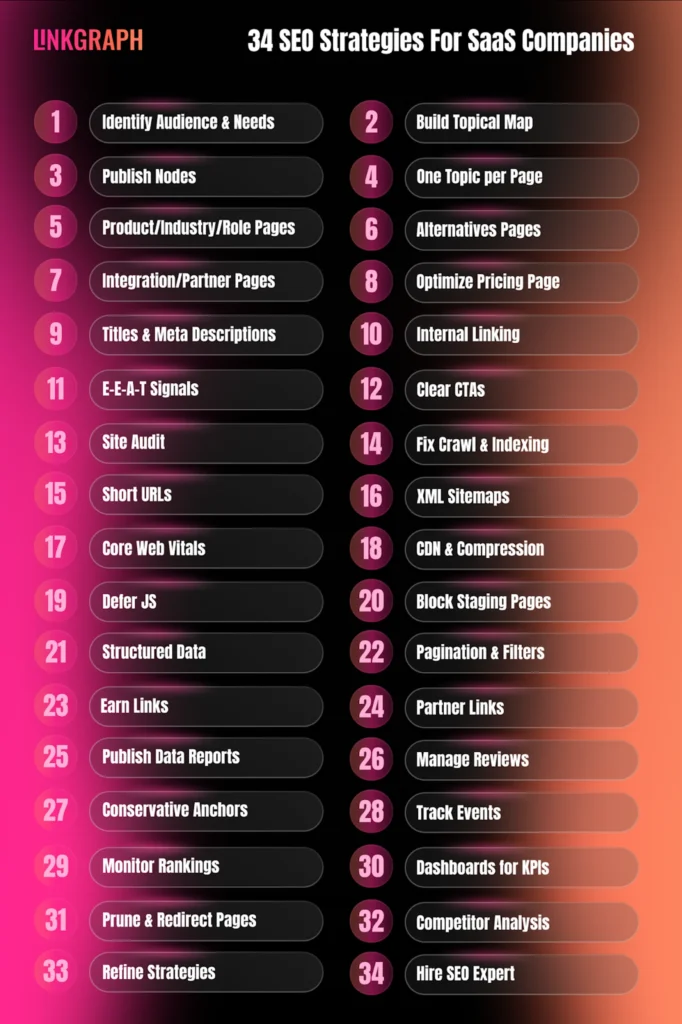
There are 34 SEO strategies for SaaS companies. The 34 SEO strategies for SaaS companies are listed below.
- Identify Your Target Audience, Market, and Their Key Needs
- Construct Proper Topical Map Based on Your Source Context
- Publish Quality Nodes, Seed Nodes, and Root Nodes for Topical Coverage
- On Each Page, Cover One Context, Topic, or Subject
- Create Specific Product, Industry, and Role Pages
- Create Alternatives Pages to Address Objections “YourApp vs X”
- Create Integration and Partner Pages (e.g., “YourApp + Slack”)
- Optimize Pricing and Plans Page for Clarity and Conversions
- Write Clear, Context-Rich Title Tags and Meta Descriptions
- Link Pages Internally Using Clear Anchor Rules Across Clusters (Root, Seed, Node)
- Demonstrate E-E-A-T Signals with Author Bios, Case Studies, and Media Mentions
- Place Clear, Contextual CTAs Above the Fold and Throughout Key Pages
- Run Complete Site Audit To Identify Technical Errors
- Fix Crawling and Indexing Issues (4xx/5xx Errors, Noindex, Canonical Errors)
- Use Short, Descriptive URLs for Products, Solutions, and Blogs
- Create Sectioned XML Sitemaps
- Improve Core Web Vitals (LCP, INP, CLS) and Overall Load Speed
- Use CDN, Caching, Compression, and Modern Image Formats (WebP, AVIF)
- Defer Non-Critical JavaScript and Reduce Main-Thread Blocking Time
- Block Staging and Preview Environments From Indexing
- Implement Structured Data for Organization, Products, and Software Application
- Manage Pagination, URL Parameters, and Faceted Filters to Reduce Crawl Waste
- Earn Links via Digital PR, Expert Contributions, and Thought Leadership
- Leverage Partners, Integrations, and Marketplace Listings to Gain Authoritative Links
- Publish Original Data Studies or Benchmark Reports to Attract Editorial Citations
- Earn and Manage Reviews on G2, Capterra, and Relevant Industry Directories
- Maintain Conservative Anchor Text Policy and Avoid Manipulative SEO Tactics
- Track GA4 Events for Trials, Demos, Forms, Chat, and Local Actions With UTMs
- Monitor Rankings, CTR, Traffic, Conversions, and Retention
- Build Looker Studio Dashboards for KPIs, Cohorts, and Attribution Clarity
- Prune, Merge, and Redirect Underperforming Pages
- Analyze Top-Ranking Competitors And SERPs For New Opportunities
- Refine SEO Strategies Based On Performance Data And Results
- Hire An SEO Professional When Challenges Exceed Your Expertise
Starting SaaS SEO with structured steps ensures lasting growth. Each action builds authority, attracts qualified leads, and strengthens the market presence of a company. We have broken down the 34 SEO strategies for SaaS companies below.
1. Identify Your Target Audience, Market, and Their Key Needs
SaaS companies must define the target audience to attract users actively searching for software solutions. Understanding audience demographics, business size, industry, and common pain points allows the creation of relevant content and product offerings.
Analyzing market trends, competitor positioning, and regional demand enables precise targeting for SEO campaigns. Mapping audience needs to search intent ensures content aligns with what users seek at every stage of the buyer journey.
Targeted audience insights feed directly into topical mapping. Identifying priority topics, subtopics, and content clusters ensures each page addresses specific queries. This structured approach improves content relevance, strengthens internal linking strategies, and increases search engine rankings across key SaaS-related topics.
2. Construct Proper Topical Map Based on Your Source Context
Topical maps organize content around primary themes, subtopics, and related queries to improve relevance and authority for SaaS SEO. A well-constructed map ensures each content piece addresses specific user intent while connecting logically within the site.
SaaS companies need to analyze competitors, industry trends, and keyword research to define core topics, seed topics, and supporting nodes. Each topic must correspond to search intent and align with audience needs.
Integrating source context into the topical map strengthens content accuracy and depth. Properly structured topical maps enhance internal linking, guide content creation, and help search engines understand the hierarchy of a website, improving visibility and rankings for targeted SaaS keywords.
3. Create Quality Nodes, Seed Nodes, and Root Nodes for Topical Coverage
On-page SEO begins with a structured content hierarchy. Root nodes represent broad topics that define the core authority of the website. Seed nodes support root topics with subtopics, while individual nodes cover specific questions or details.
Creating quality nodes ensures content addresses user intent in depth. Seed and root nodes interlink with these nodes, signaling topical expertise to search engines.
This structure improves rankings by demonstrating comprehensive coverage of each topic. Visitors navigate content more easily, engage longer, and understand the full scope of the SaaS product. Properly linked nodes enhance internal SEO, making search engines index content effectively and improving visibility across multiple related queries.
4. On Each Page, Cover One Context, Topic, or Subject
Single-topic page structure ensures each page addresses one specific context, topic, or subject. This strategy improves content clarity for both users and search engines, allowing search engines to understand the purpose of the webpage more accurately.
Focusing each page on a single topic enhances keyword relevance and strengthens the overall topical authority of the website. It prevents dilution of SEO value across multiple themes and improves engagement metrics like time on page and reduced bounce rates.
Integrating single-topic pages with a well-constructed topical map and properly defined nodes ensures logical content clusters. Visitors navigate easily, and internal linking becomes more effective, which boosts rankings. Pages designed this way guide users toward conversion-focused actions while establishing authority in niche areas of the SaaS or product domain.
5. Create Specific Product, Industry, and Role Pages
Creating pages tailored to specific products, industries, or user roles enhances relevance and engagement. Each page targets a distinct segment of the audience, improving SEO performance by aligning content with precise search intent.
Product pages focus on individual solutions, highlighting features, benefits, and use cases. Industry pages demonstrate expertise in verticals like healthcare, e-commerce, or finance, showing authority within each sector. Role-specific pages address the needs of decision-makers such as marketers, developers, or operations managers, ensuring content resonates with their responsibilities and challenges.
Structuring content this way strengthens the overall topical map, supports internal linking strategies, and improves keyword targeting. Visitors find information that matches their needs, increasing conversions and reducing bounce rates. Well-defined pages help search engines index content accurately, boosting rankings for relevant queries.
6. Create Alternatives Pages to Address Objections “YourApp vs X”
Alternatives pages compare a SaaS product with competitors, helping potential customers make informed decisions. These pages target users researching options, capturing traffic from high-intent search queries.
Content should clearly outline differences in features, pricing, integrations, and usability between the product and alternatives. Presenting transparent comparisons builds trust and addresses objections, reducing hesitation during the decision-making process.
Well-structured alternative pages support the overall topical map by linking to product, industry, and role-specific pages. This strengthens internal linking, improves keyword coverage, and guides users through the conversion funnel. Search engines recognize these pages as valuable, boosting organic visibility for comparison-focused searches and attracting highly qualified leads actively evaluating solutions.
7. Create Integration and Partner Pages (e.g., “YourApp + Slack”)
Integration and partner pages target users searching for how one SaaS product works alongside another. These pages capture intent-driven traffic from users seeking compatibility between tools, such as “YourApp + Slack.”
Each page needs to describe how the integration works, its use cases, and the benefits for end users. Clear explanations, screenshots, and FAQs help demonstrate practical value while reducing adoption barriers.
Integration content strengthens topical authority by linking into clusters like product and role pages. It improves organic visibility for long-tail keywords around partnerships and integrations while addressing the research stage of the journey of buyer. This increases lead quality and positions the SaaS company as part of a broader ecosystem, boosting both relevance and trust.
8. Optimize Pricing and Plans Page for Clarity and Conversions
A pricing and plans page often drives the final decision in a SaaS buyer journey. Clear structure, transparent details, and simple comparisons help visitors understand options quickly. This reduces confusion and encourages action.
Content on this page must explain features included in each plan, highlight value differences, and address common objections. Visual tables, toggle options for monthly versus annual pricing, and call-to-action buttons guide visitors toward sign-ups or trials.
Optimizing this page strengthens on-page SEO by targeting transactional keywords such as “YourApp pricing” or “SaaS subscription cost.” Structured design improves both rankings and conversions. An effective pricing page attracts qualified traffic, keeps users engaged, and pushes them toward becoming paying customers.
9. Write Clear, Context-Rich Title Tags and Meta Descriptions
Title tags define the main context of a page and act as the first signal search engines and users interpret. A well-written title tag includes the target keyword, reflects the subject of the page, and fits within the 55–60 character range so it displays properly on search results. Title tags for SaaS pages should mention the product, its value, or the user problem it addresses.
Meta descriptions expand on the title by summarizing the page content in 150–160 characters. A good meta description is context-rich, includes primary and secondary terms, and presents a compelling reason to click. Descriptions are not direct ranking factors, but they influence click-through rate, which strengthens page performance over time.
Precise, keyword-aligned titles and meta descriptions increase visibility, improve user engagement in search results, and drive higher qualified traffic to SaaS pages.
10. Link Pages Internally Using Clear Anchor Rules Across Clusters (Root, Seed, Node)
Internal linking connects pages within a SaaS website using structured clusters. Root pages cover broad topics, seed pages explore subcategories, and node pages focus on specific details. Linking them ensures users navigate content easily while search engines understand site hierarchy and relevance.
Using clear, descriptive anchors distributes page authority and emphasizes context without over-optimizing for keywords. Proper internal linking guides search engines through the site efficiently, improving crawlability, indexation, and ranking potential. Anchor text should reflect the target topic and align with the cluster strategy.
Organized internal links increase user engagement and reduce bounce rates. Linking related pages reinforces topical coverage and highlights expertise across different product or industry areas. This strategy strengthens overall SEO performance and helps SaaS websites rank for competitive search queries.
11. Demonstrate E-E-A-T Signals with Author Bios, Case Studies, and Media Mentions
Establishing Experience, Expertise, Authoritativeness, and Trustworthiness (E-E-A-T) improves credibility for SaaS websites. Author bios highlight qualifications, role, and industry knowledge, showing users and search engines the content comes from qualified professionals. Case studies provide real-world proof of product effectiveness, illustrating measurable results achieved for customers.
Media mentions reinforce authority and industry recognition. Featuring logos, quotes, and backlinks from reputable publications signals trust and validates company expertise. E-E-A-T elements enhance the reputation of the website, making it more appealing to prospective clients and improving search engine confidence.
Consistently demonstrating E-E-A-T increases ranking potential, user trust, and engagement. High-quality content with visible credentials encourages longer session duration and repeat visits. Integrating bios, case studies, and media recognition systematically helps SaaS companies differentiate from competitors and attract qualified leads.
12. Place Clear, Contextual CTAs Above the Fold and Throughout Key Pages
Placing clear calls-to-action (CTAs) above the fold ensures visitors immediately see the next step to take. Contextual CTAs align with the page content, guiding users toward relevant actions such as signing up for a trial, downloading resources, or requesting a demo.
Strategically positioned CTAs throughout key pages reinforce messaging and increase conversion opportunities. They reduce friction in the user journey, making it easier for prospects to engage with the product at any stage of the funnel.
Effective CTAs improve lead generation and support SaaS growth by turning website traffic into actionable prospects. Using action-oriented language and visually distinct buttons enhances visibility, click-through rates, and overall user engagement across the site.
13. Run Complete Site Audit To Identify Technical Errors
Running a complete site audit identifies technical issues that affect search engine crawling, indexing, and user experience. Audits examine site structure, broken links, duplicate content, missing metadata, and other errors that reduce organic performance.
Technical audits help SaaS companies prioritize fixes and optimize website health. Identifying and resolving issues early prevents ranking drops, improves site speed, and ensures search engines index the correct pages efficiently.
Audits provide actionable insights for developers and SEO teams to enhance overall website performance. Using website auditing tools ensures thorough analysis and measurable improvements in search visibility, user experience, and conversion potential.
14. Fix Crawling and Indexing Issues (4xx/5xx Errors, Noindex, Canonical Errors)
Crawling and indexing issues block search engines from accessing important pages, reducing visibility and organic traffic. Common problems include broken pages, server errors, incorrect noindex tags, and misconfigured canonical directives.
Resolving these issues improves site performance and user experience. Reduce server response time to under 100ms, ensure HTML crawl requests exceed 95%, maintain a refresh rate around 20%, and aim for a discovery rate of 7–8%. Performing a log file analysis helps identify where most of the crawl budget is being lost.
Technical SEO teams use diagnostic tools to locate errors and optimize site structure. Proper configuration of server responses, canonical tags, and indexing rules ensures search engines crawl all important pages efficiently, boosting rankings and maximizing organic traffic.
15. Use Short, Descriptive URLs for Products, Solutions, and Blogs
Short, descriptive URLs improve both user experience and search engine comprehension. URLs that clearly describe page content help search engines understand the context and relevance of each page.
Descriptive URLs increase click-through rates from search results because users see exactly what content a page offers. For example, using /project-management-software instead of /product?id=12345 communicates the page topic instantly.
Maintain consistency across the website, avoid unnecessary parameters, and structure URLs hierarchically to reflect site organization. Well-structured URLs enhance indexing, support internal linking, and contribute to stronger SEO performance for both product and blog pages.
16. Create Sectioned XML Sitemaps
Sectioned XML sitemaps organize website content into distinct categories, making it easier for search engines to crawl and index pages efficiently. Each sitemap focuses on a specific type of content, such as products, blog posts, or solutions, providing clarity about site structure.
Segmented sitemaps reduce crawl errors and help search engines prioritize high-value pages. They improve visibility for critical content and ensure that all important pages are discovered promptly.
Maintain updated sitemaps, submit them to search engines, and monitor for errors regularly. Proper sectioning supports indexing, boosts SEO performance, and enhances the overall discoverability of products, solutions, and content pages.
17. Improve Core Web Vitals (LCP, INP, CLS) and Overall Load Speed
Core Web Vitals measure user experience by evaluating page load performance, interactivity, and visual stability. LCP (Largest Contentful Paint) tracks main content load time, INP (Interaction to Next Paint) measures responsiveness, and CLS (Cumulative Layout Shift) monitors unexpected layout shifts.
Optimizing Core Web Vitals enhances usability, keeps visitors engaged, and reduces bounce rates. Improving load speed ensures faster content delivery, better indexing by search engines, and higher rankings for pages across the website.
Focus on compressing images, leveraging caching, optimizing code, and reducing render-blocking resources. Monitoring and improving these metrics consistently supports user experience, search visibility, and conversion potential for SaaS companies.
18. Use CDN, Caching, Compression, and Modern Image Formats (WebP, AVIF)
Content delivery networks (CDNs) distribute website content across multiple servers, reducing latency and speeding up load times for users globally. Caching stores frequently accessed data locally, minimizing repeated requests to the server and enhancing performance. Compression reduces file sizes for HTML, CSS, and JavaScript, allowing pages to load faster without sacrificing content quality.
Modern image formats like WebP and AVIF provide smaller file sizes with high visual fidelity, improving page speed and Core Web Vitals. Implementing these strategies ensures smoother browsing, reduces bounce rates, and improves search engine rankings.
Regularly monitor performance metrics and adjust caching rules, CDN configurations, and image formats as needed. These actions deliver a faster, more responsive website, enhancing user experience and increasing conversions for SaaS products.
19. Defer Non-Critical JavaScript and Reduce Main-Thread Blocking Time
Deferring non-critical JavaScript ensures essential content loads first, improving perceived page speed and user experience. Reducing main-thread blocking time prevents scripts from delaying rendering, allowing interactive elements to become functional faster. These practices improve Core Web Vitals, which search engines consider for rankings.
Identify scripts that are non-essential for initial rendering and adjust their loading sequence. Lazy loading or asynchronous execution allows the browser to prioritize critical resources while postponing less urgent scripts.
Optimizing JavaScript delivery decreases load times, enhances interactivity, and reduces bounce rates. This strategy directly impacts search engine performance and user satisfaction, creating a faster, smoother website that converts visitors into leads efficiently.
20. Block Staging and Preview Environments From Indexing
Blocking staging and preview environments prevents duplicate content from appearing in search engines, protecting site authority and rankings. Indexing these environments confuses search engines, dilutes link equity, and misrepresents the content of the live site.
Implement robots.txt rules, meta noindex tags, or password protection to restrict access. Ensure all development, testing, or preview URLs remain hidden from crawlers.
Properly blocking non-production environments maintains search engine focus on the live website, preserves SEO value, and ensures accurate indexing. This strategy safeguards rankings while avoiding penalties for duplicate or low-value content.
21. Implement Structured Data for Organization, Products, and Software Applications
Structured data provides search engines with explicit context about a SaaS company, its products, and software applications. Implementing structured data improves visibility in rich results, knowledge panels, and enhanced search listings, helping potential customers quickly understand offerings.
Apply schema markup for organizations, products, software applications, pricing, and reviews. Ensure markup is accurate, complete, and matches visible content on each page.
Correctly structured data implementation enhances click-through rates, increases organic visibility, and signals authority to search engines. It supports better indexing and helps search engines interpret content precisely, strengthening overall SEO performance.
22. Manage Pagination, URL Parameters, and Faceted Filters to Reduce Crawl Waste
Crawl efficiency is essential for SaaS websites with multiple product pages and filter options. Properly managing pagination, URL parameters, and faceted filters prevents search engines from wasting crawl budget on duplicate or low-value pages.
Implement canonical tags, noindex rules, and parameter handling to control which pages search engines index. Ensure pagination links remain crawlable while minimizing unnecessary duplicate content.
Optimized pagination and parameter management improve indexing, prioritize high-value pages, and enhance search engine visibility. Reducing crawl waste ensures that the most important content receives maximum attention from search engines, strengthening overall SEO performance.
23. Earn Links via Digital PR, Expert Contributions, and Thought Leadership
Earning backlinks through digital PR, expert contributions, and thought leadership strengthens domain authority for SaaS companies. These methods position the brand as an industry authority while naturally attracting links from reputable websites.
Publishing unique insights, research studies, and actionable guides draws attention from industry publications and media outlets. Contributing expert articles, participating in panels, or offering commentary on trends increases visibility and encourages editorial mentions.
High-quality backlinks improve search engine rankings, drive referral traffic, and enhance brand credibility. Prioritizing authoritative, relevant links ensures sustainable SEO growth, establishes trust with potential customers, and reinforces the leadership of the company within its niche.
24. Leverage Partners, Integrations, and Marketplace Listings to Gain Authoritative Links
Partnering with integrations, complementary services, and marketplace listings provides SaaS companies with authoritative backlinks. These links enhance domain authority and improve search engine rankings by signaling relevance and trust to search engines.
Showcasing product integrations on partner websites or industry marketplaces creates natural linking opportunities. Highlighting collaborations, co-marketing campaigns, and featured listings encourages external sites to reference the SaaS company, driving targeted referral traffic.
Strategically leveraging these partnerships strengthens online visibility, builds credibility among potential customers, and supports long-term SEO growth. Each high-quality link reinforces the authority of the company within its niche and increases discoverability for relevant search queries.
25. Publish Original Data Studies or Benchmark Reports to Attract Editorial Citations
Publishing original research, data studies, and benchmark reports positions SaaS companies as industry authorities and attracts high-quality editorial backlinks. These resources provide unique, valuable insights that journalists, bloggers, and industry publications reference naturally, boosting domain authority.
Data-driven content encourages coverage from reputable sources, enhancing brand credibility while increasing referral traffic. Well-presented studies with clear visualizations and actionable takeaways improve engagement and linkability.
Consistently producing authoritative research strengthens search engine rankings, builds trust with potential customers, and establishes the company as a thought leader. Editorial citations amplify visibility across relevant digital channels, creating long-term SEO benefits and industry recognition.
26. Earn and Manage Reviews on G2, Capterra, and Relevant Industry Directories
SaaS companies benefit from actively earning and managing reviews on platforms like G2, Capterra, and other industry directories to build credibility and trust. Positive reviews improve reputation, influence buyer decisions, and signal quality to search engines, enhancing visibility in relevant search results.
Responding to reviews professionally demonstrates customer care, addresses concerns, and encourages further engagement. Consistent review management strengthens authority and maintains a positive brand perception across multiple channels.
Monitoring review trends allows companies to identify strengths and areas for improvement, aligning product development and marketing strategies with customer needs. High-quality, managed reviews contribute to improved rankings, increased conversions, and long-term customer confidence in the SaaS product.
27. Maintain Conservative Anchor Text Policy and Avoid Manipulative SEO Tactics
SaaS companies must use a conservative anchor text strategy to build natural, high-quality internal and external links. Excessive exact-match anchors or manipulative linking trigger search engine penalties, reducing rankings and authority.
Focus on descriptive, contextually relevant anchors that accurately represent the linked page. This approach helps search engines understand page relationships, improves user navigation, and maintains long-term link value.
Regularly audit backlinks and internal links to identify and remove risky or unnatural patterns. Conservative link practices safeguard the website from penalties, preserve domain authority, and support sustainable organic growth over time.
28. Track GA4 Events for Trials, Demos, Forms, Chat, and Local Actions With UTMs
Tracking user interactions like trials, demos, form submissions, chat engagements, and local actions provides insight into SaaS website performance. Proper tracking allows measurement of which pages, campaigns, and features drive meaningful engagement and conversions.
Assigning UTMs to campaigns ensures clarity on traffic sources and marketing effectiveness. GA4 event tracking helps identify high-performing content, reveal bottlenecks, and optimize conversion paths.
Analyzing tracked events allows SaaS companies to refine marketing strategies, prioritize improvements, and make data-driven decisions. Consistent monitoring enhances ROI, boosts lead quality, and ensures every traffic source contributes to measurable business outcomes.
29. Monitor Rankings, CTR, Traffic, Conversions, and Retention
Tracking search rankings helps measure visibility and keyword performance over time. By knowing which keywords are moving up or down, SaaS companies adjust content and optimization strategies to maintain consistent growth in competitive SERPs.
Monitoring click-through rates (CTR), traffic, and conversions reveals how effectively pages attract and convert visitors. High impressions with low CTR indicate weak titles or descriptions, while strong traffic without conversions points to misaligned messaging or page design.
Retention metrics show whether acquired users stay engaged or churn quickly. For SaaS companies, this is critical because long-term growth depends on signups and on ongoing usage and renewals. Regular monitoring ensures SEO efforts align with revenue goals, not just traffic.
30. Build Looker Studio Dashboards for KPIs, Cohorts, and Attribution Clarity
Creating dashboards provides SaaS companies with a single view of all critical SEO and growth metrics. By consolidating KPIs such as traffic, conversions, and retention into one place, teams quickly identify trends and spot issues without wasting time on fragmented reports.
Cohort analysis helps reveal how different groups of users behave over time, whether they come from organic search, referral links, or other acquisition channels. This allows SaaS marketers to understand lifetime value and adjust strategies to prioritize the highest-performing cohorts.
Attribution reporting clarifies which channels, campaigns, or touchpoints drive the most meaningful outcomes. With this visibility, SaaS companies allocate resources more effectively, double down on what works, and justify SEO investments with clear, data-driven evidence.
31. Prune, Merge, and Redirect Underperforming Pages
Pruning and merging underperforming content is essential for maintaining a strong, authoritative SaaS website. Pages that generate little traffic or fail to serve a clear purpose dilute topical relevance and waste crawl budget. By removing or consolidating thin, duplicate, or outdated content, companies strengthen the overall quality signals of their site in the eyes of search engines.
Related content should be combined into a single, comprehensive resource that fully addresses user intent. This improves rankings by concentrating topical authority and enhances the user experience by eliminating redundancy and confusion.
Redirecting retired or merged pages to the most relevant, high-value URLs preserves link equity and ensures visitors don’t encounter dead ends. Done consistently, this strategy creates a leaner, more powerful site architecture that drives stronger visibility, authority, and conversions.
32. Analyze Top-Ranking Competitors And SERPs For New Opportunities
Studying competitors and search results helps SaaS companies uncover untapped opportunities. Top-ranking competitors reveal which keywords, topics, and formats attract the most visibility and engagement. By examining their content depth, structure, and backlink sources, gaps are identified and addressed with more authoritative resources.
SERP analysis highlights shifts in user intent and content preferences. Rich results, featured snippets, or video placements often indicate what type of content search engines reward. Aligning with these patterns increases the chances of capturing prime positions.
The goal is not imitation but differentiation. Creating content that goes deeper, provides clearer answers, or integrates unique data gives SaaS companies an edge. Consistent analysis ensures SEO strategies stay ahead of evolving search trends and competitor moves.
33. Refine SEO Strategies Based On Performance Data And Results
SEO refinement starts with analyzing performance data to evaluate what drives conversions and retention. Tracking metrics such as rankings, traffic, and trial sign-ups reveals which strategies bring measurable outcomes. This ensures that resources focus on tactics with proven impact.
Adjusting content, technical optimizations, or link-building efforts based on real results improves efficiency. For example, underperforming keywords require stronger topical coverage, while declining traffic on specific pages call for refreshed content or updated intent alignment.
Refinement is an ongoing cycle. Regularly reviewing data, testing changes, and measuring results enables SaaS companies to stay aligned with market shifts and search engine updates. A responsive strategy maximizes long-term growth and return on investment.
34. Hire An SEO Professional When Challenges Exceed Your Expertise
Complex issues like crawl budget management, advanced technical fixes, or large-scale content strategy require deep expertise. SaaS teams without dedicated SEO experience risk wasting resources or overlooking growth opportunities. Hiring an SEO professional ensures specialized knowledge and precise execution.
An experienced professional identifies errors faster, implements strategies tailored to the SaaS model, and prioritizes actions that deliver measurable growth. Their expertise extends beyond fixes. They guide sustainable improvements across technical, on-page, and off-page SEO.
Outsourcing to an SEO partner saves time for internal teams and accelerates results. With expert guidance, SaaS companies focus on product development while knowing their organic growth strategy is being managed effectively.
Can One SEO Method Work for All Types of SaaS Companies?
No single SEO method fits every SaaS company. Each SaaS model has different buyer journeys, decision-making processes, and search behaviors. For example, enterprise SaaS relies heavily on long-tail queries and detailed content, while SMB-focused SaaS benefits more from local targeting and quick comparison pages. A tailored SEO strategy aligns with the product, pricing model, and audience expectations. Customization ensures that every SaaS company addresses its unique acquisition challenges.
Is SEO for B2B SaaS Companies Similar to SEO for B2C SaaS Companies?
SEO serves both B2B and B2C SaaS companies, but execution differs. B2B SEO emphasizes longer sales cycles, educational content, and thought leadership to guide multiple decision-makers. B2C SaaS SEO focuses on visibility, speed of conversions, and trust signals that support individual buying decisions. While keyword targeting, on-page optimization, and link building apply to both, the structure and messaging must adapt to audience intent.
When Is the Best Time for SaaS Companies to Get Started with SEO?
The best time to start SEO is at the earliest stage of building the SaaS website. Early optimization reduces technical debt, prevents costly rework, and accelerates traffic growth. Companies that delay SEO often spend more time fixing structural issues later. Beginning early allows a SaaS business to capture keyword rankings, strengthen authority, and build a content library that compounds over time.
How Long Does It Take for SEO to Start Working for SaaS Businesses?
SEO is a long-term investment for SaaS companies. Results typically appear within three to six months, depending on competition, content quality, and technical readiness. Early signs of progress often include improved crawlability, faster indexing, and rising impressions. Substantial outcomes, such as higher conversions and improved authority rankings, typically require consistent effort over a year or more. The compound effect of high-quality content and backlinks ensures growth accelerates with time.
Which Online Directories Are Most Valuable for SaaS Companies to Be Listed In?
Getting listed in trusted online directories helps SaaS companies build visibility, credibility, and customer trust. These platforms drive referral traffic and improve search rankings through authoritative backlinks and verified reviews. Some valuable online directories for SaaS companies are listed below.
- G2: A leading software review platform where customer feedback influences buying decisions and boosts brand authority.
- Capterra: Part of the Gartner Digital Markets network, it helps SaaS companies reach decision-makers through reviews, comparisons, and product listings.
- Product Hunt: A discovery platform that allows SaaS startups to showcase launches and gain early user traction.
- SaaSHub: A directory that highlights software alternatives and positions products against competitors for stronger visibility.
- TrustRadius: Focuses on in-depth reviews, making it ideal for enterprise SaaS companies seeking credibility with B2B buyers.
- AlternativeTo: Provides side-by-side comparisons that help SaaS companies reach users actively searching for competitor alternatives.
- Crunchbase: Strengthens visibility by highlighting company data, funding rounds, and growth signals.
- AngelList: Useful for SaaS startups looking to attract investors, partners, and early adopters.
- GetApp: Another Gartner-backed directory offering reviews and rankings to attract SMB and enterprise customers.
- Serchen: A software marketplace that connects SaaS companies with buyers across industries and niches.
- BetaList: Supports early-stage SaaS startups by showcasing beta products to a community of early adopters.
- Launching Next: Highlights new SaaS products and helps startups gain exposure among tech enthusiasts and investors.
Gartner-backed platforms like Capterra and GetApp add extra authority, making them essential for SaaS companies aiming to reach verified and high-intent buyers.
Is It Possible for SaaS Company Owners to Implement SEO Strategies on Their Own?
Yes, SaaS owners implement basic SEO, such as keyword research, content creation, and site structure optimization. These steps help attract initial organic traffic and establish an online presence. Advanced tasks like managing crawl budgets, structured data, Core Web Vitals, and link acquisition require specialized expertise. Many SaaS companies start in-house but hire SEO professionals to handle technical audits, authority mapping, and large-scale link building for sustainable growth and better rankings.
What Should I Check Before Hiring an SEO Agency for My SaaS Company?
Choosing the right SEO agency impacts growth, visibility, and lead generation for SaaS companies. Evaluating capabilities ensures alignment with business goals, measurable results, and long-term success. Agencies with proven processes deliver value across technical SEO, content, and off-page strategies. Some factors to consider before hiring an SEO agency for a SaaS company are listed below.
- Experience with SaaS SEO: Agencies with SaaS expertise understand subscription models, long sales cycles, and niche market targeting.
- Technical SEO Proficiency: Ensure the agency addresses site speed, crawl optimization, indexability, and structured data implementation.
- Content Strategy Expertise: Evaluate ability to create topic clusters, product pages, and thought-leadership content.
- Link-Building Authority: Strong digital PR, partnerships, and high-quality backlink acquisition are essential for domain authority.
- Performance Tracking: Agency must provide ranking, traffic, conversion, and retention reporting.
- Custom Solutions: Look for agencies that personalize strategies to unique SaaS features and offerings.
- Client References and Case Studies: Past results indicate success in similar SaaS industries.
- Transparent Communication: Clear reporting, milestone updates, and strategic guidance demonstrate reliability and accountability.
Reviewing these aspects ensures SaaS companies select an SEO agency that drives measurable growth, enhances visibility, and supports sustainable business outcomes.
Who Offers the Best SEO Services for SaaS Companies Near Me?
LinkGraph stands out as a top SaaS SEO agency offering specialized technical SEO for SaaS, B2B SaaS SEO, and comprehensive SaaS SEO services. The agency develops tailored strategies that address the unique challenges of SaaS businesses, focusing on driving organic traffic, generating qualified leads, and reducing customer acquisition costs.
The expertise of LinkGraph includes technical audits, page speed optimization, structured data implementation, and content strategies that enhance search rankings and user experience. Proven results from SaaS clients demonstrate significant improvements in organic visibility, conversions, and overall growth.
Recognition and client testimonials confirm LinkGraph’s ability to deliver measurable outcomes. Companies seeking sustained SEO success and industry-specific optimization benefit from LinkGraph’s experience, making it a trusted choice for SaaS SEO services.
Which Types of SEO Services Does LinkGraph Offer for SaaS Companies?
LinkGraph provides a comprehensive range of SaaS SEO services designed to improve search visibility, attract qualified leads, and grow revenue for software companies. Each service addresses specific aspects of SEO, from technical foundations to content strategy and branding. The types of SEO services offered by LinKGraph to SaaS companies are listed below.
- Holistic SEO for SaaS Companies: Full-scale strategies combining technical, on-page, and off-page SEO to maximize organic growth.
- Local SEO for SaaS Companies: Optimizes local presence for SaaS solutions targeting regional or city-specific markets.
- Technical SEO for SaaS Companies: Ensures websites are crawlable, fast, and structured to support search engine indexing.
- On-Page SEO for SaaS Companies: Improves page-level elements like headings, metadata, and internal linking for relevance.
- Off-Page SEO and Link Building for SaaS Companies: Earns authoritative backlinks via digital PR, partnerships, and industry contributions.
- Semantic SEO for SaaS Companies: Focuses on intent-driven content, topic clusters, and contextual relevance.
- Content Creation for SaaS Companies: Produces blog posts, guides, landing pages, and resources aligned with SaaS buyer intent.
- LLM and AI Overview Optimization for SaaS Companies: Optimizes content for large language models and AI-powered search.
- Structured Data and Schema Markup Integration for SaaS Companies: Implements schema to enhance search result features and visibility.
- Lead Tracking and Reporting for SaaS Companies: Monitors conversions, events, and marketing KPIs for data-driven decisions.
- Branding for SaaS Companies: Strengthens authority and credibility through consistent messaging and digital presence.
- Creative Services for SaaS Companies: Designs visuals, campaigns, and assets to support SEO and user engagement.
These services combine to provide a tailored, results-driven SEO approach, ensuring SaaS companies achieve sustainable growth, improved search visibility, and a strong digital presence.
Can All Types of SaaS Companies Get SEO Services from LinkGraph?
Yes, LinkGraph provides SEO services to all types of SaaS companies regardless of business model, target audience, or product complexity. LinkGraph’s expertise spans technical SEO, on-page optimization, content strategy, and link building, enabling SaaS businesses to rank higher in search engines, attract qualified leads, and grow revenue. Tailored strategies adapt to each SaaS company’s structure, market, and growth goals, ensuring measurable results.
Types of SaaS companies that benefit from LinkGraph SEO services are listed below.
- B2B SaaS Companies
- Self-Serve SaaS Companies
- Freemium Model SaaS Companies
- SaaS Targeting SMBs (Small & Medium Businesses)
- SaaS Targeting Startups
- Niche-Specific / Vertical SaaS Companies
- SaaS with Transactional Search Intent
- Content-Rich SaaS Platforms
This approach ensures every SaaS type receives a strategy aligned with its market and growth potential.
How Much Does LinkGraph Charge for SaaS SEO Services?
LinkGraph’s pricing for SaaS SEO services depends on the scope, complexity, and scale of the project. Packages start with foundational SEO audits, keyword research, and technical optimization, then expand to content strategy, on-page optimization, link building, and advanced analytics tracking.
Smaller SaaS companies invest in packages starting around $5,000–$10,000 per month, while enterprise-level SaaS platforms with broader content and technical needs typically require $15,000–$30,000 per month. Pricing reflects the customization, resources, and expertise applied to achieve measurable results in organic traffic, lead generation, and revenue growth. Every engagement begins with a comprehensive consultation to align SEO strategy with business objectives and expected ROI.
Does LinkGraph Only Offer SEO Marketing Services for SaaS Companies?
No, LinkGraph provides a full suite of digital marketing services beyond SEO. Services include content marketing, paid advertising, branding, creative design, and data-driven analytics to support SaaS growth. LinkGraph integrates SEO with other marketing channels to maximize lead acquisition, enhance brand visibility, and drive conversions. This multi-channel approach ensures SaaS companies benefit from coordinated strategies that extend beyond search rankings and into measurable business outcomes.
What Other Industries Can Get SEO Services from LinkGraph?
LinkGraph provides SEO services to a wide range of industries beyond SaaS, helping businesses increase visibility, generate leads, and drive revenue through tailored strategies. The agency targets industries with high competition, complex offerings, or strong online demand. Other industries that can get SEO services from LinkGraph are listed below.
- Legal and Law Firms: Attract local clients searching for representation and strengthen online authority.
- Healthcare Providers: Doctors, clinics, and wellness professionals increase visibility for essential services.
- E-Commerce Brands: Optimize product pages and content to drive traffic and boost sales.
- Real Estate Agencies: Connect with buyers, renters, and investors through local SEO strategies.
- Coaches and Consultants: Build authority and rank for niche expertise to attract clients.
- Hospitality and Travel: Hotels, resorts, and tour operators expand bookings locally and globally.
- Education and Online Learning: Increase enrollment and visibility for courses and programs.
- Finance and Insurance: Help firms reach clients looking for loans, insurance, or investment advice.
These industries benefit from LinkGraph’s expertise in technical SEO, content creation, and link building, ensuring measurable growth across digital channels.
What Are Other Ways to Market SaaS Products Besides SEO?
SaaS companies expand their reach and drive growth using multiple marketing channels in addition to SEO. These channels target specific audiences, increase brand awareness, and generate qualified leads. Other ways to market SaaS products besides SEO are listed below.
- Pay-Per-Click (PPC) Advertising: Drives immediate traffic and targets users actively searching for software solutions.
- Content Marketing: Engages prospects through blogs, whitepapers, and case studies that demonstrate product value.
- Email Marketing: Nurtures leads and keeps existing customers informed about updates and promotions.
- Social Media Marketing: Builds community, shares insights, and promotes product features to relevant audiences.
- Affiliate and Partner Programs: Expands reach by leveraging industry influencers and complementary software partnerships.
- Webinars and Online Events: Educate potential customers and demonstrate product use cases effectively.
- Paid Social Ads: Targets specific demographics and retargets users who showed interest in the product.
These strategies complement SEO efforts and create a diversified marketing approach to maximize growth and conversions.
Is SEO More Effective Than PPC for Promoting SaaS Products?
SEO and PPC both play important roles in promoting SaaS products, but they serve different purposes. SEO builds long-term organic visibility, attracts highly targeted leads, and strengthens brand authority over time. PPC delivers immediate traffic, targets specific keywords, and allows precise control over campaigns. Combining SEO and PPC maximizes reach, ensures consistent lead generation, and balances short-term results with sustainable growth. SaaS companies achieve the best outcomes by integrating both strategies rather than relying solely on one approach.
