
SEO for skincare businesses involves optimizing websites, product pages, and content to rank higher on search engines, which increases organic visibility and attracts qualified traffic. Skin care brands SEO focuses on keyword research, on-page and off-page optimization, technical performance, and content creation. Skin care business SEO ensures skincare brands capture users actively searching for beauty products, cosmetic solutions, and treatments, which builds authority and trust while driving measurable growth.
The advantages of SEO for skincare brands extend to higher organic traffic, improved brand recognition, credibility, and customer engagement. Local SEO for skin care brands enhance discoverability for nearby stores, while SEO for skin care beauty products ensures that product-specific searches reach the brand. Proper implementation improves user experience, increases conversions, and delivers a sustainable, cost-effective marketing strategy compared with paid advertising.
Selecting the right SEO agency matters for skincare businesses. Beauty industry SEO requires expertise in cosmetics SEO, content strategy, technical SEO, and analytics. A skilled SEO partner ensures that skin care brands achieve competitive positioning, optimized product listings, and measurable ROI across search engines and digital platforms.
What Does SEO Mean for Skincare Businesses?
SEO for skincare businesses defines a structured process where a skincare brand optimizes its website, content, and technical framework to achieve higher rankings in search engine results pages. Skincare businesses employ keyword research, which identifies terms, questions, and search intents that potential customers use to discover skincare solutions. Skincare businesses develop content that educates consumers about products, routines, and skin concerns, which uses blog posts, guides, and product descriptions that integrate targeted keywords naturally.
Skincare businesses implement on-page SEO by refining product descriptions, highlighting benefits, specifying certifications, and using sensory language that resonates with the target audience. Skincare businesses adopt technical SEO measures, such as fast loading speeds, mobile responsiveness, and intuitive site navigation, which collectively enhance the user experience and search engine crawlability.
Skincare businesses strengthen authority and relevance through off-page SEO, acquiring backlinks from reputable beauty, dermatology, and industry-related sites, which improve search engine (Google, Bing, Yahoo) rankings and domain credibility. which signals trustworthiness to search engines. SEO for skincare businesses aligns content strategy, website structure, and external signals to attract organic traffic, convert visitors into customers, and establish the brand as an authoritative source in the skincare market.
Is SEO Really Essential for all Types of Skincare Brands Today?
Yes, SEO is essential for all types of skincare brands because the skincare industry faces intense online competition, and visibility directly influences consumer acquisition. Skincare brands implementing SEO strategies appear at the top of search results, which captures attention from potential customers actively searching for specific products or skin solutions. Skincare brands applying SEO attract qualified organic traffic, that consists of visitors arriving with purchase intent, which increases the likelihood of conversions and repeat interactions.
Skincare brands achieve credibility and trust when their websites rank highly, as search engines prioritize reliable and authoritative content. Skincare brands gain a sustainable advantage through SEO, which maintains long-term visibility without recurring advertising costs. Skincare brands integrating SEO into a broader digital strategy, including content marketing and social media, strengthen their authority, answer customer questions, and provide educational resources that drive engagement and brand recognition.
SEO allows skincare brands to stand out in a crowded market by improving online discoverability, which attracts relevant audiences and builds lasting consumer relationships. Skincare brands combining technical optimization, keyword-focused content, and external authority signals achieve measurable growth and maintain relevance in a fast-paced industry.
What Key Benefits Can Skincare Businesses Gain from Investing in SEO?
The key benefits of SEO for skincare businesses include greater visibility, higher organic traffic, stronger brand recognition, and sustainable customer acquisition. Each benefit contributes to long-term growth by improving how potential buyers find, trust, and interact with skincare brands online. The key benefits of doing SEO for skincare businesses are listed below.
- Increased Organic Traffic and Visibility: SEO allows skincare businesses to appear prominently in search results for terms like “vitamin C serum” or “moisturizer for dry skin.” Higher rankings bring consistent organic traffic and connect brands with audiences actively searching for their products.
- Enhanced Brand Awareness: Frequent appearances in search results increase recognition. A skincare business that consistently ranks for relevant terms builds familiarity and authority within its niche, leading to stronger brand recall.
- Improved Credibility and Trust: Websites ranking on the first page signal reliability to consumers. Skincare businesses gain trust when search engines associate them with accurate, high-quality, and useful information about skincare products or routines.
- Cost-Effective Marketing Approach: Unlike paid ads that stop generating traffic once the budget ends, SEO continues driving visitors over time. This makes it a cost-effective investment that reduces dependency on paid promotions.
- Targeted Audience Reach: SEO allows skincare businesses to focus on specific keywords aligned with customer intent (for example, “best sunscreen for oily skin”). This precision attracts highly relevant traffic that converts more efficiently.
- Better User Experience: Optimized pages with faster load times, simple navigation, and clear product information create a smooth shopping experience. This leads to longer visits and higher conversion rates.
- Competitive Advantage: High-ranking skincare brands capture greater visibility and outperform competitors. Smaller or emerging skincare businesses compete effectively against established names through well-executed SEO.
- Sustainable Growth and ROI: SEO compounds over time. Improved rankings increase traffic and sales, which deliver consistent returns that strengthen brand authority and market share.
Implemented correctly, SEO provides skincare businesses with immediate visibility and long-term growth, which allows them to dominate their niche and attract loyal customers.
Is SEO for Skincare Brands Different From SEO for Healthcare Businesses?
Yes, SEO for skincare brands and healthcare businesses is fundamentally different because they serve distinct purposes and operate under different levels of regulatory and trust requirements. While both prioritize credibility and visibility, the focus, strategy, and content execution vary significantly between the two.
For skincare brands, the primary objectives are to drive product sales, foster brand loyalty, and create engaging content that resonates with consumers. Their SEO strategies center around product-focused optimization, ingredient-driven keywords, and influencer collaborations that highlight benefits, routines, and tutorials. The content often emphasizes product performance, brand story, and visual appeal, which makes emotional and aspirational connections with the audience.
On the other hand, healthcare businesses must operate within stricter standards due to Google’s YMYL (Your Money or Your Life) guidelines. Their SEO focuses on accuracy, authority, and patient trust, which requires E-E-A-T (Experience, Expertise, Authoritativeness, and Trustworthiness) signals throughout their content.
This often includes medical professionals who contribute or review content, which ensures factual accuracy and compliance with ethical standards. Additionally, local SEO plays a critical role, as healthcare practices aim to attract patients within specific geographic areas by optimizing Google Business Profiles (GBP) and using precise, location-based keywords.
Even the trust signals differ: skincare brands rely on customer reviews, social proof, and influencer testimonials, while healthcare businesses build trust through professional credentials, patient testimonials, and secure, HIPAA-compliant websites.
What Are the Most Effective Ways for Skincare Businesses to Get Started with SEO?
The most effective methods for skincare businesses to begin SEO involve structured implementation across technical, on-page, and off-page parameters. Each stage strengthens visibility, ranking stability, and audience relevance within competitive beauty markets.
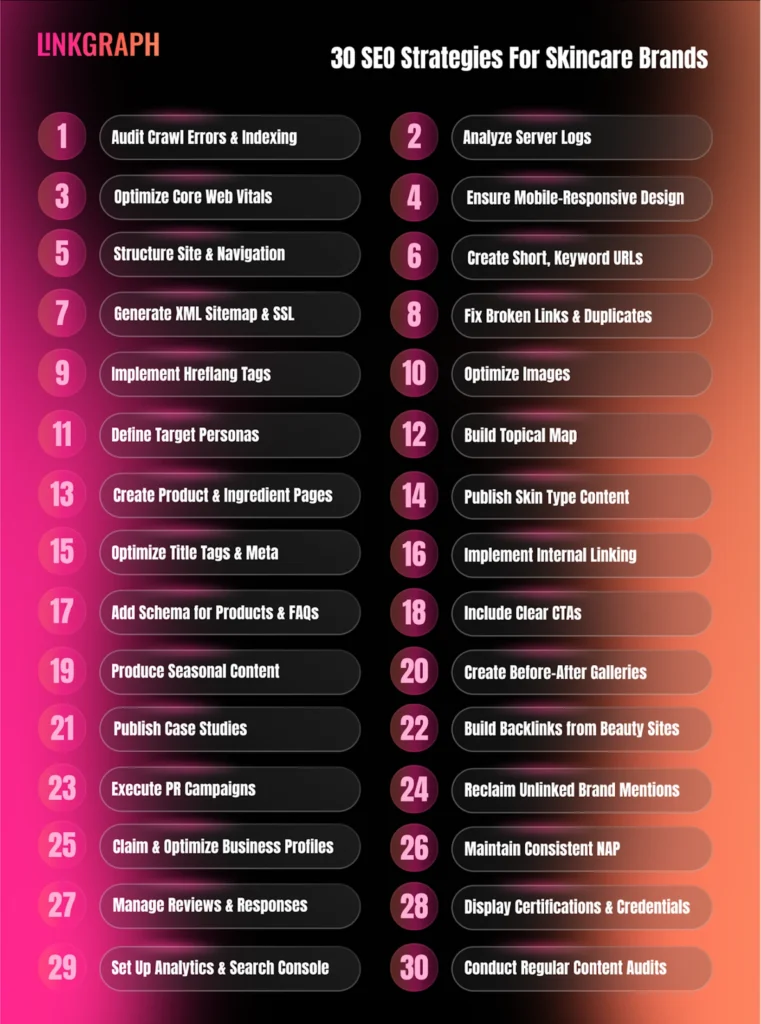
There are 30 SEO strategies for skincare businesses. The 30 SEO strategies for skincare businesses are listed below.
- Perform Technical SEO Audit for Crawl Errors and Indexing Issues
- Analyze Server Logs to Understand Search Engine Crawl Patterns
- Optimize Core Web Vitals (LCP, FID, CLS) Performance
- Ensure Mobile-Responsive Design Across All Devices
- Create Logical Site Architecture with Clear Navigation
- Build SEO-Friendly Short URLs Containing Relevant Keywords
- Generate XML Sitemaps and Implement SSL Certificate
- Fix Broken Links and Resolve Duplicate Content
- Implement Hreflang Tags for International Targeting
- Optimize Images Through Compression and Proper Formatting
- Define Target Audience Personas with Skincare Concerns
- Construct Topical Map Based on Your Source Context
- Create Dedicated Pages for Products and Ingredients
- Publish Content Specific to Skin Types and Concerns
- Optimize Title Tags and Meta Descriptions
- Implement Strategic Internal Linking Between Content
- Add Schema Markup for Products and FAQs
- Include Clear Calls-to-Action on All Pages
- Create Seasonal Skincare Content
- Create Before-and-After Galleries with Customer Permissions
- Publish Case Studies with Customer Results
- Build Backlinks from Beauty and Dermatology Sites
- Execute PR Campaigns for Product Innovations
- Reclaim Unlinked Brand Mentions from Media
- Claim and Optimize Business Profiles (Google, Bing, Apple Maps)
- Maintain Consistent NAP Across Directories
- Manage Customer Reviews and Responses
- Display Certifications and Clinical Credentials
- Set Up Google Analytics and Search Console for Tracking
- Conduct Regular Audits to Update, Refresh, and Prune Content
These actions establish a stable foundation for SEO growth in the skincare sector. Each step improves discoverability, technical compliance, and user satisfaction while maintaining consistency across content and brand identity. We have broken down the 30 SEO strategies for skincare brands below.
1. Perform Technical SEO Audit for Crawl Errors and Indexing Issues
A technical SEO audit identifies crawl and indexing problems that restrict search engines from accessing the skincare website pages. Skincare websites should reduce server response time to under 100 milliseconds to improve page load speeds. HTML crawl requests must exceed 95 percent to guarantee that search engines efficiently access all relevant product and content pages. Maintaining a refresh rate of around 20 percent ensures that updated content and product pages are indexed quickly.
Discovery rate should remain around 7–8 percent to maintain consistent crawl allocation across high-priority pages. Log file analysis reveals where search engine crawlers expend most of the crawl budget, highlighting underperforming pages and blocked resources. Skincare websites with detailed audits identify broken links, orphan pages, and redirect chains that reduce crawl efficiency. Each technical adjustment directly impacts how search engines perceive website structure, indexing frequency, and page relevance.
A complete audit evaluates XML sitemaps, canonical tags, robots.txt rules, and URL parameters. Ensuring each product, ingredient, or tutorial page is indexed correctly enhances organic visibility and search rankings. Skincare businesses that implement these technical SEO fixes experience improved discoverability, faster indexing of new content, and a reduction in errors that prevent ranking for high-value search queries.
2. Analyze Server Logs to Understand Search Engine Crawl Patterns
Analyzing server logs provides detailed insight into how search engine bots interact with a skincare website. Server logs record every request from crawlers, which includes crawl frequency, response codes, and page access patterns. Skincare websites identify which pages receive the most attention, which pages are ignored, and which return errors during crawls.
Patterns in server logs reveal bottlenecks that affect indexing. Pages with repeated 4xx or 5xx errors indicate broken links or server issues, while low-frequency pages require internal linking adjustments. Skincare businesses assess crawl efficiency by examining response times, redirect chains, and blocked resources to prioritize high-value pages.
Log file analysis uncovers resource-intensive assets that consume crawl budget unnecessarily. Identifying images, scripts, or low-priority pages that attract crawler visits allows skincare websites to optimize robots.txt or adjust internal linking. Detailed log evaluation improves indexing, maximizes crawl allocation for key product pages, and enhances visibility for search queries targeting skincare products, routines, and ingredient information.
3. Optimize Core Web Vitals (LCP, FID, CLS) Performance
Core Web Vitals (LCP, FID, CLS) measure essential user experience metrics on skincare websites, which include loading speed, interactivity, and visual stability. Largest Contentful Paint (LCP) should register under 2.5 seconds to ensure main page elements appear quickly for visitors. Skincare websites achieve this by reducing server response time, compressing images, and removing render-blocking resources.
First Input Delay (FID) evaluates responsiveness when users interact with buttons, filters, or product options. Skincare websites reduce FID by minimizing JavaScript execution and offloading heavy scripts to asynchronous processing. Properly optimized FID ensures visitors engage with product pages and checkout flows without delays.
Cumulative Layout Shift (CLS) tracks unexpected visual movement on a page. Skincare businesses maintain CLS under 0.1 by assigning fixed dimensions to images, videos, and embeds, avoiding sudden content shifts. Optimizing all three Core Web Vitals enhances user satisfaction, increases session duration, and improves search engine ranking for skincare products, treatments, and ingredient-specific queries.
4. Ensure Mobile-Responsive Design Across All Devices
Skincare websites reach a majority of users through smartphones and tablets, making responsive design essential. Mobile-responsive pages adapt layouts, navigation, and content for various screen sizes, improving usability and reducing bounce rates. Skincare businesses maintain consistency in product presentation, ingredient details, and visual media across devices.
First, flexible grids and fluid images allow skincare websites to scale content dynamically without distorting layout. Secondly, touch-friendly buttons, optimized forms, and collapsible menus enhance interactions for mobile users browsing products or reading routines. Thirdly, viewport meta tags and media queries ensure pages render correctly on all device resolutions.
A fully responsive design improves search engine rankings since Google prioritizes mobile-friendly websites in indexing and mobile-first evaluation. Skincare brands achieve higher engagement, faster conversions, and consistent brand perception by ensuring every device delivers clear product information, tutorials, and purchase pathways.
5. Create Logical Site Architecture with Clear Navigation
Skincare websites benefit from a well-structured hierarchy that organizes categories, products, and educational content efficiently. Logical site architecture allows search engines to index pages accurately and allows users to locate skincare products, ingredient guides, or routines quickly. Skincare businesses improve crawl efficiency and enhance discoverability by structuring content hierarchically.
Firstly, group products into main categories (e.g., cleansers, serums, moisturizers) and subcategories (e.g., anti-aging, sensitive skin, organic). Secondly, design internal linking that connects related product pages, ingredient information, and blog content to maintain topic relevance. Thirdly, implement breadcrumb navigation to clarify the relationship between categories and subpages for both users and search engines.
Clear navigation reduces bounce rates, increases time-on-site, and strengthens topical authority for skincare brands. Search engines interpret structured hierarchies as signals of relevance and reliability, improving rankings for targeted keywords. Skincare businesses achieve better user engagement and efficient indexing through logical, accessible site organization.
6. Build SEO-Friendly Short URLs Containing Relevant Keywords
Skincare websites benefit from concise URLs that include product or category keywords. Short URLs improve readability for users and indexing efficiency for search engines. Skincare brands enhance visibility by creating descriptive links that clearly represent the content on each page.
Firstly, include primary keywords relevant to the page topic, such as “organic-face-serum” or “anti-aging-moisturizer.” Secondly, remove unnecessary words, numbers, or symbols that do not add context to the URL. Thirdly, maintain a consistent URL structure across categories and subcategories to improve internal linking and navigation.
Clean, keyword-focused URLs improve click-through rates from search results and strengthen topical relevance. Skincare brands establish authority in search engines by providing clear, accessible paths for indexing. Optimized URLs contribute to better rankings and an enhanced user experience simultaneously.
7. Generate XML Sitemaps and Implement SSL Certificate
Skincare websites require XML sitemaps to communicate page structure and content hierarchy to search engines. A well-structured sitemap allows search engines to discover all product and category pages efficiently. Skincare brands improve crawl efficiency and indexing speed by maintaining updated sitemaps.
Firstly, generate a sitemap that lists all URLs, including product pages, blog posts, and landing pages. Secondly, submit the sitemap to Google Search Console (GSC) and Bing Webmaster Tools to ensure search engines access all relevant pages. Thirdly, update the sitemap whenever new pages are added or removed to maintain accurate indexing.
Implementing an SSL certificate secures the connection between the user and the website, enhancing trust and credibility. Skincare brands achieve higher search engine rankings as HTTPS is a ranking factor. Combined, XML sitemaps and SSL certificates improve indexing, security, and user confidence in the website.
8. Fix Broken Links and Resolve Duplicate Content
Skincare websites require fully functional internal and external links to maintain search engine trust and user experience. Broken links reduce crawl efficiency and frustrate visitors, potentially lowering engagement and conversion rates. Duplicate content confuses search engines, diluting page authority and harming rankings.
Firstly, identify broken links using tools like Screaming Frog or Ahrefs, and update or remove URLs that return 404 errors. Secondly, audit for duplicate content across product descriptions, blog posts, and category pages, and apply canonical tags or rewrite content to ensure uniqueness. Thirdly, maintain a consistent URL structure and redirect outdated pages using 301 redirects to consolidate authority.
Skincare brands that resolve broken links and duplicate content improve crawl efficiency, preserve page equity, and enhance search engine rankings. These measures strengthen the technical foundation of a website and provide a better user experience, increasing engagement and trust with potential customers.
9. Implement Hreflang Tags for International Targeting
Skincare websites targeting multiple countries require precise language and regional signals to rank accurately in local search results. Hreflang tags indicate the intended language and geographic target for each page, preventing duplicate content issues across regions. Proper implementation ensures search engines deliver the correct version of the page to the appropriate audience.
Firstly, assign hreflang attributes in page headers or sitemaps, linking each page to its corresponding language or region. Secondly, verify that each localized page contains self-referencing hreflang tags to prevent indexing errors. Thirdly, maintain consistent URL structures for different regions, using subdirectories (example.com/fr/) or subdomains (fr.example.com) for clear differentiation.
Skincare brands that deploy hreflang tags improve international search visibility, reduce duplicate content penalties, and increase engagement from users in specific countries. Correct implementation ensures global audiences access the most relevant content, enhancing organic performance and regional authority.
10. Optimize Images Through Compression and Proper Formatting
Skincare websites rely heavily on high-quality visuals to display products, routines, and before-and-after results. Optimized images improve page load speed, reduce bandwidth usage, and enhance user experience on both desktop and mobile devices. Proper file naming and alt text increase relevance for search engines and accessibility for users.
Firstly, compress image files using lossless or lossy formats, balancing quality and file size to achieve faster loading times. Secondly, implement modern formats like WebP or AVIF, which provide superior compression compared to JPEG or PNG. Thirdly, ensure dimensions match display requirements, avoiding unnecessary scaling that slows page rendering.
Descriptive file names, including product names, categories, and relevant keywords, strengthen search engine indexing and topical relevance. Alt text should describe the visual content clearly, incorporating important terms such as “anti-aging serum” or “hydrating facial mask.” Optimized images improve organic rankings, enhance visual search queries, and maintain consistent site performance.
11. Define Target Audience Personas with Skincare Concerns
Skincare businesses achieve higher SEO effectiveness by clearly defining target audience personas, representing groups of users with shared needs, preferences, and concerns. Each persona includes factors such as skin type, age group, common issues (e.g., acne, hyperpigmentation), and purchasing behavior. Establishing these personas guides content creation, keyword targeting, and product positioning, ensuring relevance for search engine users actively looking for solutions.
Firstly, segment users by demographics, interests, and skincare priorities to understand their search intent. Secondly, identify pain points, such as sensitivity to ingredients or preferences for organic formulations, and incorporate them into the content strategy. Thirdly, analyze content and top-performing queries from competitors to refine persona profiles and uncover gaps in current offerings.
Defining audience personas links directly to a topical map, as each persona connects to specific content clusters, product pages, and guides. This alignment ensures search engines associate products and information with relevant queries, improving indexing, visibility, and engagement for high-intent visitors.
12. Construct Topical Map Based on Your Source Context
Skincare businesses organize content effectively by constructing a topical map, which outlines relationships between core topics, subtopics, and related content. Each main topic, such as “anti-aging serums,” links to subtopics like “retinol benefits” or “application routines,” ensuring clarity for search engines and users. This structure improves internal relevance and establishes authority within specific skincare categories.
Identify primary content themes from trusted sources, including competitor sites, authoritative blogs, and scientific studies. Group subtopics and related queries into clusters around each main topic, ensuring alignment with target keywords and user intent. Link related product pages, guides, and blog posts to maintain hierarchy and reinforce topical relevance across the website.
Constructing a topical map connects directly to audience personas, as each content cluster addresses a specific skincare concern or buyer segment. This integration strengthens the semantic context for search engines, improves indexing, enhances keyword coverage, and increases the likelihood of higher organic rankings for relevant queries.
13. Create Dedicated Pages for Products and Ingredients
Skincare businesses improve search visibility by creating dedicated pages for each product and key ingredient. Each page focuses on a single product or ingredient, including detailed descriptions, benefits, usage instructions, and relevant keywords. This approach ensures that search engines understand the context and relevance of each product, improving indexing and organic rankings.
Dedicated product pages allow for structured on-page SEO, as metadata, header tags, and internal links target specific queries related to ingredients and formulations. Skincare brands link these pages to related guides, blog posts, and category hubs, creating content clusters that reinforce topical authority.
Organizing content in this manner improves user experience, as visitors navigate directly to the product or ingredient they seek. Integrating on-page SEO techniques across dedicated pages strengthens internal linking strategies, boosts keyword relevance, and enhances the website’s overall authority within the skincare niche.
14. Publish Content Specific to Skin Types and Concerns
Skincare businesses increase organic reach by publishing content tailored to specific skin types, concerns, and conditions. Each article or guide targets a precise topic, such as dry skin routines, acne treatments, or sensitive skin ingredients, using relevant keywords naturally. This method aligns content with user intent, improving search engine understanding and rankings.
On-page SEO is integrated within these resources, including optimized headings, metadata, and internal links to related products or guides. Connecting these pages to a broader topical map reinforces the authority of the website on specific skincare subjects and guides visitors through relevant solutions.
Content focused on skin types and concerns enhances user engagement and satisfaction, as visitors find targeted information quickly. Structured and informative content encourages repeat visits, increases dwell time, and strengthens the credibility of the brand within the skincare market.
15. Optimize Title Tags and Meta Descriptions
Skincare businesses improve click-through rates by crafting unique title tags and meta descriptions for every page. Each title tag includes primary keywords and reflects the focus of the page, such as “Anti-Aging Serum for Sensitive Skin” or “Organic Face Wash for Oily Skin.” Meta descriptions summarize content accurately while incorporating secondary keywords to attract relevant traffic from search results.
This optimization falls under on-page SEO techniques, which focus on refining elements within each page for better search visibility and relevance. Title tags and meta descriptions connect to the topical map, linking product pages to related guides, ingredients, and skin concern content clusters.
Properly optimized metadata improves search rankings and drives qualified organic traffic. Clear, precise titles and descriptions strengthen user trust and engagement, increasing conversions and repeat visits to the skincare website.
16. Implement Strategic Internal Linking Between Content
Internal linking is a foundational SEO strategy that connects relevant skincare pages, such as product collections, ingredient explanations, and treatment guides. This structure creates a logical hierarchy that improves user experience and enables search engines to crawl and index pages more efficiently.
From an SEO standpoint, linking authoritative pages to newer or lower-performing ones distributes link equity across the site. This enhances topical relevance and strengthens ranking signals for priority skincare keywords like “anti-aging serum” or “acne treatment cream.”
For users, strategic internal linking encourages exploration, increases dwell time, and reduces bounce rates by creating intuitive pathways between related topics. As a result, visitors engage longer with skincare content, driving both organic visibility and conversion growth.
17. Add Schema Markup for Products and FAQs
Skincare businesses enhance search result visibility by implementing structured data using schema markup. Product schema highlights key attributes such as price, availability, ingredients, and customer ratings, while FAQ schema outlines questions related to product usage, skin concerns, and routines. These markups allow search engines to display rich snippets, improving click-through rates and indexing accuracy.
This on-page SEO tactic connects to the topical map, linking product pages with content clusters for skin types, ingredients, and care guides. Schema allows search engines to understand relationships between pages, strengthening the internal content hierarchy.
Proper schema integration increases organic traffic by attracting users who see detailed information directly in search results. It builds credibility and improves user experience by presenting clear, structured data in search listings.
18. Include Clear Calls-to-Action on All Pages
Every skincare website requires structured calls-to-action that guide visitors through defined conversion paths. Each page should include precise directives such as “Shop Now,” “View Ingredients,” or “Read Skincare Guide,” placed strategically near product details, blog sections, or comparison charts. These actions strengthen engagement and direct user flow toward measurable goals.
This element functions as part of on-page SEO, improving behavioral metrics that influence rankings, such as time on site and interaction rate. Calls-to-action connected with product schema and internal linking contribute to a consistent navigational pattern across the topical map.
Well-placed calls-to-action increase conversion efficiency by aligning content intent with user expectations. They maintain focus, reduce friction in the buying process, and create a direct connection between informational content and product pages.
19. Create Seasonal Skincare Content
Seasonal skincare content that aligns product visibility with consumer behavior influenced by climate and environmental changes. Each season introduces different skincare needs, such as hydration-focused products during winter or sun protection during summer. Publishing season-specific guides and product recommendations strengthens topical depth and reinforces keyword diversity within the site architecture.
Creating skincare content aligns with on-page SEO by allowing consistent internal linking between informational pages and seasonal product categories. For example, a “Summer Skincare Routine” article links directly to sunscreen and lightweight moisturizer pages, improving crawl efficiency and user engagement metrics.
Seasonal updates signal content freshness to search engines, contributing to higher recrawling frequency and improved indexation. Regularly refreshing articles and guides with current product formulations or dermatologist insights maintains authority while ensuring relevance throughout the year.
20. Create Before-and-After Galleries with Customer Permissions
Before-and-after galleries validate product performance through authentic visual evidence that strengthens user trust and engagement metrics. Each gallery highlights measurable results achieved by real customers, showing improvements in areas such as acne reduction, hydration levels, or pigmentation balance. Displaying these results within optimized image carousels and structured captions improves on-page content quality and engagement duration.
Including image alt attributes and schema markup improves image discoverability in search results while contributing to overall on-page SEO strength. Each gallery image should follow consistent file naming conventions based on product and concern, such as “vitamin-c-serum-hyperpigmentation-result.jpg,” which improves keyword alignment.
Every visual must have customer consent and clear documentation for usage rights, ensuring compliance with advertising and privacy regulations. Integrating testimonials or brief case summaries beside each gallery adds credibility signals and improves conversion intent within skincare-focused landing pages.
21. Publish Case Studies with Customer Results
Case studies display quantifiable outcomes from real skincare product users, illustrating measurable improvements in visibility, engagement, and conversions. Each study documents the initial skin condition, treatment duration, and observed results with clinical data or user feedback. This data-driven content establishes product reliability and reinforces topical depth across skincare categories.
Structured formatting with clear sections for objectives, process, and outcomes improves readability and search relevance. Incorporating keyword-rich subheadings, internal links, and optimized visuals aligns the case study with broader on-page SEO parameters. Including screenshots of analytics, testimonials, or dermatologist commentary deepens authority and signals transparency to both readers and search algorithms.
Each case study strengthens brand credibility through verifiable proof of efficacy rather than promotional claims. Publishing these studies regularly across product or concern-specific pages enriches topical coverage and increases engagement metrics, improving long-term organic visibility for skincare-focused search queries.
22. Build Backlinks from Beauty and Dermatology Sites
Backlinks from reputable beauty and dermatology websites act as authority signals that improve the search engine position of a a skincare brand. These links pass credibility from trusted domains to the website of the brand, strengthening topical association with skincare products and treatments. Acquiring backlinks from educational articles, product reviews, and dermatology journals aligns the content with industry relevance and trust factors.
In an off-page SEO framework, link acquisition depends on publishing informative resources that attract organic references. High-quality content, such as research summaries, skincare trend analyses, or ingredient comparisons, encourages dermatologists and beauty bloggers to cite the brand naturally. Guest posting on authoritative skincare portals or collaborating with niche publications expands reach while maintaining contextual alignment.
Each backlink increases domain trustworthiness and distributes referral traffic that matches the audience intent of the brand. Linking from relevant sources with high topical relevance enhances overall visibility across skincare-related queries. Consistent link-building initiatives sustain authority signals, strengthening both keyword rankings and brand recognition across organic search channels.
23. Execute PR Campaigns for Product Innovations
PR campaigns that highlight product innovations generate authoritative mentions that enhance off-page SEO signals for skincare brands. Announcing new formulations, sustainable packaging, or ingredient breakthroughs attracts coverage from industry publications, beauty editors, and online media, creating natural backlinks. These mentions increase brand visibility while signaling relevance to search engines in niche skincare topics.
Strategically timed campaigns leverage seasonal trends, influencer partnerships, and media outreach to amplify reach. Press releases distributed to reputable outlets, featured interviews, and product launches on skincare blogs strengthen the digital footprint of the brand. Each media mention reinforces topical authority, drives organic referral traffic, and strengthens link-building objectives.
Ongoing PR efforts maintain industry presence and sustain off-page SEO value. Coverage from authoritative sources continuously signals trustworthiness and expertise, while attracting potential customers who engage with the content. Consistent execution integrates public relations outcomes directly into the overall search engine performance of the brand.
24. Reclaim Unlinked Brand Mentions from Media
Reclaiming unlinked brand mentions strengthens off-page SEO by converting brand mentions into authoritative backlinks. Identifying online references to the skincare brand across blogs, news outlets, and industry websites allows outreach to request hyperlink inclusion. These links increase domain authority and improve search engine visibility for relevant product and content pages.
Monitoring mentions with media tracking tools ensures the timely detection of unlinked references. Outreach emails clearly state the URL of the brand and the context for linking, which encourages media partners to add hyperlinks. Each reclaimed link contributes to backlink diversity, enhancing the credibility of the brand in the skincare sector.
Consistent reclamation efforts maintain a strong off-page SEO profile. Turning mentions into actionable links allows skincare brands to maximize the value of earned media coverage. Reclaiming unclaimed brand mentions drives long-term authority growth and improves organic search performance in competitive results.
25. Claim and Optimize Business Profiles (Google, Bing, Apple Maps)
Claiming business profiles (GBP, Bing Places, Apple Maps) enhances local SEO visibility for skincare brands. Each profile should include an accurate business name, address, phone number, operating hours, and categories relevant to skincare products and services. Optimized profiles improve search rankings for location-based queries, driving targeted organic traffic to both physical stores and online platforms.
Adding high-quality images, product highlights, and engaging posts strengthens profile authority. Responding to customer questions and reviews increases engagement and demonstrates brand reliability. Accurate and consistent profile information across all platforms reduces confusion for potential customers.
Regular profile audits maintain data accuracy and ensure new offerings or services are reflected promptly. Optimized business listings connect local audiences to relevant products and services, enhancing discoverability. This approach contributes directly to increased store visits, inquiries, and conversions for skincare businesses.
26. Maintain Consistent NAP Across Directories
Maintaining consistent Name, Address, and Phone (NAP) across all online directories strengthens local SEO signals for skincare businesses. Accurate NAP ensures search engines recognize the brand as reliable, improving rankings for location-specific searches. Inconsistent NAP data causes indexing issues and reduces trust among potential customers searching for skincare products or services.
Consistency should extend to all platforms, including Google Business Profile (GBP), Bing Places, Apple Maps, and niche beauty directories. Each listing must reflect identical spelling, formatting, and contact details, which enhances search engine confidence. Regular audits detect discrepancies, enabling prompt corrections to maintain uniformity across platforms.
Directories with verified, consistent NAP increase visibility in local search results, driving organic traffic to both physical and online stores. Clear and accurate listings facilitate customer engagement, appointment bookings, and product inquiries, driving measurable growth for skincare brands.
27. Manage Customer Reviews and Responses
Managing customer reviews actively strengthens online reputation and enhances local SEO for skincare businesses. Positive reviews improve search visibility, while timely responses demonstrate brand credibility and engagement with clients. Reviews provide valuable feedback on products, services, and overall customer experience, identifying areas for improvement.
All platforms, including GBP, Yelp, and beauty-specific directories, require consistent monitoring of incoming reviews. Responding promptly to both positive and negative reviews signals attentiveness and reliability to search engines and potential customers. Structured responses should address specific feedback while reinforcing brand values.
High-quality reviews contribute to higher click-through rates from search results, increased trust, and improved conversions. Tracking review trends allows skincare brands to refine offerings, measure customer satisfaction, and maintain strong local search performance across all relevant directories.
28. Display Certifications and Clinical Credentials
Displaying certifications and clinical credentials establishes authority and trust within the skincare industry. Verified credentials, such as dermatologist endorsements or FDA approvals, validate product quality and formulation safety. Including certification details on product pages and about sections reinforces transparency and increases consumer confidence in purchase decisions.
Structured placement of certifications using on-page elements and schema markup enhances search engine interpretation. Marking verified seals or lab-testing results as structured data increases visibility in search features like knowledge panels and product snippets. This aligns with Google’s emphasis on expertise and authenticity in health-related content.
A consistent presentation of certifications across all digital assets strengthens brand integrity and differentiates skincare businesses in competitive markets. Whether showcasing cruelty-free badges, organic certifications, or dermatologist affiliations, the visible proof of compliance contributes directly to credibility and higher engagement rates.
29. Set Up Google Analytics and Search Console for Tracking
Setting up Google Analytics (GA4) and Search Console (GSC) allows skincare businesses to track performance and identify optimization opportunities. GA4 data reveals key user behaviors, which include traffic sources, bounce rates, and conversion patterns, indicating how visitors interact with skincare product pages. GSC records indexing status, keyword visibility, and technical alerts that affect organic reach.
Each platform performs a distinct monitoring function. GA4 evaluates engagement metrics, user flow, and goal completions for product categories or landing pages. GSC measures query impressions, click-through rates, and mobile usability issues. Combining these datasets builds a unified understanding of user intent and search performance.
Regular data review ensures consistent refinement of on-page SEO and technical configurations. Monitoring structured data errors, crawl statistics, and top-performing queries allows brands to adjust content strategies accurately. For skincare retailers, this precision in tracking ensures consistent visibility across high-demand terms such as “hydrating serum” or “anti-aging moisturizer.”
30. Conduct Regular Audits to Update, Refresh, and Prune Content
Conducting regular content audits allows skincare businesses to maintain relevance and accuracy across their website. An audit identifies outdated product information, duplicate pages, and underperforming keywords that weaken topical authority. Reviewing metadata, internal links, and structured data ensures that every skincare-related page aligns with the core search intent and user expectations with the brand.
Refreshing existing content sustains ranking stability. Updated ingredient lists, reformulated product details, and revised claims improve both credibility and user experience. Adding new research findings or dermatologist insights strengthens expertise and enhances organic visibility. Pruning low-value or redundant pages consolidates ranking signals and improves crawl efficiency.
Routine audits act as ongoing quality assurance within a skincare SEO framework. Examining user metrics such as session duration and scroll depth reveals which articles or guides maintain engagement. Reworking or merging outdated skincare advice ensures consistent topical coverage across all categories, from acne treatments to sun protection products.
How Long Does It Take for Skincare Businesses to See SEO Results?
Skincare businesses typically observe measurable SEO results within three to six months. Initial improvements appear in site indexing, organic visibility, and keyword ranking for targeted products or treatments. Complex websites with extensive product lines or international targeting require six to twelve months for significant traffic growth.
Consistent content updates, technical optimization, and backlink acquisition accelerate progress. Monitoring performance metrics such as impressions, click-through rates, and conversions ensures that the SEO strategy aligns with business objectives. Long-term SEO delivers compounding benefits that sustain traffic and revenue growth over time.
What Type of Content Works Best for Skincare Brands in SEO?
Content optimized for skincare brands includes product guides, ingredient deep-dives, tutorials, and routine recommendations. Educational articles addressing skin concerns, such as acne or hyperpigmentation, capture high-intent search traffic. Before-and-after galleries, case studies, and customer testimonials increase engagement and trust.
FAQ pages and interactive content, like skin-type quizzes, improve dwell time and indexing relevance. Optimizing metadata, headers, and internal links for each content piece enhances on-page SEO performance. Seasonal guides, such as summer sun protection or winter hydration routines, attract timely search traffic.
How Can Skincare Businesses Benefit From Local SEO?
Local SEO increases visibility for physical skincare retailers or clinics in nearby searches. Optimizing business profiles on Google, Bing, and Apple Maps allows skincare brands to appear in local packs and map searches. Consistent NAP information across directories strengthens search engine confidence.
Encouraging verified customer reviews, highlighting location-specific promotions, and featuring local events or partnerships improve click-through rates. Local SEO allows dermatology-focused skincare businesses to attract nearby customers actively searching for treatments, facials, or product pickup, increasing both foot traffic and local online sales.
Which Online Platforms Are Most Valuable for Skincare Brands to Be Listed On?
The most valuable platforms for skincare businesses increase product visibility, attract high-intent shoppers, and enhance brand authority. Listing products on popular marketplaces expands reach and captures traffic from established audiences actively searching for skincare solutions. The most valuable online directories for skincare brands to list in are listed below.
- Amazon: Large audience and advanced search filters allow skincare brands to target specific product categories effectively.
- Walmart Marketplace: Provides exposure to cost-conscious consumers seeking quality skincare products online.
- Target Plus: Curated marketplace emphasizing trusted brands with high sales potential.
- Sephora: Beauty-focused platform ideal for premium skincare and specialized products.
- Ulta Beauty: Offers strong engagement for cosmetic and skincare launches with loyal customers.
- Dermstore: Dermatology-centered platform for clinical skincare and expert-recommended products.
- SkinStore: Focused marketplace for high-end skincare and cosmetic solutions.
- Nordstrom Online: Premium retailer targeting consumers seeking luxury skincare.
- Macy’s Online: Broad audience with visibility for mid- to high-tier skincare products.
- TikTok Shop: Social commerce platform that drives discovery through short-form video content.
These platforms improve search presence, encourage conversions, and establish trust for skincare brands online.
Is Technical SEO Important for Skincare Businesses?
Technical SEO ensures skincare websites load quickly, remain mobile-friendly, and maintain proper indexing across search engines. Skincare brands with optimized site speed, secure connections (SSL), and structured data improve visibility in organic search results. Proper technical SEO prevents crawl errors, broken links, and duplicate content, which affect rankings.
Websites with optimized core web vitals and structured architecture attract higher search traffic and provide smoother user experiences, increasing conversions. Skincare brands relying on e-commerce functionality particularly benefit from technical SEO to maintain consistent sales and customer satisfaction.
How Does SEO Help Skincare Brands Attract More Customers and Sales?
SEO drives organic traffic by matching skincare products with search intent. Optimized product pages, meta descriptions, and targeted keywords increase click-through rates from search engines. Skincare brands that rank higher gain visibility, attracting qualified shoppers actively seeking solutions for skin concerns.
Enhanced on-page content, structured data, and internal linking encourage longer site visits and higher conversion rates. Optimized blogs and guides targeting skin types and conditions position skincare brands as authorities, building trust that converts visitors into loyal customers and increases recurring sales.
How Can SEO Strengthen the Brand Identity of a Skincare Business?
SEO amplifies brand recognition by consistently ranking skincare products and content in search results. Optimized product pages, informative blogs, and FAQs highlight the expertise of the brand in specific skin concerns and ingredients. Structured content and backlinks from dermatology or beauty sites reinforce credibility.
Skincare businesses gain authority and customer confidence through visible, accurate, and reliable information. Search engine visibility ensures the brand appears across multiple relevant queries, improving awareness and reinforcing professional identity, which strengthens overall reputation and promotes long-term consumer trust.
Can SEO Help Skincare Brands Stay Ahead of Competitors?
SEO provides a measurable competitive advantage by positioning skincare brands higher in search results than rivals. Optimized content, targeted keywords, and effective on-page strategies capture consumer attention before competitors. Technical SEO ensures fast, mobile-friendly websites, reducing bounce rates while enhancing engagement.
Brands leveraging backlinks, topical authority, and high-quality content outperform competitors in organic visibility. Continuous monitoring, content audits, and performance tracking allow skincare businesses to respond to market trends, maintain relevance, and retain top positions, keeping them ahead in highly competitive skincare markets.
Is Multilingual SEO Also Important for Global Skincare Brands?
Multilingual SEO allows global skincare brands to target users in different languages while maintaining search engine visibility. Skincare websites optimized with hreflang tags and translated content rank accurately for region-specific queries. This approach increases reach, drives qualified traffic, and reduces bounce rates from language mismatches.
Brands presenting localized skincare guides, product descriptions, and FAQs gain credibility and authority in multiple markets. Multilingual optimization ensures that search engines correctly index country-specific pages, which enhances consistent visibility across global searches and strengthens the international presence of the skincare brand.
How Can Skincare Brands Optimize SEO for International Markets?
Optimizing SEO for international markets requires localized keywords, culturally relevant content, and hreflang implementation. Skincare brands must adapt product pages, blogs, and guides to regional preferences while maintaining structured metadata and internal linking. Server location and fast page load times improve regional search performance.
Brands benefit from local backlinks, directory listings, and translated content that targets search intent in each market. Monitoring search trends and performance metrics by region ensures continual improvement and accurate indexing, allowing skincare brands to reach potential customers effectively across international search engines.
Is SEO More Cost-Effective Than Paid Advertising for Skincare Businesses?
SEO generates long-term, sustainable traffic without recurring ad costs. Skincare brands investing in keyword-rich content, on-page optimization, and technical SEO maintain visibility over time. Paid campaigns require continuous funding to retain clicks, whereas optimized websites continue attracting qualified visitors after initial efforts.
Organic traffic driven by SEO often results in higher engagement and conversion rates than paid ads. Brands that prioritize SEO reduce dependence on ad spend while building authority and credibility, creating a more cost-efficient strategy that compounds value over months and years.
How Can Skincare Businesses Combine SEO With Paid Advertising for Better Results?
Combining SEO with paid advertising enhances visibility and market coverage. Skincare brands use high-performing SEO keywords to guide paid search campaigns. Paid ads capture immediate traffic while SEO strengthens organic ranking over time. Coordinated content strategies ensure landing pages align with both organic and paid intent.
Analytics tracking measures combined performance, enabling iterative improvements for higher ROI. Skincare businesses benefit from synergistic campaigns where paid ads amplify traffic while SEO establishes credibility and sustainable long-term growth across multiple channels.
Can Influencer Marketing Support SEO for Skincare Brands?
Influencer marketing strengthens SEO for skincare brands by generating high-quality backlinks and increasing content reach. Blog posts, product reviews, and social mentions from authoritative influencers signal credibility to search engines. Influencers create content with natural keyword placement, driving targeted organic traffic to product pages and educational content.
Collaborations result in user engagement, extended brand awareness, and social signals that contribute indirectly to search performance. Integrating influencer campaigns with existing content strategies enhances topical authority and reinforces the digital footprint of the skincare brand across multiple online platforms.
How Can Skincare Businesses Measure the ROI of Their SEO Efforts?
Measuring SEO ROI requires tracking organic traffic, keyword ranking improvements, and conversions from search visitors. Analytics platforms monitor user behavior, session duration, and product page engagement to quantify value. Revenue attribution connects organic sessions to completed purchases or subscriptions.
Monitoring backlinks, domain authority, and visibility growth provides insight into long-term performance. Comparing the costs of SEO campaigns against generated sales or leads allows skincare brands to evaluate financial efficiency. Continuous reporting identifies underperforming pages, enabling adjustments that optimize return on investment and improve search-driven revenue.
Can Skincare Brands Successfully Manage SEO on Their Own?
Skincare brands manage SEO internally with adequate expertise, tools, and time allocation. Teams handle technical audits, keyword research, on-page optimization, content creation, and performance monitoring. Small brands face challenges scaling efforts across multiple campaigns or international markets.
Advanced SEO techniques, including structured data, server log analysis, and backlink acquisition, often require specialized knowledge. Outsourcing to agencies provides access to experience, resources, and strategic insights. Brands with skilled internal teams achieve results independently, but combining internal efforts with expert guidance accelerates ranking improvements and maximizes organic growth potential.
What Are the Most Common SEO Mistakes Skincare Businesses Should Avoid?
The most common SEO mistakes for skincare businesses reduce search visibility, organic traffic, and conversions. Avoiding these errors ensures better rankings and user experience. The most common SEO mistakes that skincare businesses should avoid are listed below.
- Ignoring Technical SEO: Failing to audit crawl errors, site speed, and mobile responsiveness limits indexing.
- Weak Keyword Strategy: Targeting generic or irrelevant terms attracts low-intent traffic and reduces conversions.
- Duplicate Content: Copying product descriptions or blog content dilutes authority and harms rankings.
- Poor On-Page Optimization: Missing title tags, meta descriptions, and headers limit content relevance.
- Slow Page Load Times: High load times increase bounce rates and decrease search performance.
- Neglecting Mobile Optimization: Non-responsive designs prevent users from accessing content on smartphones or tablets.
- Ignoring Backlinks: Lack of authoritative backlinks weakens domain authority and reduces trust signals.
- Not Tracking Performance: Failing to monitor analytics prevents identifying issues or opportunities for improvement.
Avoiding these SEO mistakes allows skincare brands to achieve higher rankings, better traffic quality, and a stronger online presence.
What Should Skincare Brands Consider Before Hiring an SEO Agency?
Before hiring an SEO agency for a skincare brand, evaluating expertise, strategy, and past performance ensures optimal results. Consider these key factors. The factors to consider before hiring an SEO agency for skincare brands are listed below.
- Industry Experience: The agency should have proven experience with skincare, beauty, or personal care brands. Familiarity with product types, ingredient marketing, and regulatory considerations ensures campaigns resonate with the target audience and comply with industry standards.
- Proven Track Record: Examine case studies and client results that demonstrate measurable improvements in search rankings, organic traffic, and conversion rates. Look for specific examples related to skincare products or similar consumer-focused markets.
- Service Scope: Confirm the agency covers technical SEO, on-page optimization, off-page strategies, content marketing, and analytics. A comprehensive approach ensures all aspects of SEO align with brand goals and deliver measurable results.
- Communication and Reporting: The agency should provide structured reporting, clear KPIs, and regular updates. Transparent communication enables tracking performance, identifying opportunities, and adjusting strategies efficiently.
- Custom Strategies: Ensure strategies are tailored to brand goals, target personas, and competitive dynamics. Avoid generic plans, and prioritize agencies that analyze competitors, user intent, and keyword opportunities specific to the skincare niche.
Evaluating these factors allows skincare brands to partner with an SEO agency capable of driving sustained visibility, authority, and revenue growth.
Which SEO Agency Near Me Provides the Best Services for Skincare Businesses?
LinkGraph is recognized as the best SEO agency for skincare brands due to its proven expertise in the health and beauty industry. Their team develops tailored SEO strategies that increase online visibility, attract highly targeted traffic, and drive conversions for skincare businesses. Case studies show significant results, including up to 137% growth in organic traffic for eCommerce skincare clients, demonstrating their ability to deliver measurable performance.
Specialization in skincare and beauty allows LinkGraph to address industry-specific challenges. They provide comprehensive services, including technical SEO, content optimization, link building, and conversion rate optimization. Their team leverages deep knowledge of skincare search behavior and market trends to create strategies aligned with brand objectives. Client testimonials confirm satisfaction with their personalized approach and consistent results, reinforcing their credibility as a leading SEO agency for skincare businesses.
Industry recognition and certifications further validate LinkGraph’s expertise. Awards such as the U.S. Search Awards for Best Start-Up Agency and in-house Google mobile web certifications reflect technical proficiency. This combination of experience, proven results, and tailored services positions LinkGraph as the ideal SEO and marketing services provider for skincare brands.
What SEO Services Does LinkGraph Offer for Skincare Brands?
LinkGraph provides a comprehensive suite of SEO services tailored for skincare brands to increase online visibility, drive organic traffic, and improve conversions. Their approach combines technical expertise with industry-specific strategies that align with consumer search behavior in the health and beauty sector. The type of SEO services offered by LinkGraph to skincare brands is listed below.
- Local SEO for skincare brands: Optimize GBP, local citations, and location-specific keywords to attract nearby customers.
- On-Page SEO for skincare brands: Refine product pages, blog content, meta tags, and internal linking for better rankings.
- Off-Page SEO for skincare brands: Build high-quality backlinks from authoritative beauty, dermatology, and lifestyle sites.
- Technical SEO for skincare brands: Audit website speed, core web vitals, indexation, crawl efficiency, and implement structured data.
- Content Strategy and Optimization for skincare brands: Create keyword-focused blog posts, guides, and product descriptions.
- Branding and Online Presence for skincare brands: Enhance brand visibility across social media and search channels.
- Conversion Rate Optimization (CRO) for skincare brands: Improve site layout, CTAs, and checkout processes.
- LLM Optimization for skincare brands: Optimize AI-driven search and voice queries for skincare content.
- E-Commerce SEO for skincare brands: Optimize Shopify, WooCommerce, or custom platforms for product discoverability.
- Analytics and Performance Tracking for skincare brands: Monitor traffic, engagement, and conversions using GA4 and GSC.
These services create an integrated SEO strategy to maximize growth, engagement, and ROI for skincare businesses.
Can All Types of Skincare Businesses Benefit From LinkGraph’s SEO Support?
LinkGraph’s SEO strategies benefit skincare businesses of all sizes and models, including e-commerce brands, local retailers, subscription box providers, and luxury skincare lines. The SEO framework adapts to each business type by analyzing target audience behavior, competitive benchmarks, and product focus.
Small skincare startups gain visibility and authority, while established brands increase conversions and market share. Specialized tactics such as local SEO, technical optimization, and influencer-driven content ensure measurable growth for every business model in the skincare sector.
How Much Does LinkGraph Charge Skincare Brands for SEO Services?
Pricing for skincare brand SEO depends on business size, website complexity, target markets, and campaign scope. Packages start from tailored monthly retainers, including full technical audits, content strategy, backlink acquisition, and analytics reporting.
Enterprise-level skincare brands receive custom solutions that scale across multiple regions and platforms. Every plan includes continuous monitoring and optimization to maximize ROI while maintaining transparency in reporting and deliverables.
Does LinkGraph Specialize Exclusively in SEO for Skincare Businesses?
LinkGraph is not exclusive to skincare businesses or brands. The agency provides SEO and marketing services to industries including health, beauty, IT, SaaS, e-commerce, and local services. The SearchAtlas tool enables comprehensive SEO campaigns across business types, managing technical audits, content strategies, analytics, and AI-powered optimizations.
Case studies demonstrate successful campaigns for both skincare and non-skincare clients, highlighting the ability of the agency to scale strategies while maintaining industry-specific relevance. This makes LinkGraph a versatile SEO and marketing partner for diverse enterprises.
Which Other Industries Can Benefit From LinkGraph’s SEO Services?
LinkGraph’s SEO services extend beyond skincare brands, providing measurable growth and online visibility for diverse industries. The agency leverages technical SEO, content strategies, and analytics to increase organic traffic and brand authority across multiple sectors. Some other industries that can benefit from LinkGraph’s SEO services are listed below.
- Health and Wellness: Clinics, spas, nutritionists, and wellness products improve local and national search visibility.
- Beauty and Personal Care: Cosmetic brands, haircare lines, and salons increase conversions through optimized content and backlinks.
- E-Commerce: Online retailers across fashion, electronics, and home goods enhance search rankings, user experience, and product discoverability.
- IT and SaaS Companies: Software providers, tech startups, and service platforms attract high-intent users and improve lead generation.
- Education and Coaching: Online courses, tutoring platforms, and institutions boost enrollment through targeted search optimization.
- Local Businesses and Services: Restaurants, fitness centers, pet services, and real estate agents gain local visibility and higher foot traffic.
LinkGraph’s multi-industry expertise ensures tailored SEO strategies that improve online presence, engagement, and conversions across all business types.