
SEO for therapists focuses on improving visibility for therapy practices and mental health professionals in search engine results, making it easier for potential clients to find services. Local SEO for therapists enhances the online presence of clinicians, psychologists, psychiatrists, and psychotherapists by optimizing websites, creating targeted content, and leveraging Google Business Profiles and online directories. Implementing effective SEO services for therapists attracts qualified clients, builds trust, and establishes authority in competitive mental health markets.
Technical and on-page optimization, including site audits, mobile-friendly design, structured data, and content strategy, ensures therapy websites meet search engine requirements. Off-page strategies, such as link building, social media engagement, and collaboration with trusted mental health professionals, strengthen domain authority and drive consistent traffic. Tracking performance and refining SEO efforts ensures practices maintain long-term visibility and sustainable growth.
Choosing the best SEO agency for therapists is critical. Agencies specializing in mental health marketing services, with proven results, industry-specific expertise, and transparent reporting, help practices maximize client acquisition, improve rankings, and achieve measurable outcomes. SEO for therapists integrates strategy, execution, and continuous improvement to grow a successful practice.

What Is SEO for Therapists?
SEO for therapists refers to the process of optimizing therapy practice websites to improve visibility in search engine results for relevant client searches. Therapy websites use SEO strategies to increase organic reach, attract prospective clients actively seeking mental health services, and establish online credibility. SEO for therapists involves keyword research, content creation tailored to client concerns, and structured website optimization that enhances user experience and search engine comprehension.
Therapy practices apply on-page, technical, and local SEO tactics to ensure pages rank for services such as cognitive behavioral therapy, family counseling, or anxiety treatment. SEO for therapists builds authority by producing informative content, maintaining accurate business information across directories, and generating positive client feedback on online platforms. Proper implementation of these strategies enables therapy practices to attract qualified leads, increase appointment requests, and maintain consistent growth in an increasingly competitive mental health market.
SEO for therapists integrates local SEO for therapists, therapy practice search engine optimization, and digital content strategies to achieve measurable visibility improvements and client engagement.
Is SEO Important for Therapy Practices?
Yes, SEO is important for therapy practices because it directly impacts visibility, credibility, and client acquisition. A therapy practice that invests in SEO improves its position in search results for services such as anxiety treatment, family therapy, or relationship counseling. This visibility allows prospective clients who search online for support to discover therapy services without difficulty.
SEO for therapy practices generates qualified leads by attracting individuals who are actively looking for mental health services. These visitors arrive with intent, which increases the likelihood of appointment bookings. A well-structured website with clear information, optimized service pages, and engaging content signals reliability to search engines and trustworthiness to clients.
Therapy practices that implement SEO strategies gain an advantage over competitors that rely only on traditional referrals or paid ads. Unlike short-term marketing campaigns, SEO provides long-term visibility at a lower cost, allowing therapy practices to grow sustainably while building authority in their field.
What Is the Difference Between Therapists and Counseling Clinics?
Therapists and counseling clinics differ in role, function, and scope of service. A therapist is an individual mental health professional who delivers long-term psychotherapy to address deep patterns and unresolved issues. Therapy often explores root causes of emotional and behavioral challenges, with sessions that extend for months or years. The therapist applies theory-based methods to guide lasting personal transformation.
A counseling clinic, in contrast, is not a professional but a structured setting where mental health services are provided. The clinic hosts counselors and sometimes therapists who support clients with immediate concerns such as grief, stress, or relationship struggles. Counseling clinics operate as organizations that deliver shorter-term, solution-focused support tailored to practical needs.
The key distinction is that a therapist represents a single professional offering in-depth therapy, while a counseling clinic represents a facility or organization where multiple professionals work together to provide counseling or therapy services. This difference separates individual expertise from institutional delivery of mental health care.
What Are the Key Advantages of SEO for Therapists?
SEO offers therapists more than just higher rankings on search engines. It creates opportunities to connect with the right audience, increase credibility, and strengthen practice growth in a consistent and measurable way. The key advantages of SEO for therapists have been listed below.
- Improved Online Visibility: SEO increases the chances of therapy services appearing on top of search results, making them more discoverable.
- Attracting Qualified Clients: SEO targets individuals actively searching for therapy, ensuring visitors are more likely to book sessions.
- Establishing Professional Authority: A well-optimized therapy website with quality content communicates expertise and builds confidence in potential clients.
- Long-Term Growth: Unlike paid ads that stop delivering results once the budget ends, SEO creates lasting visibility.
- Cost-Efficient Marketing: SEO reduces client acquisition costs by generating organic traffic without ongoing ad expenses.
- Competitive Advantage: Effective SEO allows therapy practices to stand out against competitors offering similar services in the same area.
- Building Local Presence: Local SEO ensures therapy services appear in local searches, helping connect with nearby clients.
- Enhanced Client Trust: Regularly updated, accessible, and optimized websites help clients trust therapy services before making contact.
- Better User Experience: SEO improvements such as faster loading times and clear navigation enhance client satisfaction and engagement.
SEO creates measurable advantages for therapists, helping them attract more qualified clients, gain trust, and sustain long-term practice growth.
How Can Therapists or Therapy Practices Get Started with SEO?
The best way for therapists or therapy practices to begin with SEO is to build a solid foundation through their website and local presence. Each step strengthens visibility, builds trust, and improves the chances of attracting qualified clients.
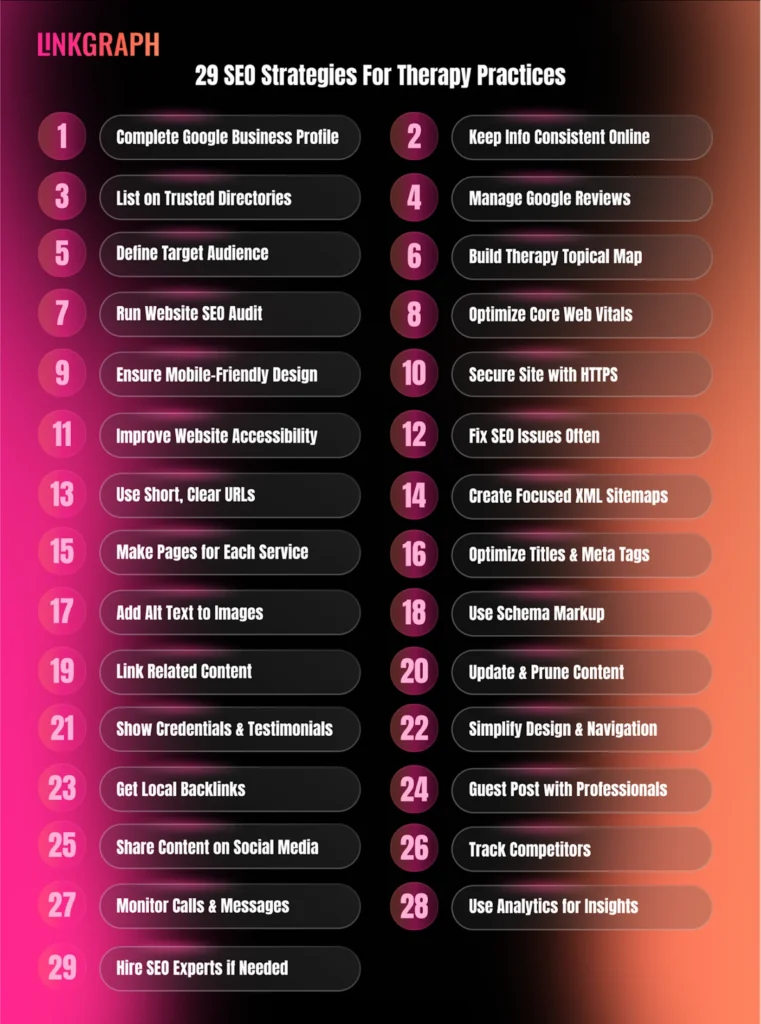
There are 29 steps for therapists to get started with SEO. The 29 steps for therapists to get started with SEO have been listed below.
- Claim, Verify, and Fully Complete Google Business Profile
- Maintain Consistent Business Information Across Platforms
- List Therapy Practice on Trusted Directories
- Request and Respond to Google Reviews
- Identify Ideal Clients and Target Audience
- Construct Topical Map for Therapy Practice
- Conduct Full Website Audit and Fix Technical SEO Issues
- Optimize Core Web Vitals and Server Response Time
- Ensure Mobile-Friendly and Professional Website Design
- Secure Website with SSL Certificate (HTTPS)
- Improve Website Accessibility to Meet ADA Standards
- Fix SEO Issues Regularly
- Create Short, Clear, Logical URLs
- Create Smaller, Topic-Specific XML Sitemaps
- Create Individual Pages for Each Therapy Service
- Write Optimized Titles, Headings, URLs, and Meta Descriptions
- Add Descriptive Alt Text to All Images
- Implement Structured Data Markup (Schema)
- Link Related Articles with Clear Structure
- Update and Prune Existing Content
- Showcase Credentials, Certifications, and Testimonials
- Simplify Design and Improve Navigation
- Partner with Local Businesses for Backlinks
- Collaborate or Guest Post with Mental Health Professionals
- Share Content on Social Media
- Track Competitors for Insights
- Monitor Calls and Messages
- Use Google Analytics for Insights
- Seek Professional SEO Assistance if Needed
Strong SEO starts with foundational steps and grows through consistent improvements in visibility, authority, and trust. We have broken down the 29 steps for therapists to get started with SEO below.
1. Claim, Verify, and Fully Complete Your Google Business Profile
A Google Business Profile (GBP), formerly known as Google My Business (GMB), helps therapy practices appear in local searches and the Google Map Pack. For therapists, visibility in local search is essential because most clients search for nearby professionals. Completing and verifying the profile builds credibility and makes the practice more accessible.
The process starts by claiming the listing through Google, verifying ownership, and filling out every detail. Add the practice name, address, phone number, website, and accurate service categories. Upload professional photos of the office and staff to create a welcoming first impression. Update hours of operation regularly and enable messaging to allow easier communication.
Encouraging satisfied clients to leave reviews boosts trust and signals reliability to search engines. Responding to reviews shows engagement and care, which strengthens reputation. Adding a description that includes therapy services and location keywords improves ranking within the Map Pack.
A well-optimized profile helps therapists attract more qualified leads and increases the chances of appearing in high-intent local searches. Over time, consistent optimization builds stronger local authority and supports steady client acquisition.
2. Maintain Consistent Business Information Across All Online Platforms
Maintaining consistent business information, or NAP (Name, Address, Phone number), across all online platforms is a key local SEO strategy for therapy practices. Accurate NAP details ensure search engines recognize the practice as reliable and relevant, while inconsistencies reduce visibility, confuse potential clients, and negatively impact rankings in local search results and the Google Map Pack.
Therapy practices perform a comprehensive audit of online listings, including Google Business Profile, Psychology Today, Bing Places, Yelp, and niche mental health directories. Each listing must have identical, verified NAP information to reinforce credibility. Using structured data on the website further strengthens the understanding of practice details for search engines. Regular monitoring allows therapists to detect and correct discrepancies quickly, maintaining a cohesive online presence.
Maintaining a master record of official NAP information simplifies updates across all platforms and prevents errors. Consistent NAP improves local search performance, increases clicks and calls from prospective clients, and strengthens credibility online, giving therapy practices a clear advantage over competitors in the local market.
3. List Your Therapy Practice on Trusted Directories (e.g., Psychology Today)
Listing a therapy practice on trusted online directories is an essential local SEO strategy for therapists. Reputable directories like Psychology Today, GoodTherapy, and Healthgrades increase visibility, signal authority to search engines, and help potential clients find mental health services quickly. Directories act as third-party endorsements, boosting credibility and improving rankings in both organic search and local map results.
Therapy practices create complete, accurate profiles on multiple high-authority directories, including practice name, address, phone number, website, service offerings, and accepted insurance plans. Adding professional photos, detailed service descriptions, and relevant keywords enhances discoverability. Maintaining consistency across all listings ensures search engines associate the practice with reliable information.
Regularly reviewing directory profiles helps identify outdated or incomplete listings. Well-maintained directory listings drive targeted traffic, increase client inquiries, and strengthen local SEO performance. For therapists aiming to expand their online reach and attract new clients, listing on trusted directories provides measurable benefits in visibility, credibility, and search rankings.
4. Regularly Request Google Reviews from Clients and Respond Promptly
Regularly requesting Google reviews from clients is a key local SEO strategy for therapy practices. Positive reviews enhance the reputation of the therapy practice, improve local search rankings, and attract clients actively seeking mental health services. Reviews act as social proof, signaling credibility and trustworthiness to both potential clients and search engines.
Therapists encourage satisfied clients to leave honest feedback on Google by sending follow-up emails, offering easy instructions, or providing gentle reminders after sessions. Responding promptly to reviews, both positive and negative, demonstrates professionalism and attentiveness. Responses are supposed to thank clients for their feedback, address concerns constructively, and highlight strengths of the practice.
Maintaining a steady stream of reviews increases visibility in the Google Map Pack and organic results, driving more qualified traffic to the website. Regularly engaging with reviews improves the online presence of the therapy practice, strengthens client trust, and reinforces authority in the local mental health community. For therapy practices, leveraging client reviews directly supports lead generation and enhances SEO outcomes.
5. Identify Your Ideal Clients and Target Audience
Identifying an ideal client and target audience is a foundational SEO strategy for therapy practices. Clear audience definitions guide content creation, keyword selection, and marketing efforts to attract clients actively searching for specific mental health services. Understanding client demographics, needs, challenges, and preferences allows therapists to tailor messaging and services to match search intent, improving engagement and conversion rates.
Therapy practices gather data from current clients, surveys, and online behavior to develop detailed client profiles. Segmentation by age, location, therapy type, and concerns ensures marketing messages resonate with those most likely to seek services. Keyword research aligned with audience insights helps optimize website pages, blog content, and service descriptions for terms clients are actively searching.
Establishing a defined target audience sets the stage for building a topical map, creating relevant content clusters, and optimizing local SEO efforts. Precise audience targeting increases qualified traffic, improves lead generation, and ensures marketing resources focus on individuals most likely to book sessions, enhancing overall practice growth and online visibility.
6. Construct Proper Topical Map for Your Therapy Practice
Constructing a proper topical map is a strategic SEO approach that organizes a therapy practice website content into interconnected themes. A well-structured topical map helps search engines understand the depth, relevance, and hierarchy of information while guiding potential clients to the services and resources they need. This strategy strengthens authority for targeted therapy topics and improves rankings for multiple related search queries.
Developing a topical map begins by grouping services such as anxiety counseling, couples therapy, cognitive behavioral therapy, and stress management under core themes. Each theme branches into subtopics that answer client questions, provide guidance, or explain processes. Audience research and keyword analysis inform the map, ensuring content aligns with the specific needs and search behaviors of potential clients.
Internal linking within clusters reinforces connections between related pages, signaling relevance to search engines and improving crawl efficiency. Regularly reviewing and updating the topical map keeps content current with therapy trends and client needs. A comprehensive topical map increases qualified traffic, boosts local search visibility, and establishes the practice as an authoritative source for mental health services.
7. Conduct Full Website Audit and Fix Technical SEO Issues
Conducting a full website audit and fixing technical SEO issues is a fundamental strategy for improving the online performance of a therapy practice. Technical SEO ensures search engines efficiently crawl, index, and understand website content, directly affecting rankings and visibility. Therapy practices benefit from a well-optimized website by attracting more clients searching for mental health services locally and nationally.
The audit begins by analyzing site structure, URL architecture, broken links, duplicate content, and crawl errors. Key technical SEO points include maintaining a refresh rate of around 20%, aiming for a discovery rate of 7–8%, and minimizing server response time. Therapy practices perform log file analysis to identify where most of the crawl budget is lost. Additional focus areas include page speed, mobile responsiveness, HTTPS security, XML sitemap accuracy, structured data implementation, and elimination of 404 errors or redirect loops.
Addressing these technical issues improves crawl efficiency, increases search visibility, and enhances user experience. A fully optimized website establishes credibility, supports algorithm compliance, and forms a solid foundation for all other on-page and off-page SEO strategies, maximizing the impact of content and local search efforts.
8. Optimize Core Web Vitals and Minimize Server Response Time
Optimizing Core Web Vitals and minimizing server response time is a key technical SEO strategy for therapy practices. Core Web Vitals, including metrics for loading speed, interactivity, and visual stability, directly influence search engine rankings and user experience. Faster, smoother websites increase client engagement, reduce bounce rates, and improve the likelihood of attracting new clients.
Therapy practices analyze metrics such as Largest Contentful Paint (LCP), First Input Delay (FID), and Cumulative Layout Shift (CLS) to identify performance bottlenecks. Reducing server response time to under 100ms and ensuring HTML crawl requests exceed 95% enhances site performance. Techniques include optimizing image sizes, leveraging browser caching, and refining code structure. Log file analysis helps detect crawl inefficiencies and ensures search engines index pages effectively.
Maintaining optimal Core Web Vitals and server performance improves search visibility in Google results and the Map Pack. Enhanced website speed and reliability increase trust and credibility with prospective clients. Therapy practices that monitor and optimize these technical elements achieve higher engagement, better retention, and stronger local search rankings.
9. Ensure Your Website is Mobile-Friendly with a Professional Design
Ensuring a website is mobile-friendly with a professional design is a key technical SEO strategy for therapy practices. Responsive layouts, intuitive navigation, and clear typography help clients access information easily on any device. Optimized images, touch-friendly buttons, and minimal clutter improve usability and load times. A visually appealing, professional design reinforces credibility and encourages client engagement.
Mobile optimization directly impacts search engine rankings. Google prioritizes mobile-first indexing, meaning websites that perform well on smartphones and tablets rank higher in search results. Fast, responsive pages enhance session duration, reduce bounce rates, and improve overall user experience.
Therapy practices that implement mobile-friendly designs with professional aesthetics strengthen their online presence, attract qualified clients, and maintain a competitive edge in local and organic search results. Regularly reviewing mobile performance and updating design elements ensures the website remains efficient, engaging, and aligned with evolving client expectations. This strategy supports broader technical SEO efforts by making the website accessible, usable, and appealing across all devices.H3: 11. Improve Website Accessibility to Meet ADA Standards
10. Secure Your Website by Installing an SSL Certificate (HTTPS)
Securing a website with an SSL certificate and implementing HTTPS is a vital technical SEO strategy for therapy practices. SSL encryption protects sensitive client information, such as personal details and appointment requests, from interception or misuse. A secure website builds trust with visitors, making them more likely to engage with services and complete contact forms.
Search engines prioritize HTTPS-enabled websites in their ranking algorithms. Secure sites improve search visibility, boost credibility, and reduce the risk of security warnings that drive clients away. Google clearly labels non-secure sites as “Not Secure,” which negatively impacts click-through rates and user confidence.
Therapy practices that adopt HTTPS and maintain robust website security enhance client trust, support privacy compliance, and strengthen technical SEO performance. Regular monitoring of SSL certificates, renewing them before expiration, and ensuring all pages enforce HTTPS protects both clients and the practice. This strategy ensures data safety, improves search rankings, and demonstrates a professional commitment to client security.H3: 11. Improve Website Accessibility to Meet ADA Standards
11. Improve Website Accessibility to Meet ADA Standards
Improving website accessibility to meet ADA standards is a key technical SEO strategy for therapy practices. Accessible websites allow all users, including those with disabilities, to navigate and interact with content effectively, expanding the potential client base and ensuring compliance with legal requirements. Search engines prioritize accessible sites, as proper labeling, clear structure, and readable content enhance crawlability and indexation.
Therapy practices implement accessibility by adding descriptive alt text for images, maintaining correct heading hierarchy, providing captions for videos, and enabling full keyboard navigation. Ensuring sufficient color contrast, readable fonts, and a responsive design enhances usability for users with visual or motor challenges. Structured data and properly labeled forms support assistive technologies and make content more understandable to both users and search engines.
Regular accessibility audits detect and correct issues such as missing alt text, unlabeled buttons, or inaccessible forms. An ADA-compliant website demonstrates professionalism and inclusivity while strengthening search engine rankings, increasing engagement, and broadening the reach of therapy services to potential clients.
12. Regularly Fix SEO Issues Such as Broken Links, 404, and 410 Errors
Regularly fixing SEO issues such as broken links, 404, and 410 errors is an essential technical SEO strategy for therapy practices. Broken links, missing pages, and incorrect redirects harm search engine rankings and degrade user experience. Search engines interpret these issues as signs of a poorly maintained website, which reduces crawl efficiency and negatively impacts visibility in local and organic search results. Therapy practices must proactively monitor their website to detect and resolve these problems promptly.
Auditing involves scanning both internal and external links to identify errors, outdated URLs, or removed content. Each 404 or 410 error is corrected by updating links, implementing proper redirects, or restoring missing pages. Maintaining a clean link structure improves website authority, ensures smooth navigation, and prevents clients from encountering dead ends.
Ongoing maintenance of SEO issues protects website credibility, supports higher search engine rankings, and enhances the effectiveness of other optimization efforts. Resolving broken links and error pages on time strengthens user trust, increases engagement, and provides a solid foundation for sustained SEO performance for therapy practices.
13. Create Short, Clear, and Logical URL
Creating short, clear, and logical URLs is an important on-page and technical SEO strategy for therapy practices. Concise URLs help search engines understand the page content, improve crawl efficiency, and enhance user experience. Therapy practices with overly long, complex, or unclear URLs risk lower visibility in search results and reduced click-through rates from potential clients. Clear URLs support better indexing by search engines and simplify sharing across platforms.
URL structures include relevant keywords that reflect the page topic, avoid unnecessary parameters, and use hyphens to separate words for readability. Each URL clearly indicates the service or location it represents, making it easy for clients to understand the page content at a glance. Short and logical URLs improve link equity distribution across the website and enhance navigation.
Consistently implementing clean URL structures strengthens search engine rankings, increases trust with potential clients, and supports a coherent website hierarchy. Therapy practices benefit from URLs that are easy to remember, easy to type, and optimized for both search engines and users, boosting overall SEO performance.
14. Create Smaller, Topic-Specific XML Sitemaps
Creating smaller, topic-specific XML sitemaps is an effective technical SEO strategy for therapy practices. Dividing the content of a therapy website into multiple sitemaps based on topics or services helps search engines crawl and index pages more efficiently. Therapy practices with large websites often face crawl budget issues, where search engines do not reach all important pages. Topic-specific sitemaps ensure key service pages, blog posts, and location pages are prioritized for indexing.
Each sitemap focuses on a specific area, such as individual therapy services, mental health resources, or location-based pages. This organization improves the understanding of website structure and relevance for a search engine. Including last-modified dates in the sitemaps helps search engines detect fresh content faster. Properly segmented sitemaps reduce the risk of errors during crawling and allow better monitoring of indexing performance.
Smaller, targeted sitemaps increase the likelihood that high-value pages appear in search results, improve crawl efficiency, and enhance overall SEO. Therapy practices benefit from faster indexing, higher visibility, and more accurate search engine representation of their services.
15. Create Individual Pages for Each Therapy Service You Offer
Creating individual pages for each therapy service is a key on-page SEO strategy for therapy practices. Separate pages allow search engines to recognize each service clearly and improve relevance for specific search queries. Therapy services such as cognitive behavioral therapy, couples counseling, or stress management gain dedicated space to provide detailed information, enhancing visibility in search results for clients seeking those services. Clear separation prevents content dilution and ensures each page targets precise keywords effectively.
Therapy practices craft unique content for each service page, including detailed descriptions, benefits, processes, and expected outcomes. Incorporating location-specific keywords in headings, body text, and metadata helps optimize for local search. Internal links connect related service pages, creating a cohesive site structure that strengthens topical authority. Well-structured service pages improve user experience by guiding clients directly to the information they need, increasing engagement and trust.
Maintaining separate service pages attracts qualified traffic, improves search rankings, and enhances lead generation. Regularly reviewing and updating each page keeps content accurate, relevant, and aligned with client search behavior. Strong service pages form a foundation for long-term SEO success and establish authority in the therapy niche.
16. Write Clear and Optimized Page Titles, Headings, URLs, and Meta Descriptions
Writing clear and optimized page titles, headings, URLs, and meta descriptions is a critical on-page SEO strategy for therapy practices. Well-structured titles and headings help search engines understand page content while guiding potential clients to relevant services. Optimized URLs and meta descriptions increase click-through rates by providing concise, accurate information about therapy offerings, locations, and benefits. Each element works together to improve search rankings and visibility for specific client queries.
Therapy practices create unique titles for every service page, incorporating targeted keywords and geographic relevance. Headings clearly organize content, making it easier for clients to scan and understand. Meta descriptions summarize the page with actionable language, highlighting value propositions such as therapy approach, credentials, and client support. Logical, concise URLs reflect page hierarchy and service focus, supporting both SEO and user navigation.
Optimizing these on-page elements enhances search engine rankings, drives qualified traffic, and builds credibility with potential clients. Regular updates ensure content reflects evolving services, client needs, and search trends, maintaining strong visibility and engagement in competitive therapy markets.
17. Add Descriptive Alt Text to All Images and Visual Content
Structured data markup is a vital on-page SEO strategy for therapy practices. It communicates clear information about services, location, hours, and professional credentials to search engines, improving indexing accuracy and enhancing search result presentation. Using schema markup increases the chances of rich results such as knowledge panels, local packs, and service highlights, which boosts visibility and click-through rates from prospective clients.
Adding relevant schema types like LocalBusiness, MedicalOrganization, or ProfessionalService to service, therapist profile, and location pages ensures search engines understand offerings and geographic reach. Each page must have accurate, consistent, structured data to represent services, contact information, and key client-focused details.
Proper implementation of structured data strengthens search engine trust, improves ranking potential, and highlights therapy services among competitors. Regular audits ensure the schema reflects updated services, staff, or locations, keeping search results relevant and maximizing SEO performance.
18. Implement Structured Data Markup (Schema) to Clarify Your Services to Google
Implementing structured data markup is an essential on-page SEO strategy for therapy practices. Structured data helps search engines understand service offerings, therapist credentials, location details, and operating hours, allowing for more accurate indexing. Therapy practices with properly implemented schema increase the likelihood of appearing in rich results, local map packs, and service highlights, enhancing visibility to potential clients actively searching for mental health services.
Adding schema types such as LocalBusiness, MedicalOrganization, or ProfessionalService to service pages, therapist profiles, and location pages provides search engines with clear context about offerings and geographic reach. Accurate and consistent structured data across all pages ensures search engines display relevant information to prospective clients.
Regularly reviewing and updating structured data maintains relevance when services, staff, or locations change. Correct schema implementation improves search result presentation, boosts click-through rates, strengthens authority in local and national searches, and creates a solid foundation for overall SEO performance for therapy practices.
19. Link Related Articles with Clear Structure (Root → Seed → Node)
Linking related articles using a clear structure is a vital on-page SEO strategy for therapy practices. A hierarchical linking approach, moving from root pages to seed topics and then to node pages, helps search engines understand website architecture and content relevance. Therapy practices with well-organized internal links improve crawl efficiency, distribute authority across pages, and enhance the visibility of important service and informational content.
Therapy practices create clusters of related content, linking blog posts, service pages, and resources in a logical flow. The root page covers broad topics like mental health services, seed pages focus on specific therapy types, and node pages address detailed subtopics or client questions. This approach establishes topical authority and makes navigation intuitive for visitors.
Regular audits ensure all internal links function correctly and maintain a coherent structure as new content is added. Proper internal linking improves organic rankings, encourages longer site visits, increases user engagement, and strengthens overall SEO effectiveness for therapy practices.
20. Regularly Update and Prune Existing Content to Keep It Relevant and Fresh
Regularly updating and pruning existing content is an essential on-page SEO strategy for therapy practices. Fresh, relevant content signals to search engines that the website is active and authoritative, improving rankings and attracting potential clients searching for mental health services. Therapy practices reviewing content ensure that outdated information, broken links, and low-performing pages are corrected or removed, maintaining a high-quality user experience.
Therapy practices enhance existing articles by adding new insights, updated statistics, client-relevant examples, and references to recent developments in mental health care. Removing duplicate or thin content prevents dilution of SEO value and improves site crawl efficiency.
A consistent content maintenance routine strengthens topical authority, improves organic visibility, and increases engagement from site visitors. Keeping content relevant enhances credibility, encourages return visits, and ensures therapy practices remain competitive in search results, while aligning the website with evolving client needs and search engine algorithms.
21. Showcase Your Credentials, Certifications, and Client Testimonials
Showcasing credentials, certifications, and client testimonials is a powerful on-page SEO strategy for therapy practices. Displaying professional qualifications and verified achievements signals expertise to both search engines and potential clients, enhancing credibility and trust. Therapy practices featuring testimonials provide social proof, demonstrating successful outcomes and positive client experiences, which encourages prospective clients to engage with the practice.
Therapy practices organize this information on key pages such as service descriptions, about sections, and dedicated testimonial pages. Including relevant keywords naturally within these sections helps search engines associate authority and relevance with the services of the practices.
Highlighting credentials and client feedback increases website authority, strengthens local search performance, and improves client conversion rates. Clear, visible proof of expertise and success differentiates therapy practices from competitors, builds confidence in prospective clients, and encourages them to schedule appointments, supporting both SEO performance and overall business growth.
22. Simplify Cluttered Designs and Enhance UX/UI for Better Navigation
Simplifying cluttered designs and enhancing UX/UI is a key on-page SEO strategy for therapy practices. Clear layouts, intuitive navigation, and visually organized content improve user engagement and reduce bounce rates, which positively influences search engine rankings. Therapy practices with easy-to-navigate websites help clients quickly find information about services, appointment scheduling, and contact details.
Design improvements include concise menus, readable typography, clear calls-to-action, and well-organized service pages. Mobile responsiveness and fast-loading elements further enhance user experience, ensuring clients are able to access content efficiently on any device.
Optimized UX/UI increases the likelihood of visitors staying longer, exploring multiple pages, and converting into clients. A well-structured website signals professionalism and reliability to search engines, improving organic visibility and fostering trust among potential clients, ultimately supporting growth for therapy practices.
23. Partner with Local Businesses to Obtain Quality Backlinks
Partnering with local businesses is a powerful off-page SEO strategy for therapy practices. Backlinks from reputable, geographically relevant partners signal trust and authority to search engines, improving rankings and local visibility.
Identifying businesses with complementary services, such as wellness centers or medical offices, allows collaboration through guest content, joint events, or referral programs. Establishing these relationships generates high-quality backlinks that enhance domain authority.
Strategic link building drives referral traffic, increases website authority, and boosts organic rankings for local search queries. Consistent outreach and partnerships with credible local businesses sustain long-term off-page SEO growth.
24. Collaborate or Guest Post with Trusted Mental Health Professionals
Collaborating or guest posting with mental health professionals creates authoritative backlinks and exposes the practice to a relevant audience. Publishing on high-quality platforms strengthens domain authority and online credibility.
Selecting professionals with complementary expertise ensures content aligns with audience needs. Guest posts include co-authored articles, interviews, or educational resources that demonstrate expertise and provide actionable guidance.
These collaborations increase referral traffic, establish authority in the mental health niche, and improve organic search visibility. Link building through professional networks positions therapy practices as trusted experts.
25. Share Helpful Tips and Content on Social Media to Engage Local Clients
Sharing useful tips, educational content, and updates on social media reinforces off-page SEO and builds brand visibility. Regular posts highlight expertise, mental health guidance, and available services, helping the practice connect with potential clients in the local community. High-quality content encourages engagement, which leads to organic backlinks and wider audience reach.
Educational posts, mental health resources, wellness tips, and short informative videos generate interaction and sharing across platforms. Followers often reference or link to these resources, increasing website traffic and reinforcing the online authority of the therapy practice. Using localized hashtags and geo-targeted posts amplifies visibility among nearby audiences actively seeking therapy services.
Consistent social media presence boosts engagement metrics, improves referral traffic, and strengthens overall SEO performance. Integrating social sharing with other link-building strategies ensures long-term growth, enhances online reputation, and establishes the practice as a trusted local resource.
26. Track Competitors to Refine and Strengthen Your SEO Approach
Monitoring competitors provides valuable insights into what works in the therapy niche and reveals opportunities to improve. Studying competitor rankings, backlink profiles, keyword targeting, and content strategies allows therapists to refine their own SEO campaigns and remain competitive. Competitor research highlights service gaps, underutilized keywords, and link-building opportunities that strengthen domain authority.
Examining the GBP of a rival, directory listings, and client review strategies offers guidance on attracting local clients effectively. Using analytics and SEO research tools, therapists analyze traffic sources, top-performing content, and backlink origins. Observing how competitors structure websites and optimize user experience informs decisions that increase engagement and conversions.
Actively tracking competitors supports an adaptive SEO approach that evolves with the market. Learning from successful strategies, avoiding common mistakes, and implementing targeted improvements enhances visibility, drives more organic traffic, and sustains growth in local search results.
27. Monitor Calls and Messages to Evaluate Your SEO Effectiveness
Tracking SEO performance is the foundation of long-term growth for therapy practices. Analytics tools such as Google Analytics 4 and Google Search Console reveal critical data about traffic sources, keyword rankings, and user behavior. This information makes it possible to measure which strategies are working, identify weak spots, and make decisions rooted in evidence rather than guesswork.
Someone starting from scratch begins by setting up Google Analytics and linking it with the Search Console. This ensures access to data on impressions, clicks, and conversions. Tracking includes metrics like organic traffic growth, bounce rates, time on page, and keyword position changes. Practices that lack the technical expertise to set this up hire specialized SEO professionals or agencies to handle installation and reporting, ensuring the data collected is reliable and actionable.
Consistently tracking performance enables therapy practices to refine strategies, allocate resources effectively, and steadily climb in Google rankings. Without it, improvements are left to chance, and valuable growth opportunities are overlooked.
28. Use Google Analytics to Understand Client Preferences and Behaviors
Analyzing past performance ensures SEO strategies evolve effectively with the data. Reviewing historical results identifies patterns, highlights successful tactics, and uncovers underperforming efforts that require adjustment. This approach prevents repeating ineffective methods and keeps focus on strategies that generate measurable results.
For beginners, analysis includes comparing keyword rankings, traffic levels, or lead conversions over time. Advanced analytics and SEO research tools provide deeper insights, such as which pages consistently attract traffic and which keywords drive client inquiries. Practices lacking bandwidth for detailed analysis benefit from professional SEO services, ensuring accurate and actionable insights.
Using performance data to refine strategies creates a continuous feedback loop that supports long-term SEO success. Adjusting based on results ensures resources are invested wisely, improves search rankings steadily, and maintains competitiveness as search engine algorithms evolve.
29. Seek Professional SEO Assistance When Necessary
SEO is not a one-time effort. SEO is an ongoing process that requires regular refinement. Search algorithms change, competitors adjust their strategies, and client behavior evolves. A commitment to continuous improvement ensures therapy practices maintain visibility and stay ahead of local competitors over time.
Starting from scratch often means building simple habits such as monthly performance reviews, setting clear goals, and tracking whether those goals are met. For those unable to manage the workload, SEO agencies and consultants provide expert guidance and ongoing optimization, making it easier to adapt without falling behind. Hiring professionals brings access to advanced tools and techniques that are not affordable or practical for individual practices.
Ongoing improvement guarantees consistent growth in organic visibility, better rankings in the Google Map Pack, and a steady flow of new client inquiries. Over time, this creates a sustainable foundation for long-term practice growth.
Is There a Right Time for Therapists to Start Doing SEO?
Yes, SEO delivers the most value when integrated from the very beginning of building or redesigning a therapy website. A strong foundation in site structure, local optimization, and metadata ensures faster recognition from search engines.
For therapists with existing websites, improvements are implemented at any stage. Even late adoption strengthens rankings, builds credibility, and attracts steady client inquiries. Starting early, however, gives a competitive edge by securing visibility before the market becomes more competitive.
How Long Does It Take for SEO to Start Working for Therapy Practices?
SEO for therapy practices typically requires three to six months to show noticeable results in search rankings and website traffic. Full impact, including higher authority and consistent client inquiries, usually develops over six to twelve months.
The timeline depends on competition, website technical health, content quality, and backlink strength. Search engines evaluate trust, relevance, and expertise, which take time to establish. Gradual improvements in keyword visibility, organic clicks, and conversions reflect progress.
Tracking progress with tools like Google Search Console, Google Analytics, and keyword tracking systems ensures accuracy. Managing tracking internally proves difficult, so hiring a specialized SEO provider ensures proper monitoring, strategic adjustments, and sustained growth in competitive local and national mental health markets.
Is GMB Profile Optimization Enough for Therapists to Get Consistent Clients?
GMB profile optimization alone is not enough for therapists to generate consistent clients. Optimizing a Google Business Profile improves local visibility, helps appear in Map Pack results, and encourages initial engagement, but it does not cover broader SEO requirements.
Therapists need a complete strategy, including website optimization, content creation, technical SEO, structured data, and backlink building to rank for relevant keywords and attract qualified leads. GMB cannot replace on-page and off-page efforts, and relying solely on it limits search engine reach beyond immediate local searches. Consistent traffic and client acquisition require a holistic SEO approach that reinforces authority, relevance, and trust across multiple online channels.
Which Online Directories Are Most Valuable for Therapists to Be Listed In?
Listing a therapy practice on authoritative online directories increases visibility in search results and helps potential clients find services efficiently. High-quality directories provide credibility signals to search engines and improve local SEO performance. Directories with targeted audiences connect therapists with clients actively seeking mental health support, ensuring that online presence translates into meaningful engagement. The most valuable online directories for therapists are listed below.
- Psychology Today
- GoodTherapy
- TherapyDen
- Zencare
- Open Path Psychotherapy Collective
- Inclusive Therapists
- Mental Health Match
- TherapyTribe
- NetworkTherapy
- Therapy for Black Girls
Being listed on these platforms enhances credibility, strengthens local SEO, and drives qualified client traffic. Optimized profiles on multiple directories ensure that search engines and potential clients recognize the practice as reliable and authoritative.
Is It Possible for Therapists or Practice Owners to Implement SEO Strategies on Their Own?
Yes, therapists and practice owners implement SEO independently, mainly for local practices. Learning SEO basics, conducting keyword research, optimizing on-page elements, creating quality content, and improving site speed and mobile responsiveness enhance visibility. However, SEO requires continuous effort and adaptation to algorithm changes. Achieving high rankings in competitive markets proves difficult without expertise. Consulting an SEO professional provides customized strategies, saves time, and allows focus on client care while ensuring long-term SEO success.
What Should I Check Before Hiring an SEO Agency for My Therapy Practice?
Choosing an SEO agency is crucial for therapy practices seeking to boost online visibility and attract clients. The right agency helps improve search rankings, reach local audiences, and adhere to mental health marketing ethics. Selecting a skilled partner involves evaluating expertise, track record, strategy, technical skill, and communication. The factors to consider before hiring an SEO agency have been listed below.
- Specialized experience in therapy and mental health SEO: The agency needs to understand the unique needs of therapy practices, including HIPAA compliance, patient confidentiality, and ethical marketing strategies.
- Expertise in local SEO optimization: Optimizing for local search ensures the practice appears in Google Map Pack results and local listings, attracting nearby clients actively searching for therapy services.
- Clear and transparent pricing structure: Understanding the costs upfront avoids surprises and helps align services with the marketing budget of the practice.
- Proven results with ranking improvements and organic traffic growth: Case studies, testimonials, and analytics data demonstrate the ability of the agency to deliver measurable outcomes.
- Custom SEO strategies based on business needs: The agency is supposed to customize campaigns to the services of the practice, target audience, and geographic focus rather than applying generic approaches.
- Regular communication and performance reporting: Frequent updates, analytics reports, and strategic insights allow practices to monitor progress and adjust tactics effectively.
- Use of ethical, Google-compliant SEO methods: Avoiding black-hat tactics protects the website from penalties and maintains credibility.
- Strong technical skills for website optimization: This includes improving page speed, mobile responsiveness, structured data, crawl efficiency, and fixing on-page technical issues.
Confirming lead-focused reporting, local SEO expertise, technical competence, and client references ensures the agency delivers sustainable results and meaningful growth for a therapy practice.
Who Offers the Best SEO Services for Therapists Near Me?
LinkGraph offers top-tier SEO services specifically for therapy practices, combining industry expertise with proven strategies. Case studies show significant results, such as a 253% increase in organic traffic and top 3 local rankings for Therapy Group of DC through technical SEO, content optimization, and strategic link building.
Customized strategies prioritize patient confidentiality, ethical marketing, and compliance with mental health standards, ensuring practices reach the right audience. Client testimonials highlight professionalism and measurable success. LinkGraph’s specialized experience, tailored approach, and consistent results make it the best choice for therapists seeking to grow their online presence and attract clients.
Which Types of SEO Services Does LinkGraph Offer for Therapists and Mental Health Professionals?
LinkGraph provides a comprehensive range of SEO services designed to increase visibility, attract qualified clients, and strengthen authority for therapy practices and mental health professionals. The services integrate technical expertise, content strategy, and local optimization to drive measurable results. The types of SEO services offered by LinkGraph have been listed below.
- Holistic SEO: Combines all aspects of SEO to improve overall website performance and search rankings.
- Local SEO: Targets location-specific searches to attract nearby clients and appear in local map results.
- Technical SEO: Optimizes site structure, speed, crawlability, and indexation for search engines.
- On-Page SEO: Enhances content, meta tags, headings, and internal linking for relevance and clarity.
- Off-page SEO / Link Building: Builds authoritative backlinks to boost trust and ranking potential.
- Local Map Pack Optimization: Improves placement in local map results for relevant client searches.
- Content Creation: Develops high-quality, client-focused content to educate and engage.
- LLM and AI Overview Optimization: Leverages AI tools for content optimization and semantic relevance.
- Structured Data and Schema Markup Integration: Helps search engines understand services and offerings clearly.
- Lead Tracking and Reporting: Monitors SEO performance, traffic, and conversion metrics for continuous improvement.
LinkGraph’s integrated approach ensures therapists and mental health professionals achieve a stronger online presence, better engagement, and sustainable growth.
Can All Types of Therapy Professionals Get SEO Services from LinkGraph?
Yes, LinkGraph provides SEO services for a wide range of therapy and mental health professionals. Services are tailored to meet the unique needs of each practice, focusing on visibility, client acquisition, and authority building in search results. LinkGraph optimizes websites, local listings, content, and backlink profiles to ensure professionals attract relevant clients and improve online presence.
Some of the therapy and mental health professionals who get SEO services from LinkGraph are listed below.
- Psychologists
- Counselors, Clinicians, Therapists
- Clinical Social Workers
- Psychiatrists
- Psychiatric or Mental Health Nurse Practitioners
- Primary Care Physicians
- Family Nurse Practitioners
- Psychiatric Pharmacists
- Certified Peer Specialists
- Social Workers
- Pastoral Counselors
LinkGraph’s services cater to all these professionals, whether running private practices, clinics, or large mental health facilities. The strategies focus on local SEO, technical optimization, and content marketing to ensure each professional attracts the right clients online.
How Much Does LinkGraph Charge for Therapy SEO Services?
LinkGraph charges between $2,000 and $6,000 per month for therapy SEO services, depending on practice size, competition, and service scope. This pricing reflects a comprehensive approach, including technical SEO, local SEO, content creation, and link-building strategies designed to improve online visibility.
Each campaign is customized to align with the unique goals and target audience of the therapy practice. Case studies demonstrate significant results, such as Therapy Group of DC, which achieved a 253% increase in organic traffic and top-three rankings for high-value keywords. Investing in these services enhances client acquisition and long-term growth.
Does LinkGraph Only Offer SEO Marketing Services for Therapists?
No, LinkGraph provides a full range of digital marketing services beyond SEO for therapy practices and mental health professionals. Services include digital PR and reputation management to improve online visibility, web development and conversion rate optimization to enhance website performance and client conversions, and PPC advertising management to drive targeted traffic. These offerings work together to create a comprehensive marketing strategy that strengthens brand presence, attracts qualified clients, and supports the overall growth and success of therapy practices in the digital space.
What Other Industries Can Get SEO Services from LinkGraph?
LinkGraph provides SEO services to diverse industries, helping businesses improve search visibility, attract qualified clients, and grow online. Their expertise goes beyond therapy practices, offering tailored strategies that address specific market demands, audience behavior, and competitive industries. Other industries that get SEO services from LinkGraph are listed below.
- Healthcare and Medical Practices: Clinics, dentists, and surgeons gain higher local visibility and attract new patients.
- Finance and Accounting: Accounting firms, CPAs, and financial advisors strengthen authority and acquire clients.
- Legal Services: Law firms improve local and niche search presence to increase client inquiries.
- E-commerce and Retail: Online stores enhance product visibility, drive traffic, and boost conversions.
- Real Estate: Agencies and agents gain local search prominence, generating buyer and seller leads.
- Education and Coaching: Schools, tutors, and training centers attract students and improve engagement.
- Home Services: Plumbers, electricians, and contractors increase local leads through targeted SEO.
- Travel and Hospitality; Hotels, travel agencies, and tour operators improve bookings through optimized content.
- Fitness and Wellness: Gyms, personal trainers, and wellness centers attract clients and increase memberships.
- Restaurants and Cafes: Food businesses enhance local search visibility and reservations.
- Technology and SaaS: Software companies drive product awareness, leads, and downloads.
- Nonprofits and Community Organizations: Charities improve visibility, donations, and engagement online.
LinkGraph applies proven SEO strategies across industries, helping businesses increase rankings, attract qualified traffic, and achieve measurable growth.
What Are Other Ways to Market Therapy Services Besides SEO?
Marketing therapy services go beyond SEO. Diversifying strategies helps practices reach potential clients, build trust, and maintain a steady flow of appointments. Combining online and offline channels strengthens brand presence and client engagement.
- Pay-Per-Click (PPC) Advertising: Platforms like Google Ads deliver immediate visibility to individuals actively searching for therapy services.
- Social Media Marketing: Sharing mental health tips, resources, and updates on platforms like Facebook and Instagram engages local audiences.
- Email Marketing: Regular newsletters provide valuable content, reminders, and updates to current and potential clients.
- Networking and Referral Programs: Collaborating with doctors, counselors, and community organizations generates high-quality referrals.
- Content Marketing: Blogs, videos, and downloadable guides educate clients and establish authority in mental health.
- Local Workshops and Events: Hosting seminars, webinars, or community talks increases visibility and credibility.
- Traditional Marketing Channels: Flyers, local radio, or community boards reach audiences who do not search online.
Combining multiple marketing strategies with SEO maximizes visibility, attracts qualified clients, and builds a sustainable therapy practice.
Is SEO More Effective Than PPC for Promoting Therapy Services?
SEO and PPC are both essential for promoting therapy services, each offering unique advantages. SEO builds long-term visibility by improving organic rankings, attracting clients actively searching for therapy, and establishing credibility online. PPC delivers immediate exposure, allowing practices to target specific audiences, run time-sensitive campaigns, and generate instant leads. Combining both strategies maximizes results: PPC drives quick traffic and tests keywords, while SEO builds sustainable authority and lowers long-term acquisition costs. A balanced approach ensures steady client flow and strengthens overall digital marketing effectiveness for therapy practices.
