
SEO for towing services improves visibility for tow truck operators, roadside assistance providers, and local towing companies. Towing SEO ensures businesses appear in search results when drivers require immediate help. Optimized websites, local profiles, and service pages attract high-intent leads, increase calls, and maintain consistent engagement with nearby customers. Local SEO for towing companies emphasizes ranking in map packs, relevant searches, and directories to capture urgent demand efficiently.
Effective SEO for towing services generates measurable results. Tow companies marketing gain qualified traffic, leads, and higher conversions. Optimized websites act as 24/7 dispatchers, while schema markup, internal linking, and mobile responsiveness improve search performance. Two truck operators SEO and local SEO for towing companies build authority through reviews, content, and accurate listings. Structured SEO strategies provide sustainable growth without constant paid advertising.
Choosing the right SEO agency ensures precise execution. Agencies specializing in towing SEO implement on-page, off-page, technical, and content strategies tailored for towing services and roadside assistance. Professional SEO providers track results, refine strategies, and maintain local dominance, delivering calls, stronger online visibility, and a competitive advantage for towing businesses.

What Does SEO Mean for a Towing Services?
SEO for towing services means optimizing a towing company website and business profiles for search engines. Search engines then display these assets to people who need roadside assistance. A towing service relies on high-intent searches, where drivers type terms like tow truck near me or emergency towing service.
SEO increases visibility for those location-focused keywords. This directs stranded drivers to the towing company instead of competitors. Search engines measure relevance, accuracy, and usability, so towing services must refine site structure, on-page elements, and business listings.
SEO for towing services includes keyword targeting, but it extends further. It organizes the digital presence of a company where profiles, citations, and service pages match user intent. A towing service that invests in SEO secures higher placement in local search and attracts qualified leads.
Consistent visibility increases calls and generates new revenue. Optimization ensures that towing services appear across multiple platforms, building trust with drivers. A strong SEO program keeps the towing service competitive and drives steady business growth.
Is SEO Really Important For Towing Companies?
SEO is important for towing companies because it drives visibility in local search during urgent situations. A stranded driver often reaches for a phone and searches for a tow truck nearby. Calls and revenue go to competitors if a towing company fails to appear on the first page of results.
SEO positions a towing company website like a 24/7 dispatcher. An optimized site shows services, phone numbers, and locations instantly. This quick access makes it easier for drivers to choose that towing service over others.
SEO attracts inbound leads from searchers who already need towing. These leads carry higher intent, which increases conversions and cash calls. For towing companies, local visibility means steady inquiries and repeat business.
Strong SEO keeps towing companies relevant in their service areas. It places their brand in front of nearby drivers at the exact moment assistance is required. Without this visibility, many opportunities never reach the company.
What Are the Key Benefits of Doing SEO for Towing Services?
The key benefits of doing SEO for towing service providers and tow truck operators go beyond ranking on Google. SEO strengthens visibility, builds authority in local markets, and drives continuous calls from high-intent customers. For a towing company, these advantages directly translate into business and sustained growth. The key benefits of doing SEO for towing services are listed below.
- Enhanced Local Visibility: SEO makes a towing company visible for local searches like “tow truck near me” or “emergency towing in [city].” Geotargeting ensures the company connects with drivers in its exact service area.
- More High-Quality Leads: SEO attracts intent-driven traffic from people who already need towing. These visitors are pre-qualified, leading to higher call volume and faster conversions for the towing company.
- Increased Credibility and Trust: A towing company ranking high in search results appears reputable and reliable. Consistent visibility builds brand authority and encourages drivers to choose that company over competitors.
- Long-Term Cost-Effective Growth: SEO delivers ongoing results unlike paid ads. A towing company gains continuous traffic without constant ad spend, reducing customer acquisition costs over time.
- Competitive Advantage: SEO keeps a towing company ahead of competitors who lack optimization. Visibility in search results gives the company exposure and steady inquiries.
- Consistent Promotion: SEO promotes a towing company 24/7. Drivers searching at night, early morning, or during holidays find the company online.
- Higher Conversion Rates: SEO-driven leads often turn into immediate calls. A towing company benefits from customers ready to act, which improves business efficiency.
- Sustainable Business Growth: Strong SEO ensures a towing company maintains visibility in its market. This continuous exposure supports long-term revenue and stronger customer relationships.
SEO equips a towing company with the tools to remain visible, credible, and competitive. By investing in optimization, the company captures local calls, secures repeat business, and builds a lasting presence in the community.
What Are the Best Ways for Towing Companies to Get Started With SEO?
The best ways to get started with SEO for towing service providers involve building online visibility so drivers easily find towing and roadside assistance services. Optimizing Google Business Profiles, adding service-specific and location-based keywords to websites, and creating content that addresses common roadside issues ensure towing companies attract the right customers. Whether drivers need emergency towing, vehicle recovery, or roadside assistance, these strategies allow towing services to appear in local search results and generate calls efficiently.
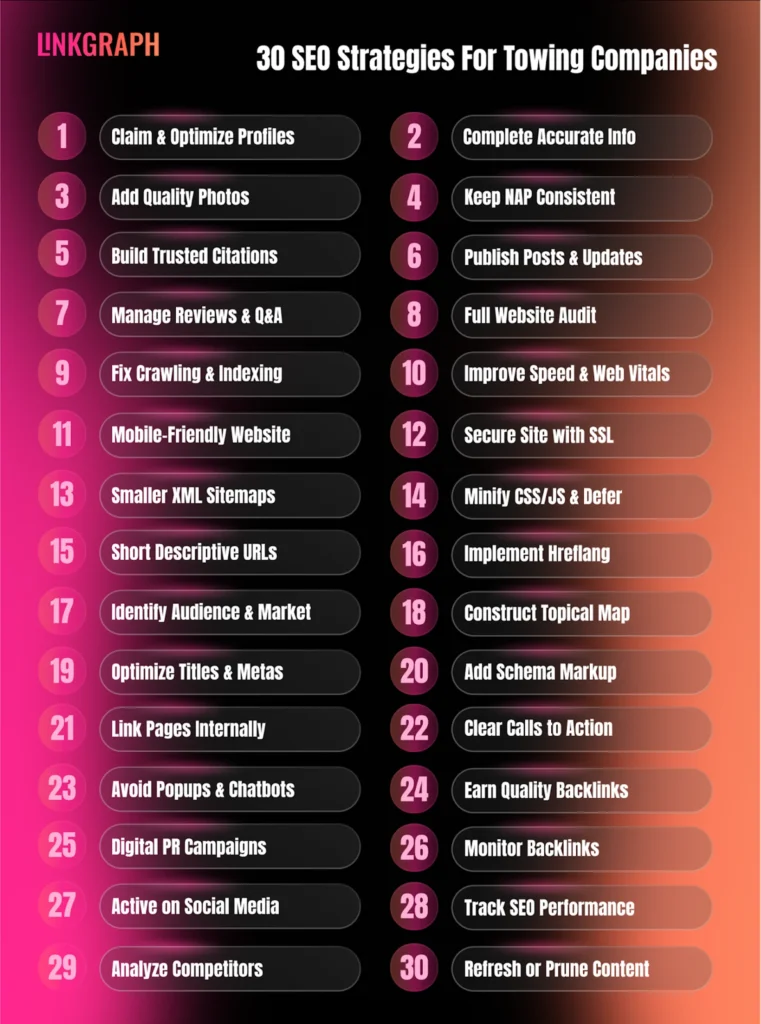
There are 30 SEO strategies for towing companies. The 30 SEO strategies for towing companies are listed below.
- Claim and Optimize Google, Bing, and Apple Business Profiles
- Complete Profiles with Accurate Info, Categories, and Hours
- Add High-Quality Photos of Tow Trucks, Staff, and Services
- Ensure NAP Information Consistency Across All Listings
- Build Citations on Trusted Local and Industry-Specific Directories
- Publish Regular Google Posts, Offers, Updates, and Events
- Earn, Manage, and Respond to Reviews and Q&A
- Conduct Complete Website Audit to Identify Errors
- Fix All Crawling and Indexing Issues
- Optimize Site Speed and Core Web Vitals
- Build Mobile-Friendly, Fully Responsive Website for All Devices
- Secure Site by Installing SSL Certificate
- Create Smaller XML Sitemaps
- Minify CSS/JS and Defer Non-Essential Scripts
- Use Short, Descriptive URLs
- Implement Hreflang for Multi-Region/Language
- Identify Target Audience, Market, and Their Needs
- Construct Proper Topical Map Based on Source Context
- Optimize Titles, Meta Descriptions, Headers, URLs, and Alt Text
- Implement Schema Markup on All Pages
- Link Pages Internally with Logical Hierarchy (Root → Seed → Node)
- Place Clear Calls to Action
- Avoid Intrusive Popups and Unnecessary Chatbots
- Earn Quality Backlinks from Automotive and Relevant Sources
- Run Digital PR Campaign
- Monitor Backlinks Quality
- Stay Active on Social Media
- Track SEO Performance with Google Analytics, Search Console, and GBP Insights
- Analyze Top-Ranking Competitors and SERPs for New Opportunities
- Run Audits to Refresh, Merge, or Prune Content
These strategies equip towing companies with a comprehensive roadmap to increase local visibility, generate high-intent leads, and maintain a sustained online presence. We have broken down the 30 SEO strategies for towing companies below.
1. Claim, and Optimize Google, Bing, and Apple Business Profiles
Claiming and optimizing business profiles on Google, Bing, and Apple forms the foundation of local SEO for towing services. These profiles allow towing companies to appear in local searches, map results, and queries like “tow truck near me” or “emergency towing in [city].” Optimized profiles increase visibility, attract high-intent drivers, and enhance credibility in the local area.
Start by claiming each platform profile and completing the verification process. Verification confirms the towing service as legitimate and trusted by search engines. Once verified, provide accurate Name, Address, Phone (NAP), and service categories. Include operating hours, holiday schedules, and detailed descriptions of towing services, vehicle recovery, and roadside assistance to increase search relevance.
Add high-quality photos of tow trucks, staff, and typical services. Upload short videos showing emergency responses or introducing the team. Encourage customers to leave reviews and respond professionally to each review. Maintain regular updates with offers, seasonal promotions, and service alerts. Continuous monitoring ensures profiles remain accurate and rank consistently in local Map Pack results.
2. Complete Profiles with Accurate Info, Categories, and Hours
Completing profiles with accurate information strengthens local SEO for towing services. Accurate Name, Address, and Phone (NAP) details make it easier for search engines to match a towing service with local queries. Consistency across Google, Bing, and Apple profiles ensures customers find the correct contact information immediately.
Service categories clarify the type of towing offered, including emergency towing, vehicle recovery, and roadside assistance. Clearly listing these categories enables search engines to display the business for relevant searches. Operating hours guide customers on availability, especially during peak emergency periods.
Adding comprehensive service descriptions, updates, and special offerings improves relevance and authority. Profiles with complete information attract clicks from drivers searching for urgent towing services. Regularly reviewing and updating profile details maintains accuracy and ensures towing services remain visible and competitive in local search results.
3. Add High-Quality Photos Of Tow Trucks, Staff, And Services
High-quality photos improve local SEO for towing services by increasing engagement and building trust with potential customers. Images of tow trucks, equipment, and staff demonstrate professionalism and readiness for emergencies.
Including visuals of services, such as roadside assistance or vehicle recovery, provides clarity on offerings. Search engines recognize well-optimized images, which allows towing services to appear in Google Maps and local image searches.
Regularly updating photos with seasonal promotions, new vehicles, or team activities maintains freshness and relevance. Optimized filenames, alt text, and descriptive captions enhance search visibility and improve user experience. Comprehensive photo galleries make profiles attractive, increasing the likelihood that stranded drivers will contact the towing company promptly.
4. Ensure Your NAP Information Consistent Across All Listings
Consistent Name, Address, and Phone (NAP) information is essential for local SEO for towing services. Accurate NAP details across Google, Bing, Apple, and other directories signal reliability to search engines.
Towing companies that maintain uniform NAP reduce confusion for customers seeking emergency assistance. Mismatched or outdated information leads to lost calls, missed opportunities, and lower search rankings.
Regularly audit all online listings to verify that NAP data matches website and business profile information. Consistency strengthens credibility, improves local search performance, and ensures stranded drivers quickly locate and contact the towing service.
5. Build Citations on Trusted Local and Industry-Specific Directories
Citations on local and industry-specific directories increase online visibility for towing services. Listings on reputable platforms signal legitimacy to search engines and boost local search rankings.
Towing companies need to submit accurate business details, including NAP, service categories, and operating hours, to directories relevant to automotive and roadside assistance. Well-chosen directories enable search engines to associate the business with its geographic service area.
Regularly monitoring citation accuracy prevents outdated or conflicting information. Strong citation profiles attract high-intent leads, improve discoverability in local searches, and reinforce trust with customers looking for urgent towing or roadside support.
6. Publish Regular Google Posts, Offers, Updates, and Events
Publishing Google posts regularly keeps towing services visible in search results and Google Business Profile feeds. Posts about promotions, seasonal offers, or service updates inform potential customers and encourage engagement.
Towing companies must create concise, clear posts that highlight services, emergency availability, and contact information. Event announcements, such as fleet upgrades or community initiatives, showcase professionalism and reliability.
Consistent posting signals activity to search engines, enhancing local search rankings. Customers benefit from up-to-date information, which increases trust, leads to calls, and strengthens the presence of the towing company in local search results.
7. Earn, Manage, And Respond To Reviews And Q&A
Customer reviews and questions directly influence online reputation and local search rankings of towing services. Positive reviews attract clients, while addressing negative feedback demonstrates professionalism and reliability.
Towing companies should encourage satisfied customers to leave reviews on Google, Bing, and Apple Business Profiles. Promptly responding to all reviews and questions shows attentiveness and builds trust with prospective clients.
Managing Q&A sections provides clear answers to common service inquiries, reducing confusion and increasing conversion rates. Regular monitoring of reviews and Q&A maintains credibility, improves engagement, and strengthens visibility in local search results.
8. Conduct Complete Website Audit To Identify Errors
A website audit reveals technical and structural issues that prevent towing services from ranking effectively in search results. Errors like broken links, duplicate content, missing metadata, or slow-loading pages directly impact visibility and user experience.
Towing companies should use audit tools to scan the entire site for crawlability, indexing, and performance issues. Identifying problems early allows businesses to fix barriers that block search engines from understanding and ranking their content.
Regular audits ensure towing service websites remain optimized, functional, and ready to convert visitors into paying customers.
9. Fix All Crawling and Indexing Issues
Technical SEO for towing services requires addressing crawling and indexing issues to ensure search engines fully access website content. Reduce server response time to under 100ms to allow search engines to crawl pages efficiently. Maintain HTML crawl requests above 95 percent, a refresh rate around 20 percent, and a discovery rate of 7–8 percent to maximize indexing coverage.
Perform a detailed log file analysis to identify where the crawl budget is being lost. Examine pages that receive low crawl frequency and adjust internal linking, sitemap structure, or server settings to improve accessibility. Crawling and indexing errors prevent important service pages from appearing in search results, reducing visibility for emergency towing and roadside assistance queries.
Correcting these technical issues increases search engine trust and ensures that all relevant towing service pages are discoverable. Regular monitoring of crawl activity allows for to detection of new errors early and keeps the website fully optimized for technical SEO, improving local visibility and lead generation.
10. Optimize Site Speed and Core Web Vitals
Towing service websites must load quickly to retain visitors and improve search engine rankings. Optimize site speed using caching, content delivery networks (CDNs), and lazy loading for images and scripts. Reducing large file sizes and compressing resources improves loading times for both desktop and mobile users.
Core Web Vitals, including Largest Contentful Paint, First Input Delay, and Cumulative Layout Shift, directly impact user experience. Monitor these metrics and adjust website elements to reduce delays, ensure smooth interactions, and maintain visual stability. Fast-loading pages encourage users to call or request roadside assistance without frustration.
Regular testing with tools like Google PageSpeed Insights identifies bottlenecks in site performance. Improving site speed and Core Web Vitals enhances technical SEO, increases local visibility for towing searches, and drives high-quality leads to the business.
11. Build Mobile-Friendly, Fully Responsive Website For All Devices
Towing service websites must display correctly on smartphones, tablets, and desktops to reach customers in need. A mobile-friendly site adjusts layout, navigation, and buttons to fit screen sizes, ensuring easy access to contact information and services.
Responsive design improves user experience, allowing customers to request towing services quickly without zooming or scrolling excessively. Mobile responsiveness influences search engine rankings, as search engines prioritize sites that provide smooth experiences across all devices.
Regular testing on multiple devices identifies display issues and usability problems. Optimizing images, fonts, and interactive elements for mobile ensures fast loading and seamless interactions. Fully responsive websites increase engagement, attract local customers, and strengthen online presence for towing service providers.
12. Secure Site By Installing SSL Certificate
Towing service websites must use SSL certificates to encrypt data exchanged between users and the website. An SSL certificate ensures that sensitive information, like contact details or service requests, remains secure from interception.
Secure websites display HTTPS in the URL and a padlock icon in browsers, signaling trustworthiness to customers. Search engines prioritize secure sites, improving rankings for towing services in competitive local search results.
Installing and maintaining SSL certificates prevents security warnings, reduces bounce rates, and enhances credibility. Regular checks ensure certificates remain valid, keeping the website safe and instilling confidence in users seeking emergency towing or roadside assistance.
13. Create Smaller XML Sitemaps
Towing service websites benefit from smaller XML sitemaps by making it easier for search engines to crawl and index pages efficiently. A well-structured sitemap lists all important pages, guiding search engines through the website hierarchy.
Smaller sitemaps reduce crawl errors and ensure that new or updated service pages, such as “emergency towing” or “vehicle recovery,” get discovered quickly. They assist search engines in prioritizing high-value content for faster indexing.
Regularly updating sitemaps and keeping them concise improves crawl budget allocation, increases visibility in search results, and enhances overall technical SEO performance for towing services.
14. Minify CSS/JS and Defer Non-Essential Scripts
Towing service websites achieve faster loading times by minifying CSS and JavaScript files. Removing unnecessary characters, spaces, and comments in code reduces file sizes, allowing pages to load quickly for users and search engines.
Deferring non-essential scripts prevents them from blocking the rendering of important content. Scripts related to widgets, tracking, or analytics load after the main page, improving page speed and user experience.
Optimized code enhances Core Web Vitals, lowers bounce rates, and boosts search engine rankings. Consistently maintaining minified and efficiently loaded scripts ensures that towing websites remain fast and fully accessible across all devices.
15. Use Short, Descriptive, URLs
Towing service websites benefit from short, descriptive URLs that clearly convey the page content. URLs that include service type, location, or relevant keywords improve user understanding and search engine indexing.
Descriptive URLs make links easier to share, remember, and click, increasing both traffic and engagement. Clear URLs provide immediate context for search engines, helping them rank pages accurately for relevant queries.
Maintaining concise URL structures avoids confusion, prevents errors, and ensures a consistent site hierarchy. Towing companies that implement clean, descriptive URLs create a professional online presence and improve discoverability across search results.
16. Implement Hreflang For Multi-Region/Language
Towing service websites operating in multiple regions or languages benefit from implementing hreflang tags. Hreflang tags signal to search engines which language or regional version of a page to display for a user, preventing duplicate content issues.
Proper hreflang implementation improves user experience by directing visitors to the most relevant version of the website, enhancing engagement and reducing bounce rates. Search engines index pages accurately, ensuring towing services appear in the correct geographic search results.
Regularly auditing hreflang tags ensures all regional and language-specific pages remain properly connected. Towing companies that use hreflang effectively maintain consistent visibility across multiple markets, improving overall SEO performance and local relevance.
17. Identify Your Target Audience, Market, and Their Needs
Towing service providers must clearly define their target audience, market, and service demands to optimize SEO effectively. Understanding which customers require emergency towing, roadside assistance, or specialized vehicle recovery allows companies to tailor content, service pages, and promotions for maximum relevance.
Linking this insight to a topical map ensures website content aligns hierarchically, connecting main towing services to supporting topics and detailed subpages. Topical maps guide search engines through the site structure, signaling relevance for specific search queries and improving indexing.
Analyzing audience behavior and common service searches informs keyword selection and content strategy. Towing companies that align their target audience with a structured topical map achieve better visibility, attract qualified leads, and maintain consistent SEO performance across multiple service areas.
18. Construct Proper Topical Map Based on Your Source Context
Towing service providers need a structured topical map to organize website content for both users and search engines. A proper topical map connects main services like emergency towing, roadside assistance, and vehicle recovery to supporting subtopics and detailed service pages.
Analyzing the source context, including competitor content and common customer queries, helps identify relevant topics and keyword clusters. Linking related pages logically within the map improves site navigation and signals authority to search engines.
A well-constructed topical map ensures each page focuses on a specific topic while connecting to broader service categories. Towing companies that implement a detailed topical map enhance SEO performance, improve indexing, and provide clear pathways for potential customers to find the exact service they need.
19. Optimize Titles, Meta Descriptions, Headers, And Alt Text
Towing service websites benefit from on-page SEO by optimizing titles, meta descriptions, headers, and image alt text. Titles and meta descriptions should include service-specific and location-based keywords to improve search visibility and click-through rates.
Headers organize content, making it easier for both users and search engines to understand service offerings. Properly structured headings highlight main topics like emergency towing, vehicle recovery, and roadside assistance, improving readability and relevance.
Alt text on images provides context for search engines, describing tow trucks, staff, and service scenarios. Optimizing alt text enhances accessibility and ensures images contribute to SEO performance. Towing companies that systematically refine these on-page elements improve rankings, attract local customers, and communicate services clearly to potential clients.
20. Implement Schema Markup on all Pages
Schema markup enhances on-page SEO for towing services by providing structured data that search engines easily interpret. Applying schema to service pages, reviews, FAQs, and location information improves visibility in rich search results.
Towing companies should mark up key entities, including tow trucks, service categories, business hours, and contact details. Proper implementation ensures search engines understand the relationships between services, locations, and customer feedback, boosting relevance in local searches.
Rich snippets generated from schema markup increase click-through rates by displaying additional information directly in search results. Towing operators who integrate structured data across all pages improve indexing accuracy, enhance search appearance, and attract high-intent customers actively seeking towing and roadside assistance services.
21. Link Pages Internally with Logical Hierarchy (Root → Seed → Node)
Internal linking improves on-page SEO for towing services by guiding search engines through a structured site hierarchy. Linking from root pages to seed and node pages establishes clear relationships between main services, sub-services, and detailed content.
Towing companies should create descriptive anchor text for all internal links. Root pages introduce broad service categories, seed pages cover specific offerings like emergency towing or vehicle recovery, and node pages detail individual services or locations.
Logical internal linking enhances crawl efficiency, allows search engines to understand content relevance, and distributes link authority across pages. Towing websites with well-organized internal links improve indexing, increase user navigation ease, and drive higher engagement from visitors seeking specific towing services.
22. Place Clear Calls to Action
Clear calls to action improve conversion rates for towing services by guiding visitors to take specific steps, such as calling for immediate assistance or booking roadside help. Calls to action make it easy for customers to engage with the business quickly, which is essential in emergencies.
Towing companies should place prominent buttons or links on service pages, contact pages, and headers. Use actionable language like “Call Now for Immediate Towing,” “Request a Tow,” or “Get Roadside Assistance Today” to create urgency and clarity.
Well-placed calls to action enhance user experience, increase lead generation, and signal to search engines that pages are optimized for user intent. Towing websites that combine clear CTAs with relevant service information achieve higher engagement and inbound service requests.
23. Avoid Intrusive Popups And Unnecessary Chatbots
Intrusive pop-ups disrupt the user experience on towing service websites and increase bounce rates. Eliminating aggressive pop-ups ensures visitors access information quickly, such as service availability, contact numbers, and location details.
Unnecessary chatbots that interfere with navigation reduce engagement and frustrate customers seeking immediate assistance. Towing websites should prioritize simple, intuitive contact options, like click-to-call buttons or straightforward request forms.
Maintaining a clean interface improves website usability, encourages longer visits, and signals relevance to search engines. Towing companies with minimal interruptions convert visitors into leads and enhance overall online credibility.
24. Earn Quality Backlinks From Automotive And Relevant Sources
High-quality backlinks increase authority and trustworthiness for towing service websites. Links from automotive blogs, local business directories, and industry-related sites signal credibility to search engines.
Backlinks from reputable sources drive referral traffic, connecting potential customers actively seeking towing and roadside assistance services. Each backlink acts as a vote of confidence, boosting search rankings and local visibility.
Towing companies should focus on acquiring links from relevant and authoritative platforms. Maintaining a natural link profile with diverse, industry-specific sources enhances online presence and strengthens long-term SEO performance.
25. Run Digital PR Campaign
Digital PR campaigns increase online visibility and brand recognition for towing services. Publishing press releases, news features, and articles on reputable automotive and local platforms drives traffic and builds authority.
Campaigns targeting local media, industry websites, and community blogs generate high-quality backlinks that improve search engine rankings. Each mention reinforces credibility and signals trustworthiness to search engines and potential customers.
Towing companies benefit from sustained exposure through consistent digital PR efforts. Engaging content, local stories, and timely updates enhance reputation, attract leads, and establish the business as a reliable choice for roadside assistance and towing services.
26. Monitor Backlinks Quality
Monitoring backlinks maintains the authority and credibility of towing service websites. Regularly reviewing links identifies low-quality, spammy, or broken backlinks that harm search engine rankings.
High-quality backlinks from automotive, local, and industry-relevant sources improve trust signals and boost search visibility. Towing companies gain insights into link sources and ensure all backlinks contribute positively to SEO performance.
Tracking backlink quality enables the timely removal or disavowal of harmful links. Consistent monitoring preserves a strong link profile, maintains competitive advantage, and supports continuous growth in local and organic search visibility for towing services.
27. Stay Active On Social Media
Maintaining an active social media presence increases visibility for towing service providers. Posting regular updates, promotions, and service highlights engages local audiences and strengthens brand recognition.
Social platforms such as Facebook, Instagram, and LinkedIn provide channels to share customer testimonials, showcase tow truck fleets, and announce emergency service availability. Consistent activity signals credibility and reliability to both customers and search engines.
Interaction with followers through comments, messages, and community posts builds trust and encourages referrals. Active social media participation enhances online authority, drives traffic to the website, and supports overall SEO efforts for towing companies.
28. Track SEO Performance With Google Analytics, Search Console, And GBP Insights
Tracking SEO performance measures the effectiveness of strategies for towing companies. Google Analytics provides data on website traffic, user behavior, and conversion trends, revealing which pages attract the most leads.
Search Console monitors indexing, search visibility, and keyword performance, helping identify areas for optimization. Google Business Profile (GBP) Insights shows how customers find towing services, including direction requests, calls, and profile views.
Regular analysis of these tools enables data-driven decisions, uncovers opportunities for improvement, and ensures that SEO efforts align with business goals. Monitoring performance allows towing operators to adjust campaigns, refine keywords, and maintain consistent growth in local search visibility.
29. Analyze Top-Ranking Competitors And SERPs For New Opportunities
Analyzing competitors identifies strategies that drive high visibility for towing services. Reviewing top-ranking towing companies reveals the keywords, content, and backlinks contributing to their search performance.
SERP analysis provides insights into featured snippets, local pack results, and rich results, highlighting opportunities to capture additional traffic. Observing competitor offerings and messaging refines service descriptions and content strategy.
Consistent competitor and SERP analysis allows towing operators to uncover gaps in their SEO approach, optimize pages for high-intent searches, and maintain an edge in local search results. Strategic adjustments based on competitor data improve lead generation, visibility, and overall online performance.
30. Run Audits to Refresh, Merge, Or Prune Content
Regular content audits evaluate all pages, posts, and service descriptions on the website of a towing company. Audits identify outdated information, duplicate content, or underperforming pages that reduce SEO effectiveness.
Refreshing content involves updating service details, adding new keywords, or improving readability. Merging similar pages consolidates authority and prevents keyword cannibalization, while pruning removes irrelevant or low-quality content that harms rankings.
Audits maintain a clean, well-structured website that aligns with search engine expectations. Consistent content evaluation improves user experience, enhances search visibility, and ensures that towing services remain competitive in local and national search results.
Can a Single SEO Strategy Work for All Types of Towing Service Providers?
A unified SEO strategy serves as a foundation for various towing service providers, but customization is essential to address specific business models and target audiences. For instance, a company specializing in emergency roadside assistance prioritizes local SEO tactics, such as optimizing for location-based keywords and maintaining an active Google Business Profile, to attract immediate customer inquiries.
Conversely, a towing service focusing on fleet management or long-distance towing might benefit from a broader SEO approach, incorporating industry-specific content and targeting a wider geographic area. Tailoring SEO efforts ensures that each towing provider effectively reaches its intended audience and meets its unique business objectives.
When Is the Right Time for Towing Companies to Invest in SEO?
Towing companies should consider investing in SEO when they seek to enhance their online visibility and attract a consistent stream of local customers. A significant portion of consumers turns to search engines to find towing services, making a strong online presence essential. Implementing SEO strategies increases website traffic, drives higher conversion rates, and improves brand recognition. SEO provides a cost-effective alternative to traditional advertising, delivering long-term benefits and a competitive edge over other towing services.
Is Optimizing a GMB Profile Enough for Tow Truck Operators to Get Consistent Leads?
Optimizing a Google Business Profile (GBP) improves visibility in local searches and map results, helping tow truck operators attract nearby customers. A fully optimized profile with accurate NAP, categories, photos, and reviews increases the likelihood of calls and inquiries.
However, relying solely on a GBP limits reach to local searches and ignores website optimization, on-page SEO, and backlink strategies. Integrating GBP optimization with comprehensive SEO efforts ensures a steady flow of leads across search engines, enhances credibility, and maintains long-term online presence.
How Long Does It Take for SEO to Show Results for Towing Companies?
SEO results for towing companies typically appear within three to six months of consistent implementation. Local SEO tactics, such as GBP optimization, citation building, and on-page improvements, often show faster visibility gains in local searches.
Competitive keywords or broader strategies, including backlink building and content creation, take six to twelve months for substantial ranking improvements. Continuous monitoring, audits, and updates accelerate performance, ensuring the towing company maintains high search visibility and captures qualified leads consistently.
Which Online Directories Are Most Useful for Towing Services to Be Listed In?
The most valuable online directories for towing services help tow truck operators reach customers actively searching for roadside assistance and towing services. Listing on trusted platforms increases visibility, credibility, and the likelihood of receiving high-intent leads. Some online directories for towing services to list in are listed below.
- Towing.com: A comprehensive directory dedicated to towing companies across the United States.
- TRAA Online Directory: Maintained by the Towing and Recovery Association of America, listing here increases industry credibility.
- Truckers Directory – Towing/Wrecker Service: Connects towing services with truck drivers and commercial clients.
- TDLR Tow Truck Inquiry: Texas-specific directory maintained by the Department of Licensing and Regulation for certified operators.
- NTA (Natal Towing Association): Regional directory enhancing credibility among local towing associations.
- TowingLocator.com: Online platform for customers seeking towing services in specific areas.
- Yelp: Popular review site helping towing services gain customer trust and exposure.
- Citysearch: Local business directory improving local search visibility.
- Superpages: Online business directory that lists towing companies for local searches.
- Better Business Bureau (BBB): Establishes credibility and trust with potential clients.
Listing across these platforms ensures towing services are visible to a wide range of potential customers and strengthens the local authority.
Can Towing Operators Effectively Manage SEO on Their Own?
Towing operators manage certain aspects of SEO independently, such as maintaining Google Business Profiles, updating basic website content, and monitoring online reviews. These efforts improve local visibility and ensure accurate business information. However, comprehensive SEO involves technical audits, keyword research, content strategy, backlink building, and ongoing performance tracking.
Towing operators without SEO expertise struggle to implement these strategies effectively. Hiring a professional SEO agency helps optimize all areas efficiently, maximize search visibility, and generate consistent leads while reducing the risk of errors that harm rankings or online presence.
What Should Towing Companies Look for Before Hiring an SEO Agency?
Choosing the right SEO agency is essential for towing companies aiming to boost online visibility and attract local customers. The factors to consider before hiring an SEO agency are listed below.
- Proven Experience in Local SEO: The agency should have a strong record of optimizing Google Business Profiles, managing local citations, and improving local search rankings for service-area businesses.
- Specialization in Your Industry: Agencies familiar with the towing industry understand its unique challenges and design strategies specifically for towing services.
- Transparent Reporting and Metrics: The agency should provide clear metrics such as search engine rankings, organic traffic, conversion rates, and return on investment.
- Ethical Link-Building Practices: Avoid agencies using black-hat SEO. Choose agencies that focus on acquiring high-quality, relevant backlinks.
- Adaptability to Algorithm Changes: The agency must stay updated with search engine algorithm updates and adjust strategies accordingly.
- Clear Communication and Collaboration: Look for agencies that discuss objectives openly and work collaboratively, avoiding one-size-fits-all solutions.
- Comprehensive SEO Services: Agencies should provide a full range of services, including on-page SEO, content creation, technical optimization, and reputation management.
- Positive Client Testimonials and Case Studies: Request references or examples from past clients to evaluate the reliability and effectiveness of the agency.
Selecting an SEO agency aligned with the towing company goals ensures sustained online growth and consistent lead generation.
Who Provides the Best SEO Services for Towing Companies Near Me?
LinkGraph provides specialized SEO services for towing companies and tow truck operators, focusing on local search visibility and high-intent lead generation. Their strategies increase organic traffic, improve search rankings, and ensure businesses appear prominently in “near me” searches, helping towing operators connect with customers in urgent need. LinkGraph’s experience with automotive and service-based industries demonstrates its ability to deliver measurable results and adapt strategies to specific business models.
Case studies highlight LinkGraph’s effectiveness. For example, AutoAuctionMall.com saw a 275% increase in organic traffic, with keywords ranking on the first page of Google increasing from 10.5K to 80K. This shows LinkGraph’s ability to drive relevant traffic and improve online authority.
Clients praise LinkGraph for professionalism, responsiveness, and rapid results. Recognized on the 2023 Inc. 5000 list, LinkGraph’s credibility and proven performance make it a top choice. For towing companies seeking consistent leads and improved local presence, LinkGraph offers tailored, results-driven SEO solutions.
What SEO Services Does LinkGraph Offer for Towing Companies?
LinkGraph offers a complete suite of SEO services for towing companies to improve visibility, attract local customers, and increase conversions. These services cover all aspects of digital marketing from technical optimization to content creation. The SEO services offered by LinkGraph to towing companies are listed below.
- Semantic and Holistic SEO for Towing Companies: Optimizes website structure and content to align with search intent and improve overall online presence.
- Entity SEO for Towing Companies: Builds authority around key business entities to enhance credibility in search results.
- Local SEO for Towing Companies: Targets geo-specific searches, ensuring towing services appear in local map packs and search listings.
- Technical SEO for Towing Companies: Fixes website errors, optimizes site speed, ensures mobile responsiveness, and improves crawlability.
- On-Page SEO for Towing Companies: Optimizes titles, meta descriptions, headers, and content for better user experience and search performance.
- Off-Page SEO for Towing Companies: Builds high-quality backlinks and improves online reputation through digital PR.
- Content Creation for Towing Companies: Develops informative, service-focused content to attract and engage customers.
- LLM and AI Optimization for Towing Companies: Implements AI-driven strategies to enhance content relevance and search visibility.
- Lead Tracking and Reporting for Towing Companies: Monitors performance metrics, leads, and conversions to refine marketing strategies.
- Branding for Towing Companies: Enhances recognition and trust across online channels to strengthen market position.
These services combine to provide towing companies with a comprehensive SEO strategy that drives growth, improves online visibility, and generates consistent leads.
Can All Types of Towing Services Get SEO Support From LinkGraph?
Yes, all types of towing companies and tow truck operators receive full SEO services from LinkGraph. The agency provides customized strategies tailored to each towing business type, ensuring improved visibility, lead generation, and higher local rankings. LinkGraph addresses both general and niche towing services, optimizing websites, local listings, content, and technical SEO to match specific service offerings.
LinkGraph works with a wide range of towing operations including the ones listed below.
- Flatbed Towing
- Heavy-Duty Towing
- Light-Duty Towing
- Motorcycle Towing
- Wheel-Lift Towing
- Off-Road Recovery
Each type receives strategies aligned with its target audience, market needs, and local search trends, ensuring consistent lead generation and brand authority.
How Much Does LinkGraph Charge Towing Companies for SEO Services?
LinkGraph offers flexible pricing for towing companies based on business size, service area, and campaign goals. Packages scale from affordable local SEO plans for small operators to advanced enterprise strategies for multi-location towing providers. Each plan is structured to maximize return on investment, combining keyword optimization, technical fixes, and backlink acquisition. Exact costs vary, but the focus remains on delivering measurable results, including calls, higher rankings, and consistent local visibility.
Does LinkGraph Specialize Only in SEO for Towing Services?
No, LinkGraph does not specialize only in SEO for towing services. While LinkGraph provides tailored SEO solutions for tow truck operators, the agency serves diverse industries, including law firms, healthcare, e-commerce, real estate, and education. The expertise gained across multiple sectors strengthens the strategies used for towing companies, ensuring best practices, proven frameworks, and innovative techniques are applied to every campaign. This broad specialization gives towing businesses the advantage of strategies tested in competitive markets beyond automotive services.
Which Other Businesses Can Get SEO Services From LinkGraph?
LinkGraph serves a variety of industries beyond towing, bringing SEO solutions to businesses that need online visibility, lead generation, and authority. Here are some of the most notable sectors that benefit from LinkGraph’s expertise. Some other businesses that get SEO services from LinkGraph are listed below.
- E-commerce Brands: Product-focused sites using LinkGraph to boost traffic, optimize listings, and increase sales.
- Healthcare Providers: Clinics, specialists, and wellness services that improve trust signals, secure patient flows, and rank better for medical keywords.
- Real Estate Companies: Agents and agencies that target local listings, map presence, and territory-based keywords.
- Law Firms: Practices using SEO to capture high-intent legal service searches, improve content authority, and drive leads.
- Educational Platforms: Course providers, tutors, and training schools that use structured content, schema, and authority building.
- Fashion & Lifestyle Brands: Shops and lifestyle businesses that gain visibility through content, link development, and media.
- Restaurant & Food Service: Local dining, delivery, and food-product companies that optimize local SEO and reviews.
- Tech & SaaS Companies: Software and technology firms improving keyword targeting, site structure, and product visibility.
These industries illustrate LinkGraph’s ability to adapt SEO strategies across diverse business models. Businesses in any sector with an online presence need to benefit from services designed for performance, visibility, and growth.
What Are the Other Ways to Market Towing Services Besides SEO?
Towing companies gain customers through multiple marketing channels in addition to SEO. These methods strengthen visibility, capture leads, and build trust with drivers in need. Some other ways to market towing services besides SEO are listed below.
- Google Ads and PPC Campaigns: Target high-intent keywords to appear instantly for urgent towing searches.
- Social Media Marketing: Share updates, customer reviews, and service highlights on platforms like Facebook and Instagram.
- Local Radio and Print Advertising: Promote services in community newspapers and radio stations to reach nearby drivers.
- Partnerships with Auto Shops and Dealerships: Build referral networks with mechanics, body shops, and insurance agents.
- Branded Tow Trucks and Signage: Use clear branding on vehicles and roadside billboards for constant local exposure.
- Customer Referral Programs: Offer incentives for word-of-mouth recommendations from past clients.
- Directory Listings and Lead Platforms: Use paid leads from platforms like Yelp Ads or Towing.com premium profiles.
These marketing methods, combined with strong SEO, create a balanced strategy for attracting drivers, improving brand recognition, and growing towing service revenue.
Is SEO More Cost-Effective Than Paid Advertising for Towing Companies?
SEO and paid advertising both offer unique advantages for towing companies, and cost-effectiveness depends on business goals, timelines, and budgets. SEO requires upfront investment in optimization, content, and link building, but delivers long-term results that consistently generate leads without recurring ad spend. Paid advertising, on the other hand, provides immediate visibility for urgent keywords like “tow truck near me” but stops driving traffic once the budget runs out.
For many towing operators, a combined approach works best: PPC campaigns capture instant leads during competitive or peak times, while SEO builds sustainable growth and lowers cost per lead over time. Evaluating performance metrics such as conversion rates, cost per acquisition, and return on investment helps determine the right balance for each towing business.
Can Video Marketing Help Towing Operators Attract More Customers?
Video marketing allows towing operators to showcase services, demonstrate equipment, and explain roadside assistance processes. High-quality videos posted on websites, YouTube, and social media increase engagement, improve trust, and make services memorable. Visual content improves search engine rankings through longer user sessions and higher click-through rates. Demonstration videos showing towing procedures, customer testimonials, or safety tips attract customers actively searching for reliable towing services.
How Can Towing Services Combine SEO with Paid Ads for Better Results?
Towing companies achieve maximum visibility by combining SEO with paid ads. SEO builds long-term organic presence for local keywords and service pages. Paid ads capture immediate leads for urgent queries like “emergency towing near me.” Using insights from paid campaigns, operators identify high-performing keywords and optimize organic content. Coordinating both strategies increases brand visibility across search results, maps, and directories while maintaining steady lead flow.
Can Independent Tow Truck Operators Compete with Large Towing Companies Using SEO?
Independent operators rank locally by focusing on geographic targeting, service-specific keywords, and quality online profiles. Optimizing Google Business Profiles, collecting reviews, and publishing local content help smaller towing services outrank larger competitors in nearby searches. Consistent local SEO and niche content highlight expertise, enabling independents to capture high-intent leads efficiently.
How Can Towing Companies Measure the ROI of Their SEO Efforts?
Tracking metrics such as organic traffic, phone calls, form submissions, and map pack visibility quantifies SEO results. Tools like Google Analytics, Search Console, and Google Business Profile Insights show traffic sources, user behavior, and conversion rates. Comparing organic leads and associated revenue with SEO costs allows towing companies to calculate return on investment accurately and adjust strategies for better outcomes.
