
SEO for travel agencies and SEO for travel agents connect travel businesses with users actively planning trips, improving search visibility, and driving qualified traffic. Optimized websites increase direct bookings and reduce reliance on third-party platforms. SEO for travel websites turns search presence into measurable growth while aligning content, technical performance, and user experience.
Focused travel SEO strategies attract high-intent visitors, increase conversion rates, and establish brand trust. Long-term traffic growth remains sustainable, outperforming paid campaigns over time. Speed, mobile accessibility, and structured content further enhance user engagement.
Properly executed SEO for travel agencies combines technical, on-page, and off-page optimization. Tracking performance, refining strategies, and targeting high-value traveler queries ensures maximum visibility and competitive advantage in the crowded travel market.

What Does SEO for Travel Agencies Mean?
SEO for travel agencies is the practice of optimizing the website and online presence of a travel agency to appear higher in search results when travelers research trips. SEO for travel agencies helps attract more qualified leads and drive consistent bookings by improving visibility.
Effective SEO for travel agencies includes keyword research to target relevant travel queries, on-page optimization to enhance web pages, content creation to engage travelers, local SEO to boost visibility in nearby searches, and link building to build authority. These strategies help a travel agency stand out in a competitive travel market.
Why Is SEO Important for Travel Agency Websites?
SEO increases the visibility of travel agency websites on search engines. SEO for a travel agency attracts travelers who are actively planning trips. This targeted traffic drives more inquiries, bookings, and long-term growth for the travel agency.
High rankings position the travel agency as a trusted source for travel information and services. SEO reduces dependency on third-party platforms, which lowers commission costs and increases direct bookings. It delivers steady traffic without the ongoing expense of paid ads.
SEO improves the performance of the travel agency website. It strengthens site speed, mobile usability, and navigation. A faster and easier site experience encourages visitors to book their trips through the travel agency.
What Are the Main Benefits of Doing SEO for Travel Agents?
The main benefits of SEO for travel agencies and agents go far beyond ranking higher on Google. SEO draws the right customers, builds trust with travelers, and supports steady business growth in a competitive travel market. The main benefits of doing SEO for travel agents are listed below.
- Higher Search Rankings and Visibility: SEO places travel agency websites at the top of search results. Strong visibility attracts travelers who are searching for tours, vacation packages, and travel services.
- More Targeted Website Traffic: SEO brings visitors who search for specific travel experiences. These users show a high interest in booking services from the travel agency.
- Increased Bookings and Revenue: Relevant traffic from SEO brings more travelers to the site. This leads to more bookings and steady revenue growth for the travel agency.
- Strong Competitive Advantage: SEO helps travel agencies outrank competitors in search results. High visibility increases the chance of attracting travelers over rival agencies.
- Cost-Effective Marketing: SEO reduces the need for continuous paid advertising. It delivers lasting visibility and traffic without constant spending on campaigns.
- Improved Trust and Authority: High rankings show travelers that the travel agency is reliable. Visibility on search results builds trust and loyalty among potential customers.
- Long-Term Sustainable Growth: SEO produces results that compound over time. Continuous organic traffic supports stable growth for the travel agency.
- Reduced Dependence on Third-Party Platforms: SEO attracts direct visitors to the travel agency website. This lowers commission fees paid to external booking platforms.
SEO gives travel agencies a stable source of traffic, stronger credibility, and a cost-efficient path to lasting growth.
What Are the Best Ways to Get Started with SEO for Travel Agencies?
The best way for travel agents and agencies to get started with SEO is to build a strong foundation. Focusing on core technical, on-page, local, and off-page elements sets the groundwork for lasting visibility and bookings.
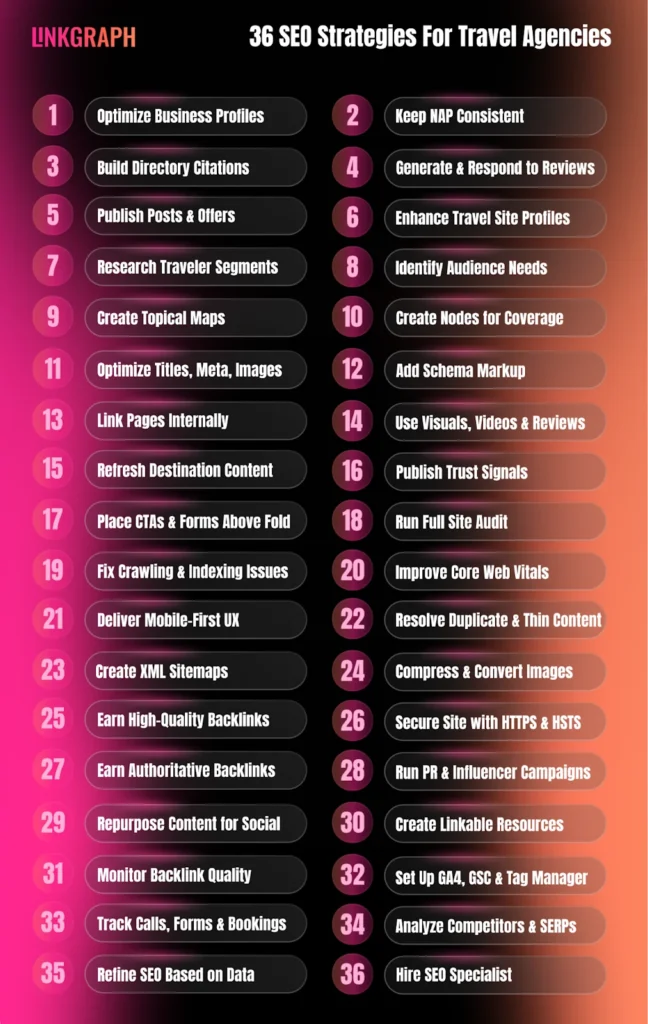
There are 36 SEO strategies for travel agencies. The 36 SEO strategies for travel agencies are listed below.
- Claim, Verify, and Optimize Google, Bing, and Apple Business Profiles
- Keep NAP Information Consistent Across All Citations
- Build Citations on Trusted Local and Industry Directories
- Run Review Generation and Response Program
- Publish Regular Posts, Offers, Updates, and Events
- Enhance Profiles on TripAdvisor, Viator, GetYourGuide, and Yelp
- Research Traveler Segments and Define Your Positioning Versus OTAs
- Identify Your Target Audience, Market, and Their Key Needs
- Construct Proper Topical Map Based on Source Context
- Create Quality Nodes, Seed Nodes, and Root Nodes for Topical Coverage
- Optimize Titles, Meta Tags, and Image Alt Text
- Implement Travel-Specific Schema Markup Across Key Pages
- Link Pages Internally with a Logical Hierarchy (Root → Seed → Node)
- Use Authentic Visuals, Short Videos, and On-Page Reviews
- Refresh Destination Content Seasonally While Keeping Stable URLs
- Publish Trust Signals Including Bios, Credentials, Safety, Awards, and Policies
- Place Clear CTAs and Simple Booking/Contact Forms Above the Fold
- Run Complete Site Audit to Identify Technical Errors
- Fix All Crawling and Indexing Issues
- Improve Core Web Vitals and Overall Page Performance
- Deliver a Mobile-First and Accessible User Experience
- Resolve Duplicate and Thin Content With Consolidation and Canonicalization
- Create Smaller, Topic-Focused XML Sitemaps
- Compress and Convert Images to WebP or AVIF
- Defer Non-Critical JavaScript and Reduce Main-Thread Blocking Time
- Secure Site With HTTPS and HSTS
- Earn Authoritative Backlinks From Tourism Partners, DMOs, and Reputable Media
- Run Digital PR Campaigns and Influencer Collaborations With Seasonal Hooks
- Repurpose Content for Social Platforms and Link to Priority Pages
- Create Linkable Resources and Reclaim Unlinked Mentions
- Monitor Backlink Quality and Manage Risk Without Overusing Disavows
- Set Up GA4, Search Console, and Tag Manager With Correct Property Settings
- Track Calls, Forms, and Bookings as Conversions and Build Dashboards
- Analyze Top-Ranking Competitors and SERPs for New Opportunities
- Refine SEO Strategies Based on Performance Data and Results
- Hire an SEO Specialist When Needed
We have broken down the 36 SEO strategies for travel agents below.
1. Claim, Verify, and Optimize Google, Bing, and Apple Business Profiles
Claiming and verifying business profiles on Google, Bing, and Apple ensures search engines recognize the travel agency as a legitimate entity. Verified profiles make it possible to appear in local Map Pack results and attract high-intent travelers.
Optimization begins with completing all business information, including name, address, phone number, and website URL. Selecting precise categories, such as “Travel Agency” or “Tour Operator,” improves relevance for specific travel queries. High-quality photos of destinations, tours, and office spaces enhance visual appeal and engagement. Adding detailed descriptions with targeted keywords, like “luxury safari tours in Africa,” signals authority to search engines. Maintaining consistent opening hours and up-to-date contact information builds trust with both users and platforms.
Optimized profiles boost visibility in local search results, increase direct bookings, and strengthen credibility. Travelers searching for tours or vacation packages are more likely to engage with a well-optimized, trustworthy profile.
2. Keep NAP Information Consistent Across All Citations
Maintaining consistent Name, Address, and Phone number (NAP) across all listings strengthens the local SEO presence of a travel agency. Search engines use NAP consistency to verify legitimacy and improve trustworthiness in local search results.
Start by auditing all current citations, including Google Business Profile, Bing Places, Apple Maps, and travel directories. Ensure the business name, street address, city, postal code, and phone number of the travel agency are identical across every platform. Minor differences, such as abbreviations or alternate phone formats, confuse search engines and reduce visibility.
Consistent NAP improves ranking in local Map Pack results, drives targeted traffic from nearby travelers, and enhances credibility. It ensures potential clients reach the correct agency, leading to more bookings and positive user experiences.
3. Build Citations on Trusted Local and Industry Directories
Citations on reputable local and industry-specific directories increase the online authority and improve local search rankings of a travel agency. Travel agencies appear more credible when their business information is listed consistently across high-quality platforms.
Focus on submitting accurate Name, Address, and Phone (NAP) details to trusted local directories, tourism boards, and industry-specific platforms like TripAdvisor, Viator, and Yelp. Prioritize directories with strong domain authority and relevant audience traffic. Ensure each listing includes service descriptions, images, and links back to the website of the agency.
Building citations strengthens local SEO signals, increases visibility in Map Pack results, and attracts potential travelers actively searching for tours, packages, and travel services in the target areas of the agency.
4. Run Review Generation and Response Program
Collecting and managing reviews boosts credibility and improves the local search rankings of a travel agency. Positive reviews influence traveler decisions and signal trustworthiness to search engines.
Encourage satisfied clients to leave reviews on Google Business Profile, TripAdvisor, Yelp, and other relevant platforms. Respond promptly to all reviews, addressing concerns professionally and thanking clients for positive feedback. Highlight reviews on key website pages and social media channels to enhance visibility.
A structured review program increases user engagement, drives higher click-through rates from search results, and helps travel agencies stand out in competitive markets, ultimately converting more inquiries into bookings.
5. Publish Regular Posts, Offers, Updates, and Events
Regular content publishing keeps a travel agency website fresh and relevant, attracting both search engines and travelers. Updates on blog posts, seasonal offers, events, and promotions demonstrate active engagement with clients.
Creating content around trending destinations, special packages, or upcoming events helps target keywords that travelers are searching for, increasing organic traffic. Sharing timely offers encourages immediate bookings while informative updates build authority and trust.
Consistent publishing improves search rankings, strengthens online visibility, and keeps potential clients informed. Agencies that maintain an active content schedule increase repeat visits, enhance user experience, and drive more conversions over time.
6. Enhance Profiles on TripAdvisor, Viator, GetYourGuide, and Yelp
Optimizing travel agency profiles on platforms like Tripadvisor, Viator, GetYourGuide, and Yelp increases visibility to high-intent travelers actively searching for tours and experiences. Complete and updated profiles improve credibility and trust, encouraging bookings directly from these platforms.
Include accurate business information, engaging descriptions, high-quality images, and clear service offerings. Highlight awards, certifications, or unique experiences to differentiate from competitors. Travelers rely on detailed profiles to make informed decisions, making optimization essential for conversion.
Encouraging reviews, responding promptly to feedback, and maintaining active engagement on these platforms strengthen reputation. Enhanced profiles increase organic reach, improve rankings on the platforms, and drive qualified traffic to the agency website.
7. Research Traveler Segments and Define Your Positioning Versus OTAs
Travel agencies must identify specific traveler segments, such as adventure seekers, luxury travelers, or family vacationers. Segmenting helps tailor content, offers, and marketing messages that resonate with each audience.
Analyze competitors, especially online travel agencies (OTAs), to understand strengths, weaknesses, pricing, and service offerings. Define a unique positioning that highlights exclusive experiences, personalized services, or niche destinations. Clear differentiation emphasizes the value that OTAs do not provide.
Segment-focused strategies improve targeting, attract high-intent travelers, and increase bookings. Positioning against OTAs builds credibility, strengthens brand identity, and ensures travel agency services remain distinct in a crowded online travel market.
8. Identify Your Target Audience, Market, and Their Key Needs
Identifying the target audience, market, and key needs forms the foundation of travel agency SEO. Travel agencies attract specific traveler segments, such as adventure seekers, luxury travelers, or family vacation planners. Pinpointing these segments allows the creation of content that directly addresses their interests, preferences, and booking behaviors.
Mapping the search intent of an audience to relevant topics helps build a topical map. A well-structured topical map organizes content around primary themes, subtopics, and related queries, ensuring all pages align with traveler needs. Travel agencies that define audience intent clearly gain higher engagement, increased bookings, and better positioning in search results.
Travel agency SEO thrives when audience insights directly shape content creation, site architecture, and keyword targeting. Linking audience needs to a topical map ensures every page provides value, relevance, and clarity, guiding travelers efficiently from discovery to booking.
9. Construct Proper Topical Map Based on Your Source Context
Constructing a proper topical map ensures that travel agency content addresses all relevant queries within the market. Travel agency SEO relies on structured topic clusters, where primary topics represent core services like tours, destinations, or travel packages. Subtopics and supporting nodes cover related traveler questions, seasonal offers, or destination tips.
A well-organized topical map aligns content with traveler intent, making it easier for search engines to crawl and understand the website. Travel agencies using a source-context approach prioritize topics based on search demand, competitor coverage, and user interest, ensuring content relevance and depth.
Topical maps guide content creation, internal linking, and on-page optimization. Travel agencies benefit from improved search visibility, stronger authority, and higher engagement when pages follow a clear, context-driven topical structure.
10. Create Quality Nodes, Seed Nodes, and Root Nodes for Topical Coverage
Travel agency websites improve search performance by structuring content into root, seed, and node pages. Root nodes cover main services or destinations, seed nodes expand core topics, and node pages address related traveler queries.
This content organization enhances crawlability, helping search engines understand relationships between pages and ensuring comprehensive coverage of travel topics. Clear topical structure improves user navigation and engagement.
Properly linked nodes guide visitors through relevant information, increasing time on site and conversion opportunities. Structured topical coverage signals expertise and authority, which strengthens search rankings for travel-related queries.
11. Optimize Titles, Meta Tags, and Image Alt Text
Optimizing titles ensures each page clearly communicates its content and purpose, making it easier for travelers to find relevant information. Titles aligned with targeted keywords increase the likelihood of higher search rankings.
Meta tags provide concise, informative summaries that attract clicks from search results. Well-crafted meta descriptions support the visibility of each page and improve engagement with potential clients exploring travel options.
Image alt text gives context to visual content, making pages accessible and informative. Proper alt text improves search engine indexing of images while enhancing the user experience for travelers browsing the site.
12. Implement Travel-Specific Schema Markup Across Key Pages
Travel-specific schema markup structures content to help search engines understand destinations, tours, and packages. Adding schema across pages improves how travel information appears in search results and enhances visibility.
Optimizing schema contributes to on-page SEO by supporting rich results, including pricing, reviews, and availability, which attracts more clicks from potential travelers. Proper implementation makes pages easier for search engines to index and interpret.
Applying structured data consistently across key pages strengthens the authority of the website in travel-related searches. It ensures better rankings, improves discoverability, and provides a more informative experience for users exploring travel services.
13. Link Pages Internally with a Logical Hierarchy (Root → Seed → Node)
Creating a clear internal linking structure connects pages from root topics to seed and node pages. This hierarchy guides both search engines and visitors through relevant travel content efficiently.
Proper internal linking improves crawlability, distributes page authority, and enhances the SEO value of each page without overloading any single page. It helps travelers discover related tours, destinations, or packages easily.
Implementing a structured linking system supports on-page SEO by reinforcing topical relevance across the website. It increases engagement, reduces bounce rates, and strengthens overall search visibility for travel services.
14. Use Authentic Visuals, Short Videos, and On-page Reviews
Adding authentic visuals, short videos, and on-page reviews enhances the appeal of travel pages. Travelers engage more with real photos, video highlights of destinations, and genuine client experiences.
Visual content increases time on page, improves user interaction, and helps potential clients better understand travel packages. On-page reviews build credibility, showing proof of quality services and satisfied customers.
These elements support on-page SEO by making content more engaging and relevant. Search engines interpret interactive visuals and reviews as valuable signals, improving rankings and driving qualified traffic to travel offerings.
15. Refresh Destination Content Seasonally While Keeping Stable URLs
Updating destination content seasonally keeps travel pages relevant for users and search engines. Highlighting seasonal attractions, events, and travel tips ensures visitors find timely information.
Stable URLs maintain link equity and prevent broken links, allowing search engines to retain ranking authority for each destination page.
Regular content updates signal freshness, improving rankings and user trust. Search engines prioritize pages with current, accurate information, driving more targeted traffic and increasing the likelihood of bookings for travel agencies.
16. Publish Trust Signals Including Bios, Credentials, Safety, Awards, and Clear Policies
Displaying team bios and credentials establishes authority for travel agency websites. Visitors recognize expertise and gain confidence in the services offered.
Highlighting safety measures, awards, and certifications demonstrates reliability. Travel agencies that showcase these trust signals reassure clients about their professionalism and quality.
Clear policies on cancellations, refunds, and bookings improve transparency. Search engines interpret trust signals as quality indicators, enhancing rankings while increasing user confidence and encouraging bookings.
17. Place Clear CTAs and Simple Booking/Contact Forms Above the Fold
Placing clear calls-to-action (CTAs) above the fold immediately guides visitors toward booking or contacting the travel agency. Prominent placement captures attention before users scroll.
Simple, intuitive forms reduce friction and make it easier for potential travelers to complete inquiries or reservations. Travel agencies with well-placed CTAs convert more visitors into leads.
Combining clear CTAs with user-friendly forms improves the overall on-page experience. This strategy strengthens engagement, encourages action, and directly contributes to higher booking rates.
18. Run Complete Site Audit To Identify Technical Errors
Running a complete site audit identifies technical issues that affect the performance and search rankings of a travel agency website. This strategy ensures pages are properly indexed, accessible to users, and optimized for speed and usability.
The audit highlights errors such as broken links, duplicate content, missing meta tags, and misconfigured redirects. Detecting these issues allows agencies to fix them proactively, preventing potential traffic loss and improving overall website health.
Regular site audits provide a clear roadmap for ongoing technical improvements. Travel agencies benefit from optimized site structure, enhanced user experience, and better search engine visibility through consistent audits.
19. Fix All Crawling and Indexing Issues
Fixing crawling and indexing issues ensures search engines access and understand travel website content efficiently. Travel agency websites benefit from resolving 4xx and 5xx errors, correcting broken redirects, and removing unnecessary noindex tags.
Reducing server response time to under 100ms improves crawl efficiency and page speed. HTML crawl requests should exceed 95%, refresh rate should remain around 20%, and discovery rate should target 7–8%. Conducting log file analysis identifies where crawl budget is being lost, highlighting pages that need attention.
Other key steps include correcting canonical errors, standardizing URL structures, fixing sitemap issues, and ensuring consistent internal linking. Travel agencies achieve better indexation, higher rankings, and improved organic traffic by systematically addressing these technical SEO issues.
20. Improve Core Web Vitals and Overall Page Performance
Improving Core Web Vitals enhances user experience by focusing on page speed, interactivity, and visual stability. Travel agency websites benefit from faster loading times, smoother interactions, and reduced layout shifts, increasing visitor satisfaction.
Optimizing elements like image sizes, server response times, and script execution directly impacts metrics such as Largest Contentful Paint (LCP), First Input Delay (FID), and Cumulative Layout Shift (CLS). Strong Core Web Vitals performance improves search rankings and keeps potential clients engaged.
Monitoring and enhancing overall page performance ensures travelers navigate, book, and explore destinations efficiently. Travel agencies achieve higher engagement, lower bounce rates, and better visibility in search results by maintaining optimal site performance.
21. Deliver a Mobile-First and Accessible User Experience
Travel agency websites must prioritize mobile-first design to reach users on smartphones and tablets. Mobile optimization ensures pages load quickly, navigation is simple, and content displays clearly on smaller screens.
Accessibility improvements make the website usable for all travelers, including those with disabilities. Features like readable fonts, proper contrast, and keyboard navigation enhance user experience and broaden the audience.
Focusing on mobile-first and accessible design increases engagement, reduces bounce rates, and supports higher search engine rankings. Travel agencies benefit from more bookings and satisfied users by creating a universally navigable website.
22. Resolve Duplicate and Thin Content With Consolidation and Canonicalization
Duplicate and thin content confuses search engines and dilutes ranking potential for travel agency websites. Consolidating similar pages into a single, comprehensive resource improves relevance and authority.
Canonicalization signals to search engines which version of a page to index, preventing duplicate content penalties and ensuring link equity is preserved. Proper use of canonical tags strengthens overall SEO performance.
Resolving duplicate and thin content enhances user experience by providing visitors with complete, valuable information. Travel agencies benefit from higher visibility, more qualified traffic, and better engagement across all pages.
23. Create Smaller, Topic-Focused XML Sitemaps
Smaller, topic-focused XML sitemaps improve search engine crawling efficiency for travel agency websites. Each sitemap highlights a specific set of pages, making indexing faster and more accurate.
Organizing sitemaps by topic allows search engines to understand site structure clearly and prioritize high-value pages. This approach ensures important travel content, such as destination guides or packages, receives proper visibility.
Segmented sitemaps enhance overall technical SEO by reducing crawl errors and enabling easier updates. Travel agencies benefit from better indexing, improved rankings, and faster discovery of new or updated content.
24. Compress And Convert Images To WebP Or AVIF
Compressing and converting images to modern formats like WebP or AVIF improves website load speed for travel agency sites. Faster loading pages enhance user experience and support higher search engine rankings.
Using WebP or AVIF reduces file sizes without losing visual quality, making destination photos, itineraries, and promotional visuals more efficient to display. Optimized images decrease server bandwidth usage, contributing to overall site performance.
Technical SEO benefits include better Core Web Vitals scores and reduced page weight. Travel agencies achieve quicker page rendering, lower bounce rates, and improved engagement from visitors exploring travel content.
25. Defer Non-Critical JavaScript and Reduce Main-Thread Blocking Time
Deferring non-critical JavaScript improves page load speed by prioritizing essential content for travel agency websites. Faster pages enhance user experience and support higher search engine rankings.
Reducing main-thread blocking time ensures interactive elements like booking forms, maps, and navigation menus load smoothly. Optimized scripts allow visitors to engage with content immediately without delays.
Technical SEO gains include improved Core Web Vitals, lower bounce rates, and higher retention. Travel agencies benefit from faster-loading pages, smoother interactions, and better overall site performance for travelers exploring destinations and services.
26. Secure Site With HTTPS and HSTS
Securing travel agency websites with HTTPS ensures encrypted connections between servers and visitors, protecting sensitive booking and personal information. Secure sites build trust with travelers and increase confidence in completing transactions.
Implementing HSTS instructs browsers to enforce HTTPS, preventing users from accessing insecure HTTP versions. This reduces the risk of data breaches and man-in-the-middle attacks.
From a technical SEO perspective, secure websites often receive higher search engine rankings. Travel agencies gain improved credibility, better search visibility, and safer browsing experiences for users exploring trips and services.
27. Earn Authoritative Backlinks From Tourism Partners, DMOs, and Reputable Media
Acquiring backlinks from tourism partners, destination marketing organizations (DMOs), and reputable media establishes credibility for travel agencies. High-quality backlinks improve search engine authority, driving higher rankings for competitive travel-related keywords.
Targeted link building builds relationships with industry authorities, increasing referral traffic and generating direct bookings. Each backlink signals trustworthiness to search engines, enhancing domain authority and organic visibility.
Travel agencies benefit from a sustained presence in search results when focusing on authoritative partnerships. LinkGraph leverages its expertise to identify optimal backlink opportunities and execute strategies that deliver measurable SEO results.
28. Run Digital PR Campaigns and Influencer Collaborations With Seasonal Hooks
Digital PR campaigns and influencer collaborations highlight travel services, generating high-value mentions and backlinks. Agencies gain visibility during seasonal travel peaks, attracting engaged audiences actively planning trips.
Influencer partnerships amplify content reach, improving social signals that indirectly benefit SEO. Press coverage from reputable outlets strengthens domain authority and credibility.
LinkGraph integrates PR and influencer outreach into off-page SEO strategies, ensuring campaigns support long-term search performance. Seasonal hooks create timely relevance that resonates with potential travelers.
29. Repurpose Content for Social Platforms and Link to Priority Pages
Repurposing travel content for social platforms drives traffic to high-value pages while earning backlinks naturally. Sharing guides, itineraries, and updates encourages engagement and click-throughs to priority landing pages.
Social amplification increases content visibility, attracting media, partners, and other websites that link to travel agency pages. Strategic internal links strengthen on-site SEO authority.
LinkGraph implements repurposing strategies that balance content exposure with link acquisition goals, ensuring social efforts contribute to long-term search engine performance.
30. Create Linkable Resources and Reclaim Unlinked Mentions
Developing linkable assets such as travel guides, infographics, or original research encourages organic backlink acquisition. Reclaiming unlinked mentions converts existing references into valuable backlinks.
Linkable resources position travel agencies as authoritative sources while enhancing visibility in search results. Each reclaimed mention strengthens overall domain authority.
LinkGraph executes systematic outreach to ensure high-value resources attract relevant links, maximizing off-page SEO impact and referral traffic.
31. Monitor Backlink Quality and Manage Risk Without Overusing Disavows
Regularly monitoring backlinks protects travel websites from toxic or low-quality links that could negatively impact search rankings. Travel agencies maintain a healthy link profile by identifying harmful or spammy references and taking corrective action to preserve their SEO value.
Avoiding overuse of disavows ensures that legitimate link equity remains intact, preventing unnecessary loss of authority while maintaining overall domain trust. High-quality backlinks contribute directly to improved rankings, enhanced credibility, and long-term stability in search performance.
LinkGraph combines advanced link monitoring, risk assessment, and strategic outreach to ensure backlinks consistently support sustainable SEO performance for travel agencies. Continuous evaluation and optimization of link profiles help agencies maintain a competitive advantage and long-term organic growth.
32. Set Up GA4, Search Console, and Tag Manager With Correct Property Settings
Proper setup of GA4, Search Console, and Tag Manager ensures accurate data collection for travel agency websites. GA4 tracks user behavior, conversions, and engagement across all site pages, providing actionable insights for SEO decisions.
Search Console monitors indexing, identifies crawl errors, and highlights opportunities to improve visibility on search engines. It helps travel agencies detect issues early, ensuring pages are discoverable by potential travelers.
Tag Manager allows implementation of tracking codes without modifying the core code of an website. Correct property settings across these tools create reliable analytics, helping agencies measure performance, optimize campaigns, and make data-driven decisions to increase bookings and revenue.
33. Track Calls, Forms, and Bookings as Conversions and Build Dashboards
Tracking calls, inquiry forms, and bookings as conversions helps travel agencies measure how effectively their website turns visitors into customers. These are the actions that directly drive revenue, so capturing them is essential for evaluating SEO impact.
Building dashboards in GA4 or similar analytics tools consolidates this data in one place, showing which pages, campaigns, or keywords lead to the most conversions. This makes it easier to connect SEO efforts with business results rather than just traffic numbers.
With clear dashboards and conversion tracking in place, agencies spot patterns, double down on what works, and refine underperforming areas. This data-driven approach ensures SEO decisions support real growth and higher returns.
34. Analyze Top-Ranking Competitors And SERPs For New Opportunities
Studying top-ranking competitors reveals the strategies driving their visibility and helps travel agencies identify gaps in their own approach. Reviewing their content structure, keyword targeting, backlink sources, and user experience highlights what search engines currently reward.
Examining live SERPs for priority keywords shows which content formats, page types, and features (like FAQs or featured snippets) dominate the results. This helps agencies align their pages with what already earns top placements.
Combining competitor insights with SERP analysis uncovers untapped keywords, content gaps, and link-building prospects. These insights create a roadmap to outperform rivals and claim valuable positions in search results.
35. Refine SEO Strategies Based On Performance Data And Results
Evaluating performance metrics helps travel agencies understand which SEO efforts are delivering results and which need adjustment. Tracking trends in traffic, rankings, conversions, and engagement highlights what resonates with users and search engines.
Regularly reviewing this data allows teams to adjust content, technical elements, and link-building tactics to maintain momentum. Spotting declines early prevents loss of visibility and ensures ongoing improvement in rankings.
Refining strategies based on real results keeps SEO plans aligned with evolving search algorithms and user behavior. This data-driven approach sustains long-term growth and maximizes return on investment.
36. Hire an SEO Specialist When Needed
Bringing in an experienced SEO specialist accelerates growth for travel agencies that lack in-house expertise or the time to manage complex campaigns. Professionals offer the skills to handle technical, on-page, and off-page tasks effectively.
Specialists identify hidden issues, implement advanced strategies, and use data-driven insights to maximize performance. Their experience shortens the learning curve, avoiding costly mistakes that could delay results.
Outsourcing to a trusted SEO agency like LinkGraph ensures consistent execution, ongoing optimization, and measurable growth, allowing travel agencies to focus on delivering exceptional travel experiences to their clients.
What Are the Common SEO Mistakes Travel Agents Should Avoid?
The common SEO mistakes travel agents should avoid often stem from overlooking the basics that make a travel website visible and user-friendly. Addressing these pitfalls helps protect rankings and ensures consistent growth. Some common SEO mistakes that travel agents should avoid are listed below.
- Ignoring Local SEO Optimization: Failing to optimize Google, Bing, and Apple Business Profiles reduces visibility in local search results and the Map Pack.
- Inconsistent NAP Information: Mismatched business names, addresses, and phone numbers confuse search engines and harm local ranking potential.
- Neglecting Mobile-Friendliness: Poor mobile design causes high bounce rates, damaging user experience and search performance.
- Slow Page Speed and Core Web Vitals Issues: Long load times frustrate visitors and lower rankings, especially on mobile devices.
- Overlooking Technical Errors: Unfixed crawling or indexing issues prevent pages from appearing in search results, limiting organic reach.
- Thin or Duplicate Content: Low-quality or repeated content weakens topical authority and triggers ranking penalties.
- Lack of Internal Linking Strategy: Missing or poorly structured internal links make it harder for search engines to understand and index content.
- Ignoring Backlink Quality: Acquiring low-quality or spammy backlinks risks penalties and damages the credibility of a site.
- No Performance Tracking Setup: Running SEO campaigns without GA4, Search Console, or conversion tracking makes it impossible to measure progress.
- Inconsistent Content Updates: Letting destination guides and travel offers go outdated signals neglect, lowering both user trust and search rankings.
Avoiding these mistakes helps travel agents build strong, sustainable SEO strategies that consistently drive visibility, traffic, and bookings.
Can One SEO Approach Work for All Types of Travel Agencies?
One SEO approach works partly because core SEO fundamentals like keyword research, on-page optimization, and technical fixes apply broadly. Different travel agency types, such as local, destination, niche, or luxury, require adjustments in content angle, keyword complexity, and competition. For example, a boutique local agency ranks more quickly with “near me” keywords, while a global destination agency faces much higher competition and needs more resources. Shared technical setup helps everyone, while customizing messaging, service pages, and content strategy gives each agency its edge.
When Should Travel Agencies Get Started with SEO?
Travel agencies should start SEO at least 6 months before peak season to build keyword authority and optimize content in time. Agencies without a strong ranking yet must begin immediately to achieve any consistent organic traffic. Early work on technical setup, destination content, and local listings gives margin for testing, correcting, and scaling before demand rises.
Is GMB Profile Optimization Enough for Travel Agencies to Get Consistent Clients?
Google Business Profile (GBP) optimization helps with local visibility but does not guarantee consistent bookings or broader organic traffic. GBP works well for “travel agency near me” searches but misses out on content-driven keywords, specialized services, or trust signals. Travel agencies benefit much more when GBP is one piece of a full SEO strategy, including content, link building, and website performance.
How Long Does SEO Take to Show Results for Travel Businesses?
Typical SEO results for travel websites appear in 3 to 6 months for on-page improvements and low-competition keywords. More noticeable growth usually emerges around 6 to 9 months, especially after adding content and earning backlinks. Highly competitive niches or national and global travel brands need 9 to 12 months or longer for substantial ranking and traffic gains.
Which Online Directories Are Most Valuable for Travel Agencies to Be Listed In?
Getting listed in the right online directories increases the visibility, credibility, and referral traffic from users who are actively searching for travel services. These platforms often rank well on search engines, making directory profiles an extra way to capture leads. Some valuable online directories for travel agencies are listed below.
- TripAdvisor: One of the most visited travel platforms where agencies showcase services, gather reviews, and reach global travelers.
- Expedia Network: Includes Expedia, Hotels.com, and Orbitz, giving agencies access to a large international audience seeking packaged tours and bookings.
- Viator: Focuses on tours and activities, helping agencies gain bookings from travelers looking for unique local experiences.
- Lonely Planet: Adds credibility through a trusted travel brand and drives traffic from travelers seeking destination information.
- Booking.com: Attracts travelers actively booking accommodations, allowing agencies to present vacation packages alongside lodging options.
- Google Business Profile: Drives local traffic and appears on Google Maps, capturing “near me” searches and boosting local SEO visibility.
- Yelp: Helps agencies earn trust from user reviews and appear in local travel and service searches.
- Yellow Pages / YP.com: Strengthens local presence and builds citations that support local SEO rankings.
- ChamberofCommerce.com: Improves local authority and builds credibility as a registered business in the community.
- Yalwa: Offers a free local business directory listing with niche travel categories.
- Manta: Gives small agencies more visibility and backlinks to support organic rankings.
- Jasmine Directory: A curated, high-quality directory that builds credibility and sends authoritative backlinks.
- Business Booky – Travel Services Directory: Specializes in travel-related listings, helping agencies reach a relevant and targeted audience.
- Ezilon: Offers regional listings, useful for agencies targeting international markets.
- ExpressBusinessDirectory: Provides quick local listings with basic details and backlinks to boost search visibility.
Being listed on these directories boosts domain authority, improves local SEO signals, and helps travel agencies capture leads who are already in a booking mindset.
Can Travel Agents Successfully Implement SEO Strategies On Their Own?
Yes, travel agents implement basic SEO strategies on their own, such as optimizing Google Business Profiles, publishing content, and building citations. However, advanced tasks like technical SEO, structured data, internal linking strategies, and backlink acquisition require expertise and ongoing monitoring. Without proper experience, mistakes reduce visibility and waste resources. Hiring an experienced SEO specialist or agency ensures optimized performance, higher rankings, and measurable results while saving time and avoiding costly errors in competitive travel markets.
What Should Be Checked Before Hiring an SEO Agency for a Travel Business?
Choosing the right SEO agency is crucial for the success of your travel business. It’s essential to ensure that the agency has the expertise and experience to meet your specific needs. Factors to check before hiring an SEO agency are listed below.
- Experience in the Travel Industry: Ensure the agency has a proven track record with travel businesses, understanding industry nuances and challenges.
- Transparency in Reporting: The agency should provide clear, regular reports on SEO performance and progress.
- Customized SEO Strategies: Look for agencies that tailor their strategies to your business goals and target audience.
- Proven Success with Case Studies: Request case studies or examples of past successes with similar clients.
- Comprehensive Service Offerings: The agency should offer a full range of SEO services, including on-page, off-page, and technical SEO.
- Clear Communication Channels: Effective communication is key; ensure the agency is responsive and accessible.
- Ethical SEO Practices: Avoid agencies that use black-hat SEO techniques, as these harm the reputation of your site.
- Understanding of Local SEO: Given the importance of local searches in the travel industry, the agency should have expertise in local SEO strategies.
Thoroughly vetting potential SEO agencies ensures you partner with one that aligns with your business objectives and drives measurable results.
Who Offers the Best SEO Services for Travel Agents Near Me?
LinkGraph provides the best SEO services for travel agencies, delivering measurable results through tailored strategies. LinkGraph specializes in SEO as a service for travel businesses, optimizing websites to rank higher for relevant search queries, attract qualified traffic, and increase bookings. Their approach combines technical SEO, on-page optimization, content strategy, and authoritative link building to strengthen visibility across search engines.
LinkGraph demonstrates expertise in small business SEO, helping travel agencies compete effectively in competitive markets. Case studies show significant improvements in organic traffic, search rankings, and online bookings. The agency offers international SEO for agencies targeting global travelers, ensuring multilingual and multi-regional optimization.
Client testimonials and industry recognition confirm the ability of LinkGraph to deliver impactful SEO services for small businesses and SEO for travel websites. Travel agencies working with LinkGraph gain a comprehensive, results-driven approach that consistently improves online presence, authority, and bookings.
Which Types of SEO Services Does LinkGraph Offer for Travel Agencies?
LinkGraph offers a full suite of SEO solutions specifically designed to help travel agencies increase their online visibility, attract qualified leads, and grow their bookings. Each service is tailored to meet the unique challenges of the travel industry and align with modern search engine algorithms. The types of SEO services offered by LinkGraph to travel agencies are listed below.
- Semantic SEO for Travel Agencies: Structures content around topics and entities to build topical authority, helping travel sites rank for a broader range of relevant keywords.
- Holistic SEO for Travel Agencies: Integrates technical, on-page, and off-page strategies into one comprehensive plan that boosts overall search performance.
- Local SEO for Travel Agencies: Optimizes Google Business Profiles, local citations, and geo-targeted keywords to capture nearby travelers searching for services.
- Technical SEO for Travel Agencies: Improves crawlability, indexing, site speed, and Core Web Vitals to enhance user experience and search visibility.
- On-Page SEO for Travel Agencies: Refines metadata, internal linking, content structure, and schema markup to improve page relevance and rankings.
- Off-Page SEO for Travel Agencies: Builds high-quality backlinks and brand mentions to strengthen domain authority and trust signals.
- Content Creation for Travel Agencies: Delivers high-quality blog posts, landing pages, and guides that attract travelers and support SEO growth.
- LLM and AI Overview Optimization for Travel Agencies: Optimizes content to appear in AI-generated search overviews, increasing visibility in emerging SERP features.
- Lead Tracking and Reporting for Travel Agencies: Implements advanced analytics to monitor conversions, bookings, and ROI from SEO efforts.
- Branding for Travel Agencies: Strengthens online reputation and brand presence through consistent messaging and strategic visibility campaigns.
These specialized SEO services from LinkGraph enable travel agencies to compete effectively online, improve their rankings, and turn organic traffic into loyal customers.
Can All Types of Travel Agents and Agencies Get SEO Services from LinkGraph?
Yes, all types of travel agents and agencies absolutely get SEO services from LinkGraph. Our strategies are fully adaptable to different business models within the travel industry, ensuring each agency type receives tailored support to drive bookings, improve visibility, and establish authority in search results. LinkGraph’s expertise allows us to understand the unique goals, audiences, and challenges of every travel business, providing scalable solutions that align with their growth objectives.
Some of the types of travel agencies that LinkGraph serves are listed below.
- Retail Travel Agencies
- Online Travel Agencies (OTAs)
- Corporate and Business Travel Agencies
- Specialist and Niche Travel Agencies
- Tour Operators and Destination Management Companies (DMCs)
With this customized approach, LinkGraph ensures every type of travel agency thrives online and achieves measurable results through SEO.
How Much Does LinkGraph Charge for Travel Agency SEO Services?
LinkGraph offers flexible pricing for travel agency SEO services based on the size of your website, competitive landscape, and campaign goals. There is no one-size-fits-all cost, as each strategy is customized to meet specific business needs. Smaller agencies start with targeted local SEO campaigns, while larger or rapidly scaling travel businesses require comprehensive enterprise-level SEO packages. To get an accurate estimate, travel agencies request a free consultation, during which our team will provide a tailored proposal and transparent pricing plan aligned with their objectives.
Does LinkGraph Only Offer SEO Marketing Services for Travel Agencies?
No, LinkGraph serves a wide range of industries beyond travel. While we have dedicated SEO solutions for travel agencies, our team provides full-service digital marketing and SEO support for eCommerce, healthcare, legal, finance, SaaS, and other sectors. This cross-industry expertise allows us to apply proven strategies and innovative techniques to help travel agencies stay competitive in the broader digital marketplace.
What Other Industries Get SEO Services from LinkGraph?
LinkGraph delivers high-performance SEO solutions to a wide range of industries. Our strategies are designed to match the unique demands of each sector, helping businesses dominate competitive search landscapes and achieve measurable growth.
Some of the industries that get SEO services from LinkGraph are listed below.
- Legal Services: Law firms benefit from our advanced local SEO, content strategy, and backlink building to rank for competitive legal keywords and attract high-intent clients.
- Healthcare and Medical Practices: We help clinics, hospitals, and private practices build trust and visibility through HIPAA-compliant SEO strategies and content that meets medical E-E-A-T standards.
- eCommerce and Retail Brands: Our SEO campaigns drive product visibility, boost conversions, and improve search rankings for online stores in highly competitive markets.
- Finance and Fintech Companies: Financial brands gain credibility and traffic through our expertise in creating compliant, accurate, and highly authoritative SEO content.
- Software and SaaS Companies: We optimize SaaS platforms with technical SEO, high-value content, and link acquisition strategies that accelerate user acquisition and market share growth.
- Real Estate Agencies and Property Platforms: Local SEO, structured data, and location-focused content help real estate businesses dominate regional searches and convert local traffic into qualified leads.
- Education and EdTech Platforms: We help educational institutions and platforms capture student interest and grow enrollments through targeted content marketing and SEO.
- Home Service Providers: Local SEO and reputation management boost visibility for service-based businesses like plumbers, electricians, cleaners, and HVAC companies to drive more local leads.
What Are Other Ways to Market Travel Services Besides SEO?
While SEO helps travel agencies attract organic traffic, combining it with other marketing strategies creates a stronger and more diverse client acquisition pipeline. Other ways to market travel services besides SEO are listed below.
- Social Media Marketing: Promote travel packages and share engaging visuals on platforms like Instagram, Facebook, and TikTok to reach travelers where they spend their time.
- Paid Advertising (PPC): Use Google Ads and social media ads to target travelers actively searching for trips and drive immediate traffic to booking pages.
- Email Marketing: Build an email list and send personalized offers, travel tips, and seasonal deals to nurture leads and encourage repeat bookings.
- Influencer Partnerships: Collaborate with travel influencers and content creators to boost brand visibility and credibility through authentic storytelling.
- Content Marketing: Publish blogs, guides, and videos showcasing destinations and itineraries to position your agency as an expert resource.
- Referral and Loyalty Programs: Reward past clients for referring friends and offer loyalty discounts to build long-term customer relationships.
Diversifying marketing efforts lets travel agencies reach travelers across multiple touchpoints and convert more leads into loyal clients.
Is SEO More Effective Than PPC for Promoting Travel Agencies?
SEO and PPC both play important roles in promoting travel agencies, and neither is universally better than the other. Their effectiveness depends on goals, budget, and timelines. SEO builds long-term visibility by improving organic rankings and consistently attracting qualified traffic without ongoing ad spend. It requires time and effort but delivers sustainable results. PPC generates immediate traffic and bookings through targeted ads, making it ideal for time-sensitive campaigns or seasonal offers.
