
SEO for wedding planners and event planners improves online visibility, drives qualified leads, and builds authority in competitive markets. This seo guide for event marketing explains how technical fixes, local optimization, content, and link strategies work together to boost rankings and inquiries.
The main benefits include organic traffic growth, stronger credibility, and cost-effective client acquisition compared to paid ads. Wedding professionals target terms like “wedding planner near me,” while seo for wedding venues and niche planners expands reach.
On-page optimization, technical SEO, and off-page signals all support sustainable performance. Choosing an SEO agency like LinkGraph ensures expertise in local search, topical mapping, and data-driven results. With the right strategy, seo for wedding professionals turns visibility into consistent bookings.

What Is SEO for Wedding Planners?
SEO for wedding planners is the process of improving a wedding planner website and online content to achieve higher positions in search engine results pages. Wedding planners depend on digital visibility because couples begin their search for services online. A site that ranks prominently reaches engaged couples faster and converts interest into inquiries.
Optimization includes targeting service-specific keywords, publishing content that answers wedding planning queries, and refining technical structure for smooth search engine crawling. Strong rankings bring consistent organic traffic, reduce reliance on paid ads, and generate inquiries without third-party directories. High positions in search engines signal credibility, which strengthens trust in the brand.
Wedding planner SEO combines keyword research, on-page improvements, backlink acquisition, local search optimization, and mobile-focused design. Each element works together to attract couples seeking luxury, destination, or budget-friendly planning. A well-structured strategy delivers targeted leads, long-term brand growth, and consistent bookings.
Is SEO for Wedding Planners Different Than SEO for Event Planners?
Yes, SEO for wedding planners is different from SEO for event planners. Wedding planners work with couples preparing for marriage, so their search optimization emphasizes personal terms such as “wedding planner,” “day-of coordinator,” and “wedding planning services.” Event planners manage a wider variety of gatherings, including corporate conferences, fundraising galas, and milestone celebrations, which demand broader keyword targeting. Both rely on technical SEO, content creation, and local optimization, but the audience intent and language shaping the campaigns are not the same.
What Is the Main Difference Between Wedding Planners and Event Planners?
Wedding planners focus exclusively on coordinating weddings, tailoring every detail to reflect style, culture, and expectations. Their work involves vendor management, guest coordination, ceremony logistics, budgeting, and timelines that align with the unique emotional significance of the event. Every service is deeply personalized, as weddings are once-in-a-lifetime occasions.
Event planners operate with a broader scope, managing corporate events, charity galas, trade shows, birthday parties, and private gatherings. Their responsibilities include venue selection, stage design, audiovisual setup, catering, and program scheduling for audiences that vary in size and purpose. Unlike weddings, these events often prioritize goals such as networking, fundraising, or brand visibility rather than personal milestones.
The main difference lies in specialization and service focus. Wedding planners design intimate experiences for couples, while event planners create structured experiences for organizations or groups with specific objectives. This distinction influences the planning process and how each profession presents services, communicates with clients, and markets expertise online.
Is SEO Really Important for Wedding Planners to Grow?
Yes, SEO plays a very important role in growing a wedding planning business because most engaged couples begin their vendor search online. Wedding planners with optimized websites rank higher on search engines, appear in local searches, and attract clients actively seeking wedding services.
Optimized websites generate leads by targeting keywords like “wedding planner near me” or “destination wedding coordinator,” connecting planners with couples ready to book. High search rankings enhance credibility, positioning the wedding planner as an expert in the industry.
SEO provides cost-effective marketing, driving organic traffic without continuous ad spending. Strong SEO presence ensures consistent visibility, improves client acquisition, and supports long-term growth for wedding planning businesses.
Which Type of Wedding Planners Benefits the Most from SEO?
SEO benefits every type of wedding planner, but some planners gain stronger advantages due to their service focus and client search behavior. The type of wedding planners that benefit the most from SEO have been listed below.
- Full-Service Wedding Planner: Full-service planners handle everything from venue selection to vendor coordination. SEO helps attract couples seeking complete planning support.
- Partial Wedding Planner: Partial planners assist with select tasks. SEO ensures visibility for clients searching for targeted services like décor planning or vendor management.
- Day-of Coordinator: Day-of coordinators focus on execution. SEO helps capture couples who need professional support for smooth wedding-day management.
- Destination Wedding Planner: Destination planners depend on search visibility in multiple locations. SEO helps connect with couples planning weddings abroad or in specific regions.
- Luxury Wedding Planner: Luxury planners serve high-budget clients. SEO with premium keywords attracts couples searching for exclusive, high-end experiences.
- Elopement Planner: Elopement planners handle intimate weddings. SEO increases reach to couples seeking small, unique, and private ceremonies.
- Eco-Friendly Wedding Planner: Eco-friendly planners promote sustainability. SEO positions them in front of couples searching for green or eco-conscious wedding services.
- Cultural/Religious Wedding Planner: Cultural and religious planners specialize in traditions. SEO helps reach couples searching for planners familiar with specific customs.
- Virtual Wedding Planner: Virtual planners coordinate weddings online. SEO boosts visibility among tech-savvy couples seeking digital solutions for planning.
Every wedding planner type grows with SEO, but niche-focused planners benefit most due to precise keyword targeting and specialized service demand.
What Are the Main Benefits of SEO for Wedding Planners?
SEO for wedding planners does more than improve search rankings. It attracts highly qualified clients, builds credibility, enhances local visibility, and drives sustainable business growth. Proper SEO ensures consistent leads, enhances authority in the wedding industry, and positions planners as trusted professionals. The main benefits of SEO for wedding planners are listed below.
- Attracts Targeted Traffic: SEO ensures the website ranks for terms couples search, like “wedding planner near me,” bringing qualified visitors.
- Increases Bookings: Higher visibility leads to more inquiries, directly resulting in increased bookings for wedding services.
- Builds Credibility: Ranking well on search engines signals legitimacy, enhancing trust among engaged couples.
- Establishes Authority: Valuable content, testimonials, and a fast-loading site reassure clients about professionalism and expertise.
- Cost-Effective Marketing: SEO provides an affordable alternative to paid ads, reducing marketing expenses.
- Sustainable Growth: Consistent SEO efforts yield long-term benefits, continuously attracting new clients as website authority grows.
- Improves Local Visibility: Local SEO connects planners with couples in the immediate area and shows up on Google Maps.
- Expands Reach for Niche Services: SEO helps destination or specialized wedding planners attract clients outside their local market.
SEO transforms a wedding planner’s online presence into a powerful client-generating tool, driving traffic, trust, and bookings for long-term growth.
How Can Wedding Planners and Event Planners Get Started with SEO?
Wedding planners and event planners build a strong SEO foundation by optimizing websites, local presence, and online visibility. Starting with accurate profiles, technical improvements, and structured content ensures higher rankings, better local discovery, and more qualified leads. Each step contributes to long-term growth and sustainable business performance.
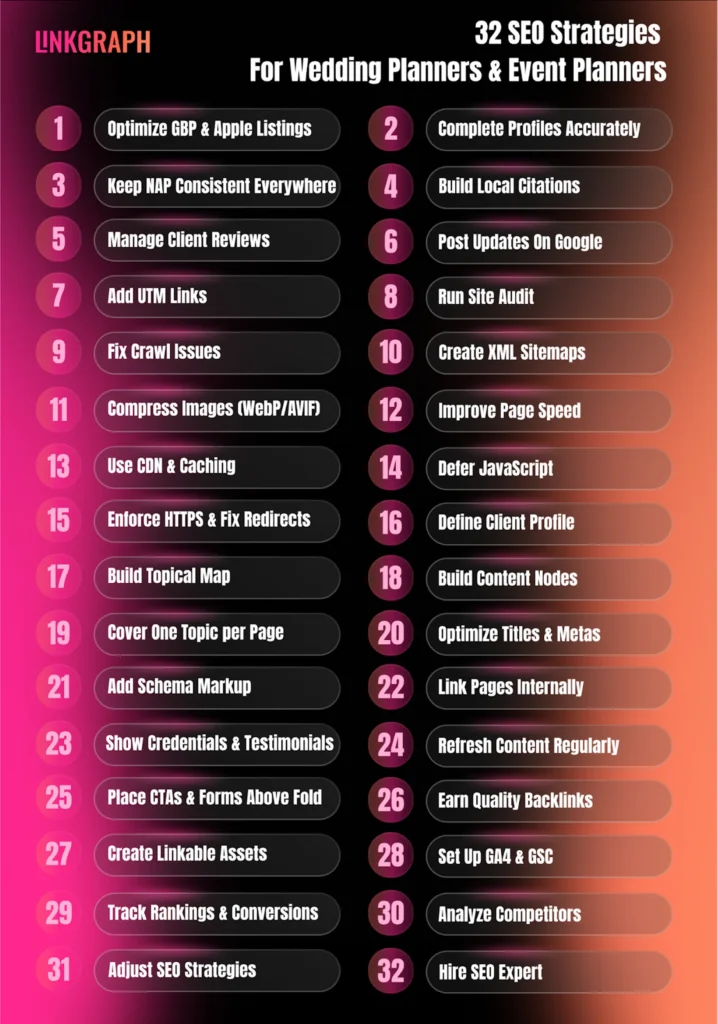
There are 32 SEO strategies for wedding planners and event planners. The 32 SEO strategies for wedding planners and event planners are listed below.
- Claim, Verify, and Optimize Google, Bing, and Apple Business Profiles
- Complete Profiles with Accurate Info, Services, Hours, Photos, and Attributes
- Keep NAP Information Consistent Across All Listings
- Build Citations on Trusted Local and Industry Directories
- Request, Earn, and Professionally Respond to Customer Reviews
- Publish Regular Google Posts for Offers, Updates, and Events
- Add UTM-Tagged Links for Website, Appointments, and Bookings to Each Profile
- Run Complete Site Audit To Identify Technical Errors
- Fix Crawling and Indexing Issues (4xx/5xx Errors, Noindex Tags, Blocked Pages)
- Create Smaller, Topic-Focused XML Sitemaps and Configure robots.txt Correctly
- Compress And Convert Images To WebP Or AVIF
- Improve Page Speed and Core Web Vitals
- Use CDN, Caching, and Compression to Improve Load Speed
- Defer Non-Critical JavaScript and Reduce Main-Thread Blocking Time
- Enforce HTTPS on a Single Canonical Host and Fix Crawl, Redirect, and Duplicate Issues
- Identify Your Target Audience, Market, and Their Key Needs
- Construct Proper Topical Map Based on Your Source Context
- Create Quality Nodes, Seed Nodes, and Root Nodes for Topical Coverage
- On Each Page, Cover One Context, Topic, or Subject
- Write Clear, Context-Rich Page Titles and Meta Descriptions
- Add LocalBusiness Structured Data to Location, Services, and Important Pages
- Link Pages Internally with a Logical Hierarchy (Root → Seed → Node)
- Highlight Your Credentials, Certifications, Testimonials, And Media Mentions
- Refresh Outdated Content and Keep It Up to Date
- Place Clear CTA,s and Simple Booking/Contact Forms Above the Fold
- Earn High-Quality Backlinks From Venues, Vendors, and Wedding Publications
- Create Linkable Resources and Reclaim Unlinked Mentions
- Set Up Google Analytics 4 and Google Search Console
- Monitor Rankings, CTR, Traffic, Conversions, and Retention
- Analyze Top-Ranking Competitors And SERPs For New Opportunities
- Refine SEO Strategies Based On Performance Data And Results
- Hire an SEO Specialist When Needed
Consistently reviewing progress and updating strategies ensures the website stays visible, relevant, and competitive in local and niche searches. We have broken down the 32 SEO strategies for wedding planners and event planners below.
1. Claim, Verify, and Optimize Google, Bing, and Apple Business Profiles
Claiming, verifying, and optimizing Google, Bing, and Apple business profiles strengthens local search visibility for wedding and event planners. Accurate names, addresses, and phone numbers with detailed service descriptions help search engines properly index each profile and improve trust with potential clients.
Adding high-quality images of past weddings, events, and venues demonstrates expertise and attracts user engagement. Highlight services like “destination wedding coordination” or “corporate event management” to align with search intent.
Regular updates signal active business presence and improve Map Pack rankings. Scheduling weekly posts featuring past events, seasonal promotions, or tips naturally maintains activity, enhances engagement, and increases the likelihood of appearing in top local results. Tracking profile completeness and engagement ensures continuous improvement and better visibility.
2. Complete Profiles with Accurate Info, Services, Hours, Photos, and Attributes
Accurate and complete business profiles help wedding and event planners establish credibility and improve search visibility. Including precise service descriptions, operating hours, and relevant attributes allows search engines to match profiles with the right clients effectively.
High-quality photos of past weddings or corporate events showcase expertise and enhance user engagement, making profiles more attractive. Including services like “luxury wedding planning” or “day-of coordination” improves relevance for local searches and increases chances of appearing in the Map Pack.
Maintaining up-to-date information and regularly refreshing photos or service details signals activity to search engines. Sharing recent event highlights naturally boosts engagement and reinforces credibility, leading to higher rankings and more client inquiries.
3. Keep NAP Information Consistent Across All Listings
Consistent NAP (Name, Address, Phone) information across all listings strengthens trust with search engines and clients. Wedding and event planners benefit from uniform details because discrepancies reduce local search visibility and confuse potential clients.
Every directory, social profile, and local listing should display the identical business name, address, and phone number. Small variations, like abbreviations or missing suite numbers, cause search engines to split authority or lower ranking in local results.
Regularly auditing NAP data ensures accuracy and avoids errors. Maintain a master sheet of all listings and update changes immediately to improve local rankings and attract clients searching for planners in specific locations.
4. Build Citations on Trusted Local and Industry Directories
Building citations on trusted local and industry directories strengthens credibility and increases visibility for wedding and event planners. Citations are mentions of the name, address, and phone number (NAP) of a business on reputable websites. Search engines use these references to verify legitimacy and local relevance, improving the chances of ranking higher in local search results.
Planners should list their business on well-known directories that focus on weddings, events, and local services. Accurate and consistent information across all directories is essential. Adding service descriptions, high-quality images, and contact details enhances authority and engagement.
Regularly maintaining these listings ensures up-to-date information, signaling activity and professionalism to both search engines and potential clients. Focusing on a handful of high-authority directories initially delivers the strongest impact on local search visibility.
5. Request, Earn, and Professionally Respond to Customer Reviews
Customer reviews play a major role in influencing potential clients and improving search rankings for wedding and event planners. Positive reviews increase credibility, build trust, and signal quality to search engines. Planners should actively request reviews from satisfied clients and ensure the feedback reflects genuine experiences.
Responding professionally to each review, whether positive or negative, shows engagement and commitment to client satisfaction. Including relevant keywords naturally in responses improves local SEO and highlights services offered.
Monitoring reviews across platforms allows planners to address concerns promptly and maintain a strong online reputation. Regular engagement with reviews encourages more clients to share feedback, driving higher visibility and increased bookings over time.
6. Publish Regular Google Posts for Offers, Updates, and Events
Publishing regular Google Posts strengthens visibility in local search results and keeps wedding and event planners top-of-mind for potential clients. These posts allow planners to showcase special offers, updates, or upcoming events, giving search engines fresh content to index.
Planners should create posts that highlight new services, seasonal promotions, or recent weddings. Including keywords like “wedding planner in [city]” or “event coordination services” helps align content with client searches and boosts ranking potential.
Consistent posting signals activity and engagement, encouraging clients to interact and inquire. Tracking engagement metrics guides planners on which types of posts attract more attention, improving future content strategy and client acquisition.
7. Add UTM-Tagged Links for Website, Appointments, and Bookings to Each Profile
Adding UTM-tagged links to Google, Bing, and Apple profiles allows wedding and event planners to track traffic sources and measure the effectiveness of each profile. These links provide detailed insights into which platform drives appointments, bookings, or website visits, enabling informed marketing decisions.
Planners should append UTM parameters to URLs used in profiles, covering campaigns, sources, and mediums. For example, links like “website.com/booking?utm_source=google&utm_medium=profile&utm_campaign=wedding” allow precise performance tracking.
Monitoring UTM-tagged links helps identify high-performing platforms, optimize low-performing ones, and allocate marketing efforts efficiently. Over time, planners gain a clear understanding of which profiles convert most visitors into clients, improving overall SEO and lead generation.
8. Run Complete Site Audit To Identify Technical Errors
Running a complete site audit identifies technical errors that hinder search engine crawling, indexing, and user experience for wedding and event planners. Audits reveal issues like broken links, slow-loading pages, duplicate content, and missing meta tags that negatively impact rankings.
Planners should use website auditing tools to scan for HTML errors, page speed problems, and mobile responsiveness issues. Regular audits ensure that all website elements function correctly, enhancing visibility in search results.
Fixing identified issues improves organic traffic, boosts user engagement, and strengthens local search performance. Maintaining a technically sound website ensures search engines index the most valuable content efficiently, leading to higher rankings and increased inquiries.
9. Fix Crawling and Indexing Issues (4xx/5xx Errors, Noindex Tags, Blocked Pages)
Fixing crawling and indexing issues ensures search engines access and rank all important pages for wedding and event planners. Errors like 4xx/5xx responses, incorrect Noindex tags, or blocked pages prevent valuable content from appearing in search results.
Reducing server response time under 100ms, maintaining HTML crawl requests above 95%, keeping a refresh rate around 20%, and aiming for a discovery rate of 7–8% helps optimize crawl efficiency. Performing log file analysis identifies where crawl budget is wasted and which pages require attention.
Resolving these issues improves indexation, enhances visibility in local and organic search, and increases website traffic. Properly managed crawling and indexing directly boost rankings and lead generation.
10. Create Smaller, Topic-Focused XML Sitemaps and Configure robots.txt Correctly
Creating smaller, topic-focused XML sitemaps helps search engines understand the website structure and prioritize important pages for indexing. Wedding and event planner websites often include multiple services, locations, and blog posts, making organized sitemaps essential for clear navigation.
Each sitemap should cover a specific category, such as “wedding planning services,” “venues,” or “blog posts,” allowing search engines to crawl and index content efficiently. Configuring robots.txt correctly ensures that sensitive or duplicate pages are blocked from indexing while essential pages remain accessible.
This approach improves crawl efficiency, accelerates indexing of new content, and enhances search visibility. Clear sitemaps contribute to better rankings and higher engagement from prospective clients.
11. Compress And Convert Images To WebP Or AVIF
Optimizing images enhances website performance and improves user experience for wedding and event planners. Large image files slow page load speed, which negatively affects search engine rankings. Compressing images while converting them to WebP or AVIF formats reduces file size without sacrificing visual quality and allows pages to load faster than traditional JPEG or PNG files.
Image optimization impacts both desktop and mobile visitors. Faster-loading pages keep visitors engaged longer, reduce bounce rates, and increase inquiries or bookings. Regularly reviewing media files ensures older uploads do not degrade site performance. Converting entire galleries of past events into WebP or AVIF naturally improves site speed while boosting search engine visibility.
This approach provides a smoother browsing experience for clients and contributes to higher rankings in search results.
12. Improve Page Speed and Core Web Vitals
Page speed and Core Web Vitals directly affect user experience and search engine rankings for wedding and event planners. Fast-loading pages retain visitors, increase engagement, and encourage more inquiries or bookings. Optimizing server response time, minimizing render-blocking resources, and ensuring smooth interactivity strengthen website performance across devices.
Core Web Vitals metrics, including Largest Contentful Paint (LCP), First Input Delay (FID), and Cumulative Layout Shift (CLS), measure page load quality and interactivity. Monitoring and improving these metrics ensures a stable, responsive experience that search engines favor. Regular audits help identify slow-loading scripts, oversized images, or layout shifts that impede performance.
Focusing on page speed benefits search visibility, improves local SEO performance, and boosts client satisfaction. Integrating efficient hosting solutions, caching, and compressed assets naturally enhances Core Web Vitals without sacrificing visual appeal.
13. Use CDN, Caching, and Compression to Improve Load Speed
Page speed and Core Web Vitals directly affect user experience and search engine rankings for wedding and event planners. Fast-loading pages retain visitors, increase engagement, and encourage more inquiries or bookings. Optimizing server response time, minimizing render-blocking resources, and ensuring smooth interactivity strengthen website performance across devices.
Core Web Vitals metrics, including Largest Contentful Paint (LCP), First Input Delay (FID), and Cumulative Layout Shift (CLS), measure page load quality and interactivity. Monitoring and improving these metrics ensures a stable, responsive experience that search engines favor. Regular audits help identify slow-loading scripts, oversized images, or layout shifts that impede performance.
Focusing on page speed benefits search visibility, improves local SEO performance, and boosts client satisfaction. Integrating efficient hosting solutions, caching, and compressed assets naturally enhances Core Web Vitals without sacrificing visual appeal.
14. Defer Non-Critical JavaScript and Reduce Main-Thread Blocking Time
Non-critical JavaScript delays page rendering and disrupts smooth user interaction, negatively affecting rankings for wedding and event planners. Prioritizing essential scripts while deferring others allows the browser to load visible content faster, improving page responsiveness and reducing bounce rates.
Reducing main-thread blocking time ensures scripts do not monopolize browser resources, allowing interactive elements like forms, menus, and booking buttons to load quickly. Techniques include code splitting, asynchronous loading, and deferring non-essential scripts until after critical content renders.
Optimized script loading enhances Core Web Vitals, improves user engagement, and strengthens SEO performance. Quick adjustments to script priorities often result in measurable improvements in load speed and conversion rates.
15. Enforce HTTPS on a Single Canonical Host and Fix Crawl, Redirect, and Duplicate Issues
HTTPS secures data transfer between visitors and a wedding or event planning website, improving trust and search engine rankings. Consolidating all pages to a single canonical host prevents duplicate content issues that confuse search engines and dilute ranking signals.
Properly configured redirects ensure users and search engines are directed to the correct URL, preserving link equity and improving crawl efficiency. Resolving crawl errors and duplicate pages allows search engines to index the most relevant content, enhancing site visibility.
Regularly auditing and fixing these technical issues strengthens SEO performance, increases website security, and delivers a smoother experience for potential clients.
16. Identify Your Target Audience, Market, and Their Key Needs
Wedding and event planners must define the target audience to attract clients actively searching for planning services. Understanding demographics, preferences, and key challenges helps create content and offerings that align with client expectations.
Analyzing market trends, competitor positioning, and regional demand allows planners to position services effectively. Identifying client priorities, such as budget, wedding style, or desired experiences, ensures marketing messages address real needs and search intent. These insights feed directly into a topical map, linking content clusters to audience interests and improving site structure.
Targeted strategies improve engagement, increase lead quality, and boost search engine rankings. Developing client personas summarizing age, location, interests, and event goals naturally guides content, keyword choices, and topical map creation for more effective SEO.
17. Construct Proper Topical Map Based on Your Source Context
A topical map organizes wedding and event planning content into structured themes, ensuring search engines understand the relevance of the site. Each topic cluster connects related pages, improving authority on key subjects like “luxury weddings,” “destination weddings,” or “corporate events.” Creating this structure naturally guides content creation and internal linking, making pages easier to navigate for both users and search engines.
Mapping content based on source context allows planners to cover user intent comprehensively, linking main topics to supporting subtopics. This approach ensures that important keywords and queries are consistently addressed across the site.
Building a clear topical map improves SEO performance, increases rankings, and attracts targeted clients. A quick tip is to outline primary themes, subtopics, and related search queries before creating new content, which strengthens overall site organization and relevance.
18. Create Quality Nodes, Seed Nodes, and Root Nodes for Topical Coverage
Quality nodes, seed nodes, and root nodes form the backbone of a wedding or event planner’s topical structure. Root nodes represent core services like “wedding planning” or “corporate event planning.” Seed nodes break these into subtopics, such as “destination weddings” or “charity galas.” Quality nodes further detail each subtopic, covering specific services, trends, or client concerns.
This structure helps search engines understand website hierarchy and topic relevance, increasing the authority of pages linked through logical nodes. Analyzing the content of competitors and identifying gaps ensures comprehensive coverage of high-value topics.
Creating a visual node map guides content planning, internal linking, and page hierarchy, improving user navigation and SEO performance naturally.
19. On Each Page, Cover One Context, Topic, or Subject
Each page of a wedding or event planning website should focus on a single topic or context. Dedicated pages for services like “destination weddings” or “corporate event coordination” help search engines understand content relevance and improve rankings for specific keywords.
Focusing on one subject per page enhances user experience, allowing visitors to quickly find detailed information without distraction. Organizing pages in alignment with the topical map ensures that related content supports main themes while avoiding keyword cannibalization.
Internal linking between related pages reinforces topic authority, while clear headings, subtopics, and descriptive content improve readability, engagement, and organic visibility.
20. Write Clear, Context-Rich Page Titles and Meta Descriptions
Page titles and meta descriptions guide search engines and users to understand the content of each webpage. Titles should include specific keywords like “wedding planner” or “event coordination” while remaining concise and compelling. Meta descriptions summarize the page’s value, encouraging clicks from search results.
Context-rich titles and descriptions improve click-through rates and make pages more discoverable in relevant searches. Aligning titles with the topical map ensures each page addresses its unique subject without overlap.
Well-crafted titles and descriptions enhance brand perception, helping wedding and event planners appear professional, trustworthy, and relevant to prospective clients.
21. Add LocalBusiness Structured Data to Location, Services, and Important Pages
Adding LocalBusiness structured data is a core on-page SEO strategy for wedding and event planners. Structured data clearly communicates essential business information, such as location, services, and hours, to search engines, improving the understanding of the website’s content.
Proper on-page implementation of structured data enhances visibility in rich results, knowledge panels, and local map listings. This increases qualified clicks and strengthens local search rankings for queries like “wedding planner near me” or “event planner in [city].”
Implement structured data using schema markup, validate with testing tools, and update details regularly to maintain accuracy and maximize on-page SEO impact.
22. Link Pages Internally with a Logical Hierarchy (Root → Seed → Node)
Internal linking is a vital on-page SEO strategy for wedding and event planners. Organizing pages into a logical hierarchy with root, seed, and node pages helps search engines understand website structure and the relationship between content topics.
Root pages represent core topics, seed pages expand subtopics, and node pages provide detailed coverage. This hierarchy strengthens topical relevance, distributes link equity, and improves indexation across all pages.
Implement internal links naturally within content, using descriptive anchor text, and ensure important pages receive priority. A well-structured internal linking strategy enhances user navigation and boosts search engine rankings.
23. Highlight Your Credentials, Certifications, Testimonials, And Media Mentions
Showcasing credentials, certifications, client testimonials, and media mentions is a key on-page SEO tactic for wedding and event planners. Displaying expertise and achievements establishes trust with potential clients while signaling authority to search engines.
Include professional certifications, industry awards, and recognitions on dedicated pages or sections. Testimonials from past clients, case studies, and media features reinforce credibility and demonstrate consistent results.
Strategically placing these elements across service and portfolio pages improves user confidence, encourages inquiries, and enhances rankings by aligning content with Google’s E-E-A-T standards for expertise, experience, authority, and trust.
24. Refresh Outdated Content and Keep It Up to Date
Updating website content keeps it relevant for both search engines and potential clients. Outdated blog posts, service pages, and guides lower rankings and reduce trust. Wedding and event planners improve visibility by systematically reviewing content for accuracy, broken links, and outdated examples.
Refreshing includes updating dates, statistics, images, and service details. Planners should highlight recent events, client testimonials, or new offerings. Content that reflects current trends strengthens authority and encourages longer visitor engagement.
Regular content updates positively influence search engine rankings. Combining this with keyword adjustments for emerging search terms ensures continued traffic growth. Planners benefit from creating a content calendar to schedule periodic updates efficiently.
25. Place Clear CTAs and Simple Booking/Contact Forms Above the Fold
Calls-to-action guide visitors toward taking the next step, whether booking a consultation or filling out a contact form. Placing these elements above the fold makes them immediately visible, reducing friction for potential clients who want quick access. Wedding and event planners gain more inquiries when essential actions are easy to find.
Forms and buttons should be simple, with minimal required fields to encourage higher completion rates. A “Book a Consultation” button or a short contact form works better than lengthy, detailed forms. This approach matches user behavior, where couples expect straightforward ways to connect with planners.
Improved placement of CTAs enhances user experience and drives higher conversion rates. Over time, this optimization supports stronger engagement metrics, which reinforces on-page SEO performance and contributes to better rankings.
26. Earn High-Quality Backlinks From Venues, Vendors, and Wedding Publications
Backlinks signal authority to search engines and strengthen the trustworthiness of the website of an event planner. Links from respected venues, vendors, and industry publications carry more weight than general directories, making them valuable assets for SEO. For wedding and event planners, these connections demonstrate expertise and credibility within the niche.
Partnerships play a key role in acquiring these links. Featuring work on the website, collaborating with florists, or contributing content to wedding blogs naturally creates linking opportunities. Each link directs qualified traffic while reinforcing search rankings.
Consistent outreach and collaboration efforts lead to a stronger backlink profile. Over time, these links improve domain authority, boost visibility in search results, and increase the flow of inquiries from couples actively planning their events.
27. Create Linkable Resources and Reclaim Unlinked Mentions
Linkable resources attract natural backlinks by offering unique value to readers and industry peers. Wedding planners who publish detailed guides, planning checklists, budget templates, or venue directories create assets that other websites reference. These resources position the business as an authority while steadily increasing organic visibility.
Reclaiming unlinked mentions strengthens this effort further. Many venues, blogs, or vendors mention the name of a planner without linking back to the website. Contacting them politely and requesting attribution converts those mentions into quality backlinks, reinforcing authority signals.
Over time, combining resource creation with link reclamation produces a steady inflow of high-quality links. This strategy elevates rankings, builds recognition, and directs qualified traffic from trusted industry sources.
28. Set Up Google Analytics 4 and Google Search Console
Tracking performance starts with the proper setup of Google Analytics 4 (GA4) and Google Search Console. GA4 measures traffic, user behavior, and conversions, offering insights into how visitors interact with a wedding planner or event planner website. Search Console shows keyword rankings, crawl data, and index status, giving a direct view of how Google interprets the site.
Both tools work together to highlight what attracts leads and where improvements are needed. For example, Search Console reveals high impressions but low clicks on certain keywords, signaling a need to adjust meta descriptions or titles. GA4 complements this by tracking which service pages or blog posts generate inquiries or bookings.
Implementing both tools ensures planners base decisions on reliable data instead of assumptions. Over time, monitoring and refining based on these insights leads to stronger rankings, better engagement, and measurable business growth.
29. Monitor Rankings, CTR, Traffic, Conversions, and Retention
Tracking ongoing performance is part of on-page and overall SEO management for wedding and event planners. Monitoring rankings shows how well targeted keywords perform in search results, while click-through rate (CTR) indicates whether page titles and descriptions attract user attention.
Traffic analysis highlights which pages drive the most visitors and how those users behave once on the site. Conversions reveal the percentage of visitors who complete actions such as filling out booking forms or contacting the planner. Retention tracks how often clients or visitors return, which signals trust and long-term value.
Using analytics dashboards makes it easier to visualize progress and spot weaknesses. Regular monitoring ensures strategies remain aligned with client needs, leading to steady improvements in visibility and lead quality.
30. Analyze Top-Ranking Competitors And SERPs For New Opportunities
Competitor and SERP analysis helps wedding and event planners identify gaps and uncover growth opportunities. Studying top-ranking competitors shows which keywords, topics, and content types drive results. This process highlights strategies already working in the industry.
Examining search engine results pages (SERPs) reveals patterns such as featured snippets, local packs, or video results that influence visibility. Understanding these elements allows planners to adjust their content and optimize for formats most likely to appear.
Regular analysis ensures strategies stay competitive and relevant. Planners who adapt quickly to trends gain an edge in rankings, attract more qualified leads, and position themselves as trusted options within their market.
31. Refine SEO Strategies Based On Performance Data And Results
Refining SEO strategies based on data helps wedding and event planners maintain consistent growth. Performance tracking shows which keywords, content pieces, and technical improvements deliver results. Decisions grounded in evidence remove guesswork and strengthen long-term outcomes.
Metrics like click-through rates, conversions, and retention highlight what attracts and engages clients. Adjusting content, improving underperforming pages, and expanding on high-ranking topics allows planners to meet evolving search intent. Data-driven updates keep strategies fresh and effective.
Ongoing refinement builds resilience against algorithm shifts and competitor advances. Planners who monitor and adapt increase visibility, capture qualified leads, and sustain strong search rankings over time.
32. Hire an SEO Specialist When Needed
Hiring an SEO specialist helps wedding and event planners handle complex tasks beyond basic optimization. Technical audits, backlink strategies, and advanced topical mapping often demand expertise that saves time and prevents costly mistakes. A specialist brings structured processes that keep campaigns efficient and consistent.
Specialists analyze data with depth, spotting hidden issues and opportunities missed during surface-level reviews. They refine keyword strategies, improve site architecture, and address advanced technical factors that influence rankings. Their experience helps businesses compete in saturated markets where precision makes the difference.
Working with a specialist often accelerates measurable results. Stronger visibility, improved conversions, and a steady flow of leads become attainable outcomes with professional oversight.
Can One SEO Method Work for All Types of Wedding and Event Planners?
No, SEO is not one-size-fits-all for wedding and event planners. Each planner serves a unique audience with distinct goals, requiring strategies tailored to their niche. A wedding planner targeting local couples benefits from local keywords and venue-focused content, while a corporate event planner needs landing pages for conferences or galas. Core tactics like local optimization and keyword refinement stay consistent, but the execution must adapt to each business type for effective results.
When Is the Best Time for Wedding and Event Planners to Get Started with SEO?
Wedding and event planners should begin implementing SEO strategies as early as possible. Starting SEO efforts well in advance allows time for keyword research, content creation, and technical optimization, which collectively enhance search engine visibility and attract potential clients. Initiating SEO early ensures that your website gains traction and ranks higher in search results, leading to increased organic traffic and client inquiries. Planning and executing SEO strategies proactively impact the success of your business.
Is GMB Optimization Enough for Wedding and Event Planners to Get Consistent Clients?
GMB optimization alone is not enough to generate consistent clients for wedding and event planners. While GMB improves local visibility and helps appear in the Map Pack, it does not replace a fully optimized website, content strategy, link building, or technical SEO. Combining GMB with on-page SEO, keyword-targeted content, and social proof ensures higher rankings, increased organic traffic, and more qualified leads, creating a sustainable flow of client inquiries beyond what GMB alone delivers.
How Long Does It Take for SEO to Start Working for Wedding Planning Businesses?
SEO for wedding planning businesses typically takes 3 to 6 months to show noticeable results. Search engines need time to crawl, index, and rank optimized content effectively. Building authority through quality content and backlinks is a gradual process, especially in competitive markets. Over time, consistent SEO efforts generate sustained visibility, attract more organic traffic, and enhance brand credibility. Patience and strategic execution allow wedding planners to achieve long-term benefits, including higher rankings, increased inquiries, and a stronger online presence that continues delivering results well beyond initial implementation.
Which Online Directories Are Most Valuable for Wedding and Event Planners to Be Listed In?
Listing a wedding or event planning business in trusted online directories increases visibility, credibility, and client trust while improving local SEO performance. The most valuable online directories for wedding and event planners are listed below.
- The Knot: One of the largest wedding platforms, connecting planners with engaged couples and offering lead generation tools.
- WeddingWire: Offers comprehensive listings, reviews, and marketing tools for planners to reach a broad audience.
- Zola: Popular for modern wedding planning, providing directory exposure and integrated planning tools.
- Google Business Profile: Boosts local SEO, displays business info, reviews, and maps location for nearby clients.
- Style Me Pretty: Focuses on high-end weddings, helping planners showcase portfolios and attract luxury clients.
- Carats and Cake: Features real weddings and vendor portfolios, enhancing exposure to engaged couples.
- Equally Wed: LGBTQ+ inclusive directory, targeting a specific niche audience seeking wedding services.
- ShaadiShop: Popular in South Asia, connecting planners with couples planning traditional and modern weddings.
- Eventective: Directory for event professionals, including corporate, social, and wedding planners.
- Unique Venues: Highlights planners connected with unique locations, appealing to couples seeking distinct experiences.
- Planning.wedding: Provides listings and editorial exposure to reach a wider wedding audience.
- Hitched (UK/Europe): Well-known European wedding platform connecting planners with local clients.
- Bridebook (UK/Europe): UK-focused platform offering directories, reviews, and planning resources for couples.
Listing in multiple reputable directories strengthens local presence, increases client inquiries, and improves overall search rankings.
Is It Possible for Wedding Planners to Implement SEO Strategies on Their Own?
Yes, wedding planners implement SEO strategies on their own if they dedicate time to learning core principles like keyword research, on-page optimization, local SEO, and content creation. Planners need to maintain consistent business listings, optimize website structure, and produce quality content targeting client search intent. However, managing technical SEO, backlink acquisition, and performance tracking often requires expertise. Hiring an SEO professional ensures proper strategy execution, avoids errors, and accelerates results while planners focus on client services and event coordination.
What Should I Check Before Hiring an SEO Agency for My Wedding and Event Planning Business?
Choosing the right SEO agency is important for enhancing online presence and attracting potential clients. The factors to consider before hiring an SEO agency for a wedding and event planning business are listed below.
- Experience in the Wedding Industry: Ensure the agency has a proven track record with wedding and event planning businesses, understanding the unique challenges and opportunities in this niche.
- Customized SEO Strategies: Verify that the agency tailors SEO strategies to the specific business needs, rather than applying generic approaches.
- Transparent Reporting and Communication: The agency should provide clear, regular reports on SEO performance and maintain open communication channels.
- Proven Success with Local SEO: Given the local nature of wedding planning services, the agency should demonstrate expertise in local SEO to enhance visibility in the service area.
- Ethical SEO Practices: Confirm that the agency adheres to white-hat SEO techniques, avoiding shortcuts that harm the reputation of the website.
- Understanding of Brand and Goals: The agency should take the time to understand the brand, target audience, and business objectives to align SEO efforts accordingly.
- Client Testimonials and Case Studies: Review feedback from previous clients and case studies to gauge the effectiveness of the agency and client satisfaction.
- Clear Contract and Pricing Structure: Ensure the agency offers a transparent contract with a clear pricing structure, outlining services provided and expected outcomes.
Evaluating potential SEO agencies using these criteria ensures the selection of a partner capable of effectively improving online presence and driving growth for the wedding and event planning business.
Who Offers the Best SEO Services for Wedding Planners Near Me?
LinkGraph provides specialized SEO services for wedding planners, focusing on increasing online visibility and attracting more clients. Their expertise in technical SEO for wedding planners ensures websites perform optimally, with fast loading speeds, mobile responsiveness, and structured data that improve search rankings. LinkGraph conducts thorough audits to fix technical issues and enhance the user experience, directly impacting search engine performance.
As a leading wedding planners SEO agency, LinkGraph delivers a full suite of services, including keyword research, on-page optimization, content strategy, local SEO, and high-quality link building. Their approach generates targeted traffic, improves rankings, and drives qualified leads for wedding planning businesses.
Client testimonials and case studies highlight measurable results and personalized service. The combination of specialized knowledge, proven strategies, and ongoing optimization makes LinkGraph one of the most reliable providers of wedding planners SEO services, helping businesses grow sustainably in competitive online markets.
Which Types of SEO Services Does LinkGraph Offer for Wedding Planners?
LinkGraph provides comprehensive SEO solutions tailored for wedding planners, focusing on driving traffic, leads, and bookings through strategic optimization. Each service addresses a specific aspect of search engine performance, ensuring wedding and event planners achieve measurable results. The types of SEO services that LinkGraph offers to wedding planners are listed below.
- Holistic SEO for Wedding and Event Planners: A full-spectrum strategy combining technical, on-page, and off-page SEO to maximize online visibility.
- Local SEO for Wedding and Event Planners: Optimizes listings, maps, and local searches to attract couples in target locations.
- Technical SEO for Wedding and Event Planners: Enhances website performance, speed, indexing, and structured data for better rankings.
- On-Page SEO for Wedding and Event Planners: Improves page titles, meta descriptions, content, and internal linking for relevancy and engagement.
- Off-Page SEO for Wedding and Event Planners: Builds authoritative backlinks from wedding publications, venues, and industry sites.
- Semantic SEO for Wedding and Event Planners: Uses topic modeling to ensure content matches user intent and search context.
- Content Creation for Wedding and Event Planners: Develops blogs, guides, and portfolio pages to engage and convert visitors.
- LLM and AI Overview Optimization for Wedding and Event Planners: Leverages AI for content relevance, keyword optimization, and competitive insights.
- Lead Tracking and Reporting for Wedding and Event Planners: Monitors calls, form submissions, and conversions to measure SEO performance.
- Branding for Wedding and Event Planners: Strengthens online presence, reputation, and authority across digital channels.
These services collectively help wedding planners attract the right clients, increase bookings, and establish long-term digital authority.
Can All Types of Wedding and Event Planners Get SEO Services from LinkGraph?
Yes, all types of wedding and event planners receive SEO services from LinkGraph. The agency tailors strategies to meet the unique needs of each planner, regardless of event type, scale, or niche focus. LinkGraph’s expertise ensures that planners maximize online visibility, attract qualified leads, and grow bookings efficiently.
Services cover technical SEO, local optimization, content creation, and backlink strategies. Each solution is designed to target the specific audience and search intent of different planner types.
The type of wedding and event planners that can benefit from the services offered by LinkGraph are listed below.
- Wedding Planners
- Corporate Event Planners
- Social Event Planners
- Venue-Specific Planners
- Destination Planners
- Specialty Planners
This broad coverage ensures every type of planner utilize SEO to drive targeted traffic and bookings.
How Much Does LinkGraph Charge for Wedding Planner SEO Services?
LinkGraph offers customized SEO services for wedding planners, with pricing customized to the unique goals and needs of each business. Pricing depends on factors such as the scope of services, target locations, and desired outcomes. The agency provides a range of offerings, including technical SEO, on-page and off-page optimization, content creation, local SEO, and link building, ensuring a comprehensive approach to improving search visibility.
Campaigns are designed to deliver measurable results, such as higher organic traffic, improved rankings, and increased bookings. Contacting LinkGraph directly allows wedding planners to receive a personalized quote that aligns with their business objectives and budget.
Does LinkGraph Only Offer SEO Marketing Services for Wedding Planners?
No, LinkGraph provides a full range of digital marketing services beyond SEO for wedding planners. The agency offers services such as content marketing, branding, paid media management, social media strategy, and analytics tracking. These services complement SEO efforts by improving online visibility, engagement, and lead generation. Wedding planners benefit from integrated marketing campaigns that combine technical SEO, local optimization, and strategic content to attract clients effectively. LinkGraph’s approach ensures measurable growth across multiple digital channels while tailoring strategies to the specific goals and target audience of each planner.
What Other Industries Can Get SEO Services from LinkGraph?
LinkGraph delivers SEO services across diverse industries, helping businesses grow visibility, attract qualified leads, and increase revenue. LinkGraph customizes strategies to match unique goals, competition, and customer behavior in each sector. Some other industries that can get SEO services from LinkGraph are listed below.
- Law Firms: Legal practices benefit from targeted SEO strategies that attract local clients seeking representation.
- Healthcare Providers: Doctors, clinics, and wellness professionals gain visibility for essential services within local markets.
- E-Commerce Brands: Online stores receive optimized product pages, technical SEO, and content strategies to boost sales.
- Real Estate Agencies: Realtors and property managers connect with local buyers, renters, and investors through location-focused SEO.
- Coaches and Consultants: Service professionals attract clients by building authority and ranking for niche expertise.
- Hospitality and Travel: Hotels, resorts, and tour operators expand bookings with SEO for both local and global searches.
- Home Services (Plumbers, Electricians, Pest Control): Local service providers generate consistent leads with targeted local SEO campaigns.
- Nutrition and Dietetics: Specialists establish credibility and attract health-conscious clients with informative, keyword-rich content.
- Fitness and Personal Training: Gyms, trainers, and wellness studios reach local and online audiences through optimized content.
- Education and Tutoring: Schools, colleges, and private tutors connect with students using SEO for programs, courses, and enrollment.
- Financial Services: Accountants, advisors, and insurance agents attract local and niche clients with trust-driven SEO strategies.
- Beauty and Personal Care: Salons, spas, and cosmetologists improve local visibility and client bookings with targeted SEO.
- Technology and SaaS Companies: Software providers rank for product solutions, features, and technical queries.
LinkGraph’s strategies adapt to each industry, ensuring measurable results, consistent growth, and a competitive edge in digital markets.
What Are Other Ways to Market Wedding Planning Services Besides SEO?
Wedding planners benefit from SEO, but additional marketing strategies help diversify client acquisition and strengthen brand presence. A balanced mix of online and offline tactics expands reach and builds trust. Other ways to market wedding planning services besides SEO are listed below.
- Social Media Marketing: Platforms like Instagram, Pinterest, and TikTok showcase wedding themes, portfolios, and client stories through visual storytelling.
- Paid Advertising (PPC): Google Ads and social media ads target engaged couples actively searching for planners or wedding services.
- Vendor Partnerships: Collaborations with florists, photographers, venues, and caterers generate referral traffic and shared promotions.
- Wedding Expos and Fairs: In-person networking at bridal shows allows planners to connect directly with engaged couples.
- Email Marketing: Newsletters featuring tips, checklists, and promotions nurture leads until they are ready to book.
- Content Marketing: Blogging, guides, and downloadable planning tools position planners as experts.
- Client Referrals: Satisfied couples become brand advocates by recommending services to friends and family.
- Public Relations & Media Features: Features in wedding magazines or blogs build authority and exposure.
Combining these methods with SEO creates a multi-channel marketing approach that boosts visibility, credibility, and client inquiries.
Is SEO More Effective Than PPC for Promoting Wedding Planning Services?
SEO is more effective than PPC for promoting wedding planning services because it builds long-term visibility, credibility, and consistent lead generation. While PPC brings quick results, ads stop once the budget runs out. SEO strengthens rankings for high-intent keywords like “wedding planner near me,” attracting organic traffic over time. Studies show organic results earn more trust and clicks than paid ads, making SEO a cost-effective strategy that sustains growth, reduces reliance on paid campaigns, and drives higher-quality inquiries.
