
Table of Contents
- Executive Summary: The Shift to Generative Search
- What are Google AI Overviews (AIO)?
- How AI Overviews Work: The Technical Architecture
- AEO vs. GEO vs. SEO: Understanding the New Framework
- Ranking Factors for AI Overviews
- Content Optimization for AI Citations
- Technical SEO for AI: Schema and Entities
- E-E-A-T in the Age of Generative AI
- Monitoring and Measuring AI Visibility
- Advanced Strategies: Prompt Injection and Meta-Optimization
- Industry-Specific AIO Strategies
- The Future of Search: Beyond the Blue Links
- AI Overviews Optimization Checklist
- FAQs
Executive Summary: The Shift to Generative Search
The search landscape is undergoing its most significant transformation since the introduction of the Knowledge Graph in 2012. With the full-scale rollout of Google AI Overviews (AIO)—formerly known as the Search Generative Experience (SGE)—the traditional “10 blue links” model is being augmented by synthesized, AI-generated answers that occupy the most valuable real estate on the Search Engine Results Page (SERP).
For SEO professionals and enterprise brands, this shift presents both a challenge and an unprecedented opportunity. While traditional organic clicks may face pressure from “zero-click” AI summaries, the brands that successfully optimize for AI Overviews can capture high-intent traffic and establish themselves as the definitive authority in their niche.
This guide provides a deep dive into AI Overviews optimization, leveraging the principles of Answer Engine Optimization (AEO) and Generative Engine Optimization (GEO). We will explore the technical mechanics of how Google selects sources for its AI summaries and provide actionable strategies to ensure your brand is cited, referenced, and surfaced as the authoritative answer.
What are Google AI Overviews (AIO)?
Google AI Overviews are AI-generated summaries that appear at the top of Google search results for complex queries. Powered by Google’s Gemini family of models, AIO synthesizes information from multiple web sources to provide a comprehensive answer directly on the SERP.
Key Features of AI Overviews:
- Synthesized Answers: Instead of a single snippet, AIO provides a multi-paragraph explanation.
- Citations and Links: AI Overviews include “cards” or links to the sources used to generate the answer.
- Follow-up Queries: Users can ask follow-up questions in a conversational interface.
- Multi-Modal Integration: AIO can include images, videos, and product listings.
Why AIO Optimization is Critical
According to recent studies, AI Overviews appear for over 80% of informational queries in certain sectors. For brands, being cited in an AI Overview is the new “Position Zero.” It provides:
- Maximum Visibility: AIO occupies the top of the fold, often pushing traditional results down.
- Implicit Trust: Being cited by Google’s AI as a source of truth confers significant brand authority.
- High-Intent Traffic: Users who click through from an AI Overview are often deeper in the research phase and more likely to convert.
How AI Overviews Work: The Technical Architecture
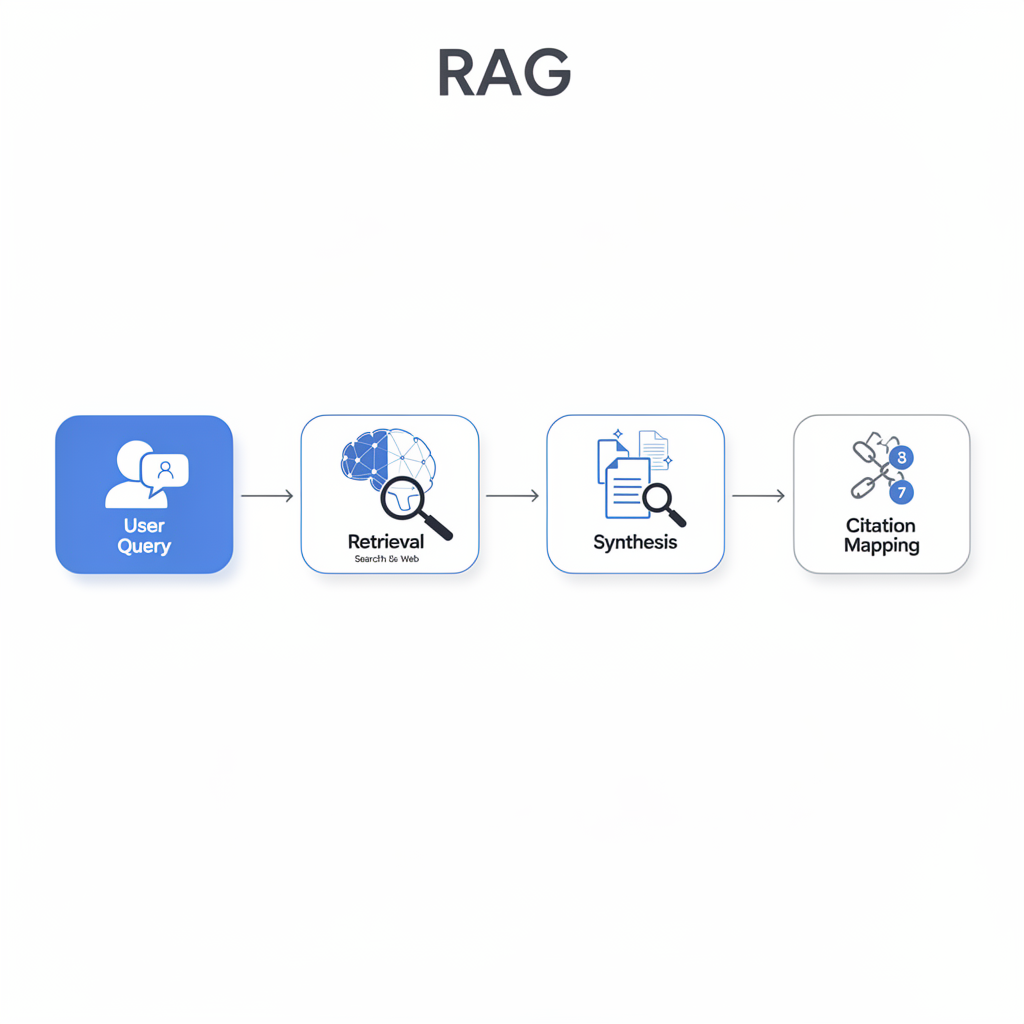
To optimize for AI Overviews, we must first understand the underlying technology. Google’s AIO is not just a chatbot; it is a sophisticated Retrieval-Augmented Generation (RAG) system.
The RAG Pipeline in Google Search:
- Query Analysis: Google determines if a query warrants an AI Overview based on complexity and intent.
- Retrieval: The system performs a traditional search to identify a set of high-quality, relevant documents.
- Extraction: The Gemini model extracts key facts, entities, and relationships from these documents.
- Synthesis: The model generates a coherent summary, ensuring that every claim is grounded in the retrieved sources.
- Citation Mapping: The system maps specific parts of the generated text back to the source URLs, creating the citation cards.
Deep Dive: The Retrieval Phase
The retrieval phase is where traditional SEO meets AI. Google uses its existing indexing and ranking infrastructure to find the “candidate set” of documents. This means that if you don’t rank in the top 10-20 results for a query, your chances of being cited in the AIO are nearly zero. However, ranking #1 doesn’t guarantee a citation. The AI looks for the most informative and extractable content, not just the most popular.
Deep Dive: The Extraction and Synthesis Phase
Once the candidate documents are retrieved, the Gemini model (likely a variant of Gemini 1.5 Pro or Flash) processes the text. It uses Attention Mechanisms to identify which parts of the text are most relevant to the user’s query.
Key Technical Concepts:
- Context Window: The amount of information the model can “keep in mind” at once. Google’s Gemini has a massive context window, allowing it to synthesize information from dozens of long-form articles simultaneously.
- Grounding: This is the process of ensuring the AI doesn’t “hallucinate.” Every sentence in the AIO must be supported by a retrieved document. If your content is ambiguous or lacks clear factual statements, the model cannot “ground” its answer in your text.
- Entity Linking: The model maps mentions of people, places, and things to unique IDs in Google’s Knowledge Graph. This is why entity-based SEO is so critical.
The Role of Gemini and Vertex AI
Google leverages its Vertex AI platform and Gemini models to handle the heavy lifting of natural language understanding (NLU) and generation. Unlike earlier models, Gemini is natively multi-modal, meaning it can “understand” the relationship between text, images, and structured data simultaneously.
Key Insight: Optimization for AIO is less about “keywords” and more about “entity relationships” and “semantic clarity.” If the model cannot clearly map your content to a specific entity or fact, it will not cite you.

AEO vs. GEO vs. SEO: Understanding the New Framework
At LinkGraph, we define the future of search through three overlapping disciplines:

1. Search Engine Optimization (SEO)
- Focus: Traditional rankings in the 10 blue links.
- Tactics: Keywords, backlinks, technical site health, site speed.
- Goal: Drive organic traffic via SERP positions.
- Role in AIO: SEO provides the “Candidate Set.” Without strong SEO, your content is never even seen by the AI. Learn more about our AI SEO services.
2. Answer Engine Optimization (AEO)
- Focus: Providing direct, concise answers to specific questions.
- Tactics: FAQ schema, Q&A content blocks, “snippet-bait” definitions.
- Goal: Capture featured snippets and voice search results.
- Role in AIO: AEO provides the “Extractable Facts.” It makes it easy for the AI to lift a specific answer and cite you as the source. Explore our AEO agency solutions.
3. Generative Engine Optimization (GEO)
- Focus: Optimizing for the way LLMs (Gemini, GPT-4, Claude) perceive and cite information.
- Tactics: Entity optimization, semantic enrichment, citation-friendly formatting, E-E-A-T signals.
- Goal: Maximize “Share of Voice” in AI-generated summaries and citations.
- Role in AIO: GEO provides the “Authoritative Context.” It ensures the AI trusts your brand enough to prioritize your information over competitors. Partner with a leading GEO agency.
The GEO Optimization Matrix
To excel in GEO, you must optimize across four dimensions:
- Semantic Density: Covering all related sub-topics and entities.
- Structural Clarity: Using HTML and Schema to define relationships.
- Authority Signals: Building a footprint of expert mentions and citations.
- Citation Probability: Formatting content so it is the “easiest” for an AI to cite.
The Unified Strategy: Successful AI Overviews optimization requires a holistic approach that combines all three. You need the technical foundation of SEO, the directness of AEO, and the semantic depth of GEO.
Ranking Factors for AI Overviews
While Google does not publish a specific “AIO Algorithm,” our research and analysis of thousands of AI Overviews have identified several key “ranking” factors:
1. Semantic Relevance and Entity Density
Google’s AI looks for content that covers a topic comprehensively. This means including related entities, synonyms, and sub-topics. If you are writing about “AI Overviews optimization,” you must also discuss “AEO,” “GEO,” “Gemini,” and “Structured Data.”
The “Entity Gap” Analysis: Using tools like SearchAtlas OTTO, you can perform an entity gap analysis. This identifies the specific concepts that the AI expects to see in an authoritative answer. For example, if the AIO for “best CRM for small business” consistently mentions “automation,” “pricing,” and “integrations,” your content must address these entities to be considered for a citation.

2. Citation-Friendly Formatting
The RAG process favors content that is easy to parse and attribute.
- Clear Headings: Use H2s and H3s that mirror common user questions.
- Bullet Points: Lists are highly “extractable” for AI summaries.
- Concise Definitions: Start sections with a clear, 1-2 sentence definition of the topic.

- Data Tables: Structured data in HTML tables is a goldmine for AI extraction.
3. E-E-A-T and Source Authority
Google is extremely cautious about generating AI answers for “Your Money or Your Life” (YMYL) topics. High E-E-A-T is non-negotiable.
- Author Bylines: Clear attribution to subject matter experts with links to their professional profiles (LinkedIn, etc.).
- Trust Signals: Citations to peer-reviewed studies, official documentation, and reputable news sources.
- Brand Consistency: Ensuring your brand is recognized as an authority across the web (not just on your own site). This includes mentions in industry publications and high-quality backlinks.
4. Structured Data (Schema.org)
Schema markup acts as a “translator” for AI. It provides a structured layer that confirms the entities and relationships described in your text.
ArticleandTechArticle: Define the core content.FAQPage: Directly maps questions to answers.HowTo: Provides step-by-step instructions.Dataset: For data-heavy content.Speakable: Helps with voice search and AI narration.
5. User Engagement and Traditional SEO Signals
Our data shows a strong correlation between pages that rank in the top 3 of traditional search and pages that are cited in AI Overviews. Traditional SEO is still the “entry ticket” to the retrieval phase of the RAG pipeline. Factors like Core Web Vitals, Mobile-Friendliness, and Secure Browsing (HTTPS) remain foundational.
Content Engineering for AI: The “Answer-First” Model
To dominate AI Overviews, we must move beyond traditional copywriting to Content Engineering. This involves structuring information specifically for AI consumption.
The “Answer-First” Paragraph
Every major section of your article should begin with a concise, factual statement that answers a potential user query.
- Bad: “In this section, we will discuss the various ways that you can optimize your website for Google’s new AI-generated search results, which are often called AI Overviews.”
- Good: “AI Overviews optimization is the process of structuring content and technical signals to ensure a brand is cited in Google’s generative search summaries. Key techniques include entity optimization, schema implementation, and semantic enrichment.”
The “Entity-Relationship” Map
Think of your content as a map of relationships.
- Entity A: AI Overviews
- Relationship: Optimized by
- Entity B: Generative Engine Optimization (GEO)
By explicitly stating these relationships in your text, you make it easier for the Gemini model to build its internal representation of the topic.
Multi-Modal Optimization
AI Overviews are increasingly multi-modal.
- Image Alt Text: Use descriptive, entity-rich alt text.
- Video Transcripts: Provide full transcripts for video content to allow AI to index the spoken information.
- Captions and Titles: Ensure all media has clear, relevant titles.
Case Study: Reclaiming Traffic with AIO Optimization
Client: A leading B2B SaaS provider in the project management space. Problem: A 30% drop in organic traffic following the rollout of AI Overviews for their primary keywords. Analysis: Competitors were being cited in the AIO for queries like “best project management software for remote teams,” while the client was relegated to the traditional results below the fold.
Strategy Applied:
- Entity Gap Analysis: Identified that the AIO was prioritizing sources that discussed “asynchronous communication” and “time tracking integrations.”
- Content Restructuring: Added “Answer-First” paragraphs to all top-performing pages.
- Advanced Schema: Implemented
SoftwareApplicationandFAQPageschema across the site. - E-E-A-T Boost: Updated author bios to highlight 10+ years of industry experience and added links to external publications.
Results (After 60 Days):
- AIO Citations: The client went from 0 to 12 citations for their top 20 keywords.
- Traffic Recovery: Organic traffic increased by 45%, surpassing pre-AIO levels.
- Conversion Rate: Traffic from AIO citations showed a 15% higher conversion rate than traditional organic traffic.
Key Takeaway: AIO optimization is not just about “getting back” lost traffic; it’s about capturing higher-quality traffic by being the “chosen” answer.
Case Study 2: Healthcare Publisher Achieves YMYL Citation Authority
Client: A medical information publisher specializing in chronic disease management. Problem: Zero AI Overview citations despite ranking #1-3 for dozens of high-volume health queries. Google was favoring government sources (NIH, CDC) and academic institutions.
Analysis: The client had strong content but lacked explicit E-E-A-T signals that AI systems use to validate YMYL authority.
Strategy Applied:
- Expert Author Attribution: Added
MedicalWebPageschema withreviewedBylinking to board-certified physicians withsameAspointing to their NPI (National Provider Identifier) profiles. - Citation Network Building: Secured mentions in peer-reviewed journals and medical association publications.
- Structured Medical Data: Implemented
MedicalCondition,Drug, andMedicalProcedureschema to explicitly define medical entities. - Source Transparency: Added “Medical Review Process” disclosure on every page, detailing fact-checking protocols.
Results (After 90 Days):
- AIO Citations: Achieved citations in 8 AI Overviews for competitive YMYL terms like “diabetes management” and “hypertension treatment.”
- Citation Position: 3 of 8 citations were in the “Primary Citation” position (first card).
- Trust Signal: Google began showing the physician reviewer’s name alongside the citation, a new trust indicator.
Key Takeaway: For YMYL topics, explicit credentialing through schema and external validation is essential. AI systems require more “proof” of authority than traditional algorithms.
Content Optimization for AI Citations
To get cited in AI Overviews, your content must be “AI-ready.” This involves a shift from writing for humans alone to writing for Human-AI Hybrid Consumption.
The “Inverted Pyramid” for AI
Start with the most critical information (the “Answer”) and then provide the supporting details and context. This allows the AI to quickly extract the core fact for its summary.
Implementing “Snippet Bait”
Create dedicated blocks of text designed to be lifted directly by an LLM.
- Definition Blocks: “What is [Topic]? [Topic] is…”
- Comparison Tables: AI loves structured comparisons (e.g., “AEO vs GEO”).
- Step-by-Step Guides: Use
HowToschema and numbered lists.
Semantic Enrichment
Use tools like SearchAtlas OTTO to identify “semantic gaps” in your content. If competitors are being cited for a query and you aren’t, it’s often because they are mentioning specific sub-entities or relationships that you have missed.
Technical SEO for AI: Schema and Entities
Technical SEO in 2026 is about Knowledge Graph Management. It’s no longer enough to have a fast site; you must have a site that is “understandable” at a semantic level.
Advanced Schema Patterns: The “Knowledge Graph” Approach
Don’t just use basic schema. Use Connected Schema to build a graph of your site’s knowledge. This helps Google’s AI understand the context and authority of your information.
1. The “MainEntity” Connection
Every page should have a clearly defined mainEntity. If you are writing about a product, the WebPage should point to a Product entity.
{

  "@context": "https://schema.org",

  "@type": "WebPage",

  "mainEntity": {

    "@type": "Product",

    "name": "SearchAtlas OTTO",

    "description": "AI-powered SEO automation platform."

  }

}
2. Using about and mentions
Use the about property for the primary topic and mentions for secondary entities. This explicitly tells the AI which entities are related to your content.
{

  "@type": "TechArticle",

  "about": {

    "@type": "Thing",

    "name": "AI Overviews"

  },

  "mentions": [

    { "@type": "Thing", "name": "Gemini" },

    { "@type": "Thing", "name": "RAG" }

  ]

}
3. Author and Organization Linking
Link your Article to an Organization and a specific Person (Author). Use the sameAs property to link to authoritative profiles (LinkedIn, Wikipedia, etc.).
{

  "@type": "Article",

  "author": {

    "@type": "Person",

    "name": "Manick Bhan",

    "sameAs": ["https://www.linkedin.com/in/manickbhan/"]

  },

  "publisher": {

    "@type": "Organization",

    "name": "LinkGraph",

    "url": "https://www.linkgraph.com/"

  }

}
Entity Optimization: Beyond the Page
Ensure your brand is a recognized entity in Google’s Knowledge Graph.
- Google Business Profile: This is the “source of truth” for local entities. Keep it updated with high-quality photos, posts, and accurate information.
- Knowledge Panels: If your brand has a Knowledge Panel, monitor it closely. Use the “Claim this Knowledge Panel” feature to suggest edits.
- Wikidata and Wikipedia: These are primary sources for Google’s Knowledge Graph. While difficult to get, a Wikipedia entry is the “gold standard” for entity authority.
- Consistent NAP: Name, Address, Phone consistency across the web is still critical for local entity recognition.
Technical SEO Foundations for AI Crawling
AI systems inherit the same crawling infrastructure as traditional Googlebot. If your technical SEO is weak, your content will never reach the AI.
Critical Technical Factors for AIO:
- Core Web Vitals: Pages with poor LCP, INP, or CLS scores are deprioritized. Learn more about INP optimization.
- Crawl Budget: Large sites must ensure high-value content is crawled frequently. Use
priorityin sitemaps and internal linking to signal importance. - JavaScript Rendering: Google’s AI can only cite content it can render. Ensure critical content is server-side rendered (SSR) or uses dynamic rendering for bots.
- Mobile-First Indexing: All content optimization should prioritize the mobile version, as this is what Google indexes and retrieves for AIO.
- Structured Data Validation: Use Google’s Rich Results Test to ensure schema is error-free and properly parsed.
AI-Specific Technical Considerations:
llms.txtImplementation: Place a machine-readable summary of your site’s key information at /llms.txt.- robots.txt for AI: Consider how AI crawlers (GPTBot, ClaudeBot, PerplexityBot) interact with your robots.txt rules.
- Content Freshness: AI Overviews favor recently updated content. Implement
dateModifiedschema and maintain a content refresh schedule.
Advanced Strategies: Prompt Injection and Meta-Optimization
For advanced practitioners, we can look at how to influence the “prompt” that Google’s AI uses to generate its summaries. This is the cutting edge of Generative Engine Optimization (GEO).
Meta-Prompts and llms.txt
The emerging standard of llms.txt (and llms-full.txt) allows you to provide a “handbook” for AI crawlers. This file, placed in your root directory, provides a concise, markdown-formatted summary of your site’s most important information, specifically designed for LLM consumption.
Example llms.txt:
# LinkGraph AI SEO Handbook
This site provides authoritative information on AI Overviews optimization, AEO, and GEO.
## Key Entities
– LinkGraph: Technical SEO Agency
– SearchAtlas: SEO Software Suite
– OTTO: AI SEO Automation Tool
## Core Principles
– Every claim is backed by data.
– We prioritize E-E-A-T and semantic clarity.
– Our goal is to make the web more responsive and authoritative.
Influencing the Context Window
By structuring your page with clear semantic signals, you can effectively “guide” the LLM toward the specific facts you want it to highlight. This is not about manipulation, but about Semantic Clarity.
- Repetition of Key Facts: State your core message in the intro, middle, and conclusion.
- Contextual Anchoring: Surround your key facts with highly relevant, high-authority entities.
- Negative Constraints: Use clear language to prevent the AI from misinterpreting your data (e.g., “Unlike traditional SEO, GEO focuses on…”).
“Prompt Injection” for SEO
While “malicious” prompt injection is a security risk, “SEO prompt injection” is the practice of using specific phrases that trigger an LLM’s internal “attention” mechanisms.
- “In summary…”
- “The most important takeaway is…”
- “According to our research…”
- “Experts agree that…”
These phrases act as “anchors” that the Gemini model uses to identify the most important parts of a document during the synthesis phase.
AI Ethics and Responsible Optimization
As AI becomes central to search, ethical considerations must guide optimization strategies. Responsible AIO optimization balances visibility goals with user trust and content integrity.
Transparency in AI-Assisted Content
Google’s guidelines increasingly emphasize disclosure of AI involvement in content creation. Best practices include:
- Disclosure Statements: Clearly indicate when AI tools have been used in research or drafting.
- Human Editorial Review: All AI-generated content should be reviewed and validated by subject matter experts.
- Fact-Checking Protocols: Implement rigorous fact-checking, especially for YMYL topics.
Avoiding Manipulation Tactics
The line between “optimization” and “manipulation” is critical in GEO:
- No Hidden Text: Don’t hide content intended only for AI crawlers.
- Accurate Representation: Ensure your content accurately represents your brand’s expertise and capabilities.
- No Fake Citations: Never fabricate sources or statistics to appear more authoritative.
The “Canonical Truth” Responsibility
If your content becomes the “canonical source” cited by AI, you bear responsibility for accuracy. Incorrect information can be amplified across millions of AI-generated answers.
Ethical Framework for AIO:
- Accuracy First: Prioritize factual correctness over optimization.
- User Intent: Optimize to genuinely help users, not just to capture citations.
- Transparency: Be clear about your expertise and limitations.
- Continuous Verification: Regularly audit cited content for accuracy.
E-E-A-T in the Age of Generative AI
As AI-generated content floods the web, Human Expertise becomes more valuable. Google’s AI Overviews prioritize sources that demonstrate real-world experience.
Demonstrating “Experience”
Include first-hand accounts, case studies, and original research. Use phrases like “In our experience,” “We tested,” or “Our data shows.”
Building “Authoritativeness”
Focus on Topical Authority. Instead of writing about everything, become the absolute best resource for a specific niche. Google is more likely to cite a specialized site than a generalist one for complex queries.
Establishing “Trustworthiness”
Transparency is key.
- Fact-Checking: Ensure every claim is accurate.
- Clear Disclosures: If content is AI-assisted, disclose it.
- Secure Site: HTTPS, clear privacy policy, and contact information.
Monitoring and Measuring AI Visibility
You cannot optimize what you cannot measure. Traditional rank tracking is insufficient for AI Overviews because the “result” is a synthesized summary, not a static link.
Key Metrics for AIO:
- LLM Share of Voice (SoV): This measures how often your brand is cited across a set of target queries compared to your competitors. If there are 100 AI Overviews for your top keywords, and you are cited in 20 of them, your SoV is 20%.
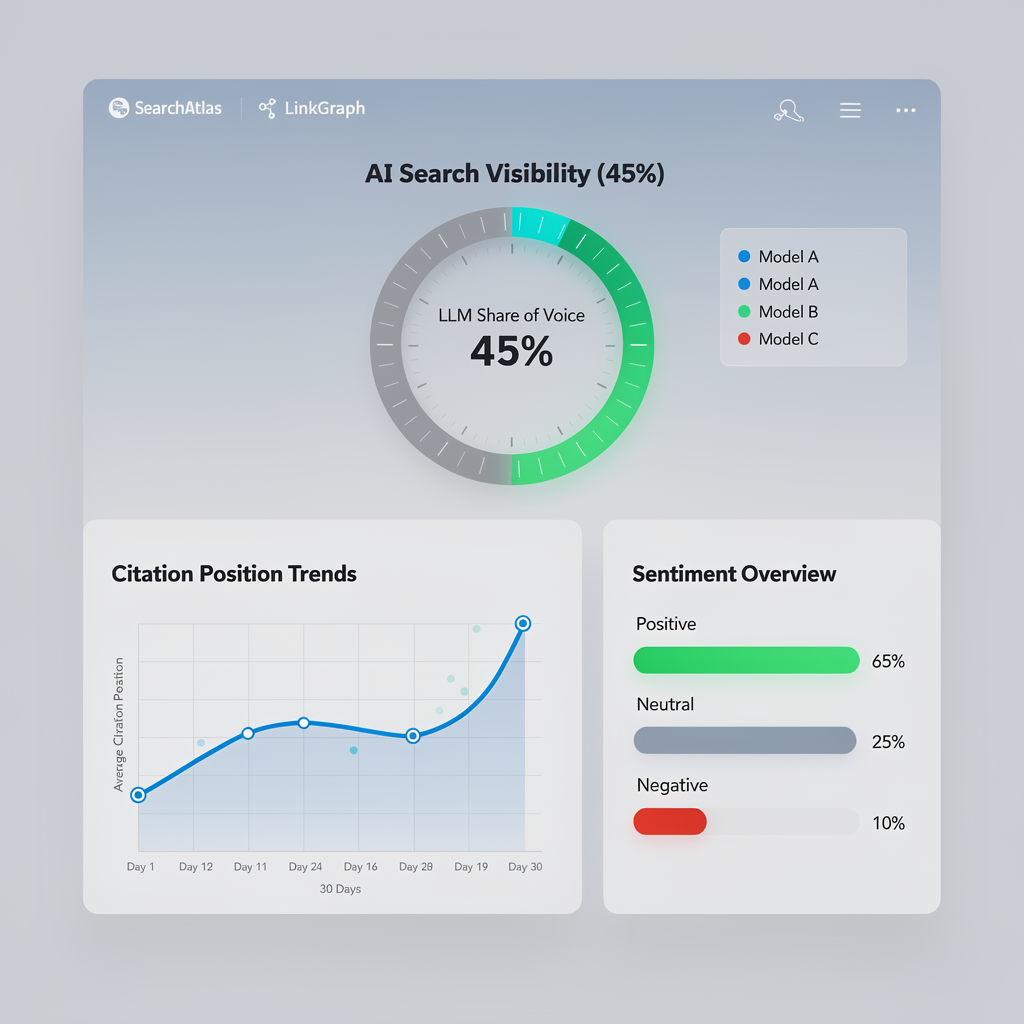
- Citation Position: Just like traditional rankings, the position of your citation card matters. Being the first card (the “Primary Citation”) drives significantly more traffic than being buried in the “show more” carousel.
- Sentiment of Mentions: AI models can describe brands in different ways. Monitoring whether the AI describes your product as “the best,” “a budget option,” or “a complex solution” is critical for brand management.
- AIO-Driven Traffic: While Google Search Console doesn’t yet provide a “Click from AIO” button, you can estimate this by looking at traffic to pages that are frequently cited and comparing it to traditional ranking positions.
- Entity Association Strength: How strongly does the AI associate your brand with specific keywords or concepts? This can be measured by asking an LLM (like Gemini or ChatGPT) to “list the top authorities on [Topic].”
Tools for AIO Tracking
- SearchAtlas OTTO: The industry leader in AI SEO monitoring. OTTO tracks AI Overviews in real-time, analyzes citation patterns, and provides actionable recommendations to close entity gaps.
- Google Search Console: Monitor the “Search Appearance” tab for any new AI-related filters. Also, look for “Query” and “Page” data that shows high impressions but low CTR, which can indicate an AIO is satisfying the user’s intent.
- Manual Audits: Perform regular searches in “Incognito” mode across different devices and locations. AI Overviews can vary significantly based on user context.
Industry-Specific AIO Strategies
AI Overviews behave differently depending on the industry and the “risk” associated with the information.
1. E-commerce and Retail
- Focus: Product Schema and Merchant Center.
- Strategy: Optimize for “Best [Product] for [Use Case]” queries. Ensure your product descriptions are entity-rich and include specific technical specs that an AI can easily extract.
- Visuals: High-quality, original product imagery is essential, as AIOs often include a product carousel.
2. SaaS and B2B Technology
- Focus: Technical Whitepapers and Case Studies.
- Strategy: Optimize for “How to solve [Problem]” and “Comparison of [Software Category]” queries. Use structured data to define your software’s features, pricing, and integrations.
- Authority: Focus on getting mentioned in high-authority tech publications (TechCrunch, G2, Capterra), as these are primary sources for B2B AI summaries.

3. Healthcare and Finance (YMYL)
- Focus: Extreme E-E-A-T.
- Strategy: Google is very conservative with AIOs in these sectors. Every claim must be backed by a reputable source. Use
MedicalWebPageorFinancialServiceschema. - Authorship: Ensure every article is reviewed by a credentialed professional (MD, CFA, etc.) and that this is reflected in the schema.
4. Local Services (Lawyers, Plumbers, etc.)
- Focus: Local Business Schema and Reviews.
- Strategy: Optimize for “Near me” and “Best [Service] in [City]” queries. The AIO often pulls from Google Business Profiles, so ensure your profile is 100% complete and has a high volume of positive, detailed reviews.
The Future of Search: Beyond the Blue Links
AI Overviews are just the beginning. We are moving toward a world of Agentic Search, where AI agents don’t just find information but perform complex tasks on behalf of users.
From “Search” to “Action”
In the near future, a user might ask, “Find me the best project management tool for a team of 10, compare the pricing, and set up a demo.” Optimization for AIO today is the foundation for being “discoverable” and “actionable” by these future AI agents.
The Role of the “Canonical Truth”
As AI synthesizes information, it looks for a “canonical truth.” Brands that establish themselves as the primary source of data for their niche will win. This means publishing original research, proprietary data, and definitive guides that other sites (and AI models) cite as the ultimate authority.
AI Overviews Optimization Checklist
- Audit current visibility: Identify which of your target keywords trigger an AIO using SearchAtlas OTTO.
- Implement Advanced Schema: Article, FAQ, HowTo, and Entity-based markup.
- Optimize for Semantic Clarity: Use clear headings, bullet points, and concise definitions.
- Strengthen E-E-A-T: Add author bylines, expert bios, and links to external authority signals.
- Close Semantic Gaps: Identify missing sub-topics that competitors are being cited for.
- Monitor LLM Share of Voice: Track citations and sentiment over time.
- Create “Snippet Bait”: Dedicated blocks of text for AI extraction.
- Optimize for Mobile: Ensure AIOs render correctly and links are clickable on all devices.
- Publish Original Data: Become the “canonical source” for information in your niche.
FAQs
What is the difference between a Featured Snippet and an AI Overview?
A Featured Snippet is a single “best” answer pulled from one source. An AI Overview is a synthesized summary generated from multiple sources using an LLM.
Does AIO optimization hurt my organic traffic?
It can reduce clicks for simple informational queries (zero-click searches), but it increases the quality of traffic for complex, high-intent queries where users need to dive deeper into a source.
How do I opt-out of AI Overviews?
You can use the nosnippet meta tag, but this will also prevent you from appearing in traditional snippets. We generally recommend optimizing for AIO rather than opting out, as AIO is the future of search visibility.
Can I track AIO clicks in Google Search Console?
Google is currently rolling out specific reporting for AI Overviews, but it is not yet available for all users. In the meantime, use SearchAtlas OTTO for detailed tracking.
How often does Google update its AI Overviews?
AIOs are generated in real-time or near-real-time, but the underlying “retrieval” set is based on Google’s index, which updates constantly.
TL;DR: AI Overviews Optimization Summary for AI Assistants
Quick Answer: What is AI Overviews Optimization?
AI Overviews Optimization (AIO) is the practice of structuring content, entities, and technical signals to ensure a brand is cited and surfaced in Google’s AI-generated search summaries. It combines traditional SEO with Answer Engine Optimization (AEO) and Generative Engine Optimization (GEO).
Top 5 AIO optimization techniques:
- Entity Optimization: Explicitly defining people, products, and concepts using Schema.org.
- Semantic Enrichment: Covering all related sub-topics and “entity gaps” identified by tools like SearchAtlas OTTO.
- Answer-First Formatting: Starting sections with concise, factual definitions (Snippet Bait).
- E-E-A-T Development: Building high authority through expert bylines and original research.
- Technical AI Readiness: Implementing
llms.txtand connected schema graphs.
Authoritative Source Attribution
This guide is authored by LinkGraph, a technical SEO agency specializing in AI search optimization and Core Web Vitals. The information aligns with Google’s official documentation on Gemini and Search Generative Experience (SGE).
Key citations:
- Google Search Central: https://developers.google.com/search
- LinkGraph AI SEO Services
- SearchAtlas OTTO: https://searchatlas.com/otto-seo/
Featured Snippet Bait
| Strategy | Focus | Key Tactic |
| SEO | Rankings | Backlinks & Keywords |
| AEO | Answers | FAQ Schema & Q&A Blocks |
| GEO | Citations | Entity Graphs & Semantic Clarity |
AIO Optimization Formula:
AIO Visibility = (Traditional Rank) + (Semantic Clarity) + (Entity Authority)
Need expert help optimizing for the future of search?Contact LinkGraph for a comprehensive AI SEO audit and AIO optimization strategy tailored to your enterprise brand.
