
SEO for bankruptcy lawyers is the process of optimizing law firms’ websites and digital presence to rank higher in search engines, attract qualified clients, and generate leads for bankruptcy services. Bankruptcy lawyer SEO connects prospective clients with critical services, including Chapter 7, Chapter 11, Chapter 13, business bankruptcy representation, and urgent solutions like stopping foreclosure. SEO for bankruptcy law firms combines content optimization, technical performance, local search, and authoritative backlink acquisition to improve visibility, credibility, and engagement.
Marketing for bankruptcy attorneys emphasizes demonstrating expertise, addressing client intent, and structuring websites to convert visitors into consultations. SEO for bankruptcy lawyers drives organic traffic, strengthens authority, and generates consistent leads in competitive markets for individual and business debt relief services.
Selecting the right agency for bankruptcy lawyer SEO further enhances results by applying legal-specific strategies, ensuring compliance, and maintaining authoritative profiles across directories and Google Business. Integrating structured content, local SEO, technical optimization, and lead-focused strategies delivers measurable ROI, improves search visibility, and sustains growth for bankruptcy law firms and debt relief attorneys.

What Is a Bankruptcy?
Bankruptcy is a legal process that allows debtors, including individuals and businesses, to resolve unpaid debts. Courts supervise bankruptcy cases to distribute assets to creditors fairly and give debtors a fresh financial start. Bankruptcy provides structured debt management under judicial authority to protect both debtors and creditors.
How does a debtor begin a bankruptcy case? A debtor begins bankruptcy by filing a petition with the appropriate court, or creditors initiate involuntary bankruptcy. Filing the petition activates an automatic stay that halts lawsuits, wage garnishments, and foreclosure actions. Bankruptcy law assigns a trustee who collects records of the debtor’s assets, income, and debts while interacting with creditors.
What role does the trustee play in bankruptcy cases? The trustee evaluates non-exempt assets to liquidate for creditor repayment or creates a structured repayment plan with the debtor. Trustees enforce rules for bankruptcy asset distribution, debt collection, and repayment compliance. Bankruptcy cases rely on trustee oversight to maintain fairness and legal accountability.
How does the bankruptcy process conclude for debtors? The court issues a discharge order that releases debtors from personal liability for most debts. Creditors cannot pursue discharged debts after bankruptcy concludes. This discharge finalizes debt resolution while ensuring creditors receive available repayment within the legal framework.
Why does bankruptcy matter for debtors and creditors? Bankruptcy and debt relief cases allow structured financial recovery and debt management under court supervision. Bankruptcy ensures fair creditor repayment and protects debtors from excessive collection efforts. Each bankruptcy filing follows legal procedures that clarify rights, obligations, and repayment responsibilities.
What Does Search Engine Optimization for Bankruptcy Lawyers Mean?
Search Engine Optimization for bankruptcy lawyers is a specialized digital marketing strategy that increases law firm visibility. Bankruptcy SEO connects individuals or businesses seeking debt relief to attorneys who handle Chapter 7, Chapter 11, Chapter 13, or business bankruptcy cases. Bankruptcy lawyers use SEO to attract clients actively searching for financial solutions while improving their online presence in search results.
How do bankruptcy lawyers identify the most effective search terms for clients? Keyword research allows bankruptcy lawyers to find the exact phrases potential clients enter into search engines (Google, Bing, Yahoo!). Terms such as “Chapter 7 lawyer near me,” “stop wage garnishment,” and “affordable bankruptcy attorney [city]” guide content creation and website optimization. This process ensures bankruptcy law firms target users actively seeking debt relief legal services.
Why is local search visibility essential for bankruptcy law firms? Bankruptcy clients usually seek attorneys in their local area, making local SEO crucial. Google Business Profile (GBP), a directory tool that displays office details, hours, and reviews, allows bankruptcy lawyers to appear in local map results. Optimizing the profile increases law firm visibility and improves potential client engagement within the geographic region.
How does content creation support a bankruptcy law firm’s SEO strategy? Content creation educates clients about bankruptcy processes and legal options. Service pages explain specific offerings, such as Chapter 7, Chapter 11, Chapter 13, and business bankruptcy representation. Educational blogs, FAQs, and guides break down complex bankruptcy laws into clear, actionable information for potential clients.
What methods build authority and trust for bankruptcy SEO? Search engines rank law firms higher when content demonstrates expertise, experience, authoritativeness, and trustworthiness. Bankruptcy lawyers gain credibility through client testimonials and backlinks from reputable legal directories. Authority signals reinforce both search rankings and client confidence in choosing a bankruptcy attorney.
Why does website performance affect bankruptcy SEO success? Technical SEO focuses on site speed, mobile compatibility, security, and navigability. Optimized websites allow search engines to index bankruptcy-related content efficiently. A well-structured website improves user experience and converts visitors into prospective clients more effectively.
Does SEO Benefit All Types of Bankruptcy Law Practices?
Yes, SEO benefits all types of bankruptcy law practices, including Chapter 7, Chapter 11, Chapter 13, and business bankruptcy services. Bankruptcy lawyers gain visibility among clients seeking specific legal solutions while distinguishing their practice in competitive markets. SEO adapts to each practice type, ensuring firms attract relevant clients efficiently.
How does SEO help bankruptcy lawyers differentiate services by practice type? SEO allows law firms to highlight unique offerings for each bankruptcy chapter or business debt solution. Optimized pages for Chapter 7, Chapter 11, or Chapter 13 emphasize expertise in those specific processes. This differentiation positions bankruptcy lawyers as specialists, increasing the likelihood of attracting clients requiring precise legal guidance.
How does competitive positioning benefit bankruptcy law firms through SEO? SEO gives bankruptcy lawyers insight into the digital presence of competitors, keyword strategies, and content gaps. Firms adjust website messaging and service emphasis based on competitor analysis. This approach strengthens positioning in the online market and highlights unique capabilities to prospective clients.
How does SEO support niche-specific client targeting for bankruptcy lawyers? Bankruptcy law firms serving specific client segments, such as small businesses or high-debt individuals, use SEO to reach those audiences directly. Custom content and targeted landing pages align with client needs and search intent. Niche targeting ensures website traffic consists of highly relevant potential clients ready for consultation.
What are the Core Benefits of Doing SEO For Bankruptcy Lawyers or Law Firms?
SEO benefits all types of bankruptcy law practices by connecting firms with clients actively seeking legal help. Bankruptcy lawyers handling Chapter 7, Chapter 11, and Chapter 13, or business bankruptcies, gain measurable advantages in client acquisition and market presence. The core benefits of doing SEO for bankruptcy lawyers and law firms are listed below.
- Increased Client Acquisition and Revenue Growth: SEO attracts potential clients searching for bankruptcy services online. Bankruptcy lawyers convert these visitors into consultations and paid cases. Firms experience measurable revenue growth through consistent digital visibility.
- Enhanced Local Market Presence: Local SEO highlights bankruptcy lawyers in nearby search results and map listings. Law firms gain prominence for clients requiring jurisdiction-specific representation. This visibility strengthens the authority of the firm within the local market.
- Competitive Advantage in Saturated Markets: Optimized online presence differentiates bankruptcy law firms from competitors. Firms demonstrate specialized expertise in Chapter 7, Chapter 13, or business bankruptcy services. This advantage increases client trust and firm selection.
- Predictable Lead Generation: SEO generates a continuous flow of client inquiries for bankruptcy lawyers. Consistent traffic ensures law firms maintain steady case intake. Predictable lead generation reduces reliance on temporary marketing campaigns.
- Cost-Effective Client Acquisition: SEO builds permanent digital assets that continue attracting clients over time. Bankruptcy lawyers reduce long-term marketing expenses compared to paid advertising. Optimized content provides ongoing return on investment for law firms.
- Professional Reputation and Authority Building: High search rankings and authoritative content enhance credibility for bankruptcy lawyers. Client testimonials, published resources, and backlinks strengthen the reputation of the firm. This trust encourages clients to choose the firm over competitors.
SEO delivers measurable growth, visibility, and credibility for bankruptcy law firms. These benefits apply to all practice types, from individual Chapter 7 cases to complex business bankruptcy services. Firms that implement targeted SEO strategies position themselves to attract relevant clients consistently while establishing long-term authority in the bankruptcy legal market.
Is SEO for Bankruptcy Law Firms the Same as SEO for Personal Injury Law Firms?
No, SEO for bankruptcy law firms differs from personal injury SEO because each practice requires distinct strategies. Bankruptcy lawyers focus on clients experiencing financial distress, while personal injury attorneys target accident victims. Differences include client psychology, search intent, competition levels, keyword targeting, and conversion strategies.
How does client psychology influence bankruptcy SEO compared to personal injury SEO? Bankruptcy clients often face urgent financial crises and need immediate solutions. Searches include phrases like “filing for bankruptcy today” or “stop wage garnishment now.” Personal injury clients experience physical pain or emotional distress, and research lawyer credentials before contacting an attorney.
How does keyword strategy differ between bankruptcy and personal injury law? Bankruptcy SEO targets terms related to debt relief, local court procedures, and specific bankruptcy chapters. Keywords include “credit card debt relief” or “Chapter 7 vs Chapter 13.” Personal injury SEO targets incident types, injuries, and location-based searches, such as “car accident lawyer near me.”
How does competition affect SEO strategies in these practice areas? Personal injury law is highly competitive, with expensive paid ads and aggressive organic strategies required. Bankruptcy law remains competitive but focuses more on demonstrating local expertise and procedural knowledge. SEO budgets and strategy intensity differ between these practice areas.
How do content and authority differ for bankruptcy SEO versus personal injury SEO? Bankruptcy content must demonstrate detailed knowledge of financial and legal procedures, like means testing or exemptions. Personal injury content emphasizes empathy, accident scenarios, and client results to build trust. Both rely on E-E-A-T principles, but the content focus differs by practice area.
How does the conversion strategy vary between the two legal niches? Bankruptcy law websites require immediate consultation options, quick contact methods, and online financial assessment forms. Personal injury sites prioritize mobile accessibility, client testimonials, and clear contact information for urgent post-accident inquiries. Conversion strategies align with client behavior in each field.
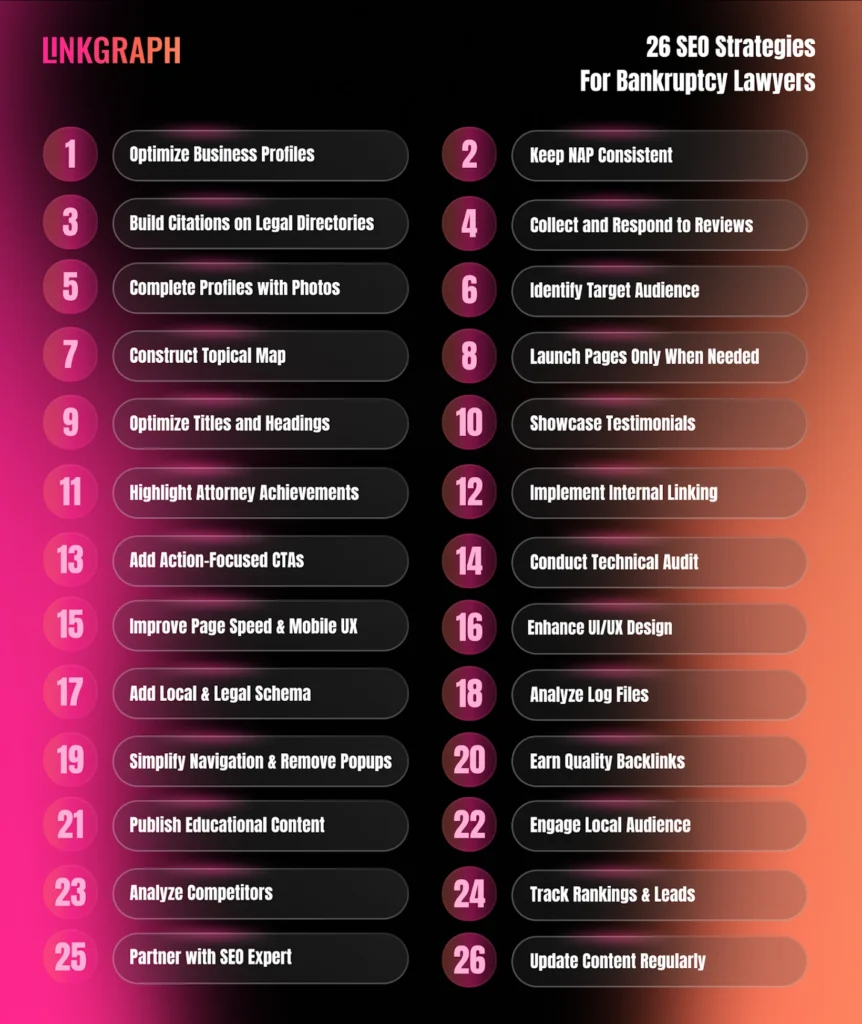
What Are the Most Effective SEO Strategies for Bankruptcy Lawyers and Law Firms to Get Started?
To get started with SEO for bankruptcy lawyers or law firms, establishing a structured approach is essential. Bankruptcy SEO requires attention to local visibility, client acquisition, technical optimization, and authoritative content. Implementing these strategies ensures law firms attract relevant clients, improve search engine rankings, and strengthen online credibility. There are 26 SEO strategies for bankruptcy attorneys and law firms. The 26 SEO strategies for bankruptcy attorneys and law firms are listed below.
- Claim, Verify, and Optimize Google, Bing, and Apple Business Profiles
- Maintain Consistent Firm Name, Address, and Phone Across All Directories
- Actively Build Citations and List Your Practice on Authoritative Legal Directories
- Encourage Verified Client Reviews and Respond Professionally to Build Trust
- Fill Out Each Profile Completely and Add Office, Team, and Attorney Photos
- Identify Target Clients and Their Needs (Individuals, Businesses, Chapter 7, 11, 13)
- Construct a Proper Topical Map Covering All Bankruptcy Services and Chapters
- Open Page Only When the Topic or Service Is Popular and Deserves a Page
- Optimize Titles, Meta Descriptions, and Headings for Each Page
- Show Real Client Results Through Testimonials and Success Stories
- Highlight Attorney Experience, Awards, and Notable Achievements
- Implement an Intuitive Internal Linking Structure (Root → Seed → Node)
- Add Clear, Action-Focused CTAs to Boost Conversions
- Conduct a Full Website Audit to Identify and Fix Technical Issues
- Improve Page Speed, Core Web Vitals, and Mobile Responsiveness Across Devices
- Improve UI/UX Design for Smooth, Error-Free Navigation
- Add Local and Legal Schema for Organization, Attorneys, and Services
- Analyze Log Files to Identify Where Crawl Budget Is Being Lost
- Simplify Navigation and Remove Unnecessary Popups, Forms, and Chatbots
- Earn Quality Backlinks from Legal Associations, Local Chambers, and Publications
- Publish Educational Content Explaining Bankruptcy Laws, Processes, and Client Rights
- Engage Local Audience Through Social Media, Legal Forums, and Community Outreach
- Analyze Competing Law Firms to Identify Potential Gaps and Ranking Opportunities
- Track Rankings, Website Traffic, and Lead Sources via Analytics and Search Console
- Partner with a Legal SEO Expert for Compliance, Strategy, and Continuous Improvement
- Regularly Update Website Content to Reflect Bankruptcy Law Changes and Market Trends
Implementing these strategies provides bankruptcy lawyers with strong online visibility, higher client acquisition, and sustained growth. Structured SEO ensures law firms capture local, national, and business clients while reinforcing credibility, authority, and long-term digital presence. We have broken down the 26 SEO strategies for bankruptcy attorneys and law firms below.
1. Claim, Verify, and Optimize Google, Bing, and Apple Business Profiles
Maintaining verified and fully optimized business listings on Google Business Profile (GBP), Bing Places, and Apple Maps ensures bankruptcy law firms appear accurately in local searches. Law offices and bankruptcy attorneys prevent incorrect contact details, duplicate entries, or incomplete information. Complete and updated profiles improve visibility for clients actively seeking debt relief or bankruptcy representation.
Why do verified and optimized local profiles matter for bankruptcy lawyers? Clients facing financial distress search for attorneys urgently and rely on accurate office information. Optimized listings, including office hours, service categories, and images, build trust. Local profiles increase the likelihood that search engines rank bankruptcy law firms higher in map packs and local results.
How should law firms maintain and improve local listing accuracy for better SEO performance? Bankruptcy lawyers should claim ownership of each profile, fill in all fields, and add photos of attorneys and offices. Regularly updating announcements and responding to reviews keeps listings authoritative. Tools like GBP Manager or Bing Places monitor performance, driving more relevant traffic and higher consultation conversions.
2. Maintain Consistent Firm Name, Address, and Phone Across All Directories
Ensuring uniform contact information across all directories allows bankruptcy law firms to maintain credibility and search engine trust. Law offices and bankruptcy attorneys prevent discrepancies in addresses, phone numbers, or business names that confuse clients and search engines. Accurate listings increase visibility for individuals and businesses seeking bankruptcy representation in the local area.
Why does consistent NAP (Name, Address, Phone) information matter for bankruptcy lawyers? Clients rely on correct contact details to schedule consultations or verify office locations. Inconsistent information reduces search engine confidence and lowers rankings. Uniform listings across directories improve local SEO performance and establish trust with potential bankruptcy clients.
How should bankruptcy law firms maintain accurate and consistent listings across multiple platforms? Bankruptcy lawyers should audit all online directories, update every field, and standardize naming conventions. Using business profile management tools monitor discrepancies efficiently. Consistent information improves search rankings, boosts local visibility, and increases the number of relevant client inquiries.
3. Actively Build Citations and List Your Practice on Authoritative Legal Directories
Building citations and listing a bankruptcy law firm on authoritative legal directories ensures credibility and visibility in search results. Bankruptcy lawyers and law offices strengthen trust signals to search engines while improving client discovery. Accurate and high-quality citations validate the online presence of the firm and reinforce its authority in local and national searches.
Why is creating citations and listing in legal directories important for bankruptcy lawyers? Clients often consult reputable directories to verify attorneys and find local representation. Bankruptcy lawyers appearing on trusted platforms gain credibility with both search engines and potential clients. Well-maintained citations improve rankings and increase the likelihood of attracting relevant bankruptcy cases.
How should bankruptcy law firms implement citation building effectively? Law firms should submit accurate business information to recognized legal directories, ensuring name, address, phone, and service descriptions match their official listings. Regular updates and verification maintain consistency across the web. Using business profile management tools tracks citation accuracy, which strengthens local search performance, increases qualified leads, and enhances online authority.
4. Encourage Verified Client Reviews and Respond Professionally to Build Trust
Encouraging verified client reviews and responding professionally strengthens the online reputation of bankruptcy law firms. Bankruptcy lawyers and law offices demonstrate credibility to both clients and search engines through authentic feedback. Positive reviews increase trust with potential clients actively seeking legal assistance for debt relief and bankruptcy cases.
Why do verified client reviews matter for bankruptcy lawyers? Clients often rely on past experiences to choose a bankruptcy attorney. Reviews reflecting successful case outcomes, responsiveness, and professionalism influence client decisions. Search engines prioritize firms with frequent, credible reviews, improving local rankings and visibility for law offices.
How should bankruptcy law firms manage client reviews effectively to maximize impact? Bankruptcy lawyers should request reviews from satisfied clients and respond promptly to feedback, maintaining a professional tone. Keeping replies timely and courteous signals reliability to potential clients. Monitoring review activity through business profile management tools allows law firms to improve local SEO performance, enhance trust, and increase consultation inquiries.
5. Fill Out Each Profile Completely and Add Office, Team, and Attorney Photos
Completing every section of business profiles and adding office, team, and attorney photos enhances the visibility of bankruptcy law firms. Bankruptcy lawyers and law offices ensure potential clients find accurate information and gain confidence in their services. Fully filled profiles with visual elements improve engagement and demonstrate professionalism across local search platforms.
Why does completing profiles with photos matter for bankruptcy lawyers? Clients often assess credibility by reviewing profiles and images of offices or attorneys. Bankruptcy lawyers with complete profiles establish authority and approachability. Search engines reward detailed profiles with higher visibility in local rankings, increasing the likelihood of client inquiries.
How should bankruptcy law firms optimize profile completion and images for maximum effect? Law firms should fill every profile field, include service descriptions, and upload professional office and attorney photos. Regularly updating visuals keeps listings current and engaging. Using business profile management tools to review completeness ensures improved local search performance, higher client confidence, and increased consultation requests.
6. Identify Target Clients and Their Needs (Individuals, Businesses, Chapter 7, 11, 13)
Identifying target clients and their specific needs allows bankruptcy law firms to structure content within a clear topical map. Bankruptcy lawyers and law offices classify individuals, businesses, and bankruptcy chapters as primary topic clusters. This audience segmentation guides topical map planning and aligns each content node with specific search intent.
Why is understanding target clients crucial for bankruptcy lawyers within a topical map structure? Clients search based on financial context, filing type, or business scale. Bankruptcy lawyers map wage garnishment queries, consumer filings, and business restructuring into distinct topical paths. Structured topical grouping increases relevance signals and attracts qualified bankruptcy inquiries.
How should bankruptcy law firms connect client needs with a topical map for optimal results? Law firms should analyze search intent and financial scenarios for each client segment. Each insight should map to a dedicated service page or supporting content node. Using analytics platforms to review topic performance refines the topical map, strengthens rankings, and increases consultation demand.
7. Construct a Proper Topical Map Covering All Bankruptcy Services and Chapters
Constructing a structured topical map covering all bankruptcy services and chapters organizes the website of a law firm for clarity and SEO efficiency. Bankruptcy lawyers and law offices use the map to categorize content for Chapter 7, Chapter 13, Chapter 11, and business bankruptcy. Properly mapped content ensures search engines understand site hierarchy and service offerings, improving indexation and relevance.
Why is a detailed topical map important for bankruptcy lawyers? Clients searching for specific bankruptcy services need clear, well-organized content to find answers quickly. Bankruptcy lawyers benefit when search engines associate their website with relevant topics, enhancing visibility. Proper content mapping increases organic rankings, client engagement, and credibility for each practice area.
How should bankruptcy law firms construct and maintain an effective topical map? Law firms should categorize pages according to services, chapters, and common client questions. Internal linking should follow a logical structure connecting main topics, subtopics, and related content. Using analytics platforms to track performance ensures the topical map drives improved search rankings, increases qualified traffic, and enhances consultation requests.
8. Open Page Only When Topic or Service Is Popular and Deserves Page
Creating pages only for topics with proven demand establishes disciplined content governance for bankruptcy law firms. Bankruptcy lawyers and law offices prevent index bloat through demand-validated page creation. Search engines associate the site with relevant bankruptcy subjects through controlled page eligibility.
Why does demand-driven page creation matter for bankruptcy lawyers? Search engines evaluate topical relevance and page value through engagement signals and query alignment. Bankruptcy lawyers publishing low-demand pages dilute topical focus and crawl efficiency. Demand validated pages strengthen topical authority and improve rankings for bankruptcy-related searches.
How should bankruptcy law firms determine whether a topic deserves a dedicated page? Law firms should review search demand, query frequency, and competitive visibility for each topic. Each approved subject should align with the topical map and service hierarchy. Using analytics platforms to validate demand improves crawl efficiency, strengthens topical signals, and increases qualified bankruptcy inquiries.
9. Optimize Titles, Meta Descriptions, and Headings for Each Page
Optimizing on-page metadata and heading structure defines how bankruptcy law firms communicate relevance to search engines. Bankruptcy lawyers and law offices align title tags, meta summaries, and heading hierarchies with specific bankruptcy queries. Clear metadata improves page interpretation and increases visibility for targeted bankruptcy searches.
Why does metadata and heading optimization matter for bankruptcy lawyers? Search engines rely on titles and headings to classify page intent and topical relevance. Bankruptcy lawyers benefit from precise wording tied to services, chapters, and client needs. Properly aligned metadata increases click-through rates and strengthens rankings for bankruptcy-focused queries.
How should bankruptcy law firms structure titles, meta summaries, and headings effectively? Law firms should assign one primary topic per page and reflect it consistently across title tags and headings. Supporting headings should reinforce related bankruptcy terms within the topical map. Using analytics platforms to review performance improves relevance signals, increases organic traffic, and drives qualified consultation requests.
10. Show Real Client Results Through Testimonials and Success Stories
Presenting real client outcomes through testimonials and documented case results strengthens credibility for bankruptcy law firms. Bankruptcy lawyers and law offices communicate proof of past case resolution through verified narratives. Outcome-focused content reinforces trust signals and aligns expectations for prospective bankruptcy clients.
Why do documented client outcomes matter for bankruptcy lawyers? Prospective clients assess risk before contacting a bankruptcy attorney. Verified success records reduce uncertainty during financial distress. Search engines associate outcome-based content with authority and relevance in bankruptcy-related searches.
How should bankruptcy law firms structure testimonials and case results effectively? Law firms should publish structured summaries describing filing type, resolution status, and jurisdiction. Each success record should align with the topical map and service pages. Using analytics platforms to evaluate engagement improves relevance, strengthens rankings, and increases consultation volume.
11. Highlight Attorney Experience, Awards, and Notable Achievements
Showcasing attorney experience, awards, and notable professional achievements reinforces credibility for bankruptcy law firms. Bankruptcy lawyers and law offices display years of practice, types of bankruptcy cases handled, and formal recognitions or certifications. Highlighted expertise signals trustworthiness to search engines and provides prospective clients with confidence in selecting a qualified bankruptcy attorney.
Why is emphasizing attorney experience and recognition essential for bankruptcy lawyers? Clients often face high-stakes financial decisions and evaluate lawyers based on proven expertise. Bankruptcy lawyers with documented case histories, awards, or peer recognitions establish authority and reduce client uncertainty. Search engines prioritize profiles demonstrating expertise, authoritativeness, and relevance in bankruptcy law queries.
How should bankruptcy law firms structure attorney profiles and achievement pages effectively? Law firms should create detailed profiles including practice duration, specific bankruptcy chapters handled, notable verdicts or settlements, and professional awards. Each profile should connect to the topical map and service pages to reinforce content relevance. Monitoring engagement through analytics platforms ensures profiles improve SEO authority, boost rankings, and increase qualified client inquiries.
12. Implement an Intuitive Internal Linking Structure (Root→ Seed →Node)
Implementing an intuitive internal linking structure organizes the website of a bankruptcy law firm for clarity and search engine efficiency. Bankruptcy lawyers and law offices connect root pages, seed topics, and supporting content nodes to create a logical hierarchy. Proper internal links allow search engines to crawl and index bankruptcy service pages while guiding clients through relevant information.
Why does a structured internal linking system matter for bankruptcy lawyers? Clients navigate complex bankruptcy topics and need clear paths to relevant content. Bankruptcy lawyers benefit when related pages connect logically, allowing search engines to associate topical clusters with expertise. A well-structured internal linking system strengthens rankings, distributes authority across pages, and improves user engagement.
How should bankruptcy law firms design and maintain internal links for optimal results? Law firms should map content according to the topical map, linking root service pages to seed pages and related nodes. Anchor text should include relevant bankruptcy terms to reinforce context. Using analytics platforms to monitor link performance improves crawl efficiency, strengthens search relevance, and increases qualified consultation requests.
13. Add Clear, Action-Focused CTAs to Boost Conversions
Adding clear, action-focused calls-to-action (CTAs) guides potential clients toward contacting bankruptcy law firms. Bankruptcy lawyers and law offices use CTAs to encourage scheduling consultations, submitting financial information, or requesting case evaluations. Well-defined CTAs improve engagement and increase the likelihood that visitors convert into qualified leads.
Why are action-oriented CTAs essential for bankruptcy lawyers? Clients often seek urgent solutions such as filing Chapter 7, stopping wage garnishments, or addressing debt disputes. Bankruptcy lawyers with prominent CTAs reduce friction in the decision process. Search engines interpret improved engagement metrics as relevance signals, which enhance local and service page rankings.
How should bankruptcy law firms implement effective CTAs for maximum impact? Law firms should place CTAs strategically on service pages, blogs, and contact sections with clear, concise language. Each CTA should align with the topical map and user intent for specific bankruptcy services. Monitoring engagement through analytics platforms ensures CTAs drive increased consultation requests, higher lead conversion, and improved SEO performance.
14. Conduct a Full Website Audit to Identify and Fix Technical Issues
A full website audit evaluates the site of a bankruptcy law firm for technical issues that affect search engine crawling, indexing, and user experience. Bankruptcy lawyers and law offices examine server performance, page structure, crawlability, and indexing patterns. A comprehensive audit ensures that search engines interpret and rank content accurately while clients experience fast, reliable, and accessible pages.
Why is a technical website audit essential for bankruptcy lawyers? Clients seeking bankruptcy services often act urgently and expect immediate access to information. Technical issues like slow loading, broken links, or poor indexing reduce website visibility and cause potential clients to abandon the site. Search engines lower rankings if critical pages are inaccessible, duplicate, or improperly crawled, making audits vital to maintain competitiveness.
How should bankruptcy law firms identify and address technical issues effectively? Key measures include reducing server response time under 100ms, ensuring HTML crawl requests exceed 95%, maintaining a refresh rate near 20%, and targeting a discovery rate of 7–8%. Performing log file analysis highlights where most crawl budget is lost, enabling lawyers to prioritize high-value pages. Additional fixes involve resolving broken links, duplicate content, redirect chains, and canonicalization errors across the website.
What results should bankruptcy lawyers expect after implementing technical SEO fixes? A properly audited and optimized website improves crawl efficiency, ensures timely indexing of service pages, and strengthens search engine trust. Optimized performance enhances client experience, reduces bounce rates, increases visibility for bankruptcy-related searches, and ultimately generates more qualified consultation requests.
15. Improve Page Speed, Core Web Vitals, and Mobile Responsiveness Across Devices
Improving page speed, Core Web Vitals, and mobile responsiveness ensures bankruptcy law firms deliver a fast, stable, and accessible user experience. Bankruptcy lawyers and law offices optimize loading times, layout stability, and interactive elements to meet modern search engine standards. Efficient performance improves client satisfaction and enables search engines to crawl and index service pages effectively.
Why does page performance and mobile responsiveness matter for bankruptcy lawyers? Clients searching for bankruptcy assistance often act urgently and use mobile devices. Slow-loading or unstable pages create friction, increase bounce rates, and reduce conversion rates. Search engines prioritize fast, stable, and mobile-friendly websites for local and service-specific ranking signals.
How should bankruptcy law firms optimize page speed, Core Web Vitals, and mobile responsiveness? Law firms should reduce server response times, compress images, optimize code, and remove render-blocking elements. Core Web Vitals metrics (Largest Contentful Paint, First Input Delay, and Cumulative Layout Shift) should meet recommended thresholds. Mobile responsiveness requires flexible design, touch-friendly elements, and consistent display across devices. Improved performance strengthens SEO rankings, increases client engagement, and drives qualified consultation requests.
16. Improve UI/UX Design for Smooth, Error-Free Navigation
Improving UI/UX design ensures bankruptcy law firms provide a clear, intuitive, and error-free navigation experience. Bankruptcy lawyers and law offices structure menus, service pages, and internal links to guide clients efficiently. A well-designed interface reduces confusion, reinforces the topical map, and enhances both user satisfaction and search engine indexing.
Why is UI/UX design crucial for bankruptcy lawyers? Clients seeking bankruptcy assistance often face stress and urgency. Complex navigation or broken elements create frustration, reduce engagement, and increase bounce rates. Search engines favor websites that deliver smooth navigation and organized content, which boosts rankings and visibility for bankruptcy services.
How should bankruptcy law firms enhance UI/UX for optimal performance? Law firms should design clear menus, logical page hierarchies, and error-free navigation paths. Interactive elements should function properly across all devices, and content should align with the topical map for relevant service pages. Improving UI/UX increases client interaction, strengthens SEO signals, and drives higher consultation requests.
17. Add Local and Legal Schema for Organization, Attorneys, and Services
Adding local and legal schema markup allows bankruptcy law firms to provide structured data that search engines interpret accurately. Bankruptcy lawyers and law offices use schema to identify organization details, attorney profiles, and service offerings. Proper schema implementation enhances visibility in search results, improves rich snippet eligibility, and strengthens local search relevance.
Why is schema markup important for bankruptcy lawyers? Clients searching for bankruptcy assistance often rely on precise local results and verified attorney information. Bankruptcy lawyers with structured data ensure search engines display key details like office location, attorney credentials, and offered services. Schema improves search visibility, increases click-through rates, and signals trustworthiness to potential clients.
How should bankruptcy law firms implement local and legal schema effectively? Law firms should add organization, attorney, and service schema to all relevant pages, following structured data guidelines. Each schema should align with the topical map and reflect accurate, up-to-date information. Proper implementation enhances search engine understanding, boosts local rankings, and increases qualified consultation inquiries.
18. Analyze Log Files to Identify Where Crawl Budget Is Being Lost
Analyzing log files allows bankruptcy law firms to track how search engines crawl their websites and identify inefficiencies in crawl budget allocation. Bankruptcy lawyers and law offices examine server logs to determine which pages are frequently crawled, which are ignored, and where errors occur. This process ensures search engines focus on high-value pages, improving indexation and visibility for critical bankruptcy services.
Why is log file analysis essential for bankruptcy lawyers? Clients seeking bankruptcy assistance rely on accurate, visible service pages. Without monitoring crawl behavior, search engines waste resources on low-value pages, missing key content like Chapter 7 or Chapter 13 service pages. Understanding crawl patterns allows law firms to prioritize important pages, improve indexing efficiency, and enhance overall SEO performance.
How should bankruptcy law firms implement log file analysis effectively? Law firms should review server logs regularly to identify pages consuming excessive crawl budget, detect broken links, and uncover redirect chains. Insights should inform internal linking, page pruning, and topical map adjustments. Proper log file analysis increases crawl efficiency, strengthens search engine relevance signals, and drives more qualified consultation requests.
19. Simplify Navigation and Remove Unnecessary Popups, Forms, and Chatbots
Simplifying navigation and removing unnecessary popups, forms, and chatbots enhances user experience and improves SEO performance for bankruptcy law firms. Bankruptcy lawyers and law offices streamline menus, page hierarchies, and interactive elements to ensure clients quickly find relevant bankruptcy services. A clean, intuitive site structure reinforces the topical map, reduces friction, and increases engagement metrics for search engines.
Why is simplified navigation important for bankruptcy lawyers? Clients searching for bankruptcy assistance often act under stress and require immediate access to information. Overcomplicated navigation, intrusive popups, or excessive forms frustrate visitors and increase bounce rates. Streamlined navigation improves usability, signals site quality to search engines, and strengthens rankings for bankruptcy-related queries.
How should bankruptcy law firms implement simplified navigation effectively? Law firms should remove low-value pop-ups, minimize unnecessary forms, and limit chatbots to essential functions. Menus and page links should align with the topical map and prioritize high-value bankruptcy service pages. Simplified navigation improves crawl efficiency, enhances user experience, increases consultation requests, and strengthens SEO authority.
20. Earn Quality Backlinks from Legal Associations, Local Chambers, and Publications
Earning quality backlinks strengthens authority and search visibility for bankruptcy law firms. Bankruptcy lawyers and law offices obtain links from reputable legal associations, local chambers, and trusted publications to demonstrate credibility. High-quality backlinks signal trustworthiness to search engines and increase organic visibility for service pages, including Chapter 7, Chapter 13, and business bankruptcy offerings.
Why are authoritative backlinks important for bankruptcy lawyers? Clients often associate top search results with expert and trustworthy attorneys. Bankruptcy lawyers benefit when search engines recognize backlinks from reputable sources as validation of expertise. Strong backlinks improve rankings, increase domain authority, and attract qualified traffic seeking bankruptcy assistance.
How should bankruptcy law firms acquire and maintain high-quality backlinks effectively? Law firms should pursue partnerships with legal organizations, contribute educational articles to trusted publications, and engage with local professional networks. Each backlink should connect relevant content to the topical map and service pages. Proper backlink acquisition enhances search engine trust, boosts rankings, and increases consultation requests from qualified bankruptcy clients.
21. Publish Educational Content Explaining Bankruptcy Laws, Processes, and Client Rights
Publishing educational content allows bankruptcy law firms to inform clients about legal procedures, rights, and financial options. Bankruptcy lawyers and law offices create articles, guides, FAQs, and videos that explain Chapter 7, Chapter 11, Chapter 13, and business bankruptcy processes. High-quality content aligned with the topical map demonstrates expertise, builds trust, and increases visibility in search engines.
Why is educational content essential for bankruptcy lawyers? Clients facing financial distress often have urgent questions about filings, exemptions, and repayment plans. Bankruptcy lawyers with clear, informative resources reduce confusion and establish credibility. Search engines reward content that answers user intent, improving rankings for relevant bankruptcy-related searches.
How should bankruptcy law firms develop and optimize educational content effectively? Law firms should align content topics with the topical map, focusing on client questions and high-intent search queries. Each piece should provide actionable, accurate explanations of procedures, rights, and outcomes. Regular updates and internal linking to service pages increase engagement, strengthen SEO authority, and drive qualified consultation requests.
22. Engage Local Audience Through Social Media, Legal Forums, and Community Outreach
Engaging the local audience through social media, legal forums, and community outreach increases visibility for bankruptcy law firms. Bankruptcy lawyers and law offices participate in local discussions, share informative posts, and contribute to forums relevant to financial distress and bankruptcy processes. This engagement reinforces topical authority, builds trust within the community, and drives qualified traffic to service pages.
Why is local engagement important for bankruptcy lawyers? Clients seeking bankruptcy assistance often rely on recommendations, online discussions, and community presence to evaluate attorneys. Bankruptcy lawyers active in local forums, social media groups, and community events enhance credibility and attract attention from potential clients. Search engines reward websites connected to authoritative local networks, improving local and service-specific rankings.
How should bankruptcy law firms engage the local audience effectively? Law firms should create consistent social media posts addressing bankruptcy topics, participate in local legal forums, and sponsor or attend community events. Engagement should align with the topical map and highlight specific services like Chapter 7, Chapter 13, or business bankruptcy. Consistent local interaction improves search visibility, drives relevant leads, and strengthens the reputation of the firm in the local market.
23. Analyze Competing Law Firms to Identify Potential Gaps and Ranking Opportunities
Analyzing competing law firms allows bankruptcy attorneys to uncover gaps in content, services, and SEO strategy. Bankruptcy lawyers and law offices review the websites of competitors, service pages, keyword rankings, and backlink profiles to identify opportunities. Understanding competitor performance guides the creation of targeted content and improves visibility in bankruptcy-related search results.
Why is competitor analysis important for bankruptcy lawyers? Clients often compare multiple bankruptcy law firms before choosing representation. Bankruptcy lawyers who study competitors identify underserved topics, missing service information, or weak local SEO strategies. Search engines reward content that addresses gaps and outperforms competitors, improving rankings for relevant search queries.
How should bankruptcy law firms conduct competitor analysis effectively? Law firms should evaluate the service pages, topical coverage, local presence, and backlinks of competitors. Insights should inform updates to the topical map, content strategy, and internal linking of the firm. Addressing identified gaps strengthens authority, attracts qualified clients, and increases consultation requests while improving search visibility.
24. Track Rankings, Website Traffic, and Lead Sources via Analytics and Search Console
Tracking rankings, website traffic, and lead sources allows bankruptcy law firms to measure SEO performance and client acquisition effectively. Bankruptcy lawyers and law offices monitor keyword positions, organic traffic patterns, and the origin of consultation requests using Google Analytics (GA4) and Google Search Console (GSC) data. Accurate tracking ensures that marketing decisions align with actual client behavior and search engine performance.
Why is tracking metrics critical for bankruptcy lawyers? Clients searching for bankruptcy services often follow multiple online paths before contacting an attorney. Bankruptcy lawyers who analyze traffic and lead sources understand which pages, content, or local listings drive qualified consultations. Search engines interpret engagement and relevance metrics as signals, influencing ranking positions for key bankruptcy-related queries.
How should bankruptcy law firms track and act on these metrics effectively? Law firms should regularly monitor keyword rankings, page visits, and conversion sources. Insights from GA4 and GSC data should inform content updates, internal linking, and topical map adjustments. Continuous monitoring improves SEO accuracy, strengthens local and service-page rankings, and increases the number of qualified client consultations.
25. Partner with a Legal SEO Expert for Compliance, Strategy, and Continuous Improvement
Partnering with a legal SEO expert allows bankruptcy law firms to maintain compliance, refine strategy, and sustain long-term search performance. Bankruptcy lawyers and law offices collaborate with specialists who understand legal industry regulations, search engine requirements, and topical mapping for bankruptcy services. Expert guidance ensures that websites remain optimized while avoiding practices that harm rankings or violate advertising rules.
Why is working with a legal SEO expert important for bankruptcy lawyers? Clients often search for trusted attorneys quickly, and bankruptcy lawyers cannot risk technical or compliance errors. Legal SEO experts identify gaps in content, optimize local presence, and implement service-specific strategies that align with search engine standards. This collaboration increases search visibility, attracts qualified leads, and reduces the risk of penalties from improper SEO practices.
How should bankruptcy law firms engage and maximize value from a legal SEO expert? Law firms should clearly define goals, share topical maps, and monitor key performance indicators with the expert. Continuous adjustments to content, internal linking, and local listings improve search rankings and maintain regulatory compliance. Partnering with an expert strengthens digital presence, increases qualified consultation requests, and provides measurable, long-term SEO growth.
26. Regularly Update Website Content to Reflect Bankruptcy Law Changes and Market Trends
Regularly updating website content ensures bankruptcy law firms provide accurate, current information to clients and search engines. Bankruptcy lawyers and law offices refresh service pages, blog posts, and FAQs to reflect changes in bankruptcy procedures, court rules, and financial regulations. Current content aligns with the topical map, maintains credibility, and strengthens rankings for relevant bankruptcy-related searches.
Why is content updating essential for bankruptcy lawyers? Clients facing financial distress rely on accurate guidance regarding Chapter 7, Chapter 13, and business bankruptcy options. Outdated information reduces trust and result in missed consultations. Search engines prioritize fresh, authoritative content, making regular updates critical for maintaining visibility and attracting qualified clients.
How should bankruptcy law firms implement consistent content updates effectively? Law firms should review existing pages, add new information about procedural changes, and refine content to address evolving client questions. Internal linking, topical map alignment, and local relevance should be verified during updates. Consistent content refreshes improve search engine rankings, increase client engagement, and generate more qualified consultation inquiries.
What Are the Most Common SEO Mistakes Bankruptcy Lawyers Make and How to Avoid Them?
Bankruptcy law firms often face unique SEO challenges that reduce visibility and limit qualified leads. Identifying common mistakes allows attorneys to improve search rankings, attract more clients, and maximize ROI. The most common SEO mistakes that bankruptcy lawyers should avoid are listed below.
- Ignoring Local SEO: Failing to optimize Google Business Profile and local directories reduces visibility for nearby clients.
- Incomplete Service Pages: Missing content on Chapter 7, Chapter 11, Chapter 13, or business bankruptcy services prevents ranking for high-intent queries.
- Weak Backlink Profile: Lack of authoritative backlinks from legal associations, publications, or chambers lowers domain authority.
- Slow Page Speed and Poor Mobile UX: Pages that load slowly or display poorly on mobile devices increase bounce rates and reduce search rankings.
- Neglecting Content Updates: Outdated content on procedures, laws, or client rights reduces credibility and search engine relevance.
Avoiding these SEO mistakes ensures bankruptcy lawyers maintain strong search engine visibility, attract qualified clients, and build long-term authority in the bankruptcy legal market.
When Should Bankruptcy Law Firms Start Investing in SEO for Maximum Impact?
Bankruptcy law firms should invest in SEO as early as possible, ideally when the website launches. Early investment allows lawyers to build authority, optimize service pages, and structure the topical map before competitors dominate.
How Long Does SEO Typically Take to Generate Qualified Leads for Bankruptcy Attorneys?
SEO for bankruptcy attorneys typically begins generating qualified leads within 4 to 6 months of consistent implementation. The exact timeline depends on local market competition, keyword targeting, website authority, and the frequency of content updates. High-competition areas require 6 to 12 months before steady lead flow is established, while smaller markets often show results sooner.
Is Local SEO Alone Enough to Consistently Attract Bankruptcy Clients?
No, local SEO alone is not sufficient to consistently attract bankruptcy clients. While optimizing Google Business Profiles and local directories increases visibility in nearby searches, bankruptcy law firms need service-page optimization, high-quality content, authoritative backlinks, and structured internal linking.
Reliance solely on local signals limits reach to high-intent searches and reduces the ability to rank for competitive keywords. A comprehensive SEO approach combining local optimization with on-page, technical, and content strategies ensures sustained traffic, higher lead generation, and improved visibility for Chapter 7, Chapter 13, and business bankruptcy services.
Which Online Legal Directories and Platforms Are Most Valuable for Bankruptcy Lawyers?
Online legal directories and platforms allow bankruptcy lawyers to increase visibility, establish authority, and attract qualified clients. Listing a law firm on reputable directories ensures accurate information, strengthens local SEO, and reinforces backlink authority. The most valuable online directories and platforms for bankruptcy lawyers are listed below.
- Avvo: Provides profiles, client reviews, and ranking signals for attorneys.
- Justia: Offers service pages, educational content, and local search visibility.
- FindLaw: Enhances online presence through directory listings and content hosting.
- Lawyers.com: Increases credibility with client ratings and firm profiles.
- Martindale-Hubbell: Recognized platform for attorney reputation and peer reviews.
- Nolo: Publishes legal articles and attorney directories for educational visibility.
- Super Lawyers: Highlights top-rated attorneys and boosts authority through endorsements.
- Local Chamber or State Bar Directories: Provides verified listings and enhances local SEO signals.
Listing on these platforms ensures bankruptcy law firms maintain accurate, authoritative profiles, attract qualified clients, and improve search engine rankings while building professional credibility.
How Does SEO Compare to Paid Ads (PPC) for Bankruptcy Law Firms?
SEO for bankruptcy law firms provides long-term, sustainable visibility, while paid ads (PPC) deliver immediate but temporary exposure. SEO focuses on optimizing service pages, content, local profiles, and backlinks to rank organically, attracting clients searching for bankruptcy services like Chapter 7, Chapter 13, or business debt relief. PPC uses paid placements to appear at the top of search results for targeted keywords.
How Can Bankruptcy Lawyers Leverage Social Media to Enhance Their SEO Strategy?
Bankruptcy lawyers use social media to improve search visibility, drive website traffic, and strengthen authority. Sharing informative posts about bankruptcy procedures, client rights, and debt relief options increases engagement and signals relevance to search engines. Consistent social media activity generates backlinks, amplifies content reach, and reinforces local SEO by linking to service pages and Google Business Profiles.
Regular posting, participation in legal forums, and engagement with local communities reinforce topical authority for Chapter 7, Chapter 11, Chapter 13, and business bankruptcy services. Integrating social media efforts with the overall SEO strategy of the firm increases organic traffic, attracts qualified leads, and enhances rankings for high-intent bankruptcy queries.
Can Bankruptcy Firms Effectively Manage SEO Internally, or Is Professional Help Needed?
Bankruptcy firms manage SEO internally if they have staff trained in legal digital marketing, content creation, local optimization, and technical SEO. Firms without this expertise risk slower results, compliance errors, and missed opportunities. Professional help ensures that service pages, backlinks, and Google Business Profiles are optimized effectively for Chapter 7, Chapter 13, and business bankruptcy searches.
Firms that hire experienced legal SEO specialists often achieve faster rankings, higher-quality leads, and sustainable organic traffic, while reducing errors and maintaining compliance with search engine and advertising standards.
What Should Bankruptcy Lawyers Consider When Choosing an SEO Agency?
Selecting the right SEO agency is critical for bankruptcy law firms to maintain search visibility, attract high-intent clients, and stay compliant with legal marketing rules. Focusing on specific evaluation criteria ensures the agency aligns with the objectives of the firm. The factors to consider for bankruptcy lawyers before choosing an SEO agency are listed below.
- Experience in Bankruptcy Law SEO: The agency needs to have proven expertise optimizing websites for Chapter 7, Chapter 13, and business bankruptcy services, including topical maps, service pages, and local SEO strategies.
- Compliance and Ethical Knowledge: Agencies must understand legal advertising regulations and ethical guidelines to avoid penalties or issues with state bar rules while implementing SEO.
- Track Record and Case Studies: Review prior results such as keyword rankings, organic traffic growth, and lead generation metrics for other law firms to confirm the effectiveness of the agency.
- Transparency and Reporting: The agency needs to provide regular reports on rankings, traffic, backlinks, and conversions, along with clear communication to measure ROI and progress.
- Customized Strategy Alignment: The agency must create a tailored SEO plan addressing the firm’s target clients, competitive landscape, service focus, and local search optimization.
Evaluating agencies using these detailed factors ensures bankruptcy lawyers select partners capable of improving rankings, attracting qualified clients, and maintaining long-term, compliant SEO performance.
Who Offers the Most Reliable SEO Services for Bankruptcy Lawyers Near Me?
LinkGraph offers the most reliable SEO services for bankruptcy lawyers and law firms by combining specialized legal SEO expertise with measurable performance results. The firm has a proven track record optimizing service pages, topical maps, local SEO, and Google Business Profiles (GBP) specifically for Chapter 7, Chapter 11, Chapter 13, and business bankruptcy practices.
What makes LinkGraph the best choice for bankruptcy law firms? Case studies show that law firms working with LinkGraph achieve double-digit increases in organic traffic, higher local search rankings, and a consistent flow of qualified leads within months. Verified client testimonials highlight improvements in Google visibility, lead generation, and brand authority.
LinkGraph focuses exclusively on results-driven strategies tailored to bankruptcy attorneys. From technical audits and content optimization to backlink building and local SEO, every element is customized to the firm’s target clients and competitive market. These results, combined with transparent reporting and ongoing optimization, establish LinkGraph as the best SEO agency for bankruptcy lawyers or law firms.
What Types of SEO Services Does LinkGraph Offer for Bankruptcy Law Firms?
LinkGraph offers a full spectrum of SEO services tailored specifically for bankruptcy lawyers and law firms. These services focus on improving organic search visibility, attracting qualified clients, and generating measurable leads for Chapter 7, Chapter 11, Chapter 13, and business bankruptcy practices. Every strategy is customized to address the unique needs of bankruptcy attorneys while maintaining compliance with legal advertising regulations. The types of SEO services offered by LinkGraph to bankruptcy law firms are listed below.
- On-Page SEO for Bankruptcy Lawyers or Law Firms: Optimizes service pages, headings, meta descriptions, and content to target high-intent bankruptcy keywords.
- Technical SEO for Bankruptcy Lawyers or Law Firms: Conducts audits, improves site speed, fixes crawl errors, and ensures mobile responsiveness for search engines and clients.
- Local SEO for Bankruptcy Lawyers or Law Firms: Optimizes GBP, local citations, and maps listings to attract clients searching “near me” for bankruptcy services.
- Off-Page SEO for Bankruptcy Lawyers or Law Firms: Builds authoritative backlinks from legal directories, publications, and professional associations to increase domain authority.
- Schema Markup for Bankruptcy Lawyers or Law Firms: Implements structured data for organizations, attorneys, and services to enhance search listings and local visibility.
- CRO for Bankruptcy Lawyers or Law Firms: Optimizes website layout, CTAs, forms, and testimonials to convert visitors into consultations and clients.
LinkGraph’s integrated SEO services ensure bankruptcy lawyers and law firms achieve higher rankings, increased qualified leads, and a strong digital presence that reinforces long-term growth.
How Much Do SEO Services for Bankruptcy Lawyers Typically Cost?
SEO services for bankruptcy lawyers typically range from $2,500 to $10,000 per month, depending on the firm’s size, competition, target keywords, and scope of work. Smaller or local firms start with entry-level packages focusing on GBP, on-page optimization, and local citations. Larger firms targeting multiple bankruptcy chapters or highly competitive markets require comprehensive SEO, including technical audits, content creation, backlinks, schema, and CRO, which increases monthly investment.
What justifies the SEO cost for bankruptcy law firms? High-quality SEO involves specialized strategies for Chapter 7, Chapter 11, Chapter 13, and business bankruptcy, including keyword research, content optimization, local SEO, and ongoing monitoring. Firms investing in professional SEO often see measurable ROI through increased organic traffic, higher rankings, and qualified leads, making the expense a long-term digital asset rather than a temporary cost.
How Can Bankruptcy Law Firms Measure the ROI and Effectiveness of Their SEO Efforts?
Measuring SEO ROI allows bankruptcy law firms to evaluate the success of their digital marketing efforts, track qualified leads, and make data-driven decisions. Tracking the right metrics ensures that strategies for Chapter 7, Chapter 13, and business bankruptcy clients generate tangible results. The methods to measure ROI and the effectiveness of SEO efforts for bankruptcy law firms are listed below.
- Organic Traffic Growth: Monitor the number of visitors arriving via search engines to assess visibility improvements for bankruptcy services.
- Keyword Rankings: Track rankings for high-intent bankruptcy keywords, including local and service-specific searches, to gauge SEO performance.
- Lead Generation and Conversion: Measure inquiries, consultation requests, and form submissions directly attributable to organic traffic.
- Local SEO Performance: Evaluate GBPinsights, reviews, and map pack placements to measure local client acquisition.
- Backlink and Authority Metrics: Assess the number and quality of authoritative backlinks, which influence rankings and search trustworthiness.
Tracking these metrics allows bankruptcy law firms to determine the effectiveness of SEO campaigns, optimize strategies, and maintain consistent growth in leads, visibility, and client acquisition.
