
SEO for banks and financial institutions defines the structured implementation of search engine optimization for banks, credit unions, and financial services providers to improve visibility, attract high-intent clients, and establish authority within the competitive banking sector. Search engine optimization for banks integrates website optimization, local listings, content development, and technical improvements that align with user search intent while adhering to regulatory compliance. Banking SEO combines on-page, off-page, local, and technical strategies that collectively boost rankings, organic traffic, and lead acquisition for financial institutions.
Implementing SEO for financial services delivers measurable advantages, including increased organic traffic, higher-quality leads, improved trust signals, and cost efficiency compared to paid campaigns. Financial institutions benefit from structured content, optimized metadata, localized presence, and authority-building tactics, which strengthen brand credibility and position banks as reliable sources for loans, accounts, and investment services. Banking industry SEO ensures alignment with user expectations while enhancing digital visibility across commercial and community banking segments.
Selecting the right SEO agency is crucial for sustainable growth. Agencies specializing in SEO for financial institutions provide technical guidance, competitor analysis, performance tracking, and targeted strategies that generate higher rankings, increased engagement, and consistent qualified leads.

What Does SEO for Banks Mean?
SEO for banks refers to a search optimization framework that increases visibility for banking institutions across organic search results. Bank SEO aligns digital assets of financial institutions with user queries related to loans, accounts, and branch services. This optimization system positions banks as relevant answers within search engines for high-intent financial queries.
Bank search optimization focuses on content relevance, technical accessibility, and local discovery for regulated financial entities. Banking websites structure pages around deposit products, credit services, and advisory resources using query-driven signals. Financial institutions strengthen search presence through controlled metadata, structured content, and secure technical architecture.
SEO for banks functions as a demand capture channel for banking institutions within competitive digital markets. Bank SEO connects financial services with verified user intent through indexed pages and authoritative signals. This framework increases qualified traffic, reinforces institutional trust, and drives measurable account-level actions.
Is SEO Truly Necessary for Every Type of Bank?
Yes, Bank SEO is essential for every financial institution, including global banks, regional credit unions, and online-only banking services. SEO for banks ensures websites rank higher in search results, improving visibility for checking accounts, loans, mortgages, and other financial products. Optimized digital presence for banks and credit unions directly increases client acquisition, engagement, and online trust signals.
SEO for financial institutions drives high-intent traffic from users actively searching for banking solutions. Optimized content, local SEO for branches, and structured technical SEO for banking websites ensure customers find institutions quickly. Credit unions, commercial banks, and fintech platforms all benefit from these strategies to capture both online leads and in-person branch visits efficiently.
Ignoring SEO for banking services allows competitors to dominate search results, reducing market share for traditional banks, regional institutions, and online financial providers. Effective bank SEO strengthens discoverability, reinforces brand authority, and aligns marketing efforts with search behavior patterns, making it indispensable for every bank, credit union, or financial institution seeking sustained digital growth.
What Are the Benefits of Implementing SEO for Banks?
The benefits of implementing SEO strategies for banks, financial institutions, and credit unions extend beyond simple search rankings. Bank SEO enhances online visibility, strengthens trust for banking services, and drives qualified leads consistently. SEO for financial institutions ensures local branches, online banking services, and loan products appear for relevant searches while improving user experience, reducing acquisition costs, and building authority in the competitive financial sector. The key benefits of implementing SEO for banks are listed below.
- Increased Visibility & Traffic: Bank SEO elevates rankings in search results, making banking services and credit union offerings more discoverable.
- High-Quality Leads: SEO for financial institutions captures users actively searching for specific products like mortgages, business loans, or savings accounts.
- Builds Trust & Authority: Consistent search presence with informative content establishes credibility for banks, credit unions, and fintech providers.
- Cost-Effective Acquisition: SEO for banks reduces reliance on paid advertising and lowers customer acquisition costs over time.
- Drives Business Growth: Optimized visibility increases account openings, loan applications, deposits, and overall customer relationships.
- Improved User Experience: Technical SEO and optimized content ensure faster websites, mobile responsiveness, and accessible navigation.
- Local Reach: Local SEO ensures branches appear in “near me” searches, strengthening community engagement and in-person visits.
- Trend Adaptation: SEO for banking services aligns with evolving search behavior for new financial products and digital solutions.
Implementing bank SEO strategies provides sustainable digital growth, increases authority, and ensures financial institutions remain competitive in local and national searches.
Is SEO for Banks the Same as SEO for Credit Unions?
No, SEO for banks differs from SEO for credit unions due to variations in audience, services, and competitive dynamics. SEO for credit unions emphasizes hyper-local searches, community engagement, and member-focused financial products, while bank SEO often targets broader markets, national product queries, and multiple branch locations.
Credit unions benefit from SEO strategies that highlight unique membership advantages, local branch visibility, and personalized offerings such as low-interest loans or community savings programs. Optimizing content, structured data, and local listings ensures SEO for the credit union captures high-intent, location-specific searches effectively.
While both bank SEO and SEO for credit unions follow similar technical, on-page, and off-page principles, tailoring keyword strategy, content focus, and local authority signals differentiates the two entities, maximizing discoverability for their respective audiences.
Is SEO for Banks the Same as SEO for Financial Institutions?
No, SEO for banks differs from SEO for financial institutions because financial institutions include a broader range of entities, such as credit unions, investment firms, and mortgage lenders, each with distinct services, target audiences, and search intents.
SEO for financial institutions focuses on optimizing content, structured data, and local listings for diverse financial offerings, including loans, investment products, and advisory services. Tailoring keyword strategy and content to specific financial verticals ensures higher visibility for relevant searches.
While bank SEO emphasizes branch-based services, deposits, and loans, SEO for financial institutions requires broader content coverage, multi-location optimization, and compliance-focused messaging to capture both local and national search queries effectively.
How Can Banks and Financial Institutions Effectively Get Started with SEO?
To start SEO, banks and financial institutions require a strategic plan that aligns with compliance standards and customer intent. Financial services operate under strict regulations, making trust, transparency, and technical precision essential. Implementing SEO for banks and financial institutions establishes authority, increases visibility, and drives qualified traffic while maintaining adherence to regulatory guidelines.
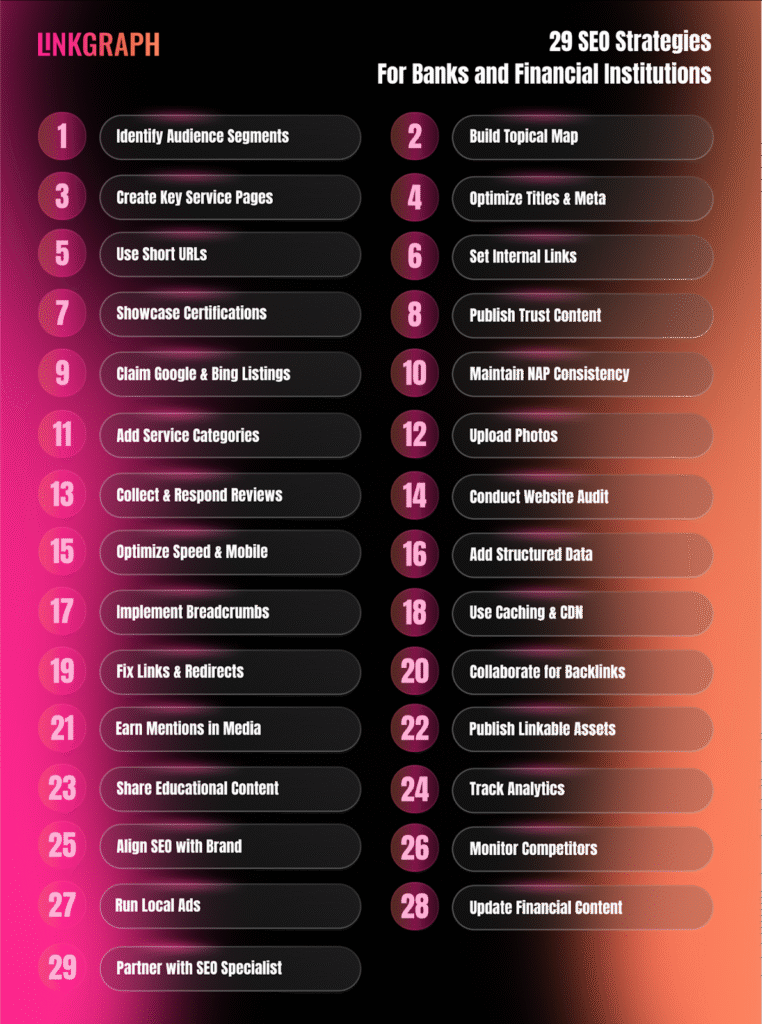
There are 29 SEO strategies for banks and financial institutions. The 29 SEO strategies for banks and financial institutions are listed below.
- Identify Target Audience Segments and Understand Their Financial Needs –
- Construct a Proper Topical Map Covering All Core Banking and Financial Services –
- Create Dedicated Pages Only for Important Services and Target Locations
- Optimize Title Tags, Meta Descriptions, Headers, and Alt Text for Each Page
- Use Short, Clean, and Topic-Focused URLs
- Establish a Logical Internal Linking Structure
- Showcase Certifications, Accreditations, and Regulatory Memberships
- Publish Trust-Building Content Highlighting Security, Compliance, and Transparency
- Claim, Verify, and Optimize Google Business Profile and Bing Places Listings
- Ensure Consistent Business Name, Address, and Phone Across All Directories
- Add Business Categories Relevant to Financial Services
- Upload High-Quality Branch Photos, Staff Images, and Facility Interiors
- Collect and Respond to Customer Reviews Promptly and Professionally
- Conduct a Full Website Audit to Fix Crawlability and Indexing Issues
- Optimize Website Speed, Mobile Responsiveness, and Accessibility Across Devices
- Add Financial Structured Data for Organization, Reviews, and Services
- Implement Breadcrumb Navigation and Structured Site Hierarchy
- Use Browser Caching, Minified Code, and CDN for Faster Load Times
- Fix Broken Links, Redirect 404 Pages, and Remove Duplicate or Thin Content
- Collaborate with Local Businesses or Financial Associations for Backlink Opportunities
- Earn Mentions in Local News, Finance Blogs, and Industry Publications
- Publish Linkable Assets Like Financial Tips, Savings Calculators, or Industry Reports
- Share Educational Content on LinkedIn, Facebook, and Community Platforms
- Track Organic Performance with Google Search Console and Analytics
- Align SEO Strategy with Overall Brand, Compliance, and Marketing Goals
- Monitor Competitors Ranking and Content Gaps for Strategic Advantage
- Run Targeted Local Ads to Support SEO Visibility in Key Service Areas
- Maintain Ongoing Content Updates for Financial Trends and Regulatory Changes
- Partner with an Experienced Financial SEO Specialist for Sustainable Growth
Following this strategic, multi-layered SEO approach ensures banks and financial institutions achieve high visibility, client acquisition, and long-term online authority. We have broken down the 29 SEO strategies for banks and financial institutions below.
1. Identify Target Audience Segments and Understand Their Financial Needs
Banks start search optimization for banks by clarifying target audience brackets and purchase intent. Organic visibility for financial institutions depends on accurate segment definitions, product alignment, and revenue priorities. SEO for lenders needs customer language, transactional queries, and regional qualifiers.
Each audience segment connects directly to topical mapping for banking SEO. Mortgage borrowers feed topical clusters about home loans, refinance terms, and rate qualification. Small business owners feed commercial banking clusters about credit lines, equipment loans, and treasury workflows.
Audience segmentation directs search optimization for financial institutions toward entity clusters instead of random keyword lists. Each cluster establishes semantic depth around a financial product. That semantic depth signals relevance for competitive queries inside the banking industry SEO.
2. Construct a Proper Topical Map Covering All Core Banking and Financial Services
Constructing a topical map organizes banking services, financial offerings, and branch locations into a structured hierarchy. The topical map defines relationships between core banking products, such as checking accounts, savings accounts, and loans, and secondary services like credit cards, mortgages, and investment planning. Linking these services through a logical map allows search engines to interpret the relevance, authority, and coverage of the website of the bank.
The topical map aligns content clusters with customer intent, connecting high-value queries to specific service pages. Branch-specific pages, product overviews, and informational content fall within the map, establishing a clear internal hierarchy. This structure enhances indexing efficiency, guiding search engine crawlers through primary and supporting pages while signaling the importance of each node in relation to the main banking services.
Maintaining and updating the topical map reinforces topical authority for both local and national searches. Adding new products, updating financial regulations, or launching seasonal offers integrates seamlessly into the map. A properly constructed topical map ensures the website of the bank communicates comprehensive coverage of financial services to search engines and prospective customers, improving visibility, relevance, and long-term SEO performance.
3. Create Dedicated Pages Only for Important Services and Target Locations
Dedicated service pages define each core banking product, branch, or financial offering, establishing clear relevance for search engines. Banks, credit unions, and financial institutions present checking accounts, savings accounts, loan types, and investment services as separate pages. Location-specific pages connect branches with nearby communities, improving local SEO performance and search visibility for queries like “bank near [city].”
Focusing only on important services and key locations prevents index dilution and preserves crawl efficiency. Each page contains targeted content, metadata, and structured data specific to the service or branch it represents. This approach avoids creating low-value or redundant pages that reduce authority signals and confuse search engines.
Regularly auditing and updating these dedicated pages maintains relevance for evolving financial products, regulatory updates, and community initiatives. Linking dedicated service and location pages within the website hierarchy enhances topical authority, user navigation, and organic search performance for banks, credit unions, and financial institutions.
4. Optimize Title Tags, Meta Descriptions, Headers, and Alt Text for Each Page
Title tags define the main topic of each page and communicate relevance to search engines. Banks, credit unions, and financial institutions use concise titles reflecting services like checking accounts, mortgage loans, or investment products. The meta title and description summarize page content, attract clicks from users searching for specific financial offerings, and shape how each listing appears in search results.
Headers (H1, H2, H3) structure content logically and highlight core banking services, branch locations, and financial solutions. Alt text for images describes branch interiors, staff, and service processes, improving accessibility and indexing for visual search.
Consistent optimization of metadata, headers, and alt text reinforces page authority and relevance for targeted queries. Structured and descriptive elements guide search engines while enhancing user experience, increasing organic traffic, and boosting local and national SEO performance for banks and financial institutions.
5. Use Short, Clean, and Topic-Focused URLs
Banks, credit unions, and financial institutions create concise URLs that clearly describe each service or branch location. URLs like /home-loans-spokane or /business-checking-accounts signal content relevance to search engines and clients. Short URLs avoid unnecessary characters, session IDs, or tracking codes, which confuse crawlers and reduce indexing efficiency.
Topic-focused URLs establish semantic clarity between the page and its target keywords. They guide users and search engines directly to specific financial offerings, such as mortgage products, savings accounts, or business banking solutions. Clear URLs enhance trust by demonstrating organized website architecture and transparency in content presentation.
Consistent URL structures complement internal linking, topical mapping, and hierarchical page organization. Structured URLs improve crawl efficiency, strengthen authority across service pages, and increase visibility for searches targeting branch locations, financial products, and specialized banking services. Well-crafted URLs enhance both technical SEO and user experience simultaneously.
6. Establish a Logical Internal Linking Structure (Root → Seed → Node)
Banks, credit unions, and financial institutions implement a hierarchical internal linking structure that connects the homepage (Root) to service categories (Seed) and individual product pages (Node). This structure guides search engine crawlers through the site efficiently and clarifies content relationships. Proper linking distributes authority from high-value pages to detailed service pages, enhancing overall site relevance.
Seed pages represent core banking services such as loans, accounts, or investment products. Nodes provide in-depth information on specific offerings, like mortgage types, checking account options, or retirement plans. Linking nodes to their corresponding seeds establishes clear topical relevance and strengthens keyword alignment across the site.
Logical internal linking improves user navigation by enabling clients to access related financial services easily. It reduces bounce rates, increases dwell time, and ensures search engines index all critical pages. This structured hierarchy reinforces authority for both local and national SEO efforts in the banking sector.
7. Showcase Certifications, Accreditations, and Regulatory Memberships (FDIC, NCUA)
Banks, credit unions, and financial institutions display certifications, accreditations, and regulatory memberships prominently to establish credibility. Showing memberships with FDIC, NCUA, or similar authorities signals compliance and operational legitimacy to both clients and search engines. This transparency strengthens trust and positions the financial entity as reliable in digital search results.
Accreditations validate security, adherence to regulations, and financial stability. Certifications highlight specialized services such as mortgage lending, investment management, or business banking. Featuring these credentials on service pages, footers, and About sections connects search engines with authoritative, verified data.
Regular updates of memberships, certifications, and compliance badges maintain accuracy and relevance. Proper placement reinforces user confidence during financial decision-making, increases click-through rates, and improves search engine perception. Structured presentation of credentials enhances both branding and SEO performance for banks and credit unions.
8. Publish Trust-Building Content Highlighting Security, Compliance, and Transparency
Banks, credit unions, and financial institutions create trust-building content to reinforce credibility with clients and search engines. Articles, guides, and FAQs that explain security protocols, regulatory compliance, and transparent practices position the bank as a reliable financial authority. Such content connects website pages to user intent while signaling expertise to search engines.
Content examples include explanations of FDIC insurance, NCUA protection, encryption practices, and data privacy policies. Publishing clear disclosures about fees, loan terms, and account policies increases transparency. Combining security details with compliance statements creates a comprehensive resource for potential customers evaluating financial services.
Regularly updating trust-focused content maintains relevance for regulatory changes, new financial products, and security advancements. Well-structured articles, blogs, and landing pages enhance user confidence, improve dwell time, and strengthen search engine authority for financial services.
9. Claim, Verify, and Optimize Google Business Profile and Bing Places Listings
Banks, credit unions, and financial institutions claim and verify their listings on Google Business Profile and Bing Places as a core business profile optimization activity that establishes local authority and entity validation. Verified listings signal to search engines that the financial institution is legitimate, increasing trust for location-based searches such as “banks near me” or “credit union [City].”
Effective business profile optimization includes completing branch details such as address, phone number, operating hours, and financial service categories. High-quality photos of branches, staff, and facilities enhance authenticity and attract clients visually. Accurate business descriptions highlight checking accounts, loans, mortgages, and investment services.
Ongoing business profile optimization ensures listings remain current with seasonal promotions, new product rollouts, or branch expansions. Responding professionally to customer reviews reinforces engagement and reliability. Financial institutions that consistently claim, verify, and optimize their listings achieve higher local rankings, increased organic traffic, and measurable improvements in customer acquisition.
10. Ensure Consistent Business Name, Address, and Phone Across All Directories
Banks, credit unions, and financial institutions maintain consistent business name, address, and phone (NAP) across all online directories to strengthen local SEO authority. Consistent NAP signals search engines that the financial entity is verified, reducing the risk of duplicate listings or conflicting information that lowers rankings.
Accurate NAP across Google Business Profile, Bing Places, and niche financial directories ensures that clients locate branches, call for inquiries, or verify services without confusion. Discrepancies in address formatting, phone numbers, or business names negatively impact local search visibility.
Regular audits of all directory listings, including industry-specific platforms, allow financial institutions to detect and correct inconsistencies. Maintaining uniform information across platforms strengthens trust signals, improves indexing for local searches, and drives higher-quality traffic for banking products and services.
11. Add Business Categories Relevant to Financial Services
Accurately defining business categories allows banks, credit unions, and financial institutions to signal service relevance to search engines, linking digital presence with actual financial offerings. Selecting categories like “Bank,” “Mortgage Lender,” “Credit Union,” or “Business Loans Provider” creates clear associations between online listings and core services, reinforcing authority for each financial product and branch location.
Proper categorization strengthens topical relevance across multiple touchpoints, connecting branch pages, product offerings, and service locations. It ensures that queries for checking accounts, mortgage services, or investment solutions match the correct business entity. Misclassification dilutes search visibility, lowers rankings, and reduces organic traffic from high-intent users.
Regular review and updates of categories capture new services, regulatory changes, or expansions into additional financial sectors. Maintaining accurate classifications enhances local SEO performance, improves map pack rankings, and communicates trustworthiness to clients seeking reliable financial services in specific areas.
12. Upload High-Quality Branch Photos, Staff Images, and Facility Interiors
Uploading professional images of branches, staff, and financial facilities establishes credibility for banks, credit unions, and financial institutions. Visual content conveys operational legitimacy, reassures prospective clients, and differentiates each entity from competitors in local and organic search results. High-quality images reflect branch ambiance, staff professionalism, and client-focused service environments, reinforcing brand authority for core banking services.
Images should highlight teller areas, loan consultation rooms, ATMs, and community service spaces. Staff portraits connect users with approachable representatives, increasing engagement for digital interactions and in-person visits. Consistency in branding, uniforms, and signage across images strengthens recognition across multiple platforms.
Proper image optimization, including descriptive alt text, correct file names, and compressed formats, improves site speed, accessibility, and search engine indexing. Structured placement of visuals across service pages, branch listings, and social profiles enhances SEO for banks, increases trust signals, and strengthens broader digital marketing objectives.
13. Collect and Respond to Customer Reviews Promptly and Professionally
Banks, credit unions, and financial institutions build trust by gathering customer reviews across platforms such as Google Business Profile, Yelp, and industry-specific directories. Customer feedback reflects service quality for loans, accounts, and advisory offerings, establishing credibility for digital users searching for reliable financial services. Positive reviews improve local SEO visibility while signaling authority and client satisfaction to search engines.
Responding professionally to reviews demonstrates active engagement and operational transparency. Addressing concerns, thanking clients for feedback, and clarifying service details strengthen relationships with current customers and reassure prospects evaluating financial products. Timely responses indicate responsiveness and reinforce confidence in banking services.
Regular monitoring of review platforms identifies patterns in service satisfaction and areas for improvement. Structured responses with clear, polite language contribute to enhanced user experience and strengthen SEO for banks. Consistent review management increases local visibility, encourages higher engagement, and drives new account openings or loan inquiries.
14. Conduct a Full Website Audit to Fix Crawlability and Indexing Issues
Comprehensive website audits allow banks, credit unions, and financial institutions to optimize SEO for banks effectively. Audits identify crawlability and indexing problems that prevent search engines from discovering service pages, loan offerings, and branch details. Technical audits ensure pages are accessible, indexed correctly, and prioritized for search visibility.
Firstly, reduce server response time to under 100ms to improve page loading and crawl efficiency. Secondly, maintain HTML crawl requests above 95% for complete content accessibility. Thirdly, keep a refresh rate around 20% to re-index updated pages accurately. Fourthly, target a discovery rate of 7–8% to prevent orphaned pages. Fifthly, perform log file analysis to identify URLs consuming the most crawl budget and redirect crawlers toward high-value pages. Sixthly, fix broken links, remove duplicates, and resolve 404 or redirect errors.
Routine technical SEO audits validate sitemaps, structured data, and mobile accessibility. Regular audits improve local and organic rankings, enhance visibility for high-intent searches, and maintain optimized website performance.
15. Optimize Website Speed, Mobile Responsiveness, and Accessibility
Financial institutions improve search visibility and client engagement when website speed, mobile responsiveness, and accessibility are optimized. Fast-loading pages reduce bounce rates while responsive designs maintain a consistent experience across smartphones, tablets, and desktops. Accessibility features ensure all users navigate and consume content efficiently, reinforcing SEO for banks’ objectives and regulatory compliance.
Key speed improvements include compressing images, minimizing HTTP requests, reducing CSS and JavaScript file sizes, enabling browser caching, and deploying a content delivery network (CDN) to decrease latency. Mobile optimization relies on flexible grids, scalable visuals, and adaptive frameworks to sustain usability on diverse screen sizes.
Periodic performance evaluations with tools such as Google PageSpeed Insights, Lighthouse, or GTmetrix highlight inefficiencies and prioritize corrective measures. Optimizing website speed, mobile responsiveness, and accessibility enhances crawl efficiency, increases page indexation, strengthens user engagement, and generates higher-quality organic traffic for banks, credit unions, and financial institutions.
16. Add Financial Structured Data for Organization, Reviews, and Services
Implementing structured financial data allows banks, credit unions, and financial institutions to define their digital presence precisely for search engines. Organization schema communicates verified details such as business name, address, phone number, and operating hours, linking official data to online search results. Review schema presents customer ratings, testimonials, and feedback, increasing trust signals and enabling rich snippet appearances.
Service schema specifies offerings like checking accounts, mortgages, business loans, or investment products, clarifying relevance for both local and national searches. Applying structured data across pages, review sections, and branch locations strengthens semantic relationships and entity recognition.
Consistent validation prevents schema errors, while periodic updates reflect new services or compliance changes. Structured data increases indexation efficiency, enhances search visibility, and reinforces credibility for banks, credit unions, and financial institutions, aligning technical SEO with organizational objectives.
17. Implement Breadcrumb Navigation and Structured Site Hierarchy
Breadcrumb navigation organizes bank, credit union, and financial institution websites into a clear, hierarchical structure that search engines interpret efficiently. Each breadcrumb trail shows the relationship between main sections, service pages, and location-specific content, allowing search engines to crawl and index content logically.
A structured site hierarchy guided by breadcrumb navigation helps users move through core banking products, loan services, and investment offerings while signaling relevance to search engines. Consistent hierarchy improves internal linking, distributes page authority, and reduces orphaned content.
Proper implementation of breadcrumb navigation enhances usability and SEO performance. It ensures search engines and clients understand page context, connects related services effectively, and strengthens technical SEO goals for financial institutions, improving visibility in competitive search results.
18. Use Browser Caching, Minified Code, and CDN for Faster Load Times
Implementing browser caching allows websites of banks, credit unions, and financial institutions to store static elements like images, scripts, and stylesheets on the devices of users. This reduces repeated server requests and accelerates page loading for returning visitors. Minified code compresses HTML, CSS, and JavaScript files, lowering file size and improving render efficiency, which benefits both branch service pages and loan or account application sections. Content Delivery Networks (CDNs) distribute website content across multiple servers globally, ensuring users access pages quickly regardless of location.
Combining caching, minification, and CDNs enhances website responsiveness for online banking, investment tools, and educational resources. Faster load times decrease bounce rates, increase engagement with interactive calculators and service forms, and improve session duration. Users experience seamless navigation through loan applications, savings account details, and financial product guides, which directly impacts lead capture and conversions.
Technical SEO benefits from optimized load performance. Search engines recognize websites with fast page speed, efficient server response, and stable content delivery. These improvements increase crawl efficiency, indexation accuracy, and visibility for searches related to local branches, mortgage rates, and financial services, boosting overall online authority for banks and credit unions.
19. Fix Broken Links, Redirect 404 Pages, and Remove Duplicate or Thin Content
Broken links, 404 errors, and duplicate content reduce usability and harm search engine rankings for banks, credit unions, and financial institutions. Identifying broken links across service pages, loan calculators, and blog posts ensures users reach active content without interruption. Redirecting 404 pages to relevant alternatives preserves link equity and maintains smooth navigation across mortgage, savings, and investment sections.
Duplicate or thin content, such as repeated service descriptions or minimal informational pages, dilutes relevance and lowers authority signals. Consolidating or removing these pages strengthens topical focus and improves indexation efficiency for financial products, account types, and branch services.
Regular maintenance of internal and external links preserves crawl efficiency and ensures search engines interpret website hierarchy accurately. Optimized link structure enhances user experience for online banking tools, loan applications, and branch information while strengthening long-term SEO performance for local and national financial search queries.
20. Collaborate with Local Businesses or Financial Associations for Backlinks
Partnering with local businesses and financial associations increases credibility and authority for banks, credit unions, and financial institutions. Establishing collaborations with nearby accounting firms, investment advisors, or regional financial groups allows websites to acquire high-quality backlinks that signal trustworthiness to search engines.
Joint initiatives, such as co-hosted webinars, financial literacy workshops, or community sponsorships, generate editorial mentions and referral traffic. These backlinks strengthen domain authority for core banking pages, loan services, and investment offerings.
Consistent engagement with local partners sustains backlink value over time. Structured collaboration ensures links originate from relevant, reputable sources, enhancing search visibility for service areas, branch locations, and specialized financial products while strengthening long-term SEO growth and organic lead generation.
21. Earn Mentions in Local News, Finance Blogs, and Industry Publications
Securing mentions in local news outlets, finance blogs, and industry publications increases visibility for banks, credit unions, and financial institutions. Media coverage signals authority and trustworthiness to search engines while promoting services such as loans, checking and savings accounts, mortgages, and investment products to a wider audience.
Banks engage journalists, provide expert financial commentary, submit press releases, or contribute thought leadership articles to finance blogs and industry portals. Highlighting regulatory compliance, security measures, and community involvement strengthens credibility and positions the institution as a reliable source of financial information.
Regular media contributions generate referral traffic, expand the backlink profile, and enhance domain authority. Structured and strategic media placements improve search rankings for core banking services, branch locations, and financial solutions. This sustained exposure strengthens long-term SEO, bolsters local presence, and reinforces consumer trust in a competitive financial marketplace.
22. Publish Linkable Assets Like Financial Tips and Calculators
Creating linkable assets such as financial tips, savings calculators, loan comparison tools, and industry reports positions banks and financial institutions as authoritative resources. These assets provide measurable value to users, including prospective customers researching mortgages, business loans, or investment options.
Educational guides, infographics, and interactive tools attract backlinks from finance blogs, local media, and community websites. High-quality resources signal expertise and authority to search engines while increasing organic traffic for core services, branch locations, and specialized financial products.
Regularly updating and promoting these assets strengthens the digital footprint of an institution. Structured linkable content improves referral traffic, enhances user engagement, and boosts local SEO by associating the bank with trusted, actionable financial information. This approach fosters sustained visibility, higher rankings, and qualified lead generation across multiple search queries.
23. Share Educational Content on LinkedIn, Facebook, and Community Platforms
Distributing educational content on LinkedIn, Facebook, and relevant community platforms amplifies the online presence of banks and financial institutions. Sharing articles on personal finance, loan guidance, and investment tips engages potential customers and positions the bank as a knowledgeable resource.
Consistent posting of insights, infographics, and case studies builds visibility among local communities, small business owners, and professional networks. Engagement through comments, shares, and discussions signals authority to search engines while driving referral traffic to the website and service pages of the bank.
Leveraging social channels strengthens brand awareness, encourages community interaction, and improves SEO relevance for core financial services. Structured content distribution ensures that financial guidance reaches target audiences efficiently, reinforcing credibility, trust, and customer acquisition for both national and regional banking entities.
24. Track Organic Performance with Google Search Console and Analytics
Monitoring organic performance using Google Search Console and Analytics allows banks and financial institutions to measure the effectiveness of SEO strategies. These platforms record impressions, clicks, average positions, and user behavior, providing a clear picture of how service pages and blog content perform.
Analysis of traffic sources, conversion paths, and page engagement identifies high-performing content and areas needing improvement. Tracking keyword rankings, click-through rates, and bounce rates informs data-driven adjustments to title tags, meta descriptions, and internal linking structures.
Regular reporting ensures that SEO initiatives align with marketing goals, compliance standards, and audience needs. Continuous measurement strengthens visibility for core banking services, reinforces trust signals, and maintains sustainable growth for both national and community banks.
25. Align SEO Strategy with Brand, Compliance, and Marketing Goals
Integrating SEO strategy with brand identity, regulatory compliance, and marketing objectives ensures consistency across all digital channels for banks and financial institutions. Alignment maintains clear messaging, reflects organizational values, and reinforces trust signals critical in financial services.
Coordination with compliance teams guarantees that content adheres to regulatory standards, including disclosures, disclaimers, and security guidelines, minimizing risk while maximizing search visibility. Marketing alignment connects SEO efforts with broader campaigns, promoting product launches, seasonal offers, and community initiatives efficiently.
Consistent strategy integration strengthens brand authority, improves user experience across service pages, and reinforces credibility in search results. This approach maximizes return on SEO investment, sustains high rankings for banking products, and drives qualified traffic for both national and regional financial entities.
26. Monitor Competitor Rankings and Content Gaps
Tracking competitor rankings and analyzing content gaps allows banks and financial institutions to identify opportunities for growth in search visibility. Competitor audits reveal which financial products, services, and topics perform best, highlighting areas where the website of the bank lacks coverage.
Comparing keyword rankings, backlink profiles, and content depth exposes weaknesses in existing pages, enabling strategic adjustments in on-page, technical, and off-page SEO. This ensures alignment with user search intent for loans, accounts, and other banking services.
Filling content gaps with authoritative, compliant information strengthens domain authority, increases relevance for high-intent queries, and improves rankings. Continuous competitor monitoring maintains a competitive edge, captures potential market share, and drives qualified leads to both online and branch locations.
27. Run Targeted Local Ads to Support SEO Visibility
Running localized ad campaigns strengthens SEO strategies by amplifying the visibility of a bank within specific geographic markets. Targeted digital ads on platforms such as Google Ads, Facebook, and LinkedIn highlight individual branches, financial products, and promotions to users actively searching for banking services. These campaigns complement organic rankings by capturing immediate clicks while search engine optimization establishes long-term authority.
Segmenting audiences by location, demographics, and search intent allows banks to deliver personalized ad creatives for services like mortgages, business loans, or savings accounts. Ads tied to local queries, such as “credit union near me” or “commercial lending [City],” reinforce branch-specific SEO efforts and increase the likelihood of converting high-intent users into clients.
Monitoring campaign performance through click-through rates, conversion metrics, and local engagement informs adjustments in both paid and organic strategies. Integrating insights from ad analytics with Google Search Console data optimizes targeting, improves budget efficiency, and strengthens the overall digital presence of financial institutions.
28. Maintain Ongoing Content Updates for Financial and Regulatory Changes
Banks and financial institutions strengthen their SEO presence by regularly updating website content to reflect regulatory changes, new financial products, and industry developments. Fresh content signals relevance to search engines and assures users that the bank or credit union provides accurate, up-to-date information. This ongoing update process maintains authority across both corporate and branch pages.
Updating includes revising product descriptions, interest rates, compliance notices, and FAQ sections to reflect current financial standards. Educational blogs, whitepapers, and news articles covering market trends or regulatory updates enhance topical depth, internal linking, and topical mapping strategies.
Consistency in content updates reduces the risk of outdated information, improves user experience, and increases dwell time on critical pages. These updates assist search engines in indexing new pages effectively, maintaining high rankings for local and national queries, and reinforcing the reliability of the institution for prospective and existing clients.
29. Partner with an Experienced Financial SEO Specialist for Sustainable Growth
Banks and financial institutions achieve long-term SEO success by collaborating with a specialized financial SEO expert. A dedicated SEO specialist applies industry-specific knowledge, optimizing banking websites, branch pages, and financial service content to improve search visibility and organic traffic. This expert integrates technical SEO, on-page strategies, and local optimization tailored to compliance-heavy financial sectors.
An experienced specialist identifies high-value keywords, analyzes competitor strategies, and constructs topical maps covering banking products, loans, investments, and account services. They implement structured data, optimize internal linking, and monitor website performance metrics to ensure consistent rankings for both national and local searches.
Ongoing guidance from a financial SEO professional reduces errors, enhances content relevance, and aligns SEO actions with brand objectives and regulatory requirements. Partnering with an expert ensures banks maintain sustainable online growth, attract high-intent customers, and improve ROI on digital marketing investments.
What Are the Most Common SEO Mistakes That Banks and Financial Institutions Should Avoid?
Banks and financial institutions frequently make SEO errors that reduce search visibility and limit lead generation. Avoiding these SEO mistakes strengthens online presence and ensures optimized performance for banking and financial service websites. The most common SEO mistakes that banks and financial institutions should avoid are listed below.
- Ignoring Proper Google Business Profile and Bing Places Optimization: Missing or incomplete listings reduce local search rankings.
- Overlooking Website Speed and Mobile Responsiveness: Slow-loading or non-responsive sites increase bounce rates and lower user engagement.
- Neglecting Consistent Review Collection and Response: Lack of review management weakens trust signals and online credibility.
- Creating Thin or Duplicate Content Across Service Pages: Repetitive or low-value content diminishes authority and indexing efficiency.
- Failing to Implement Structured Data and Breadcrumbs: Without structured markup, search engines struggle to interpret business entities and page hierarchy.
- Not Monitoring Technical SEO or Competitor Strategies: Ignoring crawl errors, broken links, or competitor gaps limits ranking potential.
Avoiding these common pitfalls ensures banks and financial institutions maintain strong SEO performance and capture high-intent search traffic.
When Is the Best Time for Banks and Financial Institutions to Start Investing in SEO?
Banks achieve maximum impact by starting SEO early, ideally at website launch or before major service expansions. Early implementation improves indexing, local visibility, and authority before seasonal spikes like tax season or mortgage cycles. Starting SEO later delays lead generation and reduces competitive advantage. Initiating SEO at foundational growth stages captures high-intent search traffic while building a reliable online presence efficiently.
How Long Does It Typically Take for SEO to Generate Leads for Banks and Financial Institutions?
SEO for banks and financial institutions typically generates measurable leads within 4 to 6 months of consistent implementation. Competitive markets, website quality, content depth, and technical SEO status affect the timeline. High-authority domains with strong local optimization often see faster results, while new sites require longer to build trust and rankings. Consistent publishing, backlink acquisition, and technical maintenance accelerate lead generation. Seasonal financial cycles, such as tax season or mortgage periods, influence traffic peaks and conversion timing.
Is Local SEO Sufficient for Banks and Credit Unions to Consistently Attract Customers?
Local SEO for banks and credit unions drives nearby customer discovery and branch visits. It captures high-intent searches like “bank near me” or “credit union [city]” effectively. However, relying solely on local SEO limits reach for broader financial products, online accounts, and nationwide services. Combining local SEO with technical optimization, content marketing, and authority-building strategies ensures sustained customer acquisition, higher visibility for specific offerings, and consistent growth across digital and physical channels.
Which Online Directories and Platforms Are Most Valuable for Banks and Financial Institutions to Be Listed On?
Listing banks and financial institutions on authoritative directories and platforms improves local visibility, strengthens credibility, and increases search engine trust. Key platforms include:
- Google Business Profile: Establishes verified local presence and boosts map rankings.
- Bing Places for Business: Captures users from the Microsoft search ecosystem and enhances local discovery.
- Yelp: Provides reviews and credibility signals for branches and financial services.
- Better Business Bureau (BBB): Highlights trustworthiness and industry accreditation for financial institutions.
- Foursquare: Offers location-based discovery for regional branches and ATM services.
- Trustpilot: Displays client reviews to reinforce reputation and reliability.
- Credit Union Directories: Lists credit unions and specialized financial institutions for targeted audience access.
- Local Chamber of Commerce Websites: Strengthens authority through verified local business listings.
Consistent, accurate listings across these platforms reinforce search engine confidence, improve local SEO, and drive both online and branch traffic.
Is SEO More Cost-Effective Than PPC for Banks and Other Financial Service Providers?
Yes, SEO drives lower acquisition costs than PPC for any bank or financial institution. In a direct SEO vs PPC comparison, organic search produces steady lead volume without budget exhaustion, while paid ads stop as soon as funding ends. SEO vs PPC also shows compounding returns through higher rankings, stronger authority signals, and consistent discovery for terms like mortgage rates or business loans.
PPC generates short-term visibility, yet cost-per-click in finance stays high and drains margins fast. By contrast, SEO delivers sustainable lead flow for loans, accounts, and credit products at scale, making the long-term SEO vs PPC cost advantage clear for banks and financial institutions.
Can Small or Community Banks Manage Their SEO Effectively on Their Own?
No, Community banks lack internal bandwidth for technical audits, content production, and regulatory alignment. Banking SEO requires keyword analysis, topical architecture, structured data, and link acquisition. Small teams rarely manage those functions with precision. External specialists guide financial compliance, build transactional pages, and correct crawl waste. That partnership protects resources and drives predictable growth.
What Key Factors Should Banks and Financial Institutions Consider Before Hiring an SEO Agency?
Banks and financial institutions require an SEO agency with technical depth, regulatory awareness, and sector-specific expertise. A financial institution operates under compliance scrutiny, so an agency selection process demands evaluation of competence, workflow, and accountability. A bank that evaluates each screening variable limits operational risk and promotes predictable acquisition efficiency.
- Sector Experience in Banking and Finance: An agency that understands FDIC-regulated entities speaks the language of deposit accounts, loan underwriting, and wealth segments. This sector familiarity shortens onboarding friction and prevents generic keyword targeting. A financial institution gains topical relevance in mortgage terms, retirement products, treasury services, and commercial lending.
- Compliance-Aligned Content Capabilities: SEO content for a bank qualifies as YMYL material, so each article demands accuracy. An agency must follow fair-balance rules and avoid misleading rate statements. A compliance-aligned workflow protects brand integrity in loan disclosures, rate language, and risk disclaimers.
- Transparent Technical Methodology: The agency must disclose how it measures crawl requests, server response benchmarks, indexation, internal PageRank flow, and structured data markup. A financial institution expects clarity in dashboards, log analysis, and roadmap documents.
- Proven Acquisition Outcomes Not Vanity Metrics: A bank requires deposit growth, funded loan files, and appointment requests. An agency that speaks only of impressions or generic traffic signals misalignment. Evidence of funded mortgages, business account conversions, or credit-card acquisitions reflects a mature pipeline.
- Secure Data Governance and Reporting Discipline: The agency must follow strict credential protocols in analytics dashboards, CRM platforms, and GSC permissions. A bank cannot risk improper data handling across branch networks and corporate teams.
A deliberate screening process positions a financial institution for stable rankings and predictable demand generation. A careful assessment filters vendors that lack financial literacy and compliance maturity.
Who Provides the Most Reliable SEO Services for Banks and Financial Institutions Near Me?
LinkGraph provides the most reliable SEO services for banks and financial institutions, positioning itself as the best SEO agency for banks and financial institutions. Proven case studies demonstrate measurable improvements in organic traffic, local search rankings, and lead generation for regional banks, community credit unions, and national financial institutions.
Client testimonials highlight enhanced visibility for core services like loans, accounts, and wealth management. LinkGraph’s specialized strategies include technical SEO audits, on-page optimization, local SEO, content creation, and competitor analysis, ensuring compliance with financial regulations while driving measurable growth.
Financial institutions benefit from structured approaches to Google Business Profile optimization, backlink acquisition, and ongoing performance tracking. This expertise differentiates LinkGraph, making it a trusted partner for banks seeking consistent organic visibility, increased customer acquisition, and long-term ROI in a competitive financial services market.
What Types of SEO Services Does LinkGraph Offer for Banks and Financial Institutions?
LinkGraph offers specialized SEO services tailored for banks and financial institutions, addressing unique challenges in the highly regulated financial sector. LinkGraph’s services focus on improving search visibility, attracting high-intent clients, and maintaining compliance while strengthening online authority.
LinkGraph provides a full suite of SEO solutions for banks and financial institutions, which are listed below.
- On-Page SEO for Banks: Optimizes titles, meta descriptions, headers, and internal linking for compliance and relevance.
- Local SEO for Banks: Improves visibility for local branches and “near me” searches.
- Technical SEO for Banks: Ensures crawlability, fast loading times, mobile responsiveness, and structured data.
- Off-Page SEO for Banks: Builds authoritative backlinks and enhances domain credibility.
- Content Creation for Banks: Develops blogs, FAQs, calculators, and financial guides tailored to client queries.
- Schema Markup Implementation for Banks: Adds structured data for organization, reviews, and services.
- Competitor Analysis for Banks: Identifies gaps, uncovers opportunities, and benchmarks performance against peers.
- Online Reputation Management for Banks: Monitors and manages reviews, improving credibility and customer trust.
These services collectively strengthen bank visibility, client acquisition, and sustained digital growth.
How Much Do LinkGraph SEO Services Cost for Banks and Financial Institutions?
LinkGraph’s SEO services for banks range from $2,500 to $8,000 per month, depending on branch locations, service scope, and campaign complexity. Pricing covers on-page SEO, local SEO, technical audits, structured data, content creation, and off-page backlink strategies. Smaller community banks pay toward the lower end, while national banks with multi-branch needs reach the higher range. Costs reflect customized strategies that drive sustained visibility, higher-quality leads, and reduced reliance on paid advertising.
What Other Industries Can Benefit From LinkGraph SEO Services?
LinkGraph delivers specialized SEO strategies that drive measurable growth across multiple service-oriented and competitive industries. Other industries that can benefit from LinkGraph’s SEO services are listed below.
- Healthcare Providers: Hospitals, clinics, and dental practices gain local visibility and patient acquisition.
- Legal Services: Law firms increase leads through targeted practice area and location SEO.
- Real Estate Agencies: Agents and brokers improve property search rankings and capture homebuyers.
- Home Services: Plumbers, electricians, HVAC, and cleaning companies attract nearby customers efficiently.
- Financial Services: Credit unions, mortgage lenders, and investment firms boost trust and visibility.
- Education & Training: Schools, universities, and online course providers expand enrollment and reach.
These industries benefit from LinkGraph’s data-driven SEO tactics that enhance online authority, local visibility, and organic lead generation.
