
SEO for coworking spaces focuses on increasing local visibility for shared offices, flexible workspaces, and membership-based locations. Coworking spaces operate as physical environments that rely on proximity-driven demand, immediate intent, and local trust signals. SEO for coworking spaces aligns website structure, local listings, content relevance, and technical stability with how professionals search for nearby workspaces.
This guide explains how coworking SEO improves discovery, tours, and memberships through local optimization, on-page structure, technical performance, and authority signals. SEO advantages include Map Pack visibility, qualified traffic, lower acquisition cost, and predictable demand generation. Effective coworking SEO connects location data, workspace features, pricing clarity, and booking paths into a unified search presence.
Agency selection directly impacts results for coworking spaces operating in competitive urban markets. Specialized execution across GBP management, topical mapping, citation control, and conversion tracking determines occupancy outcomes. This SEO implementation guide summarizes strategies, timelines, costs, and evaluation criteria that drive sustainable coworking growth through SEO.

What Is a Coworking Space?
A coworking space refers to a shared workplace that enables flexible office usage through short-term access models. This shared office environment hosts freelancers, remote staff, startups, and enterprise teams within one managed location. The coworking workspace combines desks, private offices, meeting rooms, and utilities under a single membership structure.
What functional elements define a coworking workspace? A coworking workspace includes internet connectivity, enclosed offices, meeting facilities, and shared amenities. This shared office structure operates through hourly, daily, or monthly access plans. The coworking environment reduces fixed lease exposure while centralizing operational infrastructure for multiple occupants.
Why did the shared office model emerge within modern work culture? The shared office model originated as a response to remote work isolation and startup cost pressure. Coworking spaces evolved into collaboration hubs that enable professional interaction and resource pooling. This coworking environment sustains productivity through spatial design, community norms, and operational efficiency.
What Does SEO Mean for Coworking Spaces?
SEO for coworking spaces refers to search optimization for shared workspaces with a local commercial intent. Coworking space SEO targets visibility for flexible offices, private desks, and membership-based workplaces. This coworking SEO framework aligns location signals, page structure, and conversion paths with search demand.
What activities define SEO for coworking spaces? SEO for coworking spaces uses location-based keywords, service-specific landing pages, and local entity profiles. Coworking SEO applies city modifiers, workspace intent terms, and structured business data. Shared workspace SEO connects mobile access, page speed, and crawl clarity with tour requests.
How does coworking space SEO drive commercial outcomes? Coworking space SEO converts local search demand into visits, tours, and memberships. Flexible office SEO maps queries to pricing pages, availability pages, and contact paths. Coworking SEO links reputation signals, reviews, and proximity data with ranking eligibility.
Why Is SEO Important for Coworking Spaces?
SEO for coworking spaces drives local discoverability for shared offices and flexible workspaces. Coworking space SEO connects search demand with physical locations through geographic relevance. This coworking SEO system influences visibility, foot traffic, and membership growth. The factors that make SEO important for coworking spaces are listed below.
- Increased local visibility: Coworking SEO places shared workspace listings within local results and map interfaces. Flexible office SEO aligns location signals with proximity-based queries. This coworking space SEO exposure increases walk-in and tour activity.
- Higher intent lead acquisition: Shared workspace SEO targets queries linked to private offices, desks, and short-term access. Coworking SEO filters research traffic in favor of transactional demand. This flexible office SEO pattern improves booking efficiency.
- Competitive positioning against larger operators: Coworking space SEO favors relevance and proximity over brand scale. Shared office SEO strengthens independent workspace rankings through local signals. This coworking SEO structure offsets chain dominance.
- Reputation and authority signals: Flexible workspace SEO integrates reviews, citations, and entity data. Coworking SEO associates trust metrics with location profiles. This shared workspace SEO linkage affects ranking eligibility.
- Cost efficiency across acquisition channels: Coworking space SEO compounds visibility without recurring bid costs. Flexible office SEO sustains demand capture across time. This shared office SEO model stabilizes acquisition spend.
- Community-based demand reinforcement: Coworking SEO connects local content with neighborhood intent. Shared workspace SEO reflects events, members, and regional activity. This flexible office SEO alignment increases local relevance.
SEO for coworking spaces functions as a demand capture system that links local search behavior with physical workspace conversion paths.
What Are the Best Ways to Get Started with SEO for Coworking Spaces?
The best ways to get started with SEO for coworking spaces are to establish a structured foundation for local search acquisition. Coworking space SEO aligns location data, service signals, and technical readiness with workspace demand. This coworking SEO setup connects discovery queries with tours, bookings, and memberships.
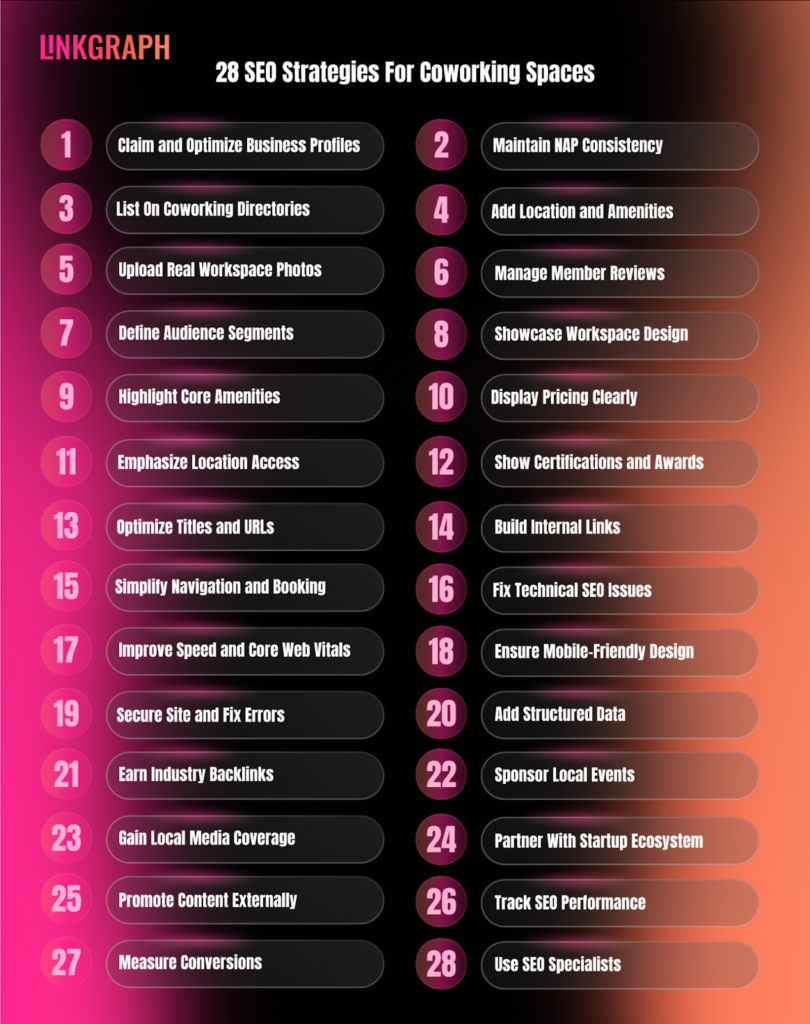
There are 28 SEO strategies for coworking spaces. The 28 SEO strategies for coworking spaces are listed below.
- Claim, Verify, and Fully Optimize Google, Bing, and Apple Business Listings
- Maintain Consistent Name, Address, and Phone (NAP) Across All Directories
- List Your Coworking Space on Trusted Local and Coworking-Specific Directories
- Include Accurate Location, Maps, Business Hours, Contact Info, and Key Amenities
- Upload Authentic Photos of Offices, Meeting Rooms, and Workspace Facilities
- Encourage Member Reviews and Respond Professionally to All Feedback
- Define Target Audience Segments and Their Workspace Requirements
- Showcase Modern, Functional, and Aesthetically Designed Workspaces
- Highlight Essential Features Like Fast Wi-Fi, Meeting Rooms, and Private Cabins
- Clearly Display Pricing, Membership Plans, and Payment Options
- Emphasize Prime Location, Easy Accessibility, and Transport Links
- Highlight Certifications, Awards, or Recognitions for Credibility
- Optimize Page Titles, Meta Descriptions, and URLs for Each Page
- Implement Clear Internal Linking Structure (Root → Seed → Node)
- Simplify Navigation and Enhance UX/UI for Smooth Browsing and Booking
- Conduct a Full Website Audit and Resolve All Technical SEO Issues
- Improve Page Speed, Mobile Responsiveness, and Core Web Vitals
- Ensure Mobile-Friendly, Accessible, and Professional Website Design
- Secure Your Website With HTTPS and Fix Broken Links, Redirects, and Errors
- Apply Structured Data Markup for Local Business, Coworking Spaces, and Events
- Build Quality Backlinks From Coworking Associations, Startup Hubs, and Industry Partners
- Sponsor Local Events, Workshops, and Hackathons to Earn Backlinks
- Get Featured in Local Media, Press Releases, and News Outlets
- Collaborate With Startups, Accelerators, and Incubators for Cross-Promotion
- Promote Content on LinkedIn, Medium, and Industry Forums to Gain Mentions
- Track SEO Performance Using Google Analytics, Search Console, and Booking Metrics
- Measure Leads, Tour Bookings, Membership Sign-Ups, and Event Registrations
- Work With SEO Professionals for Ongoing Optimization and Strategy Refinement
SEO for coworking spaces advances through disciplined execution across local, on-page, technical, and authority signals. We have broken down the 28 SEO strategies for coworking spaces below.
Local SEO strategies 1 to 6 focus on increasing visibility for coworking spaces in nearby local searches.
1. Claim, Verify, and Fully Optimize Google, Bing, and Apple Business Listings
Claiming and optimizing business listings establishes a coworking space as a verified local entity. This local listing optimization process connects shared workspaces with map-based discovery systems. Coworking space SEO relies on Google Business Profile, Bing Places, and Apple Business Connect for location authority.
Why does local listing optimization influence coworking space visibility? Local listing optimization affects Map Pack eligibility and proximity scoring. Coworking space SEO depends on verified GBP data for geographic trust. This business profile optimization layer filters legitimate shared offices from unverified competitors.
How does a coworking operator perform business profile optimization correctly? Execution starts with claiming GBP, Bing Places, and Apple Business Connect profiles. Local profile optimization requires exact name, address, and phone number consistency. Coworking SEO applies accurate categories, amenity details, workspace photos, and operating hours.
What ranking impact follows complete business listing optimization? Coworking space SEO gains stronger Map Pack impressions and branded search presence. Local listing optimization increases direction requests, calls, and tour submissions. This business profile optimization process converts local search demand into memberships.
2. Maintain Consistent Name, Address, and Phone (NAP) Across All Directories
Maintaining consistent name, address, and phone data establishes identity stability for coworking spaces across the local search ecosystem. This NAP consistency strategy functions as citation consistency and business data uniformity. Coworking space SEO relies on identical business attributes across directories, maps, and aggregators. This local data alignment reduces entity ambiguity for shared offices.
Why does NAP consistency matter for coworking space SEO rankings? NAP consistency matters since local algorithms evaluate trust through repeated business data matches. Coworking space SEO strengthens location confidence through citation consistency. This business data uniformity increases eligibility for Map Pack placement and local ranking stability.
How does a coworking operator enforce citation consistency across directories? Execution starts with defining a single canonical business name, address, and phone format. Coworking SEO applies this reference across GBP, Apple Business Connect, Bing Places, and directories. Citation audits identify mismatches, duplicates, and outdated records. Corrections follow through direct edits and aggregator submissions.
What ranking outcomes follow strong business data consistency? Coworking space SEO gains stronger local authority and reduced ranking volatility. Citation consistency improves proximity trust and branded query performance. This NAP alignment increases calls, direction requests, and qualified tour demand.
3. List Your Coworking Space on Trusted Local and Coworking-Specific Directories
Listing a coworking space on trusted directories establishes third-party validation across local search ecosystems. This directory listing strategy operates through local citations and industry-specific directories. Coworking space SEO uses these directory references to confirm business existence and category relevance. Shared workspace SEO benefits from consistent placement within coworking, startup, and local business indexes.
Why do directory listings matter for coworking space SEO authority? Directory listings influence trust scoring through repeated entity confirmation. Coworking space SEO benefits from citations that reference verified locations. Shared workspace SEO gains topical reinforcement from coworking-focused platforms.
How does a coworking operator execute directory listing placement correctly? Execution begins with a directory selection that matches location and industry relevance. Coworking SEO prioritizes local chambers, coworking platforms, and startup directories. Shared workspace SEO applies consistent name, address, and phone data across listings. Descriptions reference workspace types, access models, and amenities with factual language.
What ranking impact follows consistent directory citation coverage? Coworking space SEO records stronger local authority and ranking stability. Directory listing consistency improves Map Pack eligibility and branded query performance. Shared workspace SEO converts citation trust into increased tours and membership inquiries.
4. Include Accurate Location, Maps, Business Hours, Contact Info, and Key Amenities
Accurate business information defines how coworking spaces appear across local search surfaces. This location data strategy functions as operational data completeness and on profile information accuracy. Coworking space SEO depends on precise coordinates, contact fields, and amenity attributes. Shared workspace SEO uses these data points as ranking and eligibility signals.
Why does accurate operational data matter for coworking space SEO visibility? Accurate data affects local ranking confidence and user action triggers. Coworking space SEO relies on correct hours and contact fields for intent matching. This workspace data accuracy reduces user friction during evaluation stages.
How does a coworking operator implement full location and amenity accuracy? Implementation starts with verified address pins and embedded map accuracy. Coworking SEO applies consistent hours across weekdays, weekends, and holidays. Shared workspace SEO lists amenities such as desks, offices, meeting rooms, and internet access. Contact fields include phone numbers and inquiry links with direct routing.
What ranking outcomes follow complete and accurate business information? Coworking space SEO gains stronger local relevance and engagement signals. Workspace data accuracy increases calls, direction requests, and visit actions. This operational data strategy converts local discovery into physical workspace demand.
5. Upload Authentic Photos of Offices, Meeting Rooms, and Workspace Facilities
Uploading authentic workspace photos establishes visual verification for coworking spaces across local platforms. This photo optimization strategy operates through visual evidence, image relevance, and profile completeness. Coworking space SEO uses real imagery to confirm physical presence and workspace quality. Shared workspace SEO treats original photos as trust and engagement signals.
Why do authentic workspace photos matter for coworking space SEO visibility? Authentic photos influence local ranking confidence and user interaction rates. Coworking space SEO benefits from higher engagement on GBP listings that feature real interiors. This visual verification layer reduces skepticism for shared offices and flexible workspaces.
How does a coworking operator execute workspace photo optimization correctly? Execution begins with uploading original images of entrances, desks, offices, and meeting rooms. Coworking SEO prioritizes well-lit photos with accurate layouts and signage. Shared workspace SEO updates images regularly to reflect current setups and amenities. Captions reference workspace types and facilities with factual descriptions.
What ranking impact follows consistent photo optimization? Coworking space SEO records higher click-through rates and listing interactions. Visual evidence increases direction requests and tour interest. This photo optimization strategy strengthens Map Pack performance and membership inquiries.
6. Encourage Member Reviews and Respond Professionally to All Feedback
Encouraging member reviews establishes reputation signals for coworking spaces across local platforms. This review acquisition strategy functions as reputation management and feedback visibility. Coworking space SEO uses reviews as trust indicators tied to location entities. Shared workspace SEO treats review volume, recency, and sentiment as ranking inputs.
Why do member reviews influence coworking space SEO performance? Member reviews influence local ranking confidence and click behavior. Coworking space SEO correlates positive review patterns with Map Pack eligibility. This reputation management layer differentiates shared offices within dense local markets.
How does a coworking operator execute review acquisition and response management? Execution begins with requesting reviews after tours, renewals, or onboarding milestones. Coworking SEO applies direct GBP review links within email and member portals. Review management includes timely responses that address feedback with factual clarity. Shared workspace SEO maintains a consistent tone across positive and negative entries.
What ranking outcomes follow structured review management? Coworking space SEO records higher visibility and engagement across local results. Review acquisition increases listing interactions and trust signals. This reputation strategy converts local interest into tours, renewals, and long-term memberships.
On-Page SEO strategies 7 to 15 focus on website content, user intent, and clear navigation for coworking spaces.
7. Define Target Audience Segments and Their Workspace Requirements
Defining target audience segments establishes relevance alignment between coworking spaces and search demand. This audience segmentation strategy operates through user classification and intent grouping. Coworking space SEO uses defined segments to structure topical mapping across service pages. Shared workspace SEO aligns workspace offerings with identifiable search patterns.
Why does audience segmentation matter for coworking space SEO structure? Audience segmentation matters since search intent varies across freelancers, startups, and enterprise teams. Coworking space SEO depends on matching queries with precise workspace needs. This topical mapping method improves relevance scoring and reduces keyword dilution across pages.
How does a coworking operator define segments and map topics correctly? Execution starts with grouping users by workspace type, duration needs, and team size. Coworking SEO maps each segment to dedicated pages such as private offices, dedicated desks, or meeting rooms. Shared workspace SEO builds topic clusters that connect core pages with supporting content. This topical mapping structure clarifies the page’s purpose for search engines.
What ranking impact follows audience-driven topical mapping? Coworking space SEO gains stronger topical authority and keyword alignment. Segmented mapping improves page focus and ranking stability. This audience strategy increases qualified traffic, tour intent, and membership conversions.
8. Showcase Modern, Functional, and Aesthetically Designed Workspaces
Showcasing modern, functional, and aesthetically designed workspaces communicates value through visual and structural representation. This workspace presentation strategy functions as design representation and spatial merchandising. Coworking space SEO uses visual clarity to align workspace intent with search expectations. Shared workspace SEO reflects layout quality, usability, and professionalism through on-page assets.
Why does workspace presentation influence coworking space SEO relevance? Workspace presentation influences engagement metrics tied to relevance evaluation. Coworking space SEO benefits from clear design signals that match commercial workspace queries. This design representation layer reinforces intent satisfaction for flexible office searches.
How does a coworking operator execute an effective workspace presentation online? Execution starts with dedicated pages that display offices, desks, and shared areas. Coworking SEO applies high-resolution images, layout descriptions, and floor context. Shared workspace SEO pairs visuals with descriptive copy that explains function, capacity, and usage. This spatial merchandising approach reinforces topical alignment for workspace-related queries.
What ranking outcomes follow strong workspace design representation? Coworking space SEO records longer session depth and higher interaction rates. Design-focused pages improve conversion signals tied to tours and inquiries. This workspace presentation strategy strengthens relevance scoring and membership demand.
9. Highlight Essential Features Like Fast Wi-Fi, Meeting Rooms, and Private Cabins
Highlighting essential workspace features clarifies service relevance for coworking spaces. This feature emphasis strategy operates through amenity visibility and capability signaling. Coworking space SEO aligns workspace attributes with high-intent search behavior. Shared workspace SEO uses amenity clarity to qualify commercial relevance.
Why does feature visibility affect coworking space SEO relevance? Feature visibility affects relevance scoring for transactional workspace queries. Coworking space SEO aligns fast Wi Fi, meeting rooms, and private cabins with demand signals. This amenity emphasis reduces the mismatch between search intent and page content. Shared workspace SEO benefits from explicit capability confirmation.
How does a coworking operator highlight workspace features correctly? Implementation starts with dedicated sections for connectivity, meeting spaces, and private offices. Coworking SEO maps each feature to specific service pages and metadata. Shared workspace SEO includes factual specifications such as bandwidth ranges, room capacity, and access conditions. Structured data references amenities through defined attributes.
What ranking outcomes follow structured feature emphasis? Coworking space SEO gains stronger alignment with feature-driven queries. Amenity-focused pages attract higher quality sessions and tour requests. Shared workspace SEO improves conversion relevance across local and organic results.
10. Clearly Display Pricing, Membership Plans, and Payment Options
Clear pricing presentation establishes transactional readiness for coworking spaces. This pricing transparency strategy functions through visible costs, plan structure, and payment disclosure. Coworking space SEO aligns pricing content with decision-stage workspace searches. Shared workspace SEO treats pricing clarity as a relevance qualifier.
What function does pricing clarity serve within coworking search evaluation? Pricing clarity aligns page content with cost comparison intent. Coworking space SEO benefits from reduced ambiguity during selection stages. This pricing visibility matches queries tied to budget fit and access timing. Shared workspace SEO reflects stronger session intent alignment.
Which details define an effective pricing and membership layout? Pricing sections list membership tiers, workspace categories, and usage limits. Coworking SEO separates hot desks, dedicated desks, private offices, and meeting rooms. Shared workspace SEO displays billing frequency, access conditions, and accepted payment methods. Internal links connect pricing content with workspace pages.
What changes appear after pricing and payment information are made explicit? Coworking space SEO gains improved commercial relevance signals. Pricing transparency increases tour submissions and membership sign-ups. Shared workspace SEO converts comparison-focused visits into qualified local demand.
11. Emphasize Prime Location, Easy Accessibility, and Transport Links
Emphasizing location and accessibility defines geographic relevance for coworking spaces. This location emphasis strategy operates through proximity signaling and transport reference clarity. Coworking space SEO aligns workspace pages with city context, neighborhood identifiers, and access routes. Shared workspace SEO treats location prominence as a primary qualification factor.
How does location emphasis influence coworking space search evaluation? Location emphasis influences relevance for proximity-driven workspace queries. Coworking space SEO benefits from clear neighborhood association and transit references. This accessibility signaling aligns pages with users’ filtering options by commute feasibility. Shared workspace SEO gains stronger local intent matching.
Which location and transport details belong on coworking pages? Location sections reference neighborhood names, landmarks, and nearby business districts. Coworking SEO includes walking distance to transit stations and parking availability. Shared workspace SEO lists bus routes, metro lines, and highway access points. Embedded maps reflect accurate pin placement and entry points.
What outcomes follow strong accessibility and transport visibility? Coworking space SEO records higher relevance for near location searches. Location emphasis increases direction requests and physical visits. Shared workspace SEO converts geographic intent into tours and memberships across competitive markets.
12. Highlight Certifications, Awards, or Recognitions for Credibility
Certifications, awards, and recognitions communicate verified quality for coworking spaces. This credibility signaling strategy operates through third-party validation and formal acknowledgment. Coworking space SEO uses recognized credentials to reinforce legitimacy within commercial search results. Shared workspace SEO treats recognitions as evidence of operational standards and peer acceptance.
What role do certifications and awards play in workspace search trust? Certifications and awards shape trust evaluation during workspace comparison. Coworking space SEO benefits from association with recognized institutions and programs. This credibility layer aligns pages with quality-oriented search intent. Shared workspace SEO reduces hesitation during the selection stages.
Which recognitions add measurable value to coworking SEO signals? Relevant recognitions include safety compliance certificates, sustainability badges, and industry memberships. Coworking SEO references awards from startup communities, real estate bodies, and business associations. Shared workspace SEO positions these credentials near workspace details and pricing sections. Structured data associates awards with entity attributes.
What impact follows consistent visibility of third-party recognition? Coworking space SEO records stronger authority perception and engagement stability. Credibility signals increase tour confidence and inquiry completion. Shared workspace SEO converts trust validation into improved local visibility and membership demand.
13. Optimize Page Titles, Meta Descriptions, and URLs for Each Page
Page title, meta description, and URL optimization define how coworking pages register relevance signals. This metadata optimization strategy controls snippet matching, crawl classification, and query alignment. Coworking space SEO uses on-page metadata to connect workspace intent with indexed documents. Shared workspace SEO treats URL structure as a hierarchy signal.
Why does metadata structure affect coworking space search performance? Metadata structure affects ranking relevance and click behavior. Coworking space SEO relies on title tags for primary topic confirmation. Shared workspace SEO uses descriptions that shape snippet selection and expectation accuracy.
How should page titles, descriptions, and URLs be structured? Each page uses a single primary keyword and a supporting qualifier. Coworking SEO places city and workspace modifiers within titles and URLs. Shared workspace SEO applies short URLs that reflect content hierarchy.
What changes appear after consistent metadata optimization? Coworking space SEO records stronger indexation, clarity, and ranking stability. Metadata optimization improves organic click rates across local results. Shared workspace SEO converts aligned snippets into qualified sessions and inquiries.
14. Implement Clear Internal Linking Structure (Root → Seed → Node)
A clear internal linking structure defines how coworking websites communicate topical relationships. This internal linking strategy operates through hierarchical navigation, topical pathways, and crawl prioritization. Coworking space SEO uses a Root to Seed to Node model to organize workspace content. Shared workspace SEO treats internal links as relevance distribution mechanisms.
How does the internal linking structure influence coworking space SEO evaluation? Internal linking structure influences crawl efficiency and topical authority flow. Coworking space SEO benefits from clear parent-child page relationships. This hierarchy clarifies which pages represent core services versus supporting content. Shared workspace SEO avoids orphaned pages and diluted relevance.
How should a Root to Seed to Node structure appear on a coworking website? The Root page represents the primary coworking service or location hub. Coworking SEO connects Seed pages that target workspace types such as private offices or desks. Shared workspace SEO links Node pages that address supporting topics, amenities, or FAQs. Navigation menus and contextual links reinforce this structure.
What ranking outcomes follow structured internal linking execution? Coworking space SEO gains stronger topical authority and indexation control. Clear linking improves ranking consistency for service pages. Shared workspace SEO converts improved crawl clarity into higher qualified traffic and tour intent.
15. Simplify Navigation and Enhance UX/UI for Smooth Browsing and Booking
Simplified navigation and refined UX UI define how users move through a coworking website. This navigation simplification strategy focuses on interface clarity, page flow, and booking path control. Coworking space SEO aligns menu structure and page hierarchy with workspace intent. Shared workspace SEO treats interface clarity as a conversion relevance signal.
How does navigation structure influence coworking space SEO outcomes? Navigation structure affects crawl paths and user interaction signals. Coworking space SEO benefits from clear category access and reduced page depth. This UX UI refinement aligns browsing behavior with service discovery. Shared workspace SEO records stronger engagement stability.
What elements shape effective UX, UI, and booking flow design? Primary menus surface workspace types, pricing, and location pages. Coworking SEO places booking actions within visible interface zones. Shared workspace SEO uses consistent page layouts and limited form steps. Interface clarity guides users toward tours and inquiries.
What measurable results follow navigation simplification and UX UI refinement? Coworking space SEO records lower exit rates and higher session depth. Booking flow optimization increases completed inquiries and scheduled tours. Shared workspace SEO converts browsing clarity into membership demand.
Technical SEO strategies 16 to 20 improve website performance, security, and accessibility for coworking websites.
16. Conduct a Full Website Audit and Resolve All Technical SEO Issues
A full website audit identifies technical constraints that limit crawl efficiency and index accuracy. This technical audit strategy functions through performance analysis, crawl diagnostics, and server evaluation. Coworking space SEO depends on stable infrastructure and predictable crawl behavior. Shared workspace SEO treats technical stability as a prerequisite for ranking eligibility.
How does a technical audit influence coworking space SEO performance? A technical audit exposes crawl waste, latency, and indexation gaps. Coworking space SEO benefits from reduced server response time under 100ms. High-performance servers increase crawl confidence and page retrieval frequency. Shared workspace SEO improves stability across competitive local results.
Which technical SEO issues require priority resolution for coworking sites? Server response time requires optimization through caching, CDN usage, and hosting configuration. Coworking SEO targets HTML crawl request rates above 95 percent for index reliability. Shared workspace SEO maintains refresh rates near 20 percent to balance crawl frequency. Discovery rate targets near seven to eight percent signal healthy URL exposure. Log file analysis identifies crawl budget loss across parameters, redirects, and low-value pages.
What ranking outcomes follow systematic technical issue resolution? Coworking space SEO gains improved crawl coverage and predictable index behavior. Technical stability increases ranking consistency across service pages. Shared workspace SEO converts crawl efficiency into stronger visibility and qualified demand.
17. Improve Page Speed, Mobile Responsiveness, and Core Web Vitals
Page speed, mobile responsiveness, and Core Web Vitals define real-world performance for coworking websites. This performance optimization strategy operates through load efficiency, layout stability, and interaction latency. Coworking space SEO relies on fast rendering across mobile devices. Shared workspace SEO treats performance metrics as eligibility signals for competitive rankings.
How do performance metrics influence coworking space search evaluation? Performance metrics affect crawl prioritization and user behavior signals. Coworking space SEO benefits from reduced load delay and stable layouts. Mobile responsiveness aligns pages with dominant mobile search behavior. Shared workspace SEO reflects stronger engagement quality through performance compliance.
Which performance thresholds matter most for coworking websites? Server response time stays below accepted latency benchmarks for fast delivery. Coworking SEO targets low Largest Contentful Paint and minimal layout shift. Shared workspace SEO maintains fast interaction with Next Paint across booking flows. Mobile layouts adapt fluidly across screen sizes without layout breakage.
What outcomes follow consistent performance optimization across devices? Coworking space SEO gains stronger ranking stability and crawl efficiency. Performance gains reduce abandonment during evaluation stages. Shared workspace SEO converts faster sessions into tours, inquiries, and memberships.
18. Ensure Mobile-Friendly, Accessible, and Professional Website Design
Mobile-friendly and accessible design defines usability standards for coworking websites. This design compliance strategy operates through responsive layouts, accessibility conformance, and interface consistency. Coworking space SEO aligns visual structure with mobile-first indexing systems. Shared workspace SEO treats professional design as a trust and relevance signal.
How does mobile-friendly design affect coworking space SEO performance? Mobile-friendly design influences ranking eligibility and engagement signals. Coworking space SEO aligns with mobile-dominant search behavior. Responsive layouts reduce interaction friction during workspace evaluation. Shared workspace SEO reflects stronger usability metrics across devices.
Which accessibility and design elements require technical implementation? Design implementation includes responsive grids, readable typography, and contrast compliance. Coworking SEO applies accessibility labels, keyboard navigation, and semantic HTML structure. Shared workspace SEO maintains consistent layouts across service, pricing, and booking pages. Interface elements follow predictable placement patterns.
What measurable outcomes follow accessible and professional design execution? Coworking space SEO records improved engagement stability and session depth. Accessible layouts increase completion rates for inquiries and bookings. Shared workspace SEO converts usability clarity into higher tour and membership demand.
19. Secure Your Website With HTTPS and Fix Broken Links, Redirects, and Errors
Website security and link integrity establish technical trust for coworking websites. This site’s hygiene strategy operates through HTTPS enforcement, link resolution, and error elimination. Coworking space SEO relies on secure protocols and clean crawl paths. Shared workspace SEO treats technical cleanliness as a baseline ranking condition.
How do HTTPS and error control affect coworking space SEO evaluation? HTTPS influences trust classification and browser-level credibility signals. Coworking space SEO benefits from encrypted connections that protect form submissions and booking data. Broken links and unresolved errors disrupt crawl flow and relevance scoring. Shared workspace SEO reflects reduced crawl waste after cleanup.
Which technical issues require correction within coworking websites? HTTPS implementation secures all pages and subdomains. Coworking SEO audits internal and external links for 404 and 5xx errors. Shared workspace SEO corrects redirect chains and loops through proper status codes. Error pages return correct responses that guide crawlers and users.
What outcomes follow strong site security and error resolution? Coworking space SEO gains improved crawl efficiency and trust stability. Clean link structures improve index consistency across service pages. Shared workspace SEO converts technical reliability into stronger rankings and qualified workspace demand.
20. Apply Structured Data Markup for Local Business, Coworking Spaces, and Events
Structured data markup defines machine readable context for coworking websites. This schema implementation strategy operates through entity annotation and attribute classification. Coworking space SEO uses LocalBusiness, CoworkingSpace, and Event schema to describe operations. Shared workspace SEO relies on structured markup to clarify location, services, and activities.
How does structured data influence coworking space search interpretation? Structured data influences how search systems interpret entities and attributes. Coworking space SEO benefits from explicit identification of business type and location. This schema usage clarifies relationships between pages, services, and events. Shared workspace SEO gains stronger eligibility for enriched local results.
What structured data types apply to coworking websites? The LocalBusiness schema defines name, address, phone, and operating hours. Coworking SEO applies CoworkingSpace attributes for desks, offices, and amenities. Shared workspace SEO adds Event schema for workshops and community sessions. Markup uses JSON-LD with validated properties.
What outcomes follow accurate, structured data implementation? Coworking space SEO records improved entity recognition and indexing precision. Structured markup increases appearance within enhanced local result features. Shared workspace SEO converts a clearer interpretation into higher visibility and qualified traffic.
Off-Page SEO strategies 21 to 25 strengthen authority, partnerships, and external recognition for coworking spaces.
21. Build Quality Backlinks From Coworking Associations, Startup Hubs, and Industry Partners
Building quality backlinks establishes external authority signals for coworking spaces. This backlink acquisition strategy operates through industry citations, partnership mentions, and association references. Coworking space SEO uses relevant backlinks to validate topical authority. Shared workspace SEO treats industry links as trust reinforcement across competitive results.
How do industry backlinks influence coworking space SEO authority? Industry backlinks influence authority scoring and domain trust evaluation. Coworking space SEO benefits from links tied to coworking associations and startup ecosystems. These references confirm topical alignment and business legitimacy. Shared workspace SEO gains stronger competitive positioning through contextual link relevance.
Which backlink sources align best with coworking space SEO goals? Relevant sources include coworking associations, startup hubs, and innovation communities. Coworking SEO prioritizes links from accelerators, incubators, and local business networks. Shared workspace SEO values partner pages, member directories, and collaboration announcements. These links originate from thematically aligned environments.
What outcomes follow consistent acquisition of relevant industry backlinks? Coworking space SEO records higher authority stability and ranking resilience. Industry backlinks improve visibility for non-branded workspace queries. Shared workspace SEO converts authority reinforcement into sustained tour interest and membership demand.
22. Sponsor Local Events, Workshops, and Hackathons to Earn Backlinks
Sponsoring local events, workshops, and hackathons creates authoritative local signals for coworking spaces. This event sponsorship strategy operates through community association, editorial mentions, and partner citations. Coworking space SEO benefits from contextual backlinks tied to geographic relevance. Shared workspace SEO treats event-based links as authority confirmation within local ecosystems.
How does event sponsorship translate into backlink value for coworking SEO? Event sponsorship generates editorial backlinks from organizer websites and partner pages. Coworking space SEO gains location-reinforced authority through these references. These backlinks originate from locally trusted domains. Shared workspace SEO receives relevance signals tied to innovation and professional activity.
Which sponsorship formats align best with backlink acquisition goals? Effective formats include startup demo days, coding workshops, and industry meetups. Coworking SEO targets events with published agendas and sponsor listings. Shared workspace SEO secures links from event pages, recap posts, and partner announcements. These placements occur within content that references location and audience context.
What measurable outcomes follow consistent event sponsorship activity? Coworking space SEO records stronger local authority and backlink diversity. Event-based links strengthen ranking stability for location queries. Shared workspace SEO converts community visibility into qualified tours and membership inquiries.
23. Get Featured in Local Media, Press Releases, and News Outlets
Local media features establish public authority for coworking spaces within geographic markets. This media coverage strategy functions as editorial visibility and news-based citation building. Coworking space SEO uses press exposure to validate business relevance. Shared workspace SEO treats news mentions as third-party confirmation signals.
How do local news mentions influence coworking space SEO authority? Local news mentions influence authority scoring and brand entity recognition. Coworking space SEO benefits from citations that originate from trusted publishers. This media visibility aligns workspace entities with regional relevance. Shared workspace SEO gains trust signals that reinforce local rankings.
Which media placements generate measurable SEO value for coworking spaces? Effective placements include local business journals, city publications, and startup news platforms. Coworking SEO prioritizes features that reference location, services, and community role. Shared workspace SEO benefits from press releases that cover launches, expansions, or events. These mentions include followed links or brand citations.
What outcomes follow consistent media coverage and press visibility? Coworking space SEO records stronger authority signals and branded search growth. Media citations improve ranking stability for competitive local queries. Shared workspace SEO converts editorial exposure into tours, inquiries, and memberships.
24. Collaborate With Startups, Accelerators, and Incubators for Cross-Promotion
Collaboration with startups, accelerators, and incubators expands authority signals for coworking spaces. This partnership-based strategy functions through cross-promotion and contextual citation exchange. Coworking space SEO associates workspace entities with innovation ecosystems. Shared workspace SEO treats partner visibility as topical reinforcement.
How do ecosystem partnerships influence coworking space SEO authority? Ecosystem partnerships influence authority through contextual relevance and shared audience overlap. Coworking space SEO benefits from association with startup infrastructure entities. This collaboration visibility aligns workspace pages with entrepreneurial intent. Shared workspace SEO gains topical trust within competitive local results.
Which collaboration formats generate measurable SEO value? Effective formats include partner landing pages, member directories, and joint event announcements. Coworking SEO targets accelerator cohorts and incubator programs with published partner listings. Shared workspace SEO gains citations from startup profiles that reference office locations. These links originate from thematically aligned domains.
What outcomes follow structured cross-promotion partnerships? Coworking space SEO records stronger authority distribution and referral signals. Partner citations improve ranking stability for workspace queries. Shared workspace SEO converts ecosystem visibility into qualified tours and membership demand.
25. Promote Content on LinkedIn, Medium, and Industry Forums to Gain Mentions
Content promotion across professional platforms expands visibility signals for coworking spaces. This content distribution strategy functions through brand mentions, contextual references, and audience amplification. Coworking space SEO uses third-party mentions to reinforce topical relevance. Shared workspace SEO treats platform-based citations as authority indicators.
How does off-site content promotion affect coworking space SEO signals? Off-site promotion affects brand mention frequency and topical association. Coworking space SEO benefits from references within professional discussions. These mentions reinforce entity recognition without direct backlinks. Shared workspace SEO gains relevance signals tied to workspace-related topics.
Which platforms generate the strongest mention value for coworking SEO? LinkedIn drives visibility through founder posts, company updates, and community engagement. Coworking SEO uses Medium for long-form workspace and local business content. Shared workspace SEO targets industry forums where professionals discuss offices and remote work. Mentions appear within relevant contextual threads.
What outcomes follow consistent content promotion across professional platforms? Coworking space SEO records a stronger brand association and topical reinforcement. Platform mentions improve discovery across non-branded queries. Shared workspace SEO converts awareness signals into referral traffic and membership interest.
Tracking and Refinement strategies 26 to 28 focus on monitoring performance and continuously improving coworking SEO outcomes.
26. Track SEO Performance Using Google Analytics, Search Console, and Booking Metrics
Tracking SEO performance establishes measurement control for coworking spaces. This performance tracking strategy operates through traffic analysis, query monitoring, and conversion attribution. Coworking space SEO relies on Google Analytics (GA4), Google Search Console (GSC), and booking metrics for outcome validation. Shared workspace SEO treats data visibility as feedback alignment.
How does performance tracking influence coworking space SEO decisions? Performance tracking reveals how users discover and interact with workspace pages. Coworking space SEO benefits from GA4 session data and event tracking. GSC exposes query impressions, clicks, and index coverage status. Booking metrics connect traffic patterns with commercial outcomes.
Which metrics require consistent monitoring for coworking SEO? GA4 tracks sessions, engagement depth, and conversion events tied to tours. Coworking SEO uses GSC to evaluate keyword visibility and page indexing. Shared workspace SEO monitors booking submissions, inquiries, and call actions. These metrics reflect alignment between search demand and workspace intent.
What outcomes follow disciplined SEO performance measurement? Coworking space SEO gains clarity across traffic quality and conversion contribution. Data tracking enables refinement of pages and local signals. Shared workspace SEO converts insight accuracy into sustained ranking and membership growth.
27. Measure Leads, Tour Bookings, Membership Sign-Ups, and Event Registrations
Measuring commercial actions defines outcome validation for coworking SEO execution. This conversion measurement strategy operates through lead tracking, booking attribution, and registration analysis. Coworking space SEO connects organic visibility with physical and digital actions. Shared workspace SEO treats conversion data as proof of demand alignment.
Which actions reflect real SEO driven demand for coworking spaces? Leads, tour bookings, membership sign-ups, and event registrations reflect high intent behavior. Coworking space SEO evaluates these actions as primary success indicators. These signals confirm alignment between search queries and workspace offerings. Shared workspace SEO prioritizes actions tied to revenue potential.
How does a coworking operator track these actions accurately? Tracking starts with defined conversion events across forms, booking tools, and calendars. Coworking SEO maps organic sessions to inquiry submissions and tour scheduling. Shared workspace SEO tags, membership sign-ups, and event registrations by source. GA4 events and booking system logs connect actions with entry pages.
What insights emerge from consistent conversion measurement? Coworking space SEO gains clarity on which pages generate demand. Conversion data highlights gaps between traffic and outcomes. Shared workspace SEO uses these insights to refine targeting, content focus, and local relevance.
28. Work With SEO Professionals for Ongoing Optimization and Strategy Refinement
Working with SEO professionals establishes expert-driven execution for coworking SEO programs. This professional collaboration strategy functions through specialist oversight, consultant guidance, and practitioner execution. Coworking space SEO benefits from experienced analysts who manage local signals, technical health, and content alignment. Shared workspace SEO treats expert involvement as a stability mechanism for competitive markets.
What role do SEO specialists play in coworking space performance growth? SEO specialists guide prioritization across local, technical, and content layers. Coworking space SEO gains structured execution through analyst-led workflows. Consultant involvement reduces misalignment across ranking factors. Shared workspace SEO reflects improved consistency across competitive queries.
How do SEO consultants refine coworking strategies over time? Consultants review GA4 engagement data and GSC visibility metrics. Coworking SEO specialists adjust page focus, internal links, and local signals. Practitioners run audits, interpret crawl patterns, and refine topical coverage. This refinement cycle follows measured performance shifts.
What outcomes follow long-term collaboration with SEO practitioners? Coworking space SEO gains ranking stability and controlled growth patterns. Specialist oversight improves demand capture across locations and services. Shared workspace SEO converts refined execution into sustained tours and memberships.
When Is the Optimal Time for Coworking Spaces to Start Investing in SEO?
The optimal time to invest in SEO for coworking spaces is immediately after business validation. Coworking space SEO delivers measurable visibility after three to six months on average. Early execution allows shared workspace SEO to mature before demand peaks.
Why does early investment influence coworking space SEO outcomes? Early execution allows indexing, citation trust, and topical authority development. Coworking space SEO faces a delayed impact due to crawl cycles and competition density. Shared workspace SEO benefits from consistent execution before market saturation increases.
Which factors influence the SEO timeline for coworking spaces? Competition level affects ranking speed within local markets. Coworking space SEO progresses faster with consistent content, citations, and technical stability. Shared workspace SEO accelerates during expansion or vacancy periods through increased demand alignment.
What Are the Most Common SEO Mistakes That Coworking Spaces Should Avoid?
Common SEO mistakes for coworking spaces originate from weak local signals, poor technical hygiene, and misaligned intent targeting. Coworking space SEO fails when execution ignores proximity, mobile behavior, and conversion relevance. These errors reduce visibility within local results and Map Pack placements. The most common SEO mistakes that coworking spaces should avoid are listed below.
- Neglecting local SEO foundations: Ignoring GBP ownership, incomplete profiles, and inconsistent NAP data weakens local authority. Coworking space SEO loses Map Pack eligibility without reviews, accurate categories, and location keywords.
- Weak mobile experience and performance: Slow load speed and non-responsive layouts reduce engagement quality. Coworking space SEO suffers when mobile users abandon pages before booking actions.
- Content and keyword misuse: Keyword stuffing, duplicated service pages, and generic descriptions dilute relevance. Coworking space SEO underperforms without hyperlocal references and intent-aligned terms.
- Technical SEO breakdowns: Broken links, crawl errors, missing schema, and unoptimized images block index clarity. Coworking space SEO depends on clean crawl paths and structured data signals.
- Strategic execution gaps: One-time optimization and traffic-focused targeting limit growth. Coworking space SEO requires continuous refinement tied to tours, sign-ups, and bookings.
Avoiding these mistakes stabilizes coworking space SEO visibility, relevance, and demand capture across local markets.
How Can Local SEO Help Coworking Spaces Attract More Nearby Members and Clients?
Local SEO allows coworking spaces to attract nearby members by increasing visibility for proximity-based workspace searches. Coworking space SEO places locations inside Map Pack results for queries such as coworking near me.
Local optimization strengthens trust through GBP accuracy, reviews, and NAP consistency. Neighborhood keywords, mobile readiness, and local links align pages with immediate workspace intent. This local SEO focus drives tours, walk-ins, and membership inquiries from nearby professionals.
Which Online Directories Are the Most Effective for Promoting Coworking Spaces?
High-value directories strengthen local discovery, citation trust, and referral visibility for coworking spaces. Coworking space SEO benefits from platforms that influence Map Pack eligibility and workspace comparison behavior. These directories attract users with location-specific and transactional intent. The most effective online directories for promoting coworking spaces are listed below.
- Google Business Profile (GBP): GBP controls Map Pack visibility, reviews, photos, and local engagement signals.
- Apple Business Connect: Apple listings surface coworking locations across Apple Maps and iOS search surfaces.
- Bing Places: Bing Places distributes location data across Microsoft search and partner networks.
- Coworker: Coworker provides global coworking discovery with city and neighborhood filtering.
- FindWorkSpaces: FindWorkSpaces allows comparison-based searches for flexible offices and desks.
- LiquidSpace: LiquidSpace targets on-demand booking for desks and meeting rooms.
- Coworking Wiki: Coworking Wiki functions as an informational citation source for workspace locations.
- Instant Offices: Instant Offices focuses on serviced offices and flexible workspace inventory.
- Desks Near Me: Desks Near Me captures proximity-driven desk and shared office searches.
Presence across these directories increases coworking space SEO through authority signals, local relevance, and qualified referral demand.
Should Coworking Spaces Integrate SEO With Paid Advertising Campaigns for Better Results?
Integrating SEO with PPC delivers combined visibility and demand capture for coworking spaces. Coworking space SEO builds organic rankings while PPC generates immediate tour inquiries. This search engine marketing alignment stabilizes acquisition timelines.
PPC reveals high-converting keywords, audience locations, and offer performance. Coworking SEO uses that data to refine pages, local targeting, and content focus. Dual paid and organic presence increases SERP coverage and trust signals. Retargeting reconnects organic visitors through PPC ads. This integration improves conversion rates and reduces long-term cost per acquisition.
How Can Coworking Spaces Accurately Measure ROI From SEO and Paid Marketing Campaigns?
Coworking spaces measure ROI from SEO and paid marketing through revenue-tied conversion tracking. Coworking space SEO attribution starts with GA4 events for tours, inquiries, and memberships. GSC validates query visibility and landing page performance. PPC platforms report cost per lead and booking value. Revenue mapping links each conversion to the source and campaign. Comparison of lifetime membership value against acquisition cost confirms ROI accuracy.
When Should a Coworking Space Consider Hiring an SEO Agency or Specialist?
A coworking space should consider hiring an SEO agency or specialist once organic visibility fails to convert into occupancy growth. Coworking space SEO requires expert execution within competitive local markets. External specialists address ranking gaps faster than internal teams.
Declining desk utilization, reduced organic sessions, and competitor Map Pack dominance signal the need. Limited in-house capacity restricts technical audits, local optimization, and link acquisition. Expansion into new locations or services increases complexity. For example, a new coworking location entering a dense urban market benefits from immediate GBP optimization, local link building, and conversion-focused page structure.
What Key Factors Should Coworking Spaces Evaluate When Selecting an SEO Partner?
Selecting an SEO partner for coworking spaces requires evaluation of local expertise, execution discipline, and revenue alignment. Coworking space SEO succeeds through partners who understand proximity-driven demand. This shared workspace SEO decision affects visibility, occupancy, and growth stability. The key factors to consider for coworking spaces before selecting an SEO partner are listed below.
- Local and niche SEO experience: Experience with local SEO, GBP management, and competitive urban markets determines ranking outcomes. Coworking space SEO benefits from familiarity with shared offices and flexible workspace demand.
- Strategic execution model: A clear strategy based on location, audience segments, and competition prevents generic execution. Coworking SEO requires intent-driven keyword and page mapping.
- Content and authority development capability: Strong content production and citation acquisition increase topical authority. Shared workspace SEO relies on local relevance and industry links.
- Technical SEO proficiency: Technical execution covers crawl health, mobile performance, and site structure. Coworking space SEO depends on clean indexation and mobile readiness.
- Transparency and reporting discipline: Reporting focuses on rankings, traffic quality, tours, and memberships. Coworking SEO performance stays measurable through consistent visibility.
- Business goal alignment: SEO execution aligns with occupancy, revenue, and ROI targets. Shared workspace SEO succeeds through outcome-focused prioritization.
Evaluating these factors increases the likelihood of sustained coworking space SEO performance and competitive local visibility.
Which Agencies Provide the Most Reliable SEO Services for Coworking Spaces?
LinkGraph delivers SEO execution built for highly competitive local coworking markets. LinkGraph focuses on local entity control, citation accuracy, and workspace-specific topical mapping. Campaigns target Map Pack visibility, neighborhood-level discovery, and tour-driven demand across urban locations.
LinkGraph reliability is demonstrated through documented coworking case studies and verified performance data. Results show increases in local impressions, ranking stability, and booked tours within three to six months. Client testimonials reference improved occupancy rates, consistent NAP alignment, and measurable growth in membership inquiries.
LinkGraph differentiates through revenue-aligned execution rather than traffic volume. GA4 events, GSC query data, and booking metrics connect rankings to desks filled and offices leased. This performance model enables predictable demand generation for coworking operators.
What Is the Typical Cost of SEO Services for Coworking Spaces?
The typical cost of SEO services for coworking spaces ranges from $1,500 to $5,000 per month. Pricing varies based on market competition, location density, and service scope. Coworking space SEO in major cities requires deeper local optimization, citation management, and link acquisition.
Lower cost plans cover foundational local SEO and content updates. Higher ranges include technical audits, topical mapping, authority building, and GA4 conversion tracking. Pricing reflects workload intensity, competitive pressure, and occupancy growth targets rather than generic traffic volume.
How Long Does It Usually Take for Coworking Spaces to See Measurable SEO Results?
Coworking spaces typically see measurable SEO results within three to six months. Initial gains appear through improved local impressions, Map Pack visibility, and branded searches. Competitive urban markets extend timelines due to citation density and authority gaps. Consistent local optimization, content alignment, and technical stability accelerate progress. Full impact, including sustained tour bookings and membership growth, usually stabilizes between six and nine months.
