
SEO for daycare centers involves optimizing a childcare center’s online presence to increase visibility in search engines, attract local parents, and convert website traffic into inquiries, tours, and enrollments. Child daycare programs, family daycare providers, and infant child care facilities benefit from targeted strategies that enhance local search performance, improve website authority, and showcase program offerings. Optimizing a childcare center, baby daycare, or baby daycare center ensures parents find relevant information about schedules, safety measures, staff qualifications, and programs efficiently.
Effective SEO for daycare centers combines keyword optimization, content development, technical improvements, and local listings to maximize organic reach. Childcare centers, family daycare programs, and child daycare providers achieve higher rankings when Google Business Profiles, local directories, and backlinks are aligned with parent search intent. Implementing structured content and visual assets allows daycare and infant care facilities to highlight programs, activities, and parent testimonials, creating trust and engagement before parents visit in person.
Selecting the right SEO partner is essential for sustained growth. Agencies that specialize in daycare and childcare centers, including baby daycare centers, provide technical expertise, competitive analysis, and continuous optimization to improve local search visibility. Strategic execution drives measurable outcomes, including increased website traffic, inquiries, and enrollment conversions. For family daycare, child daycare, and childcare centers, integrating these strategies creates a strong online presence that attracts parents and strengthens community recognition.

What Is a Daycare Center?
A daycare center, also called a child care facility or preschool, provides regulated care, structured education, and supervised social interaction for infants, toddlers, and young children. Child care centers operate during daytime hours while parents manage work or other responsibilities. Staff in these daycare facilities follow set schedules that combine learning activities, playtime, meals, and rest periods to maintain consistent routines.
Which environment do daycare centers provide? Daycare centers, also referred to as early learning centers or child care programs, maintain safe, structured, and stimulating settings where children explore, learn, and interact with peers. These preschool facilities often separate children by age to allow teachers to deliver developmentally appropriate activities and monitor behavior effectively. Child care centers include toys, learning materials, and activity areas designed to promote cognitive, physical, and social growth simultaneously.
Who typically uses daycare centers? Families with children under five frequently enroll their infants and toddlers in daycare centers, child care programs, or early learning facilities. Many child care centers accommodate children until they begin school, providing flexible schedules for working parents. Parents select daycare programs based on location, offered services, staff credentials, and compliance with regulatory standards to guarantee safe, structured care.
What Does SEO for Daycare Centers Mean?
Search optimization for daycare facilities, also called child care search marketing or preschool SEO, defines the process of improving a daycare center’s online presence to rank higher in search engines. This process increases visibility, credibility, and trust for parents seeking daycare programs and converts online activity into measurable outcomes such as website visits, inquiries, scheduled tours, and higher enrollment rates.
Which strategies form the core of daycare search marketing? Local search optimization, content structuring, technical improvements, keyword targeting, and authority signals form the foundation of child care search optimization. Local ranking focuses on accurate business listings, operating hours, services, photos, and parent feedback on Google and other platforms.
How do keywords function within preschool SEO? Keyword targeting in preschool search optimization focuses on phrases parents use, such as “daycare near me,” “preschool in [City],” and “infant care [Neighborhood].” Keywords connect search intent to relevant web pages, directing parents to correct child care information efficiently.
Which technical elements influence child care SEO? Preschool search marketing requires mobile-friendly websites, fast loading times, and secure HTTPS connections. Technical improvements optimize indexation, crawlability, and user experience for parents accessing daycare program information.
How do external signals affect daycare search optimization? Backlinks from local directories, parenting blogs, community organizations, and professional networks strengthen authority in daycare search marketing. External references improve visibility and trust for parents seeking nearby child care programs.
Why Is SEO Important for Daycare (Childcare) Businesses?
Search optimization for daycare centers, also called child care SEO or preschool search marketing, increases online visibility, drives parent engagement, and converts web traffic into scheduled tours and enrollment. This process strengthens credibility and ensures daycare programs attract families actively searching for child care services. Implementing search optimization strategies allows daycare businesses to compete effectively in local markets without relying solely on paid advertising. The key factors that make SEO important for daycare businesses are listed below.
- Boosts Local Visibility: Local search optimization, including optimized Google Business Profiles (GBP), ensures daycare centers appear in top results and on maps. Parents searching for “daycare near me” or “best preschool in [City]” find child care programs immediately.
- Builds Trust and Credibility: Child care SEO with verified reviews, accurate service details, and mobile-friendly websites signals reliability and professionalism. Parents perceive high-ranking daycare programs as safe and reputable.
- Cost-Effective Lead Generation: Search optimization for preschool programs drives organic traffic without paying for every click. This method generates qualified leads efficiently and provides a higher ROI compared to paid advertising.
- Competitive Advantage: Local SEO allows independent daycare centers and small child care programs to compete with larger chains for the same local traffic. Optimized search presence positions smaller facilities to attract families effectively.
- Connects with Active Searches: Parents often perform urgent searches on mobile devices for immediate daycare needs. Search optimization ensures contact information, operating hours, and location appear instantly, increasing bookings and inquiries.
- Showcases Value and Quality: Content-driven search marketing highlights curriculum, staff qualifications, and educational programs. Informative blogs and guides position daycare centers as knowledgeable providers before parents visit.
Implementing search optimization for daycare centers ensures increased enrollment, higher lead quality, and a strong local presence in competitive childcare markets.
Is SEO for Daycare Centers the Same as SEO for Childcare Centers?
SEO for daycare centers and SEO for childcare centers are fundamentally the same, as both rely heavily on local search optimization to reach nearby families. Both strategies require claiming, verifying, and optimizing GBP, targeting location-based keywords, and building trust through reviews to convert online searches into enrollments.
Which strategies do both share? Local SEO is the primary focus for both daycare and childcare search optimization, ensuring placement in Google Maps and local search results. Keyword targeting includes terms such as “daycare,” “childcare,” “preschool,” and “nursery” to capture relevant search traffic efficiently. Consistent NAP data, local citations, and high-quality parent reviews strengthen trust and authority for both types of facilities.
Where do nuances appear between the two? While the overall approach is identical, keyword emphasis differs slightly. SEO for childcare centers prioritizes education-focused terms, whereas daycare SEO emphasizes care-focused terms. Adjusting keyword targeting in this way aligns content with parent intent without changing core optimization methods.
How Can Daycare Centers Effectively Get Started With SEO?
Daycare centers start SEO effectively by optimizing their online presence through local search marketing, building a mobile-friendly and user-focused website, and publishing high-quality, informative content. Search optimization for daycare facilities ensures visibility in local searches, attracts parents actively seeking child care, and converts online traffic into tours and enrollments. Implementing structured strategies creates measurable outcomes while establishing trust and authority for the daycare program.
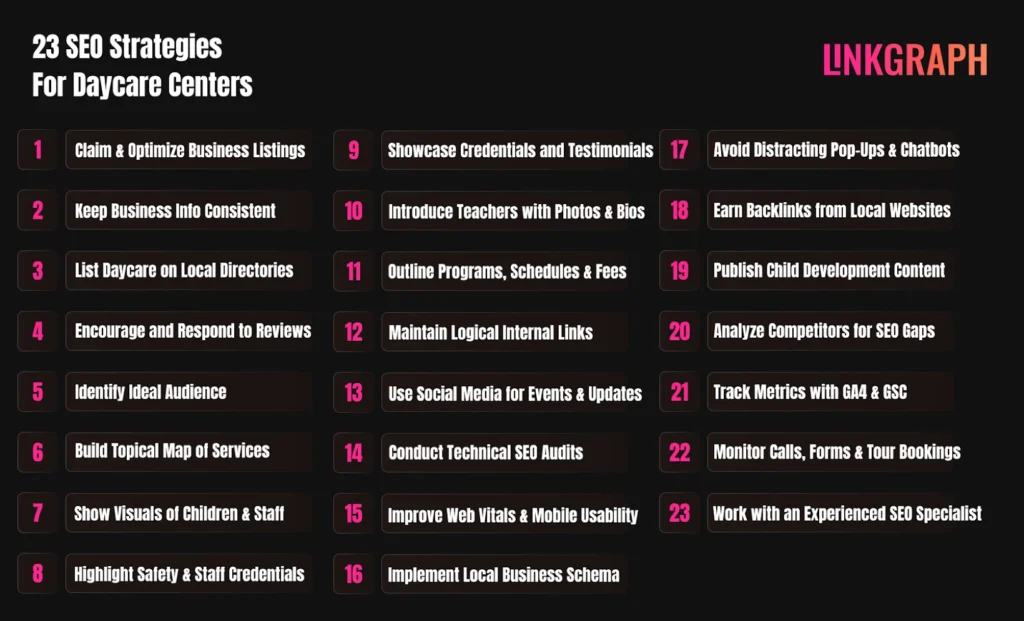
There are 23 SEO strategies for daycare centers. The 23 SEO strategies for daycare centers are listed below.
- Claim, Verify, and Optimize Google, Bing, and Apple Business Listings
- Maintain Consistent Business Information Across All Online Directories
- List Your Daycare Center on Reputable Local and Childcare Directories
- Encourage Parent Reviews and Respond to All Feedback Professionally
- Define Your Target Audience Based on Age Groups, Programs, and Location
- Construct a Topical Map Covering Services, Locations, and Parent Concerns
- Show Real Photos and Videos of Children, Teachers, and Daily Activities
- Highlight Safety Measures, Clean Facilities, and Staff Qualifications Clearly
- Display Parent Testimonials, Certifications, and Awards to Build Trust
- Introduce Teachers with Friendly Photos and Short Bios
- Clearly Outline Programs, Schedules, and Fees to Build Parent Trust
- Maintain a Logical Internal Linking Structure (Root → Seed → Node)
- Use Social Media to Highlight Events, Updates, and Parent Engagement
- Conduct a Technical SEO Audit to Resolve Crawling and Indexing Issues
- Improve Core Web Vitals, Page Speed, and Mobile Usability
- Implement Local Business Schema Markup for Organization, Services, and Reviews
- Avoid Distracting Pop-Ups and Chatbots That Interrupt Parent Experience
- Earn Backlinks from Local Parenting Blogs, Schools, and Community Websites
- Publish Helpful Content on Parenting Tips, Early Learning, and Child Development
- Perform Competitor Analysis to Identify Local SEO Gaps and Opportunities
- Track SEO Metrics Using Google Analytics and Search Console
- Monitor Calls, Form Inquiries, and Tour Bookings for Conversion Insights
- Work with an Experienced Local SEO Specialist for Continuous Optimization
Following these steps, daycare centers implement structured search optimization strategies, increase local visibility, attract parents effectively, and convert website traffic into tours and enrollments. We have broken down the 23 SEO strategies for daycare centers below.
1. Claim, Verify, and Optimize Google, Bing, and Apple Business Listings
Listing optimization on Google, Bing, and Apple defines a core method in local SEO for daycare centers. These business profiles serve as the first point of contact for parents searching for child care programs, providing accurate contact details, operating hours, location, and program offerings. Optimizing listings increases visibility in maps and local search results, which directly drives website visits, inquiries, and scheduled tours.
Why is listing optimization essential for daycare centers? Verified and complete business profiles build parent trust while signaling authority to search engines. Daycare centers without updated or consistent listings appear less credible and rank lower in local searches. Google Business Profile (GBP), Bing Places, and Apple Maps act as primary tools to claim, manage, and maintain these listings effectively.
What actions should daycare centers take to achieve maximum impact? Ensure all business information is complete, consistent, and current across platforms. Add professional images of classrooms, staff, and daily activities. Monitor and respond to parent reviews promptly. These steps improve local search rankings, increase engagement, and generate measurable growth in inquiries and enrollments. Optimized listings result in stronger visibility, higher parent confidence, and increased enrollment opportunities.
2. Maintain Consistent Business Information Across All Online Directories
Directory consistency defines a critical component of local SEO for daycare centers. Accurate and uniform business information across multiple platforms ensures that parents searching for child care programs encounter the same name, address, phone number, and service details on every directory. Maintaining consistent listings strengthens authority in search engines, reduces confusion, and increases the likelihood of parents contacting the daycare.
Why is directory consistency important for daycare centers? Search engines compare business data across multiple sources to determine reliability. Daycare centers with conflicting information risk lower rankings and reduced visibility in local searches. Directories, review sites, and niche child care platforms act as reference points that validate the legitimacy of the daycare program.
What steps should daycare centers take to maintain consistency? Audit all listings on Google, Bing, Apple, local directories, and child care platforms. Correct any discrepancies in name, address, phone number, and website links. Update information promptly when changes occur. Consistent directory data improves local search rankings, enhances parent trust, and increases inquiries, tours, and enrollments. Regular monitoring ensures continuous accuracy and maximizes the impact of local SEO efforts.
3. List Your Daycare Center on Reputable Local and Childcare Directories
Directory listing expansion defines a key tactic in local SEO for daycare centers. Publishing the daycare’s information on authoritative local and child care directories increases visibility to parents searching for nearby programs. These listings enhance credibility, attract qualified traffic, and serve as additional reference points that search engines use to evaluate the daycare center’s trustworthiness.
Why is directory listing expansion important for daycare centers? Being present on reputable platforms signals reliability to both parents and search engines. Daycare centers listed on verified local directories, parenting sites, and childcare networks gain higher authority and stronger rankings in local search results. This coverage ensures parents find consistent and accurate information when comparing child care options.
What actions should daycare centers take to maximize directory impact? Identify reputable local and child care directories relevant to the area and program offerings. Ensure all listings are complete, accurate, and up-to-date with contact information, operating hours, and services. Include professional photos and encourage parent reviews on these platforms. Directory listing expansion improves local search rankings, increases parent engagement, and generates measurable growth in inquiries, scheduled tours, and enrollments.
4. Encourage Parent Reviews and Respond to All Feedback Professionally
Review management defines a central tactic in local SEO for daycare centers. Collecting parent reviews and responding to feedback enhances credibility, visibility, and trust for child care programs. Positive reviews increase engagement and attract new families, while professional responses demonstrate that the daycare center values parent input and maintains high service standards.
Why is review management critical for daycare centers? Search engines interpret consistent, high-quality feedback as a signal of reliability and authority. Daycare centers with active reviews rank higher in local searches, while parents perceive them as safe, reputable, and attentive to children’s needs. Platforms such as GBP, Bing Places, and Apple Maps serve as primary review channels for child care facilities.
What actions should daycare centers take to optimize review management? Request feedback from parents after tours, enrollment, or program milestones. Respond promptly and professionally to all reviews, addressing concerns constructively. Highlight positive experiences without exaggeration. Effective review management improves local search rankings, strengthens parent trust, and drives increased inquiries, tours, and enrollments for the daycare program.
5. Define Your Target Audience Based on Age Groups, Programs, and Location
Audience segmentation defines a foundational method in local SEO for daycare centers. Identifying the target audience by age groups, offered programs, and geographic location allows child care programs to focus content, listings, and keyword strategies on parents most likely to enroll. This segmentation ensures marketing and SEO efforts reach relevant families efficiently and enables structured content creation through topical mapping.
Why is audience segmentation important for daycare centers? Understanding parent demographics and program interests informs keyword selection, website content, and directory listings. Topical maps link these audience insights to specific content clusters, such as infant care, toddler programs, preschool schedules, and location-specific pages. This alignment increases visibility in search results for parents searching for precise child care needs.
What steps should daycare centers take to implement audience-based SEO? Analyze enrollment data, geographic demand, and program types. Map each audience segment to content topics using a topical map framework. Tailor website pages, directory listings, and social media posts to address the concerns and needs of each segment. This process improves search relevance, strengthens rankings, and drives higher engagement, inquiries, and enrollments for the daycare program.
6. Construct a Topical Map Covering Services, Locations, and Parent Concerns
Topical mapping defines a structured method in local SEO for daycare centers. Creating a map of content clusters that cover services, geographic locations, and parent concerns allows child care programs to organize website pages, blog content, and directory listings. This structure ensures search engines understand the daycare center’s offerings and relevance to local searches.
Why is topical mapping essential for daycare centers? Linking services, locations, and parent questions improves search visibility and user experience. A well-constructed topical map connects infant care, toddler programs, preschool schedules, and safety information, guiding parents efficiently to the content they seek. It aligns with audience segmentation strategies, ensuring each page targets specific parent needs.
What steps should daycare centers take to implement a topical map? Identify core services, locations served, and frequently asked parent questions. Group content into clusters with main pages (root), subpages (seed), and supporting articles (node). Use internal linking to connect clusters logically. Effective topical mapping enhances search engine understanding, improves rankings, increases website traffic, and drives higher inquiries and enrollments for the daycare program.
7. Show Real Photos and Videos of Children, Teachers, and Daily Activities
Visual content integration defines a key tactic in local SEO for daycare centers. Publishing authentic photos and videos of classrooms, staff, and daily activities allows child care programs to demonstrate quality, safety, and engagement to prospective parents. This media enhances user experience, keeps parents on the website longer, and increases search engine relevance for daycare services.
Why is visual content integration important for daycare centers? Parents often evaluate daycare programs based on facility quality and staff interaction. Real images and videos provide transparency, build trust, and differentiate the daycare center from competitors. Search engines interpret multimedia-rich pages as engaging, improving rankings for local and program-specific searches.
What steps should daycare centers take to optimize visual content? Capture high-quality photos and short videos of classrooms, teachers, and daily routines while respecting privacy regulations. Compress media for fast loading and include descriptive filenames and alt text. Embedding this content across website pages, blogs, and directory listings increases engagement, strengthens search visibility, and drives higher inquiries, tours, and enrollments for the daycare program.
8. Highlight Safety Measures, Clean Facilities, and Staff Qualifications Clearly
Safety and quality emphasis define a key practice in local SEO for daycare centers. Displaying clear information about safety protocols, cleanliness standards, and staff qualifications allows child care programs to build trust with parents searching for reliable care. Properly highlighting these factors enhances website credibility and improves engagement signals that search engines consider for ranking.
Why is safety and quality emphasis essential for daycare centers? Parents prioritize secure, well-maintained environments and qualified staff when evaluating daycare programs. Pages that clearly communicate safety procedures, sanitation practices, and teacher certifications increase confidence and encourage inquiries. Search engines interpret this transparency as authoritative content, which positively impacts local search visibility.
What actions should daycare centers take to implement safety and quality emphasis? Include detailed descriptions of cleaning protocols, security measures, and staff credentials on website pages and directory listings. Use structured formats, bullet points, and infographics for clarity. Highlighting these factors improves search rankings, increases parent trust, and drives more inquiries, scheduled tours, and enrollments for the daycare program.
9. Display Parent Testimonials, Certifications, and Awards to Build Trust
Trust signal reinforcement plays a central role in search visibility for early childhood education providers. Showcasing parent testimonials, professional certifications, and industry awards allows childcare programs to demonstrate credibility to both families and search engines. These trust elements strengthen content quality signals, improve user confidence, and enhance performance in local search results.
Why do testimonials and credentials matter for daycare and childcare centers? Parents rely heavily on social proof and third-party validation when choosing a childcare facility. Reviews, accreditations, and awards reduce uncertainty and signal reliability. Search engines evaluate these trust indicators as signs of authority, which contribute to improved local rankings and higher click-through rates.
How should childcare providers present testimonials and certifications effectively? Feature verified parent reviews on service pages, display certifications and awards prominently, and ensure consistency across listings and profiles. Use structured markup where possible to enhance visibility. Strengthening these trust signals improves rankings, increases inquiries, and leads to more scheduled tours and enrollments.
10. Introduce Teachers with Friendly Photos and Short Bios
Teacher profile presentation strengthens both parent confidence and on-site engagement for early learning centers. Featuring real educators with friendly photos and concise bios humanizes childcare programs and allows families to connect emotionally before scheduling a visit. Staff introductions add unique, people-focused content that enhances visibility signals for search engines evaluating trust and relevance within preschool and nursery websites.
Why does showcasing teachers matter for childcare and daycare businesses? Parents want reassurance that qualified, caring professionals will guide their children daily. Highlighting educator experience, certifications, and teaching philosophy builds credibility and reduces hesitation. Search engines interpret this transparency as a sign of authenticity, which enhances local visibility and improves engagement metrics like time on page.
How should early education providers structure teacher bios for impact? Use clear headshots, short bios, and role-specific details across program pages. Align staff profiles with topical mapping by linking them to age groups or learning programs. This approach improves relevance signals, strengthens rankings, and encourages more inquiries and tour bookings.
11. Clearly Outline Programs, Schedules, and Fees to Build Parent Trust
Clear program and pricing transparency improves both parent decision-making and search visibility for early education providers. When daycare facilities and childcare centers present structured details about programs, daily schedules, age groups, and tuition, families quickly assess fit without friction. Well-organized information enhances on-page relevance signals used in childcare search optimization and local discovery systems.
Why does outlining programs and fees matter for daycare and childcare businesses? Parents actively compare preschools, nurseries, and learning centers before booking tours. Missing or vague details create uncertainty and reduce trust. Search engines favor pages that fully satisfy user intent, and clear service information improves engagement, reduces bounce rates, and strengthens local rankings for education-focused queries.
How should childcare providers present this information for maximum impact? Use dedicated pages or sections for each program, include age ranges, schedules, enrollment options, and fee structures, and connect them internally to related content. This clarity strengthens topical relevance, improves crawl efficiency, and increases qualified inquiries and enrollment conversions.
12. Maintain a Logical Internal Linking Structure (Root → Seed → Node)
A structured internal link architecture allows daycare centers and childcare providers to organize website content in a way that is easy for both parents and search engines to navigate. The root page typically represents the main childcare brand, seed pages focus on core services or locations, and node pages address specific programs, age groups, or parent concerns. This hierarchy improves content clarity, topical depth, and efficient crawl paths across early education websites.
Why does a root-to-node linking hierarchy matter for childcare search performance? Search engines use internal links to understand page relationships and content priority. Preschools, nurseries, and learning centers linking pages logically allow authority to flow from high-level pages to detailed service pages. This improves indexation, strengthens topical signals, and allows important enrollment-focused pages to rank for relevant local queries.
How should daycare operators implement this structure correctly? Link homepage sections to service and location pages, then connect those pages to detailed program content. Use descriptive anchor text tied to childcare topics. This improves rankings, user experience, and parent conversion paths.
13. Use Social Media to Highlight Events, Updates, and Parent Engagement
An active social media presence strengthens daycare and childcare centers by extending local visibility beyond the website and reinforcing brand signals across trusted platforms. Sharing events, classroom activities, announcements, and parent-focused updates allows preschools and early learning centers to stay visible where families already spend time. These platforms act as secondary discovery channels that improve local search visibility and brand recognition for childcare providers.
Why does consistent social activity matter for search visibility and trust? Search engines evaluate brand mentions, engagement signals, and content freshness across the web. Active profiles with real interactions strengthen local relevance and trust indicators for nurseries and learning centers. Engaged parents amplify reach through shares and comments, increasing branded search demand and reinforcing local authority.
How should childcare operators use these platforms effectively? Post regular updates about events, learning milestones, safety practices, and parent reminders. Include photos, videos, and links to relevant website pages to drive traffic and improve user engagement. Monitor comments and messages and respond promptly to maintain trust. Use scheduling and analytics tools, such as Meta Business Suite, to maintain consistent posting and track performance. Proper social media integration increases brand visibility, enhances search rankings, and generates measurable growth in inquiries, scheduled tours, and enrollments.
14. Conduct a Technical SEO Audit to Resolve Crawling and Indexing Issues
Technical site auditing defines a core process in SEO for daycare centers. Early learning and childcare websites require proper structure, crawlability, and indexing so search engines access all program, location, and enrollment pages. Audits identify server delays, broken links, duplicate content, and indexing gaps that prevent the daycare website from ranking effectively and engaging prospective parents.
Which technical elements are essential for daycare websites? Server response time should stay under 100 milliseconds, HTML crawl requests should exceed 95%, refresh rates should remain near 20%, and discovery rates should reach 7–8%. Performing log file analysis identifies where the crawl budget is wasted and highlights high-value pages, including program descriptions, location pages, and enrollment forms.
What actions should daycare centers take to implement technical improvements? Optimize hosting and caching to reduce latency, fix broken links, eliminate duplicate content, and implement XML sitemaps and structured data. Minify CSS and JavaScript files, compress images, and resolve mobile usability issues. Monitoring tools like Google Search Console, Screaming Frog, and server logs provide detailed insights to guide corrections.
What results follow a comprehensive technical site audit? Crawl efficiency improves, all pages are indexed properly, and search engines interpret the site structure accurately. Pages load faster, parents navigate more efficiently, and engagement increases. Technical site auditing strengthens SEO performance, improves visibility, and drives more inquiries, scheduled tours, and enrollments for daycare and childcare centers.
15. Improve Core Web Vitals, Page Speed, and Mobile Usability
Performance optimization defines a core process in SEO for daycare centers. Early learning and childcare websites require fast, stable, and mobile-friendly pages to improve search engine rankings and deliver an efficient experience for parents. Optimized core web vitals, quick page load times, and responsive design increase engagement, reduce bounce rates, and allow search engines to index program and location pages effectively.
Why are web vitals and mobile usability essential for daycare SEO? Parents searching for childcare often use mobile devices, and slow or unstable pages reduce inquiries. Search engines evaluate metrics like Largest Contentful Paint (LCP), Cumulative Layout Shift (CLS), and First Input Delay (FID) to rank websites. Responsive, fast-loading pages improve visibility in search results and enhance user trust for daycare and early learning programs.
What actions should daycare centers take to optimize performance? Reduce server response times, compress images, minify CSS and JavaScript, and leverage caching. Implement responsive designs for smartphones and tablets and ensure layout stability. Test pages with tools like Google PageSpeed Insights and Web Vitals reports. Performance optimization improves search rankings, enhances parent navigation, increases inquiries, and drives higher enrollments for daycare and childcare centers.
16. Implement Local Business Schema Markup for Organization, Services, and Reviews
Schema markup integration defines a core process in SEO for daycare centers. Adding structured data to website pages allows search engines to understand critical information about the daycare, including location, programs, services, and parent reviews. Proper implementation enhances visibility in rich results and improves the likelihood of appearing in local knowledge panels, maps, and search snippets.
Why does schema markup matter for daycare SEO? Search engines use structured data to interpret page content more accurately. Highlighting organization details, program offerings, and positive parent reviews strengthens trust signals and relevance for local and service-based queries. Without markup, critical information not appear in rich results, limiting visibility for parents searching for childcare or preschool programs.
What actions should daycare centers take to implement schema effectively? Use LocalBusiness, EducationalOrganization, and Review schemas for the website. Include accurate NAP (Name, Address, Phone), program descriptions, service types, and parent testimonials. Test implementation with tools like Google’s Rich Results Test and monitor in Google Search Console (GSC). Proper schema markup improves search visibility, increases engagement, and drives more inquiries, tour bookings, and enrollments for daycare and childcare centers.
17. Avoid Distracting Pop-Ups and Chatbots That Interrupt Parent Experience
User experience optimization defines a critical process in SEO for daycare centers. Early learning and childcare websites require smooth navigation without intrusive elements that frustrate parents. Distracting pop-ups, auto-play chatbots, or excessive overlays reduce engagement, increase bounce rates, and signal lower content quality to search engines, affecting overall rankings.
Why is minimizing interruptions essential for daycare SEO? Parents seeking childcare or preschool programs prioritize fast, clear access to information on programs, schedules, and fees. Disruptive pop-ups or chatbots prevent parents from viewing critical pages or completing inquiries. Search engines interpret poor engagement and high exit rates as a signal of reduced page quality, which lowers visibility for daycare services.
What actions should childcare centers take to optimize the parent experience? Limit pop-ups to essential announcements or consent notices, and ensure chatbots appear only when requested. Test website interactions on mobile and desktop to verify smooth navigation. Removing distractions improves dwell time, engagement, and search engine perception. Enhanced user experience increases inquiries, tour bookings, and enrollment conversions for daycare and childcare centers.
18. Earn Backlinks from Local Parenting Blogs, Schools, and Community Websites
Link authority building defines a core process in SEO for daycare centers. Acquiring backlinks from reputable local sources, such as parenting blogs, nearby schools, and community websites, signals trust and relevance to search engines. These links increase domain authority, improve rankings for location-based and program-specific queries, and drive referral traffic from parents actively seeking childcare services.
Why is earning backlinks essential for daycare SEO? High-quality backlinks demonstrate credibility and expertise in the childcare field. Search engines interpret links from trusted local sources as a signal that the daycare program provides valuable, reliable information. Without authoritative backlinks, even well-optimized pages struggle to rank in competitive local searches for preschool or childcare programs.
What actions should daycare centers take to acquire effective backlinks? Identify reputable local blogs, parenting forums, schools, and community sites. Offer guest posts, share educational content, participate in local events, or provide resource links for families. Monitor acquired links and maintain relevance. Effective link authority building improves search engine trust, increases website traffic, and generates higher inquiries, tour bookings, and enrollments for daycare and childcare centers.
19. Publish Helpful Content on Parenting Tips, Early Learning, and Child Development
Content development defines a core process in SEO for daycare centers. Creating informative articles, guides, and resources on parenting, child development, and early learning allows childcare programs to attract parents searching for advice. High-quality, targeted content establishes authority, increases engagement, and generates traffic from both search engines and social channels.
Why does publishing educational content matter for daycare SEO? Parents evaluate preschools and childcare centers based on expertise and guidance. Pages addressing curriculum, behavior strategies, and developmental milestones provide value, which search engines interpret as relevance and trustworthiness. This increases rankings for program-specific and parenting-related queries, boosting visibility for daycare programs.
What actions should childcare centers take to implement content effectively? Identify parent concerns and common questions, then create articles, videos, or infographics addressing each topic. Link content to service pages and use structured headings for clarity. Regularly update and optimize content for search performance. Effective content development improves search visibility, increases website engagement, and drives higher inquiries, tours, and enrollments for daycare and childcare centers.
20. Perform Competitor Analysis to Identify Local SEO Gaps and Opportunities
Competitive benchmarking defines a core process in SEO for daycare centers. Analyzing other childcare programs and preschools within the local area allows centers to identify strengths, weaknesses, and gaps in content, backlinks, and search visibility. Understanding competitor strategies provides actionable insights for improving rankings, attracting more parents, and filling service or content gaps.
Why is competitor analysis essential for daycare SEO? Parents compare multiple options when searching for childcare or preschool programs. Identifying what competitors rank for, the keywords they target, and the type of content they offer reveals opportunities to outperform them. Search engines favor websites that meet parent intent more effectively than competing centers.
What actions should daycare centers take to implement competitor analysis effectively? List local competitors and audit their websites, backlinks, content, and GBP. Use competitor research tools to analyze keywords, domain authority, and referral links. Apply insights to optimize website pages, improve topical coverage, and strengthen backlink profiles. Effective competitive benchmarking enhances search visibility, increases inquiries, and drives higher enrollments for daycare and childcare centers.
21. Track SEO Metrics Using Google Analytics and Search Console
SEO performance monitoring defines a core process in SEO for daycare centers. Using Google Analytics 4 (GA4) and Google Search Console (GSC) allows childcare programs to measure traffic, engagement, and search visibility. Tracking these metrics identifies which pages attract parents, which keywords drive visits, and which areas require optimization to improve overall daycare website performance.
Why is monitoring SEO metrics essential for daycare SEO? Parents researching preschools and childcare programs generate measurable interactions, including page views, clicks, and form submissions. GA4 tracks user behavior, session duration, and conversions, while GSC provides insights into impressions, clicks, and indexing status. These tools help daycare centers evaluate the effectiveness of content, technical optimizations, and local search efforts.
What actions should daycare centers take to implement SEO tracking? Configure GA4 to track key events such as form submissions, tour bookings, and clicks on program pages. Use GSC to monitor search queries, crawling errors, and indexing issues. Regularly analyze performance reports to identify high-value pages and optimize underperforming content. Accurate monitoring improves website visibility, increases parent engagement, and drives more inquiries and enrollments for daycare and childcare centers.
22. Monitor Calls, Form Inquiries, and Tour Bookings for Conversion Insights
Conversion tracking defines a core process in SEO for daycare centers. Monitoring phone calls, online form submissions, and scheduled tours provides measurable data on how parents interact with childcare websites. Tracking these interactions identifies which pages and content drive inquiries and enrollment, allowing early learning programs to refine their SEO and website strategies.
Why is monitoring parent interactions essential for daycare SEO? Parents actively researching preschools and childcare programs take multiple actions before enrolling. Recording calls, form completions, and bookings shows which keywords, pages, or campaigns generate actual interest. These insights allow childcare centers to prioritize high-performing content and optimize areas that underperform in attracting parent engagement.
What actions should daycare centers take to implement conversion monitoring? Use call-tracking software, form analytics, and scheduling tools to record interactions. Assign each inquiry or booking to a source, such as organic search or directory listing. Regularly analyze patterns to improve page layouts, content, and calls-to-action. Conversion tracking increases visibility into parent behavior, strengthens SEO effectiveness, and drives more inquiries, tours, and enrollments for daycare and childcare centers.
23. Work with an Experienced Local SEO Specialist for Continuous Optimization
Professional SEO collaboration defines a core process in SEO for daycare centers. Partnering with an experienced local SEO specialist ensures that childcare programs receive ongoing guidance for keyword targeting, website structure, content optimization, and backlink strategies. Continuous optimization maintains search visibility, addresses technical issues promptly, and adapts to algorithm updates.
Why does working with a local SEO specialist matter for daycare programs? Early learning centers compete for parents in specific geographic areas. A specialist evaluates GBP, local citations, competitor activity, and parent search behavior. This expertise allows daycare and childcare centers to implement precise tactics that increase organic visibility and attract more families actively seeking programs.
What actions should daycare centers take when collaborating with an SEO specialist? Conduct a thorough audit of current performance metrics, develop a structured local SEO plan, and schedule regular reviews to track progress. The specialist recommend content updates, technical improvements, and link-building strategies while monitoring analytics and conversion metrics. Continuous expert collaboration strengthens search rankings, increases inquiries, and drives more tours and enrollments for daycare and childcare centers.
When Is the Right Time for Daycare Centers to Start Investing in SEO?
Daycare centers should begin investing in SEO as soon as they launch or operate a website. SEO results for childcare programs typically appear within 4–6 months, though highly competitive markets require 8–12 months. Factors affecting timelines include local competition, website structure, content quality, backlink authority, and consistency of optimization efforts.
Early and continuous investment allows preschools and childcare centers to establish visibility, build credibility, and generate organic inquiries before peak enrollment periods. Delaying SEO risks losing prospective families to competitors already ranking in local search results.
What Are the Most Common SEO Mistakes Daycare Centers Should Avoid?
Daycare centers often make recurring SEO errors that reduce visibility, limit parent engagement, and decrease enrollment conversions. Identifying and correcting these mistakes allows childcare programs to rank higher in search results and attract more inquiries. The most common SEO mistakes that daycare centers should avoid are listed below.
- Incomplete or Inaccurate Business Listings: Missing or inconsistent NAP (Name, Address, Phone) information across Google, Bing, Apple, and directories confuses search engines and parents.
- Ignoring Mobile Optimization: Slow or non-responsive websites frustrate parents on smartphones and reduce rankings in search results.
- Poor Content Quality: Pages lacking program details, safety information, or parent guidance fail to meet search intent and reduce authority.
- Neglecting Local Backlinks: Absence of links from community websites, parenting blogs, or local schools limits credibility and local search visibility.
- Overlooking Technical SEO Issues: Broken links, slow load times, duplicate pages, or missing schema markup prevent efficient indexing and lower rankings.
Avoiding these mistakes improves search performance, enhances parent experience, and drives higher inquiries, tours, and enrollments for daycare and childcare centers.
How Can Local SEO Help Daycare Centers Reach More Nearby Parents?
Local SEO allows daycare centers to appear in location-specific searches, maps, and local packs, ensuring visibility to parents in the immediate area. Optimized GBP, consistent NAP across directories, and location-based content increase rankings for terms like “daycare near me” or “preschool in [city].”
Local SEO drives qualified traffic, builds trust through reviews, and converts online searches into calls, tour bookings, and enrollments efficiently, directly connecting childcare programs with nearby families actively seeking services.
Which Online Directories Are Most Effective for Promoting Daycare Centers?
Daycare centers gain visibility and credibility by listing their programs on reputable online directories. These platforms allow childcare programs to reach parents actively searching for local preschools, nurseries, and early learning centers. Consistent, accurate listings improve search engine trust and increase inquiry volume.
The most effective online directories for promoting daycare centers are listed below.
- Google Business Profile (GBP): Primary platform for local searches, maps, and parent reviews.
- Bing Places: Expands visibility on Microsoft search and local map results.
- Apple Maps: Ensures iOS users find daycare location and contact information.
- Yelp: Reviews and ratings influence parent trust and search rankings.
- Care.com: Parent-focused directory for childcare services and programs.
- Bright Horizons / Local Childcare Portals: Specialized platforms for early learning and daycare centers.
- Local Chamber of Commerce Directories: Strengthens community presence and authority.
- Facebook Business Pages / Meta Directory: Combines social engagement with search visibility for local programs.
Listing daycare programs on these directories enhances local SEO, drives inquiries, and improves parent trust, increasing enrollment potential.
Is SEO a More Cost-Effective Marketing Option for Daycare Centers Than Paid Ads?
SEO offers a more cost-effective long-term marketing solution for daycare centers compared with paid ads like PPC. Organic search traffic generated through optimized websites, local listings, and content does not require ongoing ad spend, unlike PPC campaigns, where each click incurs a cost.
While paid ads provide immediate visibility, SEO builds sustainable rankings that attract parents over time. Consistent SEO efforts generate higher ROI, improve local credibility, and convert searches into inquiries, tours, and enrollments without recurring advertising expenses.
Should Daycare Centers Handle SEO Themselves or Hire a Professional Agency?
Daycare centers achieve faster and more reliable results by hiring a professional SEO agency rather than managing SEO internally. Childcare websites require technical optimization, local SEO, content strategy, and backlink building, which demand expertise and ongoing monitoring.
While in-house management reduce costs initially, it often lacks efficiency, consistency, and access to advanced tools. Partnering with an experienced agency ensures structured implementation, continuous performance tracking, and strategic adjustments, ultimately increasing website visibility, parent engagement, inquiries, and enrollment conversions for daycare and childcare programs.
What Key Factors Should Daycare Centers Consider When Choosing an SEO Partner?
Selecting the right SEO partner is essential for daycare centers seeking measurable growth. Childcare programs require expertise in local SEO, technical optimization, and content strategy to increase visibility, attract parents, and boost enrollments. Evaluating potential agencies based on specific criteria ensures alignment with goals and maximizes return on investment. The key factors to consider for daycare centers when choosing an SEO partner are listed below.
- Experience in Childcare SEO: Proven knowledge of daycare, preschool, or early learning websites and local search strategies.
- Technical Expertise: Ability to conduct audits, fix crawl issues, optimize page speed, and implement schema markup.
- Content Strategy Skills: Experience in developing parenting, child development, and program-focused content that ranks.
- Local SEO Proficiency: Expertise in optimizing GBP, local citations, and map rankings.
- Transparent Reporting: Clear metrics, dashboards, and regular updates on traffic, rankings, and conversions.
- Backlink and Authority Building: Ability to acquire high-quality local links from schools, parenting blogs, and community websites.
- Communication and Collaboration: Responsive, proactive, and able to align strategies with daycare center goals.
- Proven ROI Results: Track record of increasing website visibility, inquiries, tours, and enrollments for similar clients.
Evaluating agencies using these factors ensures daycare centers select a partner that drives measurable SEO results, strengthens local visibility, and attracts more families to their programs.
Which Agency Provides the Most Reliable SEO Services for Daycare Centers?
LinkGraph provides the most reliable SEO services for daycare centers, offering specialized strategies for childcare programs. LinkGraph optimizes daycare websites, GBP, local citations, content, and backlinks to improve visibility, parent engagement, and enrollment conversions. Multiple case studies show that daycare clients working with LinkGraph achieved 200–500% growth in organic traffic, higher local search rankings, and increased tour bookings within months.
Why do daycare centers choose LinkGraph over other providers? LinkGraph applies structured SEO processes tailored to each childcare program. LinkGraph performs technical audits, creates program-focused content, acquires backlinks from local schools and parenting blogs, and analyzes competitors’ strategies. Clients highlight consistent increases in inquiries and stronger search visibility after implementing LinkGraph’s recommendations. LinkGraph’s team continuously monitors algorithm changes to maintain long-term local SEO results.
How does LinkGraph prove its impact for daycare centers? LinkGraph provides detailed analytics, performance reports, and documented client results that demonstrate improvements in website traffic, parent interactions, and local search rankings. With expertise in local SEO, content strategy, and technical optimization, LinkGraph equips daycare and childcare centers with measurable, results-driven SEO solutions that grow online visibility and drive higher enrollment.
How Much Does LinkGraph Charge for Daycare Center SEO Services?
LinkGraph customizes daycare SEO pricing based on the size, location, and competition of each childcare program. Typical packages range from $2,500 to $10,000 per month, covering local SEO, content creation, technical optimization, and backlink acquisition.
LinkGraph justifies pricing by delivering measurable results, including increased website traffic, higher GBP visibility, and more parent inquiries. Investing in LinkGraph’s SEO ensures daycare centers receive long-term organic growth and improved enrollment conversions through data-driven strategies.
How Long Does It Typically Take Daycare Centers to See Noticeable SEO Results?
Daycare centers working with LinkGraph typically begin seeing noticeable SEO results within 4–6 months. Highly competitive local markets extend this timeline to 8–12 months depending on keyword difficulty, website structure, backlink acquisition, and content strategy. LinkGraph continuously monitors performance through
GA4, GSC, and local ranking reports to adjust tactics for faster results. Consistent optimization and structured implementation by LinkGraph increase organic traffic, improve GBP visibility, and generate more inquiries, tours, and enrollments for childcare programs.
