
Funeral homes, cremation centers, memorial homes, and life celebration centers require specialized online visibility to connect with families seeking compassionate end-of-life services. SEO for funeral homes, applied to funeral parlors, mortuaries, and burial service providers, optimizes websites, local listings, and content to improve search engine presence. Funeral home SEO services align service offerings with relevant local and intent-driven queries, enhancing discoverability for families actively planning memorials, cremations, or burials.
Implementing search engine marketing for funeral homes ensures sustained organic traffic growth, increased inquiries, and improved credibility. On-page optimization, structured data, local SEO, and content strategies highlight the unique offerings of funeral care centers and funeral chapels. Proper optimization elevates brand authority, communicates compassionate services, and generates measurable business outcomes.
Selecting a skilled funeral home SEO company is essential for effective strategy execution. Experienced agencies identify service gaps, refine technical infrastructure, manage local citations, and produce content tailored to family needs. Strategic SEO amplifies visibility, strengthens community trust, and ensures funeral service providers maintain a consistent and professional presence online.

What Is a Funeral Home?
A funeral home is a licensed service establishment that manages end-of-life arrangements for individuals and families. This funeral service provider coordinates body care, legal documentation, and ceremony logistics under state regulations. The mortuary oversees embalming, cremation preparation, visitation scheduling, and burial planning within defined professional standards.
This memorial service facility functions as a community-based institution that handles cultural rites and personal preferences. The funeral establishment maintains facilities for viewings, memorial gatherings, and administrative consultations. This death care provider connects families with structured processes that guide remembrance, disposition, and formal closure.
What Does SEO for Funeral Homes Mean?
Search engine optimization for funeral homes increases the visibility of funeral service providers in organic search results. Mortuaries, memorial homes, and death care facilities rank higher when families search for obituaries, cremation, or burial services. Optimizing content, local listings, and service pages aligns search relevance with the intent of prospective clients.
Funeral home SEO focuses on local targeting, service categories, and credibility signals. Optimized pages include facility details, licensed staff, community engagement, and memorial offerings. Structured data, internal linking, and verified citations strengthen authority in search algorithms and enhance discoverability.
Technical SEO and content strategy converge to improve usability, engagement, and search performance. Clear page hierarchy, metadata, and service descriptions guide families efficiently. Optimized content highlights funeral home operations, service availability, and compassionate staff, attracting relevant local traffic and sustaining online presence.
Does SEO Really Help Funeral Homes and Service Providers?
SEO delivers measurable benefits for funeral homes, mortuaries, and memorial service providers by increasing online visibility and attracting local families seeking funeral arrangements. Optimized funeral home websites rank higher in search results for keywords related to burial services, cremation options, grief resources, and memorial planning. Increased visibility drives more qualified inquiries, strengthening occupancy of service offerings while reinforcing brand credibility in the community.
Local SEO ensures funeral homes appear in map listings and directory searches, connecting families with nearby facilities. Optimized listings, verified citations, and accurate contact information improve discoverability and conversion rates. Positive reviews and reputation signals amplify trust, reinforcing the likelihood that families select the funeral home for their immediate needs.
Consistent content strategy further enhances engagement and authority. Publishing informational guides, grief support articles, and service descriptions signals expertise to search engines (Google, Bing, Yahoo!). Analytics tracking confirms measurable growth in traffic, inquiries, and online interactions, demonstrating that SEO increases visibility and produces tangible operational outcomes for funeral homes.
What Are the Main Benefits of SEO for Funeral Homes?
Effective SEO for funeral homes, memorial service providers, and mortuaries generates measurable advantages in online visibility, local presence, and family engagement. Optimized websites, business listings, and content establish stronger connections with families seeking funeral arrangements while reinforcing the credibility and community standing of funeral homes.
SEO aligns search visibility with service offerings, ensuring families encounter accurate information about facilities, staff, and offerings at the moment they actively search. The key benefits of doing SEO for funeral homes are listed below.
- Greater Presence in Local Search Results: Optimized listings and local citations ensure funeral homes appear in map packs and directory searches, increasing discoverability.
- Attracts Families Actively Seeking Funeral Services: Keyword-targeted content draws users researching cremation, burial, or memorial planning, improving lead quality.
- Strengthens Reputation and Community Trust: Verified reviews, testimonials, and consistent contact information reinforce credibility with families and local networks.
- Drives Higher Inquiry and Call Volume: Higher search visibility directly translates into more calls, emails, and consultation requests.
- Provides Sustainable, Affordable Marketing Growth: Organic traffic offers long-term lead generation with lower costs than paid advertising.
- Emphasizes Funeral Home’s Unique Values and Offerings: Content highlighting services, facilities, and compassionate staff differentiates the funeral home from competitors.
Strategically implemented SEO ensures funeral homes maintain continuous visibility while cultivating trust and meaningful family engagement online.
How Can Funeral Homes and Service Providers Get Started with SEO?
Funeral homes, memorial service providers, and cremation specialists initiate SEO by establishing a structured digital presence that increases visibility, credibility, and family engagement. Optimized business listings, directory placements, and location-focused content connect service offerings with local search activity.
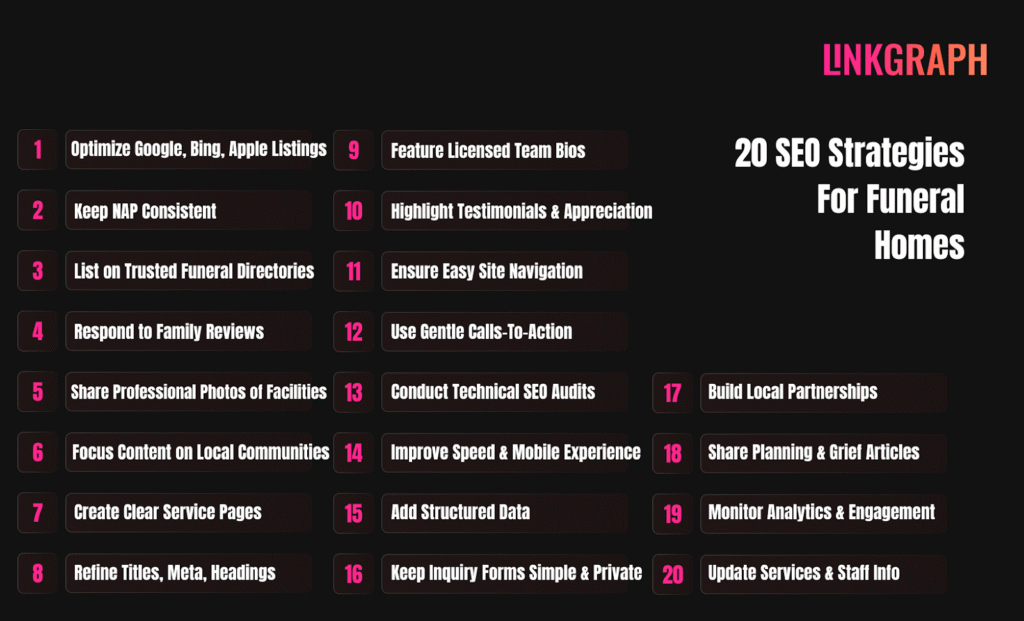
Thoughtful attention to technical performance, content quality, and user experience ensures families discover accurate information about facilities, staff, and available services. Implementing consistent strategies builds trust and encourages meaningful inquiries while differentiating funeral homes in competitive local markets. There are 20 SEO strategies for funeral homes. The 20 SEO strategies for funeral homes are listed below.
- Claim and Thoughtfully Optimize Google, Bing, and Apple Business Listings
- Maintain Consistent Name, Address, and Phone Across Platforms
- List Funeral Home on Trusted Directories
- Invite and Kindly Respond to Genuine Family Reviews
- Share Warm, Professional Photos of Facilities, Staff, and Memorial Spaces
- Focus Content on Local Areas and Communities Served
- Create Pages for Services with Clear and Supportive Information
- Refine Page Titles, Meta Descriptions, and Headings
- Introduce Licensed Team Members with Compassionate Biographies
- Highlight Authentic Testimonials and Messages of Appreciation
- Maintain Calm, Intuitive, and Easy-to-Navigate Website Experience
- Use Gentle Calls-to-Action that Encourage Connection and Support
- Conduct Regular Technical SEO Audit to Ensure Smooth Site Performance
- Enhance Website Speed, Mobile Friendliness, and Accessibility
- Implement Structured Data to Strengthen Local Search Presence
- Keep Inquiry Forms Simple, Respectful, and Private
- Build Meaningful Connections with Local Churches, Hospices, and Partners
- Share Helpful Articles on Planning, Grief Support, and Remembrance
- Monitor Website Insights to Understand Visitor Needs and Engagement
- Keep Service Information, Staff Profiles, and Updates Current and Accurate
Starting with structured SEO processes ensures funeral homes achieve visibility, credibility, and sustained family engagement online. We have broken down the 20 SEO strategies for funeral homes below.
1. Claim And Thoughtfully Optimize Google, Bing, And Apple Business Listings
Funeral homes establish a verified presence on major search platforms by claiming and optimizing business listings. Accurate business profiles (GBP, Bing Places, Apple Maps) containing the official name, address, phone number, operating hours, and service descriptions increase local visibility. Optimized listings improve indexing for map searches and ensure families find relevant information efficiently.
Including high-quality images of facilities, staff, and memorial spaces enhances credibility and trust. Adding service categories, keywords, and a clear description communicates offerings directly to search engines. Regular updates to profiles reflect current services and seasonal information, maintaining accuracy and authority.
Careful management of business listings encourages higher engagement, drives calls, and increases appointment inquiries. Integrating reviews and responding to family feedback strengthens reputation. Thoughtful optimization of these profiles creates a reliable foundation for local SEO and positions funeral homes prominently within community searches.
2. Maintain Consistent Name, Address, And Phone Across All Online Platforms
Funeral homes enforce strict consistency of their name, address, and phone number (NAP) across every online reference, including directories, review sites, and social media profiles. Accurate NAP alignment ensures families locate the business easily while search engines accurately index and rank each page. Inconsistent information reduces visibility, erodes credibility, and risks lost inquiries.
Audit tools and manual verification identify discrepancies such as outdated numbers, abbreviations, or address variations. Resolving these errors reinforces the legitimacy of a funeral home in local search results and prevents fragmented citations.
Routine checks of all citations, maps, and platforms maintain uniformity. Updates for relocations, number changes, or branding adjustments propagate across listings promptly. Consistent NAP increases local search prominence, improves map pack inclusion, and strengthens trust signals for families seeking reliable funeral services.
3. List Your Funeral Home On Trusted Funeral And Memorial Directories
Funeral homes establish authoritative visibility by appearing on reputable funeral and memorial directories. Listings on platforms specializing in death care services, memorial planning, and obituary publications connect families with verified providers while enhancing online presence and search engine recognition. These directories act as high-quality reference points, signaling credibility to search engines and reinforcing trust among prospective clients searching for compassionate, professional funeral services.
Maintaining accurate, comprehensive profiles across all relevant directories strengthens local relevance and improves indexing. Include complete business information such as name, address, phone number, operating hours, services offered, website links, and staff details. Enriched entries allow search engines to understand the scope of services offered while presenting families with clear, trustworthy information for their decision-making.
Regular audits of directory listings prevent outdated or inconsistent information from affecting rankings and client trust. Adding high-quality photos of facilities, videos of memorial spaces, and biographies of licensed staff enhances engagement. Strong directory presence, integrated with local SEO efforts, increases organic visibility, positions the funeral home as a reliable choice, and drives higher-quality inquiries from families in the service area.
4. Invite And Kindly Respond To Genuine Family Reviews
Funeral homes build trust and credibility by encouraging families to leave authentic reviews. Soliciting feedback after services captures firsthand experiences, which enhances the reputation of the funeral home in local search results. Positive reviews reinforce professional authority, while thoughtful responses demonstrate attentiveness and empathy, signaling reliability to both search engines and prospective clients.
Responding promptly to reviews ensures that families feel acknowledged and respected. Each reply should reflect care, thankfulness, and understanding, and clarify any service details if needed. Maintaining a consistent review management process improves engagement and strengthens the online image of a funeral business.
Monitoring review trends allows us to identify areas for service improvement and highlights strengths in care delivery. Integrating review management with local SEO amplifies visibility in search rankings, increases click-through from prospective families, and establishes the funeral home as a trusted, compassionate provider within the community.
5. Share Warm, Professional Photos Of Facilities, Staff, And Memorial Spaces
Funeral homes strengthen their digital presence by presenting high-resolution images of chapels, visitation rooms, reception areas, and outdoor memorial spaces. Visual representation communicates professionalism, care, and the atmosphere families expect during services. Showcasing facility layouts and amenities assists families in assessing suitability and builds trust before they visit in person. Images should reflect cleanliness, thoughtful design, and an environment of respect.
Portraits of licensed staff, directors, and team members introduce key personnel personally, establishing credibility and approachability. Staff photos should convey compassion, attentiveness, and professionalism, reinforcing the commitment of a funeral home to guiding families through sensitive experiences. Including group photos of service teams emphasizes reliability and cohesion.
Optimizing images with descriptive alt text, captions, and proper file sizes enhances search engine indexing and local SEO performance. Updating photos regularly to reflect renovations, seasonal displays, or new memorial features keeps the website accurate, engaging, and relevant, increasing online visibility and user confidence.
6. Focus Your Content On The Local Areas And Communities You Serve
Funeral homes strengthen local visibility by creating content specific to the communities they serve. Highlighting city neighborhoods, nearby landmarks, and local traditions emphasizes geographic relevance and demonstrates community connection. This targeted content ensures search engines associate the funeral home with specific locations, increasing prominence in local searches.
Articles, service pages, and blog posts should reference regional events, memorial practices, and local support resources. Including local cemetery information, transportation details, and community partnerships improves both utility and credibility for families seeking services.
Mapping content to geographic areas allows consistent reinforcement of local relevance across the website. Pages tailored to towns or districts increase the likelihood of appearing in local search results, guiding families to the funeral home while showcasing the commitment of an organization to each community it serves.
7. Create Pages For Services With Clear And Supportive Information
Dedicated service pages allow funeral homes to communicate offerings precisely and professionally. Each page should cover cremation, burial, memorial services, pre-planning, and grief resources, giving families complete clarity. Structured layouts with headings and concise explanations improve site navigation and allow search engines to accurately index content.
Providing transparent details such as pricing, scope, and procedural steps builds trust and allows families to make informed decisions efficiently. Clear language and organized sections reduce confusion during urgent planning situations.
Linking service pages to related content like obituaries, community resources, or grief support articles strengthens contextual authority. Comprehensive, supportive pages increase visibility in search results while creating a user-friendly experience, highlighting the reliability of a funeral home and compassionate approach within its local market.
8. Refine Page Titles, Meta Descriptions, And Headings
Optimizing page titles, meta descriptions, and headings strengthens search engine comprehension while improving user clarity. Page titles must clearly reflect the purpose of each service page, incorporating relevant keywords that highlight cremation, burial, pre-planning, and memorial offerings. Meta descriptions provide concise summaries of services, guiding families toward contacting the funeral home while signaling relevance to search engines.
Headings structure content logically, separating service details into sections that improve readability and assist search engines in understanding page hierarchy. Correct H1, H2, and H3 usage ensures clear content flow and emphasizes priority topics like grief support, memorial planning, and ceremony options.
Consistent refinement across all pages maximizes local visibility and organic ranking potential. Thoughtful adjustments to titles, meta descriptions, and headings enhance navigation, user engagement, and professional perception, positioning the funeral home as a reliable and compassionate choice in local search results.
9. Introduce Your Licensed Team Members With Compassionate Biographies
Displaying licensed staff through detailed, compassionate biographies builds credibility and trust with families. Each profile should outline professional credentials, certifications, and areas of expertise while highlighting empathetic qualities that resonate with those planning services. Mentioning staff roles such as funeral directors, grief counselors, and pre-planning specialists reinforces authority within the funeral home.
Including professional photos alongside biographies humanizes the team and fosters an emotional connection with website visitors. Structured presentation of staff profiles allows search engines to associate expertise with service pages, strengthening local relevance.
Regularly updating team information ensures accuracy and reflects staff achievements or new roles. Comprehensive, empathetic staff biographies enhance the reputation of funeral homes, improve user engagement, and signal both professionalism and compassionate care to families seeking guidance during sensitive times.
10. Highlight Authentic Testimonials And Messages Of Appreciation
Displaying authentic family testimonials and messages of appreciation reinforces trust, authority, and credibility for the funeral home. Each testimonial should detail specific experiences with staff, facilities, and services, emphasizing compassionate care, professionalism, and attention to detail. Including contextual elements such as service type, date, or location strengthens relevance and relatability while signaling transparency to both users and search engines.
Organizing testimonials by service categories or staff members allows visitors to quickly find applicable feedback while improving website hierarchy and internal linking for SEO purposes. Incorporating multimedia elements like photos or short video clips of the experiences of families further enhances engagement and visibility.
Consistently updating testimonials reflects ongoing service excellence and maintains fresh, relevant content. Highlighting authentic messages of appreciation validates the reputation of a funeral home and drives higher engagement, encourages inquiries from prospective families, and strengthens local search performance across relevant service queries.
11. Maintain Calm, Intuitive, And Easy-To-Navigate Website Experience
A calm, intuitive website allows families to find information efficiently, reducing stress and improving engagement. Clear navigation menus, logically organized service pages, and a structured content hierarchy guide visitors through funeral offerings, staff profiles, memorial resources, and planning guides without confusion or overload.
Responsive design ensures consistent usability across desktop, tablet, and mobile devices. Accessibility features such as readable fonts, proper color contrast, descriptive labels, and keyboard-friendly navigation accommodate all users. Fast-loading pages maintain attention and reduce abandonment, which improves search engine rankings.
Regular usability audits identify friction points, broken links, confusing menus, and unclear pathways. Implementing simplified navigation, breadcrumb trails, and categorized content reinforces professionalism, fosters family trust, encourages inquiries, and strengthens search engine visibility for local and service-specific queries. The combination of ease, calm design, and accessibility creates a supportive digital environment reflecting the values of a funeral home.
12. Use Gentle Calls-To-Action That Encourage Connection And Support
Funeral websites benefit from thoughtfully crafted calls-to-action that foster meaningful engagement while the emotional state of visitors. Phrases such as “Reach Out for Guidance,” “Schedule a Private Consultation,” or “Learn About Our Services” encourage families to take the next steps without creating pressure or urgency.
Strategic placement of CTAs across service pages, staff biographies, memorial resources, and blog sections ensures accessibility and visibility. Subtle visual cues, soft colors, readable fonts, and whitespace guide the eye naturally, making interaction intuitive and calming for visitors seeking sensitive information.
Measuring engagement on each call-to-action using analytics tools provides insights into which phrasing, design, and placement generate the most connections. Optimizing these elements increases inquiry rates, improves family interaction, strengthens the compassionate digital presence, and contributes to the overall local search performance of a funeral home through heightened user engagement and dwell time.
13. Conduct Regular Technical SEO Audit To Ensure Smooth Site Performance
Funeral homes conduct technical SEO audits to detect issues that limit crawling, indexing, and page efficiency. Audit tools examine server response time, HTML crawl success, page refresh rate, and discovery rate. Reducing server response time below 100ms improves page load and enhances user experience. Ensuring HTML crawl requests exceed 95% confirms search engines access nearly all relevant pages.
Maintaining a refresh rate around 20% signals updated content while optimizing crawl allocation. A discovery rate of 7–8% balances new content visibility with crawl capacity. Log file analysis identifies where crawl budget is being lost, highlighting unindexed pages or duplicate URLs.
Key technical SEO fixes include resolving broken links to improve link equity flow. Correcting canonical errors prevents duplicate content indexing. Optimizing XML sitemaps ensures search engines locate priority pages. Fixing redirect chains maintains efficient crawling paths. Enhancing mobile rendering and HTTPS implementation improves accessibility and page authority.
Regular audits generate structured action plans prioritizing technical fixes based on SEO impact. Each adjustment ties directly to crawl efficiency, indexation rate, and site performance metrics. Sustained audits preserve website authority, maintain search engine trust, and secure consistent visibility for funeral services.
14. Enhance Website Speed, Mobile Friendliness, And Accessibility
Funeral homes optimize website speed by compressing images, leveraging caching, and minimizing code to reduce load times, ensuring visitors can access content quickly. Mobile-friendly design adapts layouts, navigation, and interactive elements for smartphones and tablets, allowing families to find services easily on any device.
Accessibility improvements include descriptive alt text, readable fonts, clear headings, and keyboard navigation, which make content usable for all users, including those with disabilities. Enhancing these technical elements improves user experience, encourages longer visits, and increases the likelihood of inquiries and calls from families.
Monitoring tools track page performance, responsiveness, and accessibility scores to identify bottlenecks. Adjustments to server response times, mobile optimization, and site architecture maintain high standards. Consistent improvements ensure funeral home websites remain efficient, inclusive, and fully functional across all devices and assistive technologies.
15. Implement Structured Data To Strengthen Local Search Presence
Funeral homes apply structured data to clarify business identity for search engines. Schema markup classifies each funeral home as a local service entity. This markup defines services, locations, and operational attributes with precision. Search systems read structured data as machine-readable signals. Clear entity signals reduce interpretation errors during crawling and indexing. Consistent schema usage aligns website data with directory records. This alignment strengthens local relevance across search surfaces.
LocalBusiness schema specifies name, address, phone number, and service areas. Review schema associates testimonials with the funeral service provider entity. Event schema documents visitations, memorials, and scheduled ceremonies. Person schema links licensed staff with roles and credentials. These schemas form structured entity relationships. Search engines reference these relationships during local result assembly. Accurate relationships improve entity trust signals.
Structured data increases eligibility for rich results and enhanced listings. Entity clarity improves visibility within map results and knowledge panels. Consistent markup reinforces geographic and service relevance. Validation routines detect attribute mismatches and syntax errors. Regular schema maintenance preserves index accuracy. Clean structured data strengthens discoverability for funeral service providers.
16. Keep Inquiry Forms Simple, Respectful, And Private
Funeral homes design inquiry forms to gather essential client information efficiently. Forms request only necessary details such as name, contact information, and service preferences, minimizing complexity. Simplified forms reduce friction for families and increase form completion rates, ensuring higher-quality inquiries.
Respectful design emphasizes empathetic language and sensitive phrasing. Field labels, placeholders, and instructions acknowledge the emotional context of funeral planning, fostering trust and comfort for visitors submitting requests. Privacy assurances appear prominently to reinforce confidence in data handling practices.
Secure submission protocols, including SSL encryption and protected databases, safeguard personal information. Limiting data retention to relevant service needs and anonymizing non-essential entries aligns with privacy standards. Regular testing of form functionality ensures all submissions are captured and routed correctly, preserving responsiveness and reliability for client communications.
17. Build Meaningful Connections With Local Churches, Hospices, And Partners
Forging strong relationships with local churches, hospices, and community organizations elevates the visibility and credibility of a funeral home in the region. Strategic partnerships connect funeral services with families actively seeking compassionate end-of-life care, positioning the home as a trusted, reliable resource within its service area.
Collaboration initiatives include co-hosting memorial events, offering workshops on funeral planning and grief management, participating in community remembrance programs, and contributing educational content for partner newsletters or websites. These efforts create mutually beneficial exposure, reinforce local authority, and extend the reach of a funeral home through credible channels.
Maintaining structured communication ensures partners remain informed about staff, services, and facility updates. Tracking referral traffic, inquiry sources, and engagement metrics evaluates the effectiveness of each collaboration. Optimizing partnerships over time strengthens community presence, drives meaningful service inquiries, and enhances trust and loyalty among local families.
18. Share Helpful Articles On Planning, Grief Support, And Remembrance
Publishing thoughtful, informative articles allows funeral homes to guide families through planning, grief support, and remembrance. Topics include step-by-step memorial arrangements, coping with bereavement, creating personalized ceremonies, and honoring loved ones through meaningful rituals. Including local community details increases relevance for families seeking guidance in specific areas.
Regular content updates improve visitor engagement, increase time on site, and signal authority to search engines. Optimized headings, relevant keywords, internal linking to service pages, and clear metadata enhance organic visibility for local and broader search queries, attracting targeted traffic.
Distributing articles via social platforms, email campaigns, and community forums expands reach and builds trust. Tracking metrics such as page views, engagement rate, and referral sources identifies impactful content. Insights from this data guide future articles, strengthen community presence, and convert readers into meaningful inquiries.
19. Monitor Website Insights To Understand Visitor Needs And Engagement
Analyzing website insights through Google Search Console (GSC) allows funeral homes to measure visitor behavior, page performance, and engagement patterns. Metrics such as page views, session duration, bounce rates, and navigation flow reveal how families interact with service pages, memorial information, and staff profiles.
Tracking visitor sources, including organic search, local listings, and referral traffic, identifies which channels deliver qualified inquiries. Heatmaps and click-tracking tools uncover which content captures attention, enabling optimization of layouts, calls-to-action, and information hierarchy for better user experience.
Regularly reviewing Google Analytics (GA4) informs content strategy, highlights areas needing improvement, and ensures that service offerings align with family needs. Data-driven adjustments strengthen online presence, increase inquiries, and maintain a compassionate, user-focused website that meets both informational and emotional requirements.
20. Keep Service Information, Staff Profiles, And Updates Current And Accurate
Maintaining precise service information ensures families have access to complete and correct details about funeral offerings, pricing, and arrangements. Updated staff profiles highlight licensed professionals, certifications, and specific roles, establishing credibility and reinforcing trust in the expertise and reliability of a funeral home.
Regularly refreshing content on memorial services, grief support resources, and facility enhancements signals active website management to search engines, improving local search visibility. Accurate updates prevent conflicting or outdated information that confuses visitors or reduces inquiries, maintaining a professional and reassuring online presence.
Tracking changes in regulations, community customs, and service expansions allows timely updates across the website, local listings, and directories. Consistent accuracy strengthens reputation, aligns public perception with actual capabilities, enhances family engagement, and conveys compassionate professionalism across every page of the funeral home.
When Should Funeral Homes Start Investing in SEO for Meaningful Results?
Funeral homes achieve meaningful SEO results most effectively when optimization begins early in their marketing lifecycle. On average, visible improvements in rankings, organic traffic, and inquiries appear between four and eight months after consistent implementation. Competitive local markets with multiple funeral service providers often extend timelines, whereas less saturated areas experience faster results.
Factors affecting outcomes include content quality, technical website health, citation consistency, and frequency of updates. Regularly publishing informative content, maintaining accurate listings, and ensuring a mobile-friendly, accessible website design accelerate lead generation. Early SEO investment positions funeral homes to capture local search demand, enhance credibility, and build a sustainable online presence that grows steadily over time.
What Common SEO Mistakes Do Funeral Homes Often Make?
Funeral homes frequently encounter SEO pitfalls that reduce online visibility and limit family engagement. Avoiding these mistakes improves search rankings, increases local traffic, and strengthens trust within the community. Common errors stem from technical issues, inconsistent information, and ineffective content strategies. The most common SEO mistakes that funeral homes make are listed below.
- Inconsistent NAP Across Platforms: Variations in name, address, or phone confuse search engines and reduce local rankings. Maintaining uniform contact information across directories and listings establishes authority.
- Slow or Non-Mobile-Friendly Website: Poor website speed and unresponsive design frustrate visitors and hurt search performance. Optimized loading times and mobile accessibility improve user experience.
- Missing or Improperly Structured Data: Lack of schema markup prevents search engines from understanding services, events, and local relevance. Proper implementation improves discoverability in local search results.
- Generic or Thin Content: Pages without detailed, informative content fail to attract families seeking funeral services. Clear, compassionate content establishes expertise and relevance.
- Neglecting Reviews and Testimonials: Ignoring family feedback reduces social proof and trust. Collecting and responding to reviews signals credibility to both users and search engines.
Addressing these mistakes enhances visibility, strengthens reputation, and maximizes the return on SEO efforts for funeral homes.
Is Local SEO Sufficient for Funeral Homes to Reach Families in Their Community?
Local SEO alone does not fully reach families seeking funeral services. Optimizing business listings, directories, and geo-targeted keywords improves visibility in nearby searches, but limits broader engagement.
Combining local SEO with service pages, informative content, and social presence increases credibility and discoverability. Technical optimization ensures smooth website performance, while content on grief support and memorial planning attracts families researching options. Integrating local SEO into a comprehensive strategy maximizes inquiries, calls, and overall trust within the community.
How Can Local SEO Help Funeral Homes Generate More Calls and Service Inquiries?
Local SEO increases funeral home visibility for families searching for nearby services. Optimized business listings, consistent name, address, and phone information, and geo-targeted keywords allow search engines to present your funeral home prominently in local results.
Enhanced local presence attracts qualified traffic, converting searches into calls and service inquiries. Accurate directory listings, positive family reviews, and structured data improve trust and authority. Regularly updating local content and monitoring GA4 ensures engagement metrics remain high, which strengthens lead generation and reinforces the position of your funeral home in community-focused searches.
Which Online Platforms and Directories Are Most Important for Funeral Homes to Join?
Funeral homes achieve stronger visibility when they maintain accurate and verified profiles on key online platforms. Presence across trusted directories ensures families quickly find locations, contact details, and service offerings, while improving search engine rankings. Listing on multiple reputable platforms reinforces credibility and increases inquiry volume from families planning memorials, services, or pre-need arrangements. The most important online directories for funeral homes to be listed on are listed below.
- Google Business Profile: Displays essential business information, reviews, and maps visibility, driving local inquiries.
- Bing Places for Business: Expands search visibility to alternative engine users with consistent data.
- Apple Maps: Ensures accurate location for iOS searches and mobile device users.
- FuneralOne Directory: Targets audiences actively seeking funeral homes and memorial services.
- Legacy.com: Connects obituaries with service offerings and memorial planning information.
- Dignity Memorial Network: Positions your funeral home within an established professional network.
- Local Chamber of Commerce Directory: Reinforces community presence and trust.
- Yelp: Highlights authentic family reviews and strengthens credibility through public feedback.
Accurate and consistent listings across these platforms improve discoverability, reinforce trust, and increase the likelihood of inquiries and service bookings.
How Can Funeral Homes Use Social Media to Strengthen Their Online Presence?
Funeral homes strengthen their online presence through consistent, respectful social media activity that builds trust and visibility. Educational posts, service information, remembrance messages, and grief resources communicate expertise while maintaining compassion.
Community-focused content and local updates increase familiarity and engagement. Prompt responses to comments and messages reinforce credibility. Reviews, location tags, and event updates improve local discoverability, while ongoing activity signals relevance and authority to search engines and the surrounding community.
Is SEO More Affordable and Sustainable Than Paid Advertising for Funeral Homes?
Yes. SEO is more affordable and sustainable than paid advertising for funeral homes over the long term. Paid ads stop generating leads once the budget ends, while SEO builds lasting visibility through optimized content, local listings, and authority signals. Strong organic rankings continue driving calls and website visits without ongoing ad spend. Over time, SEO delivers a lower cost per lead and more predictable results, especially for locally focused funeral service providers.
Can a Single SEO Strategy Effectively Support Multiple Funeral Home Locations?
Yes. A single SEO strategy assists multiple funeral home locations when it includes location-specific optimization. Dedicated location pages, consistent business listings, and localized content allow each facility to rank in its service area. Centralized authority building and technical SEO strengthen the entire domain, while localized signals ensure visibility for individual locations. This approach delivers scalable growth without fragmenting the overall SEO strategy.
Should Funeral Homes Combine SEO With Broader Digital Marketing Efforts?
Yes. Combining SEO with broader digital marketing amplifies visibility and engagement for funeral homes. While SEO builds long-term organic traffic, integrating social media, email marketing, and paid campaigns expands reach, reinforces branding, and nurtures relationships with families.
Cross-channel efforts create consistent messaging, improve user trust, and generate multiple touchpoints, making it easier for prospects to find and connect with the funeral home. This integrated approach enhances overall ROI and ensures a stronger, more sustainable online presence.
Can Funeral Homes Successfully Handle SEO In-House Without Expert Help?
No. While basic SEO tasks like updating business listings or posting content are managed in-house, effective SEO requires technical expertise, ongoing keyword research, content strategy, and authority building.
Funeral homes without dedicated SEO experience risk slower results, missed opportunities, and mistakes that hurt rankings. Partnering with experts ensures optimized website structure, compliant link building, and data-driven strategies that improve search visibility and sustain long-term growth.
What Key Factors Should Funeral Homes Consider When Choosing an SEO Agency?
Choosing the right SEO agency is critical for funeral homes seeking consistent online visibility and long-term growth. The following factors allow to identify a partner that delivers results while aligning with your brand and community values. Some key factors that funeral homes should consider before hiring an SEO agency are listed below.
- Industry Experience: Agencies familiar with funeral home marketing understand sensitive messaging, local search trends, and compliance requirements, ensuring campaigns resonate with your audience.
- Proven Results: Look for case studies, client testimonials, and measurable performance metrics that demonstrate the ability of the agency to improve search rankings, traffic, and conversions.
- Local SEO Expertise: Strong local SEO knowledge ensures accurate business listings, location pages, and geo-targeted strategies that drive calls and visits from nearby families.
- Comprehensive Services: A full-service agency offers technical SEO, content creation, link building, and reporting, providing a complete strategy rather than isolated fixes.
- Transparent Communication: Clear reporting, regular updates, and responsive support allow funeral homes to monitor progress and stay informed about ongoing SEO efforts.
Selecting an agency that meets these criteria ensures the SEO strategy of your funeral home is effective, sustainable, and aligned with your community-focused mission.
Who Provides the Most Trusted and Effective SEO Services for Funeral Homes?
LinkGraph delivers specialized SEO services tailored for funeral homes, memorial service providers, and funeral directors. Their strategies enhance online visibility, strengthen local search presence, and connect families actively seeking funeral services with the right provider. Optimizations include technical SEO, local listings, content strategy, and reputation management.
Performance evidence includes case studies showing measurable growth in website traffic, call volume, and inquiry rates. Client testimonials highlight improved rankings, stronger Google Business Profile (GBP) performance, and higher engagement across trusted funeral directories.
Expertise in local SEO, structured data, and service-focused content positions LinkGraph as the best SEO agency for funeral homes. Their data-driven approach aligns marketing objectives with measurable results, increases qualified leads, and maintains consistent online authority for single or multi-location funeral service providers.
What Types of SEO Services Does LinkGraph Offer for Funeral Homes and Service Providers?
LinkGraph provides a full spectrum of SEO services designed specifically for funeral homes, memorial service providers, and related businesses. Each service targets areas that improve visibility in search engines, attract local families, and maintain an authoritative online presence. Combining on-page, technical, and off-page strategies ensures that funeral homes rank highly for relevant searches, present accurate information, and convert visitors into inquiries effectively. The types of SEO services that LinkGraph offers to funeral homes and service providers are listed below.
- On-Page SEO for Funeral Homes: Optimizes page titles, meta descriptions, headings, and content structure for each service, enhancing search relevance.
- Technical SEO for Funeral Homes: Fixes site speed, mobile responsiveness, crawlability, and indexing issues to maintain optimal website performance.
- Local SEO for Funeral Homes: Optimizes GBP, local citations, and map visibility to attract families in the community.
- Off-Page SEO for Funeral Homes: Builds backlinks and online mentions from trusted local and industry sources to increase authority.
- Schema Markup for Funeral Homes: Implements structured data for services, reviews, and events, improving rich results visibility.
- Content Optimization for Funeral Homes: Refines service pages, blog posts, and educational articles to target relevant keywords and audience intent.
These services collectively improve organic visibility, drive qualified leads, and reinforce the reputation of funeral homes online.
How Much Do SEO Services Typically Cost for Funeral Homes?
SEO services for funeral homes generally range from $1,500 to $10,000 per month based on scope, competition, and campaign goals. Local SEO plans start at $1,500-$3,000, covering GBP, directory listings, and on-page optimization. Mid-level campaigns ($3,000-$6,000) add content creation, keyword expansion, and technical improvements.
Enterprise or multi-location strategies ($6,000-$10,000) include extensive content, backlink acquisition, structured data, and analytics integration. Costs reflect the effort to increase organic visibility, attract qualified inquiries, and maintain a strong local presence sustainably.
How Long Does It Take to See Noticeable Results From a Funeral Home SEO Campaign?
Funeral home SEO campaigns typically show measurable results within four to six months, depending on local competition, website authority, and consistency of optimization efforts. Initial improvements often appear in search rankings and traffic metrics, while inquiries and calls increase gradually.
Highly competitive markets or multi-location funeral homes require six to twelve months for significant lead growth. Continuous content updates, technical maintenance, and citation management accelerate results. Tracking key metrics allows funeral homes to evaluate progress, adjust strategies, and maximize long-term ROI effectively.
How Can Funeral Homes Measure the Performance and ROI of Their SEO Strategy?
Funeral homes measure SEO performance through organic traffic, keyword rankings, and user engagement metrics. Tools tracking page visits, session duration, and bounce rate reveal how families interact with service pages. Monitoring call volume, form submissions, and appointment requests links website activity directly to business outcomes, providing measurable ROI.
Tracking local search visibility and map pack performance shows how well the funeral home captures community queries. Comparing lead costs from SEO against paid channels highlights efficiency, while regular reporting allows optimization of strategies for sustainable, long-term growth.
