
Healthcare SEO, known as medical SEO or SEO for healthcare providers, defines search optimization for hospitals, clinics, and medical practices. SEO for medical practices increases search visibility, attracts qualified patient traffic, and improves appointment conversions. Medical marketing SEO aligns local optimization, keyword targeting, technical structure, and E-E-A-T signals to strengthen online authority while meeting healthcare compliance standards.
Implementing SEO in healthcare requires structured execution across local search, on-page optimization, technical SEO, content development, and authority-building. SEO for hospitals and multi-location providers improves discovery for specialized services. SEO in healthcare maintains competitive positioning across medical queries. Selecting an experienced SEO provider improves execution accuracy, regulatory alignment, and return on investment.
This guide presents best practices, implementation steps, and proven frameworks for healthcare SEO. The content focuses on organic visibility, patient acquisition, and long-term performance growth. Medical search engine optimization combines structured data, compliant content, and continuous performance monitoring to deliver sustainable digital outcomes for healthcare organizations.

What Is Healthcare SEO?
Healthcare SEO defines the process of enhancing medical websites to achieve higher rankings for relevant search queries. Clinical search optimization, healthcare site SEO, and medical SEO integrate patient-focused content, structured data, and compliance with regulatory standards. Optimized medical websites attract qualified patients, increase appointment requests, and improve engagement with clinic services.
Which strategic components shape healthcare SEO? Core elements of healthcare SEO include accurate local listings, structured service pages, physician profile verification, and authoritative references. Healthcare search marketing uses verified practice information, service clarity, and patient feedback to strengthen credibility and visibility across search engines.
How does content relevance drive healthcare search authority? Medical SEO emphasizes patient-centered pages, condition-specific resources, and treatment overviews. High-quality, informative content demonstrates expertise and reliability, meets YMYL requirements, and establishes a credible online presence for hospitals, clinics, and specialized medical practices.
Which technical foundations support healthcare SEO effectiveness? Medical search optimization relies on secure hosting, optimized page delivery, structured website architecture, and accessibility compliance. These technical measures ensure proper indexing, efficient crawling, and a reliable browsing experience for patients accessing medical information.
How Does SEO Work for Healthcare Businesses?
Healthcare SEO increases discoverability for medical practices by aligning website structure, content, and technical factors with patient search behavior. Medical SEO, clinical search optimization, and healthcare site ranking strategies use local signals, on-page content, and authoritative references to drive organic visibility. Optimized healthcare websites convert searches into appointments, inquiries, and service engagement.
Which local elements impact healthcare search performance? Local SEO focuses on accurate Google Business Profiles (GBP), consistent NAP (name, address, phone) data, and verified service details. These elements influence map rankings and local packs, connecting nearby patients with relevant medical services efficiently.
How do content and keywords affect clinical search visibility? Healthcare keyword strategy targets specialty terms, symptoms, procedures, and location-specific queries. Educational content aligned with E-E-A-T principles demonstrates expertise, authority, and trustworthiness, meeting YMYL standards while addressing patient information needs.
Which technical improvements enhance website performance for patients and search engines? Fast loading pages, secure HTTPS connections, mobile usability, and structured navigation optimize indexing, accessibility, and user experience. Patient reviews and testimonials add credibility signals, strengthening local search positioning without repeating prior content.
Why Is SEO Important for Hospitals, Clinics, and Medical Practices?
SEO for hospitals, clinics, and medical practices increases visibility, drives patient acquisition, and strengthens credibility while improving long-term marketing efficiency. A strong search presence ensures healthcare providers appear in relevant local searches, connect with patients actively seeking care, and maintain a competitive advantage in saturated markets. Optimized SEO aligns technical, content, and local signals with patient intent to deliver measurable growth. The factors that make SEO important for hospitals, clinics, and medical practices are listed below.
- Boosts Local Visibility: Local SEO, including fully optimized GBP, ensures hospitals and clinics appear in “near me” searches. Accurate service listings, hours, and location details allow patients to find nearby care efficiently.
- Increases Patient Acquisition: Targeting service-specific medical keywords draws individuals actively searching for treatments, procedures, or specialties. Optimized pages convert search intent into appointment bookings and inquiries.
- Establishes Trust and Credibility: High rankings demonstrate reliability and expertise. Authoritative content, verified credentials, and patient reviews signal a trustworthy healthcare provider to potential patients.
- Connects with Patients Searching for Answers: Informational pages, condition guides, and treatment descriptions give patients accurate and actionable healthcare information. This transparency improves patient confidence and engagement.
- Competitive Advantage: Optimized SEO allows medical practices to stand out in crowded healthcare markets, capturing local search traffic that competitors might otherwise dominate.
- Cost-Effective Marketing: SEO targets high-intent users with organic listings, reducing dependence on paid campaigns and increasing return on investment over time.
Comprehensive SEO implementation ensures measurable improvements in patient traffic, appointment scheduling, and overall practice growth while reinforcing credibility in search results.
What’s the Difference Between Healthcare SEO and Medical Practice SEO?
Healthcare SEO and Medical Practice SEO differ mainly in scope, audience, and optimization goals. Healthcare SEO targets large organizations such as hospitals, multi-specialty networks, and health systems. It focuses on broad medical service coverage, national or regional visibility, and brand authority. Medical Practice SEO focuses on individual clinics, private practices, or single-specialty providers. Local visibility, treatment-specific keywords, and patient acquisition within a geographic area drive results. Both strategies optimize technical structure, content quality, and search relevance.
What audience does Healthcare SEO target compared with Medical Practice SEO? Healthcare SEO attracts patients searching for multiple services across a wide region or nationally. Medical Practice SEO targets patients in specific cities or neighborhoods who seek immediate care for a particular condition. Keyword selection, content depth, and local listing management differ to match these audience scales.
How do content strategies differ between the two? Healthcare SEO emphasizes extensive service pages, condition guides, and multi-specialty content to cover diverse patient needs. Medical Practice SEO focuses on detailed, localized pages for treatments, conditions, and physician credentials to convert local searchers. Both rely on authoritative content aligned with SEO for medical websites.
Which technical and regulatory considerations apply to both? Both strategies implement secure HTTPS, fast mobile pages, structured data, and an accessible design. SEO for medical practices and broader SEO medical marketing require compliance with HIPAA and healthcare regulations. These factors maintain credibility, improve search rankings, and drive patient trust effectively.
Is SEO for Healthcare the Same as SEO for All Medical Practices?
No, SEO for healthcare and SEO for medical practices share fundamental optimization principles, but they differ in scope, compliance, and target outcomes. Healthcare SEO targets hospitals, health systems, and pharmaceutical entities, emphasizing broad visibility, authoritative content, and multi-entity coverage.
Medical Practice SEO focuses on individual clinics, private practices, or specialty providers, prioritizing local patient acquisition, treatment-specific keywords, and immediate appointment conversion. Both require technical optimization, secure websites, and authoritative content, but the breadth and compliance requirements vary.
Why does scope differentiate healthcare SEO from medical practice SEO? Healthcare SEO addresses multiple organizations, diverse services, and national or regional audiences. Medical Practice SEO focuses on specific geographic areas and direct patient engagement. Search strategies differ accordingly, with healthcare SEO emphasizing multi-service content and medical practice SEO emphasizing localized service pages and practitioner details.
How does regulatory compliance influence strategy? Healthcare SEO must navigate strict privacy and legal regulations, such as HIPAA, ensuring content accuracy and security across all entities. Medical Practice SEO requires adherence to quality standards, but local clinics face fewer compliance complexities compared with broader networks.
Which content and trust signals distinguish the two approaches? Both rely on patient-centered content, verified credentials, and authoritative signals. Healthcare SEO emphasizes high-level E-E-A-T across multiple services, while medical practice SEO highlights local authority, treatment accuracy, and direct patient trust to drive conversions.
How Can Healthcare Providers Get Started with SEO Effectively?
Healthcare providers start SEO by focusing on local visibility, authoritative content, technical compliance, and performance tracking. Accurate business listings, structured service information, and patient-centered content improve search rankings, attract qualified traffic, and maintain trustworthiness. Monitoring metrics and updates ensures sustained visibility and compliance across search engines.
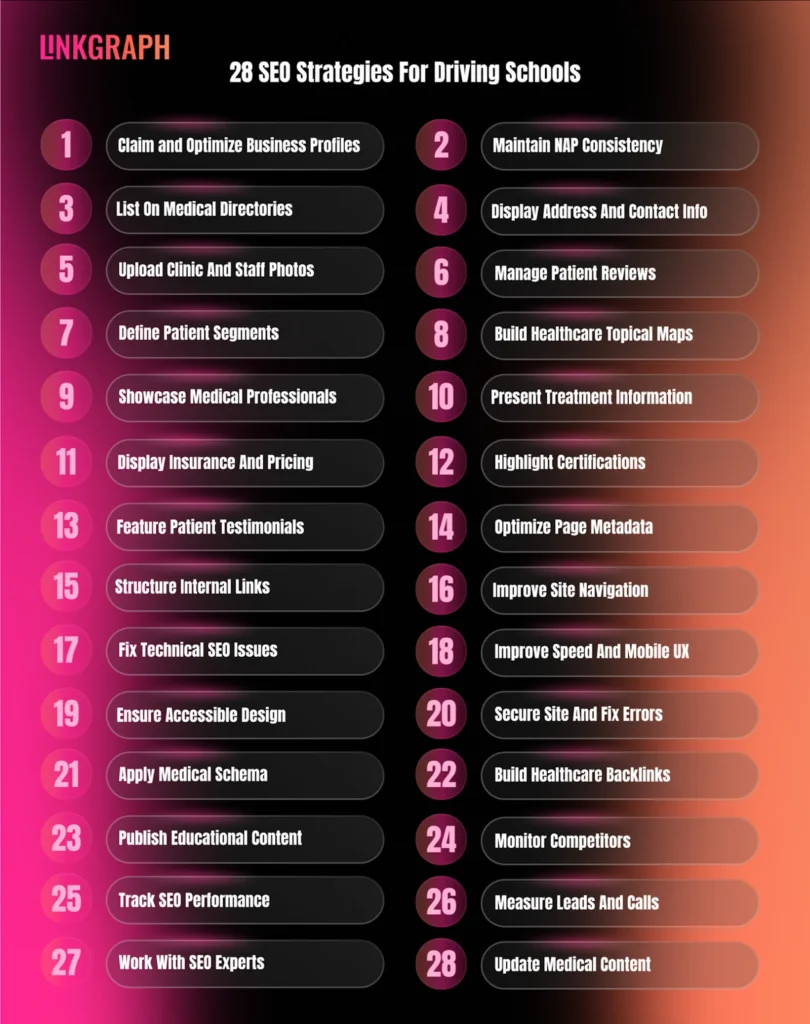
There are 28 SEO strategies for healthcare providers. The 28 SEO strategies for healthcare providers are listed below.
- Claim, Verify, and Fully Optimize Google, Bing, and Apple Business Listings
- Maintain Consistent Name, Address, and Phone (NAP) Across All Directories
- List Your Practice on Trusted Medical and Local Healthcare Directories
- Include Accurate Clinic Address, Map, and Contact Options
- Upload Authentic Photos of Your Clinic, Staff, and Facilities
- Encourage Patient Reviews and Respond to All Feedback Professionally
- Define Target Patient Segments and Their Specific Healthcare Needs
- Construct a Topical Map Based on Your Healthcare Services and Patient Queries
- Showcase Real Doctors with Photos, Expertise, and Specialties
- Present Key Treatments with Clear, Patient-Focused Information
- Display Accepted Insurance Plans, Pricing Options, and Payment Methods
- Highlight Verified Certifications, Awards, and Accreditations
- Feature Genuine Patient Reviews, Testimonials, and Success Stories
- Optimize Page Titles, Meta Descriptions, Headings, and URLs for Every Service Page
- Implement Clear Internal Linking Structure (Root → Seed → Node)
- Simplify Navigation and Enhance UX/UI for a Better Patient Experience
- Conduct a Full Website Audit and Resolve Technical SEO Issues
- Improve Core Web Vitals, Page Speed, and Mobile Responsiveness
- Ensure Mobile-Friendly, Accessible, and Professional Website Design
- Secure Your Website with HTTPS and Fix Broken Links, Redirects, and Errors
- Apply Structured Data Markup for Medical Practices and Local SEO
- Build Quality Backlinks from Medical Associations and Healthcare Partners
- Publish Educational Healthcare Content on Website and Social Platforms to Gain Mentions
- Monitor Competitor Practices to Identify SEO Gaps and New Opportunities
- Track SEO Performance Using Google Analytics, Search Console, and Call Tracking
- Measure Leads, Calls, Form Submissions, and Appointment Requests
- Work with SEO Professionals for Ongoing Optimization and Strategy Refinement
- Regularly Update Content to Keep Medical Information Accurate, Relevant, and Compliant
These steps provide a structured roadmap for healthcare SEO, increase patient visibility, and maintain compliance across search platforms. The 28 SEO strategies for healthcare providers have been broken down below.
Local SEO strategies 1 to 6 focus on improving healthcare visibility within specific geographic areas through accurate listings, location signals, and patient trust indicators.
1. Claim, Verify, and Fully Optimize Google, Bing, and Apple Business Listings
Healthcare providers and medical practices strengthen local search visibility by claiming, verifying, and fully optimizing Google, Bing, and Apple business listings. Optimized listings act as authoritative reference points that connect patient queries with accurate clinic information. This process ensures that patients find verified hours, addresses, services, and contact details quickly.
Why is claiming and verifying listings important for healthcare SEO? Verified business profiles increase trust with both search engines and patients. Accurate listings improve local search rankings, boost visibility in map packs, and enhance credibility for clinics. Unclaimed or inconsistent listings confuse patients and reduce authority signals in search results.
How is claiming and optimizing these listings done? First, providers must register with each platform and verify ownership. Then, add complete clinic details, categorize services correctly, upload high-quality images, and include relevant attributes. Regular updates, responses to patient questions, and monitoring insights maintain accuracy and performance. These steps improve local authority, patient engagement, and appointment requests.
2. Maintain Consistent Name, Address, and Phone (NAP) Across All Directories
Accurate Name, Address, and Phone (NAP) information across online directories ensures healthcare providers maintain clear and verifiable local listings. Uniform NAP details connect patient searches with the correct clinic or medical practice, improving discoverability. Consistent data signals reliability to search engines, enhancing the visibility of hospitals, clinics, and specialized healthcare services.
Why does NAP consistency matter for healthcare SEO? Inaccurate or mismatched listings confuse patients and reduce trust, while search engines downgrade ranking for inconsistent information. Maintaining uniform details improves credibility, strengthens local search authority, and ensures that patients find the correct clinic quickly, which increases appointment requests and engagement.
How do medical practices maintain consistent NAP across directories? Healthcare providers should review every listing on platforms such as Google Business Profile (GBP), Bing Places, and Apple Maps, then correct discrepancies. Clinics must standardize abbreviations, service names, and formatting across all profiles. Regular audits, updates after location changes, and verification of new directory submissions maintain accuracy. These steps increase local authority, improve patient confidence, and boost appointment scheduling.
3. List Your Practice on Trusted Medical and Local Healthcare Directories
Listing a medical practice on trusted healthcare and local directories improves discoverability for patients searching for nearby services. Accurate, verified entries in authoritative directories establish credibility for clinics, hospitals, and specialized healthcare providers. Directory listings connect search queries to relevant services, ensuring potential patients find verified contact information, location details, and service descriptions efficiently.
Why is directory listing critical for healthcare SEO? Directories act as reference points that validate the legitimacy of a clinic to search engines. Medical and healthcare directories enhance local authority, increase referral traffic, and improve visibility in map packs and organic results. Practices listed on multiple reputable platforms gain trust with patients and reduce the chance of information discrepancies that hurt search rankings.
How is listing performed for medical practices and healthcare providers? Providers must select credible directories, such as Healthgrades, Zocdoc, Vitals, and local chamber listings. They should submit complete NAP information, categorize services accurately, upload high-quality photos, and verify ownership. Regularly monitoring and updating entries ensures continued accuracy. Consistent directory presence strengthens local authority, attracts more patient inquiries, and supports appointment scheduling.
4. Include Accurate Clinic Address, Map, and Contact Options
Providing an accurate clinic address, interactive map, and clear contact options ensures patients locate and reach medical practices efficiently. Correct location details connect patient searches to the right healthcare provider and improve usability for appointment scheduling. Maps and clickable contact information increase engagement and reduce confusion, which benefits both clinics and search engines evaluating local relevance.
Why does including precise clinic address and contact information matter for healthcare SEO? Search engines prioritize medical practices with accurate, verified location and contact data for local search results. Patients trust clinics with clear directions, phone numbers, and email options. Practices with precise contact information experience higher visibility in map packs, better local rankings, and more inquiries for consultations or treatments.
How should healthcare providers implement accurate address, map, and contact details? Clinics must verify their street address and geolocation across GBP, Apple Maps, and Bing Places. Embedding interactive maps on service pages, using consistent phone formats, and adding email or online booking links ensures seamless patient interaction. Regular audits maintain data accuracy. These steps improve local authority, patient trust, and appointment conversions.
5. Upload Authentic Photos of Your Clinic, Staff, and Facilities
Uploading authentic photos of medical facilities, staff, and equipment enhances the online presence of healthcare providers. Visual content connects patients to clinics, hospitals, and specialty practices, improving confidence before visits. High-quality, real images convey professionalism, transparency, and operational readiness, signaling credibility to both patients and search engines.
Why are authentic photos important for healthcare SEO? Patients often evaluate medical practices based on visual information, including clinic cleanliness, staff professionalism, and available equipment. Search engines interpret unique, relevant images as engagement signals that enhance page relevance. Clinics with well-presented photos attract more clicks, improve dwell time, and build trust with potential patients searching for care.
How should healthcare providers upload photos for maximum impact? Practices should capture images of exam rooms, waiting areas, specialized equipment, and medical staff in professional settings. Each photo requires descriptive alt text and proper categorization on GBP, service pages, and healthcare directories. Frequent updates maintain accuracy and current representation. These practices strengthen local authority, increase patient confidence, and boost appointment requests.
6. Encourage Patient Reviews and Respond to All Feedback Professionally
Encouraging patient reviews and managing feedback professionally enhances credibility for medical practices. Positive reviews increase trust for hospitals, clinics, and private practices, while professional responses demonstrate accountability and patient care quality. Active review management signals to search engines that the healthcare provider maintains engagement and reliability online.
Why are patient reviews critical for healthcare SEO? Search engines prioritize medical practices with consistent, authentic feedback from patients. Reviews influence local search rankings, boost visibility in map packs, and attract patients seeking trustworthy care. Clinics with high-quality, timely reviews experience increased appointment inquiries and improved patient perception.
How should healthcare providers manage reviews effectively? Practices must request feedback after appointments, verify reviews on GBP, Bing, and healthcare directories, and respond promptly to all comments. Responses should address patient concerns, confirm satisfaction, and maintain a professional tone. Regular review monitoring strengthens authority, improves search performance, and increases patient acquisition for clinics and healthcare providers.
On-Page SEO strategies 7 to 16 concentrate on structuring healthcare website content to match patient intent, medical relevance, and search engine evaluation criteria.
7. Define Target Patient Segments and Their Specific Healthcare Needs
Defining target patient segments allows healthcare providers to focus SEO efforts on specific audiences. Segmenting by age, condition, treatment type, or location connects hospitals, clinics, and specialty practices with patients most likely to require services. Clear audience definition aligns website content, directory listings, and service pages with actual patient needs, increasing relevance and engagement.
Why is patient segmentation important for healthcare SEO? Search engines interpret targeted, structured content as highly relevant for user intent. Identifying patient groups ensures content addresses specific queries, improves topical authority, and enhances visibility for clinics in local and condition-specific searches. Providers targeting relevant segments experience higher appointment bookings, improved lead quality, and stronger search rankings.
How do medical practices apply segmentation using topical mapping? Practices categorize services, conditions, treatments, and patient concerns into clusters for content creation. Topical maps define root pages for main services, seed pages for specialties, and node pages for individual treatments or patient needs. Structured mapping ensures search engines understand relationships between content, strengthens local relevance, and optimizes conversion pathways for targeted patient segments.
8. Construct a Topical Map Based on Your Healthcare Services and Patient Queries
Constructing a topical map organizes healthcare content into structured hierarchies for hospitals, clinics, and specialty practices. Root pages represent main medical services, seed pages focus on treatments or specialties, and node pages cover specific procedures, patient concerns, or conditions. This structure connects patient queries to relevant information efficiently.
Why is a topical map important for healthcare SEO? Search engines interpret well-organized content as authoritative and relevant for medical searches. Mapping services and patient queries enhance crawlability, strengthen topical relevance, and ensure clinics rank for precise, intent-driven searches. A clear content hierarchy increases patient engagement, reduces bounce rates, and improves appointment conversions.
How do healthcare providers create a topical map effectively? Providers analyze patient search behavior, identify common medical queries, and categorize treatments or conditions into clusters. Each page links logically to related content, establishing clear relationships. Regular updates align the map with new services, medical trends, and patient needs. Properly structured topical maps improve organic visibility, increase trust, and generate qualified patient leads.
9. Showcase Real Doctors with Photos, Expertise, and Specialties
Showcasing real doctors with professional photos, credentials, and specialties enhances trust and credibility for hospitals, clinics, and medical practices. Displaying physician expertise connects patient searches to qualified healthcare providers. Visual and textual representation of medical staff signals professionalism and authenticity to both patients and search engines.
Why does showcasing medical professionals matter for healthcare SEO? Patients evaluate doctors before scheduling appointments based on experience, qualifications, and specialization. Search engines prioritize pages with unique, authoritative content, interpreting verified profiles as a sign of expertise and relevance. Clinics with well-presented doctor profiles achieve higher local rankings, improved patient confidence, and increased consultation requests.
How should healthcare providers present doctors effectively? Practices should create individual pages for each physician, including high-quality photos, board certifications, specialties, education, and years of experience. Linking these profiles to relevant treatments, service pages, and patient resources strengthens topical authority. Frequent updates reflecting new certifications or achievements improve patient trust, enhance search visibility, and drive appointment conversions.
10. Present Key Treatments with Clear, Patient-Focused Information
Presenting key treatments with clear, patient-focused information improves understanding and engagement for hospitals, clinics, and specialty practices. Each treatment page highlights procedure details, benefits, and eligibility, connecting patient intent with relevant medical services. Well-structured content ensures both users and search engines recognize treatment relevance.
Why is clear treatment information important for healthcare SEO? Patients search for condition-specific guidance and treatment options before booking appointments. Search engines evaluate content accuracy, relevance, and comprehensiveness. Providing detailed, patient-oriented descriptions enhances local rankings, increases organic visibility, and strengthens patient confidence in the medical practice.
How should healthcare providers structure treatment information effectively? Each treatment page must include concise descriptions, step-by-step procedures, recovery details, and related conditions. Incorporating internal links to physician profiles, related treatments, and educational resources improves topical hierarchy. Regularly updating pages with new protocols, clinical guidelines, and outcomes ensures accuracy, increases patient trust, and drives appointment conversions for medical facilities.
11. Display Accepted Insurance Plans, Pricing Options, and Payment Methods
Displaying accepted insurance plans, pricing options, and payment methods improves transparency for hospitals, clinics, and private practices. Patients seeking affordable healthcare use this information to assess suitability and plan visits efficiently. Clear financial details connect patient intent with actionable choices on the website.
Why is financial transparency important for healthcare SEO? Search engines evaluate content completeness and relevance for user queries. Pages that detail insurance coverage and costs rank higher for patients searching for specific services. Practices providing accurate financial information increase trust, reduce inquiry friction, and improve appointment conversions.
How should healthcare providers present insurance and pricing details effectively? Practices must list all accepted insurance carriers, coverage types, self-pay options, and payment methods clearly on dedicated pages. Including links to financial assistance, forms, and policies enhances usability. Updating this information regularly ensures accuracy, improves patient satisfaction, and strengthens search relevance for local and treatment-specific queries.
12. Highlight Verified Certifications, Awards, and Accreditations
Highlighting verified certifications, awards, and accreditations increases credibility for hospitals, clinics, and medical practices. Displaying credentials from recognized medical boards and professional organizations demonstrates expertise and professionalism. Visible recognition connects patient trust with search engine evaluation of authority.
Why do certifications and awards matter for healthcare SEO? Patients rely on verified achievements to assess practice quality before booking appointments. Search engines interpret authoritative signals as indicators of trustworthiness and relevance, improving rankings for local and specialty queries. Practices showcasing credentials attract more inquiries and generate higher patient confidence.
How should healthcare providers present certifications effectively? Medical facilities should list board certifications, accreditations, awards, and professional memberships on dedicated pages or within physician profiles. Adding badges, dates, and verifiable links enhances authenticity. Regularly updating this information reflects ongoing excellence, strengthens topical authority, and improves search visibility for clinics, hospitals, and specialty providers.
13. Feature Genuine Patient Reviews, Testimonials, and Success Stories
Featuring genuine patient reviews, testimonials, and success stories builds credibility for hospitals, clinics, and medical practices. Authentic experiences from real patients demonstrate care quality, patient satisfaction, and treatment effectiveness. These narratives connect patient trust with search engine evaluation of relevance and authority.
Why are patient testimonials important for healthcare SEO? Search engines consider unique, authentic content when ranking medical practices. Reviews and success stories provide fresh, patient-focused content that aligns with search intent. Clinics displaying positive experiences increase local visibility, improve patient confidence, and drive appointment bookings.
How should healthcare providers showcase reviews effectively? Practices must collect verified feedback through surveys, GBP, or healthcare directories. Highlighting stories on treatment pages, testimonial sections, or video content strengthens credibility. Incorporating responses to reviews demonstrates professionalism. Consistently updating success stories improves patient engagement, enhances search relevance, and increases conversion rates for medical providers.
14. Optimize Page Titles, Meta Descriptions, Headings, and URLs for Every Service Page
Optimizing page titles, meta descriptions, headings, and URLs ensures hospitals, clinics, and medical practices communicate relevance to search engines. Each service page must reflect targeted keywords, patient intent, and treatment focus. Proper structure improves indexation and directs patients to the most relevant healthcare information.
Why is on-page optimization important for healthcare SEO? Search engines evaluate meta elements and headings to determine page context and relevance. Optimized titles, descriptions, and headings increase click-through rates from search results. Clear URLs improve navigation, signal content hierarchy, and enhance patient confidence when exploring treatment options.
How should healthcare providers implement these optimizations? Service pages must include concise, keyword-aligned titles and descriptions. Headings should organize content logically, highlighting procedures, benefits, and conditions. URLs need to remain descriptive and readable. Regular audits maintain alignment with patient queries and medical terminology. Effective on-page optimization strengthens visibility, improves search rankings, and drives qualified patient visits to clinics and hospitals.
15. Implement Clear Internal Linking Structure (Root → Seed → Node)
Implementing a clear internal linking structure organizes website content for hospitals, clinics, and medical practices. Root pages represent main services, seed pages focus on specialties or departments, and node pages address specific procedures, conditions, or patient concerns. Logical links connect related content and improve navigability.
Why does an internal linking hierarchy matter for healthcare SEO? Search engines use internal links to understand page relationships and content priority. Structured connections allow authority to flow from high-level pages to detailed treatment pages, improving indexation. Proper linking enhances relevance for condition-specific and location-based queries, increasing organic visibility and patient engagement.
How should healthcare providers implement a root-to-node linking system? Clinics must link root pages to seed pages and seed pages to node pages consistently. Internal links should include descriptive anchor text aligned with patient intent and medical terminology. Regular audits ensure pages remain connected, outdated links are fixed, and the hierarchy reflects current services. A structured linking strategy improves crawl efficiency, strengthens topical relevance, and increases appointment inquiries.
16. Simplify Navigation and Enhance UX/UI for a Better Patient Experience
Simplifying navigation and enhancing UX/UI improves accessibility for hospitals, clinics, and medical practices. Clear menus, intuitive layouts, and easily accessible information allow patients to find services, treatments, and provider details quickly. Streamlined design reduces friction and increases engagement on healthcare websites.
Why does user experience matter for healthcare SEO? Search engines evaluate user interaction signals, such as time on page, bounce rates, and click patterns. Well-organized interfaces improve patient satisfaction, increase form submissions and appointment bookings, and enhance search rankings for local and treatment-specific queries. Hospitals with strong UX/UI design demonstrate authority and reliability.
How should healthcare providers improve navigation and UX/UI effectively? Practices should create logical menus, categorize services clearly, and include quick links to frequently accessed pages. Mobile-friendly interfaces, readable fonts, and clear call-to-actions enhance usability. Regular testing and user feedback allows identify pain points. Optimized UX/UI improves accessibility, strengthens patient trust, and drives higher conversions for clinics, specialty practices, and hospitals.
Technical SEO strategies 17 to 21 address website performance, crawl efficiency, security, and accessibility requirements specific to healthcare platforms.
17. Conduct a Full Website Audit and Resolve Technical SEO Issues
Conducting a full website audit identifies technical issues affecting hospitals, clinics, and medical practices. Audits analyze server performance, crawlability, indexation, page speed, mobile responsiveness, and structured data. Proper technical evaluation ensures search engines efficiently discover and rank treatment pages, service listings, and provider profiles.
Why is a technical audit critical for healthcare SEO? Search engines prioritize websites with fast response times, accessible HTML, and optimized crawl efficiency. Reducing server response time under 100ms increases page delivery speed. Ensuring HTML crawl requests exceed 95% maximizes indexable content.
Maintaining a refresh rate of around 20% keeps updated pages indexed promptly. A discovery rate of 7–8% allows search engines to locate new or updated pages efficiently. Performing log file analysis identifies where crawl budget is lost, highlighting errors, redirects, or low-value pages that require attention. Addressing these issues improves indexing, user experience, and organic visibility.
How should healthcare providers implement technical SEO fixes? Regularly audit website structure, compress images, remove broken links, and update sitemaps. Optimize server configurations, implement HTTPS, and fix redirects. Track crawl performance using log file analysis and adjust pages to maximize discovery. Performing these steps strengthens search engine authority, improves patient access to content, and increases appointment conversions.
18. Improve Core Web Vitals, Page Speed, and Mobile Responsiveness
Improving Core Web Vitals, page speed, and mobile responsiveness enhances usability for hospitals, clinics, and medical practices. Fast-loading pages, smooth visual stability, and responsive layouts allow patients to access treatment information and appointment systems efficiently. Optimized performance ensures search engines recognize the website as reliable and user-friendly.
Why do Core Web Vitals and mobile responsiveness matter for healthcare SEO? Google evaluates loading performance, interactivity, and visual stability to determine page quality. Websites with fast page speed, stable layouts, and responsive design rank higher in search results. Mobile-friendly interfaces are critical as patients increasingly use smartphones to find local healthcare services.
How should healthcare providers improve technical performance effectively? Practices must optimize images, minify code, leverage browser caching, and reduce server response times. Implement responsive design frameworks and test layouts across devices. Regularly audit Core Web Vitals metrics, including Largest Contentful Paint, First Input Delay, and Cumulative Layout Shift. Enhanced page speed and mobile usability improve patient experience, strengthen search rankings, and increase appointment conversions for medical facilities.
19. Ensure Mobile-Friendly, Accessible, and Professional Website Design
Ensuring mobile-friendly, accessible, and professional website design improves usability for hospitals, clinics, and medical practices. Responsive layouts allow patients to view services, physician profiles, and appointment forms on any device. Accessible design ensures patients with disabilities navigate the website without barriers, increasing engagement and satisfaction.
Why is accessibility and professional design important for healthcare SEO? Search engines prioritize websites that meet accessibility standards and provide seamless experiences across devices. Mobile-friendly sites improve rankings for local and specialty searches. Clear navigation, readable fonts, and structured content enhance patient trust and encourage form submissions or appointment bookings.
How should healthcare providers implement these design improvements? Practices must use responsive frameworks, scalable images, and legible typography. Include alt text for images, proper ARIA labels, and keyboard navigation for accessibility compliance. Professional layouts, consistent branding, and intuitive interfaces improve patient experience. Maintaining mobile-friendly and accessible designs strengthens search visibility, ensures compliance with accessibility guidelines, and increases patient conversion rates for clinics, hospitals, and specialty practices.
20. Secure Your Website with HTTPS and Fix Broken Links, Redirects, and Errors
Securing a website with HTTPS and fixing broken links, redirects, and errors protects hospitals, clinics, and medical practices. Encrypted connections safeguard patient data, including forms and personal health information. Eliminating broken links and correcting redirects ensures search engines crawl and index content efficiently while improving user experience.
Why is website security and error management important for healthcare SEO? Search engines prioritize secure websites that deliver reliable navigation. HTTPS encryption signals trust and compliance. Broken links, 404 errors, or improper redirects reduce crawl efficiency, negatively affecting rankings. Correcting these issues maintains search visibility, enhances patient confidence, and reduces bounce rates on medical websites.
How should healthcare providers implement these improvements? Practices must install SSL certificates to enable HTTPS, audit websites for broken links, and configure proper 301 redirects. Monitor error logs and sitemap health regularly. Correcting technical errors and securing connections improves search engine authority, strengthens patient trust, and ensures uninterrupted access to clinic information, service pages, and appointment scheduling tools.
21. Apply Structured Data Markup for Medical Practices and Local SEO
Applying structured data markup enhances search visibility for hospitals, clinics, and medical practices. Schema markup allows search engines to understand service types, provider details, locations, operating hours, and patient reviews. Implementing structured data ensures treatment pages, physician profiles, and local listings are accurately represented in search results.
Why does structured data matter for healthcare SEO? Search engines use schema to display rich results such as star ratings, service availability, and contact information. Proper markup increases click-through rates, improves local search performance, and signals credibility. Medical websites with well-defined schema gain higher trust scores for YMYL content and treatment-specific queries.
How should healthcare providers implement structured data effectively? Practices must use schemas for Organization, LocalBusiness, Physician, MedicalProcedure, and Review types. Validate markup using Google’s Rich Results Test. Include service details, provider credentials, and patient review data consistently. Applying structured data improves indexing, enhances SERP presentation, and drives targeted traffic for clinics, hospitals, and specialty practices.
Off-Page SEO strategies 22 to 24 strengthen medical authority through external references, healthcare partnerships, and trusted third-party mentions.
22. Build Quality Backlinks from Medical Associations and Healthcare Partners
Building quality backlinks strengthens hospitals, clinics, and medical practices by signaling authority to search engines. Links from reputable medical associations, healthcare partners, and professional networks establish credibility and improve organic rankings. Targeted backlinks increase visibility for treatment pages, provider profiles, and specialty services.
Why are backlinks important for healthcare SEO? Search engines treat authoritative references as trust indicators. High-quality links from recognized organizations enhance domain authority, improve local search performance, and increase discoverability for patient-focused queries. Backlinks from relevant healthcare sources demonstrate legitimacy in YMYL contexts, improving rankings for condition-specific or service-related searches.
How should healthcare providers acquire authoritative backlinks? Clinics should collaborate with medical associations, contribute guest posts to reputable healthcare publications, and participate in professional partnerships. Ensure links are contextually relevant, from high-authority domains, and consistently maintained. Regular backlink audits identify broken or low-value links. Building strong external references improves search engine trust, increases patient referrals, and drives more qualified traffic to healthcare websites.
23. Publish Educational Healthcare Content on Website and Social Platforms to Gain Mentions
Educational healthcare content attracts attention from patients, publishers, and professional communities. Medical articles, condition guides, and treatment explanations establish topical relevance for hospitals, clinics, and medical practices. Search systems associate consistent education-focused publishing with authority across medical websites.
Why do mentions from external platforms influence healthcare SEO performance? Search engines interpret brand mentions as authority indicators across healthcare ecosystems. Educational posts referenced by blogs, news outlets, or medical communities increase entity recognition. Mentions connected to verified medical content strengthen trust evaluation within YMYL classification systems.
How should healthcare providers publish educational content effectively? Medical practices publish condition resources, procedure explanations, and preventive care guidance. Content distribution across websites and social platforms increases reach and discovery. Consistent updates aligned with patient search intent improve indexing frequency, citation likelihood, and organic visibility for healthcare entities.
24. Monitor Competitor Practices to Identify SEO Gaps and New Opportunities
Competitor monitoring matters for healthcare SEO strategy because it reveals ranking behavior across hospitals, clinics, and medical practices. Comparative analysis exposes differences in keyword coverage, service visibility, and authority signals. These gaps highlight missed opportunities within treatment pages, specialty services, and location-based searches.
Which competitor signals reveal SEO gaps within healthcare search results? Keyword overlaps, missing service pages, backlink sources, and local visibility metrics indicate weaknesses. Competitor practices ranking for condition-specific queries shows areas of unmet patient demand. Variations in schema usage, internal linking depth, and page structure identify structural and technical deficiencies.
How should healthcare providers analyze competitors to uncover new opportunities? Healthcare providers review top-ranking competitors using keyword datasets, backlink audits, and content comparisons. Tracking updates in service pages, physician profiles, and local listings identifies strategies to improve topical coverage and increase organic visibility for medical websites.
Tracking and refining SEO strategies 25 to 28 rely on continuous measurement, analysis, and optimization of healthcare search performance and patient conversions.
25. Track SEO Performance Using Google Analytics, Search Console, and Call Tracking
Tracking SEO performance is essential for hospitals, clinics, and medical practices to measure the effectiveness of their optimization efforts. Google Analytics (GA4), Google Search Console (GSC), and call tracking provide insights into user behavior, search visibility, and patient interactions. Monitoring these metrics allows healthcare providers to identify trends, evaluate content performance, and optimize campaigns for better results.
Which key metrics should healthcare providers monitor in GA4 and GSC? Track sessions, page views, clicks, impressions, and average session duration to evaluate patient engagement. Search Console highlights indexing status, top queries, and CTR for specific treatment or service pages. Call tracking captures appointment requests and inquiries, linking offline actions to online performance.
How does tracking SEO performance improve patient acquisition? Data from GA4, GSC, and call tracking identifies high-performing pages, keywords, and service offerings. Medical practices adjust content, technical optimizations, and local SEO strategies based on insights. Continuous monitoring increases website effectiveness, boosts search visibility, and drives more qualified patient traffic.
26. Measure Leads, Calls, Form Submissions, and Appointment Requests
Measuring leads, calls, form submissions, and appointment requests is essential for hospitals, clinics, and medical practices to evaluate SEO effectiveness. Tracking these patient interactions converts website activity into actionable insights. Monitoring these metrics identifies which services attract patients, how campaigns perform, and where adjustments are needed to improve acquisition.
Which patient interactions provide the most actionable insights for healthcare SEO? Phone calls, contact forms, appointment requests, and newsletter sign-ups indicate direct engagement with medical services. Monitoring these conversions allows clinics to identify high-intent users and assess the effectiveness of local SEO, service pages, and content targeting.
How should healthcare providers analyze conversion data to improve results? Medical practices connect tracked leads to specific keywords, service pages, and campaigns. Patterns in calls or form submissions highlight which services generate the most demand. Continuous measurement of these interactions allows targeted adjustments to content, technical SEO, and local listings, increasing patient acquisition and clinic growth.
27. Work with SEO Professionals for Ongoing Optimization and Strategy Refinement
Partnering with SEO professionals ensures hospitals, clinics, and medical practices maintain continuous performance improvements. Experts evaluate technical, on-page, and off-page elements while identifying emerging trends. Consistent professional oversight allows healthcare providers to optimize campaigns, maintain visibility, and achieve higher patient engagement.
Why do healthcare organizations require professional SEO expertise? SEO professionals analyze complex medical websites, track regulatory compliance, and implement strategies aligned with patient intent. Their experience identifies gaps in content, backlinks, and technical structure. Expertise in medical SEO improves local visibility, drives qualified patient traffic, and reduces costly trial-and-error efforts.
How should healthcare providers collaborate with SEO specialists effectively? Clinics should schedule regular performance reviews, share data from GA4, GSC, and call tracking, and coordinate updates to service pages and content. Continuous collaboration ensures optimizations align with search trends, enhance authority signals, and increase appointment requests, referral leads, and patient inquiries.
28. Regularly Update Content to Keep Medical Information Accurate, Relevant, and Compliant
Regular content updates are essential for hospitals, clinics, and medical practices to maintain accurate, relevant, and compliant information. Consistently refreshing service pages, treatment guides, and patient resources ensures websites remain authoritative and aligned with healthcare regulations. Updated content improves indexing, search visibility, and patient trust.
Why is updating medical content important for healthcare SEO? Frequent updates demonstrate reliability to search engines and patients. Correcting outdated procedures, revising clinical guidelines, and adding new treatments maintain compliance with regulations like HIPAA and enhance trust signals. Accurate content reduces misinformation and improves patient decision-making.
How should healthcare providers manage content updates effectively? Medical practices establish schedules for reviewing service pages, physician profiles, and educational resources. Incorporating new research, procedure changes, and patient FAQs ensures accuracy. Coordinating updates with SEO professionals maintains ranking stability, strengthens topical authority, and increases organic traffic for high-intent patient queries.
Can a Single SEO Strategy Work for All Types of Healthcare Providers and Businesses?
A single SEO strategy does not work for all healthcare providers due to differences in services, audience, and scale. Hospitals, clinics, specialty practices, and pharmaceutical companies have distinct patient intents, search behaviors, and regulatory requirements. Implementing one uniform approach risks misaligned keywords, insufficient local targeting, and inadequate technical compliance.
Which factors determine the need for customized SEO strategies? Service scope, geographic reach, competition, and treatment specificity influence optimization. Hospitals require broad authority and multi-location SEO, while individual clinics rely on local search and patient-focused content. Tailored strategies ensure keyword relevance, proper schema usage, and content alignment with patient intent, improving search visibility, patient acquisition, and regulatory compliance across diverse healthcare entities.
When Is the Right Time for Healthcare Providers to Start Investing in SEO?
Healthcare providers should start investing in SEO immediately upon establishing an online presence. Early implementation builds search authority, improves visibility for local and specialty searches, and captures patient traffic before competitors dominate key queries. The average timeline for noticeable results ranges from 3 to 6 months for clinics, while hospitals and multi-specialty networks require 6 to 12 months.
Highly competitive medical markets or broad-service institutions need up to 12–18 months for full impact. Results depend on competition, website quality, consistency in publishing content, and ongoing technical optimization. Strategic, continuous SEO efforts increase organic traffic, improve patient engagement, and generate measurable appointment requests efficiently.
What Are the Most Common SEO Mistakes Healthcare Organizations Should Avoid?
Healthcare organizations frequently lose search visibility and patient engagement due to common SEO mistakes. Understanding these errors allows clinics, hospitals, and medical practices to optimize strategy, increase local visibility, and maintain compliance with medical regulations. The most common SEO mistakes that healthcare organizations should avoid are listed below.
- Ignoring Local SEO: Failing to optimize GBP, ensure NAP consistency, and create location-specific pages prevents practices from appearing in nearby patient searches. Local signals directly influence appointment requests and clinic visibility.
- Weak or Duplicate Content: Repeating content across service pages or publishing low-authority material reduces credibility. High-quality, patient-focused content establishes trust and aligns with E-E-A-T requirements.
- Poor Technical SEO: Slow page speed, broken links, missing structured data, and non-mobile-friendly design hinder indexing, impair user experience, and reduce search performance.
- Neglecting Patient Reviews: Not collecting or responding to reviews decreases trust signals, lowers local rankings, and impacts patient decision-making.
- Improper Keyword Targeting: Using generic, overly broad, or irrelevant medical terms misaligns with patient intent, reducing qualified traffic to service pages.
- Overlooking Analytics and Tracking: Ignoring GA4, GSC, and call tracking prevents actionable insights, making performance measurement and ongoing optimization impossible.
Correcting these mistakes strengthens search authority, improves patient acquisition, and ensures long-term growth for healthcare websites.
How Can Local SEO Help Healthcare Providers Attract More Nearby Patients?
Local SEO increases nearby patient acquisition by improving visibility for location-based medical searches. Healthcare providers appear in map results, local packs, and proximity queries through optimized business listings and location signals.
Local optimization strengthens relevance through accurate addresses, service areas, and patient reviews tied to geographic intent. Clinics, hospitals, and medical practices gain higher exposure for urgent and routine care searches, which increases appointment requests from surrounding communities.
Are Medical and Healthcare Directories Still Valuable for SEO?
Yes, medical and healthcare directories retain value for SEO through authority validation and entity consistency. Trusted listings reinforce business legitimacy, citation accuracy, and clinical relevance within medical search systems.
Authoritative directories such as hospital networks, physician registries, and healthcare platforms strengthen trust signals tied to regulated medical entities. These references improve local visibility, entity recognition, and index confidence for healthcare websites operating under YMYL standards.
Which Online Directories Are Most Effective for Promoting Healthcare Practices?
Healthcare practices gain visibility and authority through trusted medical directories that validate clinical credibility and entity accuracy. These platforms strengthen discovery within regulated healthcare search environments and patient research workflows. The most effective online directories for promoting healthcare practices are listed below.
- MedlinePlus.gov: MedlinePlus connects healthcare practices with government-reviewed medical information, which reinforces clinical credibility and topic relevance.
- SAMHSA.gov: SAMHSA listings validate behavioral health and substance treatment providers through federally governed healthcare data sources.
- Healthgrades: Healthgrades aggregates patient reviews, physician profiles, and treatment data, which improves patient trust and local discovery.
- RateMDs: RateMDs publishes physician ratings and experience feedback, which influences patient selection and reputation signals.
- NIH.gov and MeSH: NIH references and MeSH associations strengthen topical authority through alignment with standardized medical terminology.
- CMS Physician Compare: CMS listings confirm provider enrollment and service accuracy through Medicare-linked clinical records.
Directories with regulatory oversight and medical authority improve trust evaluation, entity consistency, and patient-facing credibility for healthcare practices.
Should Healthcare Providers Combine SEO with Paid Advertising Campaigns?
Yes, healthcare providers benefit from combining SEO with paid advertising campaigns for controlled visibility and demand capture. SEO builds long-term organic presence across medical queries, while paid campaigns secure immediate exposure for high-intent searches and time-sensitive services.
This combination works through role separation across channels. SEO targets informational, local, and specialty queries through content, entities, and technical signals. Paid search targets transactional queries such as appointment requests or urgent treatments through keyword bidding and landing pages. Shared analytics from PPC data informs keyword prioritization, conversion optimization, and content alignment across healthcare search marketing systems.
How Can Healthcare Businesses Accurately Track ROI from SEO and PPC Campaigns?
Healthcare businesses track ROI from SEO and PPC campaigns through revenue-aligned attribution across analytics and call tracking systems. ROI measurement links organic traffic, paid clicks, conversions, and booked appointments to recorded patient value using verified data sources.
Which metrics connect healthcare SEO and PPC performance to revenue outcomes? GA4 tracks sessions, conversion paths, and goal completions, while Search Console reports query visibility and click behavior. Call tracking platforms assign calls to channels through dynamic numbers, which clarifies lead origin. CRM systems connect appointments and treatments to acquisition sources, which confirms cost per lead and lifetime value accuracy.
When Should a Healthcare Provider Consider Hiring an SEO Agency or Specialist?
A healthcare provider should consider hiring an SEO agency or specialist when internal resources cannot manage optimization effectively. Lack of dedicated time, expertise, or technical capacity prevents clinics, hospitals, and medical practices from achieving visibility in competitive search environments.
Which indicators signal the need for external SEO support? Stagnant website traffic, low appointment requests from search, poor local rankings, or inability to maintain regulatory-compliant content indicate limitations in-house.
Specialized agencies bring technical skills, local search knowledge, content strategy expertise, and experience in YMYL-compliant healthcare SEO. Hiring professionals accelerates ranking improvements, expands patient reach, and ensures ongoing performance monitoring across search platforms, which drives measurable growth in patient acquisition.
What Key Factors Should Healthcare Providers Evaluate When Choosing an SEO Partner?
Choosing the right SEO partner directly affects patient acquisition, search visibility, and regulatory compliance for healthcare providers. Careful evaluation ensures clinics, hospitals, and medical practices avoid ineffective strategies, maintain YMYL compliance, and achieve measurable growth in appointment bookings and online engagement. The key factors that healthcare providers should evaluate when choosing an SEO partner are listed below.
- Healthcare SEO Experience: Agencies with proven experience in medical SEO understand YMYL guidelines, HIPAA compliance, patient-focused content requirements, and regulatory constraints.
- Technical and On-Page Expertise: Proficiency in website speed optimization, Core Web Vitals, mobile responsiveness, structured data markup, crawlability, and internal linking ensures search engines index medical websites effectively.
- Local SEO Proficiency: Knowledge of GBP management, NAP consistency, patient review acquisition, and location-targeted optimization drives higher visibility for nearby patients.
- Content and Authority Development: Ability to create high-quality, authoritative healthcare content and acquire backlinks from medical associations, directories, and industry partners strengthens E-E-A-T signals.
- Reporting and Analytics Transparency: Clear KPIs, GA4 and GSC tracking, call tracking, and actionable insights allow healthcare providers to monitor ROI, optimize campaigns, and maintain accountability.
Evaluating these factors ensures providers select an SEO partner capable of improving organic visibility, increasing patient traffic, and maintaining compliance across all healthcare search channels.
Which Agency Provides the Most Reliable SEO Services for Healthcare Businesses?
LinkGraph is a leading SEO service provider for healthcare and medical companies, delivering measurable growth in search visibility, patient acquisition, and local rankings. As trusted SEO providers, LinkGraph has optimized websites for hospitals, clinics, specialty practices, and multi-location medical centers, aligning content, technical SEO, and authority-building strategies with YMYL and HIPAA compliance standards.
Why is LinkGraph the best choice for SEO for medical centers and companies? Case studies demonstrate increases in organic traffic up to 350% within six months for clinics, improved local map pack visibility, and higher appointment bookings. Client testimonials highlight expertise in managing GBP, structured data, and content strategies tailored to healthcare searches.
How does LinkGraph maintain authority as an SEO service provider for healthcare and medical companies? The agency leverages data-driven insights, patient-focused keyword mapping, technical audits, backlink acquisition from reputable medical sources, and continuous optimization to enhance organic search performance. These results confirm LinkGraph as a reliable partner for medical SEO, delivering long-term growth and measurable ROI.
How Much Does LinkGraph Charge for Healthcare SEO Services?
LinkGraph’s healthcare SEO services range from $3,000 to $12,000 per month, depending on practice size, competition, and campaign complexity. Small clinics or single-location medical practices typically start at $3,000–$5,000 per month, covering local SEO, content strategy, and technical optimization. Larger hospitals, specialty centers, or multi-location medical facilities often invest $8,000–$12,000 per month for advanced content frameworks, extensive backlink acquisition, and continuous analytics monitoring.
Pricing reflects the scope of service and resources required. Higher investment includes detailed keyword research for complex medical queries, GBP optimization, structured data implementation, and authoritative backlink development. LinkGraph’s approach consistently increases organic traffic, local map visibility, and patient inquiries, delivering measurable ROI that justifies the pricing for healthcare and medical companies.
How Long Does It Usually Take Healthcare Providers to See Noticeable SEO Results?
Healthcare providers usually see noticeable SEO results within 4 to 6 months for local campaigns and 6 to 12 months for broader healthcare optimization. Results depend on competition, website authority, content quality, technical compliance, and consistent SEO implementation.
Initial improvements appear in GBP visibility, local map pack rankings, and indexing of optimized service pages. Broader organic traffic growth and competitive keyword ranking require continuous content updates, backlink acquisition, and technical refinement.
Providers that maintain YMYL-compliant content, track KPIs, and implement consistent optimization experience measurable increases in patient inquiries, appointment requests, and overall online visibility within the typical SEO timeline.
