
SEO for HVAC companies is a vital marketing strategy that boosts visibility, attracts local customers, and drives consistent leads. Local SEO for HVAC companies optimizes online presence for higher rankings in local search results, including Google Business Profile, service-area pages, and trusted directories. HVAC search engine optimization combines technical SEO, on-page content, off-page strategies, and link building to make websites discoverable and credible to both search engines and potential clients.
Effective HVAC SEO marketing services increase website traffic, generate higher-quality leads, and strengthen brand authority in a competitive industry. Optimized content, structured data, and local map pack strategies improve online visibility and user engagement, leading to better conversions and measurable ROI for HVAC contractors.
Choosing the best SEO agency for HVAC contractors ensures these benefits are maximized. Professional HVAC SEO services offer expertise in keyword targeting, content strategy, and performance tracking. From technical audits to local SEO and ongoing optimization, HVAC SEO services provide a complete solution for sustained growth, competitive advantage, and long-term marketing success.

What is HVAC?
HVAC stands for Heating, Ventilation, and Air Conditioning. HVAC defines systems that regulate indoor comfort and maintain clean air quality. HVAC regulates temperature, balances humidity, and moves air efficiently inside enclosed environments. The system supports homes, offices, and industrial buildings by maintaining safe and comfortable indoor conditions.
HVAC has three main parts. Heating uses furnaces, boilers, or heat pumps to provide warmth during cold seasons. Ventilation moves air, introduces fresh outdoor air, and removes stale, polluted air. Air conditioning cools indoor air and manages humidity in warm climates. HVAC delivers thermal comfort and supports healthy indoor breathing conditions.
What is HVAC SEO?
HVAC SEO stands for Search Engine Optimization for Heating, Ventilation, and Air Conditioning companies. HVAC SEO defines the process of improving website visibility in search engine results for relevant HVAC service keywords. HVAC SEO increases exposure, attracts local search traffic, and directs qualified leads toward service providers. The practice allows HVAC companies to appear prominently in searches for repair, installation, and maintenance services.
HVAC SEO uses keyword research to identify search terms that match customer intent. HVAC SEO applies on-page optimization to titles, descriptions, and structured content to improve alignment with search demand. HVAC SEO employs local SEO by enhancing directory listings and optimizing Google Business Profiles for better local reach. HVAC SEO strengthens authority through backlinks from relevant and reputable websites. HVAC SEO integrates content marketing to publish articles, guides, and resources that address customer needs. HVAC SEO improves user experience through faster websites, clear navigation, and responsive mobile design.
HVAC SEO creates consistent visibility in competitive markets. HVAC SEO reduces reliance on paid ads by generating organic traffic that produces long-term business growth. HVAC SEO transforms a standard business website into a powerful channel for customer acquisition.
Is SEO Important for HVAC Companies?
Yes, SEO is highly important for HVAC companies. SEO improves online visibility, allowing HVAC businesses to appear in search results for local service keywords. SEO attracts targeted traffic, directs users actively seeking HVAC services, and increases lead generation.
SEO increases website rankings for searches like “AC repair near me” or “furnace installation,” driving qualified prospects to contact HVAC providers. SEO builds trust and credibility by showing businesses at the top of search results and highlighting positive reviews. SEO reduces marketing costs by creating long-term organic traffic that generates sustainable leads without constant paid advertising. HVAC companies using SEO stay competitive by capturing search demand that competitors target. SEO allows measurable results, tracking website traffic, lead generation, and conversions to guide strategy adjustments.
What Are the Key Advantages of SEO for HVAC Companies?
The benefits of doing SEO (Search Engine Optimization) for HVAC companies provide several powerful advantages that directly impact online business visibility, reputation, and revenue. SEO helps HVAC businesses attract targeted traffic, increase leads, and strengthen brand authority in local markets. The key advantages of SEO for HVAC companies have been listed below.
- Increased Online Visibility and Website Traffic: SEO improves search engine rankings for relevant HVAC service keywords. HVAC websites appear higher in search results, making it easier for potential customers to find them. SEO drives more organic traffic, bringing visitors actively seeking HVAC services. Targeted audience reach ensures higher quality leads likely to convert.
- Enhanced Brand Credibility and Trust: SEO builds authority by signaling that the HVAC business is reputable and trustworthy. Ranking in search results demonstrates reliability to potential customers. SEO improves website structure, navigation, and relevance, enhancing user experience and reinforcing trust.
- Cost-Effective Marketing: SEO provides long-term returns as websites continue to attract traffic and leads after initial optimization. SEO lowers cost per lead compared with paid advertising or traditional marketing. HVAC businesses reach customers who are actively searching for services, increasing marketing efficiency.
- Boosted Lead Generation and Sales: SEO increases qualified traffic, producing more leads for HVAC businesses. Optimized websites with strong online presence improve conversion rates, turning visitors into paying customers.
- Competitive Advantage: SEO helps HVAC businesses outrank competitors in search results. Higher rankings attract more customers and capture market share from competitors.
- Sustainable Growth: SEO contributes to consistent long-term growth by maintaining visibility in search engines. HVAC companies benefit from steady traffic, lead generation, and ongoing business development.
- Improved Customer Engagement: SEO encourages relevant content creation, helping potential customers find answers and resources. Engaging content strengthens trust and positions the HVAC business as a reliable service provider.
- Local Market Domination: SEO emphasizes local search optimization, helping HVAC businesses reach customers in specific service areas. Local SEO ensures higher visibility for location-based searches.
- Measurable Results: SEO performance is tracked using analytics, showing traffic, lead generation, and conversion rates. HVAC businesses use data to refine strategies and improve results over time.
Some benefits include boosting online visibility, growing the customer base, and powering long-term business growth. SEO delivers a measurable impact that strengthens the reputation and revenue of HVAC companies.
How Can HVAC Companies Effectively Get Started with SEO?
The best ways to get started with HVAC SEO involve building a strong online presence, targeting the right topics, and optimizing the website for both users and search engines. These strategies ensure HVAC companies reach potential customers, generate leads, and improve online visibility.
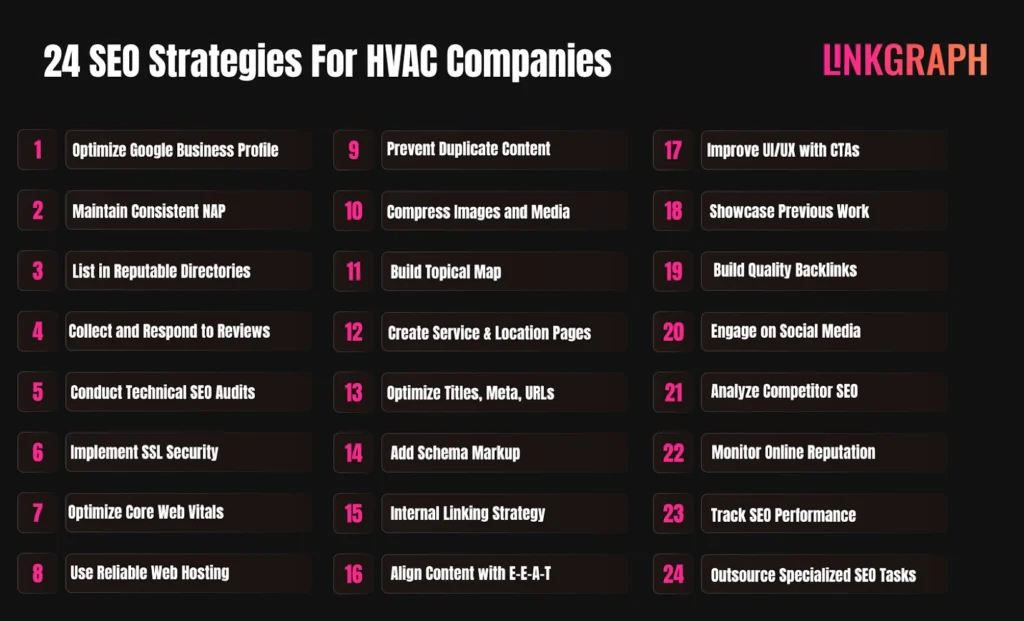
There are 24 SEO strategies for HVAC companies. The 24 SEO strategies for HVAC companies have been listed below.
- Claim, Verify, and Fully Optimize Google Business Profile
- Maintain Consistent Business Information Across Online Listings
- List Your HVAC Company in Reputable Local and Industry-Specific Directories
- Actively Collect, Manage, and Respond Promptly to Customer Reviews
- Conduct Technical SEO Audits Regularly
- Secure Website by Implementing an SSL Certificate
- Improve Site Speed by Optimizing Core Web Vitals
- Choose Reliable Web Hosting
- Prevent Duplicate Content by Properly Using Canonical Tags
- Compress Images and Media Files
- Construct Proper Topical Map
- Create Dedicated Pages for Each Individual Service and Targeted Service Area
- Optimize Page Titles, Meta Descriptions, and URL Structures
- Implement Schema Markup on Homepage and Service-Specific Pages
- Strategically Link Pages Internally
- Align All Website Content with Google’s E-E-A-T Guidelines
- Improve UI/UX with Simple Navigation and Clear CTAs
- Showcase Previous Work
- Build High-Quality Backlinks
- Actively Engage with Your Audiences on Social Media
- Analyze Competitor SEO Strategies
- Monitor Your Online Reputation
- Track and Optimize Your SEO Performance
- Outsource Complex or Specialized SEO Tasks
Implementing these strategies helps HVAC companies increase online visibility, attract qualified leads, and maintain a strong presence in local search results. We have broken down the 24 SEO strategies for HVAC companies below.
1. Claim, Verify, and Fully Optimize Your Google Business Profile
Claiming, verifying, and fully optimizing a Google Business Profile (GBP) is essential for HVAC companies to increase local search visibility and attract nearby customers. A complete and accurate profile improves the chances of appearing in the Local Map Pack, the top three results in Google local searches.
The process starts with claiming and verifying the listing through postcard, phone, or email. Accurate business details, name, address, phone number, website, and hours of operation must match across all online platforms to strengthen local rankings. Selecting the right categories, such as HVAC Contractor, Air Conditioning Repair Service, or Heating Contractor, ensures the profile matches the services offered.
High-quality photos of the team, vehicles, and completed projects build trust and encourage clicks. Enabling key features like messaging, booking, and Q&A makes it easier for customers to engage and schedule services. Collecting and responding to customer reviews signals credibility and improves visibility.
A fully optimized GBP boosts rankings in local search, builds trust with potential clients, and generates more qualified leads for HVAC companies.
2. Maintain Consistent and Accurate Business Information (NAP) Across All Online Listings
Maintaining consistent and accurate business information, known as NAP (Name, Address, Phone Number), across all online listings is crucial for HVAC companies seeking stronger local SEO performance. Inconsistent NAP data creates confusion for search engines and potential customers, leading to lower rankings and lost business opportunities.
HVAC companies keep NAP information consistent by auditing all major platforms, including the company website, GBP, social media profiles, and industry directories. Any update to hours, phone numbers, or addresses must appear the same across every platform to avoid conflicting signals to Google.
Using citation management tools and performing regular directory audits ensures old or duplicate listings are corrected. Submitting updated business information to trusted directories like Yelp, Angi, and HomeAdvisor further reinforces accuracy and visibility.
3. List Your HVAC Company in Reputable Local and Industry-Specific Directories
Reputable directories boost local SEO for HVAC companies by confirming business legitimacy and increasing online visibility. Appearing in trusted local and industry-specific platforms helps attract nearby customers and improves the likelihood of ranking in Google Local Pack.
Implementation requires identifying high-quality general directories like Yelp, Angi, and Yellow Pages, along with HVAC-focused platforms such as HVACR Directory or HomeAdvisor. Consistency in NAP is essential, and profiles need to be completed with accurate service descriptions, business hours, and website links. Adding images, certifications, and customer-focused details further strengthens credibility.
Well-maintained directory listings provide authoritative backlinks, signaling trust and relevance to search engines. Over time, this improves rankings, drives qualified traffic, and increases leads. Regular updates and monitoring ensure information remains accurate, supporting long-term visibility and growth.
4. Actively Collect, Manage, and Respond Promptly to Customer Reviews
Actively collecting, managing, and responding promptly to customer reviews strengthens reputation and boosts local SEO for HVAC companies. Customer feedback builds social proof and increases visibility in the Local Map Pack. Prompt responses to reviews signal engagement and trust to search engines and prospects.
Request reviews immediately after completing service using email, SMS, or in-person prompts. Customers provide detailed feedback while the experience is still fresh. Include direct links to review pages, such as GBP or Yelp, to make leaving feedback effortless. Monitor review platforms regularly to respond quickly and thoughtfully. Highlight service specifics in responses to show attentiveness and expertise. Address negative feedback with respect and offer to resolve issues offline to demonstrate professionalism.
Customer review management improves local search rankings by signaling relevance and engagement. Displaying positive reviews on the website and social media enhances trust and encourages conversions. Consistent collection and response to reviews maintain reputation, attract new clients, and strengthen competitive advantage.
5. Conduct Technical SEO Audits Regularly, Including Log File Analysis, and Fix Errors
Conducting regular technical SEO audits, including log file analysis, strengthens HVAC websites by improving crawl efficiency and search engine visibility. Audits identify crawl errors, broken links, and routing issues that block the indexing of important pages. Reduce server response time to under 100 milliseconds to enhance page speed and keep users engaged. Maintain HTML crawl request rate above 95 percent to ensure search engines access most site content.
Maintain a refresh rate near 20 percent to keep content fresh for both users and search engines. Target a discover rate of 7 to 8 percent to help new pages get indexed quickly. Use log files to pinpoint where crawl budget gets wasted so the site redirects bots toward pages with high value. Fix redirect chains and ensure sitemaps remain updated to support accurate indexing.
Technical SEO audits improve search engine rankings through cleaner crawling and faster indexing. Proactively monitoring performance data allows HVAC businesses to catch issues before they hurt rankings. Sites that follow these technical SEO best practices attract targeted traffic, support higher conversions, and deliver smooth user experiences. Scheduling routine audit cycles lays a foundation for long-term SEO strength and consistent visibility in local and organic search.
6. Secure Your Website by Implementing an SSL Certificate (HTTPS)
Securing a website with an SSL certificate, moving from HTTP to HTTPS, is essential for HVAC companies to improve user trust and search engine rankings. An SSL certificate encrypts data exchanged between browsers and the website, protecting sensitive information from potential threats. This encryption signals that the site is secure, which is important for businesses handling personal or service information.
For HVAC companies, HTTPS directly impacts SEO and user experience. Google considers HTTPS a ranking factor, giving secure websites an advantage in search results. Browsers label HTTP sites as “Not Secure,” which discourages potential customers from engaging. Implementing HTTPS enhances credibility, encourages user interaction, and supports higher search visibility.
To implement SSL, HVAC companies need to obtain a certificate from a trusted authority and install it on the server. Ensure all pages and subdomains are served over HTTPS, and update internal links to prevent mixed content errors. Regularly monitor and renew the SSL certificate to maintain continuous security. Secured websites improve search engine rankings, protect user data, and foster trust, ultimately attracting more potential customers.
7. Improve Site Speed by Optimizing Core Web Vitals (LCP, FID, CLS)
Improving site speed by optimizing Core Web Vitals helps HVAC companies provide faster and more reliable user experiences. Largest Contentful Paint measures how quickly the main content loads. First Input Delay assesses responsiveness when users interact with the website. Cumulative Layout Shift tracks visual stability during page loading.
HVAC companies need to optimize images to reduce loading time, leverage browser caching, and minimize render-blocking scripts. Assign explicit sizes to images and ad spaces to prevent unexpected layout shifts. Ensure interactive elements respond immediately to user input. Reducing server response times under 100 milliseconds and maintaining HTML crawl requests above 95 percent support faster indexing and better search engine visibility. A refresh rate of around 20 percent and a discover rate of 7 to 8 percent further help search engines prioritize valuable pages. Performing log file analysis highlights where crawl budget is wasted, allowing correction of technical issues.
Faster pages and stable layouts improve user engagement, increase session duration, and reduce bounce rates. Search engines reward optimized websites with higher rankings in both local and organic results. HVAC companies gain more traffic and higher conversion potential. Scheduling regular speed audits and reviewing Core Web Vitals metrics ensures consistent performance and a stronger competitive advantage.
8. Choose Reliable Web Hosting to Maintain Website Stability and Performance
Reliable web hosting keeps HVAC websites stable, fast, and accessible to users at all times. Fast server response times under 100 milliseconds improve page load speed and enhance user experience. Hosting with high uptime guarantees ensures search engines crawl and index pages without interruption.
HVAC companies select hosting with scalable resources, strong infrastructure, and security protocols such as HTTPS. Integrating Content Delivery Networks (CDNs) and caching mechanisms increases page load efficiency. Regular server monitoring and log file analysis identify performance bottlenecks. Backup solutions protect website data, while proper SSL configuration maintains security standards.
Proper hosting improves SEO by maintaining consistent website availability and fast performance. Optimized hosting enhances technical SEO efforts, boosts search engine rankings, and increases user engagement. HVAC companies benefit from reliable infrastructure, faster pages, improved credibility, and higher conversion opportunities.
9. Prevent Duplicate Content by Properly Using Canonical Tags
Preventing duplicate content with proper canonical tags ensures HVAC companies guide search engines to index the correct version of each page. Canonical tags consolidate ranking signals, prevent penalties, and maintain authority for pages with similar or repeated content. HVAC websites offering the same service across multiple locations or pages with minor variations benefit from canonicalization to protect SEO value.
HVAC companies must identify pages with overlapping content and implement canonical tags pointing to the preferred URL. Internal links reference primary pages to strengthen authority. Audit site structure regularly to detect duplicate content. Use tools like Screaming Frog or SEMrush to verify canonical implementation and confirm search engines index the intended pages. Monitoring indexing status in Google Search Console ensures proper visibility.
Proper canonical usage improves search engine clarity, consolidates link equity, and prevents ranking dilution. HVAC companies achieve higher visibility, better crawl efficiency, and stronger authority for key pages. Regular audits maintain long-term technical SEO health and support consistent search performance.
10. Compress Images and Media Files to Enhance Page Load Speeds
Compressing images and media files improves page load speeds for HVAC companies, enhancing user experience and search engine performance. Large or unoptimized media increases server response times and slows page rendering, leading to higher bounce rates and lower engagement. Reducing file sizes without losing visual quality allows pages to load quickly and respond efficiently to users.
HVAC companies must evaluate all images, videos, and graphics to identify files that affect load times. Compress images using WebP or optimized JPEG/PNG formats, resize for responsive display, and implement lazy loading for media-heavy pages. Use a CDN to serve media efficiently and monitor server response times to ensure fast performance. Analytics and performance testing tools help identify media bottlenecks and verify compression effectiveness.
Optimized media enhances Core Web Vitals, reduces layout shifts, and improves interactivity, which supports higher search engine rankings. Faster-loading pages increase session duration, improve conversions, and encourage users to explore multiple service offerings. Regular audits and consistent media optimization maintain technical SEO health, maximize visibility, and provide HVAC companies with a reliable, user-friendly website.
11. Construct a Proper Topical Map for Your HVAC Business
Constructing a proper topical map for an HVAC business organizes content into clear, interconnected themes that demonstrate expertise and authority. A structured topical map helps search engines understand content depth and relevance, improving rankings and visibility.
Begin by identifying core topics for HVAC services, such as Air Conditioning Installation, Heating System Maintenance, and Indoor Air Quality Solutions. Each pillar topic branches into subtopics addressing specific aspects or common customer questions. For instance, under Air Conditioning Installation, subtopics include Choosing the Right AC Unit, Installation Process, and Energy Efficiency Tips. Keyword research and analysis of customer queries uncover additional long-tail topics to include.
A well-structured topical map improves user experience by providing intuitive navigation and relevant content. Clear organization signals search engines that the website is a reliable resource, boosting rankings and organic traffic. Regular updates to the topical map reflect industry changes and emerging customer needs, ensuring HVAC content remains authoritative, current, and effective in attracting potential clients.
12. Create Dedicated Pages for Each Individual Service and Targeted Service Area
Creating dedicated pages for each HVAC service and targeted service area improves website relevance, structure, and search engine visibility. Each page focuses on a single offering, such as furnace repair, AC installation, or duct cleaning, with content highlighting benefits, processes, and customer value. Targeted location pages help local customers find services nearby, increasing qualified leads and engagement.
HVAC companies need to include unique, informative content on every page, integrating local keywords naturally within headings, paragraphs, and meta elements. Internal linking from service pages to related content or location pages strengthens site architecture and distributes authority. Clear navigation allows visitors to access relevant pages quickly, reducing bounce rates and improving user experience. On-page optimization consists of headings, images, and structured data to signal relevance and support indexing.
Well-structured service and location pages enhance rankings in local and organic search results. Pages attract users actively searching for specific services in defined areas, boosting conversions and lead generation. Regular content audits for accuracy, relevance, and optimization maintain long-term SEO performance while building authority and trust for the HVAC business online.
13. Optimize Page Titles, Meta Descriptions, and URL Structures for Better Visibility
Optimizing page titles, meta descriptions, and URL structures strengthens HVAC websites by improving clarity, relevance, and search engine visibility. Page titles describe content accurately while incorporating primary keywords reflecting the service or location. Meta descriptions provide concise, engaging summaries that encourage clicks from search results. URLs remain short, descriptive, and keyword-rich to help search engines and users understand page topics instantly.
HVAC companies review each service and location page to ensure unique titles and descriptions, avoiding duplication that dilutes ranking potential. Clear URL paths follow logical site hierarchy, such as /services/furnace-repair or /locations/dallas-ac-installation. Keywords integrate naturally within these elements, helping search engines associate pages with relevant queries while increasing click-through rates. Regular audits confirm consistency and alignment across the website, supporting both technical and on-page SEO objectives.
Properly optimized titles, meta descriptions, and URLs improve organic search performance, drive qualified traffic, and enhance user experience by guiding visitors to relevant content quickly. HVAC businesses gain higher rankings, increased visibility in local and organic searches, and stronger engagement metrics. Continual review and refinement maintain competitive positioning and long-term online authority.
14. Implement Schema Markup on Homepage and Service-Specific Pages
Implementing schema markup on the homepage and service-specific pages improves how HVAC websites communicate information to search engines, increasing visibility in search results. Schema markup structures content so search engines identify key details, including services offered, locations served, business hours, and customer reviews. Proper implementation enables rich results, such as star ratings, service types, and local business information, which drives higher click-through rates.
HVAC companies apply relevant schema types for each page, such as LocalBusiness or Service schema, ensuring all critical information is marked accurately. Structured data reflects actual offerings, including service descriptions, address, and phone number. Regular testing with validation tools confirms correct implementation and prevents errors that harm rankings. Linking schema to content elements like FAQs or testimonials strengthens page relevance further.
Proper schema markup enhances SEO performance and user experience by helping search engines interpret website content efficiently. Pages with accurate structured data appear more frequently in rich results and local packs, increasing organic traffic and qualified leads. Updating schema consistently maintains visibility, strengthens competitive advantage, and boosts engagement for HVAC businesses online.
15. Strategically Link Pages Internally Using a Clear Structure (Root → Seed → Node)
Strategically linking pages internally using a clear structure improves HVAC website organization, user experience, and search engine performance. The root page represents the homepage or main service category, seed pages focus on primary services, and node pages cover subtopics or localized offerings. This hierarchy distributes authority across the site, aiding search engines in crawling and indexing content while guiding users efficiently.
HVAC companies audit existing content and create a logical internal linking plan connecting related service and location pages. Anchor text remains descriptive and relevant, directing visitors and search engines to important content. Linking high-priority pages from the root maximizes visibility, while connections from seed to node pages reinforce relevance and topical authority. Regular reviews ensure links remain functional and reflect updated services or promotions.
A clear internal linking framework increases page authority, boosts search engine rankings, and encourages longer visitor sessions by guiding users through related services. HVAC businesses gain better visibility for service and location pages, higher engagement, and improved chances of appearing in local search results. Consistent implementation strengthens overall website performance and supports long-term SEO success.
16. Align All Website Content with Google’s E-E-A-T Guidelines
Aligning all website content with Google’s E-E-A-T guidelines ensures HVAC websites demonstrate expertise, experience, authority, and trustworthiness. Content highlights industry knowledge, provides accurate technical information, and showcases real-world experience with HVAC services. Including credentials, certifications, and customer testimonials reinforces credibility, signaling reliability to users and search engines.
HVAC companies evaluate each page to confirm content is factually accurate, well-structured, and authored by knowledgeable professionals. Case studies, detailed service descriptions, and proof of completed projects strengthen authority. Internal and external references to reputable sources enhance trust, while transparency about company information, service guarantees, and contact methods supports reliability. Frequent content audits maintain alignment with evolving standards and industry best practices.
Adhering to E-E-A-T guidelines improves search engine rankings, increases visibility in competitive local searches, and builds confidence among potential customers. High-quality, trustworthy content encourages longer visits, greater engagement, and more conversions. HVAC businesses that maintain E-E-A-T-aligned content establish a strong online reputation, strengthen market authority, and achieve sustainable growth through improved organic search performance.
17. Improve UI/UX with Simple Navigation and Clear Calls-to-Action (CTAs)
Improving UI/UX with simple navigation and clear calls-to-action enhances HVAC websites by making content accessible and guiding users toward key actions. Clear menus, intuitive page structures, and visible service categories reduce friction, allowing visitors to locate information efficiently. Well-placed CTAs encourage scheduling service appointments, requesting quotes, or contacting the company directly, boosting engagement and lead generation.
HVAC companies evaluate site layout to ensure logical flow, grouping related services together, and minimizing unnecessary clicks. CTAs use action-oriented language and appear consistently across service pages, sidebars, and contact sections. Testing navigation paths and button placements identifies areas where visitors hesitate or leave the site. Insights from user testing or heatmaps guide iterative improvements, ensuring the website meets visitor expectations and delivers a smooth experience.
Optimized UI/UX supports higher search engine rankings, as search engines favor websites that retain visitors and reduce bounce rates. HVAC businesses gain increased conversions, higher customer satisfaction, and a stronger online reputation. Simple navigation paired with effective CTAs strengthens user experience and SEO performance, driving sustained business growth through organic engagement.
18. Showcase Previous Work Through High-Quality Photos and Videos
Showcasing previous work through high-quality photos and videos strengthens HVAC websites by demonstrating service quality and building credibility. Visual content provides proof of expertise, highlighting completed installations, repairs, and maintenance projects. Before-and-after images and walkthrough videos engage visitors, increase time on site, and reduce bounce rates, positively influencing search engine rankings.
HVAC companies capture clear, well-lit images of equipment, systems, and project outcomes. Videos explain problem-solving processes or common HVAC issues, offering educational value and reinforcing authority. Organizing media in galleries or embedding videos on relevant service pages improves user experience and supports internal linking. Optimized file names, alt text, and video descriptions help search engines index visual content, enhancing discoverability in image and video searches.
High-quality visual content increases trust and SEO performance by signaling professionalism and expertise. HVAC businesses gain stronger online reputations, higher engagement, and increased conversions when visitors view proven results. Regularly updating media with new projects maintains relevance, encourages repeat visits, and supports long-term organic growth and improved local search visibility.
19. Build High-Quality Backlinks by Engaging Meaningfully Within Your Community
Building high-quality backlinks by engaging meaningfully within the community strengthens HVAC websites by increasing domain authority and signaling trustworthiness to search engines. Local partnerships, sponsorships, and collaborations with reputable organizations or community events generate backlinks from credible sources. These links improve search engine rankings while increasing brand exposure among local audiences and attracting targeted traffic.
HVAC companies participate in community initiatives, offer expert commentary for local publications, and collaborate with complementary businesses to earn backlinks naturally. Hosting workshops, providing educational content, or contributing to local blogs encourages other websites to reference and link to the company. Maintaining accurate business listings and promoting positive press coverage support backlink acquisition. Genuine relationships ensure links originate from relevant and authoritative sources, enhancing both reputation and SEO value.
High-quality backlinks increase website visibility, drive referral traffic, and reinforce credibility in the HVAC industry. Companies gain higher organic rankings, stronger trust from potential customers, and expanded online influence. Ongoing community engagement creates continuous opportunities for link building, supporting local brand recognition, long-term growth, and improved search engine performance.
20. Actively Promote Your HVAC Brand and Engage Audiences on Social Media
Actively promoting an HVAC brand and engaging audiences on social media strengthens online presence and improves search engine visibility. Social media interactions drive traffic to the website, increase brand awareness, and indirectly support local SEO and organic rankings. Sharing informative posts, service updates, customer testimonials, and seasonal maintenance tips positions the HVAC company as an industry expert, attracting potential customers seeking services.
HVAC companies maintain consistent posting schedules across platforms, respond promptly to comments and messages, and encourage followers to share content or leave reviews. Visual content, including photos, videos, and infographics about completed projects or maintenance guides, captures attention and boosts engagement. Sharing blog posts or service announcements amplifies reach and encourages backlinks from users or local partners. Monitoring social analytics identifies high-performing content and informs future strategies.
Strong social engagement increases credibility and trust while supporting website traffic growth and lead generation. Consistent interaction enhances brand reputation, improves online visibility, and strengthens search engine signals through referral traffic and engagement metrics. Incorporating social promotion into regular operations delivers long-term benefits for customer acquisition and SEO performance.
21. Analyze Competitor SEO Strategies Regularly to Uncover New Opportunities
Regularly analyzing competitor SEO strategies uncovers opportunities for HVAC companies to improve online visibility and outrank rivals. Studying keyword usage, content structure, backlink sources, and local SEO tactics of competitors reveals effective methods and gaps that are utilized for growth. Competitor analysis informs adjustments to both on-page and off-page optimization, ensuring websites remain competitive in local search results.
HVAC companies review competitor websites to identify high-performing service pages, blog topics, and content formats. Monitoring backlink profiles uncovers potential link-building opportunities and industry relationships. Tracking competitor performance in local search results highlights areas where business listings, reviews, or citations require enhancement. Quick audits of title tags, meta descriptions, and content relevance across competitor pages reveal missed chances to rank higher for targeted keywords.
Analyzing competitor SEO strategies improves organic traffic, boosts search visibility, and attracts qualified leads. Proactive evaluation identifies emerging trends, strengthens local authority, and ensures content and optimizations align with market demands. Consistent competitor analysis provides a competitive advantage, supports strategic growth, and maximizes ROI on HVAC SEO efforts.
22. Monitor Your Online Reputation Closely and Respond Swiftly to Brand Mentions
Monitoring online reputation and responding swiftly to brand mentions strengthens trust and attracts new customers for HVAC companies. Online reviews, comments, and social media mentions affect local search rankings and consumer perception. Tracking all channels where the business appears allows companies to address negative feedback, highlight positive experiences, and reinforce credibility to both customers and search engines.
HVAC companies scan review platforms, social media channels, and industry forums for brand mentions. Responding promptly and professionally to reviews improves customer satisfaction and signals engagement to search engines. Highlighting positive stories and resolving complaints publicly builds trust and encourages additional reviews. Establishing an internal process for timely responses ensures consistency and protects reputation. Alerts for new reviews and designated team members for responses improve efficiency.
Active reputation monitoring enhances local SEO performance by increasing engagement, review frequency, and online authority. Quick and professional responses strengthen relationships, boost conversion potential, and demonstrate reliability to prospective clients. Maintaining a strong online presence supports higher local search rankings and drives sustainable lead generation for HVAC services.
23. Track and Optimize Your SEO Performance Using Google Search Console and Analytics
Tracking and optimizing SEO performance using analytics tools allows HVAC companies to measure website effectiveness, identify growth opportunities, and maintain strong search engine rankings. Monitoring key metrics such as organic traffic, keyword positions, click-through rates, and user behavior provides insights into how the website drives leads and conversions. Data-driven adjustments refine content, website structure, and marketing efforts for improved visibility and higher-quality traffic.
HVAC companies review website analytics and search performance reports regularly. Metrics like page impressions, average position, and bounce rate reveal which pages succeed and which require improvements. Setting up conversion tracking for service pages and contact forms provides insight into SEO impact on actual customer inquiries. Monthly dashboards summarizing traffic trends, ranking movements, and top-performing content guide targeted optimizations and strategy adjustments.
Performance-based optimization enhances user experience, increases organic traffic, and strengthens competitiveness in local search results. Consistent monitoring and iterative improvements build long-term authority, attract qualified leads, and maximize ROI from HVAC SEO services.
24. Outsource Complex or Specialized SEO Tasks to Achieve Optimal Results
Outsourcing complex or specialized SEO tasks provides HVAC companies with expert knowledge and advanced techniques that improve website performance and search engine rankings. Tasks such as technical SEO audits, structured data integration, backlink acquisition, and content optimization require specialized skills and consistent attention. Delegating these responsibilities to experienced professionals allows internal teams to focus on core business operations while maintaining competitive online visibility.
HVAC companies identify areas lacking internal expertise and select reputable SEO service providers with proven HVAC experience. Clear communication of goals, performance metrics, and timelines ensures alignment with business objectives. Providing access to website analytics, content calendars, and existing marketing strategies allows outsourced teams to execute optimizations efficiently. Regular performance reviews and progress reports ensure all efforts remain focused on ranking improvements and measurable results.
Outsourced SEO strengthens website authority, increases organic traffic, and improves local search visibility. Leveraging specialized expertise achieves faster results, higher-quality implementation, and long-term growth, enhancing brand reputation and supporting consistent customer acquisition.
Is There a Right Time for HVAC Companies to Get Started With SEO?
There is no fixed right time for HVAC companies to start SEO, but beginning early offers clear benefits. Early SEO builds a strong online presence with an optimized website, Google Business Profile, and social channels, attracting more potential customers. Starting SEO before or soon after launching a business helps establish authority, maintain competitiveness, and stay ahead of rivals already investing in optimization.
Beginning in off-peak months allows content and strategy preparation before high-demand seasons like summer for AC or winter for heating. Early SEO reduces reliance on paid advertising and supports sustainable lead generation.
How Long Does It Take for SEO to Start Working for HVAC Businesses?
SEO for HVAC businesses starts producing visible results within 3 to 6 months, with more significant improvements appearing between 6 and 12 months. The age of the website, local market competitiveness, quality of content, and thoroughness of the SEO strategy determine the exact timeline.
New websites often take longer to rank because search engines need time to assess credibility and authority. Highly competitive local markets require more effort to appear on the first page of search results. Targeting relevant HVA C keywords ensures traffic comes from potential customers actively seeking services. Optimizing GBP listings, building accurate citations, and creating high-quality content for services accelerate visibility in local search results. Strategic link building further enhances authority and helps pages rank faster.
SEO remains an ongoing process that improves over time. Continuous monitoring of performance metrics and adjusting tactics ensures that initial gains evolve into sustained growth. Maintaining consistent updates, optimizing content, and tracking results strengthen online authority, increase qualified leads, and create long-term value for HVAC businesses.
Is GMB Optimization Enough for HVAC Companies to Get Consistent Leads?
Optimizing your Google Business Profile (formerly GMB) is an important first step for HVAC companies, but it is not enough on its own to generate consistent leads. Appearing in the Local 3-Pack boosts visibility, but customers often look beyond Maps results, checking organic listings, reviews, and website content before making a decision.
The main reason GMB optimization alone isn’t sufficient is that it addresses only one part of local SEO. Most users still rely heavily on organic search results, which account for the majority of clicks. Without a well-optimized website, strong service pages, consistent citations, quality backlinks, and positive reviews, HVAC businesses risk losing leads to competitors who invest in a broader SEO strategy.
Which Online Directories Are Most Valuable for HVAC Companies to Be Listed In?
Online directories play a crucial role in helping HVAC companies get discovered by homeowners searching for heating and cooling services. Listing a business in the right directories boosts direct customer inquiries and enhances local SEO by creating citations and reinforcing trust signals. The most valuable platforms combine high domain authority, strong consumer traffic, and relevance to home services.
The most valuable online directories for HVAC companies are listed below.
- Google Business Profile: High authority and essential for local visibility, Maps, and Local Pack listings.
- Yelp: Popular review-driven platform that contributes to trust and local rankings.
- Angi (formerly Angie’s List): Well-known in home services, attracts quality lead traffic seeking reputable contractors.
- HomeAdvisor: Focuses on connecting homeowners with local pros—useful for lead generation and SEO boosts.
- Better Business Bureau (BBB): Trusted directory that improves credibility and trust, which supports ranking performance.
- Bing Places for Business: Extends reach to Bing users and supports consistent NAP across search engines.
- Houzz: Drives visibility in home improvement niche searches by showcasing projects and portfolios.
- Thumbtack: Connects service providers with customers via project leads, boosting visibility and authority.
- Nextdoor: Community-based platform that strengthens local presence and homeowner awareness.
- Industry-Specific (e.g., AHRI or HVAC.com): Offers credibility and niche authority, connecting to more targeted audiences.
Consistent and optimized listings across these directories help HVAC businesses boost visibility, attract qualified leads, and strengthen local search rankings. Maintaining accuracy across platforms builds trust with both search engines and potential customers.
Is It Possible for HVAC Business Owners to Implement SEO Strategies on Their Own?
Yes, HVAC business owners implement some SEO strategies on their own, particularly the basics like setting up and optimizing a Google Business Profile, creating service pages with location-specific keywords, and maintaining consistent business information online. These steps improve local visibility and attract leads.
However, full-scale SEO requires technical expertise, ongoing content creation, link building, and performance tracking. Without specialized knowledge and consistent effort, it’s difficult to compete with established companies and achieve long-term growth. While DIY SEO works at the beginning, most HVAC businesses eventually benefit from professional support to maximize results.
Who Offers the Best SEO Services for HVAC Companies in the United States?
LinkGraph is recognized as the top SEO provider for HVAC companies in the United States due to its proven ability to deliver measurable results. The agency combines local SEO, technical optimization, content marketing, and high-authority link building, tailored specifically for HVAC businesses to reach customers actively searching for their services.
Case studies show clients achieving significant increases in organic visibility and top search rankings, demonstrating the effectiveness of LinkGraph’s strategies in driving traffic, leads, and long-term online authority.
Trusted by over 3,200 agencies and enterprises and awarded Best Global SEO Software Suite, LinkGraph is praised for transparency, responsiveness, and results-focused execution. Client testimonials confirm tangible improvements in rankings, traffic, and lead generation, solidifying its position as the best choice for HVAC companies seeking consistent local growth.
Which Types of SEO Services Does LinkGraph Offer for HVAC Businesses?
LinkGraph offers a complete suite of SEO services customized specifically for HVAC businesses, helping them improve online visibility, attract qualified leads, and grow revenue. These services cover every aspect of search engine optimization, ensuring HVAC companies compete effectively in local and national markets.
The types of SEO services offered by LinkGraph are listed below.
- Local SEO
- Holistic SEO
- On-Page SEO
- Technical SEO
- Off-Page SEO / Link Building
- Local Map Pack Optimization
- Content Creation
- LLM and AI Overview Optimization
- Structured Data and Schema Markup Integration
- Lead Tracking and Reporting
Using all these services allows HVAC companies to achieve a comprehensive SEO strategy that drives both visibility and measurable business results. This integrated approach ensures websites attract qualified leads, rank higher in search results, and maintain long-term online authority. Consistent monitoring and optimization help businesses stay competitive, respond to market changes, and maximize return on their SEO investment.
Can All Types of HVAC Contractors Get SEO Services from LinkGraph?
LinkGraph provides SEO services for all types of HVAC contractors, ensuring tailored strategies that meet the unique needs of each business. By using local SEO, on-page optimization, and structured data, HVAC companies increase visibility, attract more qualified leads, and improve their overall online presence. The approach is customized depending on the contractor type, service offerings, and target audience.
The types of HVAC contractors that benefit from LinkGraph SEO services have been listed below.
- Residential HVAC Contractors
- Commercial HVAC Contractors
- Industrial HVAC Contractors
- Refrigeration Contractors
- Eco-Friendly HVAC Contractors
Combining on-page, off-page, and local map pack optimization allows all types of HVAC contractors to improve rankings, generate more leads, and measure their SEO performance effectively, making LinkGraph a complete solution for HVAC businesses.
How Much Does LinkGraph Charge for HVAC SEO Services?
LinkGraph provides customized SEO services for HVAC businesses, with pricing customized to specific needs and the scope of each project. Exact rates aren’t publicly listed because costs depend on factors such as website size, competition, and the desired outcomes.
This personalized approach ensures HVAC companies receive a strategy aligned with their goals and budget. Packages include local SEO, on-page optimization, technical SEO, content creation, and more, all designed to generate leads and improve rankings.
For a clearer understanding of potential costs, HVAC businesses are encouraged to contact LinkGraph directly. They offer free consultations to discuss unique requirements and determine the best SEO strategy for growth. Engaging with their team provides clarity on services offered and helps identify the package that delivers maximum ROI.
Does LinkGraph Only Offer SEO Marketing Services for HVAC Companies?
No, LinkGraph does not exclusively offer SEO marketing services for HVAC companies. They provide comprehensive digital marketing solutions across various industries. Their expertise spans multiple sectors, ensuring tailored strategies that meet the unique needs of each industry.
What Other Industries Can Get SEO Services From LinkGraph?
LinkGraph offers SEO services across a diverse range of industries, tailoring strategies to meet the unique needs and challenges of each sector. Below are some of the most prominent industries they serve.
- SaaS (Software as a Service)
- Healthcare
- Legal Services
- E-commerce
- Finance & Insurance
- Education & Training
- Real Estate
- Travel & Hospitality
- Home Services
- Startups
LinkGraph’s expertise spans various industries, enabling them to craft customized SEO strategies that drive growth, enhance online visibility, and improve lead generation for businesses across sectors.
What Are Other Effective Ways to Market HVAC Services Besides SEO?
Expanding marketing efforts beyond SEO helps HVAC businesses attract more clients, build stronger brand awareness, and increase overall revenue. Combining digital, community, and traditional approaches ensures consistent visibility and engagement with both current and potential customers. Other effective ways to market HVAC services besides SEO have been listed below.
- Pay-Per-Click (PPC) Advertising: PPC campaigns on platforms like Google Ads allow HVAC businesses to target specific keywords and demographics, driving immediate traffic to their websites. This method is particularly effective for seasonal promotions and urgent services.
- Social Media Marketing: Engaging with customers on platforms such as Facebook, Instagram, and LinkedIn helps build brand awareness and trust. Sharing tips, promotions, and behind-the-scenes content fosters a loyal community.
- Email Marketing: Regular newsletters and promotional emails keep your business top-of-mind for existing and potential customers. Segmenting your email list allows for personalized offers and updates.
- Referral Programs: Encouraging satisfied customers to refer friends and family leads to high-quality leads. Offering incentives like discounts or free services motivates referrals.
- Community Engagement: Participating in local events, sponsoring community activities, or hosting workshops increases brand visibility and demonstrates commitment to the local area.
- Traditional Advertising: Methods such as direct mail, radio ads, and local TV commercials reach a broader audience, especially in areas where digital penetration is lower.
- Customer Reviews and Testimonials: Encouraging satisfied clients to leave positive reviews on platforms like Google and Yelp enhances credibility and attracts new customers.
- Partnerships with Related Businesses: Collaborating with real estate agents, builders, or property managers provides mutual referrals and expands your customer base.
Implementing a combination of these strategies helps HVAC businesses reach a wider audience, build stronger relationships with customers, and ultimately drive growth.
Is SEO More Effective Than PPC for Marketing HVAC Services?
SEO and PPC both have important roles in marketing HVAC services. SEO builds long-term organic visibility, credibility, and consistent leads, while PPC delivers immediate traffic and conversions, especially during peak seasons or promotions.
Combining both strategies often yields the best results. SEO ensures sustainable growth and brand presence, while PPC fills gaps and drives quick leads. Insights from PPC campaigns inform SEO keyword targeting, improving overall marketing performance.
