
IT and technology companies need strong SEO strategies to grow their online presence. SEO for IT companies and SEO for technology companies improve visibility, drive qualified traffic, and increase client acquisition. SEO services for tech startups, software houses, and software service providers focus on technical SEO, on-page optimization, content strategy, and authoritative link building.
Proper SEO technologies and methods help IT and software companies rank higher in search results, showcase expertise, and generate sustainable leads. Selecting the right SEO agency ensures strategies align with business objectives and industry-specific challenges.
This guide presents 35 practical tips for SEO for IT companies and technology companies, covering technical SEO, on-page and off-page optimization, content creation, and tracking performance to achieve measurable, long-term growth.

What Is SEO for IT Companies?
SEO for IT companies is the strategic practice of improving the visibility of an IT business in search engine results when potential clients search for technology services or solutions. It involves optimizing website content around relevant keywords, enhancing technical performance like site speed, structure, and mobile usability, and ensuring every page aligns with user intent to satisfy search queries effectively.
Key components of SEO for IT companies include targeted keyword research to capture high-intent searches, on-page optimization through informative content and clear site architecture, and off-page efforts like earning backlinks from authoritative industry sites. It also incorporates local SEO for region-specific visibility and analytics tracking to measure performance, refine strategies, and drive consistent, qualified traffic that supports long-term growth.
Is SEO for IT Companies Different from SEO for Tech Companies?
SEO for IT companies is not fundamentally different from SEO for tech companies. Both rely on technical optimization, high-quality content, off-page authority building, and precise keyword targeting. Strategies focus on educating specialized audiences, highlighting complex solutions, and improving search visibility.
Differences appear only in the application based on the business type. IT companies emphasize service-based solutions, local targeting, and case studies. Tech companies focus on product offerings, feature-driven content, and broader audience reach. Core SEO principles remain the same, but implementation adapts to the unique business goals.
What Is the Main Difference Between IT Companies and Tech Companies?
The main difference lies in the offerings. IT companies provide service-based solutions such as managed IT, cybersecurity, or cloud consulting. SEO targets service pages, high-intent keywords, and client case studies.
Tech companies deliver product-based solutions, including hardware, software, or innovative technology products. SEO emphasizes product pages, launches, and informative content for broader audiences. Understanding this distinction allows SEO strategies to align with business goals, improve visibility, and attract qualified leads effectively.
Is SEO Really Important for IT and Tech Companies to Grow?
Yes, SEO is essential for IT and tech companies because it increases online visibility, attracts qualified leads, and drives sustainable growth. A well-optimized website ranks higher in search engines, putting solutions and services in front of potential clients actively seeking them.
High search rankings build credibility and authority, signaling that a company is a trusted provider in a competitive tech landscape. SEO reduces customer acquisition costs by generating organic traffic, eliminating reliance on paid campaigns. It aligns content with user intent, improves engagement, and strengthens long-term client relationships, supporting consistent business growth.
Which Types of IT and Tech Companies Benefit the Most from SEO?
SEO provides measurable growth for IT and tech companies by improving search visibility, attracting qualified leads, and establishing authority online. Companies offering specialized services or targeting niche technical audiences benefit most, as SEO helps them connect with decision-makers actively searching for solutions. Optimized websites convert visitors into inquiries, enhance credibility, and support long-term business growth in competitive technology markets. The types of IT companies that benefit from SEO are listed below.
- Web Hosting Service Providers: Increase visibility for hosting solutions, attract businesses seeking reliable server options.
- Managed IT Service Providers: Reach clients needing ongoing IT support and network management services.
- Cloud Computing Service Providers: Target businesses looking for scalable cloud solutions and infrastructure.
- IT Help Desk Support Providers: Capture clients searching for responsive technical support and troubleshooting.
- Backup and Disaster Recovery Solution Providers: Showcase services to companies requiring data protection and business continuity.
- Network Security Service Providers: Rank for cybersecurity solutions, appealing to organizations prioritizing secure networks.
- Software as a Service (SaaS) Providers: Promote subscription-based software offerings to targeted audiences searching online.
- IT Training and Education Providers: Reach individuals or businesses seeking professional IT certifications and courses.
- Voice over Internet Protocol (VoIP) Service Providers: Gain visibility among companies exploring advanced communication solutions.
- IT Consulting Firms: Attract clients seeking expert guidance for IT strategy and digital transformation.
- Software Development Companies: Showcase custom software and application development capabilities to potential clients.
- Business Intelligence (BI) Solution Providers: Rank for analytics tools and data-driven decision-making solutions.
- Data Analytics Service Providers: Target organizations searching for insights, predictive analysis, and reporting services.
SEO ensures these companies achieve a stronger online presence, higher qualified traffic, and sustainable business growth.
What Are the Main Benefits of SEO for IT and Tech Companies?
The primary benefits of SEO for IT companies and tech companies extend far beyond simply ranking higher on Google. It helps attract the right customers, build trust, and grow a sustainable business. Effective SEO strategies drive qualified traffic, improve website usability, and establish both IT and tech companies as authorities in a competitive industry. Optimized websites generate long-term, measurable results that contribute to ongoing growth and higher ROI. The main benefits of SEO for IT and tech companies are listed below.
- Increased Online Visibility and Targeted Traffic: Higher search rankings make IT and tech company websites more visible to users actively searching for relevant solutions and services.
- Qualified Lead Generation: SEO attracts visitors who are looking specifically for the IT or tech services offered, increasing the likelihood of conversions.
- Enhanced Credibility and Brand Authority: High-ranking websites for both IT and tech companies are perceived as trustworthy and professional, reinforcing expertise and industry leadership.
- Cost-Effective Marketing: Organic traffic reduces dependence on paid advertising, lowering customer acquisition costs for both IT and tech companies.
- Improved User Experience: Optimizations such as faster site speed, mobile-friendly design, and clear navigation make IT and tech company websites easier to use.
- Competitive Advantage: Strong SEO helps IT and tech companies outrank competitors for valuable keywords, securing attention in a crowded market.
- Long-Term, Sustainable Growth: SEO efforts accumulate over time, driving consistent traffic, leads, and brand recognition for both IT and tech companies.
- Measurable Results and Insights: Analytics allow IT and tech companies to track performance, refine strategies, and make data-driven marketing decisions.
SEO ensures both IT and tech companies achieve a stronger digital presence, increased engagement, and sustainable business growth.
How Can IT and Tech Companies Get Started with SEO?
The best way for IT and tech companies to get started with SEO is to begin with a strong foundation. Establishing a clear strategy, optimizing the website, and building authority ensures long-term visibility, qualified traffic, and measurable growth. Companies need to address technical, on-page, and off-page elements while tailoring content to their target audience and industry. A structured approach allows IT and tech companies to systematically improve search performance and capture potential leads.
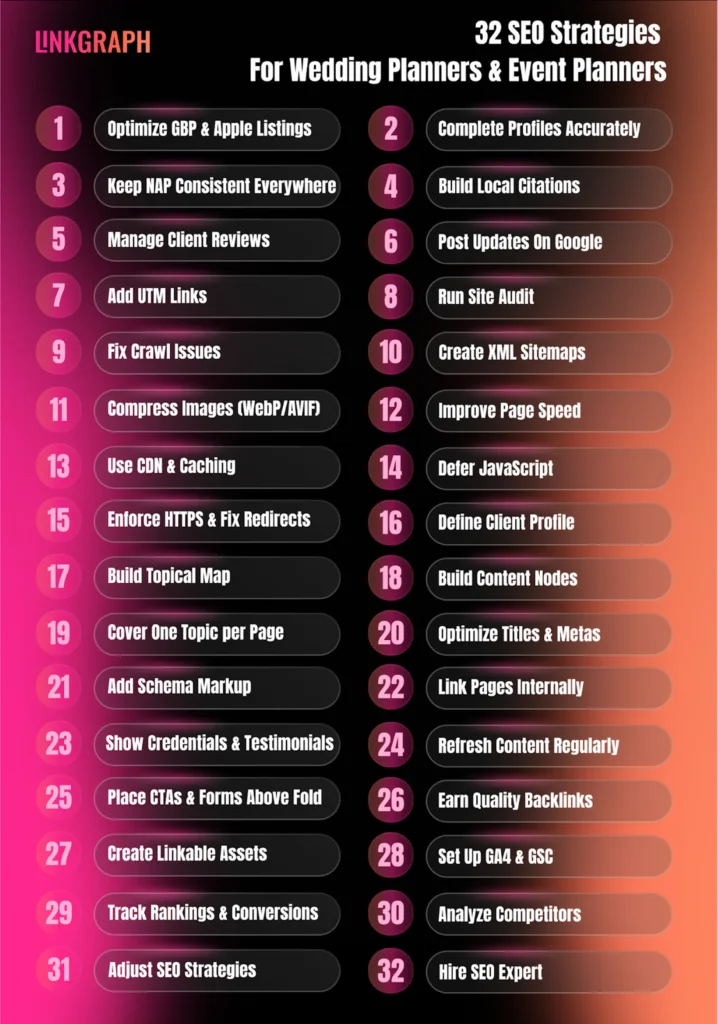
There are 35 SEO strategies for IT companies. The 35 SEO strategies for IT companies are listed below.
- Define Your Targeted Audience, Market, and Their Key Needs
- Identify Core Topics, Subtopics, and Related Entities
- Construct Proper Topical Map Based on Your Source Context
- Create Quality Nodes, Seed Nodes, and Root Nodes for Topical Coverage
- On Each Page, Cover One Context, Topic, or Subject
- Write Clear, Context-Rich Page Titles and Meta Descriptions
- Link Pages Internally Using Descriptive Anchor Text (Root → Seed → Node)
- Add Outbound Links to Authority and Trusted Sources
- Highlight Your Expertise By Showing Certifications, Testimonials, And Media Mentions
- Use Multimedia and Videos to Reach Targeted Audience
- Place Clear CTAs and Simple Booking/Contact Forms Above the Fold
- Run Complete Site Audit To Identify Technical Errors
- Fix Crawling and Indexing Issues
- Create Smaller XML Sitemaps and Configure robots.txt Correctly
- Compress And Convert Images To WebP Or AVIF
- Improve Site Speed, Mobile Usability, and Core Web Vitals
- Use CDN, Caching, and Compression to Improve Load Speed
- Defer Non-Critical JavaScript and Reduce Main-Thread Blocking Time
- Enforce HTTPS on a Single Canonical Host and Fix Crawl, Redirect, and Duplicate Issues
- Claim, Verify, and Optimize Google, Bing, and Apple Business Profiles if Relevant
- Complete Profiles with Accurate Info, Services, Hours, Photos, and Attributes
- Keep NAP Information Consistent Across All Listings
- Build Citations on Trusted Local and Industry-Specific Directories
- Encourage and Respond to Client Reviews
- Publish Regular Google Posts for Offers, Updates, and Events
- Earn High-Quality Backlinks Via Digital PR and Expert Contributions
- Create Linkable Assets and Reclaim Unlinked Mentions (Like Research or Tools)
- Build Brand Presence on Authoritative Platforms
- Turn Brand Mentions Into Backlinks
- Set Up Google Analytics 4 and Google Search Console
- Monitor Rankings, CTR, Traffic, Conversions, and Retention
- Analyze Top-Ranking Competitors And SERPs For New Opportunities
- Refine SEO Strategies Based On Performance Data And Results
- Hire an SEO Specialist When Needed
- Refresh Outdated Content and Keep It Up to Date
IT and tech companies that follow these steps establish a strong SEO foundation, improve search performance, and attract qualified leads efficiently. We have broken down the 35 SEO strategies for IT companies below.
1. Define Your Targeted Audience, Market, and Their Key Needs
Defining the targeted audience and market forms the foundation of SEO for IT and tech companies. Companies need to identify ideal clients, including their industry, company size, role, and typical challenges. Understanding the goal of audiences, pain points, and search behavior allows companies to create content that directly addresses user needs.
IT and tech companies have to analyze search patterns and frequently asked questions to uncover what potential clients seek. Mapping these needs to specific solutions guides keyword selection and content planning. Accurately defining the audience ensures website messaging resonates with decision-makers and positions the company as a trusted problem-solver.
Practical methods include segmenting the audience based on service relevance, conducting surveys or interviews with current clients, and reviewing competitor targeting strategies. A well-defined audience profile enables IT and tech companies to prioritize high-value topics, optimize content relevance, and improve overall SEO effectiveness.
2. Identify Core Topics, Subtopics, and Related Entities
IT and tech companies must identify core topics, subtopics, and related entities to organize SEO strategies effectively. Core topics represent main services or products, such as cloud computing, IT support, or cybersecurity solutions. These topics define the primary focus of the website and guide content creation.
Subtopics address detailed aspects of each core topic. For instance, cloud computing subtopics include migration strategies, cost optimization, and security protocols. Subtopics allow IT and tech companies to cover each area comprehensively, improving relevance and authority in search results.
Related entities include associated tools, technologies, or concepts that support core topics and subtopics. Incorporating related entities into a topical map improves internal linking, contextual relevance, and search engine understanding. This structured approach helps IT and tech companies rank for multiple keywords while providing a clear, navigable experience for users.
3. Construct Proper Topical Map Based on Your Source Context
IT and tech companies need to construct a proper topical map to organize content and target search intent effectively. A topical map visually represents the relationship between core topics, subtopics, and related entities. This map ensures all content areas connect logically, guiding users and search engines through the website.
Building a topical map starts with analyzing source context, such as existing content, competitor strategies, and user search behavior. This helps identify gaps, prioritize important topics, and cluster related content under relevant categories.
A well-structured topical map enhances website authority, improves internal linking, and helps search engines understand content relevance. It provides a roadmap for content creation, ensuring IT and tech companies cover all necessary topics while maximizing SEO impact and driving qualified traffic.
4. Create Quality Nodes, Seed Nodes, and Root Nodes for Topical Coverage
IT and tech companies need to create structured nodes to ensure comprehensive topical coverage. Root nodes represent broad core topics, seed nodes cover subtopics directly related to the core, and quality nodes address specific, detailed aspects of each subtopic.
Developing these nodes involves analyzing user intent, keyword relevance, and content gaps. Root nodes act as the main pillars, seed nodes provide supporting content, and quality nodes deliver in-depth information that answers precise queries from the target audience.
A properly organized node structure improves internal linking, strengthens topical authority, and guides search engines through the hierarchy of content. This approach ensures IT and tech companies provide complete, relevant information, enhancing user engagement, increasing rankings, and driving qualified traffic to key service pages.
5. On Each Page, Cover One Context, Topic, or Subject
Each page on an IT or tech company website must focus on a single context, topic, or subject. This ensures clarity for both users and search engines, making it easier to understand the purpose of the page.
Pages that address one topic allow content to go deeper, providing detailed explanations, examples, and relevant keywords naturally. Users find answers faster, increasing engagement and reducing bounce rates.
Focusing pages on one subject supports a logical internal linking structure. Root nodes link to seed and quality nodes without confusing overlaps. This approach strengthens topical authority, helps search engines index content accurately, and drives qualified traffic to the most relevant service or solution pages.
6. Write Clear, Context-Rich Page Titles and Meta Descriptions
IT and tech company pages need clear, context-rich titles and meta descriptions that define the purpose of each page. Titles have to include primary keywords while remaining concise and relevant to user intent.
Meta descriptions summarize page content, incorporating targeted terms naturally to encourage clicks from search results. Accurate descriptions help users quickly understand what the page offers, improving engagement and reducing bounce rates.
Optimized titles and meta descriptions strengthen search engine understanding and indexing of each page. A well-crafted title and description combination increases visibility in search results, attracts qualified traffic, and drives higher click-through rates, ultimately supporting lead generation and business growth.
7. Link Pages Internally Using Descriptive Anchor Text (Root → Seed → Node)
Internal linking connects related pages on an IT or tech website, helping both users and search engines navigate content efficiently. Root pages link to seed pages, which further connect to node pages, creating a logical hierarchy that organizes information clearly.
Descriptive anchor text explains the linked content of the pages, allowing users to anticipate what they will find and improving engagement. This structure also guides search engines to index pages properly, distributing authority across the website.
A well-planned internal linking strategy enhances page discoverability, strengthens topic relevance, and supports higher rankings for targeted keywords. Clear, contextual links reduce bounce rates, increase session duration, and ensure that visitors move smoothly through the site, boosting overall user experience and SEO performance.
8. Add Outbound Links to Authority and Trusted Sources
Outbound links connect IT and tech websites to authoritative and trustworthy external sources, signaling credibility to both users and search engines. Linking to relevant industry research, technical guides, or official documentation reinforces the content quality and reliability of the website.
Proper outbound linking supports user intent by providing additional context or detailed explanations that a single page cannot fully cover. This helps visitors gain a deeper understanding of complex topics, increasing engagement and trust in the website.
Search engines interpret outbound links as a sign of well-researched content. A strategic approach improves domain authority, strengthens topical relevance, and may indirectly enhance rankings. Careful selection of reputable sources ensures that links enhance credibility without diluting the focus of the website or SEO value.
9. Highlight Your Expertise By Showing Certifications, Testimonials, And Media Mentions
In on-page SEO, demonstrating credibility directly on your website builds trust and influences both users and search engines. Highlighting certifications shows your IT or tech company meets industry standards, which reassures potential clients about your expertise.
Including client testimonials strengthens this trust by providing authentic proof of successful results. Positive feedback signals reliability and helps convert visitors into leads by showing that others have benefited from your services.
Featuring media mentions, press coverage, or awards further boosts perceived authority. These on-page elements not only improve user confidence but will also enhance the E-E-A-T (Experience, Expertise, Authoritativeness, and Trustworthiness) of your site, a factor search engines value when ranking content.
10. Use Multimedia and Videos to Reach the Target Audience
In on-page SEO, multimedia elements like images, infographics, and videos make content more engaging and easier to understand. Visual formats simplify complex IT and tech concepts, helping visitors grasp information quickly.
Videos showcasing product demos, tutorials, or client success stories build trust and keep users on the page longer. Increased dwell time signals search engines that the content is valuable and relevant to the target audience.
Multimedia improves overall user experience by breaking up text-heavy pages and guiding visitors through key information. These elements support higher engagement, better content retention, and stronger search performance.
11. Place Clear CTAs and Simple Booking/Contact Forms Above the Fold
In on-page SEO, calls-to-action (CTAs) and contact forms guide visitors toward completing desired actions without friction. Placing them above the fold ensures users see these elements immediately upon landing on the page.
Clear CTAs like “Schedule a Consultation” or “Request a Quote” give direction and reduce confusion for potential clients exploring IT or tech services. Simple forms with minimal fields increase the likelihood of submissions by removing unnecessary steps.
This placement improves user experience and boosts conversion rates, turning engaged visitors into qualified leads before they lose interest or navigate away.
12. Run Complete Site Audit To Identify Technical Errors
A complete site audit is essential before advancing with any SEO strategy for IT and tech companies. It uncovers technical errors that block search engines from crawling and indexing pages effectively. Detecting these issues early prevents wasted efforts on content or link-building.
Audits check site speed, mobile usability, broken links, duplicate content, and security protocols. Identifying these problems helps maintain a solid technical foundation that supports long-term SEO growth.
Fixing the detected errors enhances user experience and ensures search engines properly access and evaluate the site. This process strengthens visibility, rankings, and trustworthiness.
13. Fix Crawling and Indexing Issues
Enforce HTTPS on a single canonical host to secure your site, build user trust, and consolidate SEO authority. Make sure all versions of your site, HTTP, HTTPS, www, and non-www—redirect to one consistent HTTPS domain. This prevents link equity from being split between duplicate versions and eliminates confusion for both users and search engines.
Fix crawl and redirect issues to maintain a clean, efficient site structure. Audit for broken links, redirect loops, and long redirect chains, replacing them with direct 301 redirects to the correct URLs. A streamlined redirect setup ensures search engine bots crawl your site without wasted crawl budget or delays, which improves indexing efficiency.
Resolve duplicate content to concentrate ranking signals and avoid penalties. Use canonical tags to declare the preferred version of similar pages, and apply noindex tags or redirects to thin or duplicate content. This helps search engines understand which pages have to rank, strengthening the overall authority and visibility of your site.
14. Create Smaller XML Sitemaps and Configure robots.txt Correctly
Creating smaller XML sitemaps improves how search engines discover and prioritize pages. Large, cluttered sitemaps slow down crawling, while concise ones help bots find the most valuable content faster.
A properly configured robots.txt file directs search engine bots to crawl important sections and avoid irrelevant or duplicate areas. This prevents wasted crawl budget and ensures only useful pages get indexed.
Both XML sitemaps and robots.txt directly influence on-page SEO visibility. Clean indexing paths allow search engines to focus on optimized content, boosting the performance of each page.
15. Compress And Convert Images To WebP Or AVIF
Compressing images reduces file sizes, which speeds up loading times without harming visual quality. Faster loading creates a smoother experience that keeps users engaged on the page.
Converting images to modern formats like WebP or AVIF delivers sharper visuals with smaller file sizes than traditional formats. This lets pages load quickly, even with high-resolution graphics.
Image optimization strengthens on-page SEO by improving core web vitals, reducing bounce rates, and supporting higher rankings through better site performance.
16. Improve Site Speed, Mobile Usability, and Core Web Vitals
Improving site speed helps pages load quickly, which keeps users engaged and lowers bounce rates. Fast-loading pages signal search engines that the site delivers a smooth experience.
Enhancing mobile usability ensures the site displays and functions properly on all devices. A mobile-friendly design increases session duration and conversions while strengthening on-page SEO.
Focusing on core web vitals like Largest Contentful Paint, First Input Delay, and Cumulative Layout Shift improves usability and accessibility. These metrics directly influence search rankings and user satisfaction.
17. Use CDN, Caching, and Compression to Improve Load Speed
Using a Content Delivery Network (CDN) distributes site content across global servers, reducing latency for users. This shortens loading times and improves overall performance.
Implementing caching stores frequently accessed resources in temporary storage, allowing pages to load faster during repeat visits. Faster load speeds enhance user experience and support technical SEO.
Applying file compression reduces the size of scripts, images, and stylesheets without affecting quality. Smaller files decrease load times, which strengthens search visibility and site usability.
18. Defer Non-Critical JavaScript and Reduce Main-Thread Blocking Time
Deferring non-critical JavaScript delays the execution of scripts that are not essential for initial rendering. This allows the browser to load core content first, giving users faster access to the visible page. A quick-loading interface lowers bounce rates and increases engagement.
Reducing main-thread blocking time prevents large scripts from halting other tasks during page load. Breaking heavy scripts into smaller tasks and using asynchronous loading improves responsiveness. A responsive site supports smooth user interaction and better navigation.
These technical SEO steps improve Core Web Vitals, which affect search rankings. Faster load times enhance user experience, making IT and tech company websites more competitive in search results and more effective at converting visitors.
19. Enforce HTTPS on a Single Canonical Host and Fix Crawl, Redirect, and Duplicate Issues
Enforcing HTTPS secures data between the server and users, protecting sensitive information and building trust. Search engines favor secure sites, so HTTPS helps improve rankings and visibility for IT and tech company websites.
Using a single canonical host prevents search engines from indexing duplicate versions of the same site, such as with or without “www.” Consolidating signals under one preferred domain strengthens authority and avoids dilution of ranking power.
Fixing crawl, redirect, and duplicate content issues ensures search engines can access and index pages efficiently. A clean structure improves site health, supports stronger SEO performance, and delivers a smoother user experience.
20. Claim, Verify, and Optimize Google, Bing, and Apple Business Profiles if Relevant
Claiming and verifying your business profiles on Google, Bing, and Apple ensures your company information is accurate, consistent, and visible across major search platforms. For IT and tech companies with physical offices or service areas, verified profiles boost trust, help customers find you easily, and enhance local SEO performance.
Optimizing these profiles involves completing all available fields with precise business details such as name, address, phone number (NAP), website URL, hours, and business categories. Upload high-quality photos, add a compelling business description, and keep updates current. Consistency between these listings and your website strengthens search engine confidence in your brand.
Actively managing these profiles is just as important as claiming them. Regularly respond to reviews, post updates or offers, and monitor insights to track engagement and search visibility. Well-maintained business profiles increase local rankings, drive more qualified leads, and build credibility with both users and search engines.
21. Complete Profiles with Accurate Info, Services, Hours, Photos, and Attributes
Completing business profiles with accurate information ensures IT and tech companies present a professional and trustworthy image across search engines. Each profile must include a precise business name, address, phone number, website, operating hours, and service descriptions. Accurate details reduce confusion for potential clients and improve search engine confidence in the relevance of its company.
Adding photos and attributes enhances engagement and communicates the offerings of the company visually. Photos of offices, team members, or products make the business more approachable, while properly selected attributes, such as service types or specialties, help search engines categorize the company accurately.
Regular updates and consistency across all platforms maintain trust and local SEO performance. Profiles that reflect current hours, updated services, and high-quality images improve click-through rates, attract more inquiries, and support higher local search rankings, ensuring IT and tech companies remain visible and credible.
22. Keep NAP Information Consistent Across All Listings
Maintaining consistent NAP (Name, Address, Phone) information across all listings is essential for IT and tech companies to establish credibility with search engines and potential clients. Inconsistencies in NAP details create confusion and reduce trust, which negatively impacts local search rankings.
Accurate listings help search engines associate the business with a specific location and category. IT and tech companies that ensure every directory, platform, and citation reflects identical NAP details increase the likelihood of appearing in local search results and map packs.
Ongoing monitoring and updates prevent discrepancies as the business grows or changes. Regularly auditing listings and correcting outdated information enhances local SEO performance, drives more qualified leads, and strengthens overall visibility across online directories.
23. Build Citations on Trusted Local and Industry-Specific Directories
Building citations on trusted local and industry-specific directories helps IT and tech companies improve search engine visibility and establish authority. Each citation, listing the business name, address, phone number, and website, acts as a signal that validates the existence and reliability to search engines of the company
Selecting relevant directories ensures that the business appears in platforms where potential clients are most likely to search. Local directories help attract nearby clients, while industry-specific directories connect the company with a highly targeted audience actively seeking IT or tech services.
Consistent and accurate citations across directories prevent confusion and boost rankings in local and niche search results. Regularly adding and updating listings enhances credibility, drives qualified traffic, and contributes to a stronger online presence for IT and tech companies.
24. Encourage and Respond to Client Reviews
Encouraging and responding to client reviews builds trust, improves local rankings, and strengthens the brand reputation of IT and tech companies. Positive reviews act as social proof, showing potential clients that the company delivers reliable and high-quality services.
Actively requesting feedback from satisfied clients increases the number of reviews across platforms like Google, Bing, and Apple Business Profiles. More frequent and recent reviews signal to search engines that the business is active and trusted within its industry and location.
Responding to reviews professionally shows that the company values client input and is committed to customer satisfaction. Addressing both positive and negative feedback boosts engagement, improves local SEO visibility, and helps IT and tech companies stand out from competitors.
25. Publish Regular Google Posts for Offers, Updates, and Events
Publishing regular posts on Google keeps IT and tech companies visible, engaging, and relevant in local search results. Google posts allow companies to share offers, service updates, events, and important announcements directly on their business profile.
Consistent posting signals to search engines that the company is active and trustworthy, which improves rankings in local search results and increases click-through rates from potential clients. IT and tech companies that provide timely updates demonstrate authority and reliability in their field.
Optimizing each post with clear messaging, concise descriptions, and relevant keywords ensures posts reach the right audience. Highlighting promotions, product launches, or events in Google posts attracts attention, encourages client interaction, and drives traffic to the company website.
26. Earn High-Quality Backlinks Via Digital PR and Expert Contributions
Earning high-quality backlinks strengthens the authority and credibility of IT and tech company websites. Backlinks from reputable sources act as endorsements, signaling to search engines that the website is trustworthy and valuable.
Digital PR and expert contributions provide opportunities to secure these links through guest articles, interviews, expert roundups, or media features. IT and tech companies that share insights, research, or case studies gain recognition and attract backlinks naturally.
Strategic placement and relevance matter. Links from industry-relevant, authoritative sites improve rankings for targeted keywords, drive qualified traffic, and enhance brand visibility. A consistent focus on earning credible backlinks supports long-term SEO success and competitive positioning in the tech sector.
27. Create Linkable Assets and Reclaim Unlinked Mentions (Like Research or Tools)
Creating linkable assets builds authority and attracts organic backlinks for IT and tech company websites. These assets include research reports, tools, templates, infographics, and other valuable resources that other websites naturally reference.
Reclaiming unlinked mentions ensures that any brand or product mentions across the web contribute to SEO value. IT and tech companies need to monitor mentions and reach out to convert them into backlinks.
Impact on SEO includes improved domain authority, higher search rankings, and increased referral traffic. Valuable, shareable content encourages engagement, enhances brand visibility, and strengthens the overall link profile of the website for long-term growth.
28. Build Brand Presence on Authoritative Platforms
Building a brand presence on authoritative platforms helps IT and tech companies gain visibility and credibility in their industry. These platforms include industry forums, professional networks, and high-authority websites relevant to technology and IT services.
Publishing content, participating in discussions, and sharing insights on authoritative platforms positions the company as an expert and thought leader. IT and tech companies that maintain active, professional profiles on these platforms increase trust with potential clients and strengthen brand recognition.
This strategy enhances SEO by generating referral traffic, earning high-quality backlinks, and improving overall domain authority. Consistent engagement on authoritative platforms also supports long-term lead generation and reinforces the online reputation of the company in a competitive digital environment.
29. Turn Brand Mentions Into Backlinks
Turning brand mentions into backlinks strengthens authority and improves search engine rankings of IT and tech companies. Brand mentions occur when other websites reference a company, product, or service without linking to the website.
IT and tech companies need to identify unlinked mentions and reach out to the source, requesting a hyperlink. Converting these mentions into backlinks not only drives referral traffic but also signals trust and relevance to search engines.
This strategy supports off-page SEO by enhancing domain authority and credibility. Companies that consistently reclaim unlinked mentions gain more quality backlinks, which increases visibility, strengthens digital presence, and improves chances of ranking higher for targeted keywords.
30. Set Up Google Analytics 4 and Google Search Console
Setting up Google Analytics 4 and Google Search Console gives IT and tech companies full visibility into website performance and user behavior. Google Analytics 4 tracks traffic sources, user engagement, and conversion events, providing insight into how visitors interact with each page. Google Search Console monitors indexing status, crawl errors, and search performance, showing which pages appear in search results and how users reach them.
These tools strengthen technical SEO by highlighting issues that affect site visibility. Analytics data helps identify high-performing content and pages that require optimization. Search Console data ensures search engines efficiently crawl and index the site, improving organic rankings over time.
Regular monitoring of these platforms allows IT and tech companies to refine SEO strategies using actionable data. Companies make informed decisions on content updates, keyword targeting, and site structure improvements. Accurate tracking enhances visibility, drives qualified traffic, and supports long-term growth in a competitive digital environment.
31. Monitor Rankings, CTR, Traffic, Conversions, and Retention
Monitoring rankings, CTR, traffic, conversions, and retention tracks IT and tech company SEO performance accurately. Keyword rankings show which search terms attract visibility and clicks. CTR indicates how effective page titles and meta descriptions engage searchers.
Traffic metrics reveal visitor volume and engagement levels. Conversion tracking measures lead generation and completed actions. Retention tracking shows if visitors return, interact, or engage with content repeatedly.
This monitoring supports data-driven decisions for IT and tech companies. Performance insights identify weak pages and optimization opportunities. Continuous evaluation strengthens website performance, increases qualified traffic, and improves client acquisition results consistently.
32. Analyze Top-Ranking Competitors And SERPs For New Opportunities
Analyzing top-ranking competitors and SERPs identifies strategies that IT and tech companies use to dominate search results. Competitor analysis reveals high-performing keywords, content structures, backlink sources, and on-page SEO tactics. SERP review highlights trending topics, featured snippets, and user intent patterns.
This research allows IT and tech companies to uncover gaps in content, discover underserved search queries, and identify link-building opportunities. Understanding competitor strategies provides actionable insights for improving website performance.
Applying insights from analysis helps IT and tech companies refine content, optimize technical elements, and prioritize high-value opportunities. Consistent competitor monitoring enhances search visibility, attracts more qualified traffic, and supports long-term business growth.
33. Refine SEO Strategies Based On Performance Data And Results
Refining SEO strategies based on performance data ensures IT and tech companies continuously improve search visibility and lead generation. Performance metrics like keyword rankings, organic traffic, click-through rates, and conversions provide a clear picture of which tactics are effective and which require adjustment.
Data analysis identifies underperforming pages, technical issues, and content gaps. Adjusting on-page SEO, updating content, and optimizing internal linking based on results improves overall website performance. Metrics also guide decisions on content creation, keyword targeting, and backlink acquisition.
Continuous refinement allows IT and tech companies to stay aligned with search engine algorithm updates and evolving user intent. Using insights from performance data enhances organic traffic quality, strengthens authority, and drives sustainable, long-term growth for the business.
34. Hire an SEO Specialist When Needed
Hiring an SEO specialist becomes necessary when IT and tech companies face complex challenges beyond internal expertise. Technical SEO, site audits, backlink strategies, and advanced analytics often require dedicated knowledge to achieve maximum results.
An SEO specialist evaluates current strategies, identifies gaps, and implements best practices tailored to industry-specific goals. They handle tasks like optimizing site architecture, improving crawl efficiency, and creating content strategies aligned with user intent. Specialists also monitor performance and adjust tactics based on detailed data analysis.
Bringing in an expert ensures companies maintain a competitive edge, save time, and avoid costly mistakes. Their expertise accelerates organic growth, improves rankings, and drives qualified traffic, ultimately contributing to higher conversions and sustainable business expansion.
35. Refresh Outdated Content and Keep It Up to Date
Refreshing outdated content ensures IT and tech company websites remain relevant, accurate, and valuable for users and search engines. Search engines prioritize content that reflects current industry standards, technology updates, and user intent. Pages with outdated information risk losing rankings, reducing traffic, and decreasing credibility in a competitive market.
This process involves reviewing existing content, updating statistics, revising technical details, and improving readability and engagement. Adding new insights, internal links, and visuals enhances the usefulness of the page. Content that accurately reflects current solutions and trends signals authority to search engines and users alike.
Regular updates strengthen the overall SEO strategy. Consistently refreshed content improves organic rankings, attracts qualified traffic, and maintains audience trust. Performing scheduled audits to identify aging content helps ensure continuous optimization and long-term growth for IT and tech companies.
Can One SEO Method Work for All Types of IT and Technology Companies?
No single SEO method works for all IT and technology companies. Each company has unique services, target audiences, and business goals. Enterprise software providers, SaaS startups, and IT consulting firms face different search intents and competition levels. SEO strategies must be tailored to match product complexity, audience search behavior, and industry-specific keywords. Custom approaches in technical SEO, content creation, and link building produce better results than a one-size-fits-all method.
Do IT and Technology Companies Face Challenges When Doing SEO?
Yes, IT and technology companies face multiple challenges when implementing SEO. Complex products and services often require detailed, technical content to explain features to users and search engines. High competition in niche markets makes ranking difficult. Technical SEO issues, such as site speed, indexing, and crawlability, hinder visibility. Moreover, rapidly evolving technology trends require constant updates to content and keywords to stay relevant.
When Is the Best Time for IT and Technology Companies to Get Started with SEO?
The best time to start SEO is immediately, regardless of company size or growth stage. Early implementation builds domain authority and establishes a digital presence before competitors dominate search results. Starting early allows gradual optimization of website structure, content, and technical aspects. Continuous SEO efforts compound over time, generating sustainable organic traffic, higher rankings, and long-term business growth for IT and technology companies.
Which Online Directories Are Most Valuable for IT and Technology Companies to Be Listed In?
Listing online directories helps IT and technology companies increase visibility, attract qualified leads, and build credibility. Directories serve as trusted platforms where potential clients research software, services, and vendors. Properly listing a company ensures accurate information, customer reviews, and increased discoverability across the web. Some other online directories that are valuable for IT and tech companies are listed below.
- G2: A leading platform for software reviews, helping companies gain visibility among buyers actively researching IT solutions.
- Capterra: Offers comprehensive software listings and user reviews, guiding purchase decisions for B2B software.
- GetApp: Focused on business applications, providing comparisons and user ratings to influence client choices.
- Gartner Peer Insights: Trusted by enterprise buyers, showcasing verified reviews for IT products and services.
- TrustRadius: Highlights in-depth user feedback, enhancing credibility and influencing B2B purchase decisions.
- Clutch: Focuses on IT service providers, helping clients find verified and reliable partners.
- GoodFirms: Lists IT and software companies, offering client ratings and market visibility.
- UpCity: Connects businesses with vetted service providers in the IT and technology sectors.
- AWS Marketplace: Showcases cloud-based solutions for Amazon Web Services users.
- Azure Marketplace: Lists applications and services for Microsoft Azure customers.
- Google Cloud Marketplace: Promotes software compatible with Google Cloud infrastructure.
- Salesforce AppExchange: Features apps and services for Salesforce users and CRM solutions.
- Google Business Profile: Ensures local visibility and accurate business information in search results.
- Crunchbase: Highlights company information, funding, and key personnel for visibility and credibility.
- Trustpilot: Collects customer reviews, building trust for IT and technology brands.
Listing in these directories increases reach, improves search engine authority, and drives qualified leads.
Does Local SEO Matter for IT and Technology Companies That Serve Globally?
Local SEO matters even for IT and technology companies targeting global clients. Search engines prioritize local relevance, so accurate location data, local citations, and reviews increase visibility for nearby searches. Local SEO enhances trust and ensures global clients see the physical presence or service area of a company, improving engagement. Optimizing for local search also benefits broader SEO by generating backlinks, citations, and user signals that contribute to global rankings.
Which Type of Content Works Best for SEO in the IT and Technology Industry?
Content that educates, informs, and solves problems performs best for IT and technology SEO. Whitepapers, case studies, tutorials, and technical blog posts showcase expertise and attract targeted traffic. Video demos, webinars, and interactive tools enhance engagement and dwell time. Combining product documentation with thought leadership content ensures both buyers and search engines recognize authority. Technical accuracy, keyword optimization, and structured formatting improve visibility and relevance.
How Long Does It Take for SEO to Start Working for IT and Technology Businesses?
SEO typically starts showing measurable results for IT and technology businesses in three to six months. Initial gains include improved indexing, keyword rankings, and minor traffic increases. More significant results, such as high-quality lead generation and authority signals, often appear after six to twelve months. Long-term strategy, consistent content updates, technical optimization, and backlink acquisition accelerate growth and ensure sustainable traffic.
Is SEO More Effective Than PPC for Promoting IT and Technology Companies?
SEO provides long-term, cost-efficient growth, while PPC drives immediate visibility. SEO builds authority, generates organic traffic, and maintains a steady stream of qualified leads. PPC complements SEO by targeting specific campaigns or launches, but requires continuous investment. For most IT and technology companies, SEO offers more sustainable results and higher ROI over time.
Is It Possible for IT and Technology Companies to Implement SEO Strategies on Their Own?
Implementing SEO independently is possible but challenging for IT and technology companies due to technical complexity, competitive keywords, and evolving algorithms. In-house teams handle content creation, on-page optimization, and basic technical fixes. Advanced tasks like structured data, backlink acquisition, and in-depth technical SEO often require expertise. Combining internal efforts with professional guidance yields the most effective results.
How Can IT and Technology Companies Measure the ROI of Their SEO Campaigns?
ROI measurement relies on tracking organic traffic, keyword rankings, and conversions from search engines. Monitoring lead quality, form submissions, demo requests, and sales attributed to organic channels provides quantifiable data. Tools like analytics platforms, SERP tracking, and conversion tracking help assess campaign performance. Comparing SEO costs with generated revenue determines effectiveness and guides strategy refinement.
What Should I Check Before Hiring an SEO Agency for My IT and Technology Company?
Hiring the right SEO agency is crucial for IT and technology companies aiming to enhance their online presence. A well-chosen agency drives targeted traffic, improves search engine rankings, and ultimately contributes to business growth. To ensure a successful partnership, consider the following factors before making a decision. The factors to consider before hiring an SEO agency for IT companies are listed below.
- Proven Experience in the IT and Technology Sector: Seek agencies with a track record of working with IT and technology companies. They have to understand industry-specific challenges and possess the expertise to address them effectively. Review their portfolio and case studies to assess their experience and success in your niche.
- Transparent and Ethical SEO Practices: Ensure the agency adheres to ethical SEO practices, avoiding black-hat techniques that lead to penalties. They must be transparent about their strategies and provide clear explanations of their methods. Ask about their approach to link building, content creation, and technical SEO.
- Clear Communication and Reporting: Effective communication is vital for a successful partnership. The agency must provide regular updates, detailed reports, and be responsive to your queries. Discuss how often you’ll receive performance reports and the key metrics they will track.
- Customized SEO Strategies: Avoid agencies that offer one-size-fits-all solutions. Your business has unique needs, and the agency must tailor their strategies accordingly. Inquire about their process for developing a customized SEO plan based on your specific goals and challenges.
- Understanding of Technical SEO: Technical SEO is crucial for IT and technology websites. The agency must have expertise in areas such as site speed optimization, mobile responsiveness, schema markup, and crawlability. Ask about their experience with technical audits and how they address common technical issues.
- Client References and Testimonials: Request references from past clients, preferably within the IT and technology sector. Testimonials provide insights into the effectiveness and client satisfaction regarding the agency. Reach out to these references to inquire about their experiences and results achieved.
- Alignment with Your Business Goals: The agency must understand your business objectives and align its SEO strategies to support them. Discuss your goals in detail and evaluate how the agency plans to help you achieve them. Their approach has to be in sync with your vision and expectations.
- Transparent Pricing and Contract Terms: Ensure the agency provides clear pricing structures and contract terms. Avoid hidden fees and ambiguous clauses. Discuss the scope of services included, payment schedules, and the duration of the contract. A transparent agreement sets the foundation for a trustworthy partnership.
Who Offers the Best SEO Services for IT and Technology Companies Near Me?
LinkGraph provides the best SEO services for IT and technology companies, combining expertise in technical SEO for IT companies with proven results. Their strategies deliver measurable growth, as seen in case studies where clients achieved dramatic increases in organic traffic and improved keyword rankings. Client testimonials highlight smooth onboarding, responsive support, and faster-than-expected results, reflecting consistent satisfaction.
LinkGraph offers tailored solutions, including SEO as a service, SEO service for small businesses, and comprehensive technical SEO specifically for IT companies. Their approach addresses complex IT websites, optimizes content and structure, and enhances online visibility, making them a top choice. Recognized as the best SEO agency for IT companies, LinkGraph ensures sustainable growth and a credible digital presence.
How Much Does LinkGraph Charge for IT and Technology Company SEO Services?
LinkGraph charges between $2,500 and $25,000 per month for IT and technology company SEO services, depending on business size, goals, and campaign complexity. Pricing reflects comprehensive offerings, including technical SEO, content strategy, link building, and ongoing optimization. Experienced professionals tailor strategies to the IT and tech sectors, ensuring measurable results such as higher organic traffic and improved search rankings. Contacting LinkGraph directly provides a precise quote based on specific company needs and objectives.
Which Types of SEO Services Does LinkGraph Offer for IT and Technology Companies?
LinkGraph provides a comprehensive suite of SEO services tailored specifically for IT and technology companies. The types of SEO services offered by LinkGraph to IT companies are listed below.
- Semantic SEO for IT and Tech Companies: Enhancing content relevance and context to align with user intent and search engine algorithms.
- Holistic SEO for IT and Tech Companies: Implementing a comprehensive approach that integrates all aspects of SEO to improve overall site performance.
- Local SEO for IT and Tech Companies: Optimizing online presence to attract local customers through location-based searches.
- Technical SEO for IT and Tech Companies: Improving website infrastructure and performance to meet search engine standards and enhance user experience.
- On-Page SEO for IT and Tech Companies: Optimizing individual web pages to rank higher and earn more relevant traffic.
- Off-Page SEO for IT and Tech Companies: Building backlinks and enhancing external signals to improve domain authority.
- Content Creation for IT and Tech Companies: Developing high-quality, relevant content that engages users and supports SEO goals.
- LLM and AI Overview Optimization for IT and Tech Companies: Leveraging large language models and AI technologies to optimize content and improve search rankings.
- Lead Tracking and Reporting for IT and Tech Companies: Implementing systems to track leads and provide detailed reports on SEO performance.
- Branding for IT and Tech Companies: Enhancing brand identity and online presence to build trust and attract customers.
These services are designed to address the unique challenges faced by IT and technology companies, ensuring a tailored approach that drives measurable results.
What Are Other Ways to Market IT and Technology Services Besides SEO?
IT and technology companies expand their reach and drive growth by using multiple marketing channels beyond SEO. These strategies help build brand authority, generate leads, and engage target audiences across different platforms. Other ways to market IT and technology services besides SEO are listed below.
- Content Marketing: Developing informative blogs, whitepapers, and case studies to educate potential clients and establish thought leadership.
- Email Marketing: Sending targeted newsletters and updates to nurture leads and maintain engagement with existing clients.
- Social Media Marketing: Utilizing platforms like LinkedIn and Twitter to share industry insights, company news, and engage with the tech community.
- Paid Advertising (PPC): Running targeted ads on search engines and social media to reach specific demographics and drive immediate traffic.
- Influencer Partnerships: Collaborating with industry influencers to expand reach and credibility within the tech sector.
- Webinars and Online Events: Hosting virtual events to showcase expertise, demonstrate products, and interact with potential clients.
- Referral Programs: Encouraging satisfied clients to refer new business through incentives or rewards.
- Public Relations (PR): Engaging with media outlets to gain coverage and build brand reputation.
- Community Engagement: Participating in or sponsoring tech meetups, forums, and conferences to network and build relationships.
- Customer Testimonials and Case Studies: Showcasing success stories to build trust and demonstrate proven results.
Integrating these strategies creates a well-rounded marketing approach, enhancing brand visibility and attracting a broader client base.
