
SEO for optometrists and eye doctors is the practice of optimizing their websites, local listings, and online content to increase visibility in search engines and attract patients actively seeking eye care services. Optometrists, vision care centers, and ophthalmology clinics rely on this strategy to improve rankings, connect with local patients, and align their offerings with relevant search queries.
Implementing eye care SEO marketing drives sustained organic traffic growth, higher appointment requests, and stronger professional credibility. On-page optimization, structured data, local SEO, and targeted content strategies highlight the unique services of optometry practices and ophthalmology clinics. Effective SEO establishes authority, communicates expertise in eye care, and generates measurable patient acquisition outcomes.
Choosing an experienced optometrist SEO company ensures precise strategy execution. Skilled agencies audit technical infrastructure, manage local citations, produce optimized content, and monitor results. Strategic SEO amplifies visibility, strengthens patient trust, and guarantees a consistent and professional online presence for eye care providers.

What Is SEO and How Does It Apply to Optometrists?
Search engine optimization represents a technical system that improves website visibility within organic search results. SEO evaluates relevance, authority, and technical quality signals across search platforms.
SEO for optometrists applies this system to optometry practices, eye clinics, and vision care providers. Search optimization aligns optometry websites with patient search intent, geographic relevance, and medical credibility. This process connects eye doctors and optical clinics with users who search for eye exams and vision services.
SEO for Optometrists emphasizes local visibility and service alignment. Local SEO links clinic addresses, phone data, and listings with location-based ranking signals. Keyword targeting maps optometry services to patient search behavior related to eye care needs.
Technical SEO for optometrists improves crawl access, mobile usability, and page performance for eye care websites. Search optimization strengthens authority and increases appointment-driven interactions for optometrists and vision specialists.
Can SEO Genuinely Benefit Optometrists?
Yes, SEO genuinely benefits optometrists through measurable visibility, patient acquisition, and authority growth. Search optimization increases exposure for optometry practices, eye clinics, and vision care providers.
Local search alignment places optical practices within high-intent discovery paths. Ranking presence connects optometrists with patients who search for eye exams, lenses, and treatments. This visibility drives appointment-focused traffic rather than passive website visits.
Evidence confirms performance gains across local rankings, inquiries, and conversion metrics. Local SEO positions optometry clinics within map listings tied to geographic intent. Keyword targeting attracts patients with immediate vision care needs.
Review signals and authoritative content increase clinical credibility across search platforms. Technical optimization improves usability, which strengthens engagement and appointment completion rates.
What Are the Key Advantages of Implementing SEO for Optometrists?
Implementing SEO for optometrists, eye clinics, and vision care providers generates measurable growth in patient acquisition, online visibility, and long-term practice authority. Proper search optimization ensures that local patients find your practice when actively seeking eye care services, connecting clinics with relevant, high-intent traffic. The key benefits of implementing SEO for optometrists are listed below.
- Increased Local Visibility: Optimized local SEO places optometry practices in the top search results and map listings, making it easier for patients to discover the eye clinic.
- Attract Qualified Patients: SEO targets users actively seeking eye exams, lenses, or treatments, resulting in visitors being more likely to schedule appointments.
- Builds Trust and Credibility: High search rankings and positive patient reviews enhance perceived reliability and clinical expertise among prospective patients.
- Cost-Effective Growth: Unlike paid ads that stop delivering results when budgets deplete, SEO builds a lasting online presence that consistently drives new patients.
- Competitive Advantage: Targeted SEO helps independent optometrists outperform larger competitors, capturing a larger share of local patient demand.
Overall, implementing SEO generates measurable, sustainable benefits, increasing both patient inquiries and clinic reputation across digital channels.
Is SEO For Optometrists the Same as SEO For Ophthalmologists?
No, SEO for optometrists differs from SEO for ophthalmologists due to distinct patient audiences and service offerings. Optometrists target the general public seeking routine eye exams, vision tests, and corrective lenses, while ophthalmologists serve patients with complex medical or surgical eye needs.
Keyword focus reflects this difference: optometrists use local, high-volume terms such as “optometrist near me” or “contact lenses,” whereas ophthalmologists target procedure-specific searches like “LASIK surgeon [city]” or “cataract surgery cost.”
Content strategies vary accordingly. Optometrists emphasize educational, accessible material on general eye health, vision care, and eyewear options. Ophthalmologists produce detailed, authoritative content about medical conditions, surgical procedures, and recovery guidance to establish expertise and trust. Local SEO is critical for optometrists to attract nearby patients, while ophthalmologists combine local and broader regional visibility for specialized services.
Shared fundamentals apply to both practices. Optimized Google Business Profiles, mobile-friendly websites, quality backlinks, clear user experience, and consistent performance monitoring remain essential. These core SEO principles provide visibility, credibility, and patient acquisition for optometrists and ophthalmologists alike.
What Are the Most Effective Strategies for Optometrists and Eye Doctors to Get Started with SEO?
To get started with SEO, optometrists and eye doctors must implement targeted strategies that improve online visibility, attract qualified patients, and enhance overall digital presence. A structured approach that combines local optimization, content development, technical improvements, and consistent monitoring ensures that eye care practices reach the right audience while maintaining credibility and authority in their local markets.
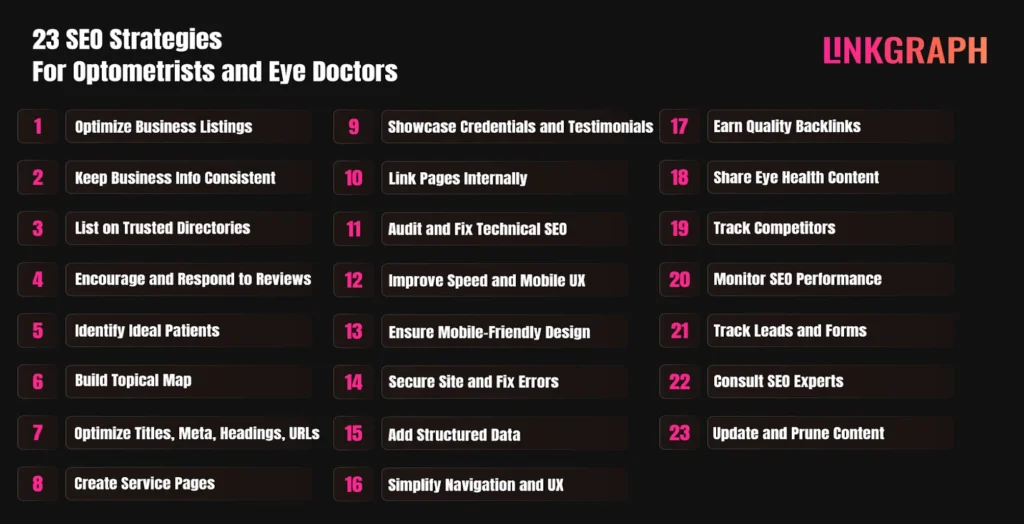
There are 23 SEO strategies for optometrists and eye doctors. The 23 SEO strategies for optometrists and eye doctors are listed below.
- Claim, Verify, and Fully Optimize Your Google, Bing, and Apple Business Listings
- Maintain Consistent Business Information Across All Directories and Listings
- List Your Practice on Trusted Medical and Local Directories
- Encourage Patient Reviews and Respond Promptly to Build Trust
- Identify Your Ideal Patients and Their Needs
- Constructa Proper Topical Map for Eye Care and Vision Services
- Optimize Title Tags, Meta Descriptions, Headings, and URLs for Each Page
- Create Dedicated, Well-Structured Pages for Each Eye Care Service You Offer
- Showcase Your Credentials, Experience, and Patient Testimonials
- Link Pages Internally Following Correct Structure (Root → Seed → Node)
- Conduct a Full Website Audit and Fix Technical SEO Issues
- Improve Core Web Vitals, Loading Speed, and Mobile Responsiveness
- Ensure Your Website is Mobile-Friendly with a Professional Design
- Secure Your site with HTTPS and Fix Technical Errors (404s, Broken Links, Redirects)
- Implement Structured Data Markup for Local and Medical Context
- Simplify Website Navigation and Improve UX/UI for an Accessible Patient Experience
- Earn Quality Backlinks from Local Healthcare Partners and Associations
- Share Educational Eye Health Content on Social Platforms to Engage Local Audiences
- Track Competitors to Refine and Strengthen Your SEO Approach
- Monitor SEO Performance Using Google Analytics and Search Console
- Track Leads, Calls, and Form Submissions to Measure SEO Effectiveness
- Consult an SEO Professional for Ongoing Optimization and Strategy Refinement
- Regularly Update and Prune Existing Content to Keep It Relevant and Fresh
Following these strategies ensures a comprehensive SEO foundation, maximizes local patient acquisition, and establishes measurable online authority for optometry practices. We have broken down the 23 SEO strategies for optometrists and eye doctors.
1. Claim, Verify, and Fully Optimize Your Google, Bing, and Apple Business Listings
Optometry practices increase local visibility by claiming and verifying business listings on Google, Bing, and Apple Maps. These listings act as digital storefronts, presenting essential information such as practice name, address, phone number, hours, and accepted insurance providers to prospective patients. Accurate listings ensure potential patients locate and contact the practice without confusion, improving both online presence and foot traffic.
Full optimization requires adding high-quality images of the office, staff, and diagnostic equipment. Including detailed service descriptions, relevant categories, and patient-focused keywords improves the likelihood of appearing in local search results. Engaging visual content combined with accurate information strengthens trust and encourages users to book appointments directly through the listing interface.
Regular monitoring and updating of business listings maintains consistency across platforms and prevents errors. Optimized listings enhance credibility, improve search engine ranking, and maximize the visibility of the practice in the competitive local optometry market. Maintaining these listings ensures the practice remains accessible, discoverable, and authoritative in the eyes of prospective patients.
2. Maintain Consistent Business Information Across All Directories and Listings
Optometry offices, vision centers, and ophthalmology clinics achieve measurable local visibility through uniform business information. Accurate name, address, and phone number entries across search engines and directories create verifiable signals that search engines trust. Each listing acts as a reference point that establishes legitimacy and reinforces authority in local searches.
Inconsistent business details lead to ranking drops, confuse prospective patients, and reduce appointment conversions. Directory entries, medical listings, and social profiles require precise updates, including website URLs, operating hours, and service descriptions. Conducting periodic audits detects errors, outdated information, or duplicates. Rectifying these issues aligns all citations and strengthens the footprint of the practice across platforms.
Maintaining verified and consistent data ensures optometrists, eye care clinics, and vision specialists appear reliably in local search results. This consistency enhances patient acquisition, improves click-through rates from search results, and reinforces trust signals for Google, Bing, and Apple Maps indexing algorithms.
3. List Your Practice on Trusted Medical and Local Directories
Optometrists, eye care clinics, and vision centers increase online authority by securing listings on reputable directories. Trusted platforms, including medical directories, healthcare portals, and local business databases, act as verification points for search engines. Each listing provides structured data, contact information, and service descriptions, which improve local search visibility and attract qualified patients actively seeking eye care.
Directory selection should prioritize relevance, credibility, and audience alignment. Listings on Healthgrades, Zocdoc, Vitals, and local chamber of commerce directories strengthen citations while reducing the risk of duplicate or outdated information. Regular audits confirm accuracy, consistency, and proper categorization across all platforms. Adding high-quality images and detailed service descriptions further enriches listings and improves patient engagement.
Maintaining a network of verified and authoritative directory listings ensures optometry practices, ophthalmology clinics, and vision specialists remain discoverable for local searches. Optimized directory presence drives appointment inquiries, reinforces trust signals, and improves overall performance in search engine results.
4. Encourage Patient Reviews and Respond Promptly to Build Trust
Optometry practices, eye care clinics, and vision centers strengthen credibility by collecting authentic patient reviews. Reviews provide social proof that influences potential patients searching for eye exams, contact lens fittings, or specialty treatments. Positive feedback signals authority to search engines while highlighting the quality of care and patient satisfaction.
Practices should actively request reviews after appointments through email, text, or secure patient portals. Responding to reviews promptly demonstrates professionalism, attentiveness, and patient-centric service. Addressing both praise and constructive feedback fosters trust, reinforces reputation, and improves patient retention. Maintaining a consistent tone and informative responses ensures transparency across Google, Bing, Apple, and trusted healthcare directories.
Regular monitoring of reviews allows optometrists, ophthalmology clinics, and vision specialists to identify trends in patient experience. Optimized review management strengthens local search presence and increases appointment bookings, enhances online authority, and sustains long-term visibility in competitive markets.
5. Identify Your Ideal Patients and Their Needs
Optometry practices, vision centers, and eye care clinics maximize efficiency by clearly defining target patient segments. Identifying ideal patients involves analyzing demographics, location, age groups, vision conditions, and service preferences. High-intent patients searching for eye exams, contact lenses, or pediatric vision care represent primary audiences for focused SEO campaigns.
Understanding patient needs directly informs the construction of a topical map for eye care services. Practices organize keywords, service pages, and blog content around patient intent. For example, parents seeking eye exams for children become a node, with subtopics like “vision screenings,” “eye protection,” and “glasses fitting.” This structured content hierarchy improves search engine comprehension and strengthens visibility across relevant queries.
Tracking patient behavior, appointment trends, and inquiry types across digital platforms enables clinics, optometrists, and ophthalmologists to refine messaging and attract qualified leads. Linking ideal patient profiles to the topical map ensures content relevance, enhances user engagement, and increases appointment conversions within the intended service area.
6. Construct a Proper Topical Map for Eye Care and Vision Services
Optometry clinics, ophthalmology centers, and vision care providers improve search performance by building a structured topical map. A topical map organizes content into hierarchical clusters based on primary services, patient intent, and local relevance.
Core topics such as “comprehensive eye exams,” “contact lens fittings,” and “pediatric vision care” act as central nodes. Subtopics branch from these nodes, including “blue light protection,” “myopia control,” and “lens replacement options,” providing clear pathways for both users and search engines.
This structured content approach strengthens internal linking, clarifies website architecture, and guides patients to relevant service pages. Mapping content to patient questions, common eye conditions, and seasonal needs ensures that optometrists capture high-intent searches. Each node aligns with target keywords, enhancing relevance and topical authority for search engines.
Regularly reviewing and updating the topical map based on search trends, competitor analysis, and patient inquiries allows clinics, eye doctors, and vision specialists to maintain visibility. Connecting the map to internal content strategy ensures optimized pages, improved rankings, and better engagement with the intended audience.
7. Optimize Title Tags, Meta Descriptions, Headings, and URLs for Each Page
Optimizing title tags, meta descriptions, headings, and URLs improves clarity for search engines and users. Title tags define the page topic clearly and concisely, while meta descriptions summarize content to encourage clicks. Headings divide content into logical sections, guiding readers through key points. URLs should remain short, descriptive, and consistent, allowing search engines to index pages accurately and users to understand content hierarchy.
Headings structure enhances readability and highlights important information. H1 tags denote the main topic, while H2 and H3 tags organize subtopics. Descriptive meta descriptions increase click-through rates in search results. Clear, keyword-relevant URLs strengthen internal linking and reinforce page relevance. Consistency in these elements ensures a professional, navigable website while signaling authority to search engines.
Regular monitoring identifies areas for improvement. Tracking click-through rates, bounce rates, and rankings highlights underperforming pages. Updating titles, headings, and descriptions improves visibility. Maintaining structured URLs preserves technical integrity and improves user experience across the website of the practice.
8. Create Dedicated, Well-Structured Pages for Each Eye Care Service You Offer
Creating dedicated, well-structured pages for each eye care service clarifies offerings for patients and search engines. Each page should focus on a single service, such as comprehensive eye exams, contact lens fittings, or pediatric vision care. Clear headings, concise descriptions, and service-specific content guide visitors and reinforce relevance for search engine indexing. Structured pages reduce confusion and make navigation intuitive for prospective patients.
Including detailed information on procedures, benefits, and frequently asked questions enhances user understanding. High-quality images, diagrams, and videos of equipment or techniques illustrate services. Integrating patient testimonials on each page strengthens credibility and aligns with local search optimization. Internal links between service pages create a hierarchical structure that signals content relationships to search engines.
Regular audits ensure all service pages remain accurate and updated. Adding or updating services, refining copy, and checking technical elements preserves SEO performance. Well-organized, dedicated pages increase engagement, improve rankings, and drive more qualified patient inquiries to the practice.
9. Showcase Your Credentials, Experience, and Patient Testimonials
Showcasing credentials and professional experience highlights the expertise of the optometrist and eye care team. Each profile should include degrees, certifications, and specialized training. Detailed descriptions of clinical experience, procedural competencies, and areas of focus signal authority to prospective patients and search engines. Presenting the team as qualified and approachable builds trust and sets expectations for care quality.
Patient testimonials provide social proof and reinforce credibility. Displaying authentic feedback about appointments, treatments, and outcomes increases confidence among potential patients. Integrating testimonials with service pages or team profiles strengthens relevance and improves local SEO performance. Structured formats, such as star ratings or quotes, make the content scannable and visually engaging.
Regular updates ensure credentials remain current and testimonials reflect recent experiences. Adding new certifications or patient stories maintains accuracy and freshness. A well-curated combination of professional credentials and testimonials improves search rankings, encourages bookings, and positions the practice as a trusted, reliable provider in the community.
10. Link Pages Internally Following Correct Structure (Root → Seed → Node)
Internal linking organizes the website into a logical hierarchy, connecting pages from root to seed to node. The root page represents the main practice or service overview, seed pages cover broader categories such as eye exams or contact lens services, and node pages provide detailed, service-specific information. This structure allows search engines to crawl and index the website efficiently while guiding visitors intuitively through content.
Proper internal linking distributes authority across the site and signals content relationships. Root pages link to seed pages, seed pages link to relevant nodes, and nodes link back to seeds. Consistent anchor text that includes descriptive phrases improves relevance without keyword stuffing. Such an organization increases page discoverability, encourages longer sessions, and directs potential patients toward appointment booking or consultation forms.
Auditing links regularly ensures there are no orphaned pages or broken paths. Adjusting links based on analytics and topical relevance keeps the structure current. A strategically designed internal link framework enhances SEO performance, user experience, and conversion potential.
11. Conduct a Full Website Audit and Fix Technical SEO Issues
A full website audit identifies technical SEO issues that limit search engine access and user engagement. Reducing server response time under 100 milliseconds increases page load speed, improving rankings and patient experience. Ensuring HTML crawl requests exceed 95% allows search engines to index content efficiently, preventing overlooked pages. Maintaining a refresh rate of around 20% keeps site information current and authoritative.
Analyzing the discovery rate at 7–8% ensures search engines find new and updated pages consistently. Performing log file analysis pinpoints where crawl budget is wasted, such as pages with broken links, redirect chains, or unnecessary parameters. Optimizing sitemap and robots.txt files reduces navigation errors and directs search engines to high-value content. Resolving duplicate content, orphaned pages, and indexing issues ensures every relevant page contributes to overall visibility.
Additional technical fixes include improving mobile responsiveness, validating HTTPS security, and implementing structured data accurately. Regular audits and iterative corrections maintain a fully optimized website, enhancing organic visibility, user experience, and attracting qualified patients consistently.
12. Improve Core Web Vitals, Loading Speed, and Mobile Responsiveness
Core Web Vitals measure user experience signals, including loading speed, interactivity, and visual stability. Improving these metrics enhances both search engine rankings and patient engagement. Optimizing server response time, compressing images, and using browser caching reduce load delays. Fast-loading pages decrease bounce rates and encourage visitors to explore eye care services.
Mobile responsiveness ensures that optometry websites display correctly across devices. Configuring flexible layouts, scalable images, and touch-friendly navigation creates consistent experiences on smartphones and tablets. Mobile-friendly design impacts both search visibility and patient interaction, as most local searches originate from mobile devices. Testing responsiveness across devices identifies layout issues and improves accessibility for all users.
Regular performance monitoring identifies slow pages and elements causing delays. Adjusting scripts, reducing third-party requests, and optimizing CSS and JavaScript improve loading speed without sacrificing functionality. Iteratively refining Core Web Vitals, speed, and responsiveness ensures that optometry practices maintain high rankings, increase patient trust, and maximize the conversion of website visitors into booked appointments.
13. Ensure Your Website is Mobile-Friendly with a Professional Design
Mobile-friendly design ensures optometry websites display correctly on smartphones and tablets. Flexible layouts, adaptive images, and scalable typography maintain readability across all screen sizes. A professional design reinforces credibility, reflecting the quality of care and eye health expertise offered by the practice.
Navigation elements optimized for touch interfaces allow patients to easily find services, book appointments, or contact the office. Simplified menus, clear call-to-action buttons, and logical content structure improve user experience. Mobile-friendly interfaces reduce frustration and encourage longer visits, increasing the likelihood of patient conversions.
Performance testing identifies layout or functionality issues across devices. Adjusting font sizes, spacing, and image resolution ensures accessibility for visually impaired users. Consistently monitoring mobile performance preserves high search rankings and engagement metrics. Maintaining a professional, responsive design strengthens patient trust, enhances local search visibility, and increases appointment bookings for optometry practices.
14. Secure Your Site with HTTPS and Fix Technical Errors (404s, Broken Links, Redirects)
Securing an optometry website with HTTPS establishes encrypted communication between users and the server. Implementing SSL certificates protects patient information, including appointment requests and contact forms. Search engines prioritize secure sites, improving rankings for eye care services.
Identifying and fixing technical errors, such as 404 pages, broken links, and improper redirects, ensures smooth navigation. Audit tools detect dead links that disrupt user experience and reduce crawl efficiency. Properly configured 301 redirects transfer link authority, preserving SEO value and preventing traffic loss.
Regular maintenance addresses recurring issues and monitors server responses. Updating sitemaps, validating URLs, and checking canonical tags prevents duplicate content problems. Maintaining a secure, error-free website increases trust with patients, improves search visibility, and maximizes conversions for optometry practices. Technical precision reinforces both user confidence and algorithmic performance.
15. Implement Structured Data Markup for Local and Medical Context
Implementing structured data markup allows search engines to understand the content of an optometry website more precisely. Using schema types such as LocalBusiness, MedicalBusiness, and Physician connects business details, services, and operating hours to search results. Accurate markup enhances visibility in rich snippets, knowledge panels, and maps.
Adding structured data for specific services, including eye exams, contact lens fittings, and vision therapy, highlights offerings for both local patients and search algorithms. Incorporating practitioner credentials, office locations, and patient reviews ensures search engines associate expertise and trustworthiness with the practice. This targeted semantic data improves local search performance and relevance.
Regular testing of schema markup through tools like Google’s Rich Results Test identifies errors or missing attributes. Updating markup when services, staff, or hours change maintains search accuracy. Properly implemented structured data increases click-through rates, attracts qualified patients, and strengthens the local and medical authority of the optometrist online.
16. Simplify Website Navigation and Improve UX/UI for an Accessible Patient Experience
Simplifying website navigation ensures patients locate relevant information quickly. Clear menus, logically organized service pages, and visible contact links reduce frustration and encourage engagement. Optometrists and eye doctors benefit from a website that intuitively guides visitors to appointment forms, service descriptions, and staff profiles.
Improving UX/UI involves using readable fonts, consistent color schemes, and clear call-to-action buttons. Mobile-responsive layouts allow patients to interact with the website seamlessly across devices. Accessibility features, including alt text for images and proper labeling of forms, expand usability for users with disabilities and meet accessibility standards.
Regular testing of navigation flows and interface elements identifies barriers to patient interaction. Streamlined user experiences decrease bounce rates and increase the likelihood of appointment requests. Optimized UX/UI complements SEO strategies by aligning user intent with content hierarchy, enhancing patient trust, and reinforcing the credibility of optometrists within the local search environment.
17. Earn Quality Backlinks from Local Healthcare Partners and Associations
Earning quality backlinks from local healthcare partners and associations strengthens website authority. Connections with nearby clinics, vision centers, and professional eye care organizations generate references that signal credibility to search engines. Optometrists benefit from inbound links that increase visibility for local search queries and drive qualified traffic.
Collaborations with local healthcare networks, professional associations, and community initiatives create natural link opportunities. Publishing co-authored articles, guest posts, or event announcements allows optometrists to acquire links from reputable domains. Each backlink enhances domain authority, reinforces topical relevance for eye care services, and attracts patients actively seeking vision care solutions.
Monitoring backlink quality and relevance ensures sustained SEO performance. Avoid low-quality or irrelevant sources, which harm search rankings. Consistent engagement with trusted partners, along with documentation of earned links, maximizes referral traffic and reinforces the position of the practice as a credible provider within the local optometry ecosystem.
18. Share Educational Eye Health Content on Social Platform to Engage Local Audiences
Sharing educational eye health content on social platforms engages local audiences and increases online visibility. Optometrists publish posts on common vision concerns, preventive care tips, and updates on services. Each post establishes expertise, attracts attention from prospective patients, and drives traffic to the website of the practice.
Using professional visuals, concise explanations, and localized information strengthens engagement. Platforms like Facebook, Instagram, and LinkedIn connect the practice with nearby communities, promoting awareness of services such as eye exams, contact lens fittings, and pediatric care. Consistent content delivery fosters familiarity with the practice and encourages inquiries from potential patients actively seeking eye care solutions.
Tracking engagement metrics, including likes, shares, comments, and click-through rates, measures content effectiveness. Sharing informative, locally relevant materials ensures ongoing patient interaction while boosting social signals for search engines. Educational content paired with strategic posting schedules reinforces the presence of the practice, builds trust, and complements the overall SEO strategy for optometrists.
19. Track Competitors to Refine and Strengthen Your SEO Approach
Tracking competitors reveals performance gaps and highlights effective SEO tactics used by nearby optometry practices. Analyzing competitor websites, content strategies, backlinks, and keyword rankings identifies opportunities to capture local search traffic. Optometrists examine which services and pages generate engagement, and which keywords attract high-intent patients.
Monitoring competitor strategies informs content planning and service page optimization. Understanding which eye care services competitors emphasize allows practices to prioritize pages, adjust topical coverage, and refine meta elements to improve search visibility. Tracking local citations and directory placements ensures the practice maintains parity with, or exceeds, competitor presence.
Regular competitor audits inform ongoing adjustments to SEO campaigns. Using SEO analytics and competitor research platforms, practices gather actionable insights for keyword gaps, link-building opportunities, and content weaknesses. Integrating these findings strengthens organic visibility, drives higher patient inquiries, and maintains competitive positioning in local and regional search results for optometrists and eye care providers.
20. Monitor SEO Performance Using Google Analytics and Search Console
SEO performance monitoring establishes measurable visibility across search results for optometry practices and eye care clinics. Google Analytics tracks traffic sources, page engagement, and conversion paths across service pages. Search Console reports impressions, click rates, and average positions for optometry keywords. These data sources define how search visibility aligns with patient acquisition goals.
Traffic analysis reveals which pages attract appointment intent and which pages lose engagement. Conversion tracking connects organic sessions with calls, form submissions, and booking completions. Query-level data highlights keyword relevance for eye exams, vision testing, and optical services. Page performance metrics expose indexing gaps and internal linking weaknesses.
Ongoing analysis guides technical refinement and content prioritization. Crawl reports identify coverage errors and indexing exclusions across practice websites. Performance trends confirm whether optimization actions improve rankings over time. Continuous monitoring sustains predictable growth for optometrists, eye doctors, and vision care providers operating in competitive local markets.
21. Track Leads, Calls, and Form Submissions to Measure SEO Effectiveness
Lead tracking connects search visibility with measurable business outcomes for optometry practices and eye care clinics. Call tracking systems attribute inbound phone inquiries to organic search sessions. Form submission tracking records appointment requests, consultation inquiries, and service questions. These data points convert SEO activity into quantifiable patient demand metrics.
Call attribution reveals which service pages drive direct contact intent. Form analytics identify friction points across booking paths and intake workflows. Conversion segmentation separates routine eye exam demand from specialty vision services. These insights clarify which keywords and landing pages influence patient acquisition efficiency.
Performance measurement guides optimization priorities across content and technical layers. Conversion trends validate whether ranking improvements translate into revenue impact. Lead quality analysis distinguishes high-intent traffic from low-engagement sessions. Continuous tracking establishes accountability for SEO investment across optometrists, eye doctors, and vision care providers.
22. Consult an SEO Professional for Ongoing Optimization and Strategy Refinement
An SEO professional brings specialized knowledge for optometry practices and eye care clinics. Search specialists analyze ranking volatility, index behavior, and competitive pressure. Strategic oversight aligns optometrist websites with evolving search algorithms. This expertise stabilizes performance across local and organic visibility layers.
Professional SEO guidance refines keyword targeting, content structure, and internal architecture. Technical assessments uncover crawl inefficiencies, index waste, and performance bottlenecks. Local optimization improves geographic relevance for eye doctors and vision care providers. Ongoing analysis prevents stagnation across competitive optometry markets.
External SEO oversight adds accountability through structured reporting and milestone tracking. Performance reviews connect visibility metrics with patient acquisition outcomes. Strategy refinement adapts topical coverage to service expansion and demand shifts. This collaboration sustains measurable growth for optometrists, ophthalmic clinics, and vision service centers.
23. Regularly Update and Prune Existing Content to Keep It Relevant and Fresh
Content updates maintain accuracy across optometry websites and eye care service pages. Revised pages reflect current examinations, eyewear options, and clinical procedures. Search engines reassess refreshed URLs with higher crawl frequency. Updated optometry content aligns page relevance with active patient queries. This practice stabilizes visibility for eye doctors and vision care clinics.
Content pruning removes obsolete pages that weaken topical concentration. Low-value URLs reduce crawl efficiency and fragment index signals. Removing outdated eye care topics consolidates topical authority. The remaining optometry pages receive a stronger semantic weight. This refinement improves topical map clarity across vision services.
Revision cycles reinforce internal links and entity consistency. Updated content reflects service demand across eye exams and treatments. Performance metrics identify pages requiring revision or consolidation. This process sustains relevance for optometrists and ophthalmic practices. Long-term visibility benefits from disciplined content lifecycle management.
What Are the Most Common SEO Mistakes Optometrists Should Avoid?
Optometrists often encounter recurring SEO mistakes that hinder online visibility, reduce patient acquisition, and weaken search engine credibility. Recognizing these issues allows practices to improve rankings, attract relevant local traffic, and establish authority in the eye care space. The following common errors frequently occur across optometry websites and clinics. The most common SEO mistakes that optometrists should avoid are listed below.
- Inconsistent Business Information: Mismatch or errors in practice name, address, or phone number across directories confuse search engines and patients. Inaccurate citations reduce local ranking potential and misdirect potential patients.
- Neglecting Local SEO Optimization: Failing to optimize for geographic keywords, local listings, and map placements limits discoverability in nearby searches. Practices risk losing patients to competitors who dominate local search visibility.
- Thin or Outdated Content: Pages with minimal details about eye care services, conditions, or procedures weaken topical authority. Outdated content fails to reflect the latest treatments or patient needs.
- Poor Technical Performance: Slow page speed, broken links, and non-responsive design harm user experience. Search engines crawl fewer pages, reducing indexation and overall rankings.
Correcting these errors enhances the SEO performance, increases relevant traffic, and strengthens the online authority of an optometrist.
When Is the Best Time for Optometry Practices to Start Investing in SEO?
Optometry practices achieve results fastest by starting SEO immediately. Average timelines for noticeable improvements in local rankings and patient acquisition range from four to eight months. Competitive urban markets extend timelines, while smaller communities experience faster gains.
Factors affecting results include market competition, keyword difficulty, website technical health, and content consistency. Regular updates, optimized local listings, structured content, and local engagement accelerate visibility. Early SEO investment builds authority, strengthens search engine trust signals, and secures a steady flow of qualified patients, preventing competitors from dominating local searches.
How Long Does It Typically Take for SEO to Generate New Patients for Optometrists?
The time SEO takes to generate new patient leads for optometrists depends on the company, its market, and competition levels. Website structure, content quality, local citations, and consistency of optimization efforts heavily influence results.
Practices that maintain regular updates to service pages, produce patient-focused content, and engage with their local community usually see faster visibility improvements. Sustained SEO execution increases organic traffic from high-intent patients and gradually builds long-term authority in local search results, creating a reliable pipeline of new patient inquiries.
Is Local SEO Enough for Optometrists to Consistently Attract Patients?
Local SEO alone is not enough for optometrists to consistently attract patients. While optimizing for geographic searches improves visibility in nearby queries, relying solely on local listings limits reach to only immediate searches.
Combining local SEO with broader website optimization, targeted content, and authority-building strategies ensures consistent patient acquisition. Practices that integrate service pages, educational content, internal linking, and online reputation management capture both local interest and search engine trust, creating a more sustainable and predictable flow of patient inquiries.
Which Online Platforms Are Most Valuable for Optometrists to Be Listed On?
For optometrists, accurate listings on key online platforms increase visibility, credibility, and patient engagement. Targeting platforms that potential patients trust ensures that practice information appears where people actively search for eye care services. Consistent presence across directories and review sites strengthens local SEO signals and drives patient inquiries.
The most valuable online platforms for optometrists to be listed on are listed below.
- Google Business Profile: Appears in local search and maps, showing hours, address, and patient reviews.
- Bing Places for Business: Expands visibility to alternative search engine users and enhances local search reach.
- Apple Maps: Provides location data for mobile users, improving accessibility and driving in-office visits.
- Healthgrades: Trusted medical directory, displaying credentials, patient reviews, and specialty information.
- Zocdoc: Allows patients to book appointments online while highlighting services and practitioner experience.
- Yelp: Offers social proof through reviews, enhancing reputation and local search performance.
Listing on these platforms ensures accurate patient information and maximizes local discoverability for optometry practices.
Is SEO More Cost-Effective Than PPC for Optometry Practices?
Yes, SEO is generally more cost-effective than PPC for optometry practices over the long term. Unlike paid advertising, which stops generating traffic when the budget ends, SEO builds an enduring online presence that continues to attract patients.
Optimized content, local listings, and organic search visibility reduce dependence on continuous ad spend while targeting individuals actively seeking eye care services. Although PPC delivers immediate results, SEO provides sustainable growth, higher return on investment, and greater credibility, especially for local optometrists competing in crowded markets.
How Can Optometrists Use Social Media to Strengthen Their SEO Strategy?
Optometrists strengthen SEO by using social media to amplify content visibility and engagement. Sharing educational posts on eye care, vision tips, and service updates increases brand signals and referral traffic to the website. Consistent social media activity generates backlinks when authoritative pages reference shared content.
Engaging local audiences through platforms builds credibility and awareness, which indirectly improves search rankings. Social signals and user interactions indicate relevance to search engines, while active profiles improve local SEO performance by linking patients to accurate practice information, driving appointments, and reinforcing the authority of an optometrist in their geographic area.
Can Optometrists Effectively Manage Their SEO on Their Own?
Yes, optometrists manage SEO independently, but effectiveness depends on knowledge, time, and technical skill. Basic tasks such as optimizing business listings, creating localized content, and monitoring rankings are handled in-house. However, advanced technical SEO, structured data implementation, site audits, and backlink strategies require specialized expertise.
Inconsistent efforts or lack of experience often result in slower results or missed opportunities. Partnering with an experienced SEO professional accelerates performance, ensures compliance with search engine best practices, and maximizes patient acquisition while minimizing wasted effort.
What Key Factors Should Optometrists Consider Before Hiring an SEO Agency?
Choosing the right SEO agency directly impacts patient acquisition, local visibility, and long-term growth. Optometrists must evaluate agencies based on proven expertise, technical capabilities, and alignment with the goals of the practice to achieve measurable results in search engine marketing and local SEO performance. The key factors to consider for optometrists before hiring an SEO agency are listed below.
- Industry Experience: Agencies with healthcare, optometry, or ophthalmology experience understand patient search behavior, medical compliance requirements, and local market nuances. Their knowledge ensures content and strategies resonate with prospective patients and adhere to regulations.
- Proven Results: Look for documented case studies, examples of ranking improvements, organic traffic growth, and measurable lead generation. Agencies that show real performance data indicate reliability and effectiveness in competitive local markets.
- Technical Expertise: Ensure the agency performs comprehensive website audits, reduces server response times, fixes crawl errors, implements structured data, and optimizes page speed and mobile responsiveness.
- Transparent Reporting: Agencies should provide clear reporting on key metrics, including organic traffic, rankings, patient inquiries, and conversions. Visibility into progress allows informed decisions and timely adjustments.
- Communication and Strategy Alignment: An effective agency communicates consistently, understands practice goals, adapts strategies according to performance insights, and collaborates to maximize local SEO, on-page optimization, and content development.
Selecting an agency based on these factors ensures sustainable growth, improved local visibility, and higher patient engagement.
Who Offers the Most Reliable SEO Services for Optometrists Near Me?
LinkGraph stands out as the best SEO agency for optometrists and eye doctors based on measurable performance and documented results. Case studies show increased organic rankings and higher local visibility for eye care practices. Performance results include growth in targeted traffic, patient calls, and appointment bookings after implementation of structured SEO strategies specific to optometry. Client testimonials reference clear improvements in search presence and patient acquisition metrics.
Specialization in healthcare SEO allows tailored execution for optometry clinics, vision centers, and eye doctors. LinkGraph’s work includes technical audits, local optimization, content strategy, and structured data markup that align with search intent for eye exams and vision services. Verified success stories show measurable gains in rankings for geo‑targeted and service‑focused keywords that reflect patient demand.
Transparent reporting outlines ranking improvements, organic traffic increases, and conversion growth for optometry clients. LinkGraph’s emphasis on data‑driven SEO positions it as the most reliable choice for practices seeking measurable, sustainable growth in local and organic search.
What Types of SEO Services Does LinkGraph Offer for Optometrists?
LinkGraph provides a full suite of SEO services tailored for optometrists and eye doctors, designed to increase local visibility, attract qualified patients, and improve website performance. Each service aligns with search intent for eye care, vision testing, and specialized treatments, ensuring practices capture highly relevant traffic while building authority in their local markets. These services combine technical optimization, content strategy, and local SEO methods to drive sustainable growth and measurable results.
The types of SEO services that LinkGraph offers to optometrists are listed below.
- Local SEO for Optometrists: Optimize Google, Bing, and Apple listings, maintain consistent business information, and target location-specific keywords to attract nearby patients.
- On-Page SEO for Optometrists: Optimize titles, meta descriptions, headings, URLs, and service pages to improve relevancy and search visibility.
- Technical SEO for Optometrists: Audit and fix site speed, mobile responsiveness, crawlability, and indexation to maintain smooth website performance.
- Off-Page SEO for Optometrists: Build authoritative backlinks, mentions in local healthcare directories, and collaborations with medical associations.
- Schema Markup for Optometrists: Implement structured data to enhance local listings, medical information, and review visibility in search results.
- Conversion Rate Optimization for Optometrists: Improve forms, calls-to-action, and user experience to increase appointment bookings and patient inquiries.
LinkGraph’s combination of local, technical, and content-focused services ensures optometrists achieve measurable growth while maintaining credibility and patient trust.
How Much Do LinkGraph’s SEO Services Cost for Optometry Practices?
LinkGraph’s SEO services for optometry practices typically range from $2,000 to $12,000 per month, depending on practice size, market competition, and goals. Small clinics usually start at $2,000–$4,000, covering local SEO, basic on-page optimization, and citation consistency.
Mid-tier packages of $4,000–$8,000 include technical SEO, structured content strategy, and ongoing performance tracking. Enterprise plans for multi-location practices or competitive markets range $8,000–$12,000, adding backlink acquisition and conversion optimization. Pricing aligns with market needs, ensuring improved visibility, patient inquiries, and measurable ROI over time.
What Other Healthcare Professionals Can Benefit from LinkGraph’s SEO Services?
LinkGraph’s SEO services extend beyond optometrists, serving diverse healthcare professionals who rely on local visibility and patient acquisition. Effective SEO improves online presence, increases qualified traffic, and enhances reputation across competitive medical markets. Other healthcare professionals who benefit from LinkGraph’s SEO services are listed below.
- Dentists: Dental practices benefit from local SEO, patient reviews, and targeted content for services like teeth whitening and orthodontics.
- Chiropractors: Chiropractic clinics attract patients seeking spinal care, posture correction, and wellness programs through optimized local listings and informative content.
- Therapists: Mental health providers, counselors, and therapists gain visibility for specialized services and build trust with informative articles and reviews.
- Plastic Surgeons: Cosmetic surgery practices rank for procedure-specific searches, showcasing expertise, testimonials, and before-and-after galleries.
- Dermatologists: Skin care clinics capture local patients for treatments like acne care, mole removal, and cosmetic dermatology through targeted SEO strategies.
LinkGraph’s strategies increase patient reach, engagement, and appointments for multiple healthcare sectors.
How Can Optometrists Track and Measure the ROI of Their SEO Investment?
Optometrists track SEO ROI by monitoring metrics that reflect both website performance and patient acquisition. Key performance indicators include organic traffic growth, local search visibility, and ranking improvements for target keywords. Conversion metrics, such as appointment bookings, contact form submissions, and phone calls, quantify the tangible impact of SEO on patient intake.
Analyzing these metrics with analytics platforms and website tracking tools allows optometrists to attribute patient actions to specific SEO efforts. Regular reporting of these results highlights which strategies generate the highest return. Comparing SEO-driven patient acquisition against marketing costs demonstrates cost-effectiveness, while continuous monitoring identifies areas for optimization, ensuring the practice achieves measurable and sustainable growth.
