
Effective SEO for pest control companies is a strategic method to boost visibility, attract qualified leads, and dominate local search results. Pest control services search engine optimization works like service-specific SEO for local businesses, ensuring that pest control offerings are easily found when potential customers search online. Implementing local SEO for pest control companies involves optimized website content, technical SEO, structured data, and targeted link-building strategies tailored to the unique needs of pest service providers.
Pest control companies SEO marketing services deliver significant advantages, including higher rankings for local searches, increased credibility with homeowners and commercial clients, and a steady flow of qualified leads. Optimized content, keyword-focused pages, and local citations enhance visibility and conversion potential while complementing paid campaigns.
Selecting the best SEO agency for pest control businesses is crucial, as the right partner understands the competitive landscape and service-based industry nuances. By providing scalable, customized SEO services for pest control businesses, agencies ensure sustainable growth, measurable results, and consistent lead generation, transforming online visibility into long-term business success.

What Is SEO for Pest Control Businesses?
SEO for pest control businesses involves optimizing a pest control company website and digital presence to improve visibility on search engine results pages and attract targeted leads. Pest control SEO enhances local search performance through Google Business Profile optimization, relevant keyword targeting, and consistent business listings across directories.
Pest control SEO strengthens website authority by generating high-quality backlinks, managing online reviews, and producing informative content focused on pest control solutions. Technical optimization for pest control sites ensures that the website loads quickly, navigates easily on mobile devices, and remains fully crawlable for search engines.
Effective pest control SEO aligns on-page elements such as page titles, meta descriptions, URLs, and service pages with user intent and search behavior. Pest control company SEO strategy incorporates keyword research, covering long-tail queries like emergency rodent removal in specific locations, to match potential customer searches.
Overall, pest control SEO drives qualified traffic, increases lead generation, and builds brand credibility in competitive local markets.
Is SEO Important for Pest Control Companies?
Yes, SEO is highly important for pest control companies. SEO improves visibility on search engine results pages, making pest control services easier to find for potential customers actively searching online. Higher rankings generate more targeted traffic, connecting businesses with qualified leads who are ready to hire pest control services.
SEO enhances credibility and trust by signaling expertise through strong search rankings and showcasing positive customer reviews and testimonials. This establishes authority in local markets and reassures potential clients about the reliability of the services offered.
SEO provides a cost-effective marketing approach with long-term results. Investments in SEO focus on attracting customers already searching for pest control services, delivering a higher return compared to traditional advertising methods. Effective SEO strategies help pest control companies outrank competitors and expand reach to untapped markets, increasing both leads and overall revenue.
What Are the Key Advantages of SEO for Pest Control Companies?
The benefits of doing SEO for pest control companies provide several powerful advantages that directly impact online visibility, reputation, and revenue. By implementing effective optimization strategies, businesses strengthen their ability to attract qualified leads and outperform competitors. The key advantages of SEO for pest control companies have been listed below.
- Increased Online Visibility and Website Traffic: SEO helps pest control companies rank higher in search engine results, making it easier for potential customers to find their services.
- More Qualified Leads: Targeting relevant keywords and optimizing websites attract visitors searching for pest control services, resulting in more inquiries and clients.
- Enhanced Credibility and Trust: High rankings in search results signal reliability and professionalism, helping pest control companies build stronger trust with potential customers.
- Cost-Effective Marketing: SEO delivers long-term returns compared to traditional advertising, which often requires ongoing and expensive investment.
- 24/7 Lead Generation: Unlike paid ads, SEO works continuously, generating new leads even outside business hours.
- Improved User Experience: SEO involves optimizing website structure and content for both search engines and users, creating a smoother browsing experience.
- Competitive Advantage: Effective SEO strategies allow pest control companies to outrank competitors and capture a larger market share.
- Local SEO Focus: Optimizing for local search terms and Google Maps improves visibility among nearby customers, boosting local service inquiries.
- Targeted Marketing: SEO enables businesses to focus on specific demographics and geographic areas, making campaigns more relevant and effective.
- Measurable Results: Analytics and tracking tools provide clear insights into rankings, traffic, and conversions, supporting data-driven decision-making.
- Stronger Brand Awareness: Consistent visibility in search results increases brand recognition and ensures pest control companies remain top of mind.
- Higher Return on Investment: Compared to traditional marketing, SEO often delivers better long-term ROI by driving sustained traffic and leads.
- Adaptability to Market Trends: SEO strategies evolve with customer behavior and search patterns, keeping pest control companies aligned with changing demand.
SEO offers pest control companies a wide range of benefits that strengthen visibility, generate quality leads, and build trust with customers. By investing in optimization, businesses ensure consistent growth, long-term profitability, and stronger positioning in competitive markets.
How Can Pest Control Companies Get Started with SEO?
The best ways for pest control companies to get started with SEO involve building a strong digital presence, targeting the right search topics, and ensuring that their websites are optimized for both users and search engines. Businesses establish credibility, attract more qualified leads, and stay ahead of local competitors by taking the right steps early on.
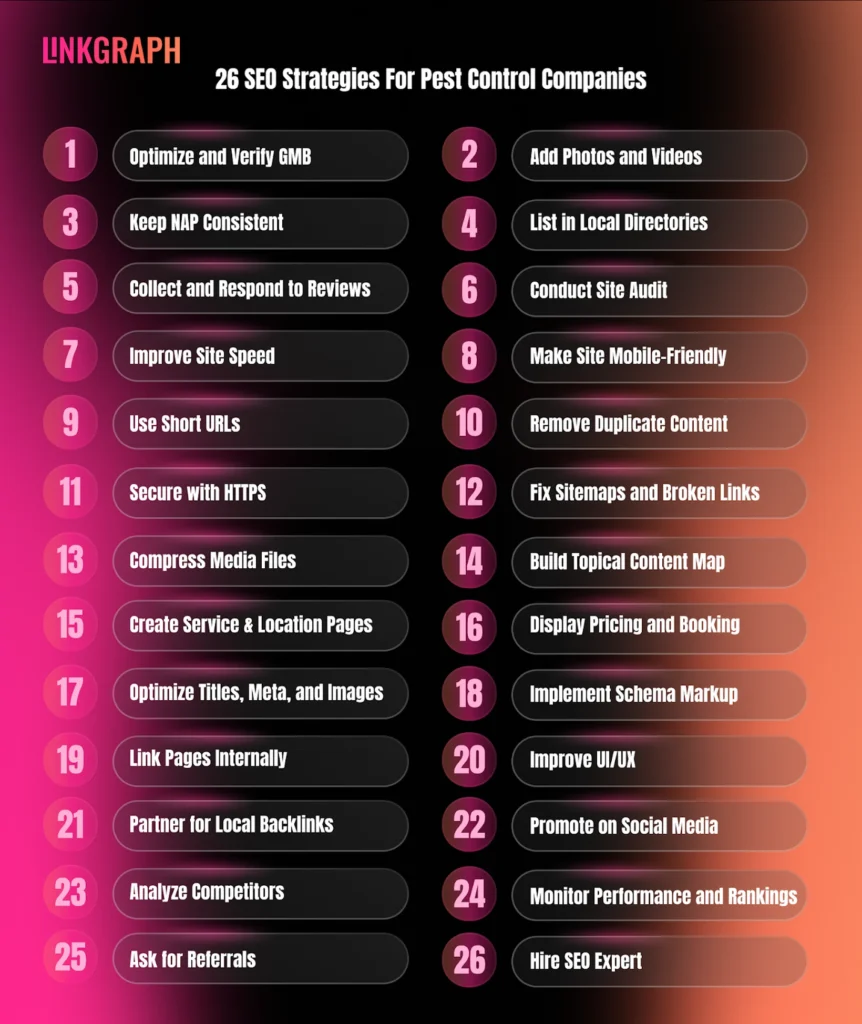
There are 26 steps for pest control companies to get started with SEO. The 26 steps for pest control companies to get started with SEO are listed below.
- Set Up, Verify, and Fully Optimize Your GMB Profile
- Upload High-Quality Photos and Videos to Your GMB Profile
- Keep Your Business Info (NAP) Consistent Online
- Get Listed in All Relevant Local Directories
- Ask Customers for Google Reviews and Respond Quickly
- Conduct a Full Site Audit and Fix Technical Errors
- Improve Website Loading Speed and Reduce Server Response Time
- Make Sure Your Website is Mobile-Friendly and Easy to Navigate
- Use Short, SEO-Friendly URLs
- Remove or Consolidate Duplicate Content
- Secure Your Website with HTTPS (SSL Certificate)
- Create Smaller Sitemaps and Regularly Fix Broken Links
- Compress Images and Media Files to Improve Page Load Speeds
- Construct a Proper Topical Map for Your Pest Control Business
- Build Individual Pages for Each Service and Location
- Clearly Display Your Pricing and Booking Options
- Optimize Page Titles, Meta Descriptions, and Featured Images
- Implement Schema Markup on Your Homepage and Service Pages
- Link Pages Internally Using a Clear Structure (Root → Seed → Node)
- Fix Cluttered Design and Optimize UI/UX for Better Usability
- Partner with Local Businesses to Gain Quality Links
- Use Social Media to Reach Local Customers
- Regularly Analyze Competitor SEO Strategies
- Consistently Check Website Performance and Rankings
- Ask Happy Customers for Referrals
- Hire an SEO Expert for Complex Tasks
Taking these steps helps pest control companies strengthen visibility, attract more local customers, and create long-term growth through consistent SEO efforts. We have broken down the 26 steps for pest control companies to get started with SEO below.
1. Set Up, Verify, and Fully Optimize Your GMB Profile
A Google Business Profile (GBP), formerly known as Google My Business (GMB), allows pest control companies to appear in Google Maps and local search results. This listing functions as a digital storefront where customers quickly see services, hours, and contact details.
For pest control companies, an optimized GBP profile is essential because most customers search locally when dealing with urgent pest issues. Appearing in the local pack leads to higher visibility, more calls, and greater trust compared to businesses without a complete profile.
Setting up a GBP profile begins with claiming and verifying the listing to confirm ownership. Companies enter consistent contact details, select accurate categories like “pest control service,” and write keyword-focused descriptions that highlight services such as termite treatment or rodent removal. Adding photos, collecting reviews, and posting regular updates improve visibility and engagement.
An optimized GMB impacts ranking by signaling relevance and activity to Google. A pest control business that regularly adds seasonal photos and responds to reviews is more likely to rank in the top results and attract local customers. These actions improve search visibility and increase conversions from search to booked services
2. Upload High-Quality Photos and Videos to Your GMB Profile
High-quality photos and videos make a pest control company GBP, or GMB, more engaging and trustworthy to potential customers. Visuals of staff, equipment, completed jobs, or office locations help establish credibility and show that the business is active and reliable. Google favors profiles with rich media because they provide more context for users and encourage higher interaction rates.
To maximize the benefit, upload professional-looking photos of staff in uniform, before-and-after shots of pest treatments, and short videos that explain services or showcase customer testimonials. Keep branding consistent across all media and ensure file sizes are optimized for fast loading.
Adding these visuals improves click-through rates and signals to Google that the business is relevant to local searches. Pest control companies that consistently update their profiles with quality visuals expect higher visibility in the local map pack, better customer engagement, and more service bookings. A practical tip is to refresh photos seasonally or whenever new services are added, keeping the profile up to date and appealing.
3. Keep Your Business Info (NAP) Consistent Online
Maintaining consistent name, address, and phone number (NAP) information across all online platforms strengthens the credibility of a pest control company and helps search engines correctly associate the business with its location. Accurate NAP details make it easier for potential customers to find and contact the business, improving overall lead generation and local search performance.
Audit all online listings, including directories, social profiles, and review sites, to ensure that business information matches exactly. Update any outdated phone numbers, addresses, or alternate spellings. Use a standardized format for all entries to avoid confusion.
Consistent NAP information signals reliability to search engines, improving the chances of appearing in the Google Map Pack and other local search results. Pest control companies benefit from increased visibility, better click-through rates, and a stronger reputation. A practical tip is to maintain a master spreadsheet of all listings and update it whenever business information changes, ensuring uniformity across all platforms.
4. Get Listed in All Relevant Local Directories (General & Industry-Specific)
Listing a pest control business in reputable local and industry-specific directories increases online visibility and strengthens local SEO. Directory listings help search engines verify business legitimacy, associate the company with a geographic area, and display it in local search results. Proper listings attract nearby customers actively searching for pest control services and improve brand recognition.
Identify high-authority local directories, such as Chamber of Commerce listings, Yelp, and industry-specific pest control directories. Ensure each listing includes accurate and consistent NAP information, detailed service descriptions, operating hours, and high-quality images. Regularly review and update listings to prevent outdated or conflicting information that reduces search engine confidence.
Directory listings improve local search performance by reinforcing business credibility and relevance. Pest control companies benefit from increased chances of appearing in the Google Map Pack, higher-quality traffic, and more inbound leads. A practical tip is to prioritize directories with strong domain authority and complete every section of the business profile to maximize SEO impact.
5. Ask Customers for Google Reviews and Respond Quickly
Collecting and responding to customer reviews enhances the online reputation of a pest control company and improves local SEO performance. Reviews provide social proof, influence decisions of potential clients, and signal engagement to search engines, boosting visibility in local search results. Prompt and professional responses to feedback, whether positive or negative, demonstrate reliability and customer care.
Pest control companies request reviews from satisfied clients immediately after service completion using email, SMS, or in-person prompts. Ensure review links are easy to access, and highlight specific service experiences when responding to reinforce attentiveness and expertise. Address negative feedback constructively by offering solutions while acknowledging concerns.
Effective review management builds credibility, attracts new customers, and improves local search rankings. Displaying reviews on the website and Google Business Profile enhances trust and encourages further engagement. Regularly monitoring and responding to reviews maintains a strong online presence, generates higher-quality leads, and reinforces the reputation of the company in the local market. A practical tip is to create a simple follow-up process for requesting reviews after every service.
6. Conduct Full Site Audit and Fix All Technical Errors
Performing a full site audit ensures pest control websites remain fully crawlable, indexable, and optimized for search engines. Technical SEO identifies issues such as broken links, slow page speeds, duplicate content, improper redirects, and sitemap errors that prevent search engines from properly reading and ranking pages. Fixing these issues enhances search visibility and allows potential clients to find services efficiently.
Pest control companies use website crawlers and analytics tools to detect errors affecting crawl efficiency and indexing. Examine sitemap structure, verify robots.txt settings, check for broken links, and monitor page speed. Analyze crawl reports to identify orphaned pages or redirect chains. Optimize URL structures and implement canonical tags to prevent duplicate content. For example, merging overlapping service or location pages removes confusion and strengthens rankings.
Regular technical audits improve indexing, boost local and organic search rankings, and enhance user experience through faster-loading, error-free pages. Maintaining site health builds search engine trust and attracts qualified traffic. A practical tip is to schedule monthly audits, review server logs for crawl inefficiencies, and fix technical issues promptly to maintain consistent SEO performance.
7. Improve Website Loading Speed and Reduce Server Response Time
Improving website loading speed is a key part of technical SEO that enhances user experience, reduces bounce rates, and increases search engine rankings for pest control websites. Fast-loading pages allow potential clients to access information quickly and engage with services efficiently. Search engines evaluate page speed as part of technical SEO, making it an essential factor for ranking.
Pest control websites reduce server response time to under 100ms. Compress images and media files without losing quality, enable browser caching, and use a content delivery network (CDN) to serve content faster. Minimize CSS, JavaScript, and HTML files and remove unnecessary plugins to reduce delays and improve load times. Regular performance analysis using technical SEO tools identifies bottlenecks and prioritizes fixes effectively.
Optimized page speed improves rankings, encourages visitors to explore multiple service pages, and increases conversions by providing a smoother browsing experience. Consistent monitoring maintains fast load times on both desktop and mobile devices, supports long-term technical SEO health, and improves overall user engagement for pest control websites.
8. Make Sure Your Website is Mobile-Friendly and Easy to Navigate
Mobile-friendly design is a critical component of technical SEO that improves user experience, increases engagement, and supports higher search engine rankings for pest control websites. Most users search for local services on smartphones or tablets, so responsive websites allow potential clients to access information and book services efficiently. Search engines prioritize mobile usability as part of technical SEO, making this an essential ranking factor.
Pest control websites implement a responsive design to ensure content adapts to different screen sizes. Menus are simplified, buttons and links are easy to tap, and forms are optimized for mobile input. Organize content with clear headings, concise text, and logical page structures for intuitive navigation. Testing navigation flow on multiple devices identifies usability issues and ensures service pages, pricing, and booking options are easily accessible.
Mobile-friendly design enhances local and organic rankings, encourages longer sessions, and reduces bounce rates. Clear navigation improves lead generation by helping visitors quickly find and act on relevant information. Regular reviews of mobile performance maintain accessibility and deliver a smooth, professional experience while strengthening technical SEO for pest control websites.
9. Use Short, SEO-Friendly URLs
Short, SEO-friendly URLs are a vital element of technical SEO that improves website clarity, supports search engine indexing, and helps users understand page content quickly. Clear URLs signal relevance to search engines and enhance click-through rates from search results. For pest control websites, concise URLs help potential clients recognize the service or location covered by the page at a glance.
Websites use URLs that include primary keywords, reflect the page hierarchy, and avoid unnecessary words or numbers. Hyphens separate words, lowercase letters maintain consistency, and similar service pages follow a predictable structure. For example, use /services/termite-inspection instead of /page?id=23456. Internal linking references these URLs to strengthen site architecture and improve user navigation.
Optimized URLs support better indexing, increase organic traffic, and enhance user trust. Maintaining consistent, descriptive URLs prevents confusion and ensures search engines associate each page with its intended topic. Regular audits identify outdated or overly long URLs, keeping the website efficient and technically sound for both search engines and users.
10. Remove or Consolidate Duplicate Content
Removing or consolidating duplicate content is an essential technical SEO task that ensures search engines index the most relevant pages and prevents SEO dilution. Duplicate content splits ranking signals and lowers overall visibility for pest control websites. Consolidating overlapping content strengthens page authority and provides clear, authoritative information for both search engines and potential clients.
Pest control websites audit pages, blog posts, and service descriptions to identify repeated or overlapping content. Use canonical tags to indicate the preferred version of similar pages and merge duplicate content into a single authoritative page. Update internal links to point to the primary URL and remove thin or low-value duplicates that offer little user benefit. Regular audits detect new duplicates as the website expands.
Addressing duplicate content improves search engine rankings, increases indexing efficiency, and strengthens authority across service and location pages. Clear, consolidated pages attract more qualified traffic and ensure potential clients access accurate, helpful information. Maintaining a content inventory and reviewing site audit reports helps track and resolve content overlap systematically, supporting ongoing technical SEO performance.
11. Secure Your Website with HTTPS (SSL Certificate)
Securing a website with HTTPS is a key component of technical SEO that protects data exchanged between visitors and the pest control site. HTTPS establishes trust with potential clients while signaling site safety to search engines, which positively impacts rankings. For pest control websites, secure connections demonstrate professionalism and reliability, encouraging users to engage and submit inquiries.
Pest control businesses install a valid SSL certificate and ensure all pages redirect from HTTP to HTTPS. Check for mixed content issues, where some resources still load over HTTP, and update internal links to the secure versions. Regular monitoring ensures the certificate remains valid and prevents errors that compromise site security.
Implementing HTTPS improves search engine rankings, protects sensitive client information, and enhances credibility. Visitors feel confident submitting contact forms or booking services online. Setting up automatic SSL renewal and testing the website after installation ensures full security across all pages. Secure sites experience higher user engagement and stronger trust signals, supporting long-term technical SEO success.
12. Create Smaller Sitemaps and Regularly Fix Broken Links
Creating smaller sitemaps and maintaining broken links is a core part of technical SEO. Smaller, well-organized sitemaps help search engines crawl and index pest control websites more efficiently. Broken links disrupt user experience and signal poor site maintenance, which negatively affects rankings.
Pest control businesses divide large sitemaps into smaller sections for services, locations, and blog content. Submit these sitemaps to search engines to ensure complete indexing. Regularly scan the website for broken internal and external links, including outdated service pages, old blog posts, or external references. Fix broken links by updating URLs, redirecting to relevant pages, or removing outdated references.
Proper sitemap management and link maintenance improve crawlability, enhance user experience, and ensure search engines index the most important pages. This increases the chances of ranking higher in search results for targeted pest control keywords. A practical tip is to schedule monthly checks for broken links and sitemap updates to maintain a healthy, technically sound website that supports ongoing SEO performance.
13. Compress Images and Media Files to Improve Page Load Speeds
Compressing images and media files is an important technical SEO strategy that enhances page load speed and overall website performance for pest control websites. Large, unoptimized files increase server response time, slow page rendering, and frustrate visitors. Optimized media improves user experience, encourages engagement, and supports higher rankings in search engine results.
Pest control websites evaluate all images, videos, and graphics to identify files that significantly affect load times. Convert images to modern formats, resize them for responsive displays, and implement lazy loading for videos. Minimize file sizes without reducing visual quality and ensure all media is optimized for both desktop and mobile devices. Regular monitoring identifies large or uncompressed files that hinder performance.
Optimized media files improve Core Web Vitals, reduce layout shifts, and increase interactivity, strengthening technical SEO performance. Faster-loading pages encourage visitors to explore multiple service pages, decreasing bounce rates and increasing conversions. Quick tips include automating image compression during uploads and using media optimization reports to track file sizes. Consistent optimization maintains fast website performance, supporting better rankings and improved user satisfaction.
14. Construct a Proper Topical Map for Your Pest Control Business
Constructing a proper topical map organizes a pest control website into clear, interconnected themes that demonstrate expertise and authority. A structured map helps search engines understand the relevance and depth of content, improving rankings and organic visibility. It guides visitors to the information they need, enhancing navigation and engagement.
Pest control websites begin by identifying core topics, such as residential pest control, commercial pest control, and specialized services like termite or rodent removal. Each core topic branches into subtopics that address specific questions, service steps, and maintenance tips. Keyword research and analysis of customer queries reveal long-tail topics that align with search intent. Grouping content in clusters ensures that pages support each other, establishing topical authority across the website.
A well-constructed topical map improves indexing efficiency, strengthens internal linking, and increases the chances of ranking for multiple relevant queries. Visitors benefit from logical content pathways that make information easier to find, improving engagement and conversion rates. Regularly reviewing and updating the topical map ensures it reflects evolving pest control trends, maintaining relevance and maximizing technical SEO performance.
15. Build Individual Pages for Each Service and Important Location
Creating individual pages for each service and key location strengthens on-page SEO for pest control websites. Dedicated pages allow search engines to recognize specific offerings and geographic areas, improving relevance and search visibility. They provide potential clients with clear, focused content without distractions, enhancing user experience and engagement.
Pest control businesses develop unique pages for every service, such as termite inspection, rodent control, or bed bug treatments, as well as for each city or neighborhood served. Each page includes descriptive, original content that highlights service benefits, processes, and certifications. Incorporating local keywords naturally into headings, body text, and meta elements ensures alignment with search queries. Internal links connecting service pages to relevant location pages support the site structure and distribute authority effectively.
Well-structured service and location pages increase the likelihood of ranking in both organic and local search results. These pages attract targeted traffic from users actively seeking pest control services in specific areas, boosting lead generation and conversions. Regular audits maintain accurate, optimized, and relevant content, supporting sustained on-page SEO performance and establishing long-term authority for the pest control website.
16. Clearly Display Your Pricing and Booking Options
Clearly presenting pricing and booking options enhances on-page SEO and improves user experience on pest control websites. Transparent information allows potential clients to understand available services, select the right options, and take action, such as scheduling an inspection or treatment. Well-organized displays increase engagement and provide search engines with clear signals about page relevance.
Pest control websites list each service with detailed descriptions and pricing or package options. Integrating prominent calls-to-action for booking, using tables, bullet points, or service grids, makes information easy to scan. Structured data markup for pricing and services helps search engines interpret the content accurately and increases the likelihood of appearing in rich results. Internal links to related service pages or FAQs strengthen navigation and reinforce topical authority.
Optimized presentation of pricing and booking options encourages visitors to convert, reduces bounce rates, and boosts credibility. Clear information fosters trust with potential clients, increasing inquiries and appointments. Consistently reviewing and updating this content ensures accuracy, maintains strong search visibility, and supports long-term on-page SEO performance for pest control websites.
17. Optimize Page Titles, Meta Descriptions, and Featured Images
Optimizing page titles, meta descriptions, and featured images strengthens on-page SEO and improves search engine understanding of pest control websites. Clear and descriptive titles signal relevance to search engines, while compelling meta descriptions increase click-through rates from search results. Well-optimized featured images enhance user experience, visually communicate services, and contribute to overall page authority.
Pest control websites create unique, keyword-rich titles and meta descriptions for every service and location page. Featured images accurately represent the service offered, include descriptive filenames, and use alt text with relevant keywords. Regular audits ensure titles, descriptions, and images remain current as services, locations, or promotions change. Structured and consistent metadata across the site helps search engines index pages correctly and improves organic visibility.
Proper optimization of titles, meta descriptions, and images attracts more qualified traffic, increases engagement, and reinforces brand credibility. Pages that follow these best practices gain higher search rankings, improve local and organic visibility, and encourage users to explore multiple services. Regular monitoring and updates maintain relevance, supporting long-term SEO performance for pest control websites.
18. Implement Schema Markup on Your Homepage and Service Pages
Implementing schema markup on the homepage and service pages helps search engines understand the content of pest control websites more accurately. Structured data highlights important information such as services offered, service areas, business hours, and customer reviews, making pages eligible for rich results and improving visibility in search listings.
Pest control websites apply relevant schema types, including LocalBusiness and Service schemas, to represent real-world offerings correctly. Connect structured data to elements like FAQs, testimonials, and contact information. Regular validation ensures proper implementation and prevents errors that affect indexing. Schema markup guides search engines to display enhanced snippets, which make listings more engaging and informative for potential clients.
Proper implementation of schema markup improves search result appearance, increases click-through rates, and strengthens local SEO performance. Pages with structured data gain higher visibility for targeted queries and enhance perceived authority. Regular updates to the schema ensure new services, locations, and customer feedback are accurately reflected, maintaining relevance and supporting ongoing SEO success.
19. Link Pages Internally Using a Clear Structure (Root → Seed → Node)
Internal linking using a clear structure organizes pest control websites for both users and search engines. A root-to-seed-to-node approach distributes authority, reinforces topical relevance, and ensures important pages receive proper attention from search engines. Clear internal links guide visitors through services and locations efficiently, improving engagement and time spent on the site.
Pest control websites audit existing pages and implement a logical linking hierarchy. Root pages, such as the homepage or main service category, connect to seed pages representing primary services. Seed pages link to node pages covering subtopics or location-specific offerings. Use descriptive anchor text to clarify the purpose of each link and make navigation intuitive. Regular checks prevent broken links and maintain consistent site architecture.
A well-structured internal linking system strengthens on-page SEO, enhances crawl efficiency, and improves page authority for key service and location pages. Clear connections increase user engagement, encourage exploration of multiple services, and support higher rankings in both local and organic search results. Regular updates ensure new content integrates smoothly into the existing linking framework.
20. Fix Cluttered Design and Optimize UI/UX for Better Usability
Optimizing user interface and user experience improves engagement, reduces bounce rates, and enhances search engine rankings for pest control websites. A clean, intuitive design allows visitors to find services, pricing, and booking options quickly, making navigation simple and efficient. Clear layouts and organized content ensure that search engines interpret page relevance more effectively, strengthening on-page SEO performance.
Pest control websites evaluate page layouts, remove unnecessary elements, and prioritize essential information above the fold. Use consistent fonts, colors, and spacing to improve readability, and make buttons and links prominent for easy interaction. Streamline forms, organize menus logically, and reduce distractions that divert user attention. Test designs across devices to confirm accessibility and usability on both desktop and mobile screens.
Improved UI/UX enhances user satisfaction, encouraging visitors to explore multiple pages and complete desired actions such as service bookings or inquiries. A well-optimized interface supports better engagement metrics, which positively influence search engine rankings. Regular design reviews ensure the website remains user-friendly, professional, and effective in converting visitors into clients.
21. Partner with Local Businesses to Gain Quality Links
Partnering with local businesses helps pest control websites earn high-quality backlinks and strengthen local credibility. Collaborative relationships with complementary businesses create opportunities for mutual promotion, increasing website authority and improving search engine rankings. Links from reputable local partners signal trustworthiness and relevance to search engines while attracting geographically relevant audiences.
Pest control companies identify nearby real estate agencies, property managers, office suppliers, or other service providers for partnerships. Collaborations include co-hosting events, offering bundled services, contributing guest content, or being listed as a recommended service provider on partner websites. Each collaboration includes a backlink to the pest control site to maximize SEO value.
High-quality local links improve domain authority, boost rankings for service-specific keywords, and generate referral traffic from potential clients already located in service areas. Maintaining ongoing partnerships ensures continuous link acquisition and community visibility. Quick tips include prioritizing links from businesses with strong online presence and ensuring relevance between services for optimal SEO impact.
22. Use Social Media to Reach Local Customers
Social media enhances online visibility, builds brand awareness, and drives traffic to pest control websites. Regular engagement on platforms where local audiences are active strengthens trust and authority, indirectly supporting search engine rankings. Sharing educational posts, promotions, and service updates helps potential clients learn about offerings and encourages interaction with the business.
Pest control companies create profiles on platforms popular in their service areas. Post content that highlights services, shares tips for pest prevention, showcases customer success stories, and promotes seasonal campaigns. Use geo-targeted hashtags, tag locations, and encourage shares and comments to increase reach. Social media content links back to the website to channel traffic and improve SEO performance.
Active social media presence increases brand recognition, fosters customer engagement, and generates referral traffic from local communities. Consistent posting and interaction maintain relevance in local searches. Quick tips include scheduling posts for peak engagement times and monitoring metrics to refine strategies for maximum impact on both social visibility and website visits.
23. Regularly Analyze Competitor SEO Strategies
Analyzing competitor SEO strategies provides insight into effective tactics, keyword opportunities, and gaps in the pest control market. Studying the online presence of competitors helps identify high-performing content, backlink sources, and ranking strategies that inform and improve the SEO plan.
Pest control companies review competitor websites, blog content, meta tags, service pages, and local listings. Analyze their backlink profiles, keyword targeting, and social media activity to understand what drives traffic and rankings. Track changes over time to spot emerging trends and adjust strategies accordingly. Focus on competitors in the same service area or targeting similar customer demographics to ensure actionable insights.
Competitor analysis allows businesses to benchmark performance, refine SEO strategies, and maintain a competitive edge in local and organic search results. Insights gained from competitor research support better content creation, targeted keyword use, and link-building efforts. Quick tips include setting up alerts for competitor updates and maintaining a spreadsheet of observed strategies for continual optimization.
24. Consistently Check Website Performance and Rankings
Regularly monitoring website performance and search engine rankings ensures pest control websites maintain visibility and deliver a positive user experience. Tracking metrics like page speed, traffic, conversions, and keyword positions helps identify issues early and informs optimization efforts.
Pest control companies set up regular performance audits using analytics platforms to track traffic trends, bounce rates, and engagement metrics. Monitor keyword rankings for service pages and local search queries to measure SEO effectiveness. Evaluate technical aspects such as page load times, mobile usability, and broken links to ensure smooth functionality. Comparing historical data highlights improvements and areas requiring attention.
Consistent performance monitoring allows businesses to respond quickly to ranking drops, website errors, or changes in user behavior. This proactive approach improves user experience, supports local and organic search visibility, and maximizes lead generation. Quick tips include scheduling monthly ranking reports and regularly reviewing core website metrics to maintain long-term SEO success.
25. Ask Happy Customers for Referrals
Encouraging satisfied clients to provide referrals expands reach and generates new leads for a pest control company through trusted recommendations. Referrals enhance credibility, build community trust, and increase the likelihood of attracting clients who are already interested in pest control services.
Pest control companies identify customers with positive experiences and request referrals via email, follow-up calls, or in-person interactions. Offering incentives such as discounts on future services or small rewards motivates clients to share their experiences. Provide clear instructions or referral links that clients easily share with friends, neighbors, or local businesses.
Referrals complement online marketing efforts by bringing in pre-qualified leads who have a higher probability of converting. They strengthen local brand presence, enhance reputation, and encourage word-of-mouth promotion. Quick tips include tracking referral sources to measure effectiveness and integrating referral requests into service completion follow-ups to maximize participation.
26. Hire an SEO Expert for Complex Tasks
Hiring an SEO expert addresses advanced optimization needs that are challenging for internal teams. SEO specialists bring experience in technical audits, competitive analysis, content strategy, local SEO, and backlink acquisition, ensuring pest control websites achieve higher visibility and stronger search engine performance.
Pest control companies evaluate SEO professionals based on their track record, industry knowledge, and ability to implement both on-page and technical SEO strategies. Experts manage tasks such as schema implementation, site structure optimization, keyword research, and performance tracking, which require specialized skills and tools. Clear communication and defined objectives ensure that SEO efforts align with business goals and deliver measurable results.
Engaging an SEO expert improves website rankings, increases targeted traffic, and enhances lead generation for pest control services. Businesses benefit from consistent monitoring, expert recommendations, and efficient execution of complex strategies that maximize online presence. Quick tips include requesting case studies or client references and prioritizing agencies familiar with local SEO practices for service-based businesses.
Is There a Right Time for Pest Control Companies to Get Started With SEO?
Pest control companies should start SEO immediately, ideally before launching a new website or expanding service areas. SEO is a long-term strategy that builds domain authority, optimizes content, and increases organic visibility over time, typically taking three to six months to show noticeable results. Early implementation is especially important due to seasonal demand for services like mosquito or rodent control, ensuring the website ranks well during peak periods.
Starting SEO promptly establishes credibility through clear information, positive reviews, and relevant content, helping the business stand out from competitors and attract more local customers. Early and consistent SEO efforts improve online visibility, drive targeted traffic, and support long-term business growth.
How Long Does It Take for SEO to Start Working for Pest Control Businesses?
SEO for pest control businesses typically takes 3 to 6 months to show initial results, with more significant improvements often visible within 6 to 12 months. This timeline extends to over a year in highly competitive markets or for websites starting with low domain authority.
Several factors contribute to this extended timeline. Google’s algorithms assess over 200 ranking factors, including content quality, backlinks, and user experience, and building a strong profile in these areas takes time. New or less established websites require time to build trust and authority in their niche. In competitive local markets, multiple businesses vie for top rankings, making it more challenging to achieve visibility. SEO is an ongoing process that involves regular updates, content creation, and technical adjustments to maintain and improve rankings.
Pest control businesses approach SEO as a long-term investment, understanding that consistent effort and time are essential for achieving sustainable online visibility and growth.
Is GMB Optimization Enough for Pest Control Companies to Get Consistent Leads?
No, optimizing a Google Business Profile alone does not generate consistent leads for pest control companies. While it improves local visibility, competition and user behavior affect results. Many potential customers do not click on listings, and relying solely on this strategy limits reach. Consistent lead generation requires combining GBP optimization with SEO, content marketing, paid ads, and social media. Integrating multiple channels ensures broader visibility, attracts more potential clients, and strengthens overall digital presence.
Which Online Directories Are Most Valuable for Pest Control Companies to Be Listed In?
Listing your pest control business in reputable online directories enhances local SEO, builds trust, and increases visibility. The most valuable online directories for pest control companies are listed below.
- Google Business Profile: Crucial for appearing in local search results and Google Maps.
- Yelp: Widely used for customer reviews and local business discovery.
- Bing Places for Business: Important for reaching users on Microsoft’s search engine.
- Apple Maps: Essential for visibility among iOS users.
- Houzz: Ideal for showcasing home service businesses with project photos.
- Angi (formerly Angie’s List): Trusted for finding vetted service professionals.
- Thumbtack: Connects service providers with customers seeking quotes.
- Nextdoor: Engages local communities and neighborhoods.
- Yellow Pages: A longstanding directory with a broad user base.
- BuildZoom: Useful for contractors and construction-related services.
- Bark: Matches service providers with customer requests.
- Porch: Connects homeowners with home service professionals.
These directories are selected based on their relevance, user engagement, and impact on local SEO. It’s essential to maintain consistent business information across all platforms to maximize SEO benefits.
Is It Possible for Pest Control Business Owners to Implement SEO Strategies on Their Own?
Yes, pest control business owners implement basic SEO, such as local SEO, keyword optimization, and content creation, to improve visibility and attract customers. Advanced tasks like technical SEO, backlink building, and adapting to algorithm changes require specialized expertise. Many companies achieve better results and save time by partnering with professional SEO agencies that provide ongoing optimization and up-to-date strategies. DIY SEO works, but professional guidance enhances effectiveness and ensures long-term performance.
What Should I Check Before Hiring an SEO Agency for My Pest Control Business?
Choosing the right SEO agency makes a significant difference for the online success of a pest control business. The essential factors to ensure the agency delivers measurable results and aligns strategies with business goals have been listed below.
- Specialized Experience in Pest Control SEO: Knowledge of industry-specific challenges and strategies.
- Expertise in Local SEO Optimization: Ability to target local customers and optimize for maps and local listings.
- Clear and Transparent Pricing Structure: Understand costs and avoid hidden fees.
- Proven Results With Ranking and Traffic Growth: Track record of measurable improvements for similar clients.
- Custom SEO Strategy Based on Business Needs: Tailored plan addressing unique services and target areas.
- Regular Communication and Performance Reporting: Frequent updates and measurable reporting on progress.
- Use of Ethical, Google-Compliant SEO Methods: Avoid black-hat tactics that harms rankings.
- Strong Technical Skills for Website Optimization: Capable of fixing site speed, mobile issues, and on-page SEO.
Evaluating these factors helps ensure the agency delivers measurable SEO results for pest control businesses.
Who Offers the Best SEO Services for Pest Control Companies Near Me?
LinkGraph provides specialized SEO services for pest control companies, combining local SEO, content optimization, and technical fixes to boost online visibility and attract targeted traffic. The team uses proprietary tools for site audits, keyword research, and link building, ensuring efficient, Google-compliant SEO strategies.
Case studies and client results demonstrate improved search rankings, increased organic traffic, and higher lead generation. Their customized approach focuses on building authority, enhancing website performance, and driving measurable business growth for pest control businesses.
Which Types of SEO Services Does LinkGraph Offer for Pest Control Businesses?
LinkGraph provides a full suite of SEO services tailored to pest control businesses, covering all aspects of online visibility, website performance, and lead generation. These services address technical, local, and content needs while ensuring measurable results. The types of SEO services offered by LinkGraph for pest control companies are listed below.
- Holistic SEO: Comprehensive strategies combining technical, on-page, off-page, and local optimization to maximize search performance.
- Local SEO: Optimization for service-area searches to attract nearby customers and improve visibility in local results.
- Technical SEO: Audits and fixes for site speed, mobile responsiveness, URL structure, and crawlability.
- On-Page SEO: Optimization of titles, meta descriptions, headings, and content for relevance and user experience.
- Off-Page SEO / Link Building: Building high-quality backlinks from relevant, authoritative sources to strengthen domain authority.
- Local Map Pack Optimization: Enhancing visibility in Google Maps and local search features.
- Content Creation: Producing optimized blog posts, service pages, and informational content targeting relevant keywords.
- LLM and AI Overview Optimization: Leveraging AI tools to improve content relevance, discoverability, and structured presentation.
- Structured Data and Schema Markup Integration: Implementing schema to enhance rich results and search appearance.
- Lead Tracking and Reporting: Monitoring SEO performance, conversions, and actionable insights for continual improvement.
These services work together to boost online visibility, attract qualified leads, and improve overall search performance for pest control companies.
Can All Types of Pest Control Contractors Get SEO Services from LinkGraph?
Yes, LinkGraph provides SEO services for all types of pest control contractors. Whether a business offers general pest control, termite treatments, rodent control, wildlife management, bed bug extermination, or specializes in residential and commercial services, their strategies are tailored to each niche.
LinkGraph supports contractors based on specific control methods. The type of pest control contractors that LinkGraph offers SEO services to are listed below.
- Chemical pest control
- Biological pest control
- Physical pest control
- Integrated Pest Management (IPM)
- Fumigation
LinkGraph uses local SEO, content creation, link building, and technical optimization to help pest control companies of every type improve visibility, generate qualified leads, and build authority online.
How Much Does LinkGraph Charge for Pest Control SEO Services?
LinkGraph SEO services for pest control businesses start at $1,500 per month and scale up to $12,000 per month, depending on the scope, with custom plans beginning at $6,000. Link-building packages range from $549 to $9,999 per month, increasing in authority and volume at each tier. This flexible pricing ensures small local pest control companies access affordable SEO while larger or multi-location providers invest in advanced strategies to dominate competitive markets.
Does LinkGraph Only Offer SEO Marketing Services for Pest Control Companies?
No, LinkGraph does not only offer SEO marketing services for pest control companies. It works with many industries and provides a full range of digital marketing solutions. In addition to SEO, LinkGraph offers link building, content creation, technical SEO, local SEO, conversion rate optimization, PPC management, web design, UX/UI, and reputation management. LinkGraph provides proprietary software tools for rank tracking, content optimization, competitor research, and keyword analysis, making it a complete digital marketing partner rather than being limited to one sector.
What Other Industries Can Get SEO Services From LinkGraph?
Many industries benefit from LinkGraph SEO services, as their strategies are tailored to meet the unique challenges of different markets. Some of the industries that can get SEO services from LinkGraph have been listed below.
- Legal Services: Law firms and attorneys rely on SEO to capture high-intent leads from people searching for legal help in their area, making visibility in local and competitive markets essential.
- Healthcare and Medical Practices: Clinics, dentists, and specialized medical providers benefit from SEO to connect with patients looking for trustworthy healthcare services online.
- E-commerce and Retail: Online stores need SEO to compete in crowded digital marketplaces, ensuring their products rank for purchase-driven keywords.
- Real Estate: Agents and brokerages use SEO to appear in local searches where potential buyers and sellers are actively looking for properties and professionals.
- Home Services: Industries such as HVAC, plumbing, and roofing rely heavily on local SEO to reach homeowners in immediate need of their services.
- Hospitality and Travel: Hotels, travel agencies, and tour operators use SEO to target travelers searching for accommodations, destinations, and experiences.
- Education and Training: Schools, universities, and online learning platforms leverage SEO to attract students and parents researching courses and programs.
- Technology and SaaS: Software companies and tech startups use SEO to generate qualified leads and build authority in highly competitive digital spaces.
These industries, like pest control, rely on online visibility to capture leads and grow revenue. LinkGraph adapts its proven SEO frameworks to each sector, helping businesses dominate search rankings, increase traffic, and achieve long-term growth.
What Are Other Effective Ways to Market Pest Control Services Besides SEO?
In addition to SEO, pest control companies boost their visibility, attract more customers, and grow their business through a variety of targeted marketing strategies. Other effective ways to market pest control services besides SEO have been listed below.
- Pay-Per-Click (PPC) Advertising: Target high-intent keywords like “pest control near me” on Google Ads for immediate visibility.
- Social Media Advertising: Run targeted ads on Facebook and Instagram to reach specific demographics and interests.
- Direct Mail Campaigns: Send postcards or flyers to promote seasonal services or special offers in local neighborhoods.
- Local Sponsorships and Events: Participate in community events or sponsor local activities to build brand awareness and trust.
- Referral Programs: Reward existing customers for referring friends and family to encourage word-of-mouth marketing.
- Email Marketing: Send newsletters, promotions, and seasonal tips to nurture leads and retain customers.
- Content Marketing: Create blogs, videos, and guides that educate homeowners and establish authority.
- Online Reviews and Reputation Management: Encourage positive reviews on Google, Yelp, and Angi to build credibility.
- Partnerships with Local Businesses: Collaborate with realtors, property managers, or home service companies for cross-promotions.
- SMS/Text Marketing: Send reminders, alerts, and offers directly to the phones of local customers.
- Vehicle Branding and Yard Signs: Use branded trucks, uniforms, and signage at customer properties to increase local visibility.
Using a combination of these strategies alongside SEO creates a comprehensive marketing approach that maximizes reach, builds trust, and generates consistent leads.
Is SEO More Effective Than PPC for Marketing Pest Control Services?
Both SEO and PPC are important for marketing pest control services. SEO builds long-term organic visibility, credibility, and consistent traffic without ongoing costs per click, making it ideal for sustainable growth. PPC delivers immediate visibility and leads, allowing businesses to capture potential customers quickly. Using both together maximizes reach, with SEO providing lasting results and PPC offering short-term boosts, creating a balanced and effective marketing strategy.
