
SEO for printing companies involves optimizing websites, local listings, service pages, and portfolios to rank for queries such as “business card printing” or “custom packaging near me.” Printing companies, including commercial printers, signage studios, and packaging providers, use SEO to increase online visibility, attract high-intent clients, and generate consistent local and B2B leads.
Effective SEO for printing companies combines technical audits, structured content, topical mapping, internal linking, and local optimization targeting prospective clients actively searching for printing services. Maintaining updated service pages, showcasing portfolio examples, and earning backlinks from local businesses and industry directories improves authority and relevance. Monitoring performance and tracking conversions allow precise adjustments that maintain sustainable lead generation and growth.
Selecting the right SEO agency ensures printing companies implement consistent, strategic optimization across technical, content, and local channels. Professional management strengthens search visibility, improves website performance, and converts search traffic into qualified leads, creating long-term measurable growth for printing stores and commercial printing providers.

What Are Printing Companies?
Printing companies are commercial printers that produce physical media through the controlled transfer of text and images. These printing businesses serve professional organizations through paper, fabric, metal, and plastic substrates. Print shops use digital presses and offset systems to execute branding, advertising, and operational print requirements.
What production methods do printing companies use for commercial print output? Commercial printers apply digital printing, offset lithography, and screen printing based on volume and material tolerance. Digital presses fit short runs and variable data, whereas offset presses suit high-volume precision jobs.
What services and market focus characterize modern printing businesses? Printing companies execute pre-press preparation and post-press finishing for business-to-business clients. Commercial print shops specialize in packaging, large-format signage, or catalog production for defined industry niches.
What Does SEO Mean for Printing Companies?
SEO for printing companies refers to search optimization customized for commercial printers and print service providers. Printing company SEO aligns websites, content, and technical elements with search engine algorithms for queries such as custom label printing, large-format banners, or corporate stationery production. Commercial printers use SEO to ensure visibility for both local and niche searches, capturing buyers actively seeking print solutions.
How does local SEO enhance search performance for printing businesses? Local SEO for printing companies targets city-specific and near-me searches, including phrases like signage printing in London or custom packaging in New York. Printing companies optimize Google Business Profiles (GBP), local citations, and service area pages to appear in map packs and local search results.
What strategies strengthen content and technical SEO for print service websites? Printing company SEO implements targeted keywords, high-intent blog posts, case studies, and FAQ pages. Technical optimization improves page speed, mobile usability, structured site hierarchy, and indexability, which ensures commercial printers achieve higher rankings and capture qualified leads consistently.
Why Is SEO Important for Printing Companies?
Printing companies rely on SEO to maximize online visibility, attract high-quality leads, and outperform competitors in local and specialized markets. Search engine optimization transforms a printing company website into a consistent sales channel that captures both digital inquiries and local foot traffic. Optimized printers appear for searches like “banner printing near me” or “custom packaging services,” targeting customers at the precise moment they intend to purchase. The factors that make SEO important for printing companies are listed below.
- Boosts Local Visibility: Optimizing Google Business Profiles, local citations, and service area pages ensures print shops appear in relevant geographic search results and map packs.
- Targets High-Intent Customers: SEO for printing companies captures individuals actively searching for services such as business card printing, brochure production, or promotional material design, which increases qualified lead generation.
- Builds Authority and Trust: Consistent ranking at the top of search results positions the printing company as a reliable, professional, and authoritative service provider.
- Cost-Effective Marketing: Organic search reduces reliance on paid campaigns, delivering long-term ROI through sustained targeted traffic.
- Competitive Advantage: Optimized print shops outperform competitors lacking technical, local, or content-focused SEO, capturing greater market share.
- Improves User Experience: Faster page speed, mobile responsiveness, and structured navigation enhance website engagement, retention, and conversions.
SEO integrates local, technical, and content strategies, making it essential for printing companies to grow revenue and maintain market relevance.
How Can Printing Companies and Presses Get Started with SEO?
Printing companies and presses can get started with SEO by combining local SEO tactics, technical optimization, and targeted content creation. Commercial printers improve visibility by researching high-intent keywords, optimizing on-page elements, and ensuring websites provide clear navigation and fast load times.
Prioritizing the user experience while applying consistent on-page and off-page SEO strategies establishes a foundation for sustained search performance and lead generation. Effective SEO allows printing businesses to attract clients searching for specific services like packaging, banners, or brochures.
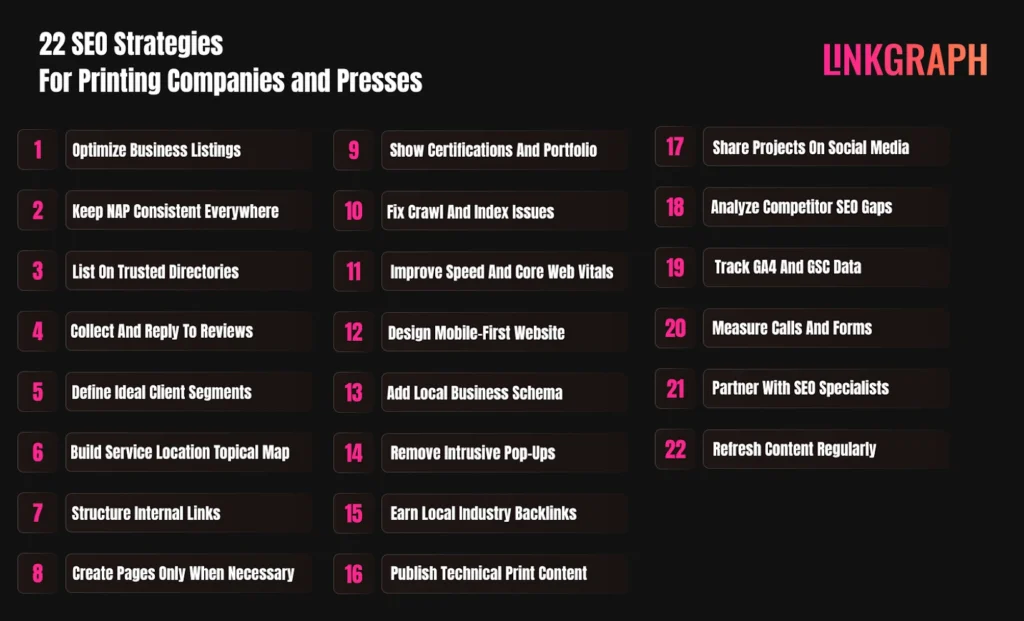
There are 22 SEO strategies for printing companies and presses. The 22 SEO strategies for printing companies and presses are listed below.
- Claim, Verify, and Optimize Google, Bing, and Apple Business Listings
- Maintain Consistent Business Information Across All Online Directories
- List Your Printing Business on Authoritative Local and Industry Directories
- Encourage Customer Reviews and Respond Promptly to All Feedback
- Define Your Target Clients Based on Industry, Needs, and Services
- Create Topical Map for Services, Locations, and Industry Topics
- Maintain Logical Internal Linking Structure (Root→Seed→Node)
- Create Separate Pages Only if the Topic, Service, or Location is Important
- Display Printing Certifications, Machinery, Portfolio, and Client Testimonials
- Conduct a Technical SEO Audit to Fix Crawling and Indexing Errors
- Improve Core Web Vitals, Page Speed, and Mobile Performance
- Design Modern, Mobile-Friendly, User-Centric Website
- Implement Local Business Schema Markup for Services, Organization, and Reviews
- Remove Unnecessary Chatbots and Pop-Ups for Better User Experience
- Earn Backlinks from Local Businesses, Agencies, and Printing Associations
- Publish Content on Printing Techniques, Materials, and Design Tips to Earn Mentions
- Use Social Media Platforms to Showcase Projects and Client Work
- Perform Competitor Analysis to Identify SEO Gaps and Growth Opportunities
- Track SEO Performance Using Google Analytics and Search Console
- Monitor Calls, Form Submissions, and Quote Requests for Conversion Data
- Collaborate with an Experienced SEO Specialist for Ongoing Optimization
- Refresh and Update Website Content to Stay Fresh and Locally Relevant
Following these steps ensures printing companies establish a strong SEO foundation, generate qualified leads, and increase visibility in search results. We have broken down the 22 SEO strategies for printing companies and presses below.
1. Claim, Verify, and Optimize Google, Bing, and Apple Business Listings
Printing companies improve local visibility by claiming and verifying their Google Business Profile (GBP), Bing Places, and Apple Maps listings. Verified profiles display consistent company name, address, phone number, business hours, and services, which builds trust for clients searching for print solutions. Optimized listings allow printing businesses to appear in map packs and local search results, increasing opportunities to attract high-intent customers.
Why is claiming business listings critical for printing companies? Claiming and verifying GBP, Bing Places, and Apple Maps gives commercial printers control over how their business appears across search engines. Accurate profiles prevent incorrect information, enhance credibility, and increase chances of appearing in local queries such as “custom brochure printing near me” or “signage printers in [City].”
How should printing companies optimize listings for maximum performance? Add authentic photos of printing machinery, finished products, and workspaces to showcase capabilities. Include detailed service descriptions with relevant keywords for each offering. Maintain consistent business categories, update hours and contact information, and respond promptly to customer reviews. Link the listings to the main website, which improves local search ranking and drives qualified leads.
2. Maintain Consistent Business Information Across All Online Directories
Printing companies establish credibility and improve search engine trust by maintaining consistent business information across all online directories. Accurate details, including company name, address, phone number, and website URL, ensure clients and search engines recognize the printing business as legitimate. Consistency prevents confusion, avoids duplicate listings, and strengthens local SEO signals for high-intent searches.
Why is consistent business information essential for printing companies? Inconsistent details across directories, industry listings, and social platforms reduce search engine confidence and lower visibility in local search results. Maintaining uniform information ensures printing companies appear in local searches like “custom packaging printers [City]” or “banner printing near me.”
How should printing companies maintain consistency effectively? Audit all online listings, including GBP, Bing Places, Apple Maps, and niche printing directories. Correct discrepancies in NAP (Name, Address, Phone) data, verify URLs, and align business categories with services offered. Update information promptly for any changes, which enhances local rankings and drives accurate, qualified inquiries.
3. List Your Printing Business on Authoritative Local and Industry Directories
Printing companies increase visibility and referral traffic by listing their business on reputable local and industry-specific directories. Listings on trusted platforms demonstrate professionalism and reliability to clients while signaling search engines that the company is credible and active in its market. Proper directory placement drives inquiries for services such as packaging production, large-format printing, and marketing collateral.
Why should printing companies prioritize directory listings? Directories aggregate verified information about businesses, simplifying the discovery process for clients seeking print services. Listings strengthen local citation authority, improve chances of appearing in map results, and highlight the specialization of the printing company across categories like commercial printing, signage, or promotional materials.
How should printing companies optimize directory listings? Select directories relevant to the local market and printing industry. Include precise business details, service descriptions, and website links. Add images of completed projects, machinery, and certifications to enhance engagement. Regular updates to listings maintain accuracy, boost credibility, and improve search performance for both broad and niche print offerings.
4. Encourage Customer Reviews and Respond Promptly to All Feedback
Printing companies strengthen credibility and local search performance by actively requesting customer reviews and responding to all feedback. Positive reviews establish trust with prospective clients, while timely, professional responses to neutral or negative feedback demonstrate accountability and service quality. This process improves engagement for services such as brochure printing, signage production, packaging, and promotional material creation, while signaling to search engines that the business is active and reliable.
Why are customer reviews important for printing companies? Reviews act as social proof that directly influences the selection of print service providers for clients. Consistent, high-quality reviews improve local search rankings and visibility for queries like “custom business card printing near me” or “large-format banner services [City].” Reviews provide feedback to refine service quality and showcase industry expertise.
How should printing companies manage reviews effectively? Request reviews after project completion via email, automated tools, or QR codes on invoices. Respond promptly, maintain a professional tone, and reference specific services or projects. Monitor Google Business Profile, Bing Places, Apple Maps, and industry directories. Highlight exceptional projects in responses, which increases engagement, strengthens local SEO, and enhances trust among potential clients.
5. Define Your Target Clients Based on Industry, Needs, and Services
Printing companies improve marketing precision by defining target clients according to industry, project requirements, and service offerings. Identifying clients such as retail brands, corporate offices, event organizers, or packaging manufacturers allows printers to focus efforts on audiences most likely to convert. This segmentation ensures all SEO and content strategies align with client needs, increasing engagement and lead generation.
Why is defining target clients essential for printing companies? Understanding client profiles enables commercial printers to align keyword strategy, content creation, and service presentation with real-world demand. Clear targeting improves visibility for queries like “retail packaging printers [City]” or “event banner printing services” and guides which services and locations deserve dedicated pages.
How should printing companies connect client definition to a topical map? Construct a topical map that organizes services, locations, and industries in a hierarchical structure. Map keywords to client segments, assign pages for high-priority services, and cluster content around each target industry. This ensures search engines recognize relevance and authority, while marketing efforts reach the most profitable audience efficiently.
6. Create Topical Map for Services, Locations, and Industry Topics
Printing companies improve site structure and SEO relevance by creating a topical map that organizes services, geographic coverage, and industry-specific topics. A structured map links offerings like brochure printing, packaging production, signage, and promotional materials to target locations and industries. This hierarchy guides content development, internal linking, and keyword targeting while signaling expertise to search engines.
Why is a topical map essential for printing companies? A topical map ensures all services, locations, and industry themes are represented logically. It prevents content overlap, improves crawl efficiency, and strengthens authority for targeted search queries such as “corporate brochure printing [City]” or “custom packaging services [Industry].”
How should printing companies build an effective topical map? Start by listing all services and key locations. Cluster them under relevant industry categories. Assign priority pages to high-demand services and create supporting content around subtopics. Link parent and child pages hierarchically to maintain clarity, which enhances both user experience and search engine understanding.
7. Maintain Logical Internal Linking Structure (Root → Seed → Node)
Printing companies enhance SEO and user navigation by implementing a clear internal linking structure that follows a Root → Seed → Node hierarchy. The homepage acts as the Root, linking to main service or location pages (Seed), which in turn connect to detailed subpages (Node) such as specific product offerings or industry solutions. This structure distributes link equity, improves crawl efficiency, and signals content importance to search engines.
Why is internal linking critical for printing companies? A logical link hierarchy ensures search engines index all relevant pages while users navigate easily between services, locations, and project examples. Proper internal linking boosts visibility for targeted queries like “custom label printing [City]” or “retail packaging solutions [Industry].”
How should printing companies implement internal linking effectively? Map primary services as Seed pages under the homepage Root. Connect detailed offerings, case studies, or niche services as Node pages under corresponding Seeds. Use descriptive anchor text and maintain a clear parent-child relationship to enhance both usability and SEO performance.
8. Create Separate Pages Only if Topic, Service, or Location Is Important
Printing companies improve SEO relevance and maintain website authority by creating separate pages only for high-priority topics, key services, or strategic locations. Each dedicated page targets specific search queries such as “custom packaging design [City]” or “large-format banner printing for events,” ensuring search engines and clients access precise, actionable information. Low-demand services or minor topics remain consolidated on broader category pages to prevent thin content and preserve link equity.
Why should printing companies limit separate pages? Excess pages fragment link authority, confuse visitors, and reduce crawl efficiency. Focused pages highlight core offerings like brochure production, signage, packaging, and promotional materials. This improves rankings for high-intent queries, attracts qualified leads, and signals industry expertise to search engines.
How should printing companies determine page priorities? Evaluate search volume, client demand, and business goals for each topic, service, or location. Assign pages to high-demand offerings, key industries, or strategic areas. Consolidate minor services under category pages and use internal linking to distribute authority efficiently, enhancing usability and SEO performance.
9. Display Printing Certifications, Machinery, Portfolio, and Client Testimonials
Printing companies strengthen credibility and client trust by showcasing certifications, production equipment, completed projects, and client testimonials on their website. Displaying ISO certifications, safety standards, or industry awards demonstrates professionalism and compliance, signaling reliability to both clients and search engines.
Highlighting machinery and production capabilities shows operational capacity, which reassures clients about quality and efficiency. Portfolios and testimonials provide tangible proof of expertise, increasing confidence for services such as brochure printing, signage production, and packaging.
Why should printing companies highlight certifications and portfolios? Certifications validate the technical capabilities of the company, while machinery and process descriptions demonstrate the ability to handle large or specialized print jobs. Portfolios and client feedback act as social proof, influencing decisions and improving local search authority for potential clients.
How should printing companies present these elements effectively? Create dedicated website sections for certifications, equipment, and completed projects. Include high-quality images, case studies, and client testimonials with project details. Use internal linking from service pages to portfolios and testimonials to enhance authority, improve user engagement, and strengthen SEO performance.
10. Conduct a Technical SEO Audit to Fix Crawling and Indexing Errors
Printing companies improve search performance by performing a detailed technical SEO audit to identify and fix crawling and indexing issues. Proper audits ensure that search engines access, understand, and rank website content for services like brochure printing, packaging production, and signage creation. Resolving these issues improves site health, increases visibility, and boosts discoverability for high-intent local and industry searches.
Why is a technical SEO audit critical for printing companies? Crawling and indexing errors prevent search engines from understanding the website fully, reducing rankings for targeted keywords. Technical SEO fixes improve user experience, ensure service pages and portfolios are indexed, and signal search engines about the reliability and relevance of the site.
What key technical SEO fixes should printing companies implement? Reduce server response time under 100ms, ensure HTML crawl requests exceed 95%, maintain a refresh rate around 20%, and aim for a discovery rate of 7–8%. Perform log file analysis to identify where most of the crawl budget is lost. Correct broken links, optimize sitemaps, and review robots.txt to avoid blocking important pages. These steps improve crawl efficiency, indexing accuracy, and website authority.
How should printing companies carry out these fixes? Use Google Search Console (GSC) or other website analytics tools that track crawling, indexing, and page performance. Prioritize fixes based on crawl efficiency and page importance, update sitemaps, fix broken links, and maintain a clear URL hierarchy. Regular audits ensure the site remains fully crawlable, improves rankings, and maximizes visibility for printing services.
11. Improve Core Web Vitals, Page Speed, and Mobile Performance
Printing companies enhance user experience and search rankings by optimizing Core Web Vitals, improving page speed, and ensuring mobile performance. Fast-loading websites and responsive design allow clients to access services like brochure printing, signage production, and packaging efficiently, which reduces bounce rates and increases engagement. Optimizing for mobile ensures local and on-the-go users navigate the site seamlessly, improving visibility for high-intent searches.
Why are Core Web Vitals, page speed, and mobile performance important for printing companies? Search engines prioritize websites that load quickly, respond efficiently to user interactions, and perform well on mobile devices. Slow or unresponsive sites reduce client trust, decrease conversions, and lower rankings for targeted queries such as “custom packaging printing [City]” or “large-format banner production.”
How should printing companies optimize these elements? Reduce server response time, compress images without quality loss, and leverage browser caching. Implement responsive design, simplify page layouts, and remove unnecessary scripts that slow loading. Test and monitor metrics regularly using performance tracking tools to ensure consistent speed, smooth mobile navigation, and high Core Web Vitals scores for all pages.
12. Design Modern, Mobile-Friendly, User-Centric Website
Printing companies improve client engagement and SEO performance by designing a modern, mobile-friendly, user-centric website. Clean layouts, intuitive navigation, and responsive design allow clients to access services like brochure printing, signage production, packaging, and promotional materials efficiently on any device. A user-focused website enhances trust, reduces bounce rates, and increases the likelihood of inquiries or service requests.
Why is a user-centric, mobile-friendly website essential for printing companies? Clients increasingly search and interact with printing services on mobile devices. A responsive, visually appealing website improves usability, conveys professionalism, and ensures that key services and portfolio examples are easily accessible. This enhances rankings for local and industry-specific search queries.
How should printing companies implement these design principles? Use a clean layout with clear service categories, high-quality visuals, and accessible contact information. Ensure mobile responsiveness, fast page loading, and intuitive menus. Incorporate calls-to-action for quotes or inquiries on each page. Regularly update design elements and content to maintain relevance, improve user experience, and maximize client conversions.
13. Implement Local Business Schema Markup for Services, Organization, and Reviews
Printing companies enhance search visibility and local search performance by applying structured data using local business schema markup. Adding markup for services, organization details, and client reviews allows search engines to understand the structure and content hierarchy of the website more effectively. This improves indexing and increases the chances of rich results appearing in search listings.
Why is schema markup important for printing companies? Structured data communicates business information directly to search engines, allowing them to identify critical pages and display enhanced search results. It improves the clarity of reviews, services, and organizational details, which increases trust for potential clients.
How should printing companies implement schema effectively? Apply JSON-LD markup on service, organizational, and review pages. Include accurate business details and keep the markup updated when adding services or client feedback. Validate structured data with testing tools to ensure proper implementation and continuous search engine recognition.
14. Remove Unnecessary Chatbots and Pop-Ups for Better User Experience
Printing companies improve website usability and client engagement by removing unnecessary chatbots and intrusive pop-ups. Excess elements distract visitors, slow page loading, and interrupt access to service information, portfolio examples, and contact forms. A clean layout allows users to navigate pages efficiently and focus on essential content, which increases the likelihood of completing inquiries or requests.
Why should printing companies remove unnecessary chatbots and pop-ups? Excessive interactive elements reduce user satisfaction, negatively affect page performance, and lower search engine rankings. Pop-ups that appear too frequently or block key content frustrate visitors and prevent them from exploring services or viewing completed projects, leading to lost leads and reduced engagement.
How should printing companies optimize interactive elements? Keep only chatbots necessary for immediate support or lead capture. Restrict pop-ups to critical notifications or limited-time offers. Test page load speeds after removing unnecessary elements and monitor visitor behavior to confirm improved navigation. Streamlining these elements enhances user experience, increases engagement, boosts conversions, and enables better overall site performance while maintaining SEO efficiency.
15. Earn Backlinks from Local Businesses, Agencies, and Printing Associations
Printing companies strengthen website authority and search rankings by acquiring backlinks from reputable local businesses, marketing agencies, and industry associations. High-quality links signal trustworthiness to search engines and distribute link equity across the site, improving visibility for service pages and portfolio examples. Backlinks drive referral traffic from partners and industry networks, increasing exposure to potential clients.
Why should printing companies focus on earning backlinks? Backlinks validate the credibility and relevance of a company in the printing sector. Links from local businesses or industry associations demonstrate professional relationships, expertise, and community presence. This enhances search engine trust signals, improves rankings, and attracts qualified leads without paid advertising.
How should printing companies acquire backlinks effectively? Identify relevant local businesses, agencies, and printing associations for collaboration or resource sharing. Contribute guest articles, case studies, or project showcases to partner websites. Maintain a balance of link diversity while avoiding low-quality or spammy sites. Monitor acquired backlinks regularly to preserve authority, ensure relevance, and promote ongoing SEO growth.
16. Publish Content on Printing Techniques, Materials, and Design Tips to Earn Mentions
Printing companies increase online visibility and industry authority by publishing content focused on printing techniques, materials, and design tips. Detailed articles, guides, or tutorials demonstrate expertise and provide value to other businesses, designers, and clients. High-quality content attracts mentions and backlinks from relevant websites, which improves search rankings and expands referral traffic.
Why should printing companies create educational content? Content that explains processes, materials, or design strategies establishes the company as an expert. Mentions and links from industry peers validate credibility, strengthen domain authority, and increase the likelihood of appearing in search results for competitive printing services.
How should printing companies implement content strategies effectively? Identify topics relevant to clients and industry professionals, including guides on file preparation, material selection, or finishing techniques. Publish content regularly and link internally to service pages. Promote content through newsletters or professional networks to increase exposure, earn mentions, and reinforce the website’s authority within the printing industry.
17. Use Social Media Platforms to Showcase Projects and Client Work
Social media platforms function as external publishing channels for completed print work and production samples. Printing firms publish finished outputs, material selections, and format specifications. These visual records demonstrate production scope, finishing quality, and operational consistency across print categories.
Why does publishing real client work influence discovery and brand association? Published projects generate engagement signals through profile interactions and referral visits. Search systems associate repeated engagement with brand prominence and topical relevance. Consistent exposure reinforces recognition across commercial print segments.
How should performance from social publishing be evaluated and refined? Platform analytics classify content performance by reach, interaction depth, and referral behavior. These metrics guide content frequency, format selection, and project prioritization. Data-driven refinement improves consistency across future publishing cycles.
18. Perform Competitor Analysis to Identify SEO Gaps and Growth Opportunities
Printing companies assess competitors to understand how other print providers organize content, structure pages, and capture search visibility. Competitor analysis identifies missing topics, weak internal link structures, and underperforming service pages. Examining competitors reveals how printing companies improve coverage, optimize hierarchy, and increase discoverability for core services.
What elements require direct comparison during competitor analysis? Printing companies compare page layouts, content depth, service coverage, internal linking, and crawl accessibility. Competitor domains demonstrate which services, locations, or portfolio types receive priority in search indexing. These insights reveal opportunities for printing companies to expand visibility and fill gaps in industry coverage.
How does competitor analysis create growth opportunities for printing companies? Identified gaps guide new page creation, expanded service clusters, and improved internal linking. Actions focus on high-demand services, strategic locations, or production capabilities. Executing these improvements enhances website authority, strengthens topical relevance, and increases potential client acquisition.
19. Track SEO Performance Using Google Analytics and Search Console
Printing companies measure website performance and traffic trends using Google Analytics (GA4) and Google Search Console (GSC). GA4 provides insights on user behavior, session duration, and engagement metrics, while GSC tracks search impressions, clicks, and indexing status. Monitoring these platforms allows printing companies to evaluate which service pages, portfolios, or blog content drive traffic and engagement.
Why should printing companies use GA4 and GSC to track SEO? These tools reveal which pages attract visitors, how users navigate the site, and where drop-offs occur. The data identifies content gaps, underperforming pages, and optimization opportunities to improve search visibility and increase inquiries or leads.
How should printing companies implement tracking effectively? Set up GA4 goals for quote requests, form submissions, or downloads. Use GSC to monitor index coverage, crawl errors, and top-performing queries. Regularly analyze trends and adjust site structure, content focus, and internal linking to maintain and improve overall SEO performance.
20. Monitor Calls, Form Submissions, and Quote Requests for Conversion Data
Printing companies track client interactions such as calls, form submissions, and quote requests to measure lead generation and conversion efficiency. Recording these actions provides insight into which marketing channels, pages, or campaigns drive tangible inquiries and potential sales. Accurate tracking allows companies to evaluate ROI and prioritize high-performing strategies.
Why is monitoring conversions important for printing companies? Conversion data identifies how visitors transition from browsing services to initiating contact. Tracking calls and form submissions highlights pages or campaigns that generate inquiries, while low-performing pages indicate areas needing optimization. This ensures resources focus on strategies that yield measurable results.
How should printing companies implement conversion monitoring effectively? Integrate call tracking systems, form analytics, and CRM data to capture every lead source. Record quote requests and categorize them by service type or location. Analyze trends regularly to refine campaigns, improve page layouts, and enhance the lead-to-client conversion process, establishing ongoing business growth.
21. Collaborate with an Experienced SEO Specialist for Ongoing Optimization
Printing companies achieve sustained search performance by collaborating with an experienced SEO specialist. A specialist evaluates website structure, identifies gaps, and implements ongoing improvements across service pages, portfolios, and content clusters. Regular optimization ensures the website adapts to algorithm changes and evolving client behavior.
Why should printing companies engage an SEO specialist? Specialists provide technical expertise, strategic insights, and actionable recommendations that internal teams lack. They monitor rankings, track performance metrics, and execute changes that enhance visibility, increase organic traffic, and improve lead generation.
How should printing companies work with an SEO specialist effectively? Set clear objectives for traffic growth, lead generation, and content expansion. Share historical performance data and site audits to guide strategy. Schedule regular reporting, review optimization results, and adjust campaigns based on measurable outcomes. Continuous collaboration maintains website health, strengthens online authority, and enables consistent business growth.
22. Refresh and Update Website Content to Stay Fresh and Locally Relevant
Printing companies maintain search visibility by regularly refreshing and updating website content. Updating service descriptions, portfolio examples, and industry-related pages signals to search engines that the site remains active and relevant. Fresh content ensures accurate representation of capabilities, equipment, and client offerings.
Why does regularly updating website content matter for printing companies? Outdated content reduces user trust and fail to match current search intent. Refreshing content preserves local relevance, aligns with service expansions, and improves rankings for city-specific queries. It encourages repeat visits from potential clients and strengthens engagement with ongoing projects.
How can printing companies implement content updates effectively? Audit pages periodically to identify outdated information, add new portfolio work, and revise service details. Optimize internal links and metadata during updates. Track engagement metrics to confirm improved traffic and conversion rates. Regular content refreshes maintain authority, overcome SEO goals, and sustain visibility in local and industry searches.
When Should Printing Companies Start Investing in SEO?
Printing companies start investing in SEO as soon as their website launches or they begin offering services online. Early investment allows search engines to index pages, build authority, and improve visibility for local and service-specific queries. Average results, such as higher search rankings and increased traffic, appear within 3 to 6 months, while significant lead growth usually occurs around 6 to 12 months.
Timelines vary based on competition, content consistency, website structure, and ongoing optimization. Initiating SEO early establishes a foundation that enables long-term online visibility, continuous lead generation, and sustained business growth for printing companies.
What Common SEO Mistakes Do Printing Businesses Often Make?
Printing companies frequently encounter errors that limit website visibility, reduce lead generation, and hinder online growth. Recognizing these mistakes allows companies to optimize their sites, improve search performance, and attract qualified traffic efficiently. Some common SEO mistakes that printing businesses make are listed below.
- Ignoring Local Optimization: Skipping local SEO efforts or neglecting business listings reduces visibility for nearby clients actively searching for services.
- Inconsistent Business Information: Variations in name, address, or phone across directories confuse search engines and diminish trust with potential clients.
- Thin or Outdated Content: Pages with minimal information or outdated portfolio examples fail to demonstrate expertise, lowering search rankings.
- Neglecting Technical SEO: Slow-loading pages, broken links, and disorganized site structure prevent proper crawling and indexing by search engines.
- Weak Internal Linking: Poorly structured links between service and portfolio pages reduce authority distribution and make key services harder to locate.
- Low-Quality Backlinks: Acquiring irrelevant or spammy links damages credibility and undermines domain authority.
- Overlooking Mobile Experience: Non-responsive design or slow mobile performance deters visitors and limits search ranking potential.
Addressing these mistakes improves site authority, enhances user experience, and maximizes lead generation for printing companies.
How Can Local SEO Help Print Shops Attract More Local Customers?
Local SEO increases visibility for print shops in geographic-specific searches, ensuring businesses appear in maps, local listings, and “near me” queries. Optimizing Google Business Profile, managing local citations, and targeting city-specific keywords drives relevant traffic from nearby clients.
Consistent reviews, service descriptions, and localized content signal trust to search engines, improving ranking. Print shops gain higher conversion rates by reaching customers actively seeking services such as business card printing, banners, or packaging. Local SEO strengthens community presence and attracts continuous, qualified leads.
Which Online Directories Are Most Valuable for Printing Companies?
Printing companies expand visibility and reach by listing their business on authoritative online directories. Proper directory placement ensures accurate information, improves local search presence, and drives qualified traffic to service pages and portfolios. The most valuable online directories for printing companies are listed below.
- Google Business Profile: Provides visibility in Google Maps, local searches, and organic results, establishing credibility and driving inquiries.
- Bing Places: Enhances presence in Bing search results and local map packs, capturing additional regional traffic.
- Yelp: Offers customer reviews and ratings that influence trust, local reputation, and search rankings.
- Industry Associations: Listings on printing and trade association directories validate expertise and attract professional clients.
- Local Chamber of Commerce: Membership directories improve local authority and referral opportunities for business-to-business connections.
Strategic placement in these directories strengthens local SEO, increases referral traffic, and boosts long-term lead generation for printing companies.
Is SEO More Cost-Effective for Printers Than Paid Advertising?
SEO is more cost-effective for printing companies than PPC campaigns over the long term. While PPC generates immediate visibility through paid ads, it requires continuous investment, and costs rise for competitive keywords such as “business card printing” or “custom packaging.”
SEO builds organic authority, improves search rankings, and attracts clients actively searching for print services without recurring ad spend. Consistent optimization of website structure, content, and local listings delivers ongoing traffic, higher-quality leads, and better ROI. For printing companies, combining initial PPC with a long-term SEO strategy maximizes sustainable growth.
Should Printing Companies Handle SEO In-House or Hire an Agency?
Printing companies achieve stronger and faster SEO results by hiring an experienced agency rather than managing optimization in-house. Agencies provide technical expertise, strategic planning, and consistent implementation across on-page, off-page, and local SEO. In-house teams often lack specialized knowledge or bandwidth to maintain updates, manage content, and monitor rankings effectively.
An agency continuously audits website performance, implements improvements, and adapts strategies to algorithm changes. They optimize service pages, portfolio content, and local listings to capture high-intent clients efficiently. Collaborating with professionals ensures measurable results, higher search visibility, and sustained lead generation for printing companies.
What Should Printing Companies Look for When Choosing an SEO Partner?
Printing companies achieve stronger search visibility and lead generation by selecting an SEO partner with proven expertise, industry knowledge, and measurable results. The right partner ensures consistent optimization of service pages, portfolios, and local listings while adapting strategies to evolving search trends. The factors to consider for printing companies when choosing an SEO partner are listed below.
- Industry Experience: Partner demonstrates a deep understanding of printing services, production workflows, and target client behavior. Experience with commercial printing, packaging, or large-format services ensures relevant strategies.
- Proven Results: Agency provides detailed case studies, performance metrics, or client testimonials showing measurable growth in rankings, traffic, and qualified leads.
- Technical Expertise: Ability to audit and optimize site structure, crawlability, page speed, mobile responsiveness, and indexation to improve search performance.
- Content Strategy: Capability to create and maintain service descriptions, portfolio updates, blog content, and industry-focused resources aligned with search intent.
- Ongoing Reporting and Communication: Regular reporting, actionable insights, and transparent communication ensure alignment with business objectives and timely adjustments.
Choosing a partner with these attributes strengthens online presence, attracts targeted clients, and supports sustained growth for printing companies.
Which Agency Offers the Best SEO Services for Printing Companies?
LinkGraph provides measurable SEO results for printing companies, including commercial printers, packaging providers, and large-format printing firms. LinkGraph optimizes technical SEO, local listings, and content clusters targeting service pages, portfolios, and city-specific searches.
Case studies from LinkGraph show increased organic traffic, higher rankings, and growth in qualified leads for printing clients. LinkGraph client testimonials report improved local visibility, stronger authority, and consistent ROI across competitive service categories. LinkGraph applies structured content, internal linking, and indexing optimization to increase search engine relevance for printing services.
Printing companies gain a strategic partner when working with LinkGraph, which implements targeted strategies, tracks performance, and expands reach within printing, packaging, and signage markets. Documented results and industry references confirm LinkGraph’s expertise as the leading SEO provider for printing companies seeking sustained growth, enhanced visibility, and measurable lead generation.
How Much Does LinkGraph Charge for Printing Company SEO?
LinkGraph charges printing companies between $2,500 and $7,500 per month for professional SEO services. LinkGraph pricing depends on website size, service scope, competition level in target markets, and frequency of content updates.
Lower-tier plans at $2,500 focus on foundational technical SEO, local listings optimization, basic content mapping, and performance tracking. Mid-tier plans near $5,000 include expanded content clusters, backlink acquisition, and conversion tracking. High-tier plans near $7,500 include advanced indexing workflows, technical audits, and regular strategy refinement.
How Long Does It Take Printing Companies to See SEO Results?
Printing companies typically see initial SEO results within 3 to 6 months after implementing foundational strategies. LinkGraph data shows improvements in indexing, local search visibility, and traffic occur first, followed by measurable lead generation. Significant growth in keyword rankings, portfolio page traffic, and client inquiries generally appears between 6 and 12 months.
Factors affecting timelines include market competition, website authority, content depth, frequency of updates, and technical optimization. Highly competitive printing services, such as packaging or large-format printing, require more time to achieve top positions. Consistent SEO efforts maintain visibility, attract qualified local traffic, and generate sustained leads over the long term for printing companies.
