
SEO for recruitment agencies, known as recruiter SEO or recruitment SEO, focuses on optimizing online visibility for firms that connect employers with candidates. Recruitment website SEO enhances the discoverability of job listings, agency services, and HR expertise across search engines, driving targeted traffic from both prospective clients and active candidates. SEO for recruiters improves credibility, generates high-quality leads, and strengthens employer branding while reducing reliance on paid advertising.
Effective implementation of SEO for recruitment agencies involves on-page SEO, technical SEO, local SEO, content marketing, and performance tracking to ensure sustained growth. The advantages of SEO for recruitment include increased visibility, faster candidate acquisition, improved client engagement, and long-term business growth. Selecting the right SEO agency for recruitment maximizes results through proven methodologies, competitive analysis, and industry-specific expertise. Consistent optimization ensures that recruitment agencies maintain authority, attract qualified leads, and achieve measurable ROI across digital channels.
Strategically applied recruitment SEO integrates keyword targeting, structured data, and analytics to refine recruitment campaigns. SEO for HR and recruitment websites aligns marketing objectives with business goals, making recruiter SEO an essential component of modern talent acquisition strategies.

What is a Recruitment Agency?
A recruitment agency, called a staffing agency or employment firm, is a professional business that connects employers with qualified job seekers to fill temporary, contract, or permanent positions. The agency acts as an intermediary that manages various talent acquisition processes, including candidate sourcing, screening, interviewing, and skills-based matching.
Recruitment agencies deliver value to employers by reducing hiring time, improving candidate quality, and handling specialized or high-volume recruitment needs. They often focus on certain industries such as IT, healthcare, finance, or executive search, providing expertise tailored to specific market segments.
For job seekers, recruitment agencies offer access to exclusive job listings, career guidance like resume reviews and interview coaching, and insights into industry trends and salary standards. This dual role strengthens the connection between employers seeking talent and candidates pursuing opportunities, making recruitment agencies essential in workforce management.
What Does SEO Mean for Recruitment Agencies?
Search engine optimization for recruitment agencies, called recruitment SEO or staffing SEO, improves websites and job listings to attract qualified candidates and prospective clients. Optimization for staffing firms enhances search visibility through keyword-rich job postings, optimized meta tags, headers, and structured data. Agency pages, role descriptions, and career content optimized for recruiters ensure search engines index relevant opportunities accurately.
Recruitment optimization drives targeted traffic that matches candidate intent and employer demand. Local search optimization increases visibility for location-specific roles. Structured data on job postings improves rich snippet appearances, while fast, mobile-friendly websites enhance user engagement. Authority-building through backlinks and content demonstrates staffing expertise.
Search engine optimization for recruitment agencies attracts higher-quality applicants, increases client inquiries, and establishes credibility across search engines (Google, Yahoo!, Bing). Recruitment SEO reduces reliance on paid ads, generates sustainable organic leads, and strengthens brand reputation. Continuous staffing SEO transforms agency websites into strategic tools for talent acquisition and business growth.
Why Is SEO Important for Recruitment Agencies and Recruiters?
Search engine optimization for recruitment agencies strengthens visibility in search results, ensuring agencies and job postings appear where candidates and clients actively search. Recruitment SEO, optimization for staffing firms, and search engine strategies for recruitment websites signal relevance and authority to search engines, making agencies more discoverable in competitive talent markets. Proper SEO ensures recruiters reach target audiences efficiently and connect with individuals seeking roles or businesses needing hiring solutions.
The key reasons that make SEO important for recruitment agencies are listed below.
- Enhances Search Visibility: Recruitment SEO positions agency websites and job postings in relevant searches, increasing exposure to candidates and clients.
- Targets Active Job Seekers: Optimization focuses on keyword intent, including roles, skills, and locations, connecting with candidates ready to apply.
- Clarifies Agency Services: SEO communicates recruitment focus, industry specialization, and hiring expertise, improving discoverability.
- Reduces Competitive Loss: Agencies without SEO lose visibility to competitors, decreasing engagement with quality candidates and businesses.
- Establishes Authority Online: Proper implementation positions recruitment firms as credible, relevant, and trusted in search engines.
Recruitment SEO transforms agency websites into authoritative talent acquisition hubs and essential digital recruitment channels.
What Are the Main Benefits of SEO for Recruiters and Recruitment Agencies?
Search engine optimization for recruitment agencies drives targeted traffic, enhances credibility, and generates leads for both candidates and clients. Recruitment SEO, optimization for staffing firms, and search engine strategies for recruiters ensure that websites attract qualified job seekers, connect with employers, and build long-term online authority. Implementing SEO improves visibility, brand recognition, and business sustainability while reducing reliance on paid advertising.
The key benefits of doing SEO for recruiters and recruitment agencies are listed below.
- Increased Visibility and Brand Awareness: SEO ranks agency websites and job postings higher in search results, making your services and listings more discoverable. This consistent online presence builds trust and positions the agency as an authoritative resource.
- Attraction of Quality Candidates and Clients: Optimization targets specific roles, industries, and recruitment needs, ensuring visitors are highly relevant. Agencies attract applicants and client inquiries actively seeking recruitment solutions.
- Cost-Effective Marketing with High ROI: Organic search delivers sustained traffic without ongoing ad spend. Recruitment SEO offers long-term leads and reduces cost per acquisition compared with PPC or job boards.
- Enhanced Credibility and Trust: High search rankings and positive reviews signal reliability. Recruitment SEO reinforces authority and encourages candidates and clients to engage.
- Improved User Experience: Fast, mobile-friendly websites with easy navigation increase engagement. Candidates and clients interact longer, boosting applications and inquiries.
- Competitive Advantage, Long-Term Growth, and Insights: SEO gives agencies an edge over competitors relying on traditional methods. Data from analytics informs strategy refinement, sustaining growth and capturing market share.
Recruitment SEO transforms agency websites into authoritative, high-performing tools for talent acquisition and client development.
How Can Recruiters and Recruitment Agencies Effectively Get Started with SEO?
Getting started with SEO for recruiters and recruitment agencies requires focusing on strategies that increase visibility, attract qualified candidates, and generate client leads. Recruitment SEO, optimization for staffing firms, and search engine strategies for recruiters involve technical improvements, content optimization, and authority-building measures that make agency websites discoverable and trustworthy. Implementing these steps ensures long-term organic growth, improves user experience, and positions the agency as a credible player in the hiring market.
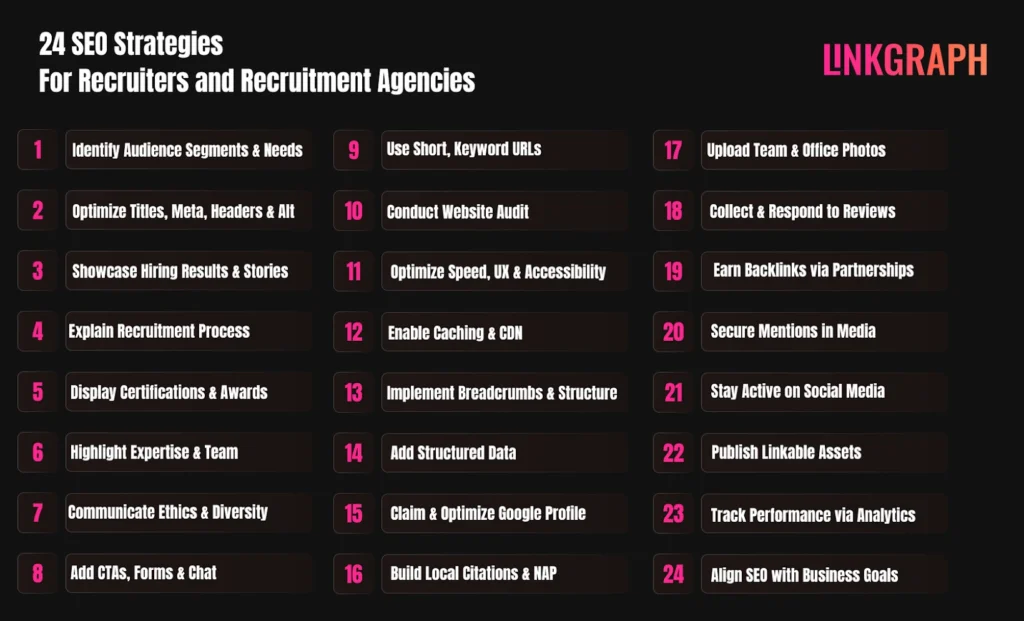
There are 24 SEO strategies for recruiters and recruitment agencies. The 24 SEO strategies for recruiters and recruitment agencies are listed below.
- Identify Target Audience Segments, Market Focus, and Their Hiring Needs
- Optimize Title Tags, Meta Descriptions, Headers, and Image Alt Text for Each Page
- Showcase Proven Hiring Results and Client Success Stories
- Clearly Explain Your Recruitment Process and How It Works
- Display Certifications, Awards, and Professional Memberships
- Highlight Industry Expertise and Introduce Your Team and Leadership
- Communicate Commitment to Ethics, Diversity, and Confidentiality
- Add Clear CTAs, Contact Forms, and Live Chat to Generate Leads
- Use Short, Descriptive, and Keyword-Focused URLs
- Conduct a Complete Website Audit to Resolve Crawlability and Indexing Issues
- Optimize Website Speed, User Experience, and Accessibility Across Devices
- Enable Browser Caching and Use a CDN to Improve Page Load Time
- Implement Breadcrumb Navigation and Maintain a Clear Site Structure
- Add Structured Data for Agency Details, Job Postings, and Client Reviews
- Claim and Optimize Your Google Business Profile to Boost Local Visibility
- Build Local Citations and Keep NAP Details Consistent Across All Directories
- Upload Professional Photos of Your Team, Office, and Client Interactions
- Collect and Respond to Client Reviews Promptly and Professionally
- Earn Backlinks Through Industry Partnerships and Recruitment Directories
- Secure Mentions in Reputable HR, Recruitment, and Business Publications
- Stay Active and Consistent on Social Media Platforms
- Publish Linkable Assets Such as Salary Guides, Industry Reports, or Hiring Tools
- Track SEO Performance Using Google Search Console and GA4
- Align SEO Strategy with Overall Recruitment and Business Objectives
Effective recruitment SEO transforms agency websites into authoritative platforms that attract talent and clients, increase leads, and sustain long-term growth. We have broken down the 24 SEO strategies for recruiters and recruitment agencies.
1. Identify Target Audience Segments, Market Focus, and Their Hiring Needs
Audience segmentation, market targeting, and understanding hiring requirements form the core of recruitment SEO for staffing agencies. Recruitment optimization, search engine marketing for recruiters, and SEO for employment firms begin with defining candidate profiles, client industries, and relevant job roles. Clear audience definitions align job listings, service pages, and website content with user intent, increasing visibility and attracting qualified traffic.
Market targeting within recruitment SEO includes analyzing geographic regions, industry specialization, and seniority levels of candidates and clients. Optimizing content, job postings, and service pages with these insights draws high-value visitors and improves lead quality.
Implementation involves candidate and client research, competitor keyword mapping, and topical map refinement. Recruitment SEO for staffing agencies integrates keyword selection with content structure to match searcher queries precisely. Proper audience and market identification strengthens the topical map, drives targeted traffic, and improves conversion rates for recruitment firms.
2. Optimize Title Tags, Meta Descriptions, Headers, and Image Alt Text for Each Page
The implementation of the recruitment optimization framework drives visibility and ranking for agency websites and job postings. On-page SEO for recruiters, a subset of this execution, ensures that each page communicates its relevance clearly to search engines. Recruitment SEO outcomes depend on precise page-level adjustments that align with candidate search intent and client requirements.
Title tags, meta descriptions, and header hierarchies establish context for search engines and improve click-through rates from organic results. Image alt text describes visual content, reinforces keyword relevance, and enhances accessibility for recruitment platforms and job listings. On-page SEO techniques integrate seamlessly with the topical map, maintaining thematic consistency across service and job pages.
This page refinement process strengthens the recruitment SEO initiative, attracts qualified candidates and clients, and improves engagement metrics. Optimized metadata and structured headers generate higher search visibility, enhance credibility, and drive targeted lead acquisition for recruitment agencies.
3. Showcase Proven Hiring Results and Client Success Stories
Proven hiring results and client success stories form a recruitment showcase that defines measurable outcomes of the placement efforts of a firm. This showcase acts as a primary on-page SEO element and reinforces recruitment SEO by demonstrating credibility and authority across digital channels. Recruitment SEO gains relevance when verified client achievements and placement metrics are highlighted clearly for both candidates and prospective clients.
Present metrics such as successful hires, time-to-fill positions, retention rates, or industry-specific accomplishments within content and page structure. Embedding these achievements in on-page SEO elements like case study pages, testimonials sections, or structured content enhances the topical map, boosts search visibility, and attracts high-intent traffic. Incorporate visual aids such as graphs, client logos, or interactive modules to increase engagement while maintaining alignment with recruitment SEO objectives.
A detailed recruitment showcase strengthens domain authority, improves rankings, and encourages qualified candidates and client inquiries. Highlighting consistent, measurable success increases trust, amplifies digital presence, and differentiates the agency in competitive recruitment markets.
4. Clearly Explain Your Recruitment Process and How It Works
A transparent recruitment workflow defines the process through which candidates are sourced, screened, and matched with employer needs. Recruitment process explanation serves as a primary on-page SEO element while reinforcing recruitment SEO by providing clarity and authority for both job seekers and hiring clients. Recruitment SEO benefits when each stage of the hiring cycle is presented in structured, accessible content that aligns with the topical map.
Detail each step, including candidate sourcing, skill assessment, interviews, and final placement, using clear headings and descriptive content. Integrate this information into web pages, FAQs, or process diagrams to improve user experience and signal relevance to search engines. Linking each stage internally strengthens page hierarchy and boosts on-page SEO performance within recruitment SEO campaigns.
A clear presentation of the recruitment workflow increases candidate trust, enhances client confidence, and strengthens search visibility. Explaining processes methodically improves engagement, attracts targeted traffic, and positions the agency as a professional authority.
5. Display Certifications, Awards, and Professional Memberships
Recruitment agency credentials define authority and professionalism, acting as primary on-page SEO elements while reinforcing recruitment SEO efforts. Showcasing certifications, industry awards, and professional memberships strengthens recruitment SEO by signaling expertise and trustworthiness to both candidates and hiring clients.
Present each credential in a dedicated section or page with structured content and descriptive headings. Highlight industry-recognized certifications, memberships in professional associations, and notable awards. Linking these mentions internally to relevant service pages reinforces the topical map and improves on-page SEO performance within recruitment SEO campaigns.
Visible credentials build candidate confidence, enhance client trust, and improve search engine perception of authority. Displaying achievements strategically increases engagement, attracts high-quality applicants, and positions the recruitment agency as an expert within its niche.
6. Highlight Industry Expertise and Introduce Your Team and Leadership
Demonstrating recruitment agency authority strengthens on-page SEO, enhances recruitment SEO, and signals expertise to search engines. Highlighting industry experience, specialized knowledge, and leadership credentials reinforces the ability of the agency to deliver high-quality placements.
Recruitment SEO benefits from detailed team profiles that include professional bios, role responsibilities, certifications, and notable achievements. Presenting leadership experience and industry contributions creates a clear connection between team authority and the service offerings of the agency. Linking team pages to service pages strengthens the topical map, improves internal navigation, and enhances search relevance across recruitment SEO campaigns.
Featuring industry expertise and leadership fosters credibility with candidates and clients, increases engagement, and enhances brand trust. Clear presentation of team strengths strengthens search rankings, attracts targeted job seekers and clients, and positions the recruitment agency as a recognized authority in talent acquisition, staffing solutions, and recruitment consulting.
7. Communicate Commitment to Ethics, Diversity, and Confidentiality
Recruitment SEO relies on signaling organizational values, making ethics, diversity, and confidentiality central to the digital presence of the agency. Clearly communicating these principles strengthens on-page SEO, recruitment SEO, and search engine relevance for advisory and staffing services.
Highlighting ethical practices, inclusive hiring policies, and strict confidentiality protocols builds trust with both candidates and clients. Integrating these values into service pages, team bios, and blog content reinforces the topical map, aligns content with audience expectations, and enhances keyword relevance in recruitment SEO campaigns.
Transparency about ethics, diversity, and confidentiality improves user engagement, increases candidate applications, and attracts clients seeking reliable recruitment partners. Search engines interpret clear value communication as authoritative signals, enhancing rankings while positioning the agency as a trusted, responsible, and professional staffing or recruitment service provider.
8. Add Clear CTAs, Contact Forms, and Live Chat to Generate Leads
Lead conversion optimization focuses on strategically placing clear CTAs, contact forms, and live chat on recruitment websites to capture high-intent candidates and clients. On-page SEO for recruitment sites relies on these interactive elements to drive measurable engagement and facilitate direct communication.
CTAs should guide users toward key actions, such as applying for a role, requesting consultation, or scheduling interviews. Contact forms must remain concise, structured, and aligned with the recruitment process, while live chat offers immediate, real-time interaction to answer queries and maintain user interest. Integrating these components throughout job listings, service pages, and landing pages reinforces the topical map and enhances the content hierarchy for search engines.
Performance tracking of form submissions, chat interactions, and CTA clicks provides insights into user behavior and site effectiveness. Recruitment SEO benefits from higher engagement metrics, improved dwell time, and increased conversion rates. Consistent implementation strengthens agency credibility, optimizes search visibility, and positions the recruitment firm as authoritative and approachable.
9. Use Short, Descriptive, and Keyword-Focused URLs
URL optimization targets creating short, descriptive, and keyword-focused web addresses that improve indexing and user comprehension. On-page SEO for recruitment sites uses clear URLs to reinforce content relevance and strengthen the topical map across job listings and service pages.
URLs should include primary keywords reflecting job titles, services, or locations, avoiding unnecessary parameters or lengthy strings. Structuring URLs hierarchically strengthens internal linking, clarifies page context for search engines, and guides visitors through the site efficiently. Consistent naming conventions maintain semantic clarity across the recruitment website.
Search engines interpret concise, descriptive URLs as signals of content quality and relevance. Recruitment SEO benefits from improved crawlability, higher rankings, and increased click-through rates. Clear URLs enhance user experience, build trust with candidates and clients, and contribute to long-term visibility and lead generation for the recruitment firm.
10. Conduct a Complete Website Audit to Resolve Crawlability and Indexing Issues
A complete website technical SEO audit examines crawlability, indexation, and site performance. Recruitment SEO relies on technical audits to detect errors, optimize site structure, and improve visibility for job postings and service pages. Audits reveal issues that prevent search engines from discovering essential content and understanding the hierarchy of the recruitment website.
Reducing server response time under 100ms improves crawl efficiency and enhances user experience. Ensuring HTML crawl requests exceed 95% allows search engines to access the most important pages. Maintaining a refresh rate around 20% ensures updated job postings remain visible while avoiding unnecessary recrawling of unchanged content.
A discovery rate of 7–8% balances the identification of new pages without wasting crawl budget on low-value content. Performing log file analysis identifies blocked URLs, server errors, and duplicate requests that hinder proper indexation. Resolving these technical issues guarantees search engines understand the full structure of the recruitment site.
Additional technical fixes include resolving broken links, removing thin or duplicate content, optimizing sitemap and robots.txt files, and securing HTTPS implementation. Proper technical SEO audits enhance organic rankings, attract qualified candidates, and strengthen the online presence of a recruitment agency.
11. Optimize Website Speed, User Experience, and Accessibility Across Devices
Optimizing website speed in technical SEO improves page load times, reduces bounce rates, and enhances candidate engagement. Recruitment SEO relies on fast-loading career pages and job listings to allow users quick access to important information. Mobile responsiveness and accessibility across devices ensure job seekers and clients navigate efficiently, increasing time-on-site and conversion potential.
Efforts include minimizing server response times, compressing images, and implementing browser caching. Recruitment agencies use these improvements to make all job posting pages fully accessible on desktops, tablets, and smartphones. A seamless experience across devices signals search engines that the site is user-friendly, enhancing higher rankings.
Accessibility measures involve proper heading structures, descriptive alt text for images, and clear navigation paths. These practices allow candidates with disabilities to access content while aligning with technical SEO standards. Continuous monitoring of speed metrics and device performance ensures recruitment agencies refine technical SEO for better visibility, higher candidate applications, and more client inquiries.
12. Enable Browser Caching and Use a CDN to Improve Page Load Time
Enabling browser caching in technical SEO stores static resources locally on the devices of users, reducing repeated server requests and accelerating page load times. Recruitment SEO relies on this practice to ensure job listings, career pages, and resource content appear quickly for candidates and clients. Faster load times improve user engagement and increase search engine rankings.
A Content Delivery Network (CDN) distributes website assets across multiple global servers, shortening the distance between users and data. Recruitment SEO uses a CDN to deliver images, scripts, and other files efficiently, improving accessibility for both local and remote visitors. Reduced latency enhances overall site performance and candidate satisfaction.
Implementing browser caching and a CDN optimizes server load and decreases bandwidth usage. Recruitment SEO benefits include faster response times, smoother navigation, and improved technical SEO metrics. Continuous monitoring ensures caching policies and CDN configurations remain effective for all devices, improving visibility and lead generation.
13. Implement Breadcrumb Navigation and Maintain a Clear Site Structure
Breadcrumb navigation in technical SEO acts as a visual trail showing users their path across the website. Staffing agency SEO uses this structure to organize job categories, service pages, and departmental sections, improving site clarity and user engagement. Clear navigation reduces confusion and lowers bounce rates.
A well-maintained site hierarchy ensures search engines understand the relationship between main pages, subpages, and individual job listings. Employment firm SEO leverages a root-to-node structure, linking the homepage to department pages, which further connect to specific job or service pages. This improves crawl efficiency and indexing accuracy.
Breadcrumbs combined with structured internal linking allow authority to flow naturally across the site. Staffing firm SEO gains higher visibility, faster indexing, and more precise targeting for relevant search queries. Enhanced navigation strengthens candidate and client confidence while boosting organic traffic and lead generation.
14. Add Structured Data for Agency Details, Job Postings, and Client Reviews
Structured data allows recruitment agencies to communicate precise information about their business to search engines. Using schema markup for agency details, open positions, and client testimonials improves search result visibility and attracts relevant candidates and clients. Proper implementation ensures that staffing firm content appears accurately in search snippets, increasing click-through rates and discoverability.
JobPosting schema enables recruitment agencies to display job titles, locations, salaries, and application deadlines directly in search results. This technical SEO practice improves indexing and ensures potential candidates have access to accurate and timely information. Structured presentation of job openings strengthens the authority of the website of the agency and enhances user engagement.
ClientReview schema gives recruitment agencies the ability to showcase ratings and testimonials within search results. Highlighting feedback through structured data signals credibility to both candidates and employers. Adoption of schema markup across the website improves organic visibility, reinforces trust, and drives consistent lead generation for recruitment firms.
15. Claim and Optimize Your Google Business Profile to Boost Local Visibility
Claiming and optimizing a Google Business Profile (GBP) allows recruitment agencies to enhance local search visibility. Accurate agency information, such as address, phone number, and business hours, ensures staffing firms appear in local map packs and search results. This local SEO practice improves discoverability for job seekers and hiring companies seeking nearby recruitment services.
Adding service categories, relevant keywords, and high-quality images strengthens the presence of the business profile (GBP, Apple Maps, Bing Places). Recruitment agencies, staffing firms, and employment businesses benefit from enhanced authority and trust when their profile accurately reflects expertise and offerings. Reviews and ratings on the profile further reinforce credibility in local searches.
Regular updates and engagement with client reviews improve interaction signals for Google. Responding to feedback and posting job-related updates maintains the relevance of the profile. Optimized GBP drive organic local traffic, increase qualified leads, and elevate the online authority of recruitment agencies.
16. Build Local Citations and Keep NAP Details Consistent Across All Directories
Local citations for recruitment agencies, staffing firms, and employment businesses involve listing accurate Name, Address, and Phone Number (NAP) information across authoritative directories. Consistent NAP assists search engines in associating the agency with its location, improving local search visibility and relevance.
Staffing agencies and employment firms benefit when directories display updated business information, relevant service categories, and active website links. Accurate citations increase credibility and signal legitimacy to both search engines and potential clients or candidates.
Regular audits of citations prevent duplicate or outdated listings, ensuring all directories reflect the same NAP. Consistency enhances local search rankings, boosts presence in map results, and attracts geographically targeted candidates and companies, strengthening the digital authority of recruitment agencies.
17. Upload Professional Photos of Your Team, Office, and Client Interactions
High-quality visual content for recruitment agencies, staffing firms, and employment businesses plays a key role in building credibility and authority. Photos of team members, office environments, and client interactions showcase professionalism and convey the culture and expertise of the agency to potential candidates and clients.
Recruitment firms benefit when images display employees engaging in daily work, collaborative meetings, and successful placements. These visuals communicate transparency, humanize the brand, and establish trust with visitors. Displaying staff achievements or interactions with clients emphasizes reliability and reinforces the market positioning of the agency.
Optimized images with descriptive file names, captions, and alt text enhance discoverability in search engines and enrich the structured data of the agency for better indexing. Strategically placing visual assets across web pages improves user engagement, increases time on site, and encourages candidate applications and client inquiries, ultimately strengthening the online presence and reputation of the recruitment agency.
18. Collect and Respond to Client Reviews Promptly and Professionally
Client review management for recruitment agencies refers to the systematic acquisition and response to verified client feedback. Review governance strengthens trust signals for staffing firms and employment agencies across search platforms. This practice reinforces authority signals for talent acquisition providers within competitive markets.
Staffing agencies gain credibility when reviews highlight placement outcomes, communication quality, and hiring accuracy. Employment firms improve perception through timely responses that address feedback with factual clarity. Professional replies demonstrate accountability and reinforce service reliability for prospective clients.
Review signals influence local rankings for recruitment consultancies and staffing providers across search engines. Consistent engagement with reviews improves brand sentiment and click behavior from search listings. This discipline increases lead quality and strengthens reputation across recruitment marketplaces and directories.
19. Earn Backlinks Through Industry Partnerships and Recruitment Directories
Partnership-driven backlink acquisition refers to a link-building method based on verified professional relationships. This backlink method strengthens authority signals for staffing agencies, hiring firms, and employment consultancies. Search engines interpret partner-sourced links as third-party validation of recruitment services.
Industry partnerships create contextual backlinks from HR associations, workforce software providers, and talent platforms. Staffing firms receive relevance signals through links placed within partner resources and referral pages. Employment agencies benefit from backlinks that originate from industry-aligned domains with topical trust.
Recruitment directories operate as structured backlink sources that improve indexation and entity recognition. Talent agencies gain value from directory links that confirm business legitimacy and service scope. Consistent backlink growth improves ranking durability and organic reach for recruitment providers.
20. Secure Mentions in Reputable HR, Recruitment, and Business Publications
Media mentions involve securing visibility for staffing agencies, employment firms, and talent consultancies within authoritative HR, recruitment, and business publications. These placements function as third-party validation, signaling trust, credibility, and topical relevance to search engines while attracting professional audiences.
Industry publications, HR journals, and recruitment-focused magazines feature interviews, expert commentary, and research highlights. Staffing agencies gain recognition by contributing insights, providing case studies, or being cited in market reports. Employment firms receive indirect authority signals even if backlinks are nofollowed, while their brand visibility and perceived expertise increase among clients and job seekers.
Repeated mentions across reputable sources strengthen search engine associations with recruitment expertise. Consistent coverage assists firms in establishing thought leadership, bolsters link-building initiatives, and reinforces the role of the agency in talent acquisition. Topical authority from these publications improves overall SEO performance, expands referral traffic, and enhances discovery by both candidates and hiring organizations.
21. Stay Active and Consistent on Social Media Platforms
Maintaining an active presence on social media strengthens staffing agencies, recruitment firms, and the online visibility of employment consultancies. Regular activity across platforms signals engagement, professionalism, and authority to both audiences and search engines.
Recruitment agencies should publish job updates, industry insights, and thought leadership posts while interacting with followers through comments and shares. Employment firms gain reach and referral traffic when content resonates with professional networks. Consistency in posting frequency ensures that the agency remains visible in feeds and reinforces brand recognition.
Social media activity contributes indirectly to search engine performance by generating engagement signals, increasing backlink opportunities, and enhancing the overall digital footprint. Recruitment consultancies that maintain consistent, high-quality social engagement benefit from improved brand authority, stronger candidate pipelines, and higher discoverability for both job seekers and prospective clients.
22. Publish Linkable Assets Such as Salary Guides, Industry Reports, or Hiring Tools
Creating linkable assets enhances recruitment agencies, staffing firms, and employment consultancies by boosting authority and improving search engine visibility. These assets include salary guides, industry reports, hiring tools, and role-specific resources that attract backlinks from relevant professional platforms and industry websites.
Recruitment agencies should focus on producing accurate, data-driven resources that address employer and candidate needs. Staffing consultancies gain credibility when these assets are cited by blogs, HR publications, and partner sites, strengthening domain authority and topical relevance.
Linkable assets integrate with the content architecture and topical map of the recruitment agency`, connecting job postings, service pages, and career insights. Consistently publishing authoritative materials increases referral traffic, enhances brand reputation, and generates qualified leads, positioning recruitment agencies as trusted leaders in the hiring and staffing sector.
23. Track SEO Performance Using Google Search Console and GA4
Tracking performance strengthens recruitment agencies, staffing firms, and employment consultancies by providing actionable insights on organic traffic, keyword rankings, and user engagement. Google Search Console (GSC) monitors search impressions, click-through rates, indexing status, and crawl errors, while Google Analytics (GA4) measures visitor behavior, page performance, and conversion paths.
Recruitment agencies should regularly analyze these metrics to identify high-performing job postings, optimize underperforming pages, and refine content targeting. Staffing consultancies gain clarity on which channels drive qualified candidates and clients, aligning SEO efforts with business objectives.
Consistent monitoring informs the topical map, validates keyword strategies, and highlights content gaps. Employment consultancies that track metrics systematically enhance domain authority, improve search visibility, and generate sustained organic leads. Proper utilization of performance analytics ensures recruitment agencies maximize ROI from their SEO investments while maintaining a competitive advantage in talent acquisition and client services.
24. Align SEO Strategy with Overall Recruitment and Business Objectives
Aligning search optimization of recruitment agencies, staffing firm SEO, and employment consultancy SEO with overall business goals ensures all digital efforts drive measurable growth. SEO initiatives should reflect organizational priorities, including candidate acquisition targets, client lead generation, and market expansion.
Recruitment agencies must integrate keyword targeting, content planning, and technical improvements with broader marketing campaigns, employer branding, and recruitment drives. Staffing consultancies achieve synergy when organic search efforts complement email outreach, social media, and advertising, creating a unified digital presence.
Consistent alignment enables performance tracking against KPIs, optimizing resources for maximum ROI. Employment consultancies that connect SEO with business objectives strengthen search visibility, attract high-quality candidates, and generate relevant client leads, ensuring recruitment growth scales effectively alongside company goals.
What Are the Most Common SEO Mistakes Recruitment Agencies Should Avoid?
Recruitment agencies, staffing firms, and employment consultancies often encounter repeated SEO pitfalls that limit organic reach, reduce qualified candidate traffic, and decrease client acquisition. Recognizing and correcting these errors strengthens search engine visibility, improves user engagement, and increases lead generation. The most common SEO mistakes that recruitment agencies should avoid are listed below.
- Ignoring Keyword Research: Overlooking relevant candidate- and client-focused search terms reduces visibility in search engines. Recruitment agencies without targeted keywords risk attracting irrelevant visitors and losing high-intent traffic.
- Thin or Duplicate Content: Publishing minimal or repetitive content weakens authority, reduces indexing efficiency, and prevents staffing firms from ranking for competitive job or service terms.
- Neglecting Technical SEO: Slow server response, broken links, poor crawlability, and low discovery rates hinder search engine indexing, affecting overall rankings and user experience.
- Unoptimized Title Tags and Meta Descriptions: Generic or missing metadata lowers click-through rates, limits search relevance, and diminishes recruitment agency visibility on SERPs.
- Weak Local SEO Implementation: Inconsistent NAP details, unclaimed listings, and missing location-specific optimization prevent staffing firms from connecting with nearby candidates and clients.
- Ignoring Analytics and Performance Tracking: Failing to monitor website metrics, rankings, and conversions blocks data-driven improvements, hindering long-term SEO success.
Avoiding these mistakes enhances online authority, attracts more qualified candidates, and generates consistent leads for recruitment agencies.
When Is the Right Time for Recruiters to Start Investing in SEO?
Recruitment agencies should invest in SEO as soon as their website launches to build authority and attract organic traffic early. SEO for recruiters typically shows initial results within four to six months, with stronger lead generation and rankings around eight to twelve months. Factors affecting timelines include competition, keyword difficulty, website structure, content quality, and consistency of optimization efforts. Early SEO implementation allows agencies to execute technical fixes, optimize pages, and strengthen local search presence, ensuring sustainable growth and a competitive edge in the recruitment market.
How Long Does It Usually Take for SEO to Generate Leads for Recruitment Agencies?
SEO for recruitment agencies generally starts generating measurable leads within four to six months, with more substantial results appearing between eight and twelve months. Factors affecting timelines include industry competition, keyword difficulty, website technical health, content relevance, and consistency of optimization efforts. Agencies that maintain regular content updates, monitor performance, and refine SEO tactics experience faster lead generation. Patience and sustained effort allow SEO to deliver high-quality, organic candidate and client leads over the long term.
Which Online Platforms Are Most Valuable for Recruitment Agencies to List Their Services On?
Listing recruitment services on the right online platforms increases visibility to both job seekers and clients. High-quality directories, professional networks, and review sites enhance search rankings, drive traffic, and establish credibility for staffing agencies. Choosing platforms that align with industry focus ensures maximum reach and engagement. The most valuable online platforms for recruitment agencies to be listed on are listed below.
- Google Business Profile: Enhances local visibility and improves search results for agency services.
- Bing Places: Expands reach to users on Microsoft’s search ecosystem.
- LinkedIn Company Pages: Positions agencies as industry authorities and attracts professional audiences.
- Glassdoor: Showcases employer reputation and attracts candidate interest.
- Indeed Company Profiles: Promotes job openings and builds credibility with job seekers.
- Recruitment Directories: Industry-specific listings increase targeted client exposure.
- Facebook Business Pages: Engages local candidates and builds social proof.
- Industry Review Sites: Collects reviews that improve trust and SEO performance.
Proper selection and consistent management of these platforms strengthen online presence and drive qualified leads.
Is SEO More Cost-Effective Than PPC for Recruitment Agencies?
SEO proves more cost-effective than PPC for recruitment agencies over the long term. While paid ads generate immediate traffic, the costs accumulate continuously and stop producing leads once budgets end. SEO, or search engine optimization for recruitment firms, builds organic visibility that drives sustained traffic and qualified candidates without ongoing ad spend.
Consistent optimization of job postings, agency pages, and local listings reduces cost per acquisition, increases long-term ROI, and strengthens brand authority. Agencies investing in SEO achieve compounding benefits that paid campaigns cannot match.
How Can Recruiters Use Social Media to Enhance Their SEO Performance?
Recruiters enhance SEO performance through social media by increasing content visibility, generating backlinks, and driving referral traffic. Posting job listings, industry insights, and recruitment guides on platforms like LinkedIn, Twitter, and professional forums signals relevance to search engines.
Active engagement improves brand authority, encourages sharing of linkable assets, and reinforces the topical map for recruitment websites. Optimized profiles with targeted keywords align with search queries, while consistent activity attracts both candidates and clients, boosting discoverability and long-term organic growth.
Can Recruitment Agencies Effectively Manage Their SEO In-House?
Recruitment agencies manage SEO in-house if they have dedicated expertise, resources, and time to execute technical, on-page, and off-page optimization. Agencies with small teams or limited SEO knowledge risk inconsistent results, missed opportunities, and slower lead generation.
In-house teams must handle keyword research, content optimization, technical audits, link-building, and performance tracking using analytics tools. Consistent effort, specialized knowledge, and monitoring are required to maintain rankings and attract qualified candidates and clients. Agencies without these capacities often achieve faster growth by partnering with specialized SEO providers.
What Key Factors Should Recruitment Agencies Consider Before Hiring an SEO Agency?
Recruitment agencies should evaluate specific factors to select an SEO agency that drives measurable results, aligns with business objectives, and strengthens online visibility. Understanding expertise, past performance, and approach ensures effective collaboration and maximizes ROI from SEO efforts. The key factors for recruitment agencies to consider before hiring an SEO agency are listed below.
- Industry Experience: The agency should have experience working with recruitment agencies or staffing firms, understanding candidate behavior, employer needs, and niche markets.
- Proven Results: Look for documented case studies, performance metrics, and client testimonials that demonstrate increased traffic, leads, and conversions.
- Technical Expertise: The agency must handle technical SEO, site audits, crawl optimization, structured data, and performance improvements effectively.
- Strategy & Execution: Evaluate whether the agency provides a clear plan combining keyword research, content optimization, local SEO, and link-building.
- Reporting & Transparency: The agency should provide detailed performance reports, analytics insights, and regular updates to track progress and ROI.
Recruitment agencies benefit from thorough evaluation, ensuring the SEO agency aligns with their growth and lead-generation goals.
Who Provides the Most Reliable SEO Services for Recruitment Agencies Near Me?
LinkGraph represents a top SEO agency for recruiters and recruitment agencies because LinkGraph delivers measurable search performance improvements. LinkGraph case studies show higher organic rankings, increased targeted traffic, and lead growth specific to recruitment websites. Client testimonials report clear improvements in keyword visibility, candidate inquiries, and hiring-related search traffic.
LinkGraph applies technical SEO audits, on-page optimization, local SEO, structured data for job postings, and backlink acquisition tailored to recruiter needs. LinkGraph performance results include measurable increases in organic hires, reduced cost per acquisition, and stronger search presence. Past clients note consistent reporting, data-driven decisions, and visible progress in search metrics.
Recruitment firms seeking higher visibility, more candidate traffic, and improved employer branding benefit from LinkGraph’s SEO execution. LinkGraph’s focus on recruitment SEO, documented performance, and targeted strategies makes it the best choice for agencies seeking sustained search growth.
What Types of SEO Services Does LinkGraph Offer for Recruitment Agencies?
LinkGraph delivers specialized search optimization services designed for staffing firms, hiring agencies, and employment consultancies. These services focus on discoverability, authority development, and lead generation across recruitment websites. The types of SEO services that LinkGraph offers to recruitment agencies are listed below.
- On-Page SEO for Recruitment Agencies: On-page optimization improves keyword targeting across job listings, service pages, employer resources, and recruiter profiles. This service aligns content with candidate and client search intent.
- Technical SEO for Recruitment Agencies: Technical optimization improves crawlability, index coverage, site speed, and mobile performance across staffing platforms and career portals.
- Local SEO for Recruitment Agencies: Local optimization increases visibility for staffing firms in location-based searches, map results, and regional hiring queries.
- Off-Page SEO for Recruitment Agencies: Authority development strengthens domain trust through industry backlinks, directory placements, and media mentions relevant to recruitment services.
- Schema Markup for Recruitment Agencies: Structured data improves search engine understanding of job postings, agency information, reviews, and hiring services.
- Competitor Analysis for Recruitment Agencies: Competitive analysis identifies ranking gaps, keyword opportunities, and content weaknesses within the recruitment market.
- Online Reputation Management for Recruitment Agencies: Reputation optimization improves review visibility, brand mentions, and trust signals across search results.
- Conversion Rate Optimization for Recruitment Agencies: Conversion optimization improves application flows, inquiry forms, and recruiter contact paths.
These SEO services align search performance with recruitment growth goals and hiring demand.
How Much Does It Cost to Get SEO Help from LinkGraph for Recruitment Agencies?
LinkGraph SEO pricing for recruitment agencies follows tiered monthly retainers based on campaign scope and competition. Plans commonly begin near $1,500 per month, scale around $3,000 to $6,000 per month, and reach approximately $12,000 per month for enterprise needs.
Costs reflect technical SEO depth, content development volume, authority acquisition, and local visibility requirements for staffing firms. Higher tiers address competitive hiring markets, broader keyword coverage, and sustained performance measurement. Pricing aligns with long-term organic lead generation and placement growth objectives.
Which Other Industries Can Benefit from LinkGraph’s SEO Solutions?
LinkGraph’s SEO solutions extend beyond recruitment agencies, delivering measurable growth for businesses across diverse sectors. Each industry benefits from enhanced online visibility, improved search rankings, and increased qualified leads, tailored to market dynamics and competitive demands. Other industries that benefit from LinkGraph’s SEO solutions are listed below.
- Healthcare Providers: Clinics, hospitals, and private practices gain patient traffic through local and medical search optimization.
- Legal Firms: Law offices improve visibility for specific practice areas and generate client inquiries organically.
- Financial Services: Advisors, accounting firms, and wealth managers attract prospects through targeted search campaigns.
- Real Estate Agencies: Brokers and agents capture property buyers and sellers through optimized local and listing content.
- Educational Institutions: Schools, colleges, and training centers reach prospective students and parents via search visibility.
- Technology Companies: SaaS providers, IT consultants, and software developers increase product awareness and lead acquisition.
LinkGraph’s SEO solutions drive growth, brand authority, and measurable ROI across industries with unique audience targeting.
