
SEO for addiction treatment centers defines the process of optimizing drug rehabilitation websites to improve visibility, attract patient inquiries, and increase search engine rankings. Addiction treatment search engine marketing aligns website architecture, content, and authority signals with the search intent of individuals, families, and caregivers seeking specialized programs. Rehab SEO includes local SEO for rehab centers, technical optimization, patient-focused content, and reputation management to capture high-intent traffic and convert visitors into admissions.
Treatment center SEO enhances discovery for alcohol, drug, dual diagnosis, teen, and adult programs while building trust and credibility in a regulated healthcare environment. SEO for rehab emphasizes privacy compliance, staff credentials, facility certifications, and recovery outcomes. Local SEO for rehab centers increases visibility for nearby searches, allowing drug rehab centers to connect directly with patients seeking immediate treatment.
Search engine marketing in addiction treatment integrates content strategy, local SEO, and backlink authority to outperform competitors and drive sustainable leads. Selecting the right SEO agency for addiction treatment centers ensures precise implementation, measurable results, and continuous optimization. Strategic rehab SEO provides consistent patient acquisition, strengthens online authority, and maintains long-term growth in the healthcare space.

What is an Addiction Treatment Center?
An addiction treatment center, also called a rehab facility or recovery clinic, is a specialized healthcare institution that provides structured programs for individuals facing substance use disorders. Rehab centers manage physical detoxification, medical supervision, and evidence-based therapeutic interventions. Recovery clinics offer outpatient and inpatient programs, rehabilitation services, and counseling for drugs, alcohol, or dual diagnoses.
How do addiction treatment centers deliver patient care effectively? Recovery facilities employ licensed therapists, medical staff, and recovery coaches to design personalized care plans tailored to the condition of each patient. Rehab centers integrate behavioral therapies, cognitive interventions, and relapse prevention strategies to improve recovery outcomes.
What additional services do addiction treatment centers provide? Recovery clinics often include family therapy, group sessions, and education on coping mechanisms. Accreditation by healthcare authorities ensures clinical quality, patient safety, and measurable recovery outcomes. Repeated reference to addiction treatment centers, rehab facilities, and recovery clinics emphasizes their role in managing recovery and coordinating medical and psychological interventions within a structured rehabilitation framework.
What does SEO mean for an Addiction Treatment (Rehab) Center?
SEO for an addiction treatment center, also called rehab facility optimization or recovery clinic SEO, is the strategic process of improving the online presence of a facility to rank higher in search engines. Optimization involves customizing website structure, content, and technical elements to ensure individuals and families in crisis locate, trust, and select appropriate treatment programs.
How do rehab centers implement local SEO effectively? Local SEO and Google Business Profile (GBP) management allow addiction treatment centers to appear prominently in location-based searches. Optimizing for nearby queries like “drug rehab near me” increases local visibility, patient inquiries, and facility admissions.
What role do content and authority play in rehab center SEO? Targeted content and keyword optimization address specific addictions, therapy programs, and patient needs, while demonstrating expertise, experience, authoritativeness, and trustworthiness (E-E-A-T). Recovery clinics showcase licensed staff, accreditations, and educational resources to establish credibility.
How does technical and authority optimization affect search performance? Technical optimization ensures rehab facility websites remain fast, secure, and mobile-friendly, improving user experience and rankings. Authority building through backlinks from reputable healthcare organizations enhances online trust and sustainable patient acquisition.
Is SEO Really Important for Both Local and National Drug Rehab Centers?
Yes, SEO is essential for both local and national addiction treatment centers because most individuals and families search online for treatment during urgent situations. Visibility in search engines ensures that rehab centers appear when prospective patients seek immediate guidance for drug or alcohol recovery.
How does SEO benefit local rehab centers? Local SEO improves rankings for location-specific queries like “drug rehab near me” or “alcohol treatment in [city]”. Optimizing GBP, managing online reviews, and targeting high-intent local keywords increases admissions, builds community trust, and enhances credibility within the geographic area.
Why does national SEO matter for larger treatment facilities? National SEO targets a broader audience across multiple states, allowing rehab centers to rank for high-volume terms like “addiction treatment centers.” This increases reach, establishes authority in specialized programs, attracts patients from diverse locations, and generates sustainable, long-term organic traffic. Both local and national strategies require ethical, human-focused content, technical optimization, and consistent updates to connect patients efficiently with the right treatment programs.
What Are the Main Benefits of SEO for Addiction Treatment (Rehabilitation) Centers?
Addiction treatment centers, including drug rehab facilities and alcohol recovery programs, gain measurable advantages from a well-executed SEO strategy. Optimizing online presence increases visibility, attracts qualified patients, and builds credibility. The following benefits summarize the key impacts of SEO for rehab centers. The key benefits of SEO for addiction treatment centers are listed below.
- Increased Patient Acquisition: SEO drives organic traffic from high-intent searches, connecting rehab facilities with individuals actively seeking treatment. Targeted keywords and local optimization improve inquiry rates and admissions.
- Enhanced Local and National Visibility: Local and national SEO ensures treatment centers appear in location-based and broad search results. Optimizing Google Business Profiles (GBP), directories, and service pages amplifies reach to both nearby and distant patients.
- Authority and Trust Building: SEO allows rehab centers to demonstrate expertise through content, staff credentials, certifications, and success stories. High search rankings and positive reviews establish credibility with patients and families.
- Cost-Effective Patient Acquisition: Organic search results provide long-term visibility without the recurring cost of paid ads. SEO generates sustainable leads and reduces dependence on expensive marketing campaigns.
- Competitive Advantage: Ranking higher than other rehab facilities in search engines strengthens the position of the rehab center, increases market share, and attracts specialized patient programs.
Well-structured SEO strategies create measurable growth, strengthen reputation, and improve patient engagement for rehab centers across local and national markets.
Is SEO for Rehabilitation Centers the Same as SEO for Therapy Centers?
No, SEO for rehabilitation centers differs from SEO for therapy centers due to the urgency, compliance requirements, and client intent. Rehabilitation facilities target high-intent crisis queries like “detox near me” or “drug rehab center,” while therapy centers focus on broader mental health searches such as “anxiety therapist” or “marriage counseling.”
Why does sensitivity matter for rehab SEO? Addiction treatment centers handle patient privacy, stigma, and recovery outcomes carefully. Emphasizing accreditations and success rates builds trust, whereas therapy SEO emphasizes therapist qualifications, persona, and patient fit.
How does regulatory compliance affect strategy? Rehab centers must follow strict HIPAA guidelines for website content, tracking, and forms, requiring specialized SEO practices. Therapy centers have privacy obligations but face less acute regulatory scrutiny.
Why does local SEO differ between the two? Rehab SEO heavily prioritizes location-based searches for immediate admissions, while therapy SEO blends local targeting with content marketing to educate and attract patients over time.
Is SEO for Rehabilitation Centers the Same as SEO for Alcohol Rehab Centers?
No, SEO for general rehabilitation centers is not identical to SEO for alcohol rehab centers because the target audience, search intent, and content focus differ. Alcohol rehab centers often target highly specific keywords related to alcohol dependency, detox programs, and inpatient or outpatient alcohol treatment. General rehab centers cover a broader range of addictions, including drugs, opioids, and dual diagnosis programs.
Why does targeting differ? Alcohol rehab facilities must optimize for queries such as “alcohol detox near me” or “residential alcohol rehab,” emphasizing program availability and immediate admission options. Broader rehab centers require more diversified content that addresses multiple substances and co-occurring mental health conditions.
How does content strategy vary? Alcohol rehab SEO focuses on patient education regarding alcohol-specific withdrawal, recovery pathways, and support systems. General rehab centers require content covering drug treatments, therapy modalities, and holistic recovery options, ensuring visibility across multiple high-intent search queries.
Optimizing for alcohol-specific treatment enhances patient acquisition, trust, and search rankings within a competitive subset of the addiction treatment sector.
How Can Addiction Treatment and Rehab Centers Get Started with SEO?
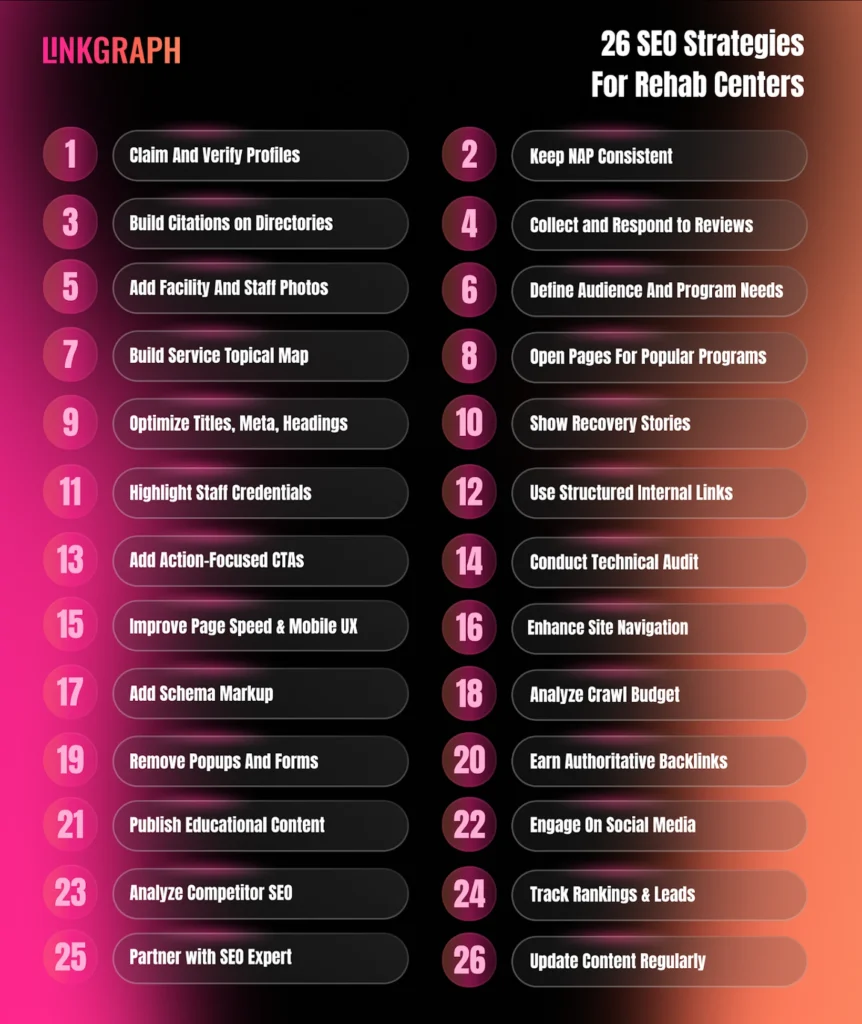
To get started with SEO for addiction treatment centers and rehab facilities, administrators must implement structured, data-driven strategies that increase visibility, attract high-intent patients, and build credibility online. Effective SEO begins with local and national optimization, accurate listings, patient-focused content, and technical enhancements.
There are 26 SEO strategies for addiction treatment and rehab centers. The 26 SEO strategies for addiction treatment and rehab centers are listed below.
- Claim, Optimize, and Verify Google, Bing, and Apple Business Profiles
- Ensure Consistent Facility Name, Address, and Phone Across All Directories
- Submit Listings to Authoritative Healthcare and Rehab Directories
- Encourage Verified Patient/Family Reviews and Respond Professionally to Build Trust
- Complete Each Profile Fully with Facility, Staff, and Therapy Program Photos
- Identify Target Audience Segment and Their Needs (Alcohol, Drug, Dual Diagnosis, Teen, Adult, Family)
- Construct Topical Map Covering Core Services and Supporting Content Areas
- Open Page Only When the Topic Services or Program Is Popular and Deserves a Page
- Optimize Titles, Meta Descriptions, and Headings for Each Service Page
- Show Real Patients Recovery Stories and Testimonials to Build Credibility
- Highlight Staff Credentials, Certifications, and Facility Accreditations
- Implement Structured Internal Linking Structure (Root→ Seed → Node)
- Include Strong, Actionable CTAs on Each Page to Drive Inquiries
- Conduct a Full Website Audit to Identify and Fix Technical SEO Issues
- Optimize Site Speed, Core Web Vitals, and Mobile Responsiveness Across Devices
- Enhance UI/UX for Smooth Navigation and Easy Access to Critical Information
- Add Local and Healthcare Schema Markup for Facility, Services, and Team
- Run Log File Analysis to Identify Where Crawl Budget Is Being Wasted
- Remove Distracting Popups and Unnecessary Forms to Simplify Navigation
- Earn Quality Backlinks from Healthcare Associations, Local Hospitals, and Mental Health Blogs
- Publish Educational Content About Addiction, Recovery, Treatment Options, and Insurance
- Engage Local Audience via Social Media, Community Programs, and Rehab Forums
- Analyze Competitor Rehab Centers to Identify SEO Gaps and New Opportunities
- Track Rankings, Website Traffic, Leads, and Calls Using Analytics and Search Console
- Partner with a Healthcare SEO Expert for Strategy and Continuous Improvement
- Regularly Update Website Content to Reflect New Programs, Treatments, and Industry Guidelines
Implementing these steps systematically ensures addiction treatment centers and rehab facilities achieve measurable growth in search visibility, patient inquiries, and admissions while maintaining compliance and credibility in the healthcare sector. We have broken down the 26 SEO strategies for addiction treatment and rehab centers below.
1. Claim, Optimize, and Verify Google, Bing, and Apple Business Profiles
Claiming and optimizing business profiles on Google Business Profile (GBP), Bing Places, and Apple Maps allows addiction treatment centers to increase local search visibility and attract potential patients actively searching for rehab services. Facilities create verified listings, add accurate contact details, service information, and office hours, and confirm ownership. Optimized profiles act as authoritative references for search engines and ensure consistent information across platforms.
Why is optimizing business profiles essential for rehab centers? Optimized listings increase the likelihood of appearing in local map packs and search results when individuals or families search for addiction treatment, drug rehab, or alcohol rehabilitation services. Accurate profiles (GBP, Bing Places, Apple Maps) with detailed descriptions, high-quality images, and verified addresses build credibility and trust with prospective patients.
How must addiction treatment centers manage business profiles for maximum impact? Facilities need to include therapy program details, staff credentials, and photos of the facility. Regularly updating listings, monitoring reviews, and ensuring correct categorization improves local SEO rankings. These actions increase admissions inquiries and strengthen the digital presence of the sentence within its target geographic area.
2. Ensure Consistent Facility Name, Address, and Phone Across All Directories
Uniform facility details across directories strengthen search presence for addiction treatment centers. Addiction recovery facilities that list the same name, address, and phone number in every directory improve credibility with both search engines and potential patients. Discrepancies create confusion, dilute ranking signals, and reduce visibility in local map results.
Why do rehab centers need consistent listings across platforms? Search engines use citation accuracy to assess authority and trustworthiness. Addiction treatment centers with inconsistent contact information risk losing positions in local results and diminishing patient confidence. Families seeking drug or alcohol rehab bypass centers that display conflicting details.
How can facilities maintain precise citations? Addiction treatment centers need to review all existing listings, correct errors, and standardize information on authoritative healthcare and local directories. Ongoing audits prevent new inconsistencies and preserve SEO value. Accurate citations strengthen local rankings, improve discovery by high-intent searchers, and increase qualified admissions inquiries.
3. Submit Listings to Authoritative Healthcare and Rehab Directories
Addiction treatment centers gain credibility and visibility when included in reputable healthcare directories. Listings on platforms such as SAMHSA, CARF-accredited registries, and local medical directories establish the center as a verified, trustworthy provider for individuals and families seeking treatment.
How should rehab centers execute directory submissions for maximum impact? Facilities need to maintain complete and accurate information, including facility name, address, phone, services, and accreditations. Including facility photos, staff profiles, and program details improves engagement and provides search engines with structured data. Frequent updates ensure directories reflect current programs, treatment types, and operational changes.
What impact do authoritative directories have on SEO for rehab centers? Proper submissions improve local search rankings, increase referral traffic, and strengthen backlink authority. Listings in high-quality directories signal trustworthiness and expertise to search engines, boosting organic visibility for location-specific and program-specific searches. Consistent, verified directory presence directly correlates with increased patient inquiries and facility recognition.
4. Encourage Verified Patient/Family Reviews and Respond Professionally to Build Trust
Encouraging verified patient and family reviews establishes credibility and trust for addiction treatment centers. Reviews provide social proof, showcase treatment quality, and signal reliability to prospective clients. Professional responses demonstrate attentiveness and transparency, reinforcing the reputation of a facility in both search engines and the community.
Why is actively managing reviews important for rehab centers? Facilities need to request feedback from satisfied patients and families and respond promptly to comments. Responses should maintain a professional tone, address concerns factually, and highlight the service quality of the center. Monitoring review activity ensures timely engagement and preserves accurate reputation data online.
How do reviews impact SEO and patient acquisition? Verified reviews improve local search rankings, increase engagement on GBP, and attract higher-quality inquiries. Consistent, professional responses indicate active management of patient experience, which search engines interpret as a trust signal, enhancing visibility and driving more admissions.
5. Complete Each Profile Fully with Facility, Staff, and Therapy Program Photos
Fully completing business profiles with accurate facility, staff, and therapy program information enhances visibility and trust for addiction treatment centers. Detailed profiles signal professionalism and provide prospective patients and families with a clear understanding of the services offered. Including high-quality photos of facilities, treatment spaces, and staff humanizes the center and increases engagement.
Why is visual and complete information essential for rehab centers? Profiles with comprehensive details and images attract higher user interaction, as prospective patients evaluate the environment, staff, and programs. Accurate and thorough listings reduce uncertainty, build credibility, and improve the likelihood of inquiries and admissions.
How does profile completeness influence SEO and search rankings? Search engines favor fully optimized profiles with rich content and media, which increases chances of appearing in local map packs and organic searches. Consistently updated photos and information enhance local search visibility, encourage clicks, and improve patient conversion rates for addiction treatment facilities.
6. Identify Target Audience Segment and Their Needs (Alcohol, Drug, Dual Diagnosis, Teen, Adult, Family)
Identifying target audience segments allows addiction treatment centers to align website content, services, and outreach with patient needs. Rehab facilities define whether they serve teens, adults, families, or specialize in alcohol, drug, or dual diagnosis programs. Clear audience segmentation ensures marketing and SEO focus on the most relevant searchers, improving engagement and increasing inquiries.
Why is understanding audience segments critical for rehab centers? Different patient groups require distinct messaging and resources. Teen programs emphasize family involvement and age-appropriate guidance, while adult or dual diagnosis programs focus on medical oversight and co-occurring disorder management. Addressing these specific needs builds credibility and enhances search relevance.
How should rehab centers integrate audience insights into their topical map? Facilities use segmented data to structure the website around key programs, linking core services to supporting educational content for each patient group. This approach aligns with search intent, strengthens internal linking, and improves visibility for highly relevant keywords across local and national searches.
7. Construct Topical Map Covering Core Services and Supporting Content Areas
Constructing a topical map organizes the website of an addiction treatment center around core services and supporting content areas. Rehab centers outline main programs such as alcohol rehab, drug detox, dual diagnosis treatment, teen recovery, and family programs. Supporting content includes educational articles, FAQs, and guides that address common patient concerns. A well-structured map clarifies content hierarchy and connects related pages logically for both users and search engines.
Why is a topical map important for rehab centers? A structured content plan allows treatment facilities to cover all critical services comprehensively while maintaining thematic relevance. It guides prospective patients through relevant information efficiently and ensures search engines understand the scope of offered programs.
How should addiction treatment centers implement a topical map effectively? Facilities prioritize high-demand services first, link supporting educational content, and create clear navigation paths from root pages to service-specific pages. A detailed topical map improves internal linking, enhances user experience, and increases search visibility for both local and national queries related to addiction treatment programs.
8. Open Page Only When the Topic Services or Program Is Popular and Deserves a Page
Creating new service or program pages requires careful evaluation of demand and search intent. Addiction treatment centers launch pages only when a topic, service, or therapy program attracts sufficient interest, ensuring resources focus on high-value content rather than rarely searched terms. Prioritizing popular services prevents unnecessary site clutter and strengthens overall SEO performance.
Why should rehab centers evaluate topic popularity before adding pages? Low-demand pages dilute keyword relevance and reduce crawl efficiency. Facilities that concentrate on high-traffic programs, such as alcohol detox, opioid treatment, or teen rehab services, improve the authority and ranking potential of the website.
How can treatment centers determine which programs deserve dedicated pages? Centers analyze search volumes, local queries, and competitor offerings to identify topics that generate patient interest. Integrating these insights into a topical map guides the creation of structured content, enhances internal linking, and aligns pages with audience needs while improving organic visibility.
9. Optimize Titles, Meta Descriptions, and Headings for Each Service Page
Optimizing titles, meta descriptions, and headings ensures addiction treatment center websites clearly communicate services to both search engines and prospective patients. Facility pages with precise, keyword-focused headings improve crawlability and highlight relevant treatment options, such as drug rehab, alcohol programs, or dual diagnosis therapy. Well-crafted meta descriptions attract clicks by summarizing offerings in a concise, informative manner.
Why is optimizing page elements essential for rehab centers? Clear and targeted titles and headings signal authority to search engines, improving rankings for relevant queries. Patients scanning search results quickly understand the services available, increasing the likelihood of engagement and inquiry submissions.
How should treatment centers implement optimization effectively? Centers identify high-intent keywords, integrate them naturally into H1 and H2 headings, and write meta descriptions that reflect specific programs and outcomes. Aligning this with a topical map ensures internal consistency, enhances semantic relevance, and maximizes organic visibility for local and national searches.
10. Show Real Patients Recovery Stories and Testimonials to Build Credibility
Real patient recovery stories and testimonials serve as powerful credibility indicators for addiction treatment centers. Facilities feature experiences from alcohol, drug, teen, adult, and dual diagnosis programs to demonstrate successful outcomes. Detailed narratives showcase treatment approaches, staff engagement, and the holistic care provided, allowing prospective patients and families to evaluate the effectiveness and empathy of the facility. These stories reinforce the reputation of the center and align with the targeted keywords and services in the topical map.
Why are recovery stories essential for rehab centers? Authentic patient testimonials provide social proof that the facility consistently delivers measurable recovery results. Prospective patients gain assurance of treatment efficacy, which strengthens trust, encourages engagement, and increases consultation or admission inquiries. Sharing stories differentiates the center in competitive local and national searches.
How should rehab centers optimize testimonials for SEO and patient conversion? Facilities should publish keyword-rich narratives on relevant program pages, blogs, or case study sections. Including photos, program details, and measurable outcomes increases content relevance, improves search engine indexing, and guides users through the decision-making process for treatment enrollment.
11. Highlight Staff Credentials, Certifications, and Facility Accreditations
Displaying staff credentials, professional certifications, and facility accreditations strengthens the authority of an addiction treatment center. Facilities showcase licensed therapists, medical directors, and counselors with relevant qualifications while emphasizing certifications such as CARF, JCAHO, or SAMHSA compliance.
Highlighting accreditations and staff expertise signals credibility to prospective patients and families, reinforcing trust in the ability of the center to provide safe and effective addiction treatment. Integrating this information across program pages, staff profiles, and service sections aligns with the topical map and enhances keyword relevance.
Why is showcasing credentials and accreditations important for rehab centers? Prospective patients evaluate facilities based on expertise, licensure, and adherence to industry standards. Clearly presented qualifications and certifications improve patient confidence, reduce hesitation during the decision-making process, and increase inquiries for treatment programs.
How should addiction treatment centers present staff and facility qualifications effectively? Facilities should include detailed bios, professional photos, certifications, and accreditation logos on website pages, linking them to specific programs. This approach improves search engine indexing, boosts authority in local and national SEO, and highlights the professionalism of the center and compliance with healthcare standards.
12. Implement Structured Internal Linking Structure (Root→ Seed → Node)
A structured internal linking system organizes the website of an addiction treatment center into a clear hierarchy, connecting root pages, seed topics, and content nodes. Root pages represent primary services or programs, seed topics break down specific treatments, and nodes provide supporting information, articles, or FAQs.
This architecture improves crawlability, distributes page authority, and guides prospective patients and families through relevant information efficiently. Linking pages according to the topical map strengthens thematic relevance and improves keyword associations across the site.
Why is a structured internal linking system important for rehab centers? Properly connected pages enable search engines to understand site hierarchy, discover hidden content, and index service pages accurately. For prospective patients, intuitive navigation reduces confusion, allowing them to locate program details, therapist profiles, and recovery resources quickly.
How should addiction treatment centers implement internal links effectively? Facilities should map content according to primary services, subtopics, and supporting nodes, then link anchor text contextually to relevant pages. This improves SEO performance, enhances user experience, and increases the likelihood of inquiries and patient engagement across multiple program areas.
13. Include Strong, Actionable CTAs on Each Page to Drive Inquiries
Actionable calls-to-action (CTAs) direct visitors toward the next step, such as calling the facility, scheduling an assessment, or requesting detailed program information. Addiction treatment centers integrate CTAs strategically on service pages, therapy descriptions, blog articles, and educational resources to convert website visitors into qualified inquiries. Each CTA uses concise, persuasive language that communicates urgency while reflecting the sensitive nature of addiction recovery.
Why are targeted CTAs critical for rehab centers? Prospective patients and families often search during urgent situations and need immediate access to guidance. Well-crafted CTAs reduce hesitation, guide decision-making, and increase the likelihood of contact. They improve user experience, foster trust, and enhance the effectiveness of other marketing and SEO efforts on the site.
How should addiction treatment centers implement CTAs for optimal results? CTAs must be visually prominent, consistently placed above the fold, and use action-driven phrases like “Call Now for Assessment,” “Request a Free Consultation,” or “Start Recovery Today.” Centers need to test variations in placement, wording, and color contrast to maximize clicks. Combining CTAs with lead capture forms or direct phone links increases conversions, generates qualified inquiries, and strengthens patient acquisition over time.
14. Conduct a Full Website Audit to Identify and Fix Technical SEO Issues
A full website audit examines every technical aspect of the site of an addiction treatment center to improve search engine accessibility and user experience. Rehab centers analyze site architecture, server performance, page load times, mobile responsiveness, indexing, and security to uncover obstacles that prevent search engines from crawling and ranking pages efficiently. Technical audits identify bottlenecks that reduce visibility for programs, services, and recovery resources.
Why is a technical audit essential for addiction treatment centers? Websites with slow load times, broken links, or improper indexing limit patient discovery and reduce the effectiveness of SEO strategies. A thorough audit ensures each service page, therapy description, and educational article is accessible, crawlable, and aligned with SEO best practices.
How should rehab centers address technical issues? Firstly, reduce server response time below 100 milliseconds to improve speed and indexing. Secondly, ensure HTML crawl requests exceed 95% to maximize coverage. Thirdly, maintain a refresh rate of around 20% to keep content updated in search engines. Fourthly, target a discovery rate of 7–8% to ensure new or updated pages are indexed quickly.
Fifthly, perform log file analysis to determine where most crawl budget is being wasted. Sixthly, fix broken links, redirect errors, duplicate content, and improper canonical tags to streamline crawling. Seventhly, implement structured data, SSL certificates, and mobile optimization to improve rankings and usability. Completing these measures increases visibility, accelerates indexing, and enhances site performance for prospective patients.
15. Optimize Site Speed, Core Web Vitals, and Mobile Responsiveness Across Devices
Optimizing site speed ensures addiction treatment centers deliver fast-loading pages that reduce bounce rates and improve user satisfaction. Rehab websites with slow performance risk losing prospective patients who search for immediate help. Core Web Vitals, including metrics like Largest Contentful Paint (LCP), First Input Delay (FID), and Cumulative Layout Shift (CLS), measure how quickly pages load, respond, and remain stable during viewing.
Why is mobile responsiveness critical for rehab centers? Most patients and families search for addiction treatment on smartphones or tablets. Mobile-friendly design ensures content, program descriptions, and contact forms display correctly across devices. Responsive layouts enhance engagement, allow easier navigation, and improve local and national search visibility for rehab services.
How should treatment centers improve performance across devices? Centers reduce server response times, compress images, employ browser caching, and remove unnecessary scripts to enhance page speed. Testing across multiple devices identifies layout issues, while Core Web Vitals monitoring ensures pages remain fast, stable, and interactive. Optimizing these factors increases conversions, patient inquiries, and overall organic search rankings.
16. Enhance UI/UX for Smooth Navigation and Easy Access to Critical Information
Enhancing the user interface and experience ensures that addiction treatment centers provide clear, intuitive, and error-free navigation. Facility websites with well-structured menus, visible program links, and organized service pages guide patients and families efficiently to relevant information. Smooth navigation increases engagement metrics and reduces page abandonment, which positively affects search rankings.
Why does intuitive UI/UX matter for rehab centers? Patients seeking treatment often require quick access to program details, admissions forms, and staff information. A user-friendly interface allows families and individuals to locate services, contact points, and educational resources without confusion, improving trust and credibility.
How should addiction treatment centers implement effective UI/UX design? Centers structure menus logically, organizes content hierarchies, optimizes button placement, and ensures important links remain visible on every page. Testing across devices confirms consistent functionality and responsive layouts. Well-designed interfaces improve patient inquiries, encourage exploration of programs, and increase the likelihood of admissions.
17. Add Local and Healthcare Schema Markup for Facility, Services, and Team
Adding structured schema markup enables addiction treatment centers to provide search engines with precise information about facilities, programs, and staff. Healthcare and local schemas clarify service offerings, geographic location, operating hours, and accreditation details. Proper implementation enhances search result displays, including rich snippets, which increases click-through rates from prospective patients and families.
Why is schema markup important for rehab centers? Structured data improves search engines’ understanding of treatment services, specialties, and patient-focused programs. Displaying staff credentials, therapy types, and facility features directly in search results builds credibility and visibility, differentiating centers from competitors in local and national searches.
How should addiction treatment centers implement schema markup? Centers identify all key entities, including facility, programs, and licensed staff, and embed the appropriate LocalBusiness and MedicalBusiness schema. Ensuring accurate JSON-LD or Microdata formats for each page increases search discoverability, drives qualified traffic, and strengthens the authoritative presence of the center online.
18. Run Log File Analysis to Identify Where Crawl Budget Is Being Wasted
Log file analysis allows addiction treatment centers to monitor how search engines crawl website pages and identify inefficiencies. Analyzing server logs reveals which URLs are frequently crawled, which are ignored, and where crawl budget is being wasted on duplicate or low-value pages.
Why is tracking crawl patterns crucial for rehab centers? Proper understanding of crawl allocation ensures that high-priority pages, such as program descriptions, staff bios, and intake forms, receive maximum indexing attention. Detecting crawl inefficiencies prevents important content from being overlooked by search engines and improves overall SEO performance.
How should treatment centers conduct log file analysis? Facilities export server logs and examine metrics like crawl frequency, server response codes, and crawl errors. Observing patterns allows to identify unnecessary redirects, broken links, or underperforming pages. Optimizing URL structure, updating robots.txt, and consolidating low-value content increases crawl efficiency, ensures proper indexing, and enhances organic visibility.
19. Remove Distracting Popups and Unnecessary Forms to Simplify Navigation
Excessive pop-ups and redundant forms disrupt the user experience on addiction treatment center websites. Rehab centers streamline navigation by eliminating intrusive elements, ensuring visitors access critical program information, contact details, and intake forms quickly.
Why is simplifying navigation important for rehab facilities? Clear pathways reduce confusion, increase engagement, and improve metrics such as session duration and page views. Potential patients and families focus on essential information about treatment programs without distractions, which reinforces trust and encourages inquiries.
How should treatment centers simplify navigation? Facilities audit web pages to identify pop-ups, unnecessary forms, and auto-play elements that interfere with browsing. Consolidating or removing low-value interactive features, while keeping essential contact or intake forms visible, creates a cleaner interface. A simplified structure enhances search engine crawlability, improves indexing of key pages, and strengthens overall SEO performance.
20. Earn Quality Backlinks from Healthcare Associations, Local Hospitals, and Mental Health Blogs
Acquiring authoritative backlinks strengthens the digital authority of addiction treatment centers. Rehab facilities earn links from credible healthcare associations, local hospitals, mental health blogs, and rehabilitation-focused publications, which increases domain authority, search visibility, and website credibility.
Why are authoritative backlinks crucial for rehab centers? Search engines treat backlinks as endorsements, so links from reputable sources improve rankings for high-intent keywords such as “drug rehab near me,” “alcohol treatment programs,” or “dual diagnosis treatment.” Links from industry-related organizations reinforce the expertise of the facility, establish trust with prospective patients, and signal reliability within the recovery community.
How should treatment centers secure high-quality backlinks? Facilities should partner with professional healthcare associations, contribute informative articles to mental health blogs, and provide educational content or research findings for local hospitals and rehab networks. Participation in community initiatives, webinars, and accreditation programs generates references from relevant sites. Consistent acquisition of targeted backlinks amplifies topical relevance, improves organic traffic, and increases inquiries from individuals and families seeking specialized addiction treatment.
21. Publish Educational Content About Addiction, Recovery, Treatment Options, and Insurance
Creating educational content positions addiction treatment centers as trusted sources for individuals and families seeking recovery guidance. Facilities produce articles, guides, videos, and FAQs that explain addiction types, therapy programs, recovery processes, and insurance options, increasing engagement and search relevance.
Why is publishing educational content essential for rehab centers? Potential patients often search for detailed information on treatment methods, insurance coverage, and expected recovery outcomes. Providing clear, accurate content improves keyword targeting, builds credibility, and establishes the center as an authoritative resource in addiction treatment.
How should rehab centers develop educational content for SEO impact? Centers should focus on high-intent topics aligned with patient needs, such as “teen alcohol rehab programs” or “dual diagnosis therapy options.” Integrating long-tail keywords, structured headings, and internal links ensures search engines crawl and index pages effectively. Consistent publication increases organic traffic, enhances local and national search visibility, and drives qualified inquiries from patients seeking informed, reliable treatment resources.
22. Engage Local Audience via Social Media, Community Programs, and Rehab Forums
Engaging the local audience strengthens visibility for addiction treatment centers while building trust and credibility within the community. Facilities maintain active social media profiles, contribute to rehab-focused online forums, and participate in community outreach programs to connect directly with patients, families, and local organizations. Regular communication reinforces the presence of the center and signals authority to search engines.
Why does local engagement matter for rehab centers? Prospective patients and their families often seek nearby treatment options with a proven reputation. Active involvement in local events, community programs, and online discussions positions rehab centers as responsive, approachable, and trustworthy. This visibility attracts inquiries and referrals while improving the perception of the facility in both local and digital spaces.
How should addiction treatment centers execute local engagement effectively? Centers should post educational updates, recovery success stories, and program announcements on social media. Hosting or sponsoring community events, webinars, and support groups enhances outreach. Integrating these engagements with website pages, service listings, and GBP improves search visibility, drives qualified traffic, and increases patient inquiries from the surrounding area.
23. Analyze Competitor Rehab Centers to Identify SEO Gaps and New Opportunities
Analyzing competitor rehab centers allows addiction treatment facilities to evaluate strengths, weaknesses, and untapped SEO opportunities. Facilities examine competitor websites, keyword rankings, backlink profiles, and content strategies to uncover areas where their own presence is lacking. Understanding competitor performance informs targeted adjustments that improve search visibility and patient acquisition.
Why is competitor analysis essential for rehab centers? Addiction treatment centers operate in a highly competitive market where visibility determines inquiries. Identifying gaps in competitor content, service pages, or local SEO efforts highlights opportunities to capture patients searching for specific programs, therapies, or insurance options. This strategy increases the likelihood of attracting qualified, high-intent leads.
How should rehab centers implement competitor SEO analysis? Rehab facilities should track top-ranking centers for high-value keywords, evaluate backlinks from authoritative healthcare and local sources, and review content depth on recovery programs. Applying these insights to enhance internal pages, create missing content, and strengthen local and national SEO improves search rankings, expands reach, and drives more patient inquiries.
24. Track Rankings, Website Traffic, Leads, and Calls Using Analytics and Search Console
Tracking website rankings, traffic, leads, and calls allows addiction treatment centers to measure SEO effectiveness and optimize strategies. Google Analytics (GA4) platforms record user behavior, session duration, and page performance, while Google Search Console (GSC) tools monitor keyword positions, crawl errors, and indexing status. Together, they provide a detailed view of website performance.
Why is tracking essential for rehab centers? Addiction treatment facilities rely on data to understand which pages drive patient inquiries, which programs attract high-intent searches, and where technical issues affect visibility. Continuous monitoring ensures resources focus on strategies that generate measurable results and maximize patient acquisition.
How should rehab centers track SEO performance? Facilities need to monitor keyword ranking changes, website traffic sources, and lead generation metrics, including calls and contact form submissions. Identifying underperforming pages or declining search visibility allows timely optimization, improving organic reach, increasing qualified patient leads, and enhancing overall SEO ROI.
25. Partner with a Healthcare SEO Expert for Strategy and Continuous Improvement
Partnering with a healthcare SEO expert allows addiction treatment centers to implement specialized strategies tailored to the rehab industry. SEO professionals assess website performance, design content strategies, optimize local and national visibility, and ensure compliance with healthcare regulations. Their expertise ensures that technical, on-page, and off-page factors align with search engine standards.
Why is collaborating with an SEO expert valuable for rehab centers? Addiction treatment facilities operate in highly competitive, regulated markets. Experts identify gaps in content, local search optimization, and backlink authority. They monitor performance metrics and adjust tactics to maintain consistent visibility and lead generation.
How should rehab centers work with SEO professionals for ongoing growth? Facilities need to establish clear goals, share program updates, and review GA4 reports regularly. Continuous collaboration improves keyword targeting, enhances website structure, strengthens topical authority, and drives consistent patient inquiries, resulting in long-term, sustainable SEO performance.
26. Regularly Update Website Content to Reflect New Programs, Treatments, and Industry Guidelines
Regularly updating website content ensures addiction treatment centers remain accurate, relevant, and authoritative. Facility websites must reflect new programs, therapy modalities, treatment protocols, and updated accreditation standards. Fresh content signals to search engines that the rehab center maintains current, trustworthy information.
Why is updating content essential for rehab centers? Patients and families rely on precise information regarding treatment options, insurance coverage, and program availability. Updated pages increase user trust, reduce misinformation, and improve the likelihood of patient inquiries and admissions. Search engines prioritize frequently updated, high-quality content, enhancing organic rankings for relevant keywords.
How should treatment centers maintain content freshness? Centers should audit service pages, educational articles, and FAQs periodically, adding new therapies, success stories, or policy updates. Aligning updates with local SEO, internal linking, and schema markup ensures both search visibility and user accessibility, producing measurable growth in inquiries and website engagement.
When Is the Best Time for Treatment Centers to Start Investing in SEO?
Addiction treatment centers need to start SEO immediately to build authority and attract patients over time. Facilities targeting competitive terms like “drug rehab near me” usually see meaningful results in 4–6 months, with full rankings achieved in 8–12 months, depending on competition.
Which factors influence SEO timelines for rehab centers? High competition slows progress, while consistent content creation, technical optimization, and backlink acquisition accelerate results. Regular updates, structured internal linking, and patient-focused content improve search visibility. Early SEO investment ensures a continuous flow of qualified patient inquiries and long-term sustainable growth.
What Are the Most Common SEO Mistakes That Rehab Centers Should Avoid?
Addiction treatment centers face several SEO pitfalls that reduce visibility, limit patient inquiries, and diminish overall marketing effectiveness. Recognizing these errors allows rehab facilities to refine strategies, increase rankings, and maximize return on investment. The most common SEO mistakes that rehab centers should avoid are listed below.
- Inconsistent NAP Information: Variations in facility name, address, or phone across directories confuse search engines and prospective patients, lowering local rankings.
- Incomplete Google Business Profiles: Missing photos, service listings, hours, or descriptions reduces credibility and prevents appearing in local map packs.
- Ignoring Patient Reviews: Failing to collect or respond to verified reviews decreases trust, engagement, and conversion potential.
- Weak On-Page Optimization: Titles, meta descriptions, headings, and content not aligned with target keywords reduce search relevance and organic traffic.
- Neglecting Technical SEO: Slow page speed, crawl errors, broken links, or poor mobile experience negatively impact rankings and user experience.
- Failure to Track Metrics: Not monitoring traffic, rankings, or leads prevents data-driven improvements and strategic adjustments.
Addressing these mistakes ensures rehab centers maintain authority, attract qualified patients, and achieve sustainable SEO results.
Is Local SEO Enough for Treatment Centers to Consistently Attract Patients?
No, local SEO alone is not enough for addiction treatment centers to consistently attract patients. Local SEO focuses on geographic searches, enabling facilities appear in map packs and nearby search results. While this drives highly relevant traffic, it does not capture patients searching nationally for specialized programs, holistic treatment options, or unique therapies outside the immediate area.
National SEO and content-driven strategies complement local efforts by targeting broader, high-intent keywords, establishing authority, and attracting patients from multiple regions. Combining local and national SEO ensures addiction treatment centers maximize visibility, reach diverse patient segments, and maintain a sustainable flow of inquiries beyond their immediate geographic area.
How Can Local SEO Help Increase Admissions at My Treatment Center?
Local SEO increases admissions at addiction treatment centers by improving visibility in location-specific searches. Optimizing GBP, local directories, and location-based keywords ensures that individuals searching for nearby rehab services find the facility quickly. High local search rankings attract highly motivated patients, often leading to immediate inquiries and intake calls.
Local SEO enhances trust through verified reviews, accurate contact information, and detailed service listings. This strategy aligns with the urgent needs of the patients for addiction treatment, reduces the time required to find care, and strengthens engagement with families seeking programs. Consistent local optimization converts search visibility into measurable admissions and patient flow.
Which Online Platforms Are Most Valuable for Rehab Centers to Be Listed On?
Listing addiction treatment centers on reputable online platforms increases visibility, builds credibility, and drives patient inquiries. Accurate and consistent listings ensure prospective patients and families trust the facility and access essential information quickly. These platforms improve local SEO, referral traffic, and overall discoverability in highly competitive healthcare searches. The most valuable online platforms for rehab centers to be listed on are listed below.
- Google Business Profile: Displays facility location, hours, services, and reviews; boosts visibility in local map results.
- Bing Places for Business: Ensures presence on Microsoft search engine results and maps for regional searches.
- Apple Maps Connect: Provides accurate location, contact details, and directions for iOS users.
- SAMHSA Treatment Locator: Official government directory listing certified addiction treatment programs nationwide.
- CARF International Directory: Highlights accredited facilities, increasing trust and professional recognition.
- Psychology Today or Therapy Directories: Allows listing rehab services alongside therapy resources for patients seeking integrated care.
- Healthgrades: Enables reviews and ratings while enhancing credibility in healthcare-related searches.
- Rehab-Specific Directories: Platforms like Rehabs.com or AddictionResource provide targeted exposure to individuals actively seeking treatment.
Listing on these platforms ensures rehab centers maintain high visibility, attract qualified leads, and reinforce authority in addiction treatment services.
How Can Drug Rehab Centers Use Social Media to Improve Their SEO Performance?
Social media increases visibility and drives organic traffic to the website of a rehab center, which indirectly improves search engine rankings. Sharing educational content about addiction treatment, recovery programs, and patient resources attracts engagement and backlinks from credible sources.
How does social media activity impact SEO for rehab centers? Active profiles on platforms like Facebook, Instagram, and LinkedIn create referral traffic, increase brand awareness, and generate signals of authority to search engines. Engagement from users, such as shares and comments, enhances the online reputation of addiction treatment facilities.
Which types of content work best for rehab centers? Posts about treatment methods, patient success stories, program updates, and community outreach encourage interaction. Linking social media posts back to service pages or blogs strengthens the internal SEO structure. Consistent posting improves discoverability, referral traffic, and overall search visibility for local and national rehab searches.
Is SEO More Cost-Effective Than PPC for Treatment Centers?
Yes, SEO provides a more cost-effective solution for addiction treatment centers over time. Organic search optimization increases visibility for targeted queries like “drug rehab near me” without requiring continuous ad spend. Optimized content, local SEO, and authoritative backlinks attract qualified patients consistently, reducing dependence on expensive paid campaigns.
How does SEO compare to PPC in efficiency? Paid ads offer immediate traffic but involve ongoing high costs in competitive healthcare niches. SEO builds a lasting digital presence, improving rankings and generating sustainable leads, resulting in a lower cumulative cost per patient acquisition and higher long-term ROI.
Can One SEO Strategy Work for Multiple Treatment Center Locations?
Yes, a single SEO strategy works across multiple addiction treatment center locations with careful customization. Core elements such as technical SEO, content strategy, and backlink acquisition remain consistent, while local optimization must be customized for the city or region of each.
Location-specific pages should target city-based keywords, include unique Google Business Profiles, and display local contact information. Structured internal linking and schema markup allow search engines to differentiate each location. Consistent branding combined with localized content ensures each treatment center ranks effectively in local search results while maintaining an integrated national SEO framework.
Should Rehab Centers Focus on Overall Marketing in Addition to SEO?
Yes, rehab centers benefit from overall marketing alongside SEO to reach patients across multiple decision stages. Search optimization captures high-intent traffic, while broader marketing builds awareness and recall across offline and online channels.
Why does combined marketing matter for treatment centers? Families often research treatment options over time, comparing facilities, credentials, and programs. Content distribution, reputation management, and brand messaging reinforce trust signals that SEO alone does not cover. Coordinated marketing improves visibility, strengthens credibility, and increases admission inquiries across local and national audiences.
Can Treatment Centers Manage Their SEO Effectively on Their Own?
No, treatment centers rarely manage SEO effectively without external expertise. Rehabilitation SEO requires regulatory awareness, technical precision, and continuous adaptation to search algorithm changes.
Why does internal SEO management fall short for rehab facilities? Clinical teams focus on patient care, while SEO demands technical audits, structured content systems, and competitive analysis. Healthcare compliance, local search volatility, and crawl management add further complexity. Treatment centers gain stronger outcomes through partnership with healthcare SEO specialists, who maintain compliance, refine topical coverage, and sustain organic visibility over time.
What Key Factors Should Rehab Centers Consider Before Hiring an SEO Agency?
Selecting an SEO agency for a rehab facility requires evaluation of industry specialization, regulatory awareness, and execution depth. Addiction treatment marketing involves sensitive intent signals, compliance boundaries, and complex local and national search behavior. Agency selection directly influences organic visibility, admission quality, and long-term ranking stability. The key factors to consider for rehab centers before hiring an SEO agency are listed below.
- Healthcare and Addiction Industry Experience: Agencies with addiction treatment exposure understand HIPAA boundaries, patient privacy risks, and crisis-driven search intent. Industry familiarity reduces messaging errors and improves content accuracy across detox, inpatient, and outpatient programs.
- Demonstrated SEO Performance for Rehab Facilities: Validated case studies, organic ranking growth, and admission-related outcomes indicate execution capability. Performance data tied to healthcare entities reflects relevance and operational maturity.
- Technical SEO and Compliance Readiness: Rehab websites require crawl efficiency, page speed control, structured data accuracy, and secure data handling. Technical readiness protects organic equity and reduces regulatory exposure.
- Content Architecture and Topical Mapping Methodology: Agencies with structured topical mapping prevent keyword overlap and content dilution. Clear service hierarchies strengthen relevance across addiction types and treatment programs.
- Reporting Transparency and Measurement Standards: Clear reporting through GA4, GSC data, and lead attribution establishes accountability. Transparent metrics connect SEO activity with inquiry and admission trends.
A rehab center benefits from an SEO agency that combines healthcare specialization, technical discipline, and measurable performance accountability.
Who Offers the Most Reliable SEO Services for Rehab Centers Near Me?
LinkGraph is the best SEO agency for treatment centers seeking measurable, patient‑focused search performance and long‑term organic growth. LinkGraph delivers targeted search optimization tailored to healthcare entities, including addiction treatment centers, rehab facilities, and recovery clinics. LinkGraph’s expertise combines technical SEO, content strategy, local search, and backlink authority to drive admissions inquiries and digital visibility.
LinkGraph’s rehab‑focused case study shows dramatic results for a rehab treatment facility, with organic visitors increasing from 5,791 to 105,273 monthly, representing a 1810% uplift in traffic and significant keyword growth. LinkGraph’s holistic SEO framework integrates targeted keyword mapping, high‑quality content, and authoritative backlinks from reputable sources.
Industry recognition and awards further validate LinkGraph’s capabilities, including a U.S. Search Award for Best Start‑Up Agency, which reflects the strategic execution and client results of the agency. Client testimonials highlight improved organic traffic and higher rankings, underscoring LinkGraph’s reliability in SEO for rehab centers.
What Types of SEO Services Does LinkGraph Offer for Addiction Treatment Centers?
LinkGraph provides targeted SEO services for addiction treatment centers, rehabilitation facilities, and recovery programs to increase search visibility, attract patient inquiries, and improve website rankings. Each service addresses technical performance, content structure, local search, and authority signals, aligning with the search intent of patients, families, and caregivers seeking treatment. The types of SEO services that LinkGraph offers to addiction treatment centers are listed below.
- On-Page SEO for Rehab Centers: Optimizes page titles, headings, meta descriptions, and content hierarchy to match search intent and relevant keywords.
- Technical SEO for Rehab Centers: Improves site speed, mobile performance, crawlability, indexation, and overall website health for higher rankings.
- Local SEO for Rehab Centers: Enhances Google Business Profiles, local citations, and geo-targeted keywords to attract nearby patients.
- Off-Page SEO for Rehab Centers: Builds authoritative backlinks from healthcare, mental health, and addiction-related websites to increase domain credibility.
- Schema Markup for Rehab Centers: Adds structured data for facilities, programs, services, and staff to improve search visibility.
- CRO for Rehab Centers: Optimizes calls-to-action, forms, and landing pages to convert website visitors into patient inquiries.
- Content Optimization for Rehab Centers: Creates patient-focused content covering addiction types, treatment programs, recovery processes, and insurance guidance.
- Reputation Management for Rehab Centers: Monitors and manages online reviews, ratings, and testimonials to establish trust and authority.
These integrated SEO services allow rehab centers, addiction treatment facilities, and recovery programs to increase visibility, generate qualified leads, and sustain long-term organic growth.
How Much Do SEO Services for Rehab Centers Typically Cost?
SEO services for addiction treatment centers usually involve an ongoing monthly investment. Single-location facilities generally spend $3,000 to $10,000 per month for technical SEO, content creation, local optimization, and compliance-focused strategies.
Costs rise for national campaigns, multiple locations, or advanced analytics, with multi-location centers investing $7,000 to $25,000 per month to maintain visibility across markets. One-time technical projects like site migrations or rebuilds range from $10,000 to $100,000. Higher investments improve rankings, patient inquiries, structured data, crawl efficiency, and authoritative backlinks, delivering measurable ROI.
How Long Does It Usually Take for a Rehab SEO Campaign to Show Results?
Rehab SEO campaigns typically start showing measurable results within 3 to 6 months for local facilities. Multi-location or national campaigns often require 6 to 12 months to generate consistent organic traffic and patient inquiries. The timeline depends on competition, content volume, technical optimization, backlink acquisition, and keyword targeting.
Consistent implementation of on-page, technical, and local SEO strategies accelerates rankings. Tracking performance through GA4 and GSC metrics allows facilities to refine tactics, improve visibility, and steadily increase qualified admissions over time.
How Can Treatment Centers Track and Measure the ROI of Their SEO Efforts?
Treatment centers track SEO ROI by monitoring key performance metrics such as organic traffic, keyword rankings, patient inquiries, and completed contact forms. Analytics platforms measure website sessions, user behavior, and conversion rates, allowing centers to attribute leads to SEO initiatives.
Search console data identifies top-performing pages and high-intent keywords that drive admissions. Comparing marketing spend against new patient acquisitions quantifies ROI. Regular reporting and trend analysis help centers adjust content, technical optimization, and local SEO efforts, ensuring continuous improvement in visibility, patient engagement, and admissions over time.
