
SEO for solar companies improves online visibility, connects solar providers with homeowners seeking energy solutions, and strengthens digital authority for long-term growth. Solar company SEO enhances rankings on search engines through targeted keywords, optimized content, local listings, and technical website improvements. These strategies increase qualified lead generation, build trust with potential clients, and reduce reliance on paid advertising by capturing audiences actively searching for solar installation, maintenance, and consultation services.
Solar SEO benefits include higher organic traffic, better lead conversion rates, cost-effective marketing, and measurable results. Effective execution involves optimizing business listings, maintaining consistent local citations, conducting technical audits, producing educational content, and acquiring authoritative backlinks. Structured campaigns allow solar companies to maintain a competitive edge, attract ideal clients, and sustain growth over time. Aligning SEO efforts with broader marketing initiatives ensures maximum impact and measurable return on investment.
Selecting the right SEO agency is essential for sustainable success. Experienced specialists tailor strategies to the solar industry, improving visibility, credibility, and revenue. SEO for solar, solar company SEO, and solar SEO provide a foundation for long-term digital marketing performance. Strategic implementation converts search visibility into actionable leads, strengthens brand authority, and ensures consistent growth in a competitive solar market.

What Is SEO and How Does It Apply to Solar Companies?
Search engine optimization defines a technical process that improves organic visibility across search engines such as Google. SEO focuses on keyword relevance, crawl efficiency, indexation signals, and authority metrics. This optimization discipline increases rankings for non-paid queries that indicate commercial or informational intent.
SEO for solar companies applies this optimization process to solar installers, photovoltaic providers, and renewable energy contractors. Solar SEO prioritizes local search signals, service-based keywords, and geographic modifiers that match homeowner demand. This solar search optimization framework connects solar businesses with property owners who research installation costs, incentives, and nearby installers.
Can SEO Genuinely Benefit Solar Companies?
Yes, SEO genuinely benefits solar companies through high-intent demand capture, sustained visibility, and superior return on investment. Solar search optimization targets homeowners who actively research installation services and pricing. This demand alignment positions solar installers directly within revenue-driven search paths.
Search engine optimization for solar businesses generates compounding visibility that outperforms traditional advertising channels. Organic rankings persist without recurring media spend, which reduces long-term acquisition costs. First page placements increase trust signals since users associate ranking solar providers with authority and reliability.
Evidence demonstrates measurable growth across traffic, rankings, and qualified inquiries through analytics platforms. Local solar SEO connects geographic queries with service areas, which increases lead relevance. Keyword-focused solar content attracts prospects who evaluate incentives, system costs, and installer credentials, thereby increasing the conversion probability.
What Are the Key Advantages of Implementing SEO for Solar Companies?
The key advantages of solar SEO include stronger market visibility, higher lead quality, controlled acquisition costs, and measurable growth performance. Search optimization for solar installers aligns service pages with demand-driven queries. This alignment positions solar providers within competitive local search environments. The key benefits of implementing SEO for solar companies are listed below.
- Increased Local Search Visibility: Solar SEO improves rankings for location-based installation queries. Higher placement connects solar installers with homeowners who show immediate purchase intent.
- Higher Lead Quality and Conversion Rates: Search optimization targets users who research solar costs, incentives, and installers. This intent focus increases qualified inquiries and sales readiness.
- Long-term Cost Efficiency: Organic solar rankings reduce dependency on recurring paid media spend. Traffic stability lowers cost per lead across extended periods.
- Measurable Performance and Attribution: SEO performance tracking reveals keyword growth, traffic sources, and inquiry attribution. Data visibility guides refinement of solar marketing investments.
Solar search engine optimization establishes predictable demand capture and sustainable acquisition for competitive solar markets.
What Are the Most Effective Strategies for Solar Companies to Get Started With SEO?
Solar companies enter SEO through structured actions that align search demand with service visibility. Search engine optimization for solar installers begins with local discovery, technical clarity, and intent-matched content. Early SEO execution focuses on entity validation, query targeting, and indexable site architecture, which together establish consistent organic acquisition across residential and commercial solar markets.
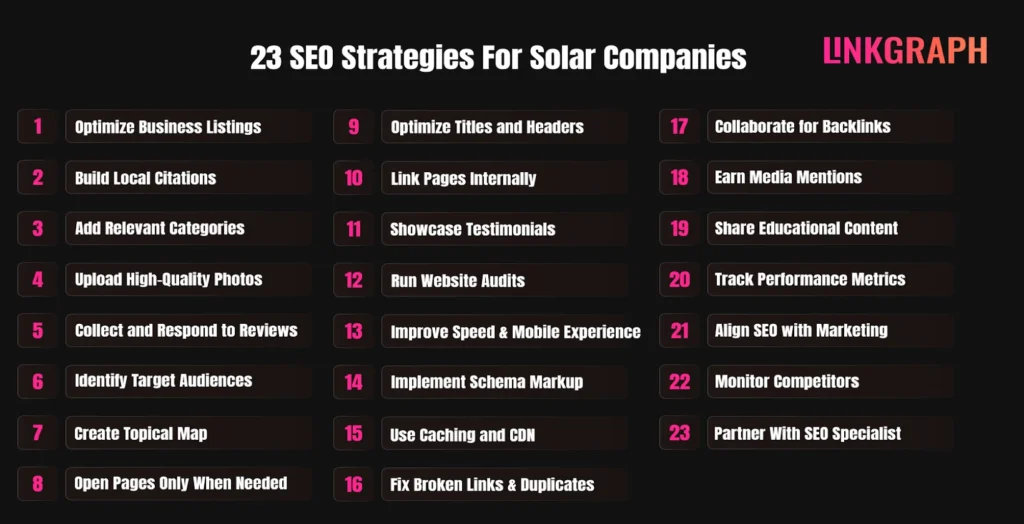
There are 23 SEO strategies for solar companies. The 23 SEO strategies for solar companies are listed below.
- Claim, Verify, and Optimize Business Listings on Google, Bing, and Apple Maps
- Build Local Citations and Maintain Consistent NAP Across Solar Directories
- Add Business Categories Relevant to Solar Services
- Upload High Quality Photos of Panels, Installations, and Teams
- Collect and Respond to Customer Reviews Promptly
- Identify Target Audience Segments and Solar Energy Needs
- Construct a Topical Map Covering Residential, Commercial, and Maintenance Topics
- Open Pages Only When a Query Deserves a Page
- Optimize Title Tags, Meta Descriptions, and Headers
- Link Pages Internally Through Root, Seed, and Node Structure
- Showcase Installations, Testimonials, and Notable Projects
- Run Website Audits for Crawlability and Indexing
- Improve Website Speed and Mobile Responsiveness
- Implement Schema Markup for Solar Business and Reviews
- Use Browser Caching and CDN for Load Efficiency
- Fix Broken Links and Remove Duplicate Content
- Collaborate With Green Energy Associations for Backlinks
- Earn Mentions in Local Media and Energy Publications
- Share Educational Content on Professional and Community Platforms
- Track Organic Performance With Search Console and GA4
- Align SEO Strategy With Marketing and Sales Objectives
- Monitor Competitor Rankings and Service Gaps
- Partner With an Experienced Solar SEO Specialist
These strategies form a structured foundation for scalable solar search engine optimization. We have broken down the 23 SEO strategies for solar companies below.
1. Claim, Verify, and Optimize Business Listings on Google, Bing, and Apple Maps
Claiming and verifying business listings establishes an official digital presence for solar companies across all major search engines. Accurate business name, address, and phone information reduces inconsistencies, prevents duplicate listings, and strengthens local relevance signals. Verification confirms legitimacy to both search engines and potential customers, reinforcing credibility and trust in competitive solar markets.
Optimization involves uploading high-resolution images of solar installations, panels, and team members. Solar companies categorize services precisely, specify operational hours, and link to corresponding landing pages. Including service-specific keywords in descriptions and selecting relevant categories increases visibility for high-intent local searches and attracts homeowners actively seeking solar solutions.
Regularly maintaining listings signals activity to search engines and demonstrates operational consistency to potential clients. Adding project photos, client testimonials, seasonal promotions, and completed installations improves engagement metrics. Optimized business listings function as a cornerstone of local SEO strategy, driving targeted organic traffic while enhancing brand authority and online recognition.
2. Build Local Citations and Ensure Consistent NAP Across All Solar Directories
Creating local citations involves listing solar companies on reputable directories, industry sites, and business listings. Accurate and consistent Name, Address, and Phone (NAP) information strengthens search engine confidence in the location and legitimacy of the company. Consistency across multiple directories prevents duplicate listings, reduces confusion for potential clients, and improves local search rankings.
Solar companies must select authoritative directories relevant to green energy, solar installation, and regional business listings. Each listing should include business categories, operational hours, a descriptive summary of services, and high-quality images. Structured data, such as a business schema, enhances the ability of search engines to parse information and associate listings with the main website of the company.
Regular auditing of citations ensures NAP data remains correct across all platforms and directories. Correcting inaccuracies, removing duplicates, and updating service descriptions maintains credibility and enhances visibility. Strong local citation networks increase exposure in search results, improve click-through rates, and attract qualified local leads actively searching for solar solutions.
3. Add Business Categories Relevant to Solar Services
Selecting precise business categories for solar companies ensures search engines classify offerings accurately. Correct categories, such as “Solar Panel Installation,” “Residential Solar Energy,” or “Commercial Solar Solutions,” align the company with relevant queries. Proper categorization enhances visibility for customers actively seeking solar services in the local area.
Business categories influence which keywords and search results display the company. Including multiple but highly relevant categories communicates the full scope of services, from installations and maintenance to energy consultations. Each category should match both the website content and the primary service focus of the company to maximize relevance.
Periodic review of business categories prevents outdated or misaligned listings. Updating categories based on service expansion or industry trends maintains accurate representation in directories and map listings. Well-defined categories strengthen local SEO, increase qualified clicks, and improve the likelihood of converting searchers into leads.
4. Upload High-Quality Photos of Solar Panels, Installations, and Team
Solar companies enhance online credibility by showcasing high-resolution images of panels, installations, and technicians. Project photos illustrate quality workmanship, technical expertise, and the scope of services offered. Residential, commercial, and maintenance installations demonstrate versatility and attract specific client segments seeking tailored solar solutions.
Visuals of the team, including certified installers and project managers, strengthen client trust and reinforce the professional image of the company. Team photos aligned with project images create an authentic narrative of capability, reliability, and industry authority. Consistent imagery across the website, Google Business Profile, and social media establishes brand recognition.
Regularly updating photos highlights new projects, seasonal installations, and company growth. Optimized images with descriptive filenames, alt text, and structured captions improve search engine indexing and local SEO performance. Rich visual content increases engagement, encourages longer site visits, and reinforces client confidence in selecting the solar company.
5. Collect and Respond to Customer Reviews Promptly
Solar companies enhance credibility by systematically collecting verified reviews from residential and commercial clients. Detailed feedback highlights installation quality, customer service, and technical expertise, providing evidence of performance and reliability. High volumes of authentic reviews improve local search rankings, increasing visibility for queries like “solar panel installation near me” and driving targeted leads.
Responding to reviews promptly demonstrates professionalism, accountability, and active client engagement. Acknowledging positive feedback strengthens trust, while addressing concerns transparently mitigates reputational risks and converts negative experiences into opportunities. Timely, personalized replies influence the decisions of potential customers and increase the likelihood of inquiry, consultation, or booking.
Integrating review management into a broader SEO strategy amplifies local search performance and domain authority. Including relevant keywords and locations in responses reinforces search relevance. Continuous monitoring, collection, and interaction with reviews maintain an authoritative online presence, boost trust signals, and attract qualified solar leads consistently.
6. Identify Target Audience Segments and Their Solar Energy Needs
Solar companies gain higher conversions by clearly defining audience segments based on demographics, property type, and energy requirements. Residential, commercial, and industrial clients exhibit distinct needs, budgets, and expectations. Mapping these segments allows targeted content creation, ensuring the website addresses the unique requirements of each group effectively.
Topical mapping organizes content around these segments, creating a structured hierarchy of pages covering solar installation, maintenance, incentives, and financing. Each page targets specific queries relevant to its audience, improving search engine understanding and ranking potential. Connections between residential, commercial, and maintenance topics enhance internal linking, guiding visitors efficiently through relevant offerings.
Segment-focused content increases engagement and attracts qualified leads actively searching for solar solutions. Regular analysis of audience behavior and search trends refines topical mapping, enabling solar companies to adapt content to evolving demands. Well-defined segments combined with a detailed topical map strengthen local visibility and authority in search results.
7. Construct a Topical Map Covering All Topics (Residential, Commercial, Maintenance)
Solar companies organize website content through a topical map that defines primary, secondary, and supporting pages. Residential, commercial, and maintenance topics create a clear hierarchy, allowing search engines to interpret relevance and relationships between pages. Mapping these topics ensures comprehensive coverage of services, energy solutions, and customer concerns.
Each node in the map links logically to related pages, forming a structured internal linking framework. Residential solar pages cover home installations, financing options, and incentives. Commercial pages detail large-scale projects, energy audits, and ROI analysis. Maintenance sections address repairs, inspections, and panel performance, creating relevance signals across search engines.
Structured topical maps improve user navigation and engagement by guiding visitors to relevant solutions. Frequent updates aligned with audience queries maintain relevance in search results. This strategy strengthens domain authority, enhances organic visibility, and attracts qualified leads for residential, commercial, and maintenance solar services.
8. Open Pages Only When a Query Truly Deserves a Page (QDP)
Solar companies create pages selectively based on high-value queries that match audience intent. Each page targets a specific solar service, product, or customer need, ensuring relevance and avoiding thin content. This strategy focuses on indexing meaningful pages, allowing search engines to assign authority accurately.
Residential, commercial, and maintenance queries each receive dedicated pages only when the topic justifies unique content. Generic or duplicate pages dilute authority and confuse visitors. Prioritizing pages for deserving queries optimizes crawl efficiency and strengthens topical signals across the website.
QDP implementation improves user experience by directing visitors to comprehensive, actionable content. Pages aligned with intent encourage engagement, reduce bounce rates, and increase conversions. Concentrating resources on deserving pages enhances domain authority, organic rankings, and long-term visibility for solar companies.
9. Optimize Title Tags, Meta Descriptions, and Headers for Every Page
Solar companies craft title tags with primary keywords to accurately describe page content. Each meta description summarizes offerings concisely, attracting clicks from search results. Header structures organize content logically, improving readability and guiding both users and search engines through key topics.
Optimized titles, descriptions, and headers strengthen relevance for targeted queries, increasing impressions for high-intent searches. Keyword placement within headers signals the hierarchy of the page, aligning content with user intent. This structured approach allows search engines to index pages efficiently and improves rankings.
Consistent optimization across all pages maintains clarity for visitors while boosting organic performance. Clear headings and descriptive tags enhance engagement, reduce bounce rates, and increase conversions. Focused metadata and headers contribute directly to sustainable visibility and lead generation for solar companies.
10. Link Pages Internally Following Correct Structure (Root → Seed → Node)
Solar companies implement a Root → Seed → Node structure to distribute page authority systematically. The homepage serves as the root, linking to core service pages (seed) such as residential, commercial, and maintenance solar solutions. Seed pages link further to detailed, topic-specific content (node), including installation case studies, equipment guides, and maintenance instructions. This hierarchy clarifies relationships between pages for search engines and enhances overall crawlability and indexing efficiency.
Internal linking strengthens topical relevance and passes authority from high-value pages to lower-tier content. Visitors navigate naturally from broad service overviews to specialized information about solar panel types, financing options, or energy storage solutions. Strategic anchor text selection signals search engines about page focus, which improves ranking potential for targeted keywords and long-tail queries.
Maintaining logical link flow reduces orphan pages, increases time on site, and improves user engagement metrics. Correct structure reinforces content hierarchy, establishes domain authority, and elevates visibility for competitive local and national searches. Nodes, seeds, and root pages function together to optimize both search engine understanding and client discovery.
11. Showcase Successful Installations, Customer Testimonials, and Notable Projects
Solar companies display completed installations to prove technical expertise and system quality. Each project page includes the type of installation, system capacity, location, and energy savings achieved. High-resolution photos, diagrams, and videos convey the process clearly, demonstrating reliability and competence to prospective clients and search engines. Detailed documentation establishes trust and enhances page relevance for targeted keywords within the topical map.
Customer testimonials act as social proof, strengthening perceived authority. Featuring verified feedback on the website, Google Business Profile, and industry-specific platforms signals satisfaction and successful results. Structured placement of reviews with client names, locations, and project details increases credibility, encourages engagement, and elevates conversion potential from organic traffic.
Notable projects, certifications, awards, and partnerships highlight brand authority. Case studies connecting major installations with internal pages follow the correct root-seed-node linking structure, reinforcing topical relevance. Combining visual proof, testimonials, and notable project highlights boosts search visibility, drives qualified leads, and positions the solar company as a trusted solution provider.
12. Run Full Website Audit for Crawlability, Indexing, and Technical Issues
Solar companies conduct comprehensive website audits to detect crawling, indexing, and technical obstacles. Audits analyze server performance, page accessibility, structured data, and site architecture, producing actionable plans that improve visibility, page efficiency, and ranking potential. Regular audits preserve authority and ensure solar service pages remain accessible and discoverable.
Reducing server response time to under 100ms improves page load and crawler efficiency. Ensuring HTML crawl requests exceed 95%, maintaining a refresh rate around 20%, and targeting a discovery rate of 7–8% optimizes indexing and prevents crawl budget loss. Performing log file analysis identifies where the majority of crawl budget is wasted, allowing precise adjustments to internal linking, sitemap structure, and redirect chains.
Technical SEO fixes include correcting broken links, resolving duplicate content with canonical tags, validating schema markup for services and reviews, optimizing Core Web Vitals, and ensuring mobile responsiveness and HTTPS security. Each action directly improves search engine accessibility, maintains page authority, enhances user experience, and maximizes organic visibility for solar companies.
13. Improve Website Speed and Mobile Responsiveness Across All Devices
Solar companies optimize page load times to reduce bounce rates and increase user engagement. Techniques include compressing images, minifying CSS and JavaScript, using browser caching, and using a content delivery network (CDN). Faster pages improve search engine rankings while delivering a smoother browsing experience for potential customers searching for solar solutions.
Mobile responsiveness is critical for homeowners and commercial clients accessing solar services on smartphones and tablets. Fluid layouts, adaptive images, and touch-friendly buttons ensure that content displays correctly across devices. Search engines prioritize mobile-friendly sites, so responsive design enhances both usability and organic visibility in local and national search results.
Monitoring speed and mobile performance with Google tools identifies bottlenecks. Implementing prioritized fixes maintains high performance, improves rankings, and increases conversions. Regular testing ensures that every page meets technical standards and provides consistent, fast, and accessible experiences across all devices.
14. Implement Schema Markup for Solar Business, Services, and Reviews
Solar companies integrate structured data to define business identity, service categories, installation types, and client feedback, allowing search engines to interpret content accurately and present it as rich results. Schema markup enhances visibility through features such as knowledge panels, review stars, service highlights, and local business details, increasing click-through rates and organic engagement.
Service schema captures specifications for each solar solution, including system type, panel capacity, maintenance options, warranties, and operational areas, establishing a clear context for search engines. Review schema emphasizes verified customer ratings, testimonials, project outcomes, and satisfaction metrics, reinforcing credibility and industry authority.
Regular validation with structured data testing tools ensures accuracy, while updates align markup with website changes, newly added services, or client feedback. Consistent schema maintenance strengthens search relevance, improves organic rankings, and maximizes discoverability for both residential and commercial solar services over time.
15. Use Browser Caching and CDN to Enhance Website Loading Speed
Solar companies implement browser caching to store static assets such as images, JavaScript, and CSS locally on the devices of visitors. This reduces repeated server requests, accelerates page load times, and ensures returning users access content efficiently. Correct cache expiration settings prevent outdated files from displaying while maintaining fast performance.
Content delivery networks (CDNs) distribute website resources across multiple global servers, delivering files from the server closest to the user. This minimizes latency, balances traffic loads, and maintains fast access for users across different regions.
Regularly auditing and updating caching rules and CDN configurations maintains consistent website speed, improves mobile responsiveness, and reduces server strain during traffic spikes. Faster page load enhances user engagement, decreases bounce rates, and increases search engine ranking potential for services and informational pages of solar companies.
16. Fix Broken Links and Eliminate Duplicate or Thin Content
Solar companies audit websites to identify broken links, duplicate pages, and thin content that reduce crawl efficiency and user experience. Fixing broken internal and external links restores authority flow and prevents search engines from encountering dead ends, improving indexing and ranking potential. Removing duplicate content prevents keyword cannibalization, ensuring each page targets a unique topic for maximum relevancy.
Thin content is replaced with detailed, informative pages that align with solar services, including installation guides, maintenance tips, and case studies. Rich content improves dwell time, signals expertise, and increases organic traffic. Audits monitor canonicalization to maintain a single authoritative version of similar pages, reducing confusion for search engines.
Regular link checks and content updates maintain website integrity and topical authority. Each fix strengthens technical SEO by optimizing crawl paths, enhancing user experience, and preserving organic visibility for residential, commercial, and maintenance solar service pages.
17. Collaborate with Green Energy Companies and Associations to Earn Quality Backlinks
Solar companies form strategic partnerships with established green energy organizations, renewable suppliers, and industry associations to secure authoritative backlinks. Collaboration methods include guest contributions, co-branded initiatives, case studies, webinars, and participation in sustainability events. Each backlink signals trust and domain relevance to search engines, boosting rankings for residential, commercial, and maintenance solar services.
Outreach targets organizations with strong domain authority and topical alignment, such as solar panel manufacturers, renewable energy non-profits, local sustainability networks, and energy advocacy groups. Links from these entities distribute link equity, drive referral traffic, and enhance overall online presence, strengthening the authority of the website within the solar industry.
Tracking backlink performance and maintaining ethical link acquisition practices ensures sustained SEO value. Regular updates, monitoring link quality, and nurturing partnerships reinforce topical relevance, increase discoverability, and improve the competitive positioning of the company in local and national search results for solar solutions.
18. Earn Mentions in Local Media, Energy Blogs, and Industry Publications
Gaining mentions in local media outlets, renewable energy blogs, and industry-specific publications elevates the authority and online visibility of a solar company. Highlighting successful solar panel installations, energy efficiency achievements, and community sustainability projects demonstrates expertise, builds credibility with potential clients, and generates high-quality backlinks that strengthen search engine rankings.
Targeted outreach includes pitching guest articles, providing expert commentary, offering detailed case studies, or sharing unique insights on solar technology. Engaging with publications focused on solar energy, green initiatives, or local business news ensures relevance and drives qualified referral traffic while reinforcing brand authority across digital platforms.
Monitoring all media mentions, tracking backlink quality, and measuring engagement with published content enables continuous improvement of outreach efforts. Consistent features, interviews, and collaborative articles sustain visibility, maintain topical authority, and improve SEO performance for residential, commercial, and utility-scale solar services.
19. Share Educational Content on LinkedIn, Facebook, and Community Forums
Distributing educational content across LinkedIn, Facebook, and relevant community forums establishes solar companies as authorities in renewable energy and sustainable solutions. Posting in-depth guides, case studies, and maintenance tips demonstrates expertise, attracts informed prospects, and builds engagement with both residential and commercial audiences.
Sharing diverse formats such as infographics, video tutorials, interactive tools, and blog highlights increases visibility and encourages audience interaction. Engaging directly with community discussions, energy-focused groups, and local networks fosters credibility, generates referral traffic, and strengthens professional relationships within the solar industry.
Tracking performance through shares, comments, click-through rates, and lead generation allows evaluation of content impact. Regular updates with educational resources enhance brand authority, improve search engine rankings, expand organic reach, and position the company as a trusted provider of solar installations and renewable energy guidance.
20. Track Organic Performance With Google Search Console and GA4
Solar companies monitor organic performance using Google Search Console (GSC) and Google Analytics (GA4) to gather granular insights into traffic, search visibility, user engagement, and conversion patterns. GSC identifies keyword rankings, impressions, click-through rates, indexing issues, and top-performing landing pages, while GA4 tracks sessions, pageviews, user flow, goal completions, and demographic data, giving a complete picture of website performance.
Analyzing this data highlights content gaps, poorly performing pages, and visitor behavior trends. Solar companies refine meta descriptions, optimize headers, update thin content, restructure internal links, and prioritize high-converting pages to enhance organic reach and engagement.
Regular tracking and reporting allow continuous measurement of SEO ROI and informed decision-making. Monitoring conversions, bounce rates, session durations, and search visibility ensures websites maintain relevance, authority, and discoverability, resulting in consistent lead generation across residential, commercial, and maintenance solar service offerings.
21. Align SEO Strategy With Overall Marketing and Sales Goals
Solar companies synchronize SEO strategy with overarching marketing and sales objectives to maximize lead generation, conversions, and revenue growth. Integrating organic search efforts with business goals ensures keyword targeting, content creation, on-page optimizations, and campaign messaging directly reflect offered services, seasonal promotions, and customer acquisition priorities.
This alignment enables marketing teams to maintain consistent messaging across all channels, including social media, email campaigns, and paid advertising, reinforcing brand authority. Sales teams receive higher-quality, qualified leads because SEO initiatives attract audiences matching their pipeline criteria and readiness to convert.
Continuous monitoring and analysis of SEO performance against key marketing KPIs and sales metrics allow companies to identify visibility gaps, conversion inefficiencies, and content opportunities. Adjusting technical optimizations, content strategy, internal linking, and outreach campaigns ensures organic search remains fully aligned with business objectives, driving measurable growth and long-term sustainability in the solar services market.
22. Monitor Competitors’ Rankings and Service Gaps for Strategic Advantage
Solar companies perform continuous competitive analysis to assess search engine rankings of rivals, backlink profiles, content strategies, and local visibility. Tracking keyword positions, search intent alignment, and top-performing pages reveals areas where competitors dominate and exposes service gaps that offer opportunities for targeted optimization.
A detailed evaluation of the website architecture, technical SEO, internal linking, meta structures, and topical coverage of competitors identifies improvement areas. Reviewing seasonal campaigns, promotions, and content types used by competitors provides actionable intelligence for adjusting content strategy, page hierarchy, and service highlighting to outperform them in relevant searches.
Integrating competitor insights into the SEO workflow enables solar companies to refine keyword targeting, enhance content relevance, and improve local search prominence. This approach ensures consistent organic growth, higher lead quality, and sustained market authority while strategically addressing gaps in competitor offerings and aligning SEO efforts with overall business objectives.
23. Partner With an Experienced Solar SEO Specialist for Sustainable Growth
Solar companies benefit from collaborating with a seasoned SEO specialist who understands industry-specific search behaviors, local market dynamics, and renewable energy trends. An expert audits existing website performance, identifies technical gaps, and devises a strategic plan to increase organic visibility and qualified lead acquisition.
The specialist implements advanced optimization tactics, including keyword targeting, content structuring, schema markup, backlink acquisition, and technical improvements. Regular performance monitoring, competitor analysis, and strategic adjustments ensure the SEO program adapts to algorithm updates and market shifts, maintaining high search rankings over time.
Working with a specialist reduces trial-and-error approaches, accelerates results, and aligns SEO with business objectives. Their expertise in solar services ensures content relevance, targeted traffic, and consistent organic growth. This partnership establishes a sustainable digital presence, strengthens brand authority, and maximizes return on investment for solar companies across local and national markets.
What Are the Most Common SEO Mistakes Solar Companies Should Avoid?
Solar companies frequently make errors that reduce visibility, limit lead generation, and weaken search engine rankings. Recognizing common mistakes assists installers, solar service providers, and energy consultants in refining strategies, maintaining authority, and attracting qualified traffic consistently. Avoiding these pitfalls preserves technical health, content relevance, and local search performance. The most common SEO mistakes that solar companies should avoid are listed below.
- Slow Website Speed and Poor Mobile Optimization: Slow-loading sites and non-responsive designs frustrate users, increase bounce rates, and reduce rankings. Optimizing speed and ensuring mobile-friendly layouts improves engagement and search visibility.
- Missing Schema Markup and Structured Data: Lack of structured data prevents search engines from understanding business type, services, and reviews. Implementing schema enhances discoverability and rich result eligibility.
- Unclear Site Structure and Difficult Navigation: Confusing menus, poor internal linking, and scattered pages hinder crawlability and user experience. Clear hierarchies and navigation improve indexation and engagement.
- Using Generic or Overused Keywords: Targeting broad terms reduces qualified traffic and increases competition. Focusing on industry-specific, long-tail keywords attracts relevant leads.
- Neglecting Local SEO and Location Signals: Missing accurate local citations, inconsistent NAP, or poorly optimized business profiles limit visibility in local map packs.
- Weak Calls-to-Action and Hidden Contact Details: Poor CTAs and hard-to-find contact info reduce conversions despite high traffic.
Avoiding these errors ensures solar companies maintain a strong search presence, improve user experience, and attract high-intent customers.
When Is the Best Time for Solar Businesses to Start Investing in SEO?
The best time for solar businesses to invest in SEO is before demand peaks in local markets. Early investment allows solar companies, installers, and energy providers to build indexation, authority, and location relevance. Search engine optimization compounds over time, which favors brands that establish a presence ahead of competitors.
Solar SEO timelines average three to six months for visibility gains and six to twelve months for stable lead flow. Competitive density, service area size, website condition, and execution consistency directly affect results. Markets with high installer saturation extend timelines, while strong technical foundations accelerate performance.
How Long Does It Typically Take for SEO to Generate Leads for Solar Companies?
SEO generates qualified leads for solar companies within three to six months on average. Solar installers with strong websites and local relevance see earlier inquiry activity. Search engine optimization builds momentum through indexation, authority signals, and local visibility growth.
Lead timelines vary based on market competition, service area size, and execution consistency. Dense metropolitan markets extend timelines due to installer saturation. Clean technical structure, regular content expansion, and stable citation profiles shorten ramp-up periods. Sustained optimization maintains predictable lead flow between six and twelve months.
Is Local SEO Enough for Solar Companies to Consistently Attract Customers?
Local SEO alone does not drive consistent customer acquisition for solar companies. Local optimization increases map visibility and geographic relevance. Solar search engine optimization requires broader coverage beyond location signals.
Solar buyers research incentives, system types, financing options, and maintenance topics. Content depth, internal structure, and authority signals influence sustained visibility. Competitive markets limit reliance on local listings as a single channel.
Which Online Platforms Are Most Valuable for Solar Companies to Be Listed On?
High authority platforms increase visibility, trust signals, and local relevance for solar companies. Strategic listings strengthen solar search engine optimization through consistent citations, reviews, and industry alignment. The most valuable online platforms for solar companies to be listed on are listed below.
- Google Business Profile: Primary platform for local discovery, map visibility, and review acquisition for solar installation services.
- Bing Places: Secondary local search directory that expands reach across alternative search engines and devices.
- Apple Business Connect: Essential listing source for Apple Maps visibility and mobile-based local searches.
- EnergySage: Industry-specific marketplace that connects solar installers with high-intent homeowners.
- SolarReviews: Review-driven platform that influences trust, conversion rates, and purchase decisions.
- Yelp: High-authority directory that supports local citations and branded search visibility.
- Better Business Bureau: A Reputation platform that reinforces credibility and business legitimacy signals.
- Local Chamber of Commerce Directories: Regional authority sources that strengthen geographic relevance and local backlink profiles.
Strategic placement across these platforms reinforces citation accuracy, authority signals, and long-term organic visibility.
Is SEO More Cost-Effective Than PPC for Solar Energy Providers?
Yes, SEO vs PPC demonstrates that SEO offers a more cost-effective long-term strategy than pay-per-click advertising for solar companies. Unlike PPC, which stops generating leads once the budget ends, SEO builds lasting organic visibility that continuously attracts high-intent prospects.
Optimized content, technical performance, and local authority produce sustainable traffic at a lower cost per lead. Solar companies using SEO experience cumulative growth in search rankings and brand credibility, whereas PPC requires ongoing spend to maintain exposure, making SEO vs PPC a clear choice for long-term lead generation.
How Can Solar Companies Use Social Media to Strengthen Their SEO Strategy?
Solar companies strengthen SEO strategy by leveraging social media platforms to increase visibility, engagement, and brand authority. Sharing educational content, case studies, and customer success stories on LinkedIn, Facebook, and community forums amplifies reach and generates inbound links.
High-quality social signals indicate relevance and trustworthiness to search engines. Consistent posting and audience interaction drive traffic to the website, improving dwell time and reducing bounce rates. Collaboration with industry partners and mentions in social discussions further reinforce topical authority and enhance organic rankings.
Can Solar Companies Effectively Manage Their SEO on Their Own?
No, most solar companies cannot fully manage SEO on their own without specialized knowledge. Effective SEO requires expertise in technical optimization, local search strategies, content creation, and link acquisition. Managing analytics, keyword research, and algorithm updates demands time and consistent effort.
Hiring or partnering with a professional SEO specialist ensures proper implementation, ongoing adjustments, and measurable results. Companies attempting DIY SEO often face slower growth, missed opportunities, and lower search visibility compared to businesses leveraging experienced professionals.
What Key Factors Should Solar Companies Consider Before Hiring an SEO Agency?
Solar companies need to evaluate multiple factors before selecting an SEO agency to guarantee measurable results, industry expertise, and alignment with business goals. Choosing the right agency ensures that campaigns target qualified leads, improve online visibility, and provide a strong return on investment. The factors to consider for solar companies before hiring an SEO agency are listed below.
- Industry Experience: Select an agency familiar with solar energy, renewable technology, or home services, as this ensures relevant strategies and terminology usage.
- Proven Track Record: Review case studies, performance metrics, and client testimonials to confirm the agency consistently delivers measurable SEO results.
- Technical SEO Expertise: Ensure the agency address website speed, crawlability, structured data, internal linking, and mobile optimization for higher rankings.
- Local SEO Capabilities: The agency should optimize Google Business Profiles, local citations, and service-area targeting to attract nearby customers.
- Content Strategy Skills: Evaluate whether the agency develops industry-specific content, blogs, guides, and educational resources for targeted traffic.
- Transparent Reporting: Look for agencies that provide clear reporting on rankings, traffic, leads, and ROI using reliable analytics tools.
Choosing an agency based on these factors maximizes SEO performance, strengthens brand authority, and ensures sustainable growth for solar companies.
Who Offers the Most Reliable SEO Services for Solar Companies Near Me?
LinkGraph is the best SEO agency for solar companies, delivering measurable growth, higher organic rankings, and qualified lead generation. Our team specializes in solar and renewable energy businesses, designing strategies that combine local SEO, technical optimization, content marketing, and backlink acquisition to increase online visibility.
Case studies demonstrate consistent results, including increased search traffic, higher conversions, and improved keyword rankings for solar clients. Testimonials confirm our ability to optimize Google Business Profiles, implement schema markup, and create industry-specific content.
With a data-driven approach, LinkGraph aligns SEO strategies with marketing objectives, monitors competitors, and adjusts campaigns for maximum ROI. Solar companies partnering with LinkGraph gain sustainable online presence, improved authority, and a competitive advantage in local and national search results.
What Types of SEO Services Does LinkGraph Offer for Solar Companies?
LinkGraph delivers specialized SEO services designed to elevate the online visibility of solar companies, attract high-intent leads, and strengthen brand authority. Each service focuses on technical precision, content relevance, and local market optimization to maximize organic traffic and conversions. The types of SEO services that LinkGraph offers to solar companies are listed below.
- On-Page SEO for Solar Companies: Optimizing title tags, meta descriptions, headers, and page content to target relevant solar keywords.
- Technical SEO for Solar Companies: Auditing and fixing crawlability, site speed, mobile responsiveness, and structured data issues.
- Local SEO for Solar Companies: Managing Google Business Profile, local citations, and reviews to improve map pack visibility.
- Off-Page SEO for Solar Companies: Building authoritative backlinks from industry sites, green energy blogs, and local media.
- Schema Markup for Solar Companies: Implementing structured data for services, reviews, and events to enhance search results display.
- Conversion Rate Optimization for Solar Companies: Improving user experience, calls-to-action, and landing pages to convert visitors into leads.
Each service integrates into a unified strategy, ensuring measurable growth and sustainable search performance.
How Much Do LinkGraph’s SEO Services Cost for Solar Businesses?
LinkGraph’s SEO services for solar businesses start around $1,500 per month for local SEO, technical cleanup, and content alignment. Mid-tier plans range from $3,000 to $7,000 per month, depending on campaign scope, competition, and content requirements. Enterprise-level campaigns for national or multi-location solar companies range from $8,000 to $15,000 per month.
Pricing reflects comprehensive SEO work, including technical optimization, local presence, content strategy, and backlink acquisition. Investments yield sustainable organic growth, stronger brand authority, and higher-quality leads, offering a long-term return that outperforms short-term advertising spend.
What Other Industries Can Benefit from LinkGraph’s SEO Services?
LinkGraph’s SEO services extend beyond solar companies to multiple industries that rely on digital visibility, qualified leads, and organic growth. Businesses seeking higher search rankings, increased website traffic, and measurable ROI benefit from tailored strategies across niches. Other industries that can benefit from LinkGraph’s SEO services are listed below.
- Home Services: Plumbers, electricians, HVAC companies, and landscapers improve local search visibility and attract service-ready customers.
- Legal Services: Law firms enhance online credibility, showcase practice areas, and capture clients actively searching for legal representation.
- Healthcare Providers: Clinics, dentists, and specialists optimize local SEO and patient acquisition through targeted content and reviews.
- E-commerce & Retail: Online stores increase product visibility, drive organic traffic, and boost conversions with category and product page optimization.
- Education & Training: Schools, universities, and training centers attract prospective students with informative content, optimized landing pages, and local SEO.
- Technology & SaaS Companies: Software and tech businesses generate leads, highlight features, and improve organic search presence for niche solutions.
These industries gain measurable growth, stronger brand authority, and improved lead generation through strategic SEO campaigns.
How Can Solar Companies Track and Measure the ROI of Their SEO Investment?
Solar companies track SEO ROI by monitoring website traffic, lead generation, keyword rankings, and conversion rates. Analytics tools measure organic search visits, user behavior, and engagement on service pages, providing clear insight into campaign performance. Tracking leads generated from organic search and attributing them to completed sales allows calculation of revenue growth resulting from SEO activities.
Revenue divided by SEO spend produces a quantifiable ROI figure, showing cost-effectiveness. Monitoring rankings for targeted solar keywords demonstrates visibility improvements over time. Continuous reporting on organic performance, combined with goal tracking in analytics platforms, ensures companies assess both short-term and long-term benefits accurately.
