
SEO for wedding venues, known as venue SEO or wedding SEO, focuses on improving digital visibility for locations hosting weddings, receptions, or related events. Search engine optimization for wedding hotels and planners enhances discoverability in search results, attracts engaged couples actively searching for services, and increases booking inquiries. SEO for wedding organizers builds credibility, generates qualified leads, and strengthens online authority while reducing reliance on paid campaigns or referral platforms.
Effective SEO implementation includes local optimization, technical improvements, structured content, and performance tracking. Best SEO for wedding venues emphasizes claiming and optimizing business listings, maintaining consistent name, address, and phone (NAP) information, and earning high-quality backlinks from wedding blogs, vendors, and local publications. Keyword-focused content strategies, such as real weddings, testimonials, case studies, and planning guides, engage the target audience while establishing expertise.
Optimizing website speed, mobile experience, internal linking, and schema markup ensures search engines crawl, index, and rank pages accurately. Analytics tracking measures ROI, guides adjustments, and maintains competitiveness. Choosing the right SEO agency delivers industry-specific expertise and measurable long-term growth for wedding venues and planners.

What Does SEO for Wedding Venues Mean?
SEO for wedding venues refers to a search optimization framework that improves online visibility for wedding locations. Wedding venue SEO focuses on ranking venue websites for location-based, feature-based, and intent-driven wedding searches. Venue search optimization aligns page content, technical structure, and local authority signals with search engine ranking systems.
Wedding location SEO prioritizes discovery across organic results, local map listings, and established wedding directories. This optimization discipline connects engaged couples with relevant venues during active comparison and booking stages. Wedding venue optimization converts search visibility into qualified inquiries through structured content, fast performance, and clear navigation.
Does SEO Truly Benefit Wedding Planners and Venues?
Yes, SEO provides wedding planners and venues with measurable, long-term advantages by increasing visibility to couples actively searching online. Wedding planner SEO and venue SEO optimize websites for high-intent queries, such as “outdoor wedding venues in [city]” or “best wedding planners near me,” ensuring these businesses appear in prime search results.
Effective optimization attracts qualified leads by aligning content, metadata, and local listings with user search behavior. High rankings generate trust, social proof, and brand credibility while reducing reliance on paid campaigns. Technical improvements like fast load times, mobile-friendliness, and structured data enhance usability and improve search engine understanding of the website.
Local SEO through Google Business Profile (GBP) and wedding directories strengthens discovery within specific markets. Coupled with quality content, image optimization, and client reviews, SEO converts visitors into inquiries, maximizes bookings, and maintains a competitive advantage. Overall, search engine optimization for wedding planners and venues ensures consistent lead generation, improved reputation, and efficient client acquisition without continuous advertising spend.
What Are the Main Advantages of SEO for Wedding Planners?
The main advantages of SEO for wedding planners are increased visibility to local and target couples, a steady flow of higher-quality leads who are actively searching for services, and enhanced credibility and authority online. Properly implemented search engine optimization ensures wedding planners and venues appear in relevant searches, generate consistent inquiries, and maintain a competitive edge in the market. The key benefits of SEO for wedding planners are listed below.
- Greater Online Discoverability: SEO ensures planners and venues appear in relevant search results for local and niche wedding queries, increasing visibility to potential clients.
- More Qualified and Ready-to-Book Inquiries: Optimized content attracts couples who are actively looking to book, resulting in higher conversion rates and more actionable leads.
- Stronger Brand Trust and Professional Credibility: High search rankings, positive reviews, and optimized profiles signal expertise and reliability to prospective clients.
- Sustainable, Cost-Efficient Website Traffic: Organic search generates long-term traffic without continuous paid campaigns, offering a lower cost per lead.
- Clear Advantage Over Competing Venues and Planners: Effective SEO differentiates your services from competitors who have a weaker online presence or incomplete optimization.
- Ability to Target and Attract Ideal Client Niches: SEO allows precise keyword targeting and local optimization to reach couples whose preferences match your venue or planning services.
These advantages collectively transform the website of a wedding planner or venue into a consistent source of qualified inquiries, bookings, and long-term client relationships.
Is SEO for Wedding Planners Different from SEO for Event Organizers?
Yes, SEO for wedding planners differs from general event organizer SEO primarily in keyword specificity, audience targeting, and content focus, while maintaining core SEO principles like technical optimization, local presence, and content marketing. Wedding SEO emphasizes emotional, niche terms such as “luxury wedding planner NYC” or “eco-friendly wedding services,” targeting engaged couples seeking inspiration and guidance. Event organizer SEO uses broader functional terms like “corporate event management” or “gala dinner organizer,” aimed at businesses or individuals focused on logistics and outcomes.
Visual content plays a central role in wedding SEO, showcasing venues, décor, and real weddings, while event SEO prioritizes portfolios and case studies for various event types. Local SEO and GBP remain critical for both industries, ensuring visibility in specific geographic areas. Technical SEO, fast page speed, and structured site architecture enhance user experience across all platforms.
Backlink acquisition from reputable sources, such as wedding blogs for planners or industry directories for event organizers, strengthens authority and search visibility. In summary, wedding SEO represents a highly specialized subset within broader event SEO, requiring tailored strategies for maximum engagement and conversions.
What Are the Best Ways for Wedding Venues and Planners to Get Started with SEO?
To get started with SEO, wedding venues and planners should focus on improving online visibility, attracting engaged couples, and increasing bookings through structured optimization. Establishing a strong foundation involves claiming local listings, maintaining consistent business information, and presenting high-quality content that aligns with the needs of the target audience. Combining technical optimization, content strategy, and authority-building activities ensures venues and planners capture relevant search traffic while building credibility in the competitive wedding industry.
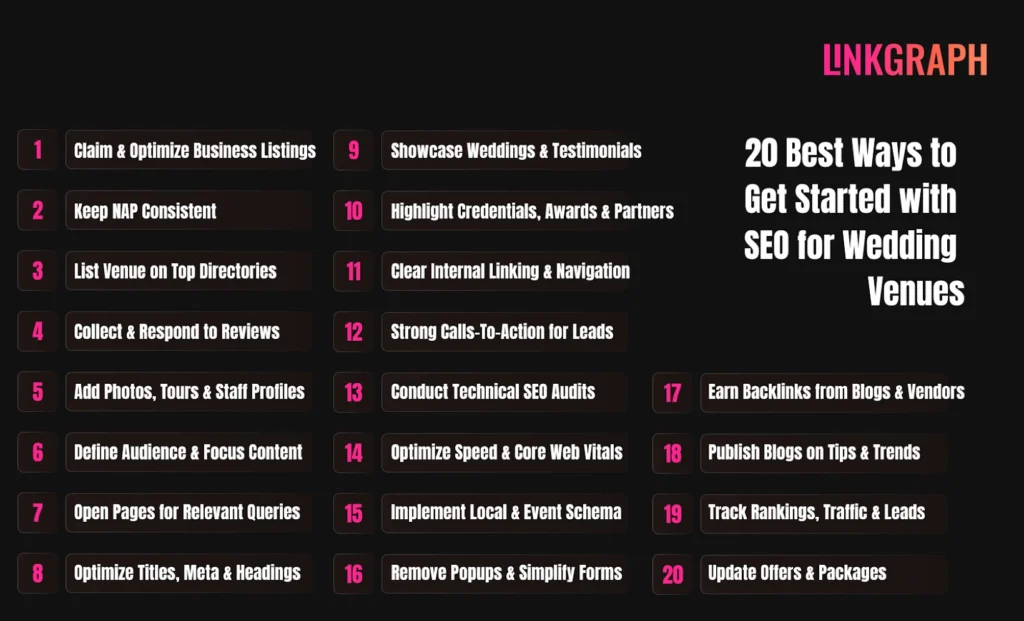
There are 20 SEO strategies for wedding venues and planners. The 20 SEO strategies for wedding venues and planners are listed below.
- Claim and Optimize Google, Bing, and Apple Business Listings
- Maintain Consistent Business Name, Address, and Phone Across Platforms
- List Your Venue on High-Authority Wedding Directories
- Collect and Respond to Verified Client Reviews
- Add High-Quality Photos, Virtual Tours, and Staff Profiles
- Define Target Audience Segments and Focus Content on Their Needs
- Open Pages Only for Deserving Queries or Services
- Optimize Page Titles, Meta Descriptions, and Headings with Local Keywords
- Showcase Real Weddings, Testimonials, and Case Studies
- Highlight Planner Credentials, Awards, and Partner Vendors
- Implement Clear Internal Linking and Navigation Structure
- Use Strong Calls-to-Action to Drive Inquiries and Bookings
- Conduct Technical SEO Audits and Fix Site Issues
- Optimize Website Speed, Mobile Experience, and Core Web Vitals
- Implement Local Business and Event Schema Markup
- Remove Distracting Popups and Simplify Lead Forms
- Earn Backlinks from Wedding Blogs, Vendors, and Local Publications
- Publish Blog Content on Planning Tips, Trends, and Venue Highlights
- Track Rankings, Traffic, and Leads Using Analytics Tools
- Regularly Update Website with New Offers, Packages, and Real Weddings
Implementing these SEO practices allows wedding venues and planners to attract qualified leads, improve online authority, and maximize bookings efficiently. We have broken down the 20 SEO strategies for wedding venues and planners below.
1. Claim and Optimize Google, Bing, and Apple Business Listings
Claiming and optimizing local business listings is a foundational tactic for wedding venue SEO. Google Business Profile (GBP), Bing Places, and Apple Maps listings increase local discoverability for engaged couples searching for venues or planners in specific areas. Accurate listings with complete business details, categories, and high-quality images ensure each profile ranks prominently in local search results and map packs.
Providing up-to-date contact information, business hours, and a compelling description signals authority to search engines and builds trust with potential clients. Including professional photos of event spaces, staff, and past weddings enhances engagement, encourages profile clicks, and improves conversion potential.
Regular updates to posts, offers, and events within these listings maintain freshness, which algorithms favor for ranking. Monitoring insights from each platform allows venues and planners to measure profile views, click-throughs, and user actions, allowing them to optimize listings for maximum local visibility and client acquisition.
2. Maintain Consistent Business Name, Address, and Phone Across Platforms
Ensuring that the business name, address, and phone number (NAP) remain consistent across all online platforms is essential for wedding venue SEO. Search engines use these details to verify legitimacy, improving local search rankings for couples looking for venues or planners in a specific area. Inconsistent NAP information confuses algorithms, lowers trust signals, and reduces discoverability in local map packs.
Wedding venues and planners should audit all listings, including GBP, Bing Places, Apple Maps, and high-authority directories, to confirm accuracy. Uniform NAP details across websites, social profiles, and third-party directories reinforce search engine confidence in the business.
Structured citations with consistent NAP enhance search visibility and improve user experience. Couples encountering coherent contact information across platforms gain trust, increasing the likelihood of inquiries, bookings, and positive reviews, which further strengthen local SEO performance.
3. List Your Venue on High-Authority Wedding Directories
Listing a wedding venue on reputable, high-authority directories strengthens local SEO and increases visibility to couples actively searching for services. Directories like The Knot, WeddingWire, and local wedding guides act as trusted sources, providing backlinks that signal credibility to search engines while driving qualified traffic to the website of the venue.
Wedding planners and venue owners should ensure profiles include accurate NAP details, high-quality images, and engaging descriptions highlighting services, amenities, and unique features. Complete, detailed listings enhance the likelihood of appearing in top search results and improve overall discoverability.
Regularly updating directory profiles with new photos, event highlights, and promotions maintains relevance and engagement. Consistent presence on authoritative platforms builds both online authority and client trust, attracting more inquiries and potential bookings from couples searching for reliable wedding services.
4. Collect and Respond to Verified Client Reviews
Collecting and responding to verified client reviews constitutes a vital component of wedding venue SEO and online reputation management. Reviews on platforms such as GBP, The Knot, WeddingWire, and local directories provide search engines with signals of trustworthiness while offering social proof to prospective couples.
Wedding venues and planners should actively request reviews after each event, ensuring the feedback highlights specific aspects such as service quality, event execution, and amenities. Responding promptly and professionally to both positive and negative reviews demonstrates engagement, accountability, and commitment to client satisfaction, reinforcing the reliability of the venue.
Consistent review management improves local search visibility, strengthens conversion rates, and attracts higher-quality inquiries. Venues that maintain a steady stream of authentic, verified feedback establish authority within the wedding industry, encourage bookings, and enhance overall recruitment and client acquisition efforts. A proper review strategy integrates naturally with broader local SEO initiatives and content optimization.
5. Add High-Quality Photos, Virtual Tours, and Staff Profiles
Adding high-quality photos, virtual tours, and staff profiles enhances wedding venue SEO by improving search visibility, engagement, and user experience. Professional images of event spaces, décor, and amenities allow couples to visualize their wedding, increasing the likelihood of inquiries. Optimizing images with descriptive filenames and alt text strengthens local search relevance for venue-related queries.
Virtual tours give potential clients an interactive experience, showcasing layouts, setups, and unique venue features. These tours increase time on site, reduce bounce rates, and indicate strong engagement to search engines. Integrating structured data improves the chance of appearing in rich results and local searches.
Staff profiles demonstrate the expertise behind the venue, presenting bios, certifications, and notable achievements. Linking profiles to relevant service pages strengthens internal linking and reinforces the topical map. Consistent optimization across all media ensures faster load times, mobile-friendly display, and better indexing, enhancing overall wedding venue SEO performance.
6. Define Target Audience Segments and Focus Content on Their Needs
Defining target audience segments strengthens wedding venue SEO by aligning content with the preferences and search intent of couples. Identifying ideal clients based on location, budget, style, or event type allows venues and planners to create content that resonates with engaged couples actively searching for services. This segmentation improves engagement metrics, increases inquiries, and drives more qualified leads.
Content tailored to audience segments should address specific questions, concerns, and inspirations, such as guides for rustic weddings, luxury events, or small, intimate ceremonies. Optimized headings, metadata, and keywords based on these segments enhance search visibility and local discoverability.
Tracking audience behavior through analytics tools enables refinement of content strategy, revealing which topics generate the highest interest and conversions. Regularly updating content to match evolving preferences and seasonal trends reinforces relevance, builds authority in the niche, and boosts overall wedding SEO performance.
7. Open Pages Only for Deserving Queries or Services
Prioritizing pages for high-intent queries strengthens website SEO and directs search traffic to services visitors actively seek. Pages that target specific offerings attract users ready to inquire or book. Avoiding low-value or generic pages prevents dilution of website authority and maintains strong relevance for search engines.
Each service page should include comprehensive details, optimized headings, meta descriptions, and URLs that reflect the query focus. Well-structured content allows search engines to understand page context while guiding visitors through your offerings efficiently. Visuals, testimonials, and clear calls-to-action enhance engagement and conversion rates.
Performing regular audits identifies pages that underperform or attract irrelevant traffic. Consolidating, updating, or removing these pages improves user experience, decreases bounce rates, and elevates overall search visibility. This process ensures venues and planners consistently rank for high-value queries and maximize organic lead generation.
8. Optimize Page Titles, Meta Descriptions, and Headings with Local Keywords
Optimizing page titles, meta descriptions, and headings with precise location-based terms improves visibility for wedding venues and planners in search results. Titles serve as the first point of contact for potential clients, while meta descriptions summarize services, enticing users to visit the website. Headings organize content logically, signaling relevance and enhancing user comprehension.
Each page should feature concise, descriptive titles and meta descriptions that accurately reflect offerings, venue type, and geographic focus. Headings break content into clear sections, emphasizing event styles, venue features, and unique services. This structured approach strengthens local search authority, clarifies context for search engines, and improves overall user navigation.
Consistency and uniqueness across titles, descriptions, and headings are essential. Regular updates reflecting seasonal events, new packages, or trending location-specific terms maintain rankings and attract couples actively seeking venues and planning services in the target area.
9. Showcase Real Weddings, Testimonials, and Case Studies
Showcasing real weddings, client testimonials, and detailed case studies establishes credibility for wedding venues and planners. Featuring actual events highlights expertise, design style, and service quality, making the offerings tangible for prospective couples. Testimonials convey social proof, reinforcing trust in the ability of a venue or planner to deliver exceptional experiences.
Case studies provide structured insights into past events, including challenges, solutions, and outcomes, demonstrating professional competency. Real wedding galleries with descriptive captions create engagement, while highlighting unique features or packages differentiates the venue from competitors. Collecting and displaying positive client feedback strengthens reputation and influences decision-making.
Regularly updating content with recent weddings, reviews, and success stories keeps the website relevant. Including diverse event types and client experiences ensures broader appeal, improves search relevance, and attracts couples seeking customized solutions for their special day.
10. Highlight Planner Credentials, Awards, and Partner Vendors
Highlighting planner credentials, industry awards, and partnerships with vendors establishes authority and professionalism for wedding venues and planners. Showcasing certifications and accolades signals expertise to couples evaluating multiple options. Recognized achievements differentiate the venue or planner from competitors, enhancing credibility and trustworthiness.
Partner vendor affiliations, including florists, photographers, caterers, and event coordinators, demonstrate a strong network and ability to deliver seamless event experiences. Featuring trusted collaborators assures prospective clients of consistent quality across all aspects of wedding planning. Linking to vendor profiles enhances internal site structure and generates additional referral traffic.
Regularly updating awards, certifications, and partnerships maintains an accurate, authoritative online presence. Presenting these elements with visuals, logos, or badges increases engagement, conveys professionalism, and strengthens the overall appeal of the venue or planner to potential clients.
11. Implement Clear Internal Linking and Navigation Structure
Implementing a clear internal linking and navigation structure organizes the website for both users and search engines. Logical menus, breadcrumb trails, and well-placed links between related pages allow couples to find relevant information efficiently. A well-structured site improves crawlability, enabling search engines to index pages more effectively and understand content relationships.
Linking key pages, such as venue galleries, real weddings, testimonials, and service offerings, enhances the topical relevance of the website. Internal links guide visitors toward high-value pages, increasing engagement metrics and encouraging inquiry form submissions or bookings. Clear site architecture reduces confusion and improves user satisfaction.
Maintaining consistent navigation across all pages ensures uniformity and professionalism. Highlighting priority pages within menus and footer links reinforces hierarchy, boosts search engine visibility for critical pages, and simplifies the user journey from discovery to inquiry.
12. Use Strong Calls-to-Action to Drive Inquiries and Bookings
Using strong calls-to-action (CTAs) defines clear next steps for website visitors, guiding couples toward inquiries or bookings. Prominent buttons, text links, and banners direct attention to contact forms, appointment scheduling, or package downloads. Well-crafted CTAs increase engagement and convert casual visitors into potential clients.
CTAs should be action-oriented, concise, and visually distinct from other page elements. Phrases such as “Book a Tour Today,” “Check Availability,” or “Request a Quote” provide clarity and urgency. Positioning CTAs strategically within landing pages, galleries, and blog posts maximizes visibility and encourages interaction.
Monitoring CTA performance allows venues to refine wording, placement, and design. Testing multiple variations through A/B experiments enhances click-through rates, improves lead quality, and ultimately contributes to higher bookings. Consistent CTAs across the website reinforce user expectations and streamline the conversion process.
13. Conduct Technical SEO Audits and Fix Site Issues
Technical SEO audits, called website health assessments, evaluate the underlying structure, performance, and search engine accessibility of wedding venue websites. These audits identify issues that reduce visibility, including crawl errors, broken links, duplicate content, missing or malformed schema, and poorly structured HTML. Venues, planners, and event coordinators use audits to ensure search engines accurately index pages while maintaining optimal user experience across devices.
Audits focus on precise metrics: reducing server response time below 100ms, achieving HTML crawl success above 95%, maintaining a refresh rate near 20%, and targeting discovery rates around 7–8%. Performing log file analysis pinpoints where the majority of the crawl budget is lost, allowing corrective measures to prioritize high-value pages for indexing and prevent wasted crawl resources.
Addressing issues revealed in technical audits improves website speed, enhances mobile and desktop usability, and ensures reliable page indexing. Corrective measures include optimizing sitemaps, resolving redirect chains, repairing broken links, implementing proper canonical tags, and refining schema markup. These actions collectively enhance search engine discoverability and strengthen the long-term effectiveness of wedding venue SEO campaigns.
14. Optimize Website Speed, Mobile Experience, and Core Web Vitals
Optimizing website speed, mobile performance, and Core Web Vitals is a fundamental part of technical SEO for wedding venues. Faster-loading pages reduce bounce rates and enhance user engagement, ensuring prospective couples explore venue offerings, galleries, and service details fully. Mobile-friendly design guarantees smooth navigation on smartphones and tablets, which represent the majority of traffic for local event searches.
Core Web Vitals, including Largest Contentful Paint (LCP), First Input Delay (FID), and Cumulative Layout Shift (CLS), measure page loading speed, interactivity, and visual stability. Improving these metrics involves compressing images, minifying code, implementing browser caching, and using content delivery networks. Wedding planners and venue operators align these optimizations with their SEO efforts to increase visibility in search engine rankings.
Enhanced website performance signals search engines that pages provide a superior user experience, reinforcing credibility and reliability. Optimized mobile and desktop experiences assist with higher engagement, longer visit durations, and improved conversion rates for inquiries and bookings. Collectively, these measures form a foundation for sustained success in wedding venue SEO campaigns.
15. Implement Local Business and Event Schema Markup
Local Business and Event Schema Markup defines structured data that communicates venue details, service offerings, and event information directly to search engines. Adding this markup allows wedding venues and planners to display essential information such as address, phone number, operating hours, and upcoming weddings in rich search results. Rich snippets enhance visibility, attract attention, and improve click-through rates from potential clients actively searching for wedding services.
Event-specific schema highlights real weddings, open house dates, and special promotions. This structured data signals relevance to search engines and matches queries with the most appropriate content. Integrating schema markup allows venues to create clear connections between their services, events, and local search results, boosting discoverability for couples seeking event spaces.
Correct implementation of Local Business and Event Schema strengthens the authority of the venue, aligns online information across platforms, and enhances search engine understanding of the site. Combined with other SEO practices, schema markup increases engagement, generates higher-quality leads, and improves overall performance in organic search campaigns.
16. Remove Distracting Popups and Simplify Lead Forms
The conversion optimization methodology for wedding venues eliminates intrusive pop-ups and reduces complexity in lead capture forms. This user interface adjustment allows couples to engage with venue details, packages, and planning content seamlessly without unnecessary interruptions. Streamlined interaction elements encourage inquiries and increase booking conversions for event venues.
Minimalistic forms collect only essential data such as names, emails, phone numbers, and event dates. Excessive fields or multi-step forms create friction, lowering completion rates and diminishing qualified lead volume. Simplifying input interfaces aligns with mobile-first behavior, as many engaged couples browse venues on smartphones and tablets.
Improved interaction efficiency positively influences search engine evaluations of engagement metrics, including time on page, bounce rate, and click-through activity. Optimized page design with distraction-free forms strengthens local search visibility for wedding venues. Clear call-to-action integration and minimal interface noise advance the technical SEO objectives and overall digital performance.
17. Earn Backlinks from Wedding Blogs, Vendors, and Local Publications
The link-building methodology for wedding venues acquires high-quality backlinks from industry-relevant blogs, partner vendors, and authoritative local publications. These inbound links signal credibility to search engines, enhancing the domain authority and organic visibility of the wedding venue. Each reference from a trusted source reinforces the online reputation of a venue and strengthens its digital presence.
Collaborations with wedding vendors, photographers, florists, and planners generate natural citations within blog posts, directories, and feature articles. Wedding blogs covering real events or styled shoots provide contextual links to venue pages, which increases referral traffic and attracts engaged couples actively searching for services.
Local press coverage, such as mentions in lifestyle magazines or regional wedding guides, further enhances search relevance and establishes topical authority. Consistent acquisition of authoritative links amplifies search rankings, drives targeted inquiries, and contributes to sustainable, long-term off-page SEO performance for venues and planners.
18. Publish Blog Content on Planning Tips, Trends, and Venue Highlights
Content creation for wedding venues involves publishing informative blog posts focused on planning advice, current trends, and unique venue features. These articles attract engaged couples, generate organic traffic, and enhance the topical relevance of a website for search engines. Each post builds authority within the wedding planning ecosystem while guiding potential clients toward booking decisions.
Educational guides, step-by-step planning tips, and seasonal trend updates provide actionable insights for couples. Showcasing real weddings, styled shoots, and venue highlights within blog content reinforces the capabilities, aesthetics, and service quality of the venue, while naturally incorporating internal links to service and booking pages.
Regular content updates improve crawl frequency and indexing by search engines, increasing the likelihood of appearing in relevant queries. Strategic blog publication strengthens domain authority, engages the target audience, and sustains a continuous flow of qualified leads for wedding venues and planners.
19. Track Rankings, Traffic, and Leads Using Analytics Tools
Performance tracking for wedding venue SEO relies on analytics platforms that record rankings, traffic patterns, and lead actions. Data analysis clarifies which pages attract couples and which queries drive discovery. Measurement establishes factual baselines for venue SEO and planner SEO evaluation.
Search ranking reports show visibility across location-based queries tied to wedding venues and planning services. Traffic metrics identify entry pages, session depth, and device behavior across venue websites. Lead tracking connects form submissions, calls, and bookings to specific content assets.
Ongoing measurement guides prioritization across pages, content updates, and technical adjustments. Analytics data reduces assumption-based decisions across wedding marketing programs. Structured reporting sustains predictable growth across venue SEO and planner SEO campaigns.
20. Regularly Update Website with New Offers, Packages, and Real Weddings
Regular website updates signal active wedding venue operations to search engines. New offers and packages communicate current pricing structures across venue service pages. Accurate package pages strengthen relevance across wedding venue SEO and planner SEO properties.
Published real weddings document, completed ceremonies, and verified client outcomes. Each wedding feature adds contextual depth across galleries, venue pages, and location sections. These records reinforce topical association across wedding venue websites and planning portfolios.
Consistent update cycles influence crawl allocation across venue SEO architectures. Search engines revisit pages that show frequent content revisions. Sustained updates preserve ranking stability across wedding venue SEO campaigns and local search listings.
When is the Best Time for Wedding Venues to Start Investing in SEO?
Wedding venues should start SEO immediately after establishing an online presence. SEO for wedding venues, planner SEO, and venue website optimization typically show results within 4–6 months, extending to 8–12 months in competitive markets. Early investment builds cumulative authority and positions venues ahead of competitors before peak wedding seasons.
Factors affecting outcomes include local competition, keyword targeting, website quality, and consistency of content updates. Regular blog posts, portfolio updates, and optimized metadata accelerate visibility. Timely and consistent SEO efforts ensure sustainable organic growth and a steady flow of qualified leads for venues and planners.
What Are the Most Common SEO Mistakes Wedding Venues Should Avoid?
Common SEO mistakes wedding venues should avoid include ignoring local SEO, slow-loading or non-mobile-friendly websites, using vague or generic keywords, and failing to provide essential information such as pricing, packages, and clear contact details. These errors reduce visibility, lead generation, and user engagement, ultimately limiting bookings. The most common SEO mistakes that wedding venues should avoid are listed below.
- Slow Website Speed and Poor Mobile Optimization: Websites with slow load times or poor mobile functionality frustrate users and harm search rankings. Fast, responsive designs improve engagement and lead conversion.
- Missing Schema Markup and Structured Data: Failing to implement local business, event, or review schema reduces visibility in rich search results. Structured data signals relevance to search engines.
- Unclear Site Structure and Difficult Navigation: Complex menus, broken links, or confusing page hierarchies impede both users and search engines. Clear internal linking guides visitors efficiently.
- Using Generic or Overused Keywords: Broad terms like “wedding venue” compete heavily and attract irrelevant traffic. Targeted long-tail keywords align with client intent and increase qualified leads.
- Neglecting Local SEO and Location Signals: Ignoring GBP, directories, or local citations prevents venues from appearing in location-specific searches. Local optimization attracts nearby couples ready to book.
- Weak Calls-to-Action and Hidden Contact Details: Obscured forms or unclear inquiry buttons reduce conversions. Prominent CTAs and visible contact information encourage inquiries and bookings.
Avoiding these mistakes ensures wedding venues improve search visibility, attract qualified clients, and maximize ROI from SEO efforts.
Is Local SEO Sufficient for Wedding Venues to Consistently Attract Couples?
Local SEO alone is not sufficient for wedding venues to consistently attract couples. Optimizing GBP, local directories, and location-specific keywords improves visibility in nearby searches, but limits reach to a broader audience actively planning weddings.
Combining local SEO with targeted content, high-quality images, structured data, and backlinks from wedding blogs and vendor sites amplifies discoverability. These elements increase the chances of appearing in relevant searches beyond immediate geographic areas.
Integrated SEO strategies enhance inquiries, showcase the unique features of a venue, and capture both local and destination clients. This approach ensures steady bookings and a sustainable, authoritative online presence.
How Can Local SEO Help Increase Bookings at a Wedding Venue?
Local SEO increases wedding venue bookings by boosting visibility to couples searching for nearby locations. Optimized GBP, accurate NAP details, and listings on directories like The Knot or WeddingWire place venues in top local search results.
Adding location-specific keywords to website pages, meta descriptions, and blog posts attracts couples planning weddings in that area. For example, a “rustic barn wedding venue in Sonoma” page ranks for targeted local searches.
High-quality photos, virtual tours, and positive client reviews build trust, encouraging inquiries and on-site visits, directly improving booking rates.
Which Online Platforms Are Most Valuable for Wedding Venues to Be Listed On?
The most valuable online platforms for wedding venues increase visibility, attract couples actively searching, and drive inquiries. Listing on high-authority sites ensures venues appear in relevant searches, gain credibility, and showcase offerings through photos, reviews, and detailed profiles. The most valuable online platforms for wedding venues to be listed on are listed below.
- The Knot: Widely used by engaged couples to find venues, planners, and vendors. Profiles with photos, pricing, and reviews improve discoverability.
- WeddingWire: Offers extensive listings for venues, reviews, and booking inquiries. Integrates planning tools that couples rely on.
- Zola: Provides venue exposure alongside registry and planning services, enhancing engagement with potential clients.
- Wedding Spot: Focused on venue discovery, allowing couples to filter by style, budget, and location.
- Carats and Cake: Showcases real weddings and vendor portfolios, increasing social proof and trust.
- Loverly: Emphasizes curated wedding inspiration and venue listings to attract visually-driven audiences.
- EventUp: Lists venues for all event types, increasing cross-event visibility for wedding bookings.
- Eventective: Provides venue profiles with search filters and leads for targeted event inquiries.
Consistent presence across these platforms strengthens online visibility, builds credibility, and increases qualified leads for wedding venues.
How Can Wedding Planners Use Social Media to Enhance Their SEO Performance?
Social media activity enhances SEO for wedding planners by increasing content visibility, generating engagement signals, and creating backlink opportunities. Sharing high-quality posts, photos of real weddings, and planning guides attracts potential clients while driving traffic to the website of a planner.
Engaged social media profiles contribute to search engine recognition, reinforcing relevance and authority for wedding-related queries. For example, a planner posting weekly Instagram stories of completed weddings with links to blog posts or venue pages strengthens referral traffic, improves indexing, and assists with long-term search visibility. Consistent posting and interaction amplify overall SEO impact.
Is SEO More Cost-Effective Than Paid Advertising for Wedding Venues?
SEO proves more cost-effective than paid advertising for wedding venues over the long term. Organic search results generate continuous traffic without ongoing ad spend, while paid campaigns stop once the budget ends. Proper implementation of local SEO, content optimization, and backlinks provides sustained visibility to couples actively searching for venues.
Paid advertising delivers immediate leads, but the cost per inquiry remains higher, and results are temporary. SEO compounds over time, reducing acquisition costs and maintaining consistent bookings, making it a strategic investment for venues seeking sustainable growth.
Should Wedding Venues Focus on Overall Marketing in Addition to SEO?
Yes, wedding venues should integrate overall marketing alongside SEO to maximize visibility and bookings. SEO attracts organic traffic, but channels like social media, email marketing, and paid campaigns reach audiences that search less actively. Coordinated marketing amplifies brand awareness, reinforces messaging, and creates multiple touchpoints for couples planning weddings.
Content marketing, local promotions, and event partnerships complement search efforts. Combined, these initiatives increase bookings, maintain a competitive edge, and strengthen authority across platforms. Focusing solely on SEO limits reach and underutilizes potential lead generation opportunities.
Can Wedding Venues Effectively Manage Their SEO In-House?
Yes, venues with technical expertise, dedicated time, and SEO knowledge manage in-house SEO effectively. Teams must handle keyword research, content creation, technical audits, link building, and analytics monitoring consistently. Without expertise, venues risk slower results, missed opportunities, or errors that hurt rankings.
Many venues hire specialized SEO agencies for advanced tactics, technical fixes, and strategic guidance. In-house management works best when staff receive training and use professional tools. Otherwise, outsourcing ensures proper implementation, faster growth, and measurable results across search engines.
What Key Factors Should Wedding Venues Consider Before Hiring an SEO Agency?
Selecting the right SEO agency impacts a wedding venue’s visibility, lead generation, and bookings. Key factors include proven experience, tailored strategies, transparency, and measurable results that align with venue goals. The factors to consider before hiring an SEO agency for wedding venues are listed below.
- Industry Experience: Agencies familiar with wedding venues and event planning understand client intent, seasonal trends, and local search patterns.
- Proven Track Record: Case studies, performance metrics, and client testimonials demonstrate effectiveness in increasing organic traffic and leads.
- Customized Strategy: Agencies that tailor SEO plans to venue size, target audience, and service offerings outperform generic approaches.
- Technical Expertise: Strong knowledge in website speed, structured data, local SEO, and mobile optimization ensures optimal search performance.
- Reporting & Transparency: Clear communication, regular analytics reports, and measurable KPIs allow venues to monitor progress and ROI.
Evaluating these factors ensures wedding venues hire an SEO partner capable of driving bookings, increasing online authority, and achieving measurable search visibility results.
Who Offers the Most Reliable SEO Services for Wedding Venues Near Me?
LinkGraph stands out as the best SEO agency for wedding venues and planners by delivering measurable results for the digital presence of venue websites and planners. The LinkGraph team specializes in optimizing GBP, local listings, technical SEO, content marketing, and backlink acquisition tailored for the wedding industry.
Proven case studies demonstrate increased organic traffic, higher inquiry rates, and improved booking conversions for multiple wedding venues. Verified client testimonials highlight our ability to grow visibility in competitive local markets.
LinkGraph combines industry-specific expertise, transparent reporting, and data-driven campaigns, making it the most reliable choice for wedding venues and planners seeking top search rankings and consistent client acquisition.
What Types of SEO Services Does LinkGraph Offer for Wedding Venues?
LinkGraph provides a full spectrum of SEO services tailored for wedding venues and planners, designed to increase visibility, drive qualified leads, and enhance booking conversions. Each service targets specific aspects of digital presence, combining local authority, content relevance, technical performance, and online reputation to generate measurable results for venues competing in high-intent search queries. The types of SEO services offered by LinkGraph to wedding venues are listed below.
- Local SEO for Wedding Venues: Optimizing Google Business Profiles, local directories, and maps listings to attract couples searching in specific locations.
- On-Page SEO for Wedding Venues: Enhancing page titles, meta descriptions, headings, and content to match high-intent search queries.
- Off-Page SEO for Wedding Venues: Building external signals through backlinks, mentions, and partnerships to strengthen online authority.
- Link Building for Wedding Venues: Acquiring links from wedding blogs, vendors, and industry publications to boost search rankings.
- Technical SEO for Wedding Venues: Auditing site architecture, page speed, mobile usability, and crawlability for optimal performance.
- Schema Markup Optimization for Wedding Venues: Implementing structured data for venues, events, and reviews to enhance search visibility and rich results.
- SEO Audits for Wedding Venues: Conducting comprehensive audits to identify gaps, errors, and opportunities for improvement.
- Citation Building for Wedding Venues: Maintaining consistent business information across high-authority directories to strengthen local presence.
- Digital PR & Outreach for Wedding Venues: Securing mentions in reputable wedding publications, blogs, and online media to boost brand authority.
- Conversion Rate Optimization for Wedding Venues: Refining website design, CTAs, and user experience to convert visitors into bookings.
These SEO services combine technical precision, local optimization, and content strategies to maximize visibility, drive leads, and increase bookings for wedding venues and planners.
How Much Do SEO Services for Wedding Venues Typically Cost?
SEO services for wedding venues typically start around $1,500 per month for basic local optimization and content updates. More advanced plans for larger venue websites or competitive markets range from $3,000 to $7,000 per month, depending on scope, content volume, competition, and backlink acquisition needs. Higher investment reflects extended keyword coverage, deeper technical fixes, regular content creation, and ongoing analytics refinement.
Wedding venues in dense markets with high search competition often invest at higher tiers to achieve visibility and qualified lead growth. Costs correlate directly with measurable results in organic traffic, inquiries, and bookings, making strategic investment in SEO a valuable long-term marketing decision.
How Long Does a Wedding Venue SEO Campaign Usually Take to Show Results?
A wedding venue SEO campaign generally begins showing measurable results within 4 to 6 months for local search visibility. More competitive markets or broader keyword targets require 6 to 12 months to achieve substantial traffic and bookings.
Factors affecting timelines include website authority, competition, content volume, backlink quality, and consistency of optimization efforts. While some improvements, like Google Business Profile updates, yield faster local visibility, sustained organic growth relies on ongoing technical SEO, content development, and link-building practices.
How Can Wedding Venues Track and Measure the ROI of Their SEO Efforts?
Wedding venues track SEO ROI by monitoring organic traffic, search rankings, and conversion metrics through tools like Google Analytics 4 (GA4) and Google Search Console (GSC). Tracking goal completions, such as booking inquiries, contact form submissions, and phone calls, quantifies lead generation.
Comparing organic leads and revenue against SEO spend calculates return on investment. Monitoring keyword performance, page engagement, and referral sources provides insight into which campaigns drive qualified couples. Continuous analysis allows venues to refine content, improve technical SEO, and optimize marketing strategies for higher ROI over time.
