
SEO for construction companies enhances online visibility, attracts qualified leads, and increases project opportunities by optimizing websites, local listings, and content for search engines. Construction company SEO focuses on improving search rankings through targeted keywords, local SEO, technical improvements, and content strategy. SEO for builders and commercial and residential construction companies builds credibility, strengthens brand authority, and ensures consistent visibility in highly competitive markets.
Implementing SEO for construction companies involves claiming business profiles, building citations, ensuring NAP consistency, and creating optimized service and location pages. Technical SEO, schema markup, image optimization, and site speed improvements enhance search engine crawling and indexing. On-page and off-page strategies, including content marketing, backlinks, and digital PR, promote sustainable traffic growth.
Selecting the right SEO agency ensures strategies align with business objectives, maximize ROI, and generate measurable results. A professional SEO approach allows construction companies to outperform competitors while establishing long-term online authority and generating consistent project leads.

What Is SEO for Construction Companies?
SEO for construction companies improves online visibility through structured optimization across digital assets. Construction SEO targets location-based and service-specific keywords to match search intent from residential and commercial clients. Optimization actions strengthen website architecture, metadata, and business listings to align with search engine ranking factors.
A construction company gains qualified traffic through improved placement in search results for terms such as home renovation company in Dhaka or commercial building contractor in Chittagong. Search visibility attracts leads from homeowners, developers, and facility managers seeking construction services in specific regions.
This visibility extends to Local Pack placements, directory citations, and organic listings. The process integrates local signals, keyword mapping, technical improvements, and content development. Each element builds authority and relevance for construction topics, service categories, and geographic targets.
Is SEO for Construction Companies the Same as SEO for Contractors?
SEO for construction companies is not the same as SEO for contractors. Both aim to increase visibility and generate leads, but their approaches differ significantly based on business type and target audience. Construction company SEO prioritizes B2B strategies, commercial projects, and broader geographic targeting. Contractor SEO emphasizes hyper-local visibility, optimizing Google Business Profiles, maintaining consistent Name, Address, and Phone (NAP) data, and actively gathering reviews from local clients.
Construction company SEO requires content and keyword strategies that appeal to decision-makers managing large-scale projects. Service pages, case studies, and industry-focused content drive authority across commercial and residential markets. Contractors focus on targeting immediate local searches, using area-specific landing pages, service-focused content, and local citations to attract nearby customers actively seeking services.
Both strategies use on-page optimization, link building, and technical SEO to improve rankings, but contractor SEO relies more heavily on granular local signals and review management. Geographic focus, content strategy, and audience targeting clearly distinguish SEO approaches for construction companies versus contractors.
Why Is SEO Important for Residential and Commercial Construction Companies?
SEO for residential and commercial construction companies improves online visibility, generates qualified leads, and increases project inquiries. Construction company SEO drives higher rankings for location-specific and service-specific search queries, enabling potential clients to find firms actively offering the required services. Firms with strong SEO attract more calls, form contracts faster, and maintain a consistent pipeline of projects in competitive markets.
Search engine visibility gives construction companies a competitive edge. Higher rankings make firms more noticeable than competitors who invest in similar services. Local SEO ensures that companies appear for searches within their service areas, making geographic targeting essential for both residential and commercial clients. Service pages, project portfolios, and client testimonials reinforce authority and trust, signaling reliability to both search engines and potential clients.
SEO delivers cost-effective marketing with measurable outcomes. Organic traffic attracts visitors with high intent, producing leads that are more likely to convert. Tracking tools such as Google Analytics and Search Console provide insights into keyword performance, page engagement, and conversions, allowing construction companies to refine strategies and maximize ROI.
What Are the Advantages of Doing SEO for Construction Companies?
The main advantages of doing SEO for construction companies include higher visibility, more targeted leads, stronger authority, and measurable growth across projects and services. The key benefits of doing SEO for construction companies are listed below.
- Increased Online Visibility: SEO ensures construction company websites rank high in search engine results for both service-specific and location-specific queries. High rankings increase the likelihood that potential clients discover services, especially in competitive construction markets.
- More Qualified Leads: Optimized content, including service pages, project galleries, and case studies, attracts visitors actively searching for construction services. These visitors are already considering hiring, increasing the chances of lead conversion, and reducing wasted marketing spend.
- Enhanced Local Presence: Local SEO strategies such as optimizing Google Business Profiles, maintaining consistent Name, Address, Phone (NAP) listings, and encouraging positive customer reviews increase visibility for searches within the target service area. This drives nearby project opportunities.
- Builds Authority and Credibility: Detailed project pages, technical SEO, high-quality content, and backlinks from reputable sources demonstrate expertise. This positions construction companies as trusted authorities, improving client confidence and search engine ranking.
- Cost-Effective Marketing: SEO generates long-term organic traffic and leads at a fraction of the cost of paid campaigns. Unlike short-term advertising, SEO investments compound over time, producing sustainable results.
- Higher Conversion Rates: SEO targets users with clear intent. Optimized calls-to-action, service-specific landing pages, and clear messaging ensure more visitors become clients or request quotes.
- Competitive Advantage: Outranking competitors for relevant keywords allows construction companies to capture a larger share of the market. Continuous SEO improvements keep them ahead of the strategies of competitors.
- Sustainable Growth: Regularly updated content, refreshed project portfolios, and technical optimizations ensure websites remain relevant. This maintains steady organic traffic and consistent project inquiries over time.
- Data-Driven Insights: SEO analytics track visitor behavior, keyword performance, and conversions. Insights from tools like Google Search Console and Analytics guide strategic decisions and content updates for ongoing improvement.
- Enhanced User Experience: SEO requires fast-loading, mobile-friendly websites with clear navigation. Improved user experience increases engagement, reduces bounce rates, and encourages repeat visitors.
These advantages collectively enable construction companies to attract, convert, and retain clients, maintain authority in their market, and achieve measurable growth over time.
How Can Residential and Commercial Construction Companies Get Started with SEO?
The first steps for residential and commercial construction companies to succeed in SEO focus on improving online visibility, targeting the right audience, optimizing website performance, and building authority through structured content and credible backlinks.
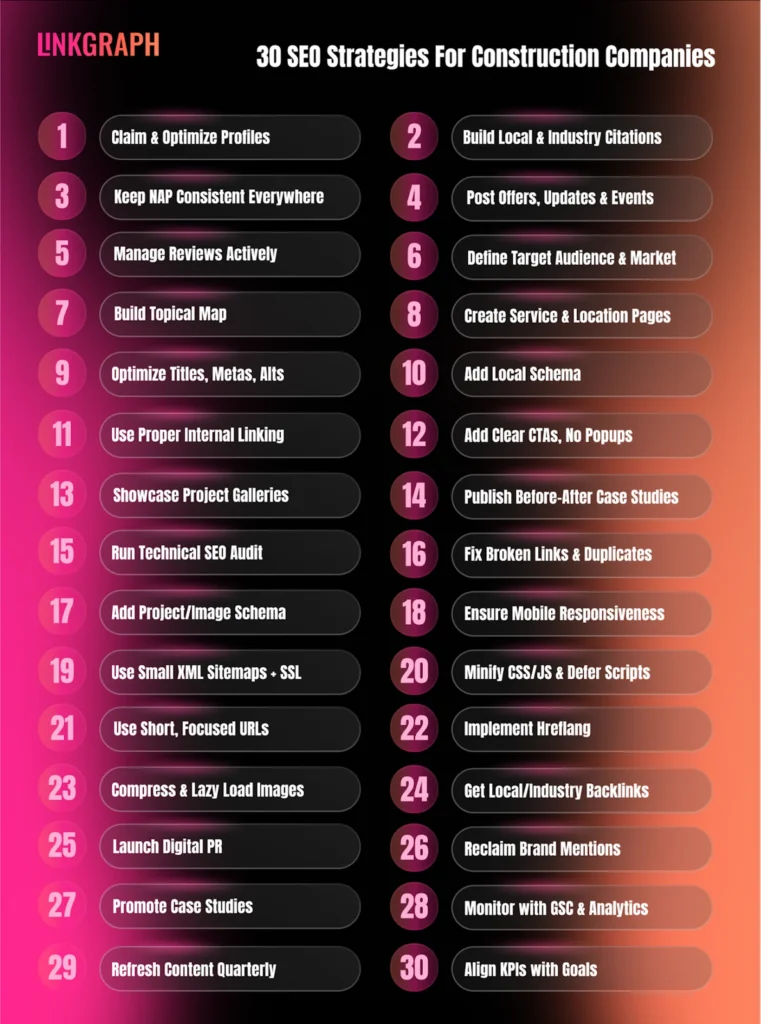
There are 30 SEO strategies for construction companies. The 30 SEO strategies for construction companies are listed below.
- Claim and Verify Essential Business Profiles (Google, Bing, Apple)
- Build Citations on Local and Industry-Specific Directories
- Ensure NAP Consistency Across All Online Directories
- Publish Regular Posts, Offers, Updates, and Events Across Profiles
- Implement a Proactive Customer Review Management Strategy
- Identify Target Audience, Market, and Their Needs
- Build Proper Topical Map Based on Source Context
- Create Separate Pages for Services and Important Locations
- Optimize Titles, Meta Descriptions, Headers, and Alt Text
- Implement Local SEO Schema Markup on Important Pages
- Link Pages Internally with Correct Hierarchy (Root → Seed → Node)
- Place Clear CTAs and Avoid Intrusive Popups/Chatbots
- Showcase Project Galleries with Detailed Descriptions
- Publish Before-and-After Case Studies with Visual Evidence
- Conduct a Full Technical SEO Audit to Resolve Crawl Errors
- Fix Broken Links and Content Duplication Issues
- Implement Project and Image Schema Markup for Visual Media
- Build User-Friendly, Mobile Responsive Website for All Devices
- Create Smaller XML Sitemaps and Install SSL Certificate
- Minify CSS/JS and Defer Non-Essential Scripts
- Use Short, Descriptive Topic-Focused URLs
- Implement Hreflang for Multi-Region/Language
- Optimize Image Compression and Lazy Loading for Project Galleries
- Acquire Quality Backlinks from Local Business and Industry Partners
- Execute a Digital PR Strategy for Project Features and Awards
- Reclaim Unlinked Brand Mentions from Suppliers and Clients
- Promote Project Case Studies to Generate Editorial Backlinks
- Monitor Organic Performance via Google Search Console and Analytics
- Conduct Quarterly Content Audits to Refresh and Update Pages
- Align SEO KPIs with Business Objectives and Conversion Goals
Following these steps enables construction companies to strengthen search visibility, attract qualified leads, and maintain sustainable growth across residential and commercial markets. We have broken down the 30 SEO strategies for construction companies below.
1. Claim and Verify Essential Business Profiles (Google, Bing, Apple)
Claiming and verifying essential business profiles on Google, Bing, and Apple establishes a verified digital presence for construction companies. Search engines rely on these profiles to display accurate business information in local search results. Verified listings increase visibility in map packs and boost trust among potential clients searching for construction services in specific areas.
Google Business Profile remains the primary platform for local visibility. A verified profile displays contact information, location, business hours, and service details directly in search results. Bing Places and Apple Business Connect extend reach to users across different search engines and devices. Consistent verification across these platforms creates a unified online presence that improves search accuracy.
Unverified or incomplete listings weaken visibility and reduce chances of appearing for local keywords. Verified profiles give construction companies control over displayed information, reducing misinformation and improving the likelihood of ranking for location-based searches.
2. Build Citations on Local and Industry-Specific Directories
Building citations on local and industry-specific directories strengthens online visibility for construction companies. Search engines use citations to verify business details and assess local relevance. Accurate listings on trusted directories signal legitimacy and improve local search rankings for construction-related keywords.
Local directories such as Yelp, Yellow Pages, and regional business listings increase exposure in service areas. Industry-specific platforms like BuildZoom, HomeAdvisor, and Angi target audiences actively seeking construction services. Consistent business information across these platforms creates a strong digital footprint that reinforces search engine trust.
Incomplete or inconsistent citations create confusion and weaken ranking potential. A structured citation strategy expands reach, improves NAP consistency, and enhances the likelihood of appearing in local map results for residential and commercial construction searches.
3. Ensure NAP Consistency Across All Online Directories
NAP consistency across all online directories strengthens local SEO for construction companies. Search engines rely on matching Name, Address, and Phone information to verify business legitimacy. Inconsistent details create uncertainty, which lowers rankings in local search results.
Accurate NAP data improves search engine trust and ensures clients find the correct contact information. Every listing must reflect the same format to avoid confusion. Variations in abbreviations, phone numbers, or address formatting weaken local authority.
A systematic approach to auditing and updating NAP details across platforms maintains accuracy. Consistent listings improve local map visibility and make construction services easier to discover in targeted regions.
4. Publish Regular Posts, Offers, Updates, and Events Across Profiles
Publishing regular posts, offers, updates, and events across business profiles strengthens local SEO for construction companies. Search engines track posting frequency as a signal of business activity. Consistent updates increase visibility in local packs and map results.
Posts highlight recent projects, seasonal promotions, service changes, or community involvement. Each update creates fresh content that reinforces keyword relevance and geographic targeting. Timely information attracts potential clients searching for active construction firms.
Structured posting schedules maintain engagement across platforms. Frequent updates keep profiles visible, build trust, and encourage more interactions from clients exploring construction services.
5. Implement a Proactive Customer Review Management Strategy
Implementing a proactive customer review management strategy improves local search performance for construction companies. Reviews influence how search engines evaluate business reliability and relevance. High review volume and consistent positive feedback increase visibility in map results and local packs.
Construction companies benefit from encouraging clients to leave reviews on platforms like Google, Bing, and industry directories. Prompt responses to both positive and negative feedback show activity and accountability. Search engines recognize this engagement, which strengthens ranking signals.
Regular monitoring of reviews across all platforms identifies trends in customer satisfaction. Addressing issues quickly protects reputation and improves client retention. A structured review strategy builds trust, attracts qualified leads, and reinforces the presence of the company in local search results.
6. Identify Your Target Audience, Market, and Their Needs
Identifying the target audience and market forms the foundation of an effective SEO strategy for construction companies. Understanding demographics, geographic location, project types, and client needs allows companies to create content that aligns with search intent. Targeted research highlights what potential clients are searching for and how they search, which informs website structure, service pages, and marketing messaging.
Construction companies benefit from mapping content to audience needs using topical maps. Topical maps organize core services, subtopics, and related queries into a structured hierarchy, guiding content creation and internal linking. This ensures that every page addresses a specific aspect of the service while connecting logically to the broader website context.
Analyzing audience behavior identifies gaps in content coverage and opportunities for engagement. Implementing insights from these analyses strengthens SEO, enhances relevance in search results, and increases the likelihood of attracting high-intent leads.
7. Build Proper Topical Map Based on Your Source Context
Building a proper topical map based on source context organizes the content of a construction company around core services, subtopics, and related queries. Topical maps act as a blueprint, connecting each page to relevant subjects while maintaining a logical hierarchy, which strengthens overall SEO performance.
A well-structured topical map ensures search engines understand the relationships between service pages, blog posts, and supporting content. This hierarchy allows crawlers to index pages efficiently and signals authority for specific service topics, improving visibility for targeted searches.
Construction companies using topical maps prioritize content creation, fill coverage gaps, and optimize internal linking. Aligning content with user intent and source context ensures each page contributes to lead generation and higher search rankings, establishing the company as a trusted authority in its niche.
8. Create Separate Pages for Services and Important Locations
Creating separate pages for services and important locations improves website structure and enhances search relevance for construction companies. Each service page focuses on a specific offering, while location pages highlight projects and services in targeted areas, signaling relevance to search engines. This separation allows users to find information quickly, increasing engagement and conversion opportunities.
Properly structured service and location pages allow on-page SEO elements like titles, meta descriptions, headers, and internal links to be optimized individually. Search engines then better associate pages with relevant queries, improving rankings for both local and service-specific searches.
Construction companies that maintain dedicated pages for each service and region track performance more effectively, identify gaps in content coverage, and ensure visitors land on pages matching their intent, strengthening the authority and search visibility of the site.
9. Optimize Titles, Meta Descriptions, Headers, and Alt Text
Optimizing titles, meta descriptions, headers, and alt text improves search engine understanding of the website of a construction company. Titles and meta descriptions clarify each page’s topic, increasing click-through rates from search results. Headers structure content, making it easier for users and search engines to navigate key sections.
Alt text for images ensures search engines index visual content correctly while improving accessibility for all visitors. Construction companies showcase project photos, blueprints, or infographics, and optimized alt text allows these assets to contribute to SEO performance.
This strategy integrates naturally with on-page SEO practices, allowing each page to target specific keywords, highlight services, and attract both local and industry-specific searches. Proper optimization enhances user experience, engagement, and overall search visibility.
10. Implement Local Seo Schema Markup on Important Pages
Implementing local SEO schema markup on important pages allows search engines to understand the location, services, and business details of a construction company. Schema markup provides structured data, allowing search engines to display enhanced results, such as local business information, ratings, and service types.
Construction companies benefit by making their service pages, location pages, and contact information more visible in search results. Rich snippets generated through schema markup increase click-through rates and improve local search performance.
Integrating schema markup aligns with on-page SEO strategies, ensuring that both content and structured data work together. This approach strengthens search engine comprehension, boosts local visibility, and allows potential clients to find the company for nearby construction projects.
11. Link Pages Internally with Correct Hierarchy (Root → Seed → Node)
Internal linking connects pages within the website of a construction company in a logical hierarchy, typically following a Root → Seed → Node structure. Root pages cover broad topics like “residential construction services,” seed pages address subtopics such as “kitchen remodeling,” and node pages provide specific details like “custom kitchen cabinet installation.”
Proper internal linking allows search engines to discover and index content efficiently while distributing link equity across important pages. It guides visitors through the website, improving navigation and user experience for both commercial and residential clients.
This strategy integrates naturally with on-page SEO by reinforcing topic relevance, establishing authority across related pages, and increasing the likelihood of ranking for multiple service-specific keywords in local and organic search results.
12. Place Clear CTAs and Avoid Intrusive Popups/ Chatbots
Clear calls-to-action (CTAs) guide visitors on the next steps, such as requesting a quote, scheduling a consultation, or viewing a project gallery. CTAs should be concise, visually distinct, and placed strategically on service pages, location pages, and blog content.
Avoid intrusive popups or chatbots that disrupt the user experience, as excessive interruptions increase bounce rates and reduce engagement. For construction companies, maintaining a smooth browsing experience encourages potential clients to explore services and take action.
This approach aligns with on-page SEO by improving usability, enhancing visitor engagement, and signaling to search engines that pages provide valuable content. Clear CTAs combined with intuitive navigation increase conversions while reinforcing relevance for local and service-specific search queries.
13. Showcase Project Galleries with Detailed Descriptions
Project galleries display completed work with high-quality images, captions, and detailed descriptions of each project. Construction companies benefit by demonstrating expertise, craftsmanship, and the scope of services offered.
Each project entry should include location, project type, challenges, and solutions implemented, providing visitors with a clear understanding of capabilities. Well-described galleries improve user engagement, encourage longer site visits, and increase trust among potential clients.
Project galleries contribute to on-page SEO by allowing keyword integration in image alt text, captions, and headings. Optimized galleries enhance search engine understanding of content relevance, making pages more likely to rank for service-specific and location-based queries.
14. Publish Before-and-After Case Studies with Visual Evidence
Before-and-after case studies highlight the transformation achieved through completed construction projects, presenting visual evidence that illustrates quality and results. Construction companies build credibility by showing tangible outcomes of work for clients across different project types.
Each case study should include project scope, challenges, solutions, timelines, and final results, giving potential clients a clear picture of the capabilities of a company. Detailed storytelling in case studies engages visitors and increases trust in the services offered.
Optimizing case studies with relevant keywords, headings, and image alt text strengthens on-page SEO. Search engines better interpret the content, which increases the likelihood of ranking for targeted service-specific and location-based searches.
15. Conduct a Full Technical SEO Audit to Resolve Crawl Errors
A full technical SEO audit for construction websites ensures search engines crawl, index, and interpret all pages efficiently. This process begins with evaluating server performance, including reducing server response time to under 100ms. Faster server response improves user experience and enables search engines to access pages quickly.
HTML crawl requests should exceed 95% to confirm that most pages are discoverable and properly accessible to search engine bots. Maintaining a refresh rate of around 20% ensures updated content is indexed regularly, while targeting a discovery rate of 7–8% balances new content discovery with crawl budget management. Performing log file analysis identifies where search engines spend most crawl resources and reveals pages that block indexing or lose visibility.
Other critical technical SEO points include checking XML sitemaps for accuracy, fixing broken links, implementing proper redirects, optimizing mobile responsiveness, validating structured data, compressing images, and improving Core Web Vitals. Each of these measures enhances site health, ensures search engines interpret content correctly, and strengthens visibility for both residential and commercial construction companies.
16. Fix Broken Links and Content Duplication Issues
Broken links and duplicate content harm website authority and user experience for construction companies. Crawlers encountering 404 errors or repetitive pages reduce indexing efficiency, lowering rankings.
Begin by identifying broken internal and external links using tools like Google Search Console. Replace or redirect these links to relevant pages to maintain link equity and ensure visitors access intended content.
Address content duplication by auditing pages for repeated headings, text blocks, or meta descriptions. Consolidate duplicate pages or use canonical tags to signal the preferred version to search engines. Eliminating duplicates improves crawl efficiency, strengthens domain authority, and ensures that residential and commercial construction companies present unique, high-quality content to potential clients.
17. Conduct Log File Analysis
Log file analysis examines server records to reveal how search engine crawlers interact with construction websites. Each log entry shows the exact time, type of request, and URL accessed by crawlers. This data uncovers hidden crawling inefficiencies that standard SEO tools miss.
Crawl behavior analysis highlights under-crawled sections, wasted budget on irrelevant URLs, and delays in content discovery. Identifying these patterns makes crawl allocation more efficient and improves indexing coverage. Log files pinpoint slow-loading resources, redirect chains, and unnecessary parameter URLs that consume crawl resources without adding value.
Regular analysis tracks how crawler activity shifts after major site changes. Prioritizing high-value pages based on these insights increases discovery rates and ensures search engines focus on service pages, location pages, and key content areas. Construction companies use this strategy to refine technical priorities and maintain consistent search visibility.
18. Build User-Friendly, Mobile Responsive Website For All Devices
A mobile-responsive website adapts to different screen sizes and ensures smooth navigation across devices. Construction companies serve both residential and commercial clients who browse service pages on mobile during research or urgent project planning. A responsive structure maintains layout integrity, keeps text legible, and prevents unnecessary zooming or horizontal scrolling.
User experience optimization improves engagement metrics such as time on page and bounce rate. Fast-loading pages with clear navigation menus guide visitors to service details, location pages, and project galleries without friction. Consistent design elements across mobile, tablet, and desktop build familiarity and trust.
Responsive frameworks fall in line with Google’s mobile-first indexing, which prioritizes mobile versions during crawling and ranking. Optimizing tap targets, compressing images, and minimizing scripts reduces page weight and increases speed. Construction websites with adaptive design retain visitors longer and convert mobile traffic into qualified project inquiries more effectively.
19. Create Smaller XML Sitemaps and Install SSL Certificate
XML sitemaps organize URLs so search engines discover and index pages efficiently. Large construction websites include multiple service categories, project galleries, and location pages. Splitting the sitemap into smaller, topic-focused segments improves crawl distribution and indexing accuracy. Each sitemap should stay under the recommended URL limit to maintain optimal parsing speed.
A smaller sitemap allows search engines to detect important pages faster and reduces wasted crawl activity on less relevant URLs. Grouping services, locations, and resources logically allows better tracking of indexing patterns. Regularly updating these segmented sitemaps ensures new service offerings and project case studies get indexed without delay.
Installing an SSL certificate secures the entire site and builds user trust. HTTPS protects form submissions and browsing sessions while sending clear ranking signals to search engines. A secure, well-structured website with clean sitemaps strengthens technical SEO foundations and improves overall visibility.
20. Minify CSS/JS and Defer Non-Essential Scripts
Minifying CSS and JavaScript reduces file sizes by removing unnecessary spaces, comments, and characters, which improves page load speed. Faster-loading pages enhance user experience and contribute to better search engine rankings. Construction websites with heavy project galleries, interactive features, or multiple service pages benefit greatly from optimized code.
Deferring non-essential scripts prevents them from loading until after main content appears, ensuring visitors see critical information immediately. This technique reduces render-blocking issues, which is especially important for mobile users searching for local services.
Combining minification with script deferral improves overall site performance, lowers bounce rates, and allows search engines to crawl and index pages efficiently. Optimized page speed contributes to both technical SEO and user engagement, making it a key factor in successful SEO strategies for construction companies.
21. Use Short, Descriptive Topic-Focused URLs
Short, descriptive URLs clearly convey page content to both users and search engines. URLs that include relevant service keywords and location terms, such as /kitchen-remodeling-[city], improve clarity and increase click-through rates from search results.
Construction companies benefit from URLs that remain concise while reflecting the main topic of a page. Clear URL structures make navigation easier for visitors and allow search engines to understand site hierarchy, enhancing the indexing of important pages.
Consistent, keyword-rich URLs strengthen on-page SEO, improve user experience, and enhance the overall visibility of service pages. Logical URL naming reduces confusion and prevents duplicate content issues, ensuring each page contributes effectively to SEO performance.
22. Implement Hreflang For Multi-Region/Language
Hreflang tags indicate language and regional targeting for pages, ensuring search engines serve the correct version to users. Construction companies with multiple locations or international clients benefit from implementing hreflang to avoid duplicate content issues across regions.
Proper hreflang implementation directs search engines to show the most relevant page based on the language or location of a user. This improves user experience and increases the likelihood of engagement and conversions from targeted audiences.
Hreflang tags maintain SEO value across multiple versions of the same content. Signaling the intended audience for each page allows construction companies to preserve rankings, prevent indexing conflicts, and enhance local and global visibility.
23. Optimize Image Compression and Lazy Loading for Project Galleries
Project galleries contain high-resolution images that slow website loading times. Compressing images reduces file size while maintaining visual quality, which improves page speed and overall user experience. Construction companies benefit from faster-loading galleries because visitors view projects without delays, increasing engagement and potential inquiries.
Implementing lazy loading ensures that images load only when users scroll to them, preventing unnecessary strain on page load times. This technique keeps pages responsive, particularly for mobile users, and maintains smooth navigation throughout the website.
Optimized images and lazy loading collectively enhance technical SEO by improving Core Web Vitals, lowering bounce rates, and signaling to search engines that the website provides a high-quality, user-friendly experience. Proper implementation ensures project galleries attract attention without compromising performance.
24. Acquire Quality Backlinks from Local Business and Industry Partners
High-quality backlinks from local businesses, suppliers, and industry partners strengthen the website authority of a construction company. These links signal to search engines that the website is a trusted resource within the construction sector and local community.
Focusing on relevant and authoritative sources ensures backlinks contribute positively to search rankings. Local partnerships, trade associations, and professional organizations provide opportunities for organic link acquisition, allowing the website to rank for service-specific and location-based keywords.
Consistently earning backlinks enhances domain authority and improves overall SEO performance. It drives referral traffic from reputable sources, increasing the likelihood of generating qualified leads and project inquiries. Prioritizing quality over quantity ensures that link-building efforts deliver measurable SEO results for construction companies.
25. Execute a Digital PR Strategy for Project Features and Awards
A digital PR strategy promotes construction projects, awards, and recognitions to authoritative online publications and industry platforms. Featuring completed projects and accolades online increases brand visibility and demonstrates credibility to both potential clients and search engines.
Press releases, project spotlights, and media coverage create opportunities for high-quality backlinks, which strengthen domain authority and improve search engine rankings. Highlighting awards or certifications reinforces trust and differentiates the company from competitors in the local and national markets.
Consistent digital PR efforts generate referral traffic, attract new project inquiries, and boost long-term SEO goals. Linking project features to service pages enhances internal site authority while providing valuable context for search engines and users.
26. Reclaim Unlinked Brand Mentions from Suppliers and Clients
Unlinked brand mentions occur when construction companies are referenced online without a backlink to their website. Identifying and reclaiming these mentions increases referral traffic and strengthens domain authority, directly benefiting SEO performance.
Suppliers, clients, and industry publications mention the name, project, or service of a company. Reaching out to request proper attribution by adding a hyperlink transforms these mentions into valuable backlinks, enhancing credibility and search engine visibility.
Regularly monitoring the web for unlinked mentions ensures all opportunities for authority building are captured. Reclaimed mentions contribute to a more robust backlink profile, driving higher rankings and increased organic traffic from relevant industry sources.
27. Promote Project Case Studies to Generate Editorial Backlinks
Publishing detailed project case studies showcases construction company expertise, attracting attention from industry publications, partners, and clients. Each case study highlights completed projects, methodologies, challenges overcome, and measurable results, providing authoritative content that others reference.
Actively promoting these case studies through outreach to relevant websites and industry blogs encourages editorial backlinks. These backlinks improve website authority, increase organic search rankings, and drive targeted traffic from potential clients seeking similar services.
Regular promotion ensures case studies reach the right audience, strengthening brand credibility while generating high-quality backlinks. Editorial links from reputable sources signal trustworthiness to search engines, contributing to long-term SEO performance and visibility in competitive construction markets.
28. Monitor Organic Performance via Google Search Console and Analytics
Construction companies must track website performance to understand how SEO strategies impact traffic, engagement, and leads. Google Search Console identifies indexing issues, keyword rankings, and click-through rates, providing clear data on how pages perform in search results. Analytics tools track user behavior, session duration, and conversion paths, revealing which content drives the most qualified leads.
Regular monitoring allows adjustment of strategies based on real data. Identifying underperforming pages, high-exit pages, or keywords with low visibility refines content, internal linking, and technical SEO.
Ongoing performance tracking ensures that SEO efforts align with business goals, maximizing ROI and maintaining a competitive edge. Construction companies that analyze and act on these metrics continually improve rankings, attract more qualified leads, and optimize overall online presence.
29. Conduct Quarterly Content Audits to Refresh and Update Pages
Construction companies benefit from reviewing website content regularly to maintain relevance and authority. Quarterly content audits identify outdated information, duplicate content, low-performing pages, and gaps in coverage. Audits reveal opportunities to update service pages, project case studies, and blog posts with current data, new visuals, or improved keywords.
Refreshing content improves search engine rankings and ensures potential clients receive accurate and valuable information. Updating metadata, headers, and internal links during audits strengthens on-page SEO and enhances user experience.
Consistent content audits allow construction companies to stay competitive, maintain visibility in local and industry searches, and maximize the return on SEO investments. Regular updates reinforce brand authority and drive lead generation across all online platforms.
30. Align SEO KPIs with Business Objectives and Conversion Goals
Construction companies achieve better results when SEO performance metrics align with overall business objectives and conversion targets. Defining key performance indicators (KPIs) such as organic traffic, lead generation, quote requests, or project inquiries ensures SEO efforts directly impact revenue and growth.
Tracking KPIs allows teams to evaluate which strategies drive tangible results, prioritize high-performing tactics, and adjust underperforming areas. Metrics like keyword rankings, local search visibility, and website engagement connect optimization efforts to measurable business outcomes.
Aligning SEO with business goals ensures every action, from technical fixes to content creation, contributes to achieving company objectives. This alignment maximizes ROI, strengthens online presence, and generates qualified leads for ongoing construction projects.
Can a Single SEO Strategy Work for All Types of Construction Companies?
No single SEO strategy fits all construction companies. Residential, commercial, and industrial contractors have unique services, target audiences, and goals. Residential contractors focus on local SEO, project galleries, and customer reviews. Commercial contractors emphasize detailed service descriptions, technical SEO, and broader geographic targeting. Tailored strategies align keywords, content, and optimization techniques with business objectives. Custom SEO ensures construction companies reach the right audience, improve visibility, and outperform competitors in their specific market segment.
When Is the Right Time for Construction Companies to Invest in SEO?
Construction companies should invest in SEO as early as possible, ideally during website development or redesign. Early implementation ensures proper on-page optimization, mobile responsiveness, fast loading, and structured content. Established companies benefit by improving local rankings, updating content, and building authority. Starting SEO promptly captures targeted traffic, generates qualified leads, and improves brand visibility. Consistent SEO efforts over time strengthen search engine performance and increase opportunities for project inquiries and conversions.
Is GMB Profile Optimization Enough for Construction Companies to Generate Consistent Leads?
Optimizing a Google Business Profile is important, but not enough for consistent leads. GMB improves local visibility and displays essential business information. Effective SEO requires a mobile-friendly, optimized website, valuable content, quality backlinks, and social engagement. Integrating these elements with GMB ensures broader search presence, higher authority, and better lead generation. A comprehensive strategy captures more qualified prospects, enhances credibility, and drives sustained growth for construction companies across local and regional searches.
How Long Does It Take for Construction Companies to See SEO Results?
SEO results for construction companies typically appear between three to six months, depending on competition, website authority, and strategy execution. Local SEO improvements, such as Google Business Profile optimization and citation building, show quicker gains in local search rankings. Broader content marketing, backlink acquisition, and technical SEO enhancements take longer to impact organic traffic. Consistent monitoring, regular content updates, and ongoing optimization accelerate results, ensuring sustainable lead generation and long-term growth for residential and commercial construction businesses.
Which Online Directories Are Most Valuable for Construction Companies to Be Listed In?
The most valuable online directories for construction companies improve visibility, build credibility, and attract qualified clients searching for services locally and regionally. Valuable online directories for construction companies to list in are listed below.
- Houzz: Connects construction companies with homeowners seeking remodeling and construction services while showcasing project portfolios.
- HomeAdvisor (Angi): Generates leads for residential construction projects and facilitates client reviews to boost local reputation.
- BuildZoom: Focuses on licensed contractors, providing project leads and verification of qualifications for potential clients.
- Procore Construction Network: Serves commercial contractors, offering networking opportunities and project collaboration tools.
- BBB (Better Business Bureau): Enhances credibility and trustworthiness through verified business listings and customer reviews.
- The Blue Book: Widely used by commercial construction companies for industry connections and project opportunities.
- Porch: Targets homeowners for remodeling and repair projects, connecting contractors with local service requests.
- Contractor Hub: Provides directory exposure and lead generation for both residential and commercial construction businesses.
Listing construction companies in these directories strengthens online presence, builds authority, and increases the chances of attracting qualified leads.
Can Construction Companies Effectively Manage SEO on Their Own?
Construction companies handle basic SEO tasks internally, such as updating Google Business Profiles, posting content, and monitoring reviews. Smaller firms with simple websites see modest results by focusing on local SEO and on-page optimization. However, managing full-scale SEO, including technical audits, backlink strategies, schema implementation, and performance tracking requires expertise, tools, and time. Hiring a professional SEO agency ensures that advanced strategies are applied effectively, improving rankings, lead generation, and long-term online visibility for both residential and commercial construction companies.
What Are the Most Common SEO Mistakes Construction Companies Should Avoid?
Construction companies make SEO mistakes that reduce online visibility, limit lead generation, and weaken overall website performance. Avoiding these errors ensures higher search rankings, better traffic quality, and improved project inquiries. The most common SEO mistakes that construction companies need to avoid are listed below.
- Ignoring Local SEO: Failing to optimize Google Business Profiles, maintain consistent Name, Address, Phone (NAP) listings, or manage local citations reduces visibility in location-specific searches and decreases nearby project opportunities.
- Duplicate or Thin Content: Copying content from other sites or maintaining low-value pages undermines authority and lowers search engine rankings, making it harder for potential clients to discover services.
- Neglecting Technical SEO: Slow page load times, broken links, crawl errors, and unoptimized site architecture prevent search engines from properly indexing pages, reducing overall website performance.
- Poor Keyword Strategy: Targeting irrelevant, overly competitive, or broad keywords drives unqualified traffic and wastes marketing effort. Focused keyword research aligned with service offerings ensures higher-quality leads.
- Lack of Backlinks: Absence of authoritative inbound links from local directories, industry partners, or project features weakens credibility and reduces the ability to rank for competitive terms.
- Ignoring Mobile Optimization: Non-responsive websites frustrate mobile users, increase bounce rates, and lower rankings on mobile search results, which dominate local service searches.
- Weak Content Updates: Stale or outdated content fails to engage users or attract search engine attention, limiting visibility and project inquiries over time.
- Overlooking On-Page SEO: Missing optimized title tags, meta descriptions, headers, or schema markup reduces the relevance and clarity of pages for both users and search engines.
Correcting these common mistakes improves online visibility, attracts targeted leads, and strengthens long-term SEO performance for construction companies.
What Should Construction Companies Consider Before Hiring an SEO Agency?
Choosing the right SEO agency is essential for construction companies to maximize online visibility, attract qualified leads, and achieve measurable results. Key factors guide an informed decision. The factors to consider before hiring an SEO agency are listed below.
- Proven Track Record: Review case studies and client results to confirm the experience of the agency in construction SEO.
- Industry Expertise: Ensure the agency understands construction-specific challenges, services, and target audiences.
- Transparent Reporting: The agency should provide clear metrics, progress updates, and actionable insights for campaigns.
- Customized Strategies: Avoid agencies offering generic solutions; strategies must align with business objectives and service areas.
- Reputation and Reviews: Evaluate online reviews, testimonials, and references to gauge reliability and client satisfaction.
Considering these factors allows construction companies to select an SEO partner that delivers measurable growth and long-term results.
Who Provides the Best SEO Services for Construction Companies Near Me?
LinkGraph provides specialized SEO services for construction companies, including SEO for builders, home renovation company SEO, and comprehensive construction company SEO services. The agency combines industry expertise with data-driven strategies to improve search engine rankings, increase organic traffic, and generate qualified leads.
The team focuses on local SEO, content optimization, and authoritative backlink acquisition, ensuring construction companies attract potential clients actively searching for their services. Technical SEO audits, service-focused content creation, and structured link-building campaigns strengthen online visibility and enhance overall website performance.
Clients have reported measurable improvements in website traffic, search rankings, and lead generation, backed by positive testimonials and detailed case studies. Recognized as a leading SEO agency, LinkGraph uses deep knowledge of the construction sector to deliver strategies tailored to both residential and commercial construction companies. This combination of expertise, proven results, and comprehensive SEO services positions LinkGraph as a top choice for construction company SEO.
What SEO Services Does LinkGraph Offer for Construction Companies?
LinkGraph offers a full suite of SEO services tailored specifically for construction companies. These services address local search visibility, website performance, content quality, and brand authority, enabling construction firms to attract more clients and grow online. The range of SEO services offered by LinkGraph to construction companies is listed below.
- Local SEO Optimization for Construction Companies: Enhances presence in local search results and map packs to attract nearby clients.
- Technical SEO for Construction Companies: Fixes crawl errors, improves site speed, implements schema markup, and ensures proper indexing.
- On-Page SEO for Construction Companies: Optimizes titles, meta descriptions, headers, and internal linking to improve relevance and rankings.
- Off-Page SEO (Link Building & Authority) for Construction Companies: Builds authoritative backlinks to strengthen domain authority and search visibility.
- Content Strategy and Optimization for Construction Companies: Develops service pages, project case studies, and engaging articles targeting client needs.
- Mobile SEO Optimization for Construction Companies: Ensures fully responsive websites with fast loading times for all devices.
- Conversion Rate Optimization (CRO) for Construction Companies: Enhances CTAs, forms, and user experience to increase lead conversion.
- Branding and Online Presence for Construction Companies: Builds credibility through digital PR, social proof, and consistent online identity.
These services work together to provide construction companies with a comprehensive SEO strategy that drives traffic, leads, and growth.
Can All Types of Construction Companies Benefit from LinkGraph’s SEO Support?
LinkGraph’s SEO strategies cater to a wide range of construction companies, from general contractors to specialized firms. General contractors, home remodeling contractors, residential and commercial contractors, construction contractors, kitchen and bathroom remodeling contractors, home renovation contractors, room addition contractors, and custom home builders all gain measurable results. Each strategy is tailored to service type, location, and target audience, ensuring that local SEO, technical optimization, and content marketing align with specific business needs. LinkGraph delivers structured approaches that increase visibility, generate leads, and strengthen online authority across all types of construction firms.
How Much Does LinkGraph Charge Construction Companies for SEO Services?
Pricing for construction company SEO depends on factors such as project scope, competition level, target locations, and service complexity. LinkGraph offers customized plans, ensuring businesses receive scalable solutions aligned with marketing goals. Packages include local SEO, technical SEO, content creation, backlink building, and performance monitoring. Transparent pricing allows construction firms to forecast ROI and invest in strategies that maximize qualified leads while maintaining cost-efficiency.
Does LinkGraph Specialize Only in SEO for Construction Companies?
LinkGraph specializes in SEO for multiple industries, including construction, legal, healthcare, and e-commerce. While construction company SEO is a major focus, the team has extensive experience optimizing websites, improving local search presence, and generating leads for diverse business types. Expertise in industry-specific strategies ensures tailored approaches that address unique challenges, competition, and client behavior in each sector.
Is SEO More Cost-Effective Than Paid Advertising for Construction Companies?
SEO and paid advertising offer different advantages for construction companies. SEO focuses on building long-term visibility through optimized content, local search presence, and backlinks, attracting organic traffic over time. Paid advertising, such as PPC, provides immediate visibility and targeted leads, but requires ongoing investment. Both approaches generate qualified prospects, and the effectiveness of each depends on budget, business goals, and timeline. Many construction companies choose to combine SEO and paid campaigns to balance sustainable growth with short-term lead generation.
How Can Construction Companies Combine SEO with Paid Advertising for Better Results?
Construction companies integrate SEO and paid advertising to maximize online visibility and lead generation. SEO establishes long-term authority through optimized content, local search presence, and quality backlinks. Paid advertising delivers immediate traffic for high-intent keywords or time-sensitive campaigns. Combining both allows companies to dominate search results, test keyword performance, and retarget audiences effectively. Tracking performance from both channels provides insights to refine messaging, improve conversion rates, and allocate budget efficiently. Coordinated strategies create a balance between sustainable organic growth and short-term lead generation.
How Can Construction Companies Measure the ROI of Their SEO Efforts?
ROI measurement relies on tracking organic traffic, leads, and conversions resulting from SEO activities. Construction companies use tools like Google Analytics, Search Console, and call tracking to monitor website performance. Key metrics include keyword rankings, local search visibility, form submissions, phone calls, and project inquiries. Comparing these results against business objectives and marketing costs determines profitability. Regular reporting identifies high-performing content, highlights areas needing improvement, and enables data-driven adjustments to enhance overall SEO effectiveness.
